
Isaiah 40:13

Hebrew (Westminster Leningrad Codex) Isaiah 40:13 appears in the Hebrew Old Testament. The text above is from the Westminster Leningrad Codex. Each word links to its Strong’s number, a concise gloss, and parsing drawn from the Open Scriptures Hebrew Bible morphology. Click any word for its full Brown-Driver-Briggs (BDB) entry.
Download image
Cite this verse

Isaiah 40:13 (World English Bible). Public Domain. Lemma interlinear Bible study tool, https://lemma.gebible.app/v/isaiah/40/13.

Show BibTeX & RIS
BibTeX
RIS
English Translation
Who has directed the Spirit of Yahweh, or being his counselor has taught him?
World English Bible · Public Domain
Download a study sheet

One document with this verse’s original text, its word-by-word gloss line, the meaning frame, cross-references with their text, attributed commentary, and full source and license credits — printable, and it pastes into notes with its structure intact.

This verse Autodidact and up

Study sheet (.html) Plain text (.txt)

A passage Seminary Student

Up to 50 verses in one chapter. A passage sheet keeps up to 6 commentary sources and 12 cross-references per verse, in the order this page ranks them, and says so on the sheet whenever that leaves anything out. Ask for a single verse and you get the Autodidact verse sheet above.

Everything on this page stays free to read, with no account — the sheet is a download of what is already on screen, not access to it.

Want to remove ads? Support Godless Engineer
Compare translations 3

The same verse in 3 English versions, stacked beneath the original-language interlinear above. Click any original word for its lexicon entry.

Each is an independent rendering of the whole verse — the interlinear is not word-aligned to these translations.

Highlighted words mark where these versions differ — a whole-verse word diff, not a word-by-word alignment.

  • World English Bible Public Domain
    Who has directed the Spirit of Yahweh, or being his counselor has taught him?
  • King James Version Public Domain
    Who hath directed the Spirit of the LORD, or being his counsellor hath taught him?
  • unfoldingWord Literal Text CC BY-SA 4.0
    Who has measured the Spirit of Yahweh or a man of his counsel has advised him?

unfoldingWord Literal Text — © unfoldingWord, licensed CC BY-SA 4.0. Word-aligned USFM3 via Door43 (git.door43.org/unfoldingWord/en_ult).

Versions to compare (up to 4)

3 of 4 selected

Show all 18 translations

Every available English version of this verse, each an independent rendering of the whole verse.

  • World English Bible Public Domain
    Who has directed the Spirit of Yahweh, or being his counselor has taught him?
  • Berean Standard Bible Public Domain
    Who has directed the Spirit of the LORD, or informed Him as His counselor?
  • Majority Standard Bible Public Domain
    Who has directed the Spirit of the LORD, or informed Him as His counselor?
  • King James Version Public Domain
    Who hath directed the Spirit of the LORD, or being his counsellor hath taught him?
  • American Standard Version (1901) Public Domain
    Who hath directed the Spirit of Jehovah, or being his counsellor hath taught him?
  • Revised Version (1885) Public Domain
    Who hath directed the spirit of the LORD, or being his counsellor hath taught him?
  • Geneva Bible (1599) Public Domain
    Who hath instructed ye Spirit of the Lord? or was his counseler or taught him?
  • Douay-Rheims (1899) Public Domain
    Who hath forwarded the spirit of the Lord? or who hath been his counsellor, and hath taught him?
  • Young's Literal Translation Public Domain
    Who hath meted out the Spirit of Jehovah, And, `being' His counsellor, doth teach Him!
  • Literal Standard Version CC BY-SA 4.0
    Who has meted out the Spirit of YHWH, || And [being] His counselor, teaches Him?
  • Unlocked Literal Bible CC BY-SA 4.0
    Who has comprehended the mind of Yahweh, or instructed him as his counselor?
  • unfoldingWord Literal Text CC BY-SA 4.0
    Who has measured the Spirit of Yahweh or a man of his counsel has advised him?
  • Darby Bible Public Domain
    Who hath directed the Spirit of Jehovah, and, [as] his counsellor, hath taught him?
  • World Messianic Bible Public Domain
    Who has directed the LORD’s Spirit, or has taught him as his counselor?
  • Webster's Bible Public Domain
    Who hath directed the Spirit of the LORD, or being his counselor hath taught him?
  • Free Bible Version CC BY-SA 4.0
    Who has measured the Spirit of the Lord, or taught him what to do as his counselor?
  • Bible in Basic English Public Domain
    By whom has the spirit of the Lord been guided, or who has been his teacher?
  • JPS Tanakh (1917) Public Domain
    Who hath meted out the spirit of the LORD? Or who was His counsellor that he might instruct Him?

Literal Standard Version (2020), Covenant Press — licensed CC BY-SA 4.0. Text via the HelloAO Bible API (eBible.org). Unlocked Literal Bible (unfoldingWord) — licensed CC BY-SA 4.0. Text via the HelloAO Bible API (eBible.org). unfoldingWord Literal Text — © unfoldingWord, licensed CC BY-SA 4.0. Word-aligned USFM3 via Door43 (git.door43.org/unfoldingWord/en_ult). Free Bible Version, Dr. Jonathan Gallagher — licensed CC BY-SA 4.0. Text via the HelloAO Bible API (eBible.org).

Word by word

More ways to search: Search by grammar → Find every occurrence → Compare this word →

Practice this passage: Drill this verse → Learn its vocabulary →

תִכֵּ֥ן
tâkan
H8505
“to measure”
Verb, Piel, Perfect, 3rd Person, Masculine, Singular
Part of Speech
Verb
Stem
Piel
Form
Perfect
Person
3rd Person
Gender
Masculine
Number
Singular
Full BDB Definition

Origin: a primitive root

TWOT: 2511

to regulate, measure, estimate, ponder, balance, make even, level, weigh, be equal, be weighed out, test, prove - (Qal) estimate (participle) - (Niphal) - to be estimated - to be made even or right, be adjusted to the standard - (Piel) to weigh out, mete out - (Pual) - to be weighed out, be measured out - measured out (participle)
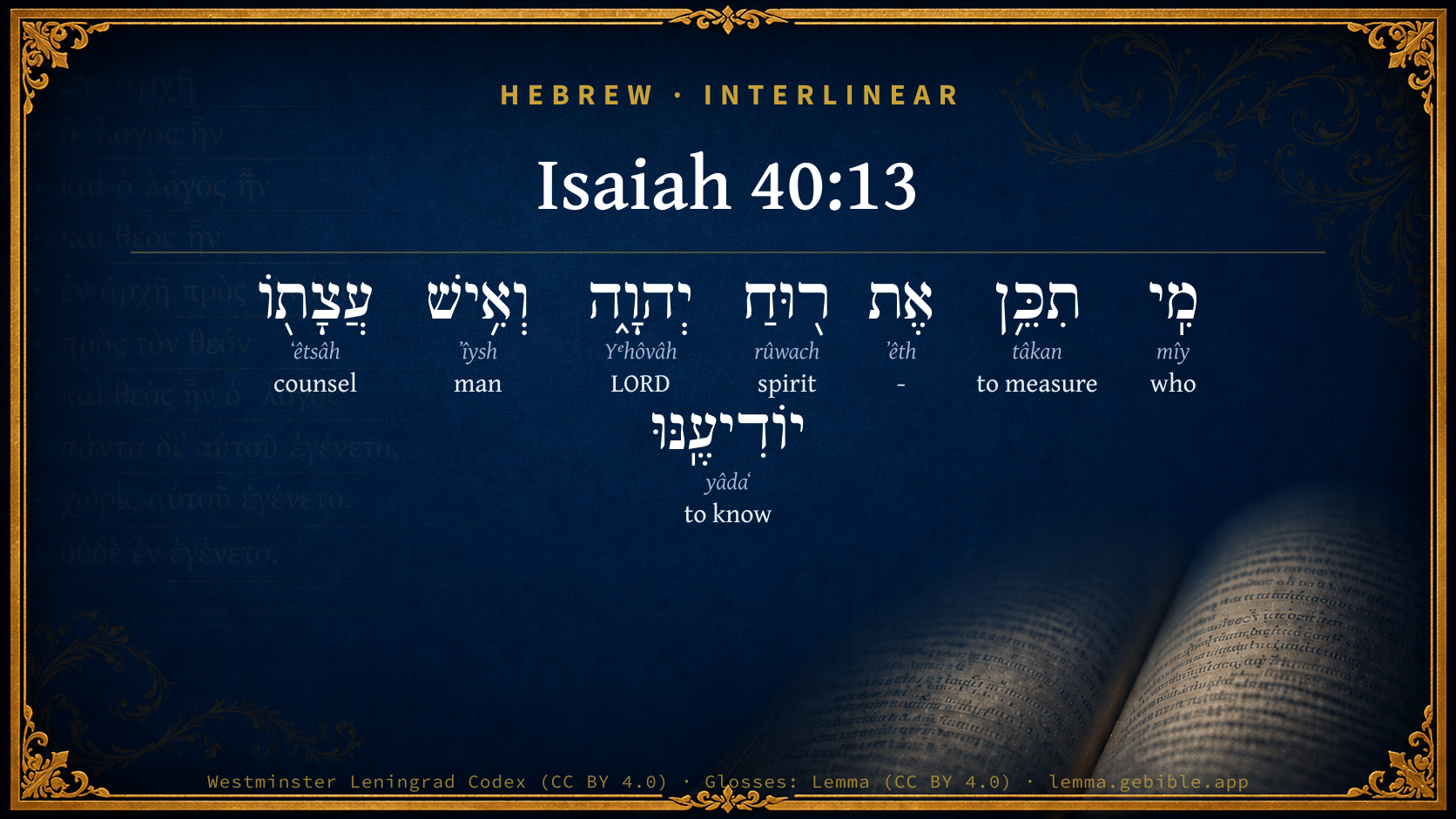
  1. מִֽי mîy H4310 “who” Particle, Interrogative
  2. אֶת ʼêth H853 “-” Particle, Direct Object
  3. ר֖וּחַ rûwach H7307 “spirit of” Noun, Common, Both, Singular, Construct
  4. יְהוָ֑ה Yᵉhôvâh H3068 “LORD” Noun, Proper
  5. וְאִ֥ישׁ ʼîysh H376 “and · man of” Conjunction + Noun, Common, Masculine, Singular, Construct
  6. עֲצָת֖וֹ ʻêtsâh H6098 “counsel · his” Noun, Common, Feminine, Singular, Construct + Suffix, Personal, 3rd Person, Masculine, Singular
  7. יוֹדִיעֶֽנּוּ yâdaʻ H3045 “to know · him” Verb, Hiphil, Imperfect, 3rd Person, Masculine, Singular + Suffix, Personal, 3rd Person, Masculine, Singular

About this verse

These counts appear in no published source. They are computed here, from the morphology-tagged text and Lemma’s own curated glosses. What Lemma adds →

8
words
8
distinct lemmas
Prophets
section

Notable vocabulary

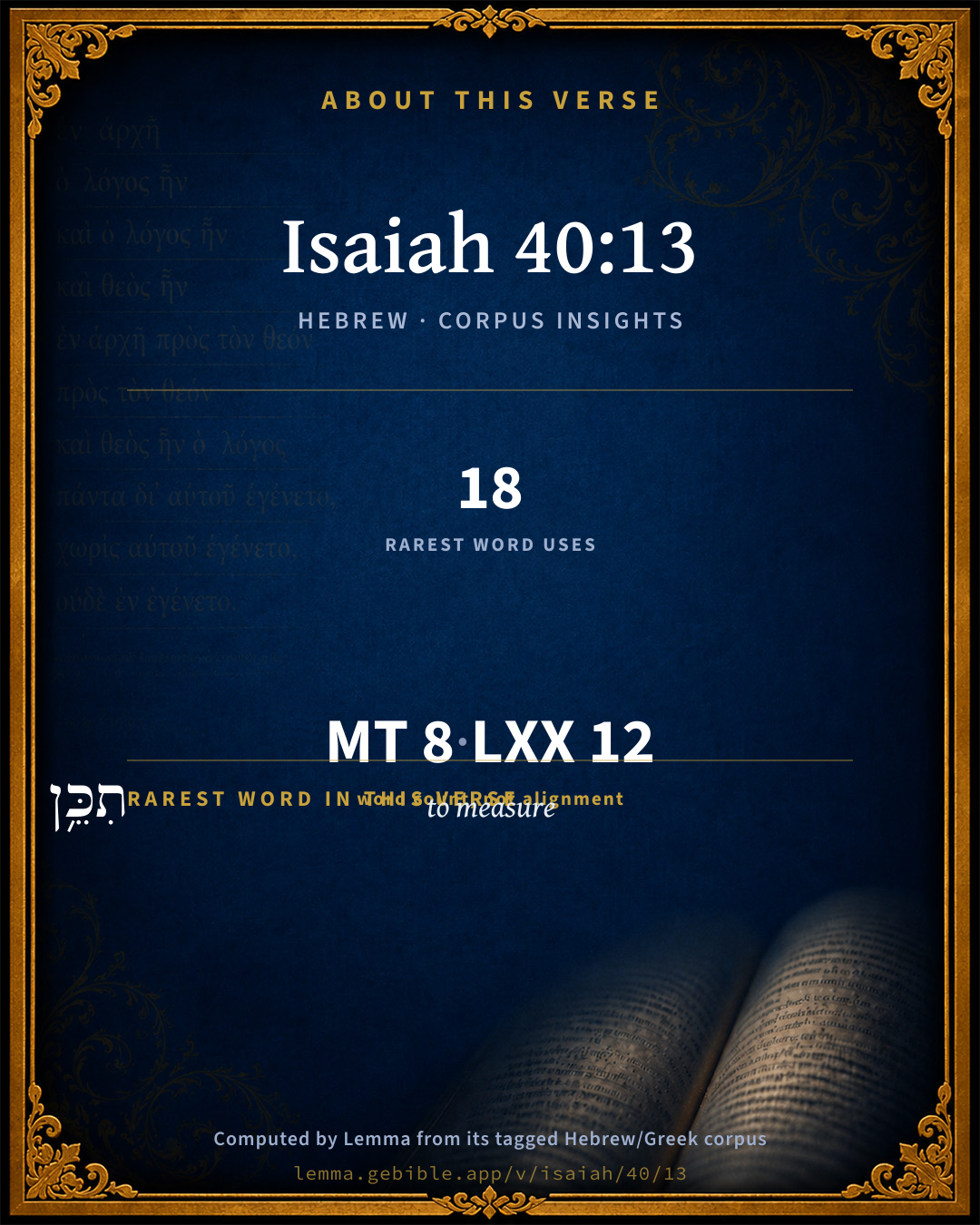
The rarest word here is תִכֵּ֥ן to measure H8505 — appearing just 18 times in the whole Hebrew Bible.

Shared distinctive vocabulary

תִכֵּ֥ן to measure H8505 occurs in 13 verses of the Hebrew Bible. Also found in:

Grammatical profile

  • 2 verbs
  • 4 nouns
  • 2 particles

Verb forms

  • תִכֵּ֥ן Piel · Perfect
  • יוֹדִיעֶֽנּוּ Hiphil · Imperfect

Hebrew & Septuagint length

In English translation the verse runs 14 words from the Hebrew and 17 from the Septuagint (LXX English) — closely comparable.

A rough comparison of the two English renderings, which tokenize alike — not a word-level alignment.

Word counts can differ between the Hebrew and the Greek without any difference in meaning — e.g. the Hebrew direct-object marker אֵת has no separate Greek word, and Greek often adds the article ὁ.

In the original languages it is 8 Hebrew tokens and 12 Greek tokens — but the two are counted differently (Hebrew bundles its prefixes and suffixes into one token; the Greek is in lemma form), so that isn’t a like-for-like length.

Cross-references

7

Topical passages linked to Isaiah 40:13 in the Treasury of Scripture Knowledge — connected by theme and wording, ordered by reader-vote popularity; previews shown in the World English Bible.

  • 1 Corinthians 2:16 "For who has known the mind of the Lord, that he should instruct him?" But we have Christ's mind.
  • Romans 11:34 "For who has known the mind of the Lord? Or who has been his counselor?"
  • Job 21:22 "Shall any teach God knowledge, Seeing he judges those who are high?
  • Job 36:22–23 Behold, God is exalted in his power. Who is a teacher like him?
  • Luke 10:22 Turning to the disciples, he said, "All things have been delivered to me by my Father. No one knows who the Son is, except the Father, and who the Father is, except the Son, and he to whomever the Son desires to reveal him."
  • Ephesians 1:11 in whom also we were assigned an inheritance, having been foreordained according to the purpose of him who works all things after the counsel of his will;
  • John 1:13 who were born not of blood, nor of the will of the flesh, nor of the will of man, but of God.

Cross-references courtesy of OpenBible.info (CC BY 4.0).

Hebrew and Greek witnesses Masoretic Hebrew ↔ Greek Septuagint

The same verse in the two great witnesses to the Old Testament, shown verse-for-verse.

These are two independent witnesses, not word-aligned to each other, and the Septuagint is shown in lemma (dictionary) form.

Hebrew Isaiah 40:13 Masoretic · Westminster Leningrad Codex

מִֽי תִכֵּ֥ן אֶת ר֖וּחַ יְהוָ֑ה וְאִ֥ישׁ עֲצָת֖וֹ יוֹדִיעֶֽנּוּ

Who has directed the Spirit of Yahweh, or being his counselor has taught him?

World English Bible · Public Domain

Greek LXX Isaiah 40:13 Septuagint · lemma form

τίς γιγνώσκω νοῦς κύριος καί τίς αὐτός σύμβουλος γίγνομαι ὅς συνβιβάζω αὐτός

Who has known the mind of the Lord? and who has been his counsellor, to instruct him?

LXX2012 (modern English Septuagint) · Public Domain

On this verse, Keil & Delitzsch discusses the Septuagint’s reading. Read the note in Commentary ↓

Hebrew: Westminster Leningrad Codex (CC BY 4.0). Greek: Septuagint (public domain); English from LXX2012 (modern English Septuagint) (Public Domain). How the Septuagint differs from the Hebrew →

Targum (Aramaic paraphrase)

1

The Targum is the ancient Jewish Aramaic paraphrase of the Hebrew Scriptures — an interpretive translation, not the Hebrew text itself. Onkelos (literal) and Pseudo-Jonathan (expansive) render the Torah, and Jonathan the Prophets. Coverage is partial: where no permissively-licensed English translation exists for a verse, only the Aramaic is shown. This is verse-level text, not a word-by-word alignment to the Hebrew.

  1. Targum Jonathan Prophets (Joshua–Malachi)
    מַן תַּקִין יַת רוּחַ קוּדְשָׁא בְּפוּם כָּל נְבִיַיָא הֲלָא יְיָ וְצַדִיקַיָא עָבְדֵי מֵימְרֵהּ פִּתְגָמֵי רְעוּתֵהּ הוֹדְעִינוּן:

    Who hath directed the Holy Spirit in the mouth of all the prophets? Is it not the Lord? He maketh known the words of His will to the righteous, the servants of His WORD.

    Targum Jonathan — Aramaic: “Mikraot Gedolot” (public domain). English: “Sefaria Community Translation” (CC0 1.0 (public-domain dedication)); “London "Chaldee Paraphrase," 1871” (public domain). Text via Sefaria.

Commentary

Notes on Isaiah 40:13 from classic Christian and Jewish commentators (each source and its license shown beneath its notes). The classic Christian expositions comment on the surrounding passage and are grouped to its opening verse, so a note may address several verses; the Jewish commentaries on the Tanakh (Rashi and others) are per-verse, so they appear only where the commentator wrote on this verse.

Lemma curates 59 commentaries, every one of them public domain or Creative Commons licensed, each selected and text-cleaned for this edition rather than reprinted as found. About our sources →

Trapp's Complete Commentary

John Trapp

Isa 40:13 Who hath directed the Spirit of the LORD, or [being] his counsellor hath taught him?

Ver. 13. Who hath directed the Spirit of the Lord?] Who was then of his council when he made the universe? None but his own essential wisdom. {Pro 8:30} See Rom 11:34-35. {See Trapp on "Rom 11:34"} {See Trapp on "Rom 11:34"}

John Trapp, A Commentary or Exposition upon All the Books of the Old and New Testament (1647–1656) — public domain. Text from a community e-Sword module.

Keil & Delitzsch

C. F. Keil & F. Delitzsch

A second question follows in Isa 40:13, Isa 40:14. "Who regulated the Spirit of Jehovah, and (who) instructed Him as His counsellor? With whom took He counsel, and who would have explained to Him and instructed Him concerning the path of right, and taught Him knowledge, and made known to Him a prudent course?" The first question called to mind the omnipotence of Jehovah; this recalls His omniscience, which has all fulness in itself, and therefore precludes all instruction from without. "The Spirit of Jehovah" is the Spirit which moved upon the waters at the creation, and by which chaos was reduced to order. "Who," inquires this prophet - "who furnished this Spirit with the standard, according to which all this was to be done?" תּכּן as in Isa 40:12, to bring into conformity with rule, and so to fit for regulated working. Instead of mercha tifchah athnach, which suggests the Targum rendering, "quis direxit spiritum? Jehova" (vid., Pro 16:2), it would be more correct to adopt the accentuation tifchah munach athnach (cf., Exo 21:24; Exo 23:9), and there are certain codices in which we find this (see Dachselt). In Isa 40:13 we might follow the Septuagint translation, καὶ τίς αὐτοῦ σύμβουλος ἐγένετο ὃς σύμβιβᾶ (Rom 11:34; Co1 2:16, συμβιβάσει) αὐτόν, but in this case we miss the verb היה. The rendering we have given above is not so harsh, and the accentuation is indifferent here, since silluk is never written without tifchahif only a single word precedes it. In Isa 40:14 the reciprocal נוע is connected with את = אם. The futt. cons. retain their literal meaning: with whom did He consult, so that he supplied Him with understanding in consequence (hēbhı̄n, generally to understand, here in a causative sense). The verbs of instruction are sometimes construed with בּ of the lesson taught, sometimes with a double accusative. In reply to the questions in Isa 40:13, Isa 40:14, which are essentially one, Israel must acknowledge that its God is the possessor of absolute might, and also of absolute wisdom.

Keil & Delitzsch — Biblical Commentary on the Old Testament (1861–1891) — public domain (CC PDM 1.0). Text via the HelloAO Bible API. (Old Testament only.)

Geneva Bible (1599)

Geneva Bible translators

He showeth God’s infinite wisdom for the same.

Geneva Bible (1599) marginal notes — public domain. Text via Bolls.life.

Jamieson, Fausset & Brown

Robert Jamieson, A. R. Fausset & David Brown

Quoted in Rom 11:34; Co1 2:16. The Hebrew here for "directed" is the same as in Isa 40:12 for "meted out"; thus the sense is, "Jehovah measures out heaven with His span"; but who can measure Him? that is, Who can search out His Spirit (mind) wherewith He searches out and accurately adjusts all things? MAURER rightly takes the Hebrew in the same sense as in Isa 40:12 (so Pro 16:2; Pro 21:2), "weigh," "ponder." "Direct," as in English Version, answers, however, better to "taught" in the parallel clause.

Jamieson, Fausset & Brown — Commentary Critical and Explanatory on the Whole Bible (1871) — public domain (CC PDM 1.0). Text via the HelloAO Bible API.

Ellicott's Commentary for English Readers

(13) Who hath directed the Spirit of the Lord?—The term, which had been used in a lower sense in Isa_40:7, is here clothed as with a Divine personality, answering, as it were, to the wisdom of Pro_8:22-30, with which the whole passage has a striking resemblance. Eastern cosmogonies might represent Bel or Ormuzd, as calling inferior deities into counsel (Cheyne). The prophet finds no other counsellor than One who is essentially one with the Eternal.

A Bible Commentary for English Readers, edited by Charles John Ellicott (1878–1897) — public domain. Text from a community e-Sword module.

The Cambridge Bible for Schools and Colleges

gen. ed. J. J. S. Perowne

13. From the power of Jehovah, the writer passes to expatiate on His perfect and self-sufficing wisdom.

Who hath directed] The verb is the same as “meted out” in the previous verse, and the transition from the literal to the metaphorical use is somewhat uncertain. From the idea of “weighing out” according to a fixed scale we get the notion of “regulating” or “determining”; cf. Eze_18:25 (and pars.) “the way of Jehovah is not weighed out,” regulated, i.e. is arbitrary. Or, on the other hand, the meaning might be “rightly estimated,” “searched out” (as Pro_16:2; Pro_21:2). The first sense suits the context best; whether we render “direct” or “regulate” or “determine.” LXX. probably read a different word; its τίς ἔγνω νοῦν Κυρίου is verbally cited in 1Co_2:16.

the spirit of the Lord] denotes here the organ of the Divine intelligence (see 1Co_2:11). This is more likely than that the spirit is personified and then endowed with intelligence. The idea, however, does not appear to be found elsewhere in the O.T. The Spirit of God is ordinarily mentioned as the life-giving principle emanating from Jehovah, which pervades and sustains the world, and endows select men with extraordinary powers and virtues.

or being … him] Better, perhaps: and was the man of His counsel who taught Him. “His” and “Him” refer of course to Jehovah, not the Spirit.

The Cambridge Bible for Schools and Colleges (gen. ed. J. J. S. Perowne; Cambridge University Press, 1878–1918) — public domain. Text from a community e-Sword module.

John Gill's Exposition

Who hath directed the Spirit of the Lord,.... In the creation of all things, in garnishing the heavens, and moving upon the face of the waters? not anyone, angel or man; there were none with him, nor did he need any to guide and direct him what to do (s):

or being his counsellor, hath taught him? or, "the man of his counsel (t)"; there was no other than the Wonderful Counsellor, the Angel of the great council, the essential Word of God, whose spirit is here spoken of.

(s) The Targum is, "who hath directed the Holy Spirit in the mouth of all the prophets? is it not the Lord?" which agrees with the accents; for so according to them the words should be rendered "who hath directed the Spirit? the Lord"; so Reinbeck, de Accent. Heb. p. 418. and who renders the next clause, and he hath made the man of his counsel (Moses) to know that.

(t) "vir a consiliis", Junius & Tremellius Piscator.

John Gill's Exposition of the Whole Bible (1746–1763) — public domain (CC PDM 1.0). Text via the HelloAO Bible API.

Albert Barnes' Notes on the Bible

Who hath directed - This passage is quoted by Paul in Rom 11:34, and referred to by him in 1Co 2:16. The word rendered ‘directed’ here (תכן tikēn) is the same which is used in the previous verse, ‘and meted out heaven.’ The idea here is, ‘Who has fitted, or disposed the mind or spirit of Yahweh? What superior being has ordered, instructed, or disposed his understanding? Who has qualified him for the exercise of his wisdom, or for the formation and execution of his plans?’ The sense is, God is supreme. No one has instructed or guided him, but his plans are his own, and have all been formed by himself alone. And as those plans are infinitely wise, and as he is not dependent on anyone for their formation or execution, his people may have confidence in him, and believe that he will be able to execute his purposes.

The Spirit - The word ‘spirit’ is used in the Bible in a greater variety of senses than almost any other word (see the note at Isa 40:7). It seems here to be used in the sense of mind, and to refer to God himself. There is no evidence that it refers to the Holy Spirit particularly. ‘The word spirit, he uses,’ says Calvin, ‘for reason, judgment. He borrows the similitude from the nature of mankind, in order that he may more accommodate himself to them; nor, as it seems to me, does he here speak of the essential Spirit of God’ (Commentary in loc). The design of the prophet is not to refer to the distinction in the divine nature, or to illustrate the special characteristics of the different persons of the Godhead; but it is to set forth the wisdom of Yahweh himself, the one infinite God, as contradistinguished from idols, and as qualified to guide, govern, and deliver his people. The passage should not be used, therefore, as a proof-text in regard to the existence and wisdom of the Holy Spirit, but is suited to demonstrate only that God is untaught; and that he is independent and infinite in his wisdom.

Or being his counselor - Margin, as in Hebrew, ‘Man of his counsel.’ He is not dependent for counsel on men or angels. He is supreme, independent, and infinite. None is qualified to instruct him; and all, therefore, should confide in his wisdom and knowledge.

Albert Barnes' Notes on the Bible (1834–1885) — public domain. Text from a community e-Sword/MySword module.

Matthew Poole's English Annotations

Who did God either need or take to advise him in any of his works, either of creation or the government of the world? were they not all the effects of his own sole wisdom? Therefore though all the nations of the world contrive and conspire against him, and against this work of his, as indeed they will do, yet his own counsel shall confound all their devices, and carry on his work in spite of them.

Matthew Poole's English Annotations on the Holy Bible (1683–1685) — public domain. Text from a community e-Sword/MySword module.

The Pulpit Commentary

Who hath directed the Spirit of the Lord? Mr. Cheyne remarks, that "in Isaiah there is a marked tendency to hypostatize the Spirit;" and the remark is undoubtedly a just one. (see Isa_32:15 Isa_34:16 Isa_48:16 Isa_61:1, etc.) In the present place, perhaps, the introduction of "the Spirit of the Lord" arises out of the remembrance of the part in creation which is assigned to the Spirit in Gen_1:2. He "moved," or "brooded," upon the face of the waters, and thence began the change, or series of changes, by which order was produced out of confusion. The Spirit of the Lord "directed," or regulated, these changes; but who, Isaiah asks, "directed," or regulated, the Spirit itself? Can it be supposed that he too had a director over him? Isaiah does not seriously doubt on this point, or "leave it an open question." He makes his inquiry by way of a reductio ad absurdum. Is it not absurd to suppose that he had a director or a counsellor? He does not here, at any rate so far "hypostatize the Spirit" as to view him as a Person distinct from the Person of God the Father, working under him, and carrying out his will. Or being his counsellor hath taught him? "The Lord by wisdom founded the earth"; (Pro_3:19) but he was his own counsellor. He had no adviser external to himself. The wisdom which wrought with him was his own wisdom, an essential part of the Divine essence. The evangelical prophet approaches those mysteries of God"s nature which the gospel brought to light, but cannot penetrate them.

The Pulpit Commentary (1880–1919), ed. H.D.M. Spence-Jones & Joseph S. Exell — public domain. Text from a community e-Sword module.

John Wesley's Explanatory Notes

Who - Who did God either need or take to advise him in any of his works, either of creation or the government of the world.

John Wesley, Explanatory Notes Upon the Whole Bible (1754–1765) — public domain. Text via the GEBible commentary corpus.

J. A. Alexander on Isaiah

Joseph Addison Alexander

“Who hath measured the spirit of Jehovah, and (who, as) the man of His counsel, will teach him (or cause him to know)?” The natural connection seems to be, that He Who weighs the hills etc. must Himself be independent, boundless, and unsearchable. The last clause is not an answer to the first, but a continuation of the question. Both tenses seem to have been used, as in many other cases, for the purpose of making the implied negation more exclusive. ‘Who has, and who will or can?’

Joseph Addison Alexander, The Prophecies of Isaiah (1846–1847; New York: Scribner, 1870–1878) — public domain. Text from a community e-Sword module.

unfoldingWord translationNotes

Door43 World Missions Community

General Information:

Isaiah continues using questions to emphasize Yahweh's uniqueness. (See: Rhetorical Question)

Who has comprehended the mind of Yahweh, or instructed him as his counselor?

This rhetorical question anticipates a negative answer and emphasizes that no one is able to do these things. AT: "No one has comprehended the mind of Yahweh, and no one has instructed him as his counselor." (See: Rhetorical Question)

comprehended the mind of Yahweh

Here the word "mind" refers not only to Yahweh's thoughts, but also to his desires and motivations.

From whom did he ever receive instruction?

This rhetorical question anticipates a negative answer and emphasizes that no one has ever done this. AT: "He has never received instruction from anyone." (See: Rhetorical Question)

Who taught him the correct way to do things, and taught him knowledge, or showed to him the way of understanding?

This rhetorical question anticipates a negative answer and emphasizes that no one has ever done these things. AT: "No one taught him the correct way to do things. No one taught him knowledge. No one showed to him the way of understanding." (See: Rhetorical Question)

translationWords

mind

Yahweh

advice

know

unfoldingWord translationNotes — © Distant Shores Media and the Door43 World Missions Community, licensed CC BY-SA 4.0. Source: git.door43.org/Door43/en_tn.

Rashi

Rabbi Shlomo Yitzchaki (Rashi)

Who meted the Holy Spirit in the mouth of the prophets? The Lord prepared it, and He is worthy of belief.

and His adviser who informs Him [and the one with whom He takes counsel He informs] of His spirit. So did Jonathan render it. [Who meted out the spirit? The Lord, and the one with whom He takes counsel He informs him, i.e., the righteous in whom God confides, He informs of His plans for the future.] But, according to its context, וְאִישׁ עֲצָתוֹ refers back to the beginning of the verse. Who meted out His spirit and who is His adviser who informs the Holy One, blessed be He, of counsel?

Rashi on the Tanakh — English translations: “The Judaica Press complete Tanach with Rashi, translated by A. J. Rosenberg” (CC BY 4.0); “Pentateuch with Rashi's commentary by M. Rosenbaum and A.M. Silbermann, 1929-1934” (public domain); “The Metsudah Tanach series, Lakewood, N.J” (CC BY 4.0); and “The Book of Joshua, Metsudah Publications, 1997” (CC BY 4.0). Text via Sefaria.

Ibn Ezra

Rabbi Abraham ibn Ezra

רוח יי The spirit of the Lord. The Gaon says that תוח the wind (air) has not yet been mentioned with the other three elements in the preceding verse, and that יי the Lord is the answer given to the question, and the meaning of the phrase is: Who has directed the wind? The Lord. I do not agree with this explanation, because it is said את רוח, and besides, the second half of the verse has no sense at all if this explanation be adopted. I explain the verse thus: Who has directed the spirit of the Lord: רוח is in the construct state; comp. אלהים רוח (Gen. 1:2); the interrogative pronoun מי who, is to be supplied before the second part of the verse: And who is the man, to whom God communicated His counsel, why He created things in such and such a manner.

Ibn Ezra on the Tanakh — English translations: “Sefaria Community Translation” (CC0 1.0 (public-domain dedication)); “Yalkut, Sifsei Chachomim Chumash, Metsudah Publications, 2009” (CC BY 4.0); and “Commentary of Ibn Ezra on Isaiah - trans. by M. Friedlander, 1873” (public domain). Text via Sefaria.

Lesson kit

Teaching starters — assembled from the data on this page, not authored interpretation. Every prompt links to the verse data it draws on. Edit before teaching.

Isaiah, in the Prophets, opens this verse with 8 words (8 distinct Hebrew lemmas). Its most distinctive word is tâkan (“to measure”). A historical commentator’s framing appears above. Read the whole chapter for the surrounding context.

Discussion questions

  1. What does “to measure” (tâkan) contribute to the verse as a whole?
  2. How does 1 Samuel 2:3, which shares the word «to measure», read alongside this verse?
  3. These translations render this verse differently. What is at stake in choosing one wording over another?
  4. «תִכֵּ֥ן» is a Piel Perfect verb. How does that grammatical form shape the action described?
  5. Compare how Trapp's Complete Commentary and Keil & Delitzsch read this verse. Where do they agree or differ?

Things to notice

Reading settings

Reading text

Shown beneath each verse's original-language words.

Old Testament
Old Testament edition

Read the OT as the Masoretic Hebrew (MT) or the Greek Septuagint (LXX).

English shown for the Greek Septuagint (in the Hebrew ↔ Greek comparison).

Comparing translations? Open the Compare panel on any verse page to stack up to four side by side.