
Job 29:21

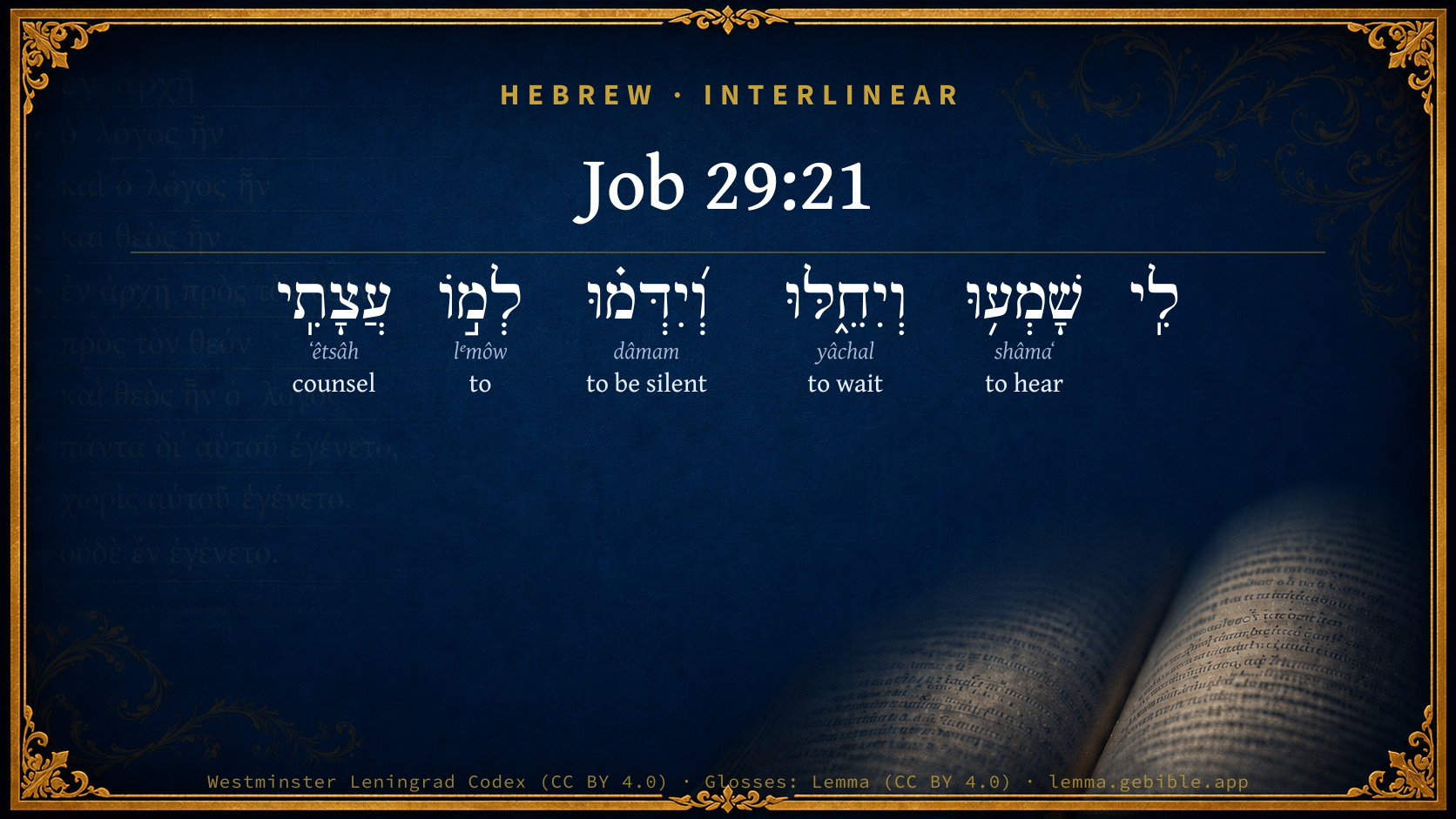
Hebrew (Westminster Leningrad Codex) Job 29:21 appears in the Hebrew Old Testament. The text above is from the Westminster Leningrad Codex. Each word links to its Strong’s number, a concise gloss, and parsing drawn from the Open Scriptures Hebrew Bible morphology. Click any word for its full Brown-Driver-Briggs (BDB) entry.
Download image
Cite this verse

Job 29:21 (World English Bible). Public Domain. Lemma interlinear Bible study tool, https://lemma.gebible.app/v/job/29/21.

Show BibTeX & RIS
BibTeX
RIS
English Translation
"Men listened to me, waited, And kept silence for my counsel.
World English Bible · Public Domain
Download a study sheet

One document with this verse’s original text, its word-by-word gloss line, the meaning frame, cross-references with their text, attributed commentary, and full source and license credits — printable, and it pastes into notes with its structure intact.

This verse Autodidact and up

Study sheet (.html) Plain text (.txt)

A passage Seminary Student

Up to 50 verses in one chapter. A passage sheet keeps up to 6 commentary sources and 12 cross-references per verse, in the order this page ranks them, and says so on the sheet whenever that leaves anything out. Ask for a single verse and you get the Autodidact verse sheet above.

Everything on this page stays free to read, with no account — the sheet is a download of what is already on screen, not access to it.

Want to remove ads? Support Godless Engineer
Compare translations 3

The same verse in 3 English versions, stacked beneath the original-language interlinear above. Click any original word for its lexicon entry.

Each is an independent rendering of the whole verse — the interlinear is not word-aligned to these translations.

Highlighted words mark where these versions differ — a whole-verse word diff, not a word-by-word alignment.

  • World English Bible Public Domain
    "Men listened to me, waited, And kept silence for my counsel.
  • King James Version Public Domain
    Unto me men gave ear, and waited, and kept silence at my counsel.
  • unfoldingWord Literal Text CC BY-SA 4.0
    They listened to me and they waited, and they kept silent for my counsel.

unfoldingWord Literal Text — © unfoldingWord, licensed CC BY-SA 4.0. Word-aligned USFM3 via Door43 (git.door43.org/unfoldingWord/en_ult).

Versions to compare (up to 4)

3 of 4 selected

Show all 18 translations

Every available English version of this verse, each an independent rendering of the whole verse.

  • World English Bible Public Domain
    "Men listened to me, waited, And kept silence for my counsel.
  • Berean Standard Bible Public Domain
    Men listened to me with expectation, waiting silently for my counsel.
  • Majority Standard Bible Public Domain
    Men listened to me with expectation, waiting silently for my counsel.
  • King James Version Public Domain
    Unto me men gave ear, and waited, and kept silence at my counsel.
  • American Standard Version (1901) Public Domain
    Unto me men gave ear, and waited, And kept silence for my counsel.
  • Revised Version (1885) Public Domain
    Unto me men gave ear, and waited, and kept silence for my counsel.
  • Geneva Bible (1599) Public Domain
    Vnto me men gaue eare, and wayted, and helde their tongue at my counsell.
  • Douay-Rheims (1899) Public Domain
    They that heard me, waited for my sentence, and being attentive held their peace at my counsel.
  • Young's Literal Translation Public Domain
    To me they have hearkened, Yea, they wait, and are silent for my counsel.
  • Literal Standard Version CC BY-SA 4.0
    They have listened to me, || Indeed, they wait, and are silent for my counsel.
  • Unlocked Literal Bible CC BY-SA 4.0
    To me men listened; they waited for me; they stayed silent to hear my advice.
  • unfoldingWord Literal Text CC BY-SA 4.0
    They listened to me and they waited, and they kept silent for my counsel.
  • Darby Bible Public Domain
    Unto me they listened, and waited, and kept silence for my counsel:
  • World Messianic Bible Public Domain
    “Men listened to me, waited, and kept silence for my counsel.
  • Webster's Bible Public Domain
    To me men gave ear, and waited, and kept silence at my counsel.
  • Free Bible Version CC BY-SA 4.0
    People listened carefully to what I had to say; they kept quiet as they listened to my advice.
  • Bible in Basic English Public Domain
    Men gave ear to me, waiting and keeping quiet for my suggestions.
  • JPS Tanakh (1917) Public Domain
    Unto me men gave ear, and waited, and kept silence for my counsel.

Literal Standard Version (2020), Covenant Press — licensed CC BY-SA 4.0. Text via the HelloAO Bible API (eBible.org). Unlocked Literal Bible (unfoldingWord) — licensed CC BY-SA 4.0. Text via the HelloAO Bible API (eBible.org). unfoldingWord Literal Text — © unfoldingWord, licensed CC BY-SA 4.0. Word-aligned USFM3 via Door43 (git.door43.org/unfoldingWord/en_ult). Free Bible Version, Dr. Jonathan Gallagher — licensed CC BY-SA 4.0. Text via the HelloAO Bible API (eBible.org).

Word by word

More ways to search: Search by grammar → Find every occurrence → Compare this word →

Practice this passage: Drill this verse → Learn its vocabulary →

About this verse

These counts appear in no published source. They are computed here, from the morphology-tagged text and Lemma’s own curated glosses. What Lemma adds →

6
words
5
distinct lemmas
Wisdom
section

Notable vocabulary

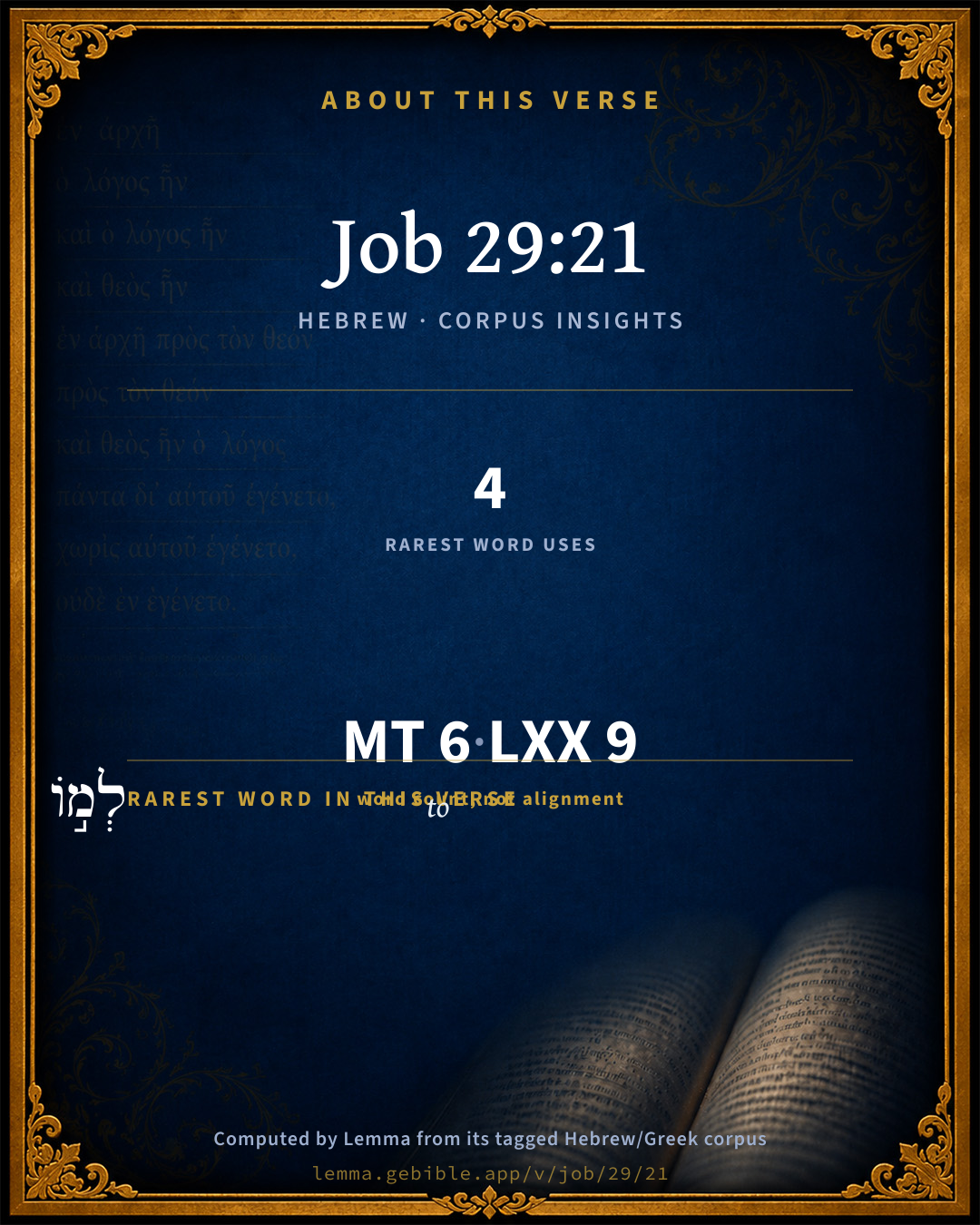
The rarest word here is לְמ֣וֹ to H3926 — appearing just 4 times in the whole Hebrew Bible.

Shared distinctive vocabulary

לְמ֣וֹ to H3926 occurs in 4 verses of the Hebrew Bible. Also found in:

Grammatical profile

  • 3 verbs
  • 1 noun
  • 2 prepositions

Verb forms

  • שָׁמְע֥וּ Qal · Perfect
  • וְיִחֵ֑לּוּ Piel · Perfect
  • וְ֝יִדְּמ֗וּ Qal · Imperfect

Hebrew & Septuagint length

In English translation the verse runs 11 words from the Hebrew and 13 from the Septuagint (LXX English) — closely comparable.

A rough comparison of the two English renderings, which tokenize alike — not a word-level alignment.

Word counts can differ between the Hebrew and the Greek without any difference in meaning — e.g. the Hebrew direct-object marker אֵת has no separate Greek word, and Greek often adds the article ὁ.

In the original languages it is 6 Hebrew tokens and 9 Greek tokens — but the two are counted differently (Hebrew bundles its prefixes and suffixes into one token; the Greek is in lemma form), so that isn’t a like-for-like length.

Cross-references

2

Topical passages linked to Job 29:21 in the Treasury of Scripture Knowledge — connected by theme and wording, ordered by reader-vote popularity; previews shown in the World English Bible.

  • Job 29:9–10 The princes refrained from talking, And laid their hand on their mouth;
  • Job 32:11–12 "Behold, I waited for your words, And I listened for your reasoning, While you searched out what to say.

Cross-references courtesy of OpenBible.info (CC BY 4.0).

Hebrew and Greek witnesses Masoretic Hebrew ↔ Greek Septuagint

The same verse in the two great witnesses to the Old Testament, shown verse-for-verse.

These are two independent witnesses, not word-aligned to each other, and the Septuagint is shown in lemma (dictionary) form.

Hebrew Job 29:21 Masoretic · Westminster Leningrad Codex

לִֽי שָׁמְע֥וּ וְיִחֵ֑לּוּ וְ֝יִדְּמ֗וּ לְמ֣וֹ עֲצָתִֽי

"Men listened to me, waited, And kept silence for my counsel.

World English Bible · Public Domain

Greek LXX Job 29:21 Septuagint · lemma form

ἐγώ ἀκούω προςἔχω σιωπάω δέ ἐπί ὁ ἐμός βουλή

Men heard me, and gave heed, and they were silent at my counsel.

LXX2012 (modern English Septuagint) · Public Domain

On this verse, Keil & Delitzsch discusses the Septuagint’s reading. Read the note in Commentary ↓

Hebrew: Westminster Leningrad Codex (CC BY 4.0). Greek: Septuagint (public domain); English from LXX2012 (modern English Septuagint) (Public Domain). How the Septuagint differs from the Hebrew →

Commentary

Notes on Job 29:21 from classic Christian and Jewish commentators (each source and its license shown beneath its notes). The classic Christian expositions comment on the surrounding passage and are grouped to its opening verse, so a note may address several verses; the Jewish commentaries on the Tanakh (Rashi and others) are per-verse, so they appear only where the commentator wrote on this verse.

Lemma curates 59 commentaries, every one of them public domain or Creative Commons licensed, each selected and text-cleaned for this edition rather than reprinted as found. About our sources →

Trapp's Complete Commentary

John Trapp

Job 29:21 Unto me [men] gave ear, and waited, and kept silence at my counsel.

Ver. 21. Unto me men gave ear, and waited] i.e. Such a gift I had in flexanimous oratory, that my auditors were held, as it were, by the ears in great attention to my speeches; as Lucian saith of Alcibiades, and Cicero of Crassus; and as the poets fable of their Hercules, that he had the ears of his hearers chained to his tongue, as being,

Aμφοτερος ρητηρ τ αγαθος, κρατερος τ αιχημτης.

And kept silence at my counsel] Received it as an oracle from heaven with all humble submission and plenary satisfaction; so great was the force of his wisdom, the weight of his counsel, and the authority of his person, tanquam ex tripode dictum. Erant κυριαι και αμυμονες δοξαι (Lavat.). In some men’s discourses a man shall have satis eloquentiae, sapientiae parum, much eloquence, little enough wisdom. But where there is a concurrence of these two, as was in Job, much may be done. This great men are not ignorant of, and do therefore greatly covet eloquence, Non phaleratam illam sed fortem; non effeminatum sed virilem, not a pedantic style or phrase, but majestic; such as was that of Phocion, a great orator, but one that could speak much in few, as Plutarch reporteth, πλειστον εν ελαχιστη λεξει νουν ειχε; or that of Julius Caesar, who wrote as he fought; and whom a man might know to be a soldier by his words, had he never heard of his noble achievements.

John Trapp, A Commentary or Exposition upon All the Books of the Old and New Testament (1647–1656) — public domain. Text from a community e-Sword module.

Joseph Benson's Commentary

Job 29:21-23. Unto me men gave ear — When I spake all men gave me the greatest attention, and my word was a law to them; and waited and kept silence, &c. — Expecting till I spake, and silently listening to my counsel, which they were confident would be wise, and just, and good, and preferring it to their own judgment. After my words they spake not again — Either to confute them as false, or to add any thing to them as being lame and imperfect. And my speech dropped upon them — Hebrew, תשׂŠ, tittop, distilled as the dew, as Ab. Ezra renders it, referring to Deu 32:2, where Moses, writing in the same style, says, My doctrine shall drop as the rain, &c. As rain is most acceptable and beneficial to the earth, not when it comes down in great and violent storms, but when it descends in moderate and gentle showers; so my words sweetly distilled upon them, and sunk into their hearts. And they waited for me as for the rain — They expected my opinion and advice, with silent attention, and with the same eager desire wherewith the husbandman expects the showers after he has sown his seed. And they opened their mouth wide — They gaped, as it were, with desire for my words, as the dry and parched earth thirsts and opens its mouth to receive the rain after a long, droughty season. Among the Egyptians, the heavens pouring down rain or dew, was the hieroglyphic, or emblem, of learning and instruction.

Joseph Benson's Commentary on the Old and New Testaments (1811–1818) — public domain. Text from a community e-Sword module.

Jamieson, Fausset & Brown

Robert Jamieson, A. R. Fausset & David Brown

Job reverts with peculiar pleasure to his former dignity in assemblies (Job 29:7-10).

Jamieson, Fausset & Brown — Commentary Critical and Explanatory on the Whole Bible (1871) — public domain (CC PDM 1.0). Text via the HelloAO Bible API.

Adam Clarke's Commentary

Verse 21. Unto me men gave ear] The same idea as in Job 29:9-11.

Adam Clarke's Commentary on the Bible (1810–1826) — public domain. Text from a community e-Sword/MySword module.

The Cambridge Bible for Schools and Colleges

gen. ed. J. J. S. Perowne

21–25. Return to the main thought of the passage, his place among men, his brothers.

The Cambridge Bible for Schools and Colleges (gen. ed. J. J. S. Perowne; Cambridge University Press, 1878–1918) — public domain. Text from a community e-Sword module.

John Gill's Exposition

Unto me men gave ear,.... Or give ear, or shall give ear, being all ear; all attention to him, listening to what he said with the utmost diligence and earnestness; even all sorts of men, high and low, rich and poor, princes, nobles, and common people; this they had done, and Job concluded they still would do the same; see Job 29:9;

and waited; patiently, without any weariness, with pleasure and delight, without giving any interruption, or wishing his discourse was ended; and though continuing ever so long, were not impatient until it was finished:

and kept silence at my counsel; which was the thing waited for, and which when given, it was to the highest satisfaction; they acquiesced in it, and showed their approbation of it by their silence, not having anything to object to it, any alteration to be made in it, or any thing to be added to it; but being so complete and full, they were ready to take it at once, and act according to it; Job's counsel being like that of Ahithophel, which was as the oracle of God, Sa2 16:23.

John Gill's Exposition of the Whole Bible (1746–1763) — public domain (CC PDM 1.0). Text via the HelloAO Bible API.

Albert Barnes' Notes on the Bible

Unto me men gave ear - Job here returns to the time when he sat in the assembly of counsellors, and to the respectful attention which was paid to all that he said. They listened when he spoke; they waited for him to speak before they gave their opinion; and they were then silent. They neither interrupted him nor attempted a reply.

Albert Barnes' Notes on the Bible (1834–1885) — public domain. Text from a community e-Sword/MySword module.

Matthew Poole's English Annotations

Expecting till I spoke, and silently listening to my counsel, which they were confident would be like the oracle of God, wise, and just, and good, and preferring it before their own judgment.

Matthew Poole's English Annotations on the Holy Bible (1683–1685) — public domain. Text from a community e-Sword/MySword module.

Whedon's Commentary on the Bible

Daniel D. Whedon

21. Kept silence at my counsel — Not unlike “the long silence” that followed upon one of the masterly arguments of Socrates. — Phaedo, 76.

Daniel D. Whedon (gen. ed.), Commentary on the Old and New Testaments (1874–1909) — public domain. Text from a community e-Sword module.

The Pulpit Commentary

Unto me men gave ear, and waited, and kept silence at my counsel (comp. vers. 9, 10). Job, however, does not repeat himself, sines in the previous passage he is speaking of his work and office as judge, whereas now he declares the position which he had occupied among his countrymen as statesman and counsellor.

Vers. 21-23. Welcome counsel.

Among the happy circumstances of Job"s sunny days of prosperity, he recalls the welcome that was accorded to his words of advice. Too often advice is more freely offered than thankfully received. Let us, then, consider the quality, the utility, and the acceptance of welcome counsel.

I THE QUALITY OF WELCOME COUNSEL. What conditions must be fulfilled to make advice worthy of acceptation?

1. It must be full of knowledge. A glib tongue is ready enough to offer gratuitous advice, but we want to ascertain whether a full mind is inspiring it. Religious teachers must know for themselves before they can safely lead others. The doubt that is pardonable in the private person may be fatal to the public instructor.

2. It must be based on experience. Evidently Job was a man of wide experience. He spoke out of the fulness of his own observation of the world. Armchair counsellors are not much valued. An apprenticeship must be served to the affairs on which we would give advice.

3. It must be accompanied by practical wisdom. Knowledge and experience may find a man very foolish, and leave him so. We have to learn how to apply our acquisitions. We need practical tact in dealing with men and affairs.

4. It must be offered in sympathy. It is very little good to give preaching advice. We must talk to a man as a brother. We must let people see that we care for them, and that we are truly studying their good. A suspicion that the advice is not disinterested vitiates it entirely.

II THE UTILITY OF WELCOME COUNSEL. Bushels of advice have to be thrown on one side as so much burdensome rubbish. Nevertheless, the rare value of really good advice is beyond all reckoning.

1. Right living is supremely important. Counsel deals with life rather than with opinions. It touches conduct. Now, as Matthew Arnold quaintly says, "conduct is three parts of life." Anything that really helps conduct must be valuable.

2. Right living is not easy. We are often perplexed and in uncertainty. Our prejudices and interests warp our judgments.

3. External advice brings new light. It may not be better than what we already possess; but it is an addition. The wise counsellor helps us to look at our affairs from a fresh point of view. At the same time, he comes with a certain calmness and detachment that enable him to take a fair view of the situation.

III THE ACCEPTANCE OF WELCOME ADVICE.

1. It needs humility to receive it. We are all ready to receive the advice that concurs with our previous opinions; but that advice is scarcely needed. The difficulty is to accept the advice that contradicts our notions or wishes. Pride resents it; yet it may be most needful to us.

2. It should be taken with discrimination. Well-meant advice may be very foolish; even wise advice is not infallible. We have to select what commends itself to our judgment.

3. It ought not to supersede independent thought and choice. We may be advised by counsellors; but we have no business to let ourselves be ruled by them. After all, it is we and not they who will be responsible for what we do. Let us, then, preserve independence of judgment, and cultivate strength of will.

4. It deserves to be treated with gratitude. For the sake of its value. Also because, if it is worth much, it must have cost our counsellor time and pains. Too often giving advice is a very thankless task. N.B. All earthly counsel is useful only in so far as it follows the heavenly, of which it is a type. The most welcome counsel should be that which comes through the voice of the Holy Spirit in our hearts. W.F.A.

The Pulpit Commentary (1880–1919), ed. H.D.M. Spence-Jones & Joseph S. Exell — public domain. Text from a community e-Sword module.

Keil & Delitzsch

C. F. Keil & F. Delitzsch

21 They hearkened to me and waited,

And remained silent at my decision.

22 After my utterance they spake not again,

And my speech distilled upon them.

23 And they waited for me as for the rain,

And they opened their mouth wide for the latter rain.

24 I smiled to them in their hopelessness,

And the light of my countenance they cast not down.

25 I chose the way for them, and sat as chief,

And dwelt as a king in the army,

As one that comforteth the mourners.

Attentive, patient, and ready to be instructed, they hearkened to him (this is the force of שׁמע ל), and waited, without interrupting, for what he should say. ויחלּוּ, the pausal pronunciation with a reduplication of the last radical, as Jdg 5:7, חדלּוּ (according to correct texts), Ges. 20, 2, c; the reading of Kimchi, ויחלוּ, is the reading of Ben-Naphtali, the former the reading of Ben-Ascher (vid., Norzi). If he gave counsel, they waited in strictest silence: this is the meaning of ידּמוּ (fut. Kal of דּמם); למו, poetic for ל, refers the silence to its outward cause (vid., on Hab 3:16). After his words non iterabant, i.e., as Jerome explanatorily translates: addere nihil audebant, and his speech came down upon them relieving, rejoicing, and enlivening them. The figure indicated in תּטּף is expanded in Job 29:23 after Deu 32:2 : they waited on his word, which penetrated deeply, even to the heart, as for rain, מטר, by which, as Job 29:23, the so-called (autumnal) early rain which moistens the seed is prominently thought of. They open their mouth for the late rain, מלקושׁ (vid., on Job 24:6), i.e., they thirsted after his words, which were like the March or April rain, which helps to bring to maturity the corn that is soon to be reaped; this rain frequently fails, and is therefore the more longed for. פּער פּה is to be understood according to Psa 119:131, comp. Psa 81:11; and one must consider, in connection with it, what raptures the beginning of the periodical rains produces everywhere, where, as e.g., in Jerusalem, the people have been obliged for some time to content themselves with cisterns that are almost dried to a marsh, and how the old and young dance for joy at their arrival!

In Job 29:24 a thought as suited to the syntax as to the fact is gained if we translate: "I smiled to them - they believed it not," i.e., they considered such condescension as scarcely possible (Saad., Raschi, Rosenm., De Wette, Schlottm., and others); עשׂחק is then fut. hypotheticum, as Job 10:16; Job 20:24; Job 22:27., Ew. 357, b. But it does not succeed in putting Job 29:24 in a consistent relation to this thought; for, with Aben-Ezra, to explain: they did not esteem my favour the less on that account, my respect suffered thereby no loss among them, is not possible in connection with the biblical idea of "the light of the countenance;" and with Schlottm. to explain: they let not the light of my countenance, i.e., token of my favour, fall away, i.e., be in vain, is contrary to the usage of the language, according to which הפּיל פּנים signifies: to cause the countenance to sink (gloomily, Gen 4:5), whether one's own, Jer 3:12, or that of another. Instead of פּני we have a more pictorial and poetical expression here, אור פּני: light of my countenance, i.e., my cheerfulness (as Pro 16:15). Moreover, the אשׂחק אליהם, therefore, furnishes the thought that he laughed, and did not allow anything to dispossess him of his easy and contented disposition. Thus, therefore, those to whom Job laughed are to be thought of as in a condition and mood which his cheerfulness might easily sadden, but still did not sadden; and this their condition is described by לא יאמינוּ (a various reading in Codd. and editions is ולא), a phrase which occurred before (Job 24:22) in the signification of being without faith or hope, despairing (comp. האמין, to gain faith, Psa 116:10), - a clause which is not to be taken as attributive (Umbr., Vaih.: who had not confidence), but as a neutral or circumstantial subordinate clause (Ew. 341, a). Therefore translate: I smiled to them, if they believed not, i.e., despaired; and however despondent their position appeared, the cheerfulness of my countenance they could not cause to pass away. However gloomy they were, they could not make me gloomy and off my guard. Thus also Job 29:25 is now suitably attached to the preceding: I chose their way, i.e., I made the way plain, which they should take in order to get out of their hopeless and miserable state, and sat as chief, as a king who is surrounded by an armed host as a defence and as a guard of honour, attentive to the motion of his eye; not, however, as a sovereign ruler, but as one who condescended to the mourners, and comforted them (נחם Piel, properly to cause to breathe freely). This peaceful figure of a king brings to mind the warlike one, Job 15:24. כּאשׁר is not a conj. here, but equivalent to כאישׁ אשׁר, ut (quis) qui; consequently not: as one comforts, but: as he who comforts; lxx correctly: ὃν τρόπον παθεινοὺς παρακαλῶν. The accentuation (כאשׁר Tarcha, אבלים Munach, ינחם Silluk) is erroneous; כאשׁר should be marked with Rebia mugrasch, and אבלים with Mercha-Zinnorith.

From the prosperous and happy past, absolutely passed, Job now turns to the present, which contrasts so harshly with it.

Keil & Delitzsch — Biblical Commentary on the Old Testament (1861–1891) — public domain (CC PDM 1.0). Text via the HelloAO Bible API. (Old Testament only.)

Rashi

Rabbi Shlomo Yitzchaki (Rashi)

They listened to me and waited Those who listened to my words would wait until they would be realized, and they would be realized because the tradition of wisdom was in my hand.

Rashi on the Tanakh — English translations: “The Judaica Press complete Tanach with Rashi, translated by A. J. Rosenberg” (CC BY 4.0); “Pentateuch with Rashi's commentary by M. Rosenbaum and A.M. Silbermann, 1929-1934” (public domain); “The Metsudah Tanach series, Lakewood, N.J” (CC BY 4.0); and “The Book of Joshua, Metsudah Publications, 1997” (CC BY 4.0). Text via Sefaria.

Lesson kit

Teaching starters — assembled from the data on this page, not authored interpretation. Every prompt links to the verse data it draws on. Edit before teaching.

Job, in the Wisdom, opens this verse with 6 words (5 distinct Hebrew lemmas). Its most distinctive word is lᵉmôw (“to”). A historical commentator’s framing appears above. Read the whole chapter for the surrounding context.

Discussion questions

  1. The word lᵉmôw carries the sense “to.” How does it shape the verse?
  2. How does Job 27:14, which shares the word «to», read alongside this verse?
  3. The translations on this page render this verse differently — a whole-verse word diff, not a word-by-word alignment. What might account for the different wordings?
  4. «שָׁמְע֥וּ» is a Qal Perfect verb. How does that grammatical form shape the action described?
  5. Compare how Trapp's Complete Commentary and Joseph Benson's Commentary read this verse. Where do they agree or differ?

Things to notice

Reading settings

Reading text

Shown beneath each verse's original-language words.

Old Testament
Old Testament edition

Read the OT as the Masoretic Hebrew (MT) or the Greek Septuagint (LXX).

English shown for the Greek Septuagint (in the Hebrew ↔ Greek comparison).

Comparing translations? Open the Compare panel on any verse page to stack up to four side by side.