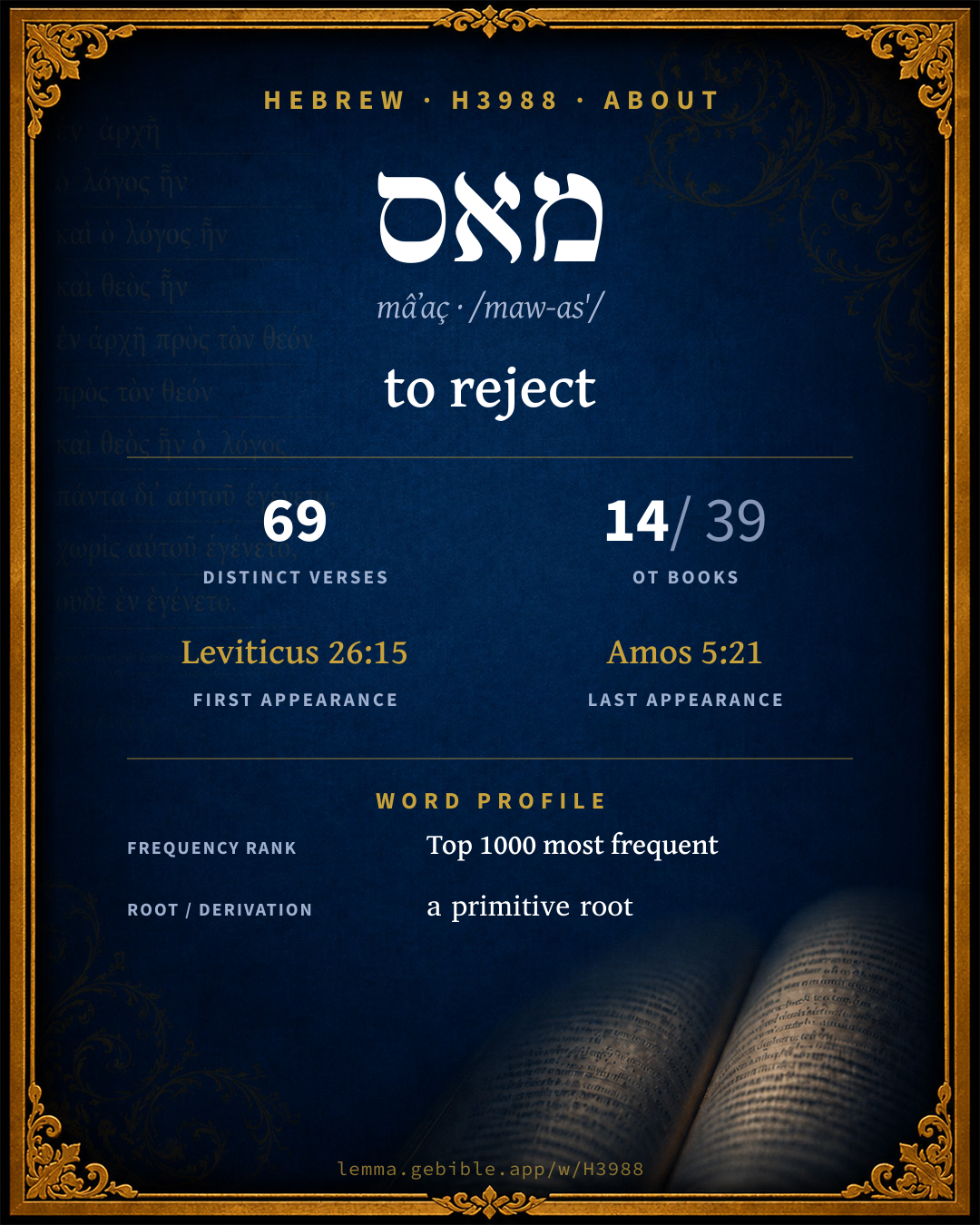
מָאַס
to reject
also: despise, refuse fuller range ↓
Full lexicon entry — Brown-Driver-Briggs (BDB)
From Brown-Driver-Briggs (BDB)
Where this word appears
See every Qal verb in the Hebrew Bible →
Grammar key — what these labels mean
Part of speech
- Verb
- An action or state-of-being word.
Stem
- Qal
- The basic, simple active stem — the plain form of the verb (“he wrote”). Here: ‘reject’
- Niphal
- Usually the simple passive or reflexive of the Qal (“he was written”). Here: ‘be rejected’
Form
- Perfect
- A completed action or state — Hebrew marks aspect (completeness) more than strict tense (“he wrote”).
- Imperfect
- An incomplete, ongoing, or future action (“he will / would write”).
- Sequential Imperfect
- An imperfect with prefixed waw — the standard past-narrative form (waw-consecutive imperfect).
- Infinitive Absolute
- An unbound verbal noun, often intensifying or standing in for a finite verb.
- Participle Active
- A verbal adjective expressing ongoing or characteristic action (“writing / one who writes”).
- Jussive
- A third- or second-person volitional form expressing wish or command (“let him write”).
- Sequential Perfect
- A perfect with prefixed waw continuing a preceding imperfect or command (waw-consecutive perfect).
- Infinitive Construct
- A bound verbal noun, frequently with prepositions (“to write / in writing”).
State
- Absolute
- The independent form of a noun, not bound to a following word.
- Construct
- A noun bound to a following noun in a possessive / “of” relationship (the construct chain).
Person
- 3rd Person
- The one spoken about (“he / she / it / they”).
- 2nd Person
- The one addressed (“you”).
- 1st Person
- The speaker (“I / we”).
Gender
- Common
- Either gender — not distinguished for this form.
- Masculine
- Grammatically masculine.
- Feminine
- Grammatically feminine.
Number
- Plural
- More than one (in Hebrew, generally three or more).
- Singular
- One.
1 verse where H3988 appears in the Niphal stem in the Book of Job. Filtered view — show all forms. Click any verse to open its interlinear word-by-word view. Verse text shown in the World English Bible for context — . Each verse’s Hebrew form is shown with its reference; the English is not keyword-highlighted, since the data carries no word-level English alignment. Use “Compare translations” on any verse to read it across multiple English versions. This concordance covers the Hebrew Bible; Septuagint (Greek Old Testament) occurrences are not indexed here.
Job
About this entry
At a glance — auto-summarized from this page’s data, not written by a person. Every figure links to its source below. This summary describes the numbers; it doesn’t interpret them.
“to reject” is the headline sense of the Hebrew word מאס (mâʼaç). Older and newer Bibles part ways — “rejected” in the King James Version, “reject” (Berean Standard Bible) in modern versions. See the renderings breakdown. It appears 69 verses across 14 books of the Hebrew Bible, among its moderately common vocabulary. Scripture first uses it in Leviticus 26:15. Not a single-sense word: its full sense range also takes in “despise” and “refuse”. See the sense tree, 69-verse concordance, and the renderings breakdown below.
Gloss history
Strong's 1890 vs modern scholarship
About this word
Strong's H3988 catalogs a Hebrew word from the Hebrew Old Testament.
These counts are not copied from any lexicon or concordance. They are computed here, from the morphology-tagged Hebrew Old Testament. What Lemma adds →
- 69
- distinct verses
- The word appears in 69 distinct verses.
- 14 / 39
- OT books
- The word appears in 14 of 39 Old Testament books.
- #523
- by frequency
- Top 1000 most frequent Hebrew words (rank 523 of 8,640 Hebrew words by occurrence).
View all 69 occurrences in the concordance →
By section of the Old Testament
By traditional corpus
Conventional, traditional groupings — biblical authorship is debated, so this is a traditional corpus grouping, not an authorship claim. Each share is this word’s portion of its verses in that division of the Hebrew canon. Each figure is a share of the word’s 69 distinct verses.
- Prophets (Nevi'im) 40 verses · 58%
- Writings (Ketuvim) 24 verses · 35%
- Torah (Pentateuch) 5 verses · 7%
How translations render this word
Counts come from each version’s own published word-to-Strong’s tagging or interlinear alignment — an approximate guide to how each version renders this word, not a word-level alignment the data otherwise carries. Because each total is that version’s own tagged count, the per-version totals vary from one another and need not match the appearance or distinct-verse counts above. These counts may also differ from a printed concordance because Lemma counts each distinctly tagged rendering and does not collapse phrase taggings into a single head-word total. This is a fixed set of word-tagged versions (KJV, ASV, BSB, ULT) and does not change with the reading translation you choose elsewhere. Each version’s license is shown beside its name below (and on Sources).
BDB lists this Strong’s number as 2 distinct words (homographs). Each count above pools all of them and is not split by sense — see the Senses section below. A low-frequency rendering may belong to a different one of those words, not the primary meaning.
- King James Version†: Rejected 5×, Hath rejected 4×, They despised 3×
- American Standard Version†: Rejected 6×, They rejected 4×, Despise 3×
- Berean Standard Bible†: Reject 9×, Has rejected 5×, Rejected 5×
- unfoldingWord Literal Text†: Reject 5×, Rejected 5×, Has rejected 4×
King James Version Public Domain
Renders H3988 across 75† tagged occurrences — most commonly:
Plus 53 renderings that appear only once — usually multi-word phrases or single function words the recovered tagging swept in, not distinct renderings. Not rendered by a distinct English word in 1 further occurrence.
American Standard Version Public Domain
Renders H3988 across 75† tagged occurrences — most commonly:
Plus 44 renderings that appear only once — usually multi-word phrases or single function words the recovered tagging swept in, not distinct renderings.
Berean Standard Bible Public Domain
Renders H3988 across 75† tagged occurrences — most commonly:
Plus 32 renderings that appear only once — usually multi-word phrases or single function words the recovered tagging swept in, not distinct renderings. Not rendered by a distinct English word in 1 further occurrence.
unfoldingWord Literal Text CC BY-SA 4.0
Renders H3988 across 86† tagged occurrences — most commonly:
Plus other, less common renderings. Plus 40 renderings that appear only once — usually multi-word phrases or single function words the recovered tagging swept in, not distinct renderings.
7 senses and sub-senses in the full BDB
Hebrew verbs can shift meaning by stem (binyan): Qal is the basic action, Niphal is often passive or reflexive, Piel often intensifies or makes it factitive, and Hiphil is typically causative. The senses below are grouped under the stem BDB assigns to each.
What do BDB’s symbols mean?
BDB uses these scholarly abbreviations:
| Symbol | Meaning |
|---|---|
| 𝔊 | the Septuagint (the ancient Greek translation, LXX) |
| 𝔙 | the Vulgate (the Latin translation) |
| 𝔖 | the Syriac version (the Peshitta) |
| 𝔗 | the Targum (the Aramaic translation) |
| ψ | the Psalms |
| √ | root (the underlying root or stem) |
| ‖ | parallel passage (a synonymous or contrasted parallel) |
| † | the dagger: every passage where the word occurs is cited |
The 7 senses and sub-senses the full Brown-Driver-Briggs lexicon distinguishes for this word, in lexicon order (not ranked by frequency), with BDB’s own verbatim wording and sub-sense lettering. Shown in Hebrew script with BDB’s own scholarly abbreviations. The condensed entry is in the Lexicon Entry tab. See also the Forms in the corpus table below.
מאס I reject (NH id.
Qal
- Pf. 3 ms. מָאַס Is 8:6 + 4 times; sf. מְאָסָם ψ 53:6; 2 ms. מָאַסְתָּ Je 14:19 + 3 times; מָאַסְתָּה Ju 9:38 1 S 15:26 + 22 times Pf.; Impf. יִמְאַס Jb 8:20 + 3 times; יִמְאָ֑ס ψ 36:5 Jb 36:5; sf. וַיּמְאָֽסְךָ 1 S 15:23, 26; for וְאֶמְאָֽסְאךָ Ho 4:6 (so Baer, cf. DeComplut. Var. 18 f.; not וָא׳ Van d. H.) read וְאֶמְאָֽסְךָ; 3 mpl. יִמְאֲסוּ Je 6:19 + 2 times; יִמְאָס֑וּן Is 31:7; + 12 times Impf.; Inf. abs. מָאוֹס Is 7:15, 16 מָאֹס Je 14:19 La 5:22; cstr. מָֽאָסְכֶם Is 30:12; מָאֳסָם Am 2:4; Pt. מוֹאֵס Pr 15:32; מֹאֵס Is 33:15, f. מֹאֶסֶת Ez 21:15 (text dub., Co מוֹאֲסֵי; Berthol וּמְאַסֵּף), v 18 (also dub., Co מִטֻּמְאָתָם; Berthol מְאַסֵּף);— e.g. Isaiah 8:6
- 1. reject, refuse,
- a. c. acc.: God rejects men Ho 4:6; 9:17; 1 S 15:23, 26; 16:1, 7; 2 K 23:27; Is 41:9; Je 7:29; 14:19(×2); 33:24, 26; Lv 26:44 (H), ψ 53:6 Jb 8:20; 10:3 La 5:22(×2); זָנַחְתָּ וַתִּמְאָם ψ 89:39; men reject God Nu 11:20 (J), 1 S 8:7; 10:19; men 1 S 8:7; Jb 30:1; idols Is 31:7, evil ψ 36:5, knowledge Ho 4:6, divine תורה Am 2:4; Is 5:24; דבר 1 S 15:23, 26, חקות Ez 20:24, חקים 2 K 17:15; מוסר Jb 5:17; Pr 3:11; var. things Is 8:6 Ez 21:15 ψ 118:22; Jb 31:13. e.g. Hosea 4:6
- b. c. בְ God rejects men 2 K 17:20 Je 6:30; 31:37 ψ 78:59, 67 that in which man confides Je 2:37; men reject evil Is 7:15, 16 divine תורה Je 6:19, דבר Is 30:12; Je 8:9, חקות Lv 26:15 (H); משׁפטים v 43 (H), Ez 5:6; 20:13, 16; var. things, Nu 14:31 (J) Is 33:15; Je 4:30 ψ 106:24. e.g. 2 Kings 17:20
- 2. despise, c. acc., God subj. שׂנאתי מאסתי חגיכם Am 5:21 I hate, I despise your feasts; elsewhere men subj. גם עוילים מ׳ בי Jb 19:18 even young children despise me; אמ׳ חיי 9:21 I despise my life, cf. מואס נפשׁוֹ Pr 15:32; הלא זה העם אשׁר מ׳ בוֹ Ju 9:38 is not this the people that thou despisedst? מ׳ עָרִים Is 33:8; obj. om. Jb 7:16 (34:33; 36:5; 42:6 (𝔖 Siegf אֶשְׁתֹּק; 𝔊 𝔙 Symm Bö אֶמָּאֵס) Ez 21:18 (but v. supr.).— e.g. Amos 5:21
Niphal
- be rejected: Impf. תִּמָּאֵס Is 54:6 (wife); Pt. נִמְאָס Je 6:30; (silver), ψ 15:4 (= reprobate; opp. יִרְאֵי י׳); + f. נִמְאָסָה, נִמְאֶסֶת 1 S 15:9 rejected, i.e. worthless (for ℌ נָמֵס) according to We Klo Dr Kit Bu HPS (‖ נמבזה, read נִבְזָה; cf. מסס, בזה Niph.) e.g. Isaiah 54:6
מאס II
Niphal
- flow, run (Aramaic id., but rare and dub.;—secondary form of מסס q.v.);—Impf. 3 ms. וַיִּמָּאֵס Jb 7:5 my skin hath hardened and run (i.e. again, afresh; > GHoffm Du read וַיִּמַּס, Bu וַיִּמָּאס, √ מסס); 3 mpl. יִמָּֽאֲסוּ כְּמוֹ מַיִם ψ 58:8 (fig. of annihilation of wicked). e.g. Job 7:5
Senses from the full Brown-Driver-Briggs lexicon (Brown, Driver, Briggs; Oxford 1906 — public domain), digitized via Sefaria, supplemented by the OpenScriptures HebrewLexicon (CC BY 4.0). Full attribution on Sources.
Word origin
vb. reject (NH id.; Aramaic מְאַס reject, despise; BAES 15 comp. (dub.) Arabic مَعَسَ lightly esteem (Ḳam.; Assyrian ma’âsu is perhaps destroy MeissnSuppl. 55);—
— Brown-Driver-Briggs (Oxford 1906, public domain), digitized via Sefaria, supplemented by the OpenScriptures HebrewLexicon (CC BY 4.0). See Sources.
Origin: a primitive root
Jastrow Dictionary
A second Hebrew/Aramaic lexicon for comparison, covering Aramaic and post-biblical (Talmudic, Targumic, Midrashic) usage that the biblical-Hebrew BDB does not. Matched by lemma rather than by Strong’s number, so a lemma may carry more than one Jastrow headword (shown separately below), and the entries cover usage well beyond the Bible.
מָאַס
- [to melt, faint,] (with ב) to be tired of, loathe; (with accus.) to cast away, reject. Ber. 8ᵃ אין הקב"ה מוֹאֵס בתפלתו וכ׳ the Lord never tires of the prayer of assemblies. Sifra B’ḥuck. ch. III, Par. 2 מואס באחרים despises others (for being his betters); (ib. מואס אחרים, corr. acc.). Tanḥ. Mishp. 11 כבר מָאֲסָן וכ׳ their god has rejected them; Ex. R. s. 31. Ib. אמת שמָאַסְתָּ וכ׳ is it true that thou hast rejected thy son?; a. fr.—Part. pass. מָאוּס, f. מְאוּסָה; pl. מְאוּסִים, מְאוּסִין; מְאוּסוֹת. Midr. Till. to Ps. LXXV, 9 (play on כמס, Deut. XXXII, 34) כמוס למאוסים reserved for the rejected (nations; differ. in Sifré Deut. 324). Der. Er. ch. II המ׳ בעיניהם those who are despised in their own eyes (think little of themselves); a. e. e.g. Deuteronomy 32:34
- to be repulsive, loathsome; to be rejected. Sifra B’ḥuck. Par. 2, ch. VIII (ref. to Lev. XXVI, 44) וכי … שלא נִמְאֲסוּ ושלא נגעלו what has been left to them so that (it might be said) they were not cast away and loathed?; Yalk. Lev. 675 (corr. acc.). Ḥag. 5ᵃ ונ׳ and becomes loathsome (creates aversion to his neighbor).—V. מִיאוּס. e.g. Leviticus 26:44
מְאַס
- Targ. Y. Lev. XXVI, 44; a. e.—V. מְאִיס.
- to melt, faint. Targ. Ps. LVIII, 8 Ms. (ed. יתמסון).
- , v. מְאִיס
מָאָס
- (preced.) rejection, contempt. Lam. R. introd. (R. Abba 2) מָאֲסָהּ של תורה the contempt of the Law; (Y. Ḥag. I, 76ᶜ על מאסם בתורה).
A Dictionary of the Targumim, the Talmud Babli and Yerushalmi, and the Midrashic Literature (Marcus Jastrow; London, Luzac, 1903) — Public Domain. Digitized via Sefaria. Digitized via Sefaria. Full attribution on Sources.
Forms in the corpus
The 68 distinct written forms H3988 takes in the Hebrew Bible, most frequent first — each parse links to that stem’s occurrences in the concordance. Hebrew forms include their vowel points and cantillation, so a single lemma takes many written forms.
The 60 most common forms are shown; 8 rarer forms follow in the full concordance.
Same root — word family
Other BDB entries built from the same root as H3988, grouped by Strong’s listed origin. These share a root / origin per the lexicon — not necessarily a shared meaning. Each links to that word’s own entry.
Derived from this word
Compare all same-root words → They share a root, not necessarily a meaning.
Septuagint verse parallels
This word appears in 65 verses that also exist in the Greek Old Testament (Septuagint), out of the 69 Hebrew verses it occurs in. You can read those verses in Greek by switching the Old Testament edition to the Septuagint.
Read these verses in the Septuagint
- Leviticus 26:15
- Numbers 11:20
- Judges 9:38
- 1 Samuel 8:7
- 2 Kings 17:15
- Job 5:17
- Psalms 15:4
- Proverbs 3:11
- Isaiah 5:24
- Jeremiah 2:37
- Lamentations 5:22
- Ezekiel 5:6
This is a verse-level parallel only — the same verses exist in both the Hebrew and Greek Old Testaments. No word-level Hebrew↔Greek correspondence is claimed: the data carries no such alignment, so no Greek word is shown as this Hebrew word’s translation. Coverage is not total — the Septuagint omits the deuterocanon and renumbers the Psalms, so some Hebrew verses have no direct Greek parallel.