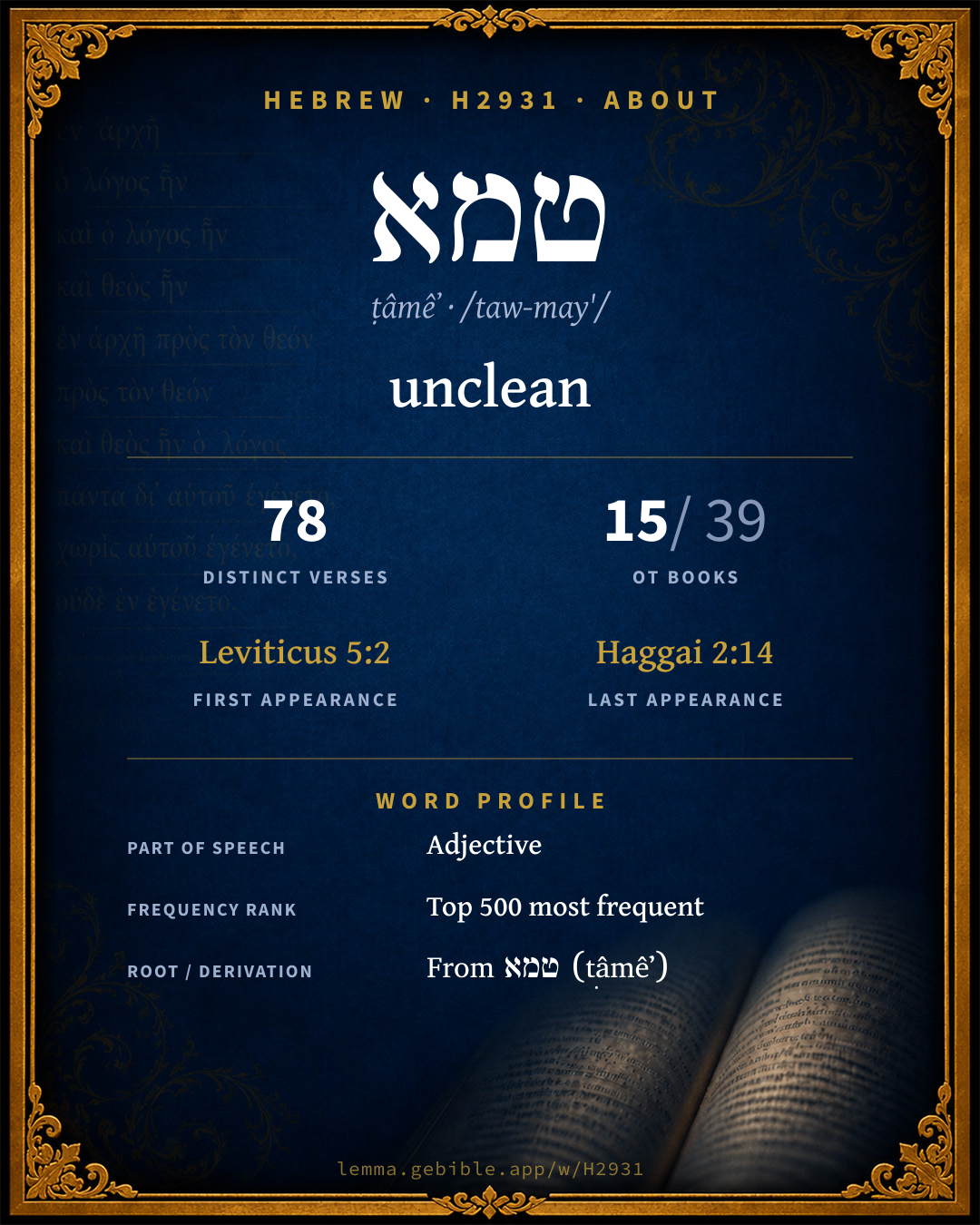
טָמֵא
unclean
‘unclean’ is one of 4 main senses fuller range ↓
Full lexicon entry — Brown-Driver-Briggs (BDB)
From Brown-Driver-Briggs (BDB)
Where this word appears
See every Absolute-state word in the Hebrew Bible →
Grammar key — what these labels mean
Part of speech
- Adjective
- A word that describes or qualifies a noun.
State
- Absolute
- The independent form of a noun, not bound to a following word.
- Construct
- A noun bound to a following noun in a possessive / “of” relationship (the construct chain).
Gender
- Masculine
- Grammatically masculine.
- Feminine
- Grammatically feminine.
Number
- Singular
- One.
- Plural
- More than one (in Hebrew, generally three or more).
1 verse where H2931 appears in the Construct state in the Book of Leviticus. Filtered view — show all forms. Click any verse to open its interlinear word-by-word view. Verse text shown in the World English Bible for context — . Each verse’s Hebrew form is shown with its reference; the English is not keyword-highlighted, since the data carries no word-level English alignment. Use “Compare translations” on any verse to read it across multiple English versions. This concordance covers the Hebrew Bible; Septuagint (Greek Old Testament) occurrences are not indexed here.
Leviticus
About this entry
At a glance — auto-summarized from this page’s data, not written by a person. Every figure links to its source below. This summary describes the numbers; it doesn’t interpret them.
טמא (ṭâmêʼ) is a Hebrew adjective most often rendered “unclean.” It is not a single-sense word — see its full sense range. Spanning 78 verses in 15 books, it ranks among the moderately common words of the Hebrew Bible. Leviticus dominates its distribution — 38 of 78 verses. It first appears in Leviticus 5:2. The sections below give every sense, occurrence, and version rendering.
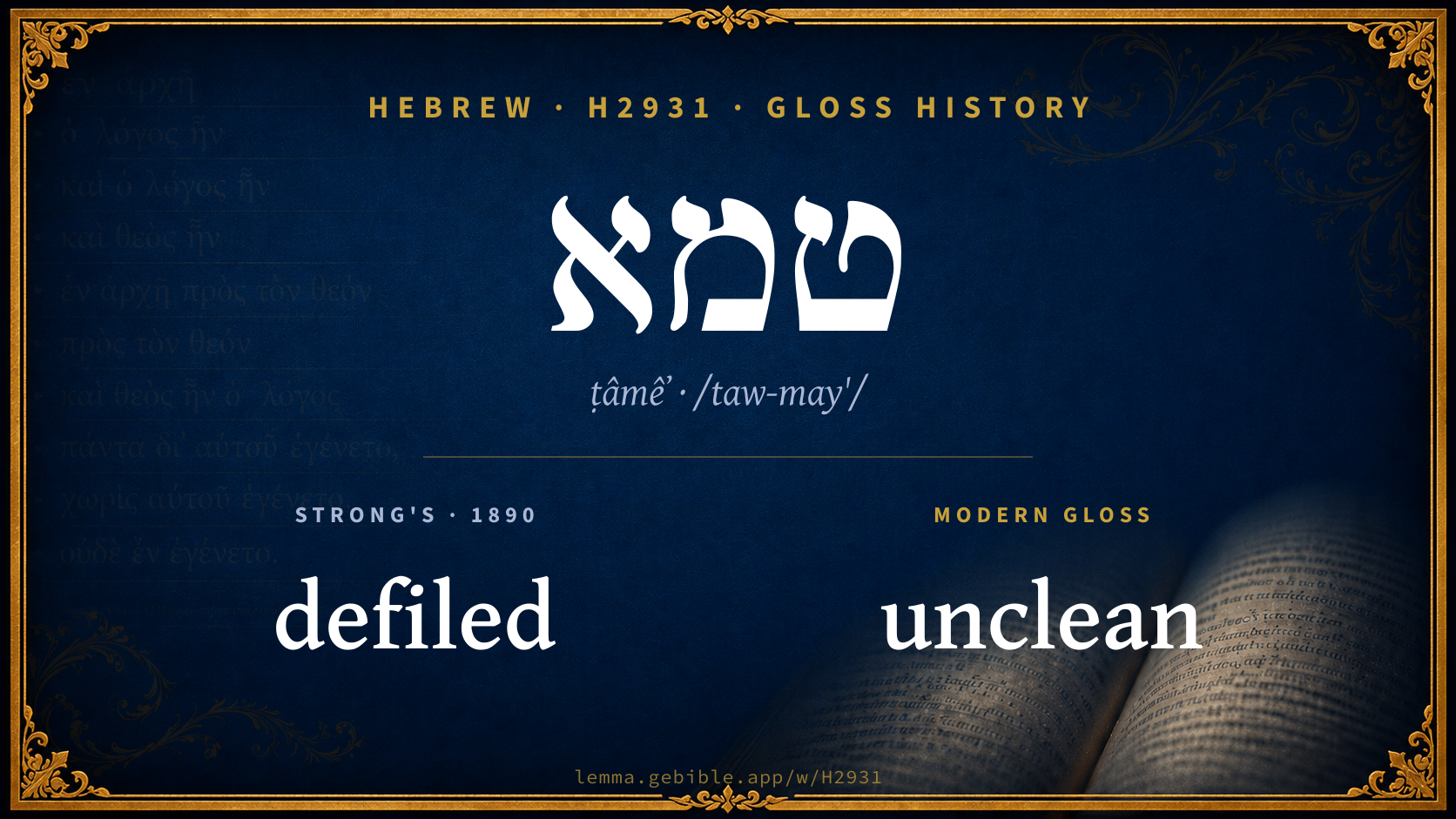
Gloss history
Strong's 1890 vs modern scholarship
About this word
Strong's H2931 catalogs a Hebrew word from the Hebrew Old Testament.
These counts are not copied from any lexicon or concordance. They are computed here, from the morphology-tagged Hebrew Old Testament. What Lemma adds →
- 78
- distinct verses
- The word appears in 78 distinct verses.
- 15 / 39
- OT books
- The word appears in 15 of 39 Old Testament books.
- #467
- by frequency
- Top 500 most frequent Hebrew words (rank 467 of 8,640 Hebrew words by occurrence).
View all 78 occurrences in the concordance →
Most concentrated in
- Leviticus 38 verses 49%
- Numbers 11 verses 14%
- Deuteronomy 8 verses 10%
By section of the Old Testament
By traditional corpus
Conventional, traditional groupings — biblical authorship is debated, so this is a traditional corpus grouping, not an authorship claim. Each share is this word’s portion of its verses in that division of the Hebrew canon. Each figure is a share of the word’s 78 distinct verses.
- Torah (Pentateuch) 57 verses · 73%
- Prophets (Nevi'im) 17 verses · 22%
- Writings (Ketuvim) 4 verses · 5%
How translations render this word
Counts come from each version’s own published word-to-Strong’s tagging or interlinear alignment — an approximate guide to how each version renders this word, not a word-level alignment the data otherwise carries. Because each total is that version’s own tagged count, the per-version totals vary from one another and need not match the appearance or distinct-verse counts above. These counts may also differ from a printed concordance because Lemma counts each distinctly tagged rendering and does not collapse phrase taggings into a single head-word total. This is a fixed set of word-tagged versions (KJV, ASV, BSB, ULT) and does not change with the reading translation you choose elsewhere. Each version’s license is shown beside its name below (and on Sources).
BDB lists this Strong’s number as 2 distinct words (homographs). Each count above pools all of them and is not split by sense — see the Senses section below. A low-frequency rendering may belong to a different one of those words, not the primary meaning.
- King James Version†: Unclean 22×, Is unclean 11×, He is unclean 9×
- American Standard Version†: Unclean 19×, Is unclean 8×, Between the unclean 5×
- Berean Standard Bible†: Unclean 38×, Is unclean 20×, Are unclean 8×
- unfoldingWord Literal Text†: Unclean 43×, Is unclean 22×, Are unclean 8×
King James Version Public Domain
Renders H2931 across 87† tagged occurrences — most commonly:
Plus 28 renderings that appear only once — usually multi-word phrases or single function words the recovered tagging swept in, not distinct renderings.
American Standard Version Public Domain
Renders H2931 across 85† tagged occurrences — most commonly:
Plus 31 renderings that appear only once — usually multi-word phrases or single function words the recovered tagging swept in, not distinct renderings.
Berean Standard Bible Public Domain
Renders H2931 across 85† tagged occurrences — most commonly:
Plus 9 renderings that appear only once — usually multi-word phrases or single function words the recovered tagging swept in, not distinct renderings. Not rendered by a distinct English word in 3 further occurrences.
unfoldingWord Literal Text CC BY-SA 4.0
Renders H2931 across 95† tagged occurrences — most commonly:
Plus 14 renderings that appear only once — usually multi-word phrases or single function words the recovered tagging swept in, not distinct renderings.
24 senses and sub-senses in the full BDB
Hebrew verbs can shift meaning by stem (binyan): Qal is the basic action, Niphal is often passive or reflexive, Piel often intensifies or makes it factitive, and Hiphil is typically causative. The senses below are grouped under the stem BDB assigns to each. This entry also uses Pual (the passive of Piel), Hithpael (reflexive or reciprocal), and Hothp (the passive of Hithpael).
What do BDB’s symbols mean?
BDB uses these scholarly abbreviations:
| Symbol | Meaning |
|---|---|
| 𝔊 | the Septuagint (the ancient Greek translation, LXX) |
| 𝔙 | the Vulgate (the Latin translation) |
| 𝔖 | the Syriac version (the Peshitta) |
| 𝔗 | the Targum (the Aramaic translation) |
| ψ | the Psalms |
| √ | root (the underlying root or stem) |
| ‖ | parallel passage (a synonymous or contrasted parallel) |
| † | the dagger: every passage where the word occurs is cited |
The 24 senses and sub-senses the full Brown-Driver-Briggs lexicon distinguishes for this word, in lexicon order (not ranked by frequency), with BDB’s own verbatim wording and sub-sense lettering. Shown in Hebrew script with BDB’s own scholarly abbreviations. The condensed entry is in the Lexicon Entry tab. See also the Forms in the corpus table below.
טמא I be or become unclean (NH Pi. pollute (ceremonially)
Qal
- Pf. 3 ms. ט׳ Lv 11:25 + 22 times; 3 fs. טָֽמְאָה 12:2 + 2 times; 2 fs. טָמֵאת Ez 22:4; pl. טָֽמְאוּ Lv 15:18; Impf. יִטְמָא Lv 5:3 + 34 times; 3 fs. תִּטְמָא 12:2 + 4 times; pl. יִטְמְאוּ ψ 106:39; Inf. טָמְאָה Lv 15:32 + 6 times;—be or become unclean: e.g. Leviticus 11:25
- 1. sexually, c. בְּ Lv 18:20, 23 (H), Ez 23:17; the land Lv 18:25, 27 (H). e.g. Leviticus 18:20
- 2. religiously, with idols Ez 22:3; c. בְ v 4; with necromancers Lv 19:31 (H); by sacrificing children to idols ψ 106:39. e.g. Ezekiel 22:3
- 3. ceremonially, by contact with carcasses of unclean animals Lv 11:24, 27, 28, 31, 32, 33, 34(×2), 35, 36, 40 (P); any carcass 17:15 (H); eating of a carcass 22:8 (H); by issues 15:4, 9, 20(×2), 24, 27, 32 (P); by contact with an unclean man 5:3; 15:4 (P), 22:5 (H), or thing 22:6 (H); by leprosy 13:14, 46; 14:36, 46 (P); by contact with the dead Nu 6:12; 19:20 (P), Ez 44:25, or with one unclean by such contact Nu 19:22 (P), Hg 2:13(×2); by contact with creeping things Lv 22:5 (H); certain animals were always unclean 11:26, 27 (P). In ordinary cases of uncleanness טמא עד הערב unclean till even Lv 11:24, 25, 27, 28, 31, 32, 39, 40(×2); 14:46; 15:5, 6, 7, 8, 10(×2), 11, 16, 17, 18, 19, 21, 22, 23, 27 Nu 19:7, 8, 10, 21, 22 (all P), Lv 17:15; 22:6 (H); but uncleanness lasted 7 days for woman bearing a son Lv 12:2(×2) (P), for man lying with woman having an issue 15:24 (P), or one coming in contact with the dead Nu 19:11, 14, 16 (P); it lasted 14 days for a woman bearing a daughter Lv 12:5 (P). e.g. Leviticus 11:24
Niphal
- Pf. 3 ms. נִטְמָא Ho 5:3; 6:10; 3 fs. נִטְמְאָה Nu 5:27, 28; נִטְמָ֑אָה 5:13 + 5 times; 1 s. נִטְמֵאתִי Je 2:23; 2 m.pl. נִטְמֵתֶם Lv 11:43 (א omitted by scribal error; but Ges al. derive from טמה), etc. + 4 times pf.; Pt. pl. נִטְמְאִים Ez 20:30, 31;—defile oneself, be defiled: e.g. Hosea 5:3
- 1. sexually, Lv 18:24 (H), Nu 5:13, 14(×2), 20, 27, 28, 29 (P). e.g. Leviticus 18:24
- 2. by idolatry conceived as whoredom Ho 5:3; 6:10 Je 2:23 Ez 20:30, 31, 43; 23:7, 13, 30. e.g. Hosea 5:3
- 3. ceremonially, by eating creeping things Lv 11:43. e.g. Leviticus 11:43
- 4. be regarded as unclean (cf. Pi. 4), prob. נִטְמִינוּ Jb 18:3 we are accounted as unclean; metapl. form; on another view v. טמה. e.g. Job 18:3
Piel
- Pf. טִמֵּא Gn 34:5 + 15 times; sf. טִמְּאוֹ Lv 13:8 + 3 times; 2 fs. טִמֵּאת Ez 5:11, etc. + 7 times Pf.; Impf. יְטַמֵּא 2 K 23:8, etc. + 12 times Impf.; Imv. pl. טַמְּאוּ Ez 9:7; Inf. טַמֵּא Lv 13:44 + 2 times; sf. טַמְּאָם 15:31, etc. + 4 times Inf.;—defile: e.g. Genesis 34:5
- 1. sexually Gn 34:5, 13, 27 (R), Ez 18:6, 11, 15; 22:11; 33:26; the land by sexual impurities of the people Lv 18:28 (H); Isr. by spiritual whoredom Ez 23:17. e.g. Genesis 34:5
- 2. religiously: the land, by bloodshed Nu 35:34 (P); by allowing the dead body of the murderer to hang on the tree over night Dt 21:23; by idolatry Je 2:7 Ez 36:17, 18; Isr. defiled the sacred places by the sacrifice of children Lv 20:3 (H), Ez 23:38, and God defiled him thereby 20:26; he defileth the sacred places by idolatry 2 Ch 36:14 Je 7:30 = 32:34, Ez 5:11; the holy name of י׳ 43:7, 8; Josiah defiled the idolatrous places of worship by destroying them and making them unfit for use 2 K 23:8, 10, 13, 16; of Isr. defiling idolatrous images Is 30:22, and the nations the temple of God ψ 79:1. e.g. Numbers 35:34
- 3. ceremonially: by ceremonial uncleanness, the sacred places Lv 15:31 Nu 19:13, 20 (P); the camp Nu 5:3 (P); the temple by dead bodies Ez 9:7; the Nazirite’s head of separation by a death occurring in his presence Nu 6:9 (P); the people defile themselves (נפשׁתיכם) by creeping things Lv 11:44 (P). e.g. Leviticus 15:31
- 4. pronounce or declare ceremonially unclean: the leper Lv 13:3, 8, 11, 15, 20, 22, 25, 27, 30, 44(×2), 59 (P); unclean animals 20:25 (H). e.g. Leviticus 13:3
Pual
- Pt. נַפְשִׁי לֹא מְטֻמָּאָה Ez 4:14 myself is not polluted. e.g. Ezekiel 4:14
Hithpael
- Impf. יִטַּמָּא Lv 21:1 + 4 times; pl. יִטַּמְּאוּ Ez 14:11; 37:23; יִטַּמָּ֑אוּ Ho 9:4 Ez 44:25, etc. + 6 times Impf.;—reflexive, defile oneself: by eating of an unaccepted peace-offering Ho 9:4; c. בְּ Lv 18:24, 30 (H), 11:43 (P), Ez 14:11; 20:7, 18; 37:23; c. לְ for a dead person Lv 21:1, 3, 11 (H), Nu 6:7 (P); by Lv 11:24 (P); without prep. 21:4 (H), Ez 44:25. e.g. Leviticus 21:1
Hothp
- Pf. אַהֲרֵי אֲשֶׁר הֻטַּמָּ֑אָה Dt 24:4 after that she has been defiled (sexually); on form v. Ges§ 54. 3. e.g. Deuteronomy 24:4
טמא II unclean
- 1. ethically and religiously ט׳ שׂפתים Is 6:5(×2) unclean of lips; ט׳ השׁם Ez 22:5 defiled of name, infamous; טהור מִטּ׳ Jb 14:4. e.g. Isaiah 6:5
- 2. ritually:
- a. of persons, ‖ טהור Dt 12:15, 22; 15:22 Ec 9:2; ט׳ נפשׁ Lv 22:4 (H); (אדם) ט׳ לנפשׁ unclean for a (dead) person Nu 5:2; 9:6, 7, 10 (P) = ט׳ נפשׁ Hg 2:13; elsewhere for various reasons Dt 26:14; Lv 5:2; 13:11, 36, 44, 45(×2), 46; 15:2, 25, 33 Nu 19:13, 17, 19, 20, 22 (all P), 2 Ch 23:19; Is 64:5 Ez 4:13; 22:10 La 4:15. e.g. Deuteronomy 12:15
- b. of animals Lv 5:2(×4); 7:21(×2); 11:4, 5, 6, 7, 8, 26, 27, 28, 29, 31; 27:11, 27 Nu 18:15 (all P), Lv 20:25(×2) (H), Dt 14:7, 8, 10, 19. e.g. Leviticus 5:2
- c. of things in gen. Lv 11:35(×2), 38; 15:26 Nu 19:15 (all P), Is 52:11; food Ju 13:4 Ho 9:3; houses Je 19:13; leprosy Lv 13:15, 51, 55; 14:44, 57 (P); offering Hg 2:14. e.g. Leviticus 11:35
- d. persons and things in general כל טמא Lv 7:19, 21 (P); הבדיל בין הט׳ ובין הטהור Lv 10:10; 11:47; הודיע בין (ה)ט׳ לטהור Ez 22:26; 44:23; of aliens Is 52:1 (‖ עָרֵל), perhaps also 35:8. e.g. Leviticus 7:19
- 3. specif. of places: מקום ט׳ unclean place (place of refuse away from holy place and human habitation) Lv 14:40, 41, 45 (P); טמאה ארץ land on the east of the Jordan separated from the land of the tabernacle of י׳ Jos 22:19 (P); so אדמה ט׳ a foreign land Am 7:17. e.g. Leviticus 14:40
Senses from the full Brown-Driver-Briggs lexicon (Brown, Driver, Briggs; Oxford 1906 — public domain), digitized via Sefaria, supplemented by the OpenScriptures HebrewLexicon (CC BY 4.0). Full attribution on Sources.
Word origin
I. vb. be or become unclean (NH Pi. pollute (ceremonially); Aramaic טְמָא and especially deriv., ܛܰܡܰܐ Pa. pollute; v. RSK 307 ff.)—
II. adj. unclean;—ט׳ Lv 5:2 + 58 times; cstr. טְמֵא 22:4 + 3 times; f. טְמֵאָה 5:2 + 11 times; cstr. טְמֵאַת Ez 22:5, 10; pl. טְמֵאִים Lv 11:8 + 10 times;—unclean,
— Brown-Driver-Briggs (Oxford 1906, public domain), digitized via Sefaria, supplemented by the OpenScriptures HebrewLexicon (CC BY 4.0). See Sources.
Derived from טמא (ṭâmêʼ) (H2930) — to be unclean.
Jastrow Dictionary
A second Hebrew/Aramaic lexicon for comparison, covering Aramaic and post-biblical (Talmudic, Targumic, Midrashic) usage that the biblical-Hebrew BDB does not. Matched by lemma rather than by Strong’s number, so a lemma may carry more than one Jastrow headword (shown separately below), and the entries cover usage well beyond the Bible.
טַמָּא
- (= טעמא, v. M. Kat. 18ᵃ quot. s. v. טַעֲמָא, a. T’shuboth G’onim ed. Cassel, p. 22ᵃ) reason, argument (on the cause of grief), consolation.—Pl. טַמַּיָּא, or טָמַיָּא.—בֵּי ט׳ gathering of comforters around the mourner in his house or at the place of worship. Ber. 6ᵇ אגרא דבי ט׳ וכ׳ (Ar. טמא, Tshub. G’onim l. c. טעמא) the merit of attending the mourner’s gathering lies in the silence (which must be observed until the mourner begins to speak). Snh. 113ᵃ [read:] למשאל ביה ט׳ (v. Rabb. D. S. a. l. note), v. טַעֲמָא.
טָמֵא I
- [to be filled up, inaccesible,] to be unclean; v. טָמֵא II.
- 1. to make unclean, to soil, defile. Yoma 39ᵃ אדם מְטַמֵּא עצמו מעט מְטַמְּאִין וכ׳ if a man begins to defile himself a little (through sin), he will soon be defiled largely. Yad. III, 5, a. fr. מט׳ את הידים their handling makes the hands unclean (washing the hands is required after handling them). Kel. I, 1; a. v. fr.
- 2. to declare unclean. Toh. VI, 2. Eduy. I, 11; a. v. fr.—Makhsh. VI, 2 טִימְּאוּ; Y. Dem. V, 24ᵈ טִימּוּ.
- , Hithpa. הִתְטַמֵּא, הִיטַּמֵּא
- 1. to become unclean, to be made unclean. Ukts. I, 1 מְטַמֵּא ומִיטַּמֵּא eventually makes unclean and becomes unclean. Kel. II, 1 מִיתְטַמְּאִין וכ׳ (ed. Dehr. מִיטַּ׳) are fit to become unclean and to make unclean. Ib. ומיט׳ מאחוריהן ואינן מיט׳ וכ׳ Mish. ed. (Talm. ed. מִטַּ׳) may be made unclean through their backs (touching uncleanness), &c. Ib. VI, 4 ונִטְמְאוּ and which became unclean; a. v. fr.—Yoma 38ᵇ [read:] בא לִטַּמֵּא פְּתָחִין לו (v. Rabb. D. S. a. l. note) to him who is willing to defile himself, doors are open; Sabb. 104ᵃ; Ab. Zar. 55ᵃ; Men. 29ᵇ
- 2. to make one’s self unclean by handling a corpse &c. (v. Lev. XXI, 1, sq.). Yeb. 60ᵃ מִטַּמֵּא לה he (the priest) may attend to her burial; a. fr. e.g. Leviticus 21:1
טְמָא
- v. טְמִי
טָמֵא II
- v. preced. art.) unclean, levitically impure, forbidden. Kel. XII, 2 המחובר לט׳ ט׳ whatever is attached to an object which is fit to become unclean, may become unclean. Ib. 1 טבעת אדם ט׳ a ring used by man may eventually become unclean; a. v. fr.—Ḥull. VII, 5 דג ט׳ a fish forbidden to eat. Ib. 6 (בהמה) ט׳ a forbidden animal; a. v. fr.—Ab. Zar. 39ᵃ (referring to ‘the ass of the sea’, v. חֲמָר, a. ‘the ox of the sea’, v. תּוֹרָא) ט׳ טהור טהור ט׳ what is unclean (on land) is clean (in water) &c.—טְמֵא מת = b. h. טָ׳ למת, one made unclean through a corpse. Pes. 19ᵇ; a. fr.—Pl. טְמֵאִים, טְמֵאִין; f. טְמֵאוֹת. Ḥull. VIII, 6. Pes. 17ᵃ. Kel. XI, 8; a. v. fr.—טְמֵאֵי מתים, v. supra. Pes. 66ᵇ; a. fr.
טְמֵא
- v. טְמֵי
טְמִי
- = h. טָמֵא, to be, become unclean. Targ. Ps. CVI, 39 טְמִיאוּ (some ed. incorr. טַמִּי׳).
- to make unclean. Targ. Y. II, Num. XII, 12.—Targ. Mic. II, 10 בדיל לטַמָּיוּתָהּ ed. Lag. (ed. בדיל ט׳ corr. acc.) in order to defile her.—Ḥull. 3ᵃ לטַמְּיֵיה וטַמִּיתֵיה לבשר … the person will make the knife unclean and then the knife will make the flesh unclean. Pes. 79ᵃ דבשר הוא דמְטַמְּיָא ליה וכ׳ which affects only the flesh, but not the person. (Ms. M. דמִיטַּמֵּי … מִיטַּמְּאֵי, Ithpe.). Ib. 67ᵇ טַמּוּיֵי מְטַמֵּי makes unclean; a. fr.
- to be made unclean. Ḥull. 2ᵇ; a. e.
טְמֵי
- , constr. (preced.) unclean. Targ. Num. V, 2, a. fr. ט׳ נפשא, v. טָמֵא II.—Pl. f. טַמְיַין. Targ. Y. Deut. XIV, 4 [read:] עִיבּוּרֵי ט׳ (v. Bekh. 7ᵃ) offsprings of unclean mothers.
A Dictionary of the Targumim, the Talmud Babli and Yerushalmi, and the Midrashic Literature (Marcus Jastrow; London, Luzac, 1903) — Public Domain. Digitized via Sefaria. Digitized via Sefaria. Full attribution on Sources.
Forms in the corpus
The 43 distinct written forms H2931 takes in the Hebrew Bible, most frequent first — each parse links to that state’s occurrences in the concordance. Hebrew forms include their vowel points and cantillation, so a single lemma takes many written forms.
Same root — word family
Other BDB entries built from the same root as H2931, grouped by Strong’s listed origin. These share a root / origin per the lexicon — not necessarily a shared meaning. Each links to that word’s own entry.
Derives from
Shares the same root
Compare all same-root words → They share a root, not necessarily a meaning.
Septuagint verse parallels
This word appears in 78 verses that also exist in the Greek Old Testament (Septuagint), out of the 78 Hebrew verses it occurs in. You can read those verses in Greek by switching the Old Testament edition to the Septuagint.
Read these verses in the Septuagint
- Leviticus 5:2
- Numbers 5:2
- Deuteronomy 12:15
- Joshua 22:19
- Judges 13:4
- 2 Chronicles 23:19
- Job 14:4
- Ecclesiastes 9:2
- Isaiah 6:5
- Jeremiah 19:13
- Lamentations 4:15
- Ezekiel 4:13
This is a verse-level parallel only — the same verses exist in both the Hebrew and Greek Old Testaments. No word-level Hebrew↔Greek correspondence is claimed: the data carries no such alignment, so no Greek word is shown as this Hebrew word’s translation. Coverage is not total — the Septuagint omits the deuterocanon and renumbers the Psalms, so some Hebrew verses have no direct Greek parallel.