Leviticus 13:44

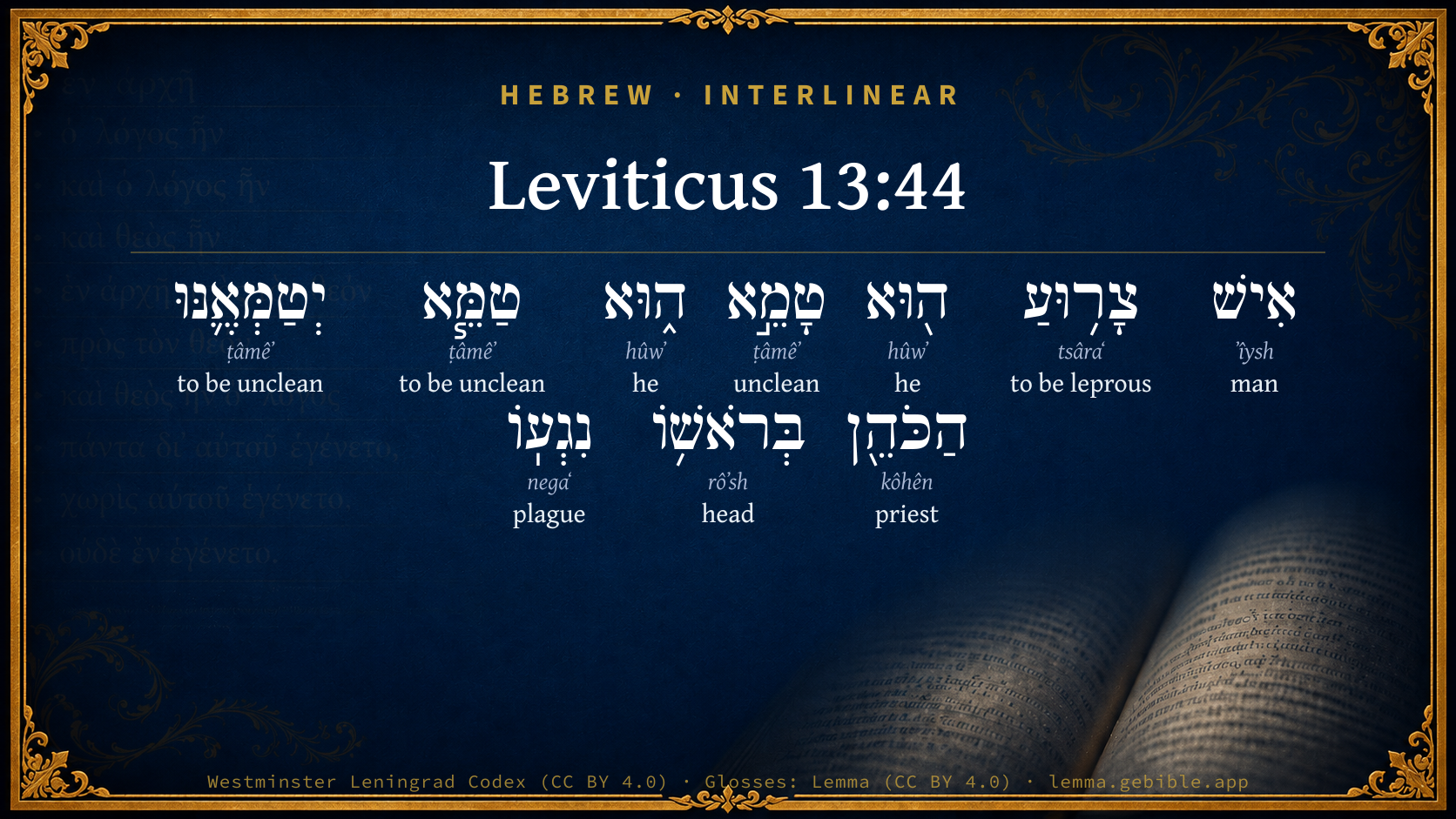
Hebrew (Westminster Leningrad Codex) Leviticus 13:44 appears in the Hebrew Old Testament. The text above is from the Westminster Leningrad Codex. Each word links to its Strong’s number, a concise gloss, and parsing drawn from the Open Scriptures Hebrew Bible morphology. Click any word for its full Brown-Driver-Briggs (BDB) entry.
Download image
Cite this verse

Leviticus 13:44 (World English Bible). Public Domain. Lemma interlinear Bible study tool, https://lemma.gebible.app/v/leviticus/13/44.

Show BibTeX & RIS
BibTeX
RIS
English Translation
he is a leprous man. He is unclean. The priest shall surely pronounce him unclean. His plague is on his head.
World English Bible · Public Domain
Download a study sheet

One document with this verse’s original text, its word-by-word gloss line, the meaning frame, cross-references with their text, attributed commentary, and full source and license credits — printable, and it pastes into notes with its structure intact.

This verse Autodidact and up

Study sheet (.html) Plain text (.txt)

A passage Seminary Student

Up to 50 verses in one chapter. A passage sheet keeps up to 6 commentary sources and 12 cross-references per verse, in the order this page ranks them, and says so on the sheet whenever that leaves anything out. Ask for a single verse and you get the Autodidact verse sheet above.

Everything on this page stays free to read, with no account — the sheet is a download of what is already on screen, not access to it.

Want to remove ads? Support Godless Engineer
Compare translations 3

The same verse in 3 English versions, stacked beneath the original-language interlinear above. Click any original word for its lexicon entry.

Each is an independent rendering of the whole verse — the interlinear is not word-aligned to these translations.

Highlighted words mark where these versions differ — a whole-verse word diff, not a word-by-word alignment.

  • World English Bible Public Domain
    he is a leprous man. He is unclean. The priest shall surely pronounce him unclean. His plague is on his head.
  • King James Version Public Domain
    He is a leprous man, he is unclean: the priest shall pronounce him utterly unclean; his plague is in his head.
  • unfoldingWord Literal Text CC BY-SA 4.0
    He a man of a skin disease; he unclean. Being unclean, the priest shall pronounce him unclean on his head of his infection.

unfoldingWord Literal Text — © unfoldingWord, licensed CC BY-SA 4.0. Word-aligned USFM3 via Door43 (git.door43.org/unfoldingWord/en_ult).

Versions to compare (up to 4)

3 of 4 selected

Show all 18 translations

Every available English version of this verse, each an independent rendering of the whole verse.

  • World English Bible Public Domain
    he is a leprous man. He is unclean. The priest shall surely pronounce him unclean. His plague is on his head.
  • Berean Standard Bible Public Domain
    the man is diseased; he is unclean. The priest must pronounce him unclean because of the infection on his head.
  • Majority Standard Bible Public Domain
    the man is diseased; he is unclean. The priest must pronounce him unclean because of the infection on his head.
  • King James Version Public Domain
    He is a leprous man, he is unclean: the priest shall pronounce him utterly unclean; his plague is in his head.
  • American Standard Version (1901) Public Domain
    he is a leprous man, he is unclean: the priest shall surely pronounce him unclean; his plague is in his head.
  • Revised Version (1885) Public Domain
    he is a leprous man, he is unclean: the priest shall surely pronounce him unclean; his plague is in his head.
  • Geneva Bible (1599) Public Domain
    He is a leper and vncleane: therefore the Priest shall pronounce him altogether vncleane: for the sore is in his head.
  • Douay-Rheims (1899) Public Domain
    Now whosoever shall be defiled with the leprosy, and is separated by the judgment of the priest,
  • Young's Literal Translation Public Domain
    he `is' a leprous man, he `is' unclean; the priest doth pronounce him utterly unclean; his plague `is' in his head.
  • Literal Standard Version CC BY-SA 4.0
    he [is] a leprous man—he [is] unclean; the priest pronounces him utterly unclean; his plague [is] in his head.
  • Unlocked Literal Bible CC BY-SA 4.0
    If it is, then he has an infectious disease and he is unclean. The priest must surely pronounce him unclean because of his disease on his head.
  • unfoldingWord Literal Text CC BY-SA 4.0
    He a man of a skin disease; he unclean. Being unclean, the priest shall pronounce him unclean on his head of his infection.
  • Darby Bible Public Domain
    he is a leprous man, he is unclean; the priest shall pronounce him utterly unclean; his sore is in his head.
  • World Messianic Bible Public Domain
    he is a leprous man. He is unclean. The priest shall surely pronounce him unclean. His plague is on his head.
  • Webster's Bible Public Domain
    He is a leprous man, he is unclean: the priest shall pronounce him utterly unclean; his plague is in his head.
  • Free Bible Version CC BY-SA 4.0
    then he has an infectious disease; he is unclean. The priest must declare him unclean because of the infection on his head.
  • Bible in Basic English Public Domain
    He is a leper and unclean; the priest is to say that he is most certainly unclean: the disease is in his head.
  • JPS Tanakh (1917) Public Domain
    he is a leprous man, he is unclean; the priest shall surely pronounce him unclean: his plague is in his head.

Literal Standard Version (2020), Covenant Press — licensed CC BY-SA 4.0. Text via the HelloAO Bible API (eBible.org). Unlocked Literal Bible (unfoldingWord) — licensed CC BY-SA 4.0. Text via the HelloAO Bible API (eBible.org). unfoldingWord Literal Text — © unfoldingWord, licensed CC BY-SA 4.0. Word-aligned USFM3 via Door43 (git.door43.org/unfoldingWord/en_ult). Free Bible Version, Dr. Jonathan Gallagher — licensed CC BY-SA 4.0. Text via the HelloAO Bible API (eBible.org).

Word by word

More ways to search: Search by grammar → Find every occurrence → Compare this word →

Practice this passage: Drill this verse → Learn its vocabulary →

צָר֥וּעַ
tsâraʻ
H6879
“leprous”
Verb, Qal, Participle Passive, Masculine, Singular, Absolute
Part of Speech
Verb
Stem
Qal
Form
Participle Passive
Gender
Masculine
Number
Singular
State
Absolute
Full BDB Definition

Origin: a primitive root

TWOT: 1971

to be diseased of skin, be leprous - (Qal) to be a leper - (Pual) to have leprosy
  1. אִישׁ ʼîysh H376 “man of” Noun, Common, Masculine, Singular, Construct
  2. ה֖וּא hûwʼ H1931 “he” Pronoun, Personal, 3rd Person, Masculine, Singular
  3. טָמֵ֣א ṭâmêʼ H2931 “unclean” Adjective, Adjective, Masculine, Singular, Absolute
  4. ה֑וּא hûwʼ H1931 “he” Pronoun, Personal, 3rd Person, Masculine, Singular
  5. טַמֵּ֧א ṭâmêʼ H2930 “to be unclean” Verb, Piel, Infinitive Absolute
  6. יְטַמְּאֶ֛נּוּ ṭâmêʼ H2930 “to be unclean · him” Verb, Piel, Imperfect, 3rd Person, Masculine, Singular + Suffix, Personal, 3rd Person, Masculine, Singular
  7. הַכֹּהֵ֖ן kôhên H3548 “the · priest” Particle, Definite Article + Noun, Common, Masculine, Singular, Absolute
  8. בְּרֹאשׁ֥וֹ rôʼsh H7218 “in/at · head · his” Preposition + Noun, Common, Masculine, Singular, Construct + Suffix, Personal, 3rd Person, Masculine, Singular
  9. נִגְעֽוֹ negaʻ H5061 “plague · his” Noun, Common, Masculine, Singular, Construct + Suffix, Personal, 3rd Person, Masculine, Singular

About this verse

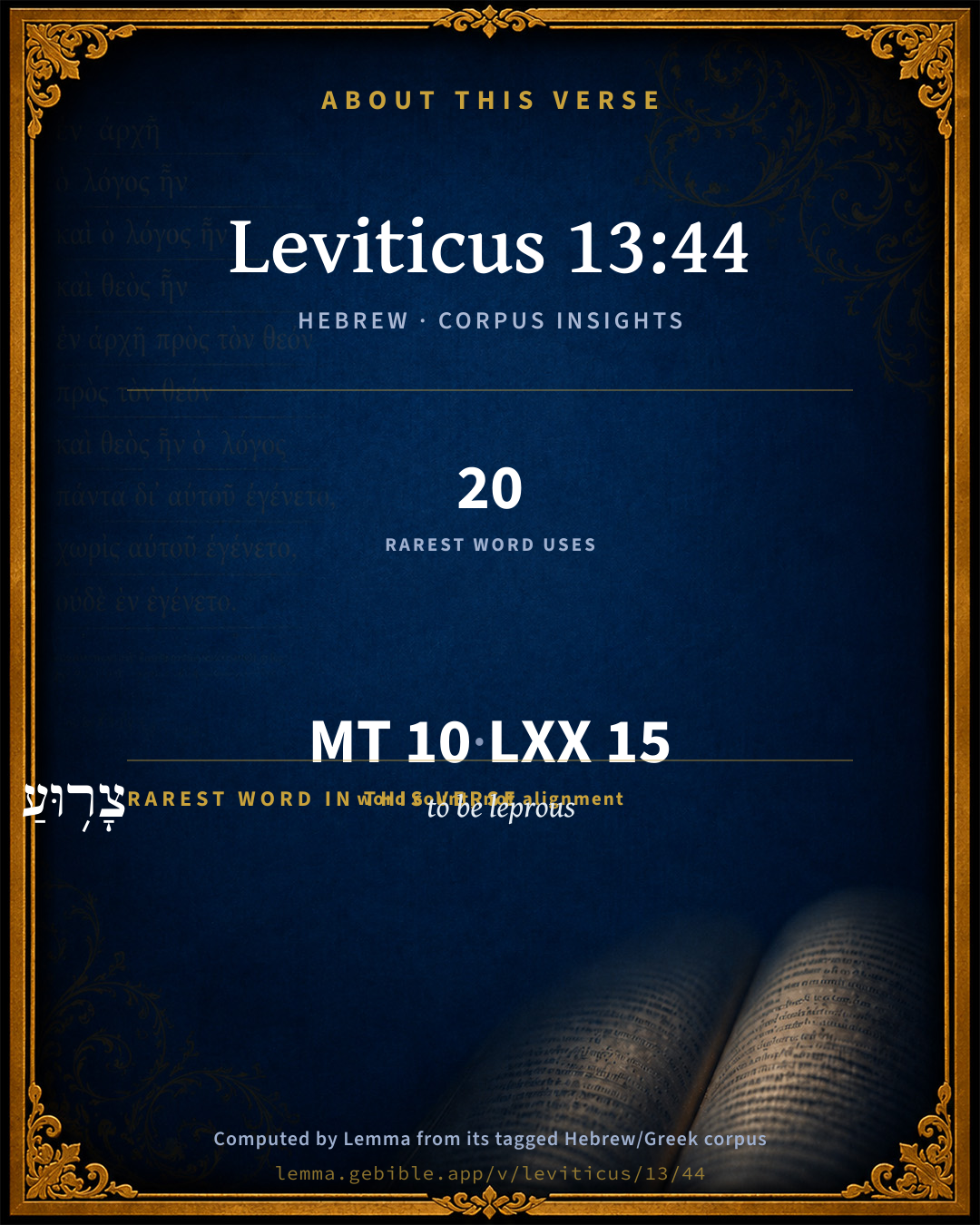
These counts appear in no published source. They are computed here, from the morphology-tagged text and Lemma’s own curated glosses. What Lemma adds →

10
words
8
distinct lemmas
Pentateuch
section

Notable vocabulary

The rarest word here is צָר֥וּעַ to be leprous H6879 — appearing just 20 times in the whole Hebrew Bible.

Shared distinctive vocabulary

צָר֥וּעַ to be leprous H6879 occurs in 18 verses of the Hebrew Bible. Also found in:

Grammatical profile

  • 3 verbs
  • 4 nouns
  • 1 adjective
  • 2 pronouns

Verb forms

  • צָר֥וּעַ Qal · Participle Passive
  • טַמֵּ֧א Piel · Infinitive Absolute
  • יְטַמְּאֶ֛נּוּ Piel · Imperfect

Repetition

Words recur within this verse — often emphatic in Hebrew:

  • טַמֵּ֧א to be unclean H2930 ×2
  • ה֖וּא he H1931 ×2

Hebrew & Septuagint length

In English translation the verse runs 21 words from the Hebrew and 18 from the Septuagint (LXX English) — closely comparable.

A rough comparison of the two English renderings, which tokenize alike — not a word-level alignment.

Word counts can differ between the Hebrew and the Greek without any difference in meaning — e.g. the Hebrew direct-object marker אֵת has no separate Greek word, and Greek often adds the article ὁ.

In the original languages it is 10 Hebrew tokens and 15 Greek tokens — but the two are counted differently (Hebrew bundles its prefixes and suffixes into one token; the Greek is in lemma form), so that isn’t a like-for-like length.

Cross-references

5

Topical passages linked to Leviticus 13:44 in the Treasury of Scripture Knowledge — connected by theme and wording, ordered by reader-vote popularity; previews shown in the World English Bible.

  • Job 36:14 They die in youth. Their life perishes among the unclean.
  • Isaiah 1:5 Why should you be beaten more, That you revolt more and more? The whole head is sick, And the whole heart faint.
  • Matthew 6:23 But if your eye is evil, your whole body will be full of darkness. If therefore the light that is in you is darkness, how great is the darkness!
  • 2 Peter 2:1–2 But there also arose false prophets among the people, as among you also there will be false teachers, who will secretly bring in destructive heresies, denying even the Master who bought them, bringing on themselves swift destruction.
  • 2 John 1:8–10 Watch yourselves, that we don't lose the things which we have accomplished, but that we receive a full reward.

Cross-references courtesy of OpenBible.info (CC BY 4.0).

Hebrew and Greek witnesses Masoretic Hebrew ↔ Greek Septuagint

The same verse in the two great witnesses to the Old Testament, shown verse-for-verse.

These are two independent witnesses, not word-aligned to each other, and the Septuagint is shown in lemma (dictionary) form.

Hebrew Leviticus 13:44 Masoretic · Westminster Leningrad Codex

אִישׁ צָר֥וּעַ ה֖וּא טָמֵ֣א ה֑וּא טַמֵּ֧א יְטַמְּאֶ֛נּוּ הַכֹּהֵ֖ן בְּרֹאשׁ֥וֹ נִגְעֽוֹ

he is a leprous man. He is unclean. The priest shall surely pronounce him unclean. His plague is on his head.

World English Bible · Public Domain

Greek LXX Leviticus 13:44 Septuagint · lemma form

ἄνθρωπος λεπρός εἰμί μίανσις μιαίνω αὐτός ὁ ἱερεύς ἐν ὁ κεφαλή αὐτός ὁ ἁφή αὐτός

he is a leprous man: the priest shall surely pronounce him unclean, his plague is in his head.

LXX2012 (modern English Septuagint) · Public Domain

Hebrew: Westminster Leningrad Codex (CC BY 4.0). Greek: Septuagint (public domain); English from LXX2012 (modern English Septuagint) (Public Domain). How the Septuagint differs from the Hebrew →

Targum (Aramaic paraphrase)

2

The Targum is the ancient Jewish Aramaic paraphrase of the Hebrew Scriptures — an interpretive translation, not the Hebrew text itself. Onkelos (literal) and Pseudo-Jonathan (expansive) render the Torah, and Jonathan the Prophets. Coverage is partial: where no permissively-licensed English translation exists for a verse, only the Aramaic is shown. This is verse-level text, not a word-by-word alignment to the Hebrew.

  1. Targum Onkelos Torah (Genesis–Deuteronomy)
    גְבַר סְגִיר הוּא מְסָאָב הוּא סָאֳבָא יְסָאֵבִנֵהּ כַּהֲנָא בְּרֵישֵּׁהּ מַכְתָּשֵׁהּ

    (no public-domain English translation for this verse)

    Targum Onkelos — Aramaic: “Onkelos Genesis” (public domain); “Onkelos Exodus” (public domain); “Onkelos Leviticus” (public domain); “Onkelos Numbers” (public domain); “Onkelos Deuteronomy” (public domain). English: “Sefaria Community Translation” (CC0 1.0 (public-domain dedication)); “J.W. Etheridge. The Targums of Onkelos and Jonathan Ben Uzziel on the Pentateuch. London: Longmans, Green, 1862” (public domain). Text via Sefaria.

  2. Targum Pseudo-Jonathan Torah (Genesis–Deuteronomy)
    גְבַר סְגִיר הוּא מְסָאָב הוּא סָאֲבָא יְסַאֲבִינֵיהּ כַּהֲנָא מְטוּל דִבְרֵישֵׁיהּ מַכְתְּשֵׁיהּ

    he is a leprous man, he is unclean, and the priest shall verily make him to be unclean, for the plague is on his head.

    Targum Pseudo-Jonathan — Aramaic: “Targum Jonathan on Genesis” (public domain); “Targum Jonathan on Exodus” (public domain); “Targum Jonathan on Leviticus” (public domain); “Targum Jonathan on Numbers” (public domain); “Targum Jonathan on Deuteronomy” (public domain). English: “The Targum of Jonathan ben Uzziel, trans. J. W. Etheridge, London, 1862” (public domain). Text via Sefaria.

Commentary

Notes on Leviticus 13:44 from classic Christian and Jewish commentators (each source and its license shown beneath its notes). The classic Christian expositions comment on the surrounding passage and are grouped to its opening verse, so a note may address several verses; the Jewish commentaries on the Tanakh (Rashi and others) are per-verse, so they appear only where the commentator wrote on this verse.

Lemma curates 59 commentaries, every one of them public domain or Creative Commons licensed, each selected and text-cleaned for this edition rather than reprinted as found. About our sources →

Trapp's Complete Commentary

John Trapp

Lev 13:44 He is a leprous man, he [is] unclean: the priest shall pronounce him utterly unclean; his plague [is] in his head.

Ver. 44. His plague is in his head.] Such a leper is every ignorant man; how much more the man that is a heretic! whom therefore after the first and second admonition we must reject, {Tit 3:10} yea from such stand off. {1Ti 6:5} Keep aloof as from lepers, their very breath is infectious; and like the dogs of Congo, they bite, though they bark not. {a}

{a} Purchas’s Pilg.

John Trapp, A Commentary or Exposition upon All the Books of the Old and New Testament (1647–1656) — public domain. Text from a community e-Sword module.

John Gill's Exposition

All the days wherein the plague shall be in him he shall be defiled,.... Reckoned an unclean person, and avoided as such:

he is unclean; in a ceremonial sense, and pronounced as such by the priest, and was to be looked upon as such by others during the time of his exclusion and separation, until he was shown to the priest and cleansed, and his offering offered:

he shall dwell alone; in a separate house or apartment, as Uzziah did, Ch2 26:21; none were allowed to come near him, nor he to come near to any; yea, according to Jarchi, other unclean persons might not dwell with him:

without the camp shall his habitation be; without the three camps, as the same Jewish writer interprets it, the camp of God, the camp of the Levites, and the camp of Israel: so Miriam, when she was stricken with leprosy, was shut out of the camp seven days, Num 12:14. This was observed while in the wilderness, but when the Israelites came to inhabit towns and cities, then lepers were excluded from thence; for they defiled, in a ceremonial sense, every person and thing in a house they came into, whether touched by them or not. So Bartenora (b) observes, that if a leprous person goes into any house, all that is in the house is defiled, even what he does not touch; and that if he sits under a tree, and a clean person passes by, the clean person is defiled; and if he comes into a synagogue, they make a separate place for him ten hands high, and four cubits broad, and the leper goes in first, and comes out last. The Persians, according to Herodotus (c), had a custom much like this; he says, that if any of the citizens had a leprosy or a morphew, he might not come into the city, nor be mixed with other Persians (or have any conversation with them), for they say he has them because he has sinned against the sun: and there was with us an ancient writ, called "leproso amovendo" (d), that lay to remove a leper who thrust himself into the company of his neighbours in any parish, either in the church, or at other public meetings, to their annoyance. This law concerning lepers shows that impure and profane sinners are not to be admitted into the church of God; and that such who are in it, who appear to be so, are to be excluded from it, communion is not to be had with them; and that such, unless they are cleansed by the grace of God, and the blood of Christ, shall not inherit the kingdom of heaven; for into that shall nothing enter that defiles, or makes an abomination, or a lie; see Co1 5:7 Rev 21:27.

(b) In Misn. Celim, c. 1. sect. 4. so in Misn. Negaim, c. 13. sect. 7, 11, 12. (c) Clio, sive, l. 1. c. 138. (d) See the Supplement to Chambers's Dictionary, in the word "Leprosy".

John Gill's Exposition of the Whole Bible (1746–1763) — public domain (CC PDM 1.0). Text via the HelloAO Bible API.

Whedon's Commentary on the Bible

Daniel D. Whedon

44. Utterly unclean — “The Bible is everywhere careful not to allow the idea of partial goodness or partial uncleanness. There is a great moral suggestion in all this. Once let a man consider that he is not so bad as some other man, and instantly false standards of purity are set up. The Pharisee adopted this method of self-measurement, and separated himself from the publican by certain degrees of supposed righteousness.” — Joseph Parker.

Daniel D. Whedon (gen. ed.), Commentary on the Old and New Testaments (1874–1909) — public domain. Text from a community e-Sword module.

Rashi

Rabbi Shlomo Yitzchaki (Rashi)

בראשו נגעו HIS PLAGUE IS ON HIS HEAD — I have only a statement that the following laws apply to the case of נתקין, plagues on hairy places! Whence may we learn that there are included the sufferers from all other kinds of leprous plagues? Because it states מא יטמאנו‎ט, “he shall in any case proclaim him unclean” (Sifra, Tazria Parashat Nega'im, Chapter 12 2)— thus including all of these: regarding all of these it says: “his garments shall be rent etc.”.

Rashi on the Tanakh — English translations: “The Judaica Press complete Tanach with Rashi, translated by A. J. Rosenberg” (CC BY 4.0); “Pentateuch with Rashi's commentary by M. Rosenbaum and A.M. Silbermann, 1929-1934” (public domain); “The Metsudah Tanach series, Lakewood, N.J” (CC BY 4.0); and “The Book of Joshua, Metsudah Publications, 1997” (CC BY 4.0). Text via Sefaria.

Lesson kit

Teaching starters — assembled from the data on this page, not authored interpretation. Every prompt links to the verse data it draws on. Edit before teaching.

Leviticus, in the Pentateuch, opens this verse with 10 words (8 distinct Hebrew lemmas). Its most distinctive word is tsâraʻ (“to be leprous”). A historical commentator’s framing appears above. Read the whole chapter for the surrounding context.

Discussion questions

  1. What does “to be leprous” (tsâraʻ) contribute to the verse as a whole?
  2. Exodus 4:6 shares the word «to be leprous» with this verse. How do the two illuminate each other?
  3. “to be unclean” occurs 2× in this one verse. What is the effect of the repetition?
  4. These translations render this verse differently. What is at stake in choosing one wording over another?
  5. The verb «צָר֥וּעַ» is Qal Participle Passive. How does its form color the action?
  6. Reading how Trapp's Complete Commentary and John Gill's Exposition read this verse, where do the two commentators agree and where do they part?

Things to notice

Reading settings

Reading text

Shown beneath each verse's original-language words.

Old Testament
Old Testament edition

Read the OT as the Masoretic Hebrew (MT) or the Greek Septuagint (LXX).

English shown for the Greek Septuagint (in the Hebrew ↔ Greek comparison).

Comparing translations? Open the Compare panel on any verse page to stack up to four side by side.