
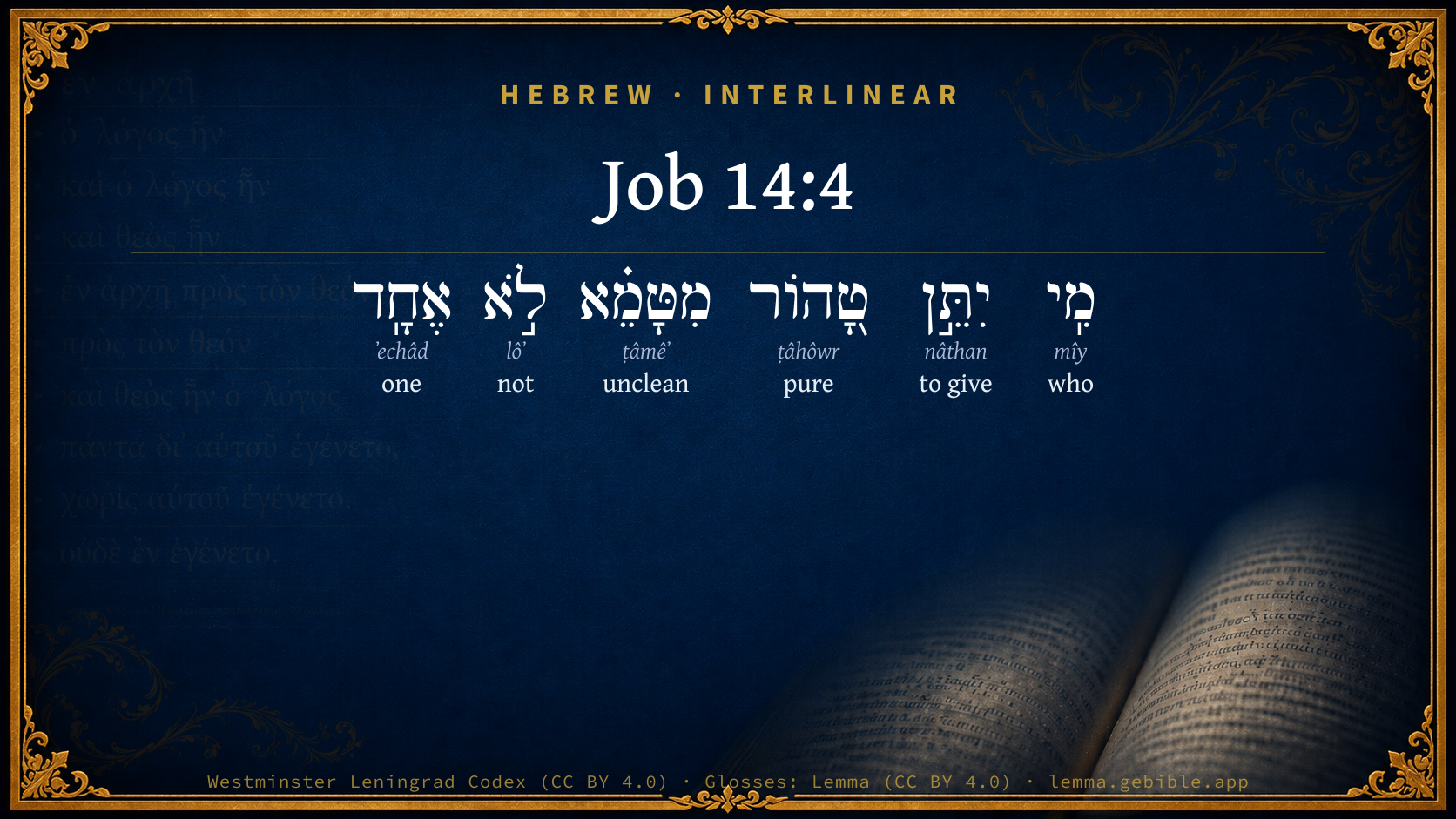
Job 14:4

Hebrew (Westminster Leningrad Codex) Job 14:4 appears in the Hebrew Old Testament. The text above is from the Westminster Leningrad Codex. Each word links to its Strong’s number, a concise gloss, and parsing drawn from the Open Scriptures Hebrew Bible morphology. Click any word for its full Brown-Driver-Briggs (BDB) entry.
Download image
Cite this verse

Job 14:4 (World English Bible). Public Domain. Lemma interlinear Bible study tool, https://lemma.gebible.app/v/job/14/4.

Show BibTeX & RIS
BibTeX
RIS
English Translation
Who can bring a clean thing out of an unclean? Not one.
World English Bible · Public Domain
Download a study sheet

One document with this verse’s original text, its word-by-word gloss line, the meaning frame, cross-references with their text, attributed commentary, and full source and license credits — printable, and it pastes into notes with its structure intact.

This verse Autodidact and up

Study sheet (.html) Plain text (.txt)

A passage Seminary Student

Up to 50 verses in one chapter. A passage sheet keeps up to 6 commentary sources and 12 cross-references per verse, in the order this page ranks them, and says so on the sheet whenever that leaves anything out. Ask for a single verse and you get the Autodidact verse sheet above.

Everything on this page stays free to read, with no account — the sheet is a download of what is already on screen, not access to it.

Want to remove ads? Support Godless Engineer
Compare translations 3

The same verse in 3 English versions, stacked beneath the original-language interlinear above. Click any original word for its lexicon entry.

Each is an independent rendering of the whole verse — the interlinear is not word-aligned to these translations.

Highlighted words mark where these versions differ — a whole-verse word diff, not a word-by-word alignment.

  • World English Bible Public Domain
    Who can bring a clean thing out of an unclean? Not one.
  • King James Version Public Domain
    Who can bring a clean thing out of an unclean? not one.
  • unfoldingWord Literal Text CC BY-SA 4.0
    Who will bring clean from unclean? Not one!

unfoldingWord Literal Text — © unfoldingWord, licensed CC BY-SA 4.0. Word-aligned USFM3 via Door43 (git.door43.org/unfoldingWord/en_ult).

Versions to compare (up to 4)

3 of 4 selected

Show all 18 translations

Every available English version of this verse, each an independent rendering of the whole verse.

  • World English Bible Public Domain
    Who can bring a clean thing out of an unclean? Not one.
  • Berean Standard Bible Public Domain
    Who can bring out clean from unclean? No one!
  • Majority Standard Bible Public Domain
    Who can bring out clean from unclean? No one!
  • King James Version Public Domain
    Who can bring a clean thing out of an unclean? not one.
  • American Standard Version (1901) Public Domain
    Who can bring a clean thing out of an unclean? not one.
  • Revised Version (1885) Public Domain
    Who can bring a clean thing out of an unclean? not one.
  • Geneva Bible (1599) Public Domain
    Who can bring a cleane thing out of filthinesse? there is not one.
  • Douay-Rheims (1899) Public Domain
    Who can make him clean that is conceived of unclean seed? is it not thou who only art?
  • Young's Literal Translation Public Domain
    Who giveth a clean thing out of an unclean? not one.
  • Literal Standard Version CC BY-SA 4.0
    Who gives a clean thing out of an unclean? Not one.
  • Unlocked Literal Bible CC BY-SA 4.0
    Who can bring something clean out of something unclean? No one.
  • unfoldingWord Literal Text CC BY-SA 4.0
    Who will bring clean from unclean? Not one!
  • Darby Bible Public Domain
    Who can bring a clean [man] out of the unclean? Not one!
  • World Messianic Bible Public Domain
    Who can bring a clean thing out of an unclean? Not one.
  • Webster's Bible Public Domain
    Who can bring a clean thing out of an unclean? not one.
  • Free Bible Version CC BY-SA 4.0
    Who can bring something clean of what is unclean? No one.
  • Bible in Basic English Public Domain
    If only a clean thing might come out of an unclean! But it is not possible.
  • JPS Tanakh (1917) Public Domain
    Who can bring a clean thing out of an unclean? not one.

Literal Standard Version (2020), Covenant Press — licensed CC BY-SA 4.0. Text via the HelloAO Bible API (eBible.org). Unlocked Literal Bible (unfoldingWord) — licensed CC BY-SA 4.0. Text via the HelloAO Bible API (eBible.org). unfoldingWord Literal Text — © unfoldingWord, licensed CC BY-SA 4.0. Word-aligned USFM3 via Door43 (git.door43.org/unfoldingWord/en_ult). Free Bible Version, Dr. Jonathan Gallagher — licensed CC BY-SA 4.0. Text via the HelloAO Bible API (eBible.org).

Word by word

More ways to search: Search by grammar → Find every occurrence → Compare this word →

Practice this passage: Drill this verse → Learn its vocabulary →

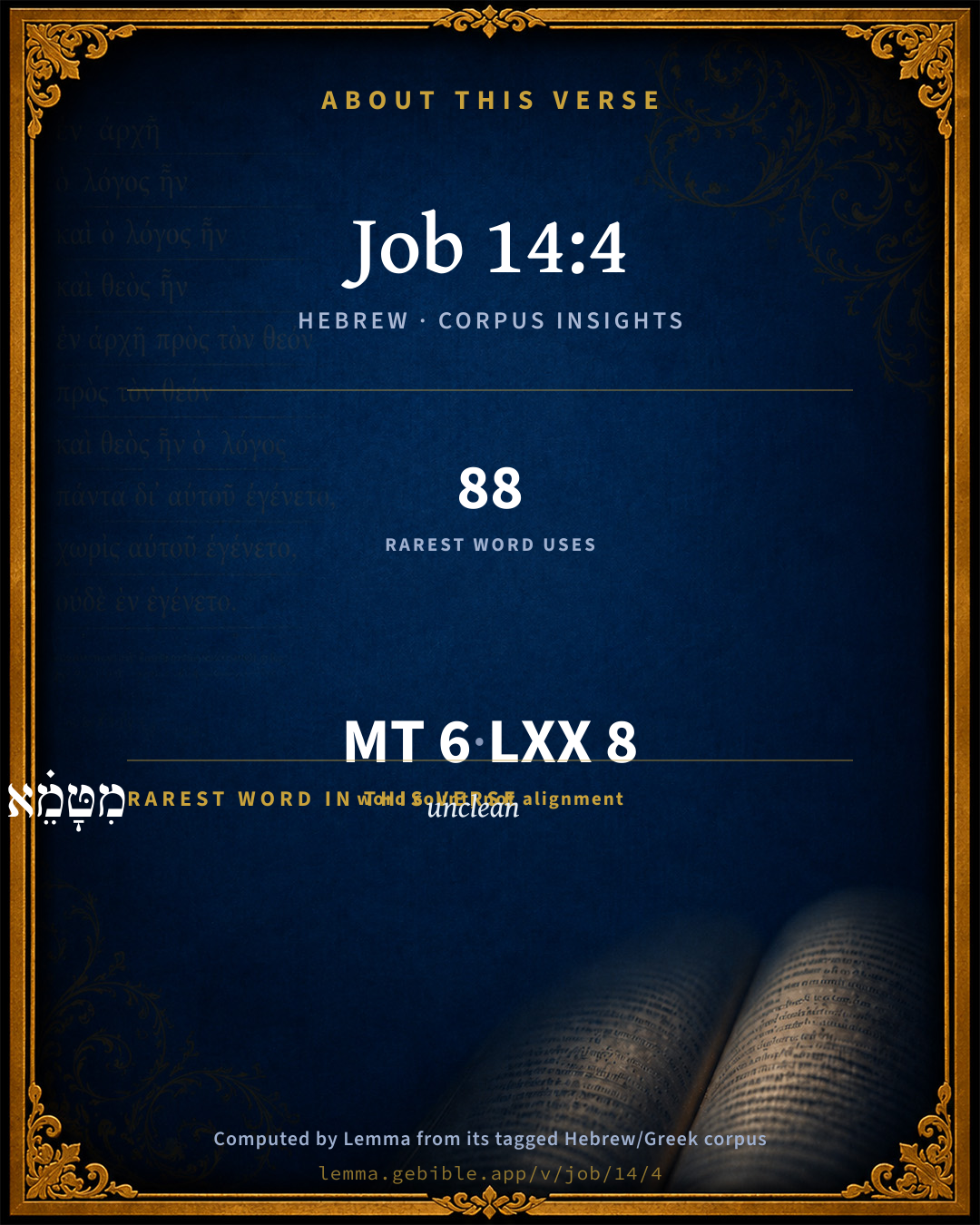
About this verse

These counts appear in no published source. They are computed here, from the morphology-tagged text and Lemma’s own curated glosses. What Lemma adds →

6
words
6
distinct lemmas
Wisdom
section

Grammatical profile

  • 1 verb
  • 3 adjectives
  • 2 particles

Verb forms

  • יִתֵּ֣ן Qal · Imperfect

Hebrew & Septuagint length

In English translation the verse runs 12 words from the Hebrew and 10 from the Septuagint (LXX English) — closely comparable.

A rough comparison of the two English renderings, which tokenize alike — not a word-level alignment.

Word counts can differ between the Hebrew and the Greek without any difference in meaning — e.g. the Hebrew direct-object marker אֵת has no separate Greek word, and Greek often adds the article ὁ.

In the original languages it is 6 Hebrew tokens and 8 Greek tokens — but the two are counted differently (Hebrew bundles its prefixes and suffixes into one token; the Greek is in lemma form), so that isn’t a like-for-like length.

Cross-references

9

Topical passages linked to Job 14:4 in the Treasury of Scripture Knowledge — connected by theme and wording, ordered by reader-vote popularity; previews shown in the World English Bible.

  • John 3:6 That which is born of the flesh is flesh. That which is born of the Spirit is spirit.
  • Job 15:14 What is man, that he should be clean? He who is born of a woman, that he should be righteous?
  • Romans 8:8–9 Those who are in the flesh can't please God.
  • Ephesians 2:3 among whom we also all once lived in the lust of our flesh, doing the desires of the flesh and of the mind, and were by nature children of wrath, even as the rest.
  • Job 25:4–6 How then can man be just with God? Or how can he who is born of a woman be clean?
  • Psalms 51:5 Behold, I was brought forth in iniquity. In sin my mother conceived me.
  • Luke 1:35 The angel answered her, "The Holy Spirit will come on you, and the power of the Most High will overshadow you. Therefore also the holy one who is born from you will be called the Son of God.
  • Romans 5:12 Therefore, as sin entered into the world through one man, and death through sin; and so death passed to all men, because all sinned.
  • Psalms 90:5 You sweep them away as they sleep. In the morning they sprout like new grass.

Cross-references courtesy of OpenBible.info (CC BY 4.0).

Hebrew and Greek witnesses Masoretic Hebrew ↔ Greek Septuagint

The same verse in the two great witnesses to the Old Testament, shown verse-for-verse.

These are two independent witnesses, not word-aligned to each other, and the Septuagint is shown in lemma (dictionary) form.

Hebrew Job 14:4 Masoretic · Westminster Leningrad Codex

מִֽי יִתֵּ֣ן טָ֭הוֹר מִטָּמֵ֗א לֹ֣א אֶחָֽד

Who can bring a clean thing out of an unclean? Not one.

World English Bible · Public Domain

Greek LXX Job 14:4 Septuagint · lemma form

τίς γάρ καθαρός εἰμί ἀπό ῥύπος ἀλλά οὐδείς

For who shall be pure from uncleanness? not even one;

LXX2012 (modern English Septuagint) · Public Domain

On this verse, Keil & Delitzsch discusses the Septuagint’s reading. Read the note in Commentary ↓

Hebrew: Westminster Leningrad Codex (CC BY 4.0). Greek: Septuagint (public domain); English from LXX2012 (modern English Septuagint) (Public Domain). How the Septuagint differs from the Hebrew →

Commentary

Notes on Job 14:4 from classic Christian and Jewish commentators (each source and its license shown beneath its notes). The classic Christian expositions comment on the surrounding passage and are grouped to its opening verse, so a note may address several verses; the Jewish commentaries on the Tanakh (Rashi and others) are per-verse, so they appear only where the commentator wrote on this verse.

Lemma curates 59 commentaries, every one of them public domain or Creative Commons licensed, each selected and text-cleaned for this edition rather than reprinted as found. About our sources →

Trapp's Complete Commentary

John Trapp

Job 14:4 Who can bring a clean [thing] out of an unclean? not one.

Ver. 4. Who can bring a clean thing out of an unclean? not one] q. d. I confess I am unclean; but what can I do withal? or how can I do otherwise, since I do but my kind? But was this a sufficient plea? David was of another mind when he alleged this as a great aggravation of his bloodguiltiness, "Behold, I was shapen in iniquity; and in sin did my mother conceive me," Psa 51:5 : q.d. I have not only fallen into these foul sins, but I have done it out of the venomousness and vitiosity of my nature, commonly called original, and by the apostle inhabiting sin, Rom 7:17, as by the schools peccatum peccans, the sinning sin, as that which is the source and seminary of all actual disobedience. And because this uncleanness is natural to us, therefore it maketh us as loathsome to God as a toad is to us, because poison is in the nature of it. Papists say (but not truly) that original sin is the smallest of all sins, not deserving any more of God’s wrath than only a want of his blessed presence; and that too without any pain or sorrow of mind from the apprehension of so great a loss. They hold also those motions of the heart not consented to be no sins, but necessary conditions, arising from our constitution, and such as Adam had in his innocence. Contrariwise, Job here grants a birthblot upon all, and lays his hand upon it as the cause of the length of men’s troubles and shortness of their lives; only he forgetteth himself (saith Mercer here) when he pleadeth that he should rather be pitied than thus sharply punished, because he was naturally inclined to sin, and cannot avoid it. For as Aristotle saith of drunkards, that they deserve double punishments, διπλα τα τπιτιμια (Ethic. lib. 3, cap. 5); first, for their drunkenness, and then for the sin committed in and by their drunkenness: so do all men deserve double damnation; first, for the corruption of nature (signified by those legal pollutions, by bodily issues), and then for the cursed effects of it, Gen 6:5 Rom 7:8. But it may be Job here had an eye to that promise made to Noah after the flood, Gen 8:21, where the Lord moveth himself to mercy by consideration of man’s native corruption, even from his childhood, for he knoweth our frame, &c., Psa 103:14, that is (as the Chaldee paraphrast explaineth it), he knoweth our evil figment or thought which impelleth to sin; he knoweth it, and weigheth it. See the like Isa 48:8-9. We may beseech the Lord to spare us when we act in sin, because our natures are sinful; but let not any go about either to palliate or extenuate their acts of sin by the sinfulness of their natures; as those do, who, being told of their evil pranks and practices, plead for them, saying, We are flesh and blood, &c.

Not one] Fortes creantur fortibus et bonis; but no mere man can bring forth a clean child out of unclean seed. Adam begat a son after his own image, Gen 5:3. Corruptus corruptum, that which is of the flesh, Joh 3:3-8. Sin is propagated, and proceedeth from the union of body and soul into one man. That phrase, warmed in sin, Psa 51:5, is meant of the preparation of the body, as an instrument of evil, which is not so actually till the soul come. But we should not be so inquisitive how sin came in, as how to be rid of it; like as when a fire is kindled in a city, all men are more careful to quench it than to question where and how it began. Now there is one only way of ridding our hearts of sin, viz. to run to Christ, and to believe in him; "For if the Son make you free, ye shall be free indeed"; and hereunto, both the Chaldee paraphrast had respect, likely, when he rendered this text, Cannot one? that is, cannot God? as also the Vulgate Latin, Nonne tu qui solus es? Canst not thou alone? sc. by thy merit and Spirit, according to that of the apostle, 1Co 6:11.

John Trapp, A Commentary or Exposition upon All the Books of the Old and New Testament (1647–1656) — public domain. Text from a community e-Sword module.

Joseph Benson's Commentary

Job 14:4. Who can bring a clean thing out of an unclean? — I confess I am an unclean creature, and therefore liable to be abhorred by thy holiness, and condemned by thy justice, if thou wilt deal rigorously with me. But, remember, this is not my peculiar case, but the common lot of every man, who descended from sinful parents, and, being infected with original corruption, must unavoidably be unclean. Why, then, dost thou inflict such peculiar and extraordinary judgments upon me for that which is common to all men? And although my natural corruption do not excuse my actual sins, yet I hope it may procure some mitigation of my punishment, and move thy divine pity to deal less severely with me. Observe, reader, clean children can no more come from unclean parents, nor clean performances from an unclean principle, than pure streams can proceed from an impure spring, or grapes from thorns. Our habitual corruption is derived, with our nature, from our progenitors, and is therefore bred in the bone: and our blood is not only attainted by a legal conviction, but tainted with an hereditary disease. And hence flow all actual transgressions, which are the natural product of habitual corruption. This holy Job here laments, as all that are sanctified do, tracing the streams up to the fountain. The Chaldee paraphrase reads this verse, Who can make a man clean that is polluted with sin? Cannot one? that is, God: or, who but God, who is one, and will spare him? God can change the skin of the Ethiopian, and to him we ought to direct our prayer, saying, It is the prerogative of thy grace to bring a clean thing out of an unclean, and that grace I humbly implore.

Joseph Benson's Commentary on the Old and New Testaments (1811–1818) — public domain. Text from a community e-Sword module.

Keil & Delitzsch

C. F. Keil & F. Delitzsch

4 Would that a pure one could come from an impure!

Not a single one - -

5 His days then are determined,

The number of his months is known to Thee,

Thou hast appointed bounds for him that he may not pass over:

6 Look away from him then, and let him rest,

Until he shall accomplish as a hireling his day.

Would that perfect sinlessness were possible to man; but since (to use a New Testament expression) that which is born of the flesh is flesh, there is not a single one pure. The optative מי־יתּן seems to be used here with an acc. of the object, according to its literal meaning, quis det s. afferat, as Job 31:31; Deu 28:67; Psa 14:7. Ewald remarks (and refers to 358, b, of his Grammar) that לא, Job 14:4, must be the same as לוּ; but although in Sa1 20:14; Sa2 13:26; Kg2 5:17, לא might be equivalent to the optative לו, which is questionable, still אחד לא here, as an echo of אין גם־אחד, Psa 14:3, is Job's own answer to his wish, that cannot be fulfilled: not one, i.e., is in existence. Like the friends, he acknowledges an hereditary proneness to sin; but this proneness to sin affords him no satisfactory explanation of so unmerciful a visitation of punishment as his seems to him to be. It appears to him that man must the rather be an object of divine forbearance and compassion, since absolute purity is impossible to him. If, as is really the case, man's days are חרוּצים, cut off, i.e., ἀποτόμως, determined (distinct from חרוצים with an unchangeable Kametz: sharp, i.e., quick, eager, diligent), - if the number of his months is with God, i.e., known by God, because fixed beforehand by Him, - if He has set fixed bounds (Keri חקּיו) for him, and he cannot go beyond them, may God then look away from him, i.e., turn from him His strict watch (מן שׁעה, as Job 7:19; מן שׁית, Job 10:20), that he may have rest (יחדּל, cesset), so that he may at least as a hireling enjoy his day. Thus ירצה is interpreted by all modern expositors, and most of them consider the object or reason of his rejoicing to be the rest of evening when his work is done, and thereby miss the meaning.

Hahn appropriately says, "He desires that God would grant man the comparative rest of the hireling, who must toil in sorrow and eat his bread in the sweat of his brow, but still is free from any special suffering, by not laying extraordinary affliction on him in addition to the common infirmities beneath which he sighs. Since the context treats of freedom from special suffering in life, not of the hope of being set free from it, comp. Job 13:25-27; Job 14:3, the explanation of Umbreit, Ew., Hirz., and others, is to be entirely rejected, viz., that God would at least permit man the rest of a hireling, who, though he be vexed with heavy toil, cheerfully reconciles himself to it in prospect of the reward he hopes to obtain at evening time. Job does not claim for man the toil which the hireling gladly undergoes in expectation of complete rest, but the toil of the hireling, which seems to him to be rest in comparison with the possibility of having still greater toil to undergo." Such is the true connection.

(Note: In honour of our departed friend, whose Commentary on Job abounds in observations manifesting a delicate appreciation of the writer's purpose and thought, we have quoted his own words.)

Man's life - this life which is as a hand-breadth (Psa 39:6), and in Job 7:1. is compared to a hireling's day, which is sorrowful enough - is not to be overburdened with still more and extraordinary suffering.

It must be asked, however, whether ריה seq. acc. here signifies εὐδοκεῖν (τὸν βίον, lxx), or not rather persolvere; for it is undeniable that it has this meaning in Lev 26:34 (vid., however Keil [Pent., en loc.]) and elsewhere (prop. to satisfy, remove, discharge what is due). The Hiphil is used in this sense in post-biblical Hebrew, and most Jewish expositors explain ירצה by ישלים. If it signifies to enjoy, עד ought to be interpreted: that (he at least may, like as a hireling, enjoy his day). But this signification of עד (ut in the final sense) is strange, and the signification dum (Job 1:18; Job 8:21) or adeo ut (Isa 47:7) is not, however, suitable, if ירצה is to be explained in the sense of persolvere, and therefore translate donec persolvat (persolverit). We have translated "until he accomplish," and wish "accomplish" to be understood in the sense of "making complete," as Col 1:24, Luther ("vollzhlig machen") = ἀνταναπληροῦν.

Keil & Delitzsch — Biblical Commentary on the Old Testament (1861–1891) — public domain (CC PDM 1.0). Text via the HelloAO Bible API. (Old Testament only.)

Jamieson, Fausset & Brown

Robert Jamieson, A. R. Fausset & David Brown

A plea in mitigation. The doctrine of original sin was held from the first. "Man is unclean from his birth, how then can God expect perfect cleanness from such a one and deal so severely with me?"

Jamieson, Fausset & Brown — Commentary Critical and Explanatory on the Whole Bible (1871) — public domain (CC PDM 1.0). Text via the HelloAO Bible API.

Adam Clarke's Commentary

Verse 4. Who can bring a clean thing] This verse is thus rendered by the Chaldee: "Who will produce a clean thing from man, who is polluted with sins, except God, who is one?" By Coverdale thus: Who can make it cleane, that commeth of an uncleane thinge? No body.

The text refers to man's original and corrupt nature. Every man that is born into the world comes into it in a corrupt or sinful state. This is called original sin; and is derived from fallen Adam, who is the stock, to the utmost ramifications of the human family. Not one human spirit is born into the world without this corruption of nature. All are impure and unholy; and from this principle of depravity all transgression is produced; and from this corruption of nature God alone can save.

The Septuagint, in the Codex Alexandrinus, reads the verse thus: Τις γαρ εσται καθαρο· απο ῥυπου; ουδε εἱς, εαν και μιας ἡμερας γενηται ὁ βιος αυτου επι της γης; "Who is pure from corruption? Not one, although he had lived but one day upon the earth."

Adam Clarke's Commentary on the Bible (1810–1826) — public domain. Text from a community e-Sword/MySword module.

Ellicott's Commentary for English Readers

(4) Who can bring a clean thing . . .—How can man be clean that is born of woman, who is unclean? This question is reiterated by Bildad (Job_25:4). We ought perhaps, however, rather to render “Oh, that the clean could come forth from the unclean! but none can.”

A Bible Commentary for English Readers, edited by Charles John Ellicott (1878–1897) — public domain. Text from a community e-Sword module.

The Cambridge Bible for Schools and Colleges

gen. ed. J. J. S. Perowne

4. The question of astonishment in Job_14:3 supported by reference to the universal sinfulness of man. The verse reads,

Oh that a clean might come out of an unclean!

There is not one.

The phrase who will give (as margin) is a mere optative expression. Job throws his idea of the universal uncleanness of man, and that there is not one without sin, into the form of a wish that it were otherwise. If the race of men were not universally infected with sin, which each individual inherits by belonging to the race, God’s stringent treatment of the individuals would not be so hard to understand. For similar ideas of the universality of the sinfulness of mankind cf. Gen_6:5; Isa_6:5; Psa_51:5, also the words of Eliphaz ch. Job_4:17 seq. Job urges the admitted fact as a plea for forbearance on the side of God.

The Cambridge Bible for Schools and Colleges (gen. ed. J. J. S. Perowne; Cambridge University Press, 1878–1918) — public domain. Text from a community e-Sword module.

John Gill's Exposition

Who can bring a clean thing out of an clean?.... Either produce a clean person from an unclean one: it is not to be expected that one, perfectly free from sin, should be generated by, or brought out of, one that is defiled with it; which is the case of all men; the first man, though made upright, sinned, and by sinning defiled himself, and all human nature in him: and so those that immediately descended from him were polluted likewise, and so on in all generations, every man being conceived and shaped in iniquity; so that it is not possible that man that is born of a woman, sinful and unclean, should be clean himself, or be free from sin; by which it is manifest, that the sinfulness of human nature is unavoidable; it is natural and necessary, and cannot be otherwise, such being the case and circumstances of immediate parents, from whom men descend; and that this is the case of all men that come into the world by ordinary and natural generation; there is none righteous or pure from sin: no,

not one; and things being so, Job thought it hard that he should be singled out, and so severely chastised, when the sinfulness of nature was from and by his birth, and was natural and unavoidable, and when there was not a single person on earth free from it. There never was but one instance of one clean being brought out of an unclean person, and that was our Lord Jesus Christ of the Virgin Mary; which was not in the ordinary way of generation, but by a supernatural and extraordinary production of his human nature, through the power of the Holy Ghost, whereby it escaped the original contagion and pollution of mankind: or else, in consequence of this, the sense is, who can bring forth or produce a good work from an impure person? or how can it be expected that a man that is defiled with sin should do a good work perfectly pure? for there is not even a just and good man that doth good and sinneth not; and much less is it to be looked for, that men in a mere state of nature, that are as they come into the world, sinful and impure, should ever be able to perform good works; it may as well be thought that grapes are to be gathered of thorns, or figs of thistles; men must be born again, created in Christ Jesus, have faith in him, and the Spirit of God in them, before they can do that which is truly good from right principles, and with right views; and man at most and best must be an imperfect creature, and deficient in his duty, and cannot bear to be strictly examined, and rigorously prosecuted: or the meaning is, "who can make" (g) an unclean man a clean one? "no, not one"; a man cannot make himself clean by anything he can do, by his repentance and humiliation, by his good works, duties, and services; none can do this but God; and to this sense some render the words, "who can--is there one" (h)? there is, that is, God, he can do it, and he only: though men are exhorted to cleanse themselves, this does not suppose a power in them to do it; this is only designed to convince them of the necessity of being cleansed, and to awaken a concern for it; and such as are made sensible thereof will apply to God to purge them, and make them clean, and create a clean heart within them: and this God has promised to do, and does do; he sprinkles the clean water of his grace, and purifies the heart by faith in the blood of Jesus, which cleanses from all sin, and is the fountain opened to wash in for sin and uncleanness; the Targum is,

"who can give a clean thing out of a man that is defiled with sins, except God who is one, and can forgive him?''

none can pardon sin but God, or justify a sinner besides him; and he can do both in a way of justice, upon the foot of the blood and righteousness of Christ.

(g) "quis potest facere?" V. L. "dabit", i.e. "faciet", Vatablus; "sistet aut efficiet", Michaelis; "quis efficiet?" Cocceius. (h) "nonne tu qui solus est?" V. L. "annon unus?" sc. Mediator, Cocceius.

John Gill's Exposition of the Whole Bible (1746–1763) — public domain (CC PDM 1.0). Text via the HelloAO Bible API.

Albert Barnes' Notes on the Bible

Who can bring a clean - thing “out of an unclean?” This is evidently a proverb or an adage; but its connection here is not very apparent. Probably, however, it is designed as a plea of mitigation for his conscious frailties and infirmities. He could not but admit that he had faults. But he asks, how could it be expected to be otherwise? He belonged to a race that was sinful and depraved. Connected with such a race, how could it be otherwise than that he should be prone to evil? Why then did God follow him with so much severity, and hold him with a grasp so close and so unrelenting? Why did he treat him as if he ought to be expected to be perfectly pure, or as if it were reasonable to suppose he would be otherwise than unholy? This passage is of great value as showing the early opinion of the world in regard to the native character of man. The sentiment was undoubtedly common - so common as to have passed into a proverb - that man was a sinner; and that it could not be expected that anyone of the race should be pure and holy.

The sentiment is as true as it is obvious - like will beget like all over the world. The nature of the lion, the tiger, the hyaena, the serpent is propagated, and so the same thing is true of man. It is a great law, that the offspring will resemble the parentage; and as the offspring of the lion is not a lamb but a young lion; of a wolf is not a kid but a young wolf, so the offspring of man is not an angel, but is a man with the same nature, the same moral character, the same proneness to evil with the parent. The Chaldee renders this: “Who will give one pure from a man polluted in sin, except God, who is one, and who forgiveth him?” But this is manifestly a departure from the sense of the passage. Jerome, however, has adopted nearly the same translation. As a historical record, this passage proves that the doctrine of original sin was early held in the world. Still it is true that the same great law prevails, that the off-spring of woman is a sinner - no matter where he may be born, or in what circumstances he may be placed. No art, no philosophy, no system of religion can prevent the operation of this great law under which we live, and by which we die; compare the notes at Rom 5:19.

Albert Barnes' Notes on the Bible (1834–1885) — public domain. Text from a community e-Sword/MySword module.

Haydock's Catholic Bible Commentary

Seed, is not expressed in Hebrew, "unclean." It may refer to Adam. There is no contagion in the seed to infect the soul, as Tertullian supposed; it in only unclean in the cause, as every person who is born according to the common course of nature, becomes a child of Adam, and partakes in his original sin. (The Scholastics) (Tirinus) --- Only art. Essence itself. (Denis the Carthusian) --- "The justification of the sinner is a greater miracle than the creation of the world." (St. Augustine, ibid.) --- The birth of Jesus Christ was free from stain; (Luke i. 35.) as was also the conception of his virgin Mother [Mary], by the power of God; (Menochius) and his grace, as it is piously believed. (Haydock) --- He alone can purify man. (Calmet) --- Hebrew, "who can produce what is clean out of the unclean? Not one." Or Chaldean, "Is there not one?" Septuagint, "For who shall be pure from corruption? Not so much as one: (5) though his life be only of one day upon earth." The more ancient Fathers have generally quoted the text in this manner, to prove original sin; (Haydock; St. Cyrian; Tertullian, St. Deo. Mag.[St. Leo the Great?] in Nat. i., &c.; Tirinus) and Bellarmine almost does the same, (Grat. iv. 4.) observing that the Septuagint have taken in three words from the following verse: "though his days are few." Yet there are some words which are not in Hebrew, though the doctrine here maintained is indubitable. (Amama) --- Job was fully convinced of it, and adduced it as plea for mercy. It also tends to keep us in the most profound humility and watchfulness, to resist the motions of concupiscence. (Calmet) --- Man, -----"Now too late,

Saw the rash error, which he could not mend;

An error fatal not to him alone,

But to his future sons, his fortune’s heirs." (Blair’s Grave. Milton, x. 151.) (Haydock)

George Leo Haydock (1774–1849), Haydock's Catholic Family Bible and Commentary, 1859 edition — public domain. Excludes Psalms (Douay-Rheims chapter numbering differs from Protestant) and Deuterocanonical books (Catholic canon only).

Matthew Poole's English Annotations

I do not say, I am clean, as Zophar pretendeth, Job 11:4; but confess that I am a very unclean creature, and therefore liable to thy justice, if thou wilt deal rigorously with me; but remember that this is not my peculiar case, but the common lot of every man, who, coming from sinful parents, and being infected with original corruption, must unavoidably be unclean. Why then dost thou inflict such peculiar and extraordinary judgments upon me for that which is common to all men? And although my original corruption do not excuse my actual sins, yet I hope it may procure some mitigation to my punishments, and move thy Divine pity, which oft showeth itself upon such occasions. See Gen 8:21.

Not one, i.e. no man can cleanse himself or any other from all sin. See 1Ki 8:46; Psa 14:3; Ecc 7:21. This is the prerogative of thy grace, which therefore I humbly implore of thee.

Matthew Poole's English Annotations on the Holy Bible (1683–1685) — public domain. Text from a community e-Sword/MySword module.

Whedon's Commentary on the Bible

Daniel D. Whedon

4. Who can bring — Literally, who will give. In almost every case in the Old Testament this form of question is idiomatic, and is used (as in Job_14:13) to express a desire. Some would accordingly read, “Could but a clean thing come out of an unclean!” — Schlottmann. The idea would still be, that such a result, however much to be desired, is an impossibility. Not one pure being comes forth. Compare the not one of Psa_14:3. The law of evil is such that a pure nature cannot spring from an impure one. “That which is born of the flesh is flesh.” Hence the intervention of the Holy Ghost was indispensable that one pure being might be born of a woman. Luk_1:35.

Daniel D. Whedon (gen. ed.), Commentary on the Old and New Testaments (1874–1909) — public domain. Text from a community e-Sword module.

The Pulpit Commentary

Who can bring a clean thing out of an unclean? not one. It is scarcely true to say that "the fact of original sin is thus distinctly recognized" ("Speaker"s Commentary," vol. 4. p. 61). Original uncleanness and infirmity are recognized; but the uncleanness is material, and removable by material expiation. (Lev_12:2-8) It is rather man"s weakness than his sinfulness that is here under discussion.

"A clean thing out of an unclean.

Job seems to mean that man cannot transcend his origin. He comes from the frail, imperfect, human stock; how, then, can he be expected to manifest the traits of perfection and immutability? Job"s question and the difficulty it contains may be applied in various ways.

I EVOLUTION. We are not now concerned with the scientific aspect of the question of evolution. That must be determined by the men of science. But there is a religious aspect of it that calls for attention, because some are dismayed as though evolution had banished God from his universe. Now, if this idea of the world is set forth as a substitute for the theological conception of creation and providence, it is removed from its rightful sphere and made to trespass on a foreign domain, where it cannot justify the claims of its supporters. There it is confronted by Job"s question, "Who can bring a clean thing out of an unclean?" Evolution signifies a certain kind of progress. But the cause must be equal to the effect. It is contrary to the very law of causation that dead matter should produce life, and that the merely animal should produce the spiritual human being. For every elevation and addition a corresponding cause is needed. If the unclean ape were the ancestor of a saint, something must have been added that was not in the ape. Whence was this? It must have had a cause. Thus we may see that evolution requires the idea of the Divine, not only at the primal creation, but throughout the process.

II HEREDITY. Men inherit their parents" characters. The man who is not the heir of any estate is yet perforce an heir of the most real kind of property. Now, the past of our race is stained with sin, steeped in iniquity. It is not to be supposed that the succeeding generations will be spotless. Moral guilt cannot be charged till the individual soul has chosen evil, and consented to sin in its own freedom. But the degradation of evil tendencies is in us from our birth. Men are shapen in iniquity and conceived in sin. (Psa_51:5)

III REDEMPTION. This is offered by God. It cannot come from man. No sinful man could redeem his brethren. To do this would be to bring the clean out of the unclean. We must have a sinless Redeemer. Moreover, as sin has lowered the whole of life, there is need of a perfect Man to raise the type of the race. Even this would not be enough, for the great work is not to set an example, but to transform the world. None but God who created it can do this. Thus we need what we have in Christ a sinless, perfect Man, who is also the only begotten Son of God.

IV REGENERATION.

1. In the individual man. He must first be regenerated. All prior attempts at goodness fail. Really clean words cannot come out of a foul heart. Clean deeds must spring from a clean soul. All the corrupt man"s conduct is besmirched with the filth of his own inner life. He must be pure in heart in order to live a truly pure life. The sinner must have a new heart before he can live a new life.

2. In Christian work. He who would lead others from sin must first forsake sin himself. The reformer must be a reformed man. The missionary must be a Christian. To do good we must first be good. W.F.A.

The Pulpit Commentary (1880–1919), ed. H.D.M. Spence-Jones & Joseph S. Exell — public domain. Text from a community e-Sword module.

John Wesley's Explanatory Notes

Not one - No man. This is the prerogative of thy grace, which therefore I humbly implore.

John Wesley, Explanatory Notes Upon the Whole Bible (1754–1765) — public domain. Text via the GEBible commentary corpus.

unfoldingWord translationNotes

Door43 World Missions Community

General Information:

Job continues speaking to God.

Who can bring something clean out of something unclean? No one

Job uses this question to persuade God to apply what he knows about unclean things to Job. AT: "No one can bring something clean out of something unclean" (See: Rhetorical Question)

Man's days are determined

This can be expressed in active form. AT: "You determine a man's days" or "You decide how long a man lives" (See: Active or Passive)

The number of his months is with you

The number of man's months being with God represents God deciding the number of months that the man will live. "You decide how many months he will live" (See: Metonymy)

you have appointed his limits that he cannot pass

Passing a limit represents living past a time that God has set for a person to die. AT: "you have appointed the time that he will die, and he cannot live longer than that" (See: Metaphor)

hired man

a man who is hired to do a job and goes home afterwards

translationWords

clean

clean

appoint

rest

unfoldingWord translationNotes — © Distant Shores Media and the Door43 World Missions Community, licensed CC BY-SA 4.0. Source: git.door43.org/Door43/en_tn.

Rashi

Rabbi Shlomo Yitzchaki (Rashi)

Who can bring a clean thing from a putrid drop, and semen, which is unclean? Not one of them is clean, that he should not sin.

Rashi on the Tanakh — English translations: “The Judaica Press complete Tanach with Rashi, translated by A. J. Rosenberg” (CC BY 4.0); “Pentateuch with Rashi's commentary by M. Rosenbaum and A.M. Silbermann, 1929-1934” (public domain); “The Metsudah Tanach series, Lakewood, N.J” (CC BY 4.0); and “The Book of Joshua, Metsudah Publications, 1997” (CC BY 4.0). Text via Sefaria.

Lesson kit

Teaching starters — assembled from the data on this page, not authored interpretation. Every prompt links to the verse data it draws on. Edit before teaching.

Job, in the Wisdom, opens this verse with 6 words (6 distinct Hebrew lemmas). Its most distinctive word is ṭâmêʼ (“unclean”). A historical commentator’s framing appears above. Read the whole chapter for the surrounding context.

Discussion questions

  1. The word ṭâmêʼ carries the sense “unclean.” How does it shape the verse?
  2. John 3:6 shares this passage’s theme. How do the two illuminate each other?
  3. These translations render this verse differently. What is at stake in choosing one wording over another?
  4. The verb «יִתֵּ֣ן» is Qal Imperfect. How does its form color the action?
  5. Reading how Trapp's Complete Commentary and Joseph Benson's Commentary read this verse, where do the two commentators agree and where do they part?

Things to notice

Reading settings

Reading text

Shown beneath each verse's original-language words.

Old Testament
Old Testament edition

Read the OT as the Masoretic Hebrew (MT) or the Greek Septuagint (LXX).

English shown for the Greek Septuagint (in the Hebrew ↔ Greek comparison).

Comparing translations? Open the Compare panel on any verse page to stack up to four side by side.