
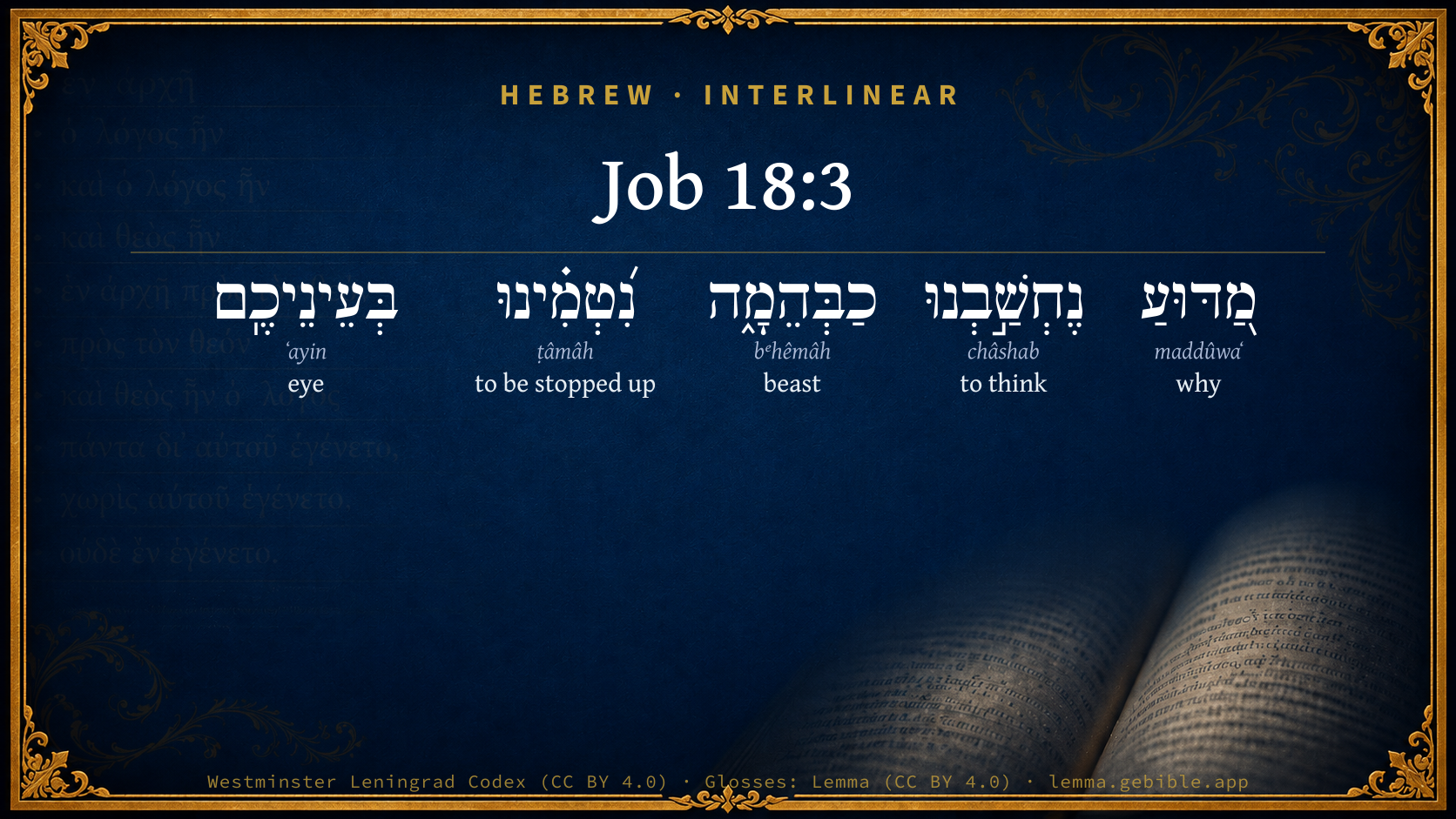
Job 18:3

Hebrew (Westminster Leningrad Codex) Job 18:3 appears in the Hebrew Old Testament. The text above is from the Westminster Leningrad Codex. Each word links to its Strong’s number, a concise gloss, and parsing drawn from the Open Scriptures Hebrew Bible morphology. Click any word for its full Brown-Driver-Briggs (BDB) entry.
Download image
Cite this verse

Job 18:3 (World English Bible). Public Domain. Lemma interlinear Bible study tool, https://lemma.gebible.app/v/job/18/3.

Show BibTeX & RIS
BibTeX
RIS
English Translation
Why are we counted as animals, Which have become unclean in your sight?
World English Bible · Public Domain
Highlights
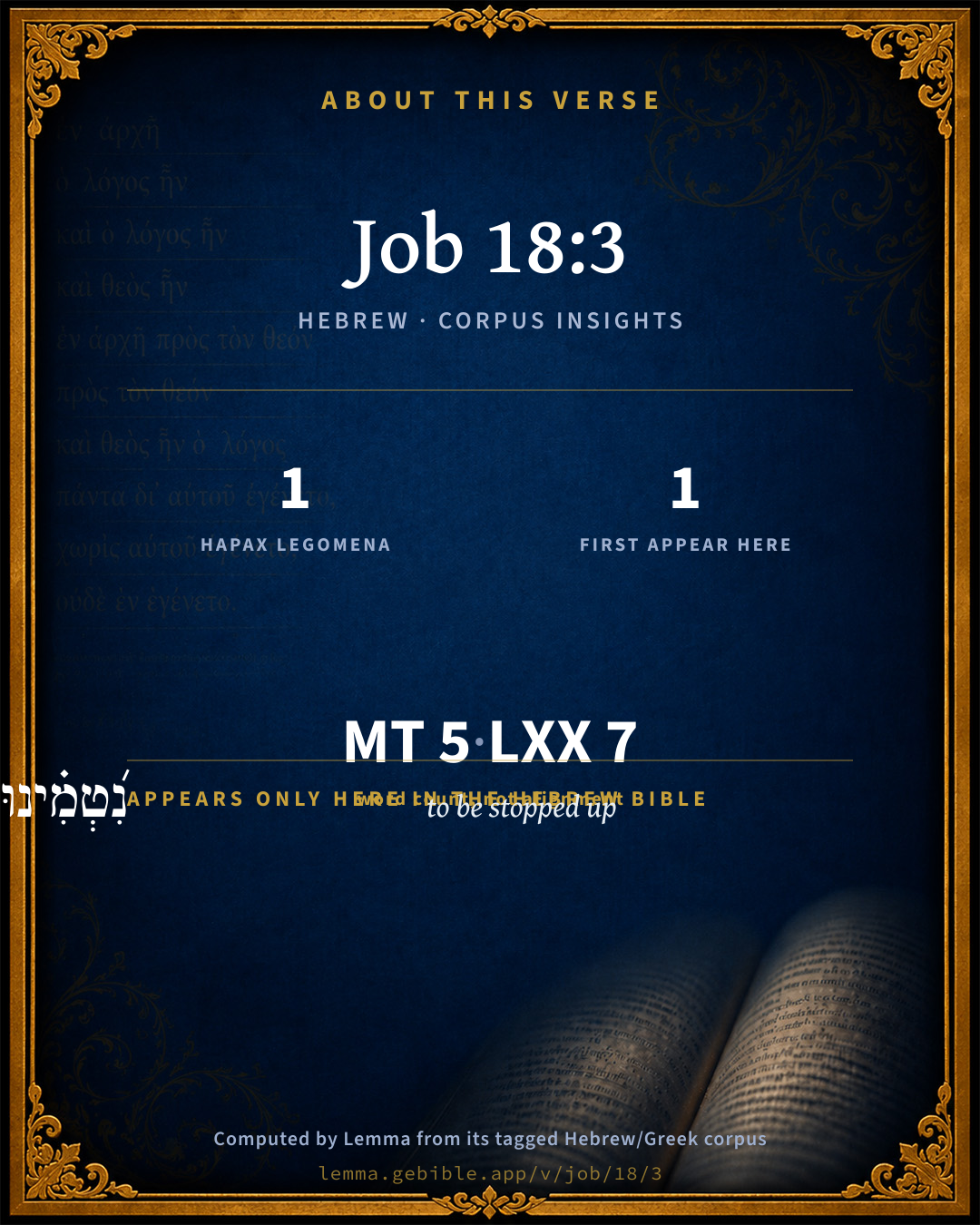
  • 1 hapax legomenon — only here in the Hebrew Bible
  • 1 first appearance in the Hebrew Bible
Full analysis ↓
Download a study sheet

One document with this verse’s original text, its word-by-word gloss line, the meaning frame, cross-references with their text, attributed commentary, and full source and license credits — printable, and it pastes into notes with its structure intact.

This verse Autodidact and up

Study sheet (.html) Plain text (.txt)

A passage Seminary Student

Up to 50 verses in one chapter. A passage sheet keeps up to 6 commentary sources and 12 cross-references per verse, in the order this page ranks them, and says so on the sheet whenever that leaves anything out. Ask for a single verse and you get the Autodidact verse sheet above.

Everything on this page stays free to read, with no account — the sheet is a download of what is already on screen, not access to it.

Want to remove ads? Support Godless Engineer
Compare translations 3

The same verse in 3 English versions, stacked beneath the original-language interlinear above. Click any original word for its lexicon entry.

Each is an independent rendering of the whole verse — the interlinear is not word-aligned to these translations.

Highlighted words mark where these versions differ — a whole-verse word diff, not a word-by-word alignment.

  • World English Bible Public Domain
    Why are we counted as animals, Which have become unclean in your sight?
  • King James Version Public Domain
    Wherefore are we counted as beasts, and reputed vile in your sight?
  • unfoldingWord Literal Text CC BY-SA 4.0
    Why are we regarded as beasts, we are stupid in your eyes?

unfoldingWord Literal Text — © unfoldingWord, licensed CC BY-SA 4.0. Word-aligned USFM3 via Door43 (git.door43.org/unfoldingWord/en_ult).

Versions to compare (up to 4)

3 of 4 selected

Show all 18 translations

Every available English version of this verse, each an independent rendering of the whole verse.

  • World English Bible Public Domain
    Why are we counted as animals, Which have become unclean in your sight?
  • Berean Standard Bible Public Domain
    Why are we regarded as cattle, as stupid in your sight?
  • Majority Standard Bible Public Domain
    Why are we regarded as cattle, as stupid in your sight?
  • King James Version Public Domain
    Wherefore are we counted as beasts, and reputed vile in your sight?
  • American Standard Version (1901) Public Domain
    Wherefore are we counted as beasts, `And' are become unclean in your sight?
  • Revised Version (1885) Public Domain
    Wherefore are we counted as beasts, and are become unclean in your sight?
  • Geneva Bible (1599) Public Domain
    Wherefore are wee counted as beastes, and are vile in your sight?
  • Douay-Rheims (1899) Public Domain
    Why are we reputed as beasts, and counted vile before you?
  • Young's Literal Translation Public Domain
    Wherefore have we been reckoned as cattle? We have been defiled in your eyes!
  • Literal Standard Version CC BY-SA 4.0
    Why have we been reckoned as livestock? We have been defiled in your eyes!
  • Unlocked Literal Bible CC BY-SA 4.0
    Why are we regarded as beasts, stupid in your sight?
  • unfoldingWord Literal Text CC BY-SA 4.0
    Why are we regarded as beasts, we are stupid in your eyes?
  • Darby Bible Public Domain
    Wherefore are we counted as beasts, and reputed stupid in your sight?
  • World Messianic Bible Public Domain
    Why are we counted as animals, which have become unclean in your sight?
  • Webster's Bible Public Domain
    Why are we counted as beasts, and reputed vile in your sight?
  • Free Bible Version CC BY-SA 4.0
    Do you think we're dumb animals? Do we look stupid to you?
  • Bible in Basic English Public Domain
    Why do we seem as beasts in your eyes, and as completely without knowledge?
  • JPS Tanakh (1917) Public Domain
    Wherefore are we counted as beasts, and reputed dull in your sight?

Literal Standard Version (2020), Covenant Press — licensed CC BY-SA 4.0. Text via the HelloAO Bible API (eBible.org). Unlocked Literal Bible (unfoldingWord) — licensed CC BY-SA 4.0. Text via the HelloAO Bible API (eBible.org). unfoldingWord Literal Text — © unfoldingWord, licensed CC BY-SA 4.0. Word-aligned USFM3 via Door43 (git.door43.org/unfoldingWord/en_ult). Free Bible Version, Dr. Jonathan Gallagher — licensed CC BY-SA 4.0. Text via the HelloAO Bible API (eBible.org).

Word by word

More ways to search: Search by grammar → Find every occurrence → Compare this word →

Practice this passage: Drill this verse → Learn its vocabulary →

About this verse

These counts appear in no published source. They are computed here, from the morphology-tagged text and Lemma’s own curated glosses. What Lemma adds →

5
words
5
distinct lemmas
Wisdom
section

Notable vocabulary

1 hapax legomenon — a word that appears only here in the entire Hebrew Bible:

  • נִ֝טְמִ֗ינוּ to be stopped up H2933

First appearance in Scripture

This word makes its first canonical appearance in the Hebrew Bible here:

  • נִ֝טְמִ֗ינוּ to be stopped up H2933

Grammatical profile

  • 2 verbs
  • 2 nouns
  • 1 particle

Verb forms

  • נֶחְשַׁ֣בְנוּ Niphal · Perfect
  • נִ֝טְמִ֗ינוּ Niphal · Perfect

Hebrew & Septuagint length

In English translation the verse runs 13 words from the Hebrew and 10 from the Septuagint (LXX English) — closely comparable.

A rough comparison of the two English renderings, which tokenize alike — not a word-level alignment.

Word counts can differ between the Hebrew and the Greek without any difference in meaning — e.g. the Hebrew direct-object marker אֵת has no separate Greek word, and Greek often adds the article ὁ.

In the original languages it is 5 Hebrew tokens and 7 Greek tokens — but the two are counted differently (Hebrew bundles its prefixes and suffixes into one token; the Greek is in lemma form), so that isn’t a like-for-like length.

Cross-references

6

Topical passages linked to Job 18:3 in the Treasury of Scripture Knowledge — connected by theme and wording, ordered by reader-vote popularity; previews shown in the World English Bible.

  • Psalms 73:22 I was so senseless and ignorant. I was a brute beast before you.
  • Job 17:4 For you have hidden their heart from understanding, Therefore shall you not exalt them.
  • Job 17:10 But as for you all, come on now again; I shall not find a wise man among you.
  • Job 12:7–8 "But ask the animals, now, and they shall teach you; The birds of the sky, and they shall tell you.
  • Ecclesiastes 3:18 I said in my heart, "As for the sons of men, God tests them, so that they may see that they themselves are like animals.
  • Romans 12:10 In love of the brothers be tenderly affectionate one to another; in honor preferring one another;

Cross-references courtesy of OpenBible.info (CC BY 4.0).

Hebrew and Greek witnesses Masoretic Hebrew ↔ Greek Septuagint

The same verse in the two great witnesses to the Old Testament, shown verse-for-verse.

These are two independent witnesses, not word-aligned to each other, and the Septuagint is shown in lemma (dictionary) form.

Hebrew Job 18:3 Masoretic · Westminster Leningrad Codex

מַ֭דּוּעַ נֶחְשַׁ֣בְנוּ כַבְּהֵמָ֑ה נִ֝טְמִ֗ינוּ בְּעֵינֵיכֶֽם

Why are we counted as animals, Which have become unclean in your sight?

World English Bible · Public Domain

Greek LXX Job 18:3 Septuagint · lemma form

διά τίς ὥσπερ τετράποδος σιωπάω ἐναντίον σύ

For therefore have we been silent before you like brutes?

LXX2012 (modern English Septuagint) · Public Domain

On this verse, Haydock's Catholic Bible Commentary discusses the Septuagint’s reading. Read the note in Commentary ↓

Hebrew: Westminster Leningrad Codex (CC BY 4.0). Greek: Septuagint (public domain); English from LXX2012 (modern English Septuagint) (Public Domain). How the Septuagint differs from the Hebrew →

Commentary

Notes on Job 18:3 from classic Christian and Jewish commentators (each source and its license shown beneath its notes). The classic Christian expositions comment on the surrounding passage and are grouped to its opening verse, so a note may address several verses; the Jewish commentaries on the Tanakh (Rashi and others) are per-verse, so they appear only where the commentator wrote on this verse.

Lemma curates 59 commentaries, every one of them public domain or Creative Commons licensed, each selected and text-cleaned for this edition rather than reprinted as found. About our sources →

Trapp's Complete Commentary

John Trapp

Job 18:3 Wherefore are we counted as beasts, [and] reputed vile in your sight?

Ver. 3. Wherefore are we counted as beasts, &c.] Here he taxeth Job with pride and arrogance; grounding upon those words of his taken at the worst, Job 12:7; Job 17:4; Job 17:10, and not considering his case, that he was full of pain, which maketh wise men touchy (as oppression maketh them mad, Ecc 7:7), and that they had sorely provoked him by their bitter taunts and scurrilous invectives, which called for so sharp a currycomb. Pessime autem habet hypocrisin, si contemnatur, Hypocrisy loves not to be sighted, saith Brentius here. And Gregory upon this text saith, that in Bildad heretics are set forth, who stomach it much that the faithful take upon them to reprove them, as carried away by error; as if the knowledge of the truth resided in themselves only, and all others had no more understanding than beasts. "This people which know not the law are cursed," say those Pharisees, Joh 7:49. "Ye know nothing at all," saith Caiaphas to his assessors, Joh 11:49. The Gnostics and Illuminates referred to themselves as being the only knowing men. But if Bildad had been right, he would neither have so far misconstrued Job’s words nor yet have been behind to fool himself, as Asaph in a similar case did, Psa 73:22, where he useth the plural of the words here used in the singular, calling himself, Behemoth, id est, magnam et crassam bestiam, a great and a gross beast.

And reputed vile in your sight?] Heb. Polluted or unclean; that is, as beasts unfit for food, much less fit for sacrifice. The same Hebrew word signifieth polluted and vile. Every wicked man is a vile man, be he never so high and honourable in the world’s account, as Antiochus, Dan 11:21; is called a vile person, and yet he was the great king of Syria, surnamed Epiphanes, or illustrious, and by the flattering Samaritans he was styled, Antiochus, the mighty God. See Psa 15:4.

John Trapp, A Commentary or Exposition upon All the Books of the Old and New Testament (1647–1656) — public domain. Text from a community e-Sword module.

Joseph Benson's Commentary

Job 18:3-4. Wherefore are we counted as beasts? — That is, ignorant and stupid men, Job 17:4; Job 17:10; and reputed vile in your sight — Hebrew, נשׂמנו, nitmeinu, polluted or unclean; that is, not fit to be conversed with, or contemptible, as such things are. He teareth himself in his anger —

That is, Job does, as if he had said, O thou that tearest thyself, thou complainest of us for vexing thee with our speeches, when, in truth, thou art thy own greatest tormentor. Shall the earth be forsaken for thee? — Shall God, for thy sake, or to prevent thy complaints and clamours, give over the government of the earth and men and things in it, and suffer all things to fall out by chance and promiscuously, to good and bad men, without any regard to his truth, wisdom, or justice? And shall the rock be removed out of its place? — Shall the counsels of God, which are more firm and immoveable than rocks, and the whole course of his providence, be altered to comply with thy fancies or humours?

Joseph Benson's Commentary on the Old and New Testaments (1811–1818) — public domain. Text from a community e-Sword module.

Jamieson, Fausset & Brown

Robert Jamieson, A. R. Fausset & David Brown

beasts--alluding to what Job said (Job 12:7; so Isa 1:3).

vile--rather from a Hebrew root, "to stop up." "Stubborn," answering to the stupidity implied in the parallel first clause [UMBREIT]. Why should we give occasion by your empty speeches for our being mutually reputed, in the sight of Job and one another, as unintelligent? (Job 17:4, Job 17:10).

Jamieson, Fausset & Brown — Commentary Critical and Explanatory on the Whole Bible (1871) — public domain (CC PDM 1.0). Text via the HelloAO Bible API.

Adam Clarke's Commentary

Verse 3. Counted as beasts] Thou treatest us as if we had neither reason nor understanding.

Adam Clarke's Commentary on the Bible (1810–1826) — public domain. Text from a community e-Sword/MySword module.

Ellicott's Commentary for English Readers

(3) Wherefore are we counted as beasts.—Referring to Job’s words (Job_13:4, &c., Job_16:2, &c.). In this chapter there is a marked increase in his harshness and violence. It has, however, a certain resemblance to Job 8, inasmuch as Bildad works out a simile here, as he did there; and in Job_18:16 the two similes touch. In Job_18:2, which resembles Job_8:2, we must supply, as the Authorised Version does, Will it be ere? or the negative, Will ye not make? &c., or else we must render, “How long [will ye speak thus]? Make an end of words,” &c. The plural is used because Job is regarded as the representative of a class, or else as we use the plural instead of the singular in addressing a person.

A Bible Commentary for English Readers, edited by Charles John Ellicott (1878–1897) — public domain. Text from a community e-Sword module.

The Cambridge Bible for Schools and Colleges

gen. ed. J. J. S. Perowne

3. and reputed vile] lit. and are unclean. Bildad describes what Job’s treatment of his friends suggests to him as Job’s idea of them. The reference is to the passages, ch. Job_17:4; Job_17:10, and the words “clean of hands” ch. Job_17:9, which Job had used of himself and other unjustly persecuted men, cf. Psa_73:22.

The Cambridge Bible for Schools and Colleges (gen. ed. J. J. S. Perowne; Cambridge University Press, 1878–1918) — public domain. Text from a community e-Sword module.

John Gill's Exposition

He teareth himself in his anger,.... Or "his soul" (l), meaning Job, and referring to what he had said in Job 16:9; Now, says Bildad, it is neither God nor man that tears you, it is you yourself; representing Job as a madman, rending his clothes, tearing his flesh, and even his very soul; for by his passion which he expressed, whether to God or his friends, it did himself the most hurt, he broke his peace, and spoiled his comfort, and ruined his health, and made himself the most unhappy of mankind, by giving vent to his passion, to his wrath and anger, which slays and a man, Job 5:2; here a charge of impatience is suggested, contrary to the character even of Job, Jam 5:11;

shall the earth be forsaken for thee? through fear of thee, because of thy rage and fury; dost thou think that the inhabitants of the earth will flee before thee, at thy storming, rage, and wrath? before God none can stand when he is angry: there is no abiding his indignation when his fury is poured out like fire, and persons of the greatest rank will flee to the rocks and mountains to hide them from his face and fury; but what dost thou think, or make thyself to be, to be as Deity, that the inhabitants of the earth should flee fore thee, and forsake it? or when thou diest, dost thou think that all the inhabitants of the earth will die with thee, and so it will be forsaken for thy sake? taking the hint from what Job had said, Job 17:16; or dost thou think thyself a man of so much importance and consequence in the earth that when thou diest there will not be a man left of any worth and notice, that all might as well die with thee? or will God drop the government of the world on thy account? will he no more employ his care and providence in concerning himself in the affairs of the world, but let all things go as they will, and so the earth, as to his providential regards to it, be forsaken for thy sake? will God neither do good to good men, nor punish bad men? which must be the case according to thy doctrine; but will God counteract this method of his providence, he has always taken in the earth, that thou mayest appear not to be an evil man, as might be concluded from thine afflictions, but a good man notwithstanding them?

and shall the rock be removed out of his place? which is not usual, nor can it be done by man; it may be done by God, who touches the mountains, and they smoke, and at whose presence they drop and move, as Sinai did, and as the mountains and hills will flee away at the presence of the Judge of all the earth, when he appears; but no such phenomenon can be expected upon the presence and sight of a man; much less can God himself, who is often called a Rock, and is immovable, unalterable, and unchangeable in his nature, perfections, purposes, and the counsels of his will, be made to act contrary to either of them, Deu 32:4; nor will he do it for the sake of any man; he does all things after the counsel of his own will; he takes a constant course in Providence, in the government of the world, canst thou think that he will go out of his usual way for thy sake, in punishing wicked men, and rewarding good men? you may as soon imagine that a rock will be removed out of its place as the ordinary course of Providence will be altered on thy account; to suppose this is presumption, pride, and arrogance, which is what Bildad means to fasten upon Job.

(l) "animam suam", Pagninus, Montanus, &c.

John Gill's Exposition of the Whole Bible (1746–1763) — public domain (CC PDM 1.0). Text via the HelloAO Bible API.

Albert Barnes' Notes on the Bible

Wherefore are we counted as beasts? - “Why are we treated in your remarks as if we had no sense, and were unworthy of sound argument in reply to what we say?” It is possible that there may be reference here to what Job said Job 12:7 - that even the beasts could give them information about God. But the general idea is, that Job had not treated their views with the attention which they deserved, but had regarded them as unworthy of notice.

And reputed vile - The word used here (טמה ṭâmâh) means to be unclean, or polluted; and the idea is, that Job regarded them as worthless or impious.

Albert Barnes' Notes on the Bible (1834–1885) — public domain. Text from a community e-Sword/MySword module.

Haydock's Catholic Bible Commentary

Reputed. Septuagint, "silent as four-footed animals before thee? (Haydock) without discipline or understanding," chap. xvii. 4. (Menochius)

George Leo Haydock (1774–1849), Haydock's Catholic Family Bible and Commentary, 1859 edition — public domain. Excludes Psalms (Douay-Rheims chapter numbering differs from Protestant) and Deuterocanonical books (Catholic canon only).

Matthew Poole's English Annotations

As beasts, i.e. ignorant, blockish, and stupid men, Job 17:4,10.

Vile, Heb. polluted, or unclean, i.e. not fit to be conversed or discoursed with; or contemptible, as such things are.

In your sight; either,

1. To your faces, or in your own hearing. Or,

2. In thy sight or judgment, O Job; so he speaks of Job in the plural number, as he did Job 18:2.

Matthew Poole's English Annotations on the Holy Bible (1683–1685) — public domain. Text from a community e-Sword/MySword module.

Whedon's Commentary on the Bible

Daniel D. Whedon

3. As beasts — Only by implication, Job_12:7-8; Job_17:4.

Vile — Stupid.

Daniel D. Whedon (gen. ed.), Commentary on the Old and New Testaments (1874–1909) — public domain. Text from a community e-Sword module.

The Pulpit Commentary

Wherefore are we counted as beasts? The allusion is probably Job_16:10, where Job spoke of his "comforters" as "gaping upon him with their mouths." And reputed vile in your sight! or, reckoned unclean. Job had spoken of his "miserable comforters" as "ungodly and wicked", (Job_16:11) without wisdom (Job_17:10) and without understanding. (Job_17:4) But he had not said that they were "unclean." Bildad, therefore, misrepresents him.

The Pulpit Commentary (1880–1919), ed. H.D.M. Spence-Jones & Joseph S. Exell — public domain. Text from a community e-Sword module.

John Wesley's Explanatory Notes

Beasts - Ignorant, and stupid men, chap. xvii, 4, 10.

John Wesley, Explanatory Notes Upon the Whole Bible (1754–1765) — public domain. Text via the GEBible commentary corpus.

unfoldingWord translationNotes

Door43 World Missions Community

General Information:

Bildad continues speaking to Job.

Why are we regarded as beasts, stupid in your sight?

Bildad uses this rhetorical questions to emphasize to Job that he should not consider his friends as animals who cannot think or speak. It can be written as a statement in active form. AT: "We should not be regarded as beasts, as stupid in your sight." or "You should not regard us as beasts or think of us as stupid." (See: Rhetorical Question and Active or Passive)

Why are we

The word "we" probably refers to Bildad and Job's other friends and so is exclusive. (See: Exclusive and Inclusive "We")

regarded

Regarding, looking, is a metonym here for thinking well or badly of someone. (See: Metonymy)

in your sight

Here sight represents judgment or evaluation. AT: "in your judgment" or "in your thinking" (See: Metaphor)

your sight

The word "your" here is plural. Bildad is using sarcasm to tell Job that Job should not think of himself as a great man. AT: "your sight, you who wrongly think you are great" (See: First, Second, or Third Person and Irony)

You who tear at yourself in your anger

Here Bildad is stating that it is because of Job's anger and disobedience that he has been injured, not because of God's anger as Job has previously claimed. The word "tear" here means to "injure." AT: "You who have caused your own injuries because of your anger" (See: Assumed Knowledge and Implicit Information)

should the earth be forsaken for you or should the rocks be removed out of their places?

This rhetorical question suggests that letting Job, whom they consider a guilty man, go free would be like changing the whole world. Bildad uses these huge exaggerations here to emphasize how outrageous he thinks this is. This can be written as a statement. AT: "asking God to let you, a guilty man, go free is as silly as asking for God to forsake the earth for your sake or for God to move the rocks out of their places to please you!" (See: Rhetorical Question and Hyperbole and Generalization)

should the earth be forsaken

This can be stated in active form. AT: "should everyone leave the earth" (See: Active or Passive)

should the rocks be removed out of their places

This can be stated in active form. The word "rocks" here refers to large rocks, such as those in the mountains. AT: "should God remove the rocks from their places" or "should God move mountains around" (See: Active or Passive)

translationWords

beast

anger

earth

forsake

unfoldingWord translationNotes — © Distant Shores Media and the Door43 World Missions Community, licensed CC BY-SA 4.0. Source: git.door43.org/Door43/en_tn.

Rashi

Rabbi Shlomo Yitzchaki (Rashi)

and reputed dull in your sight Heb. נטמינו. We are considered in your eyes as stopped up. The word has no radical besides the “teth” “mem,” like טַמוֹנוּן פְלִשְתָּאֵי, which is the Aramaic translation of סִתְּמוּם פלשתים “the Philistines stopped them up” (Gen. 26:15). Some explain [this] as an expression of hiding (טמינה), but they are in error, because were that the case, the word would require two “nun”s, one for the radical and one for the plural suffix.

Rashi on the Tanakh — English translations: “The Judaica Press complete Tanach with Rashi, translated by A. J. Rosenberg” (CC BY 4.0); “Pentateuch with Rashi's commentary by M. Rosenbaum and A.M. Silbermann, 1929-1934” (public domain); “The Metsudah Tanach series, Lakewood, N.J” (CC BY 4.0); and “The Book of Joshua, Metsudah Publications, 1997” (CC BY 4.0). Text via Sefaria.

Lesson kit

Teaching starters — assembled from the data on this page, not authored interpretation. Every prompt links to the verse data it draws on. Edit before teaching.

Job, in the Wisdom, opens this verse with 5 words (5 distinct Hebrew lemmas). Its most distinctive word is ṭâmâh (“to be stopped up”). A historical commentator’s framing appears above. Read the whole chapter for the surrounding context.

Discussion questions

  1. How does “to be stopped up” (ṭâmâh) shape what this verse is saying?
  2. 1 word here appears nowhere else in the Hebrew Bible. Why might the author reach for such rare wording?
  3. This is the first place “to be stopped up” appears in Scripture (first appears here). What does its debut here establish?
  4. How does Psalms 73:22, which shares this passage’s theme, read alongside this verse?
  5. These translations render this verse differently; the difference is in the English rendering, not the original. What questions does that raise?
  6. «נֶחְשַׁ֣בְנוּ» is a Niphal Perfect verb. How does that grammatical form shape the action described?
  7. Compare how Trapp's Complete Commentary and Joseph Benson's Commentary read this verse. Where do they agree or differ?

Things to notice

Reading settings

Reading text

Shown beneath each verse's original-language words.

Old Testament
Old Testament edition

Read the OT as the Masoretic Hebrew (MT) or the Greek Septuagint (LXX).

English shown for the Greek Septuagint (in the Hebrew ↔ Greek comparison).

Comparing translations? Open the Compare panel on any verse page to stack up to four side by side.