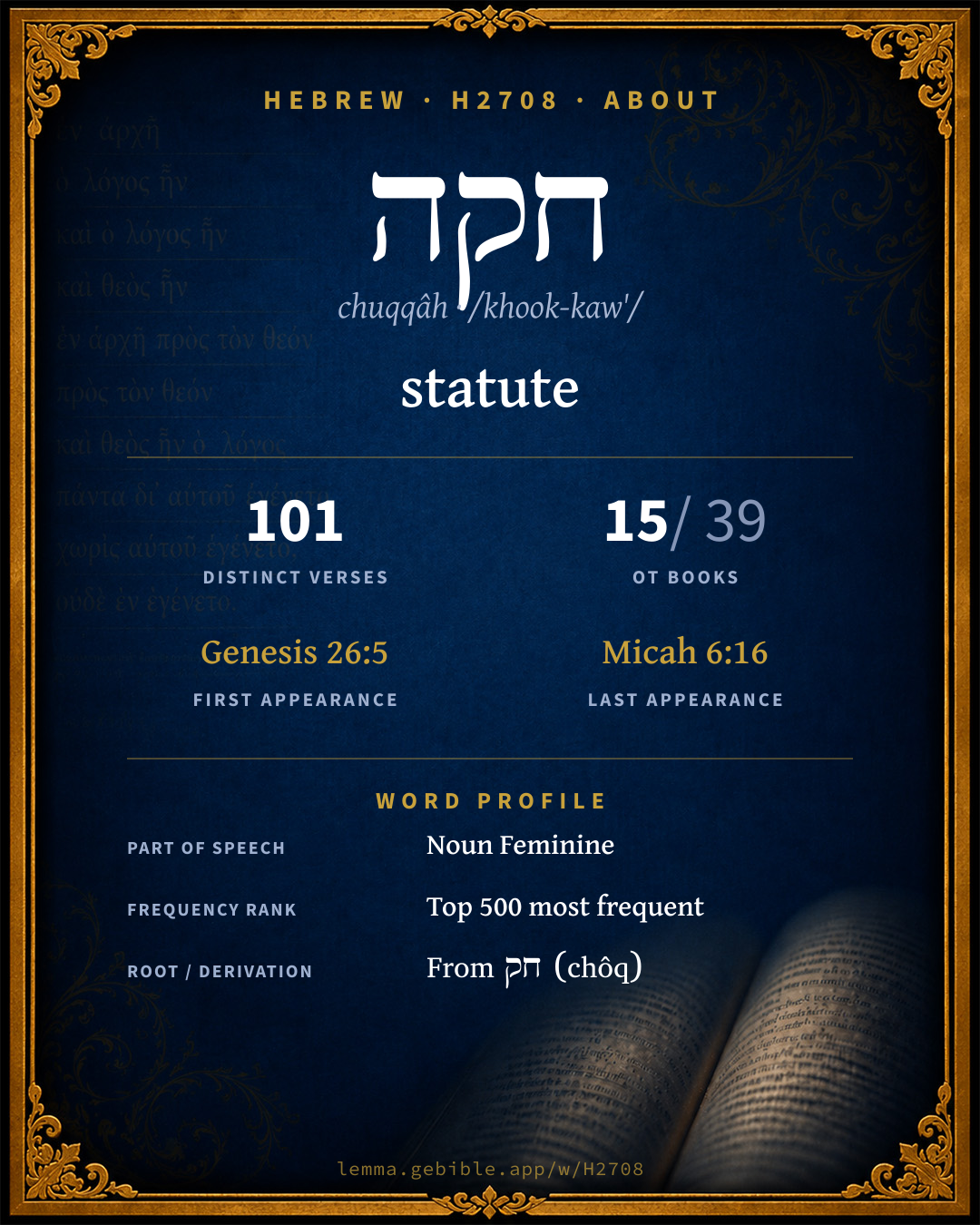
חֻקָּה
statute
also: ordinance, limit, enactment, something prescribed fuller range ↓
Full lexicon entry — Brown-Driver-Briggs (BDB)
From Brown-Driver-Briggs (BDB)
Where this word appears
See every Construct-state word in the Hebrew Bible →
Grammar key — what these labels mean
Part of speech
- Noun
- A naming word — a person, place, thing, or idea.
Noun type
- Common
- A common noun — a general class of person, place, or thing (“king,” “city,” “water”), not a specific name.
State
- Construct
- A noun bound to a following noun in a possessive / “of” relationship (the construct chain).
- Absolute
- The independent form of a noun, not bound to a following word.
Gender
- Both
- Attested as both masculine and feminine.
Number
- Plural
- More than one (in Hebrew, generally three or more).
- Singular
- One.
3 distinct verses where H2708 appears in the Absolute state, across 2 books. Filtered view — show all forms. Click any verse to open its interlinear word-by-word view. Verse text shown in the World English Bible for context — . Each verse’s Hebrew form is shown with its reference; the English is not keyword-highlighted, since the data carries no word-level English alignment. Use “Compare translations” on any verse to read it across multiple English versions. This concordance covers the Hebrew Bible; Septuagint (Greek Old Testament) occurrences are not indexed here.
Exodus 1 verse
Numbers 2 verses
- Numbers 9:14 כְּ/חֻקַּ֥ת חֻקָּ֤ה prep + n c bs cs n c bs If a foreigner lives among you, and desires to keep the Passover to Yahweh; according to the statute of the Passover, and according to its ordinance, so shall he do. You shall have one statute, both for the foreigner, and for him who is born in the land.'"
- Numbers 15:15 חֻקָּ֥ה חֻקַּ֤ת n c bs n c bs cs For the assembly, there shall be one statute for you, and for the stranger who lives as a foreigner [with you], a statute forever throughout your generations: as you are, so shall the foreigner be before Yahweh.
About this entry
At a glance — auto-summarized from this page’s data, not written by a person. Every figure links to its source below. This summary describes the numbers; it doesn’t interpret them.
At its core, חקה (chuqqâh) means “statute.” Scripture first uses it in Genesis 26:5. It appears 101 verses across 15 books of the Hebrew Bible, among its common vocabulary. The word gravitates to Leviticus (26%), then Ezekiel and Numbers. Beyond its headline sense, its full sense range takes in “ordinance”, “limit”, and “enactment”. Each statement above links to its evidence; the full detail follows below.
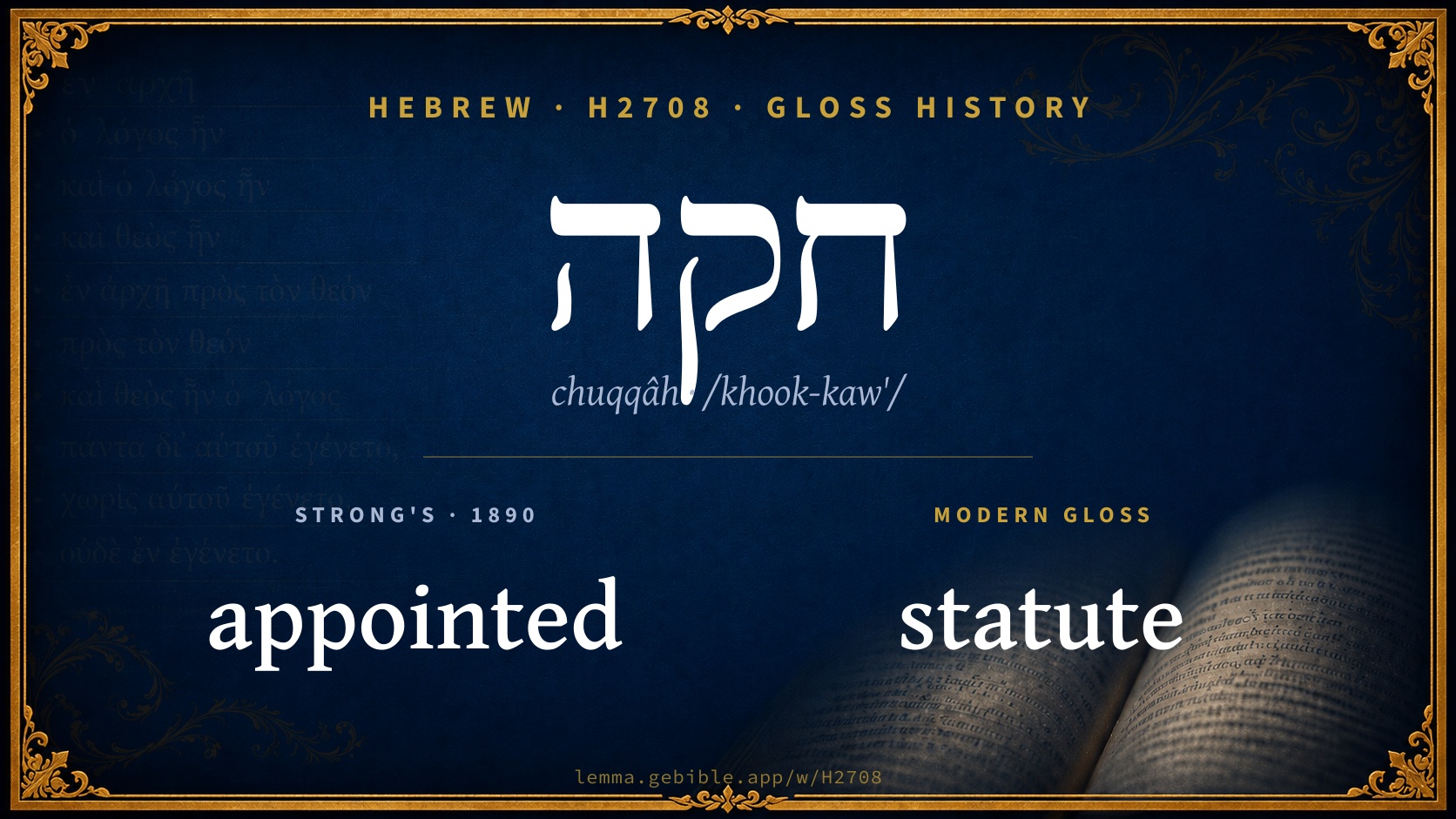
Gloss history
Strong's 1890 vs modern scholarship
About this word
Strong's H2708 catalogs a Hebrew word from the Hebrew Old Testament.
These counts are not copied from any lexicon or concordance. They are computed here, from the morphology-tagged Hebrew Old Testament. What Lemma adds →
- 101
- distinct verses
- The word appears in 101 distinct verses.
- 15 / 39
- OT books
- The word appears in 15 of 39 Old Testament books.
- #408
- by frequency
- Top 500 most frequent Hebrew words (rank 408 of 8,640 Hebrew words by occurrence).
View all 101 occurrences in the concordance →
By section of the Old Testament
By traditional corpus
Conventional, traditional groupings — biblical authorship is debated, so this is a traditional corpus grouping, not an authorship claim. Each share is this word’s portion of its verses in that division of the Hebrew canon. Each figure is a share of the word’s 101 distinct verses.
- Torah (Pentateuch) 54 verses · 53%
- Prophets (Nevi'im) 41 verses · 41%
- Writings (Ketuvim) 6 verses · 6%
How translations render this word
Counts come from each version’s own published word-to-Strong’s tagging or interlinear alignment — an approximate guide to how each version renders this word, not a word-level alignment the data otherwise carries. Because each total is that version’s own tagged count, the per-version totals vary from one another and need not match the appearance or distinct-verse counts above. These counts may also differ from a printed concordance because Lemma counts each distinctly tagged rendering and does not collapse phrase taggings into a single head-word total. This is a fixed set of word-tagged versions (KJV, ASV, BSB, ULT) and does not change with the reading translation you choose elsewhere. Each version’s license is shown beside its name below (and on Sources).
BDB lists this Strong’s number as 2 distinct words (homographs). Each count above pools all of them and is not split by sense — see the Senses section below. A low-frequency rendering may belong to a different one of those words, not the primary meaning.
- King James Version†: Statutes 48×, Shall be a statute 10×, Statute 8×
- American Standard Version†: Statutes 46×, Statute 7×, Shall be a statute 6×
- Berean Standard Bible†: Statutes 60×, Statute 26×, Customs 4×
- unfoldingWord Literal Text†: Statutes 53×, Statute 15×, Statute of 7×
King James Version Public Domain
Renders H2708 across 104† tagged occurrences — most commonly:
Plus 17 renderings that appear only once — usually multi-word phrases or single function words the recovered tagging swept in, not distinct renderings.
American Standard Version Public Domain
Renders H2708 across 104† tagged occurrences — most commonly:
Plus 23 renderings that appear only once — usually multi-word phrases or single function words the recovered tagging swept in, not distinct renderings.
Berean Standard Bible Public Domain
Renders H2708 across 104† tagged occurrences — most commonly:
Plus 9 renderings that appear only once — usually multi-word phrases or single function words the recovered tagging swept in, not distinct renderings.
unfoldingWord Literal Text CC BY-SA 4.0
Renders H2708 across 109† tagged occurrences — most commonly:
Plus 11 renderings that appear only once — usually multi-word phrases or single function words the recovered tagging swept in, not distinct renderings.
7 senses and sub-senses in the full BDB
What do BDB’s symbols mean?
BDB uses these scholarly abbreviations:
| Symbol | Meaning |
|---|---|
| 𝔊 | the Septuagint (the ancient Greek translation, LXX) |
| 𝔙 | the Vulgate (the Latin translation) |
| 𝔖 | the Syriac version (the Peshitta) |
| 𝔗 | the Targum (the Aramaic translation) |
| ψ | the Psalms |
| √ | root (the underlying root or stem) |
| ‖ | parallel passage (a synonymous or contrasted parallel) |
| † | the dagger: every passage where the word occurs is cited |
The 7 senses and sub-senses the full Brown-Driver-Briggs lexicon distinguishes for this word, in lexicon order (not ranked by frequency), with BDB’s own verbatim wording and sub-sense lettering. Shown in Hebrew script with BDB’s own scholarly abbreviations. The condensed entry is in the Lexicon Entry tab. See also the Forms in the corpus table below.
- 1. sg. statute, of special ritual laws: of passover Ex 13:10 (J); elsewhere only in P (and H), חקת הפסח Ex 12:43; Nu 9:12, 14; ח׳ התורה Nu 19:2; 31:21; ח׳ משׁפט Nu 27:11; 35:29; ח׳ עולם Ex 12:14, 17; 27:21; 28:43; 29;9; Lv 3:17; 10:9; 16:29, 31, 34; 23:21, 31; 24:3; Nu 10:8; 15:15; 18:23; 19:10, 21 (all P), Lv 17:7; 23:14, 41 (H); חֻקָּה אַחַת לַגֵּר ולאזרח Nu 9:14; 15:15. e.g. Exodus 13:10
- 2. pl. statutes:
- a. of nature ח׳ שׁמים Jb 38:33; Je 33:25; of moon and stars Je 31:35; of weeks of harvest Je 5:24. e.g. Job 38:33
- b. fig. of a firmly established custom ח׳ עמרי Mi 6:16; ח׳ הגוי(ם) Lv 20:23 (H); 2 K 17:8; ח׳ העמים Je 10:3; idolatry ח׳ ישׂראל 2 K 17:19; sexual offences Lv 18:30 (H). e.g. Micah 6:16
- c. ח׳ דוד statutes of David 1 K 3:3. e.g. 1 Kings 3:3
- d. ‖ משׁפטים 2 S 22:23 = ψ 18:23 (of the law known to David); ‖ מצות ψ 89:32; ברית וח׳ 1 K 11:11; elsewhere of the prescriptions of the codes of D, H, P, Ez: usually חקות ומשׁפטים Lv 18:5, 26; 19:37; 20:22 (H), 25:18; Nu 9:3 (P), 1 K 11:33 Ez 5:7; 11:20; 18:9; 20:11, 13, 19, 21; preceded by מצות Dt 30:16; followed by מצות Lv 26:15 (H), Dt 11:1; 1 K 6:12; תורה ומצוה 2 K 17:34; or else משׁפטים וחקות Lv 18:4; 26:43 (H), Ez 5:6(×2); 18:17; 20:16, 24; 37:24; preceded by מצות Dt 8:11; in diff. order, ח׳ מצות ומ׳ ועדות 1 K 2:3; frequently also ח׳ ומצות Lv 26:3 (H), Dt 6:2; 1 K 11:38; 2 Ch 7:19; or מצות (ו)ח׳ Dt 10:13; 28:15, 45; 30:10; 1 K 9:6; 11:34; Ez 43:11 (Co), 2 K 17:13; foll. by תורות Gn 26:5 (R); מצות ועדות וח׳ 2 K 23:3; תורה וח׳ Je 44:10; ותורה וח׳ ועדות 44:23; ח׳ ותורות Ez 44:5; 43:11 (Co); תורות יח׳ 44:24; special ordinances are ח׳ המזבח Ez 43:18; ח׳ בית י׳ Ez 44:5; ח׳ חיים Ez 33:15 (which are life to those who keep them); ח׳ עולם תמיד (𝔊 𝔖 𝔙 Talm Co del. עולם) Ez 46:14. e.g. 2 Samuel 22:23
- e. phrases of obedience are הלך ב׳ Lv 18:3; 20:23; 26:3 (H), 1 K 3:3; 6:12; 2 K 17:8, 19; Je 44:10, 23; Ez 5:6, 7; 11:20; 18:9, 17; 20:13, 16, 19, 21; 33:15; שׁמר Lv 18:4, 5, 26; 19:19, 37; 20:8, 22 (H), Gn 26:5 (R), Dt 6:2; 8:11; 10:13; 11:1; 28:45; 30:10, 16; 1 K 2:3; 9:6; 11:11, 34, 38; 2 K 17:13; 23:3; Ez 18:19, 21; 37:24; 43:11; 44:24; עשׂה Lv 25:18 (P), Dt 28:15; 1 K 11:33; עשׂה כח׳ 2 K 17:34; בח׳ אֶשְׁתַּעֲשָׁ֑ע ψ 119:16; phrases of disobedience are מאס ח׳ Ez 20:24 מאס בח׳ Lv 26:15 (H); געל Lv 26:43 (H); עזב 2 Ch 7:19; חלל ψ 89:32.—[חֹק and חֻקָּה differ somewhat in shade of meaning and frequency in various writings: e.g. חֹק oftener in Jb ψ Pr (חֻקָּה not at all Pr, once Jb), and in Chr (חֻקָּה only 2 Ch 7:19); חֻקָּה often in K, rarely in Hex. except in P (H); in proph., חֹק occurs Am 2:4; Is 5:14; 24:5; Mi 7:11; Je 3 times, Ez 6 times, חֻקָּה only Ez, Je (6 times) and Mi 6:16; חֻקִּים especially in Dt and ψ 119, חֻקּוֹת especially in H, Ez and sometimes (8 times) Dt; חֹק עוֹלָם usually = due, חֻקַּת ע׳ much more often statute, ordinance, etc.] e.g. Leviticus 18:3
Senses from the full Brown-Driver-Briggs lexicon (Brown, Driver, Briggs; Oxford 1906 — public domain), digitized via Sefaria, supplemented by the OpenScriptures HebrewLexicon (CC BY 4.0). Full attribution on Sources.
Word origin
n.f. Ex 13:10 something prescribed, enactment, statute;—ח׳ Nu 9:14 + 2 times; cstr. חֻקַּת Ex 12:14 + 28 times; pl. חֻקּוֹת Je 5:24 + 12 times; חֻקֹּת Lv 20:23; Je 31:35; sf. חֻקּוֹתַי Gn 26:5 + 14 times; חֻקֹּתַי Lv 18:4 + 21 times etc.;—
— Brown-Driver-Briggs (Oxford 1906, public domain), digitized via Sefaria, supplemented by the OpenScriptures HebrewLexicon (CC BY 4.0). See Sources.
Derived from חק (chôq) (H2706) — statute.
Jastrow Dictionary
A second Hebrew/Aramaic lexicon for comparison, covering Aramaic and post-biblical (Talmudic, Targumic, Midrashic) usage that the biblical-Hebrew BDB does not. Matched by lemma rather than by Strong’s number, so a lemma may carry more than one Jastrow headword (shown separately below), and the entries cover usage well beyond the Bible.
חֹק
- , v. חוֹק, חוּקָּה.
חָקָה
- , v. חקי
חקי
- , Pi. חִיקָּה (b. h.; denom. of חֹק)
- 1. to draw circles, to survey. Gen. R. s. 39, end (ref. to Gen. XII, 9) מְהַקֶּה והולך וכ׳ surveying as he went along, with the direction towards the Temple. e.g. Genesis 12:9
- 2. to imitate a person’s customs, to follow a person’s footsteps. Sifra K’dosh. beg. (ref. to Lev. XIX, 2) פמליא של מלך מה עליה להיות מְחַקָּה למלך Rab. (ed. פ׳ למלך ומה וכ׳) what is the duty of the King’s retinue?—To follow in the wake of the King; (Yalk. Lev. 604 מְחַכָּה). Ḥull. II, 9 שלא יְחַקֶּה וכ׳ that he may not appear to imitate the customs of the heretics. e.g. Leviticus 19:2
A Dictionary of the Targumim, the Talmud Babli and Yerushalmi, and the Midrashic Literature (Marcus Jastrow; London, Luzac, 1903) — Public Domain. Digitized via Sefaria. Digitized via Sefaria. Full attribution on Sources.
Forms in the corpus
The 59 distinct written forms H2708 takes in the Hebrew Bible, most frequent first — each parse links to that state’s occurrences in the concordance. Hebrew forms include their vowel points and cantillation, so a single lemma takes many written forms.
Septuagint verse parallels
This word appears in 95 verses that also exist in the Greek Old Testament (Septuagint), out of the 101 Hebrew verses it occurs in. You can read those verses in Greek by switching the Old Testament edition to the Septuagint.
Read these verses in the Septuagint
- Genesis 26:5
- Exodus 12:14
- Leviticus 3:17
- Numbers 9:3
- Deuteronomy 6:2
- 2 Samuel 22:23
- 1 Kings 2:3
- 2 Kings 17:8
- 1 Chronicles 29:19
- 2 Chronicles 7:19
- Job 38:33
- Jeremiah 5:24
This is a verse-level parallel only — the same verses exist in both the Hebrew and Greek Old Testaments. No word-level Hebrew↔Greek correspondence is claimed: the data carries no such alignment, so no Greek word is shown as this Hebrew word’s translation. Coverage is not total — the Septuagint omits the deuterocanon and renumbers the Psalms, so some Hebrew verses have no direct Greek parallel.