
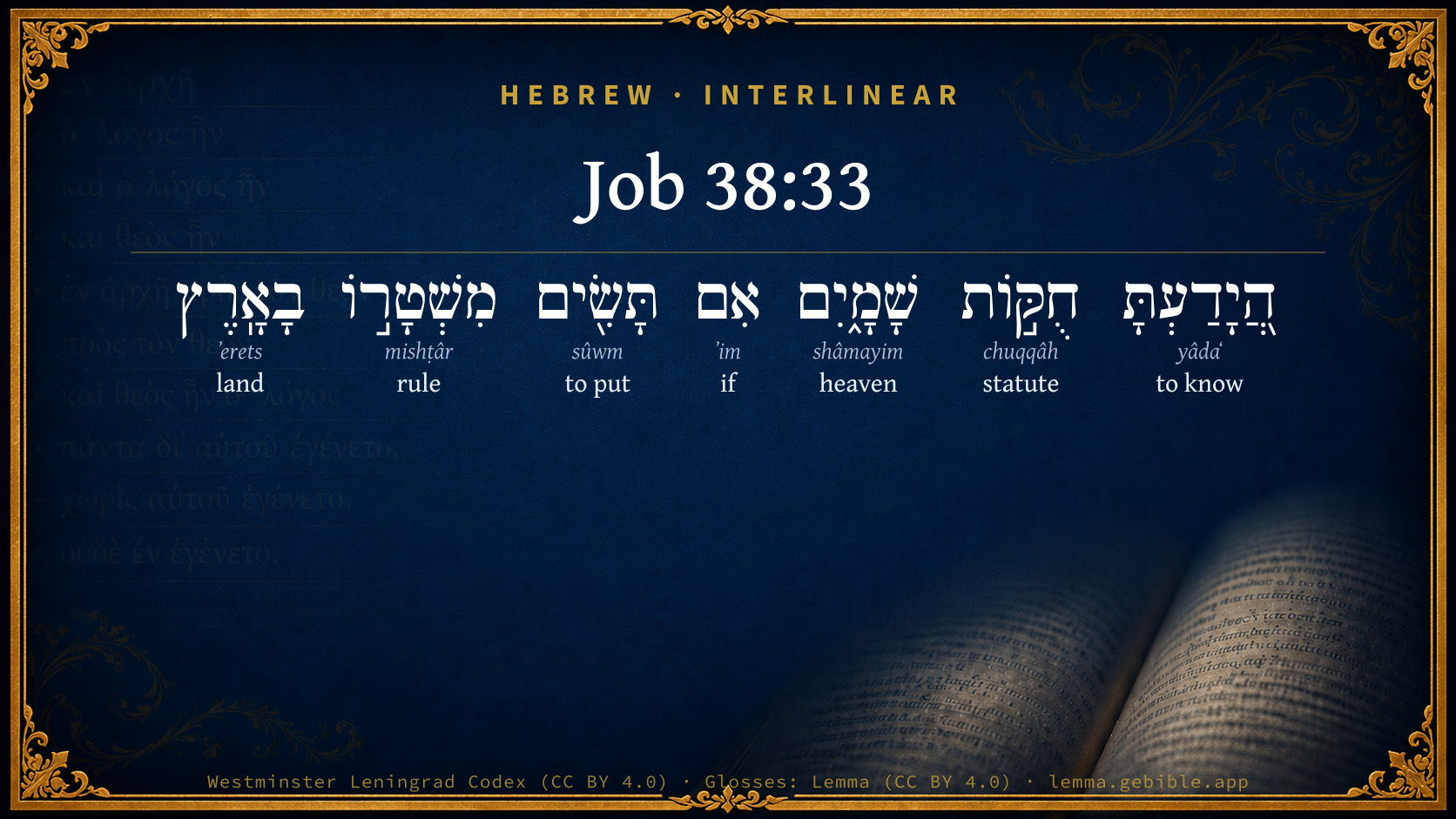
Job 38:33

Hebrew (Westminster Leningrad Codex) Job 38:33 appears in the Hebrew Old Testament. The text above is from the Westminster Leningrad Codex. Each word links to its Strong’s number, a concise gloss, and parsing drawn from the Open Scriptures Hebrew Bible morphology. Click any word for its full Brown-Driver-Briggs (BDB) entry.
Download image
Cite this verse

Job 38:33 (World English Bible). Public Domain. Lemma interlinear Bible study tool, https://lemma.gebible.app/v/job/38/33.

Show BibTeX & RIS
BibTeX
RIS
English Translation
Do you know the laws of the heavens? Can you establish the dominion of it over the earth?
World English Bible · Public Domain
Highlights
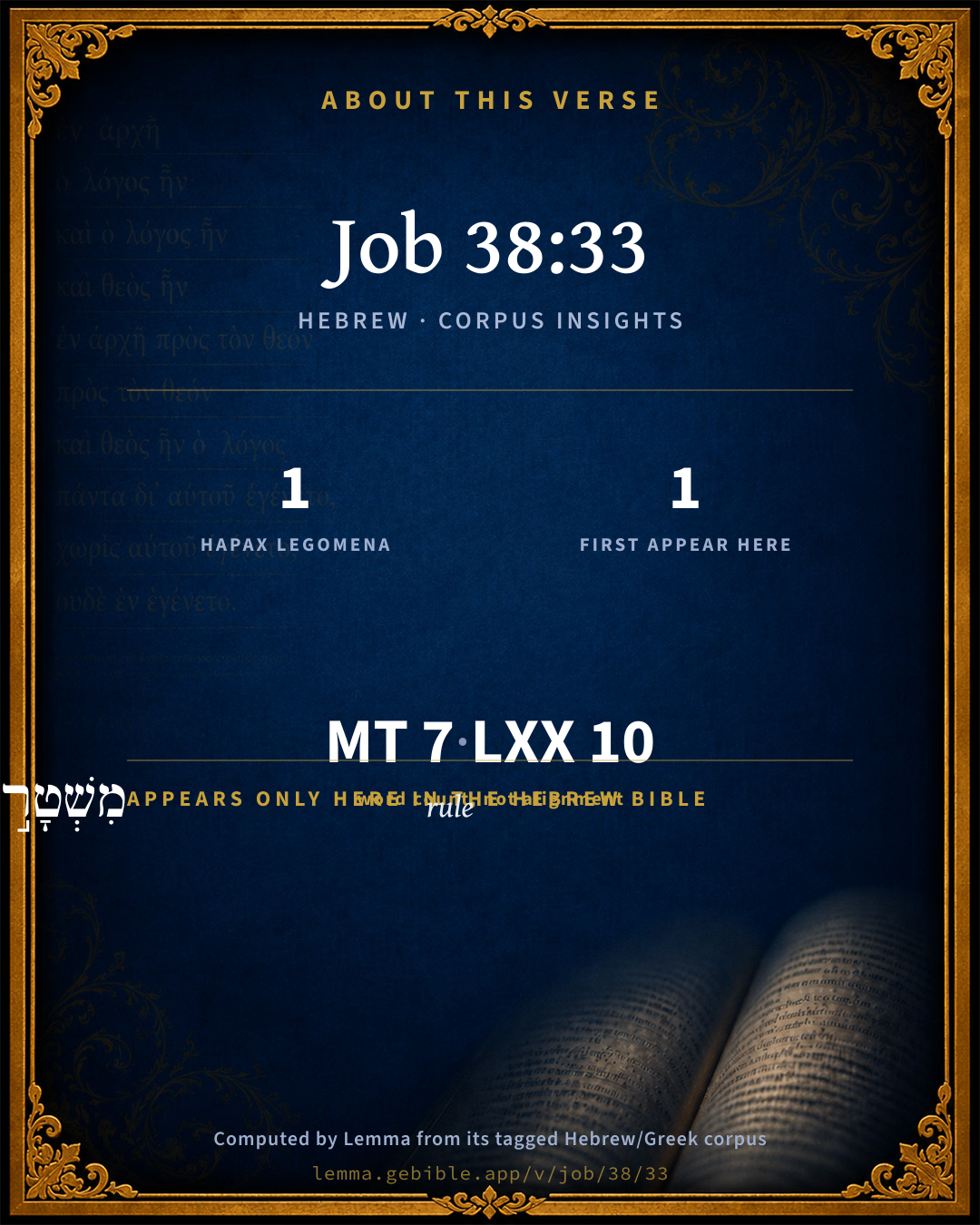
  • 1 hapax legomenon — only here in the Hebrew Bible
  • 1 first appearance in the Hebrew Bible
Full analysis ↓
Download a study sheet

One document with this verse’s original text, its word-by-word gloss line, the meaning frame, cross-references with their text, attributed commentary, and full source and license credits — printable, and it pastes into notes with its structure intact.

This verse Autodidact and up

Study sheet (.html) Plain text (.txt)

A passage Seminary Student

Up to 50 verses in one chapter. A passage sheet keeps up to 6 commentary sources and 12 cross-references per verse, in the order this page ranks them, and says so on the sheet whenever that leaves anything out. Ask for a single verse and you get the Autodidact verse sheet above.

Everything on this page stays free to read, with no account — the sheet is a download of what is already on screen, not access to it.

Want to remove ads? Support Godless Engineer
Compare translations 3

The same verse in 3 English versions, stacked beneath the original-language interlinear above. Click any original word for its lexicon entry.

Each is an independent rendering of the whole verse — the interlinear is not word-aligned to these translations.

Highlighted words mark where these versions differ — a whole-verse word diff, not a word-by-word alignment.

  • World English Bible Public Domain
    Do you know the laws of the heavens? Can you establish the dominion of it over the earth?
  • King James Version Public Domain
    Knowest thou the ordinances of heaven? canst thou set the dominion thereof in the earth?
  • unfoldingWord Literal Text CC BY-SA 4.0
    Do you know the statutes of the skies? If you will establish its rule over the earth?

unfoldingWord Literal Text — © unfoldingWord, licensed CC BY-SA 4.0. Word-aligned USFM3 via Door43 (git.door43.org/unfoldingWord/en_ult).

Versions to compare (up to 4)

3 of 4 selected

Show all 18 translations

Every available English version of this verse, each an independent rendering of the whole verse.

  • World English Bible Public Domain
    Do you know the laws of the heavens? Can you establish the dominion of it over the earth?
  • Berean Standard Bible Public Domain
    Do you know the laws of the heavens? Can you set their dominion over the earth?
  • Majority Standard Bible Public Domain
    Do you know the laws of the heavens? Can you set their dominion over the earth?
  • King James Version Public Domain
    Knowest thou the ordinances of heaven? canst thou set the dominion thereof in the earth?
  • American Standard Version (1901) Public Domain
    Knowest thou the ordinances of the heavens? Canst thou establish the dominion thereof in the earth?
  • Revised Version (1885) Public Domain
    Knowest thou the ordinances of the heavens? canst thou establish the dominion thereof in the earth?
  • Geneva Bible (1599) Public Domain
    Knowest thou the course of heauen, or canst thou set the rule thereof in the earth?
  • Douay-Rheims (1899) Public Domain
    Dost thou know the order of heaven, and canst thou set down the reason thereof on the earth?
  • Young's Literal Translation Public Domain
    Hast thou known the statutes of heaven? Or dost thou appoint Its dominion in the earth?
  • Literal Standard Version CC BY-SA 4.0
    Have you known the statutes of the heavens? Or do you appoint || Its dominion in the earth?
  • Unlocked Literal Bible CC BY-SA 4.0
    Do you know the regulations of the sky? Could you set in place the sky's rule over the earth?
  • unfoldingWord Literal Text CC BY-SA 4.0
    Do you know the statutes of the skies? If you will establish its rule over the earth?
  • Darby Bible Public Domain
    Knowest thou the ordinances of the heavens? dost thou determine their rule over the earth?
  • World Messianic Bible Public Domain
    Do you know the laws of the heavens? Can you establish its dominion over the earth?
  • Webster's Bible Public Domain
    Knowest thou the ordinances of heaven? canst thou set its dominion on the earth?
  • Free Bible Version CC BY-SA 4.0
    Do you know the laws of the heavens? Can you apply them to the earth?
  • Bible in Basic English Public Domain
    Have you knowledge of the laws of the heavens? did you give them rule over the earth?
  • JPS Tanakh (1917) Public Domain
    Knowest thou the ordinances of the heavens? Canst thou establish the dominion thereof in the earth?

Literal Standard Version (2020), Covenant Press — licensed CC BY-SA 4.0. Text via the HelloAO Bible API (eBible.org). Unlocked Literal Bible (unfoldingWord) — licensed CC BY-SA 4.0. Text via the HelloAO Bible API (eBible.org). unfoldingWord Literal Text — © unfoldingWord, licensed CC BY-SA 4.0. Word-aligned USFM3 via Door43 (git.door43.org/unfoldingWord/en_ult). Free Bible Version, Dr. Jonathan Gallagher — licensed CC BY-SA 4.0. Text via the HelloAO Bible API (eBible.org).

Word by word

More ways to search: Search by grammar → Find every occurrence → Compare this word →

Practice this passage: Drill this verse → Learn its vocabulary →

About this verse

These counts appear in no published source. They are computed here, from the morphology-tagged text and Lemma’s own curated glosses. What Lemma adds →

7
words
7
distinct lemmas
Wisdom
section

Notable vocabulary

1 hapax legomenon — a word that appears only here in the entire Hebrew Bible:

  • מִשְׁטָר֣וֹ rule H4896

First appearance in Scripture

This word makes its first canonical appearance in the Hebrew Bible here:

  • מִשְׁטָר֣וֹ rule H4896

Grammatical profile

  • 2 verbs
  • 4 nouns
  • 1 conjunction

Verb forms

  • הֲ֭יָדַעְתָּ Qal · Perfect
  • תָּשִׂ֖ים Qal · Imperfect

Hebrew & Septuagint length

In English translation the verse runs 18 words from the Hebrew and 16 from the Septuagint (LXX English) — closely comparable.

A rough comparison of the two English renderings, which tokenize alike — not a word-level alignment.

Word counts can differ between the Hebrew and the Greek without any difference in meaning — e.g. the Hebrew direct-object marker אֵת has no separate Greek word, and Greek often adds the article ὁ.

In the original languages it is 7 Hebrew tokens and 10 Greek tokens — but the two are counted differently (Hebrew bundles its prefixes and suffixes into one token; the Greek is in lemma form), so that isn’t a like-for-like length.

Cross-references

7

Topical passages linked to Job 38:33 in the Treasury of Scripture Knowledge — connected by theme and wording, ordered by reader-vote popularity; previews shown in the World English Bible.

  • Jeremiah 31:35–36 Thus says Yahweh, who gives the sun for a light by day, and the ordinances of the moon and of the stars for a light by night, who stirs up the sea, so that the waves of it roar; Yahweh of hosts is his name:
  • Genesis 8:22 While the earth remains, seed time and harvest, and cold and heat, and summer and winter, and day and night shall not cease."
  • Genesis 1:16 God made the two great lights: the greater light to rule the day, and the lesser light to rule the night. He also made the stars.
  • Job 38:12–13 "Have you commanded the morning in your days, And caused the dawn to know its place;
  • Psalms 148:6 He has also established them forever and ever. He has made a decree which will not pass away.
  • Jeremiah 33:25 Thus says Yahweh: If my covenant of day and night fails, if I have not appointed the ordinances of heaven and earth;
  • Psalms 119:90–91 Your faithfulness is to all generations. You have established the earth, and it remains.

Cross-references courtesy of OpenBible.info (CC BY 4.0).

Hebrew and Greek witnesses Masoretic Hebrew ↔ Greek Septuagint

The same verse in the two great witnesses to the Old Testament, shown verse-for-verse.

These are two independent witnesses, not word-aligned to each other, and the Septuagint is shown in lemma (dictionary) form.

Hebrew Job 38:33 Masoretic · Westminster Leningrad Codex

הֲ֭יָדַעְתָּ חֻקּ֣וֹת שָׁמָ֑יִם אִם תָּשִׂ֖ים מִשְׁטָר֣וֹ בָאָֽרֶץ

Do you know the laws of the heavens? Can you establish the dominion of it over the earth?

World English Bible · Public Domain

Greek LXX Job 38:33 Septuagint · lemma form

ἐπίσταμαι δέ τροπή οὐρανός ἤ ὁ ὑπό οὐρανός ὁμοθυμαδόν γίγνομαι

And know you the changes of heaven, or the events which take place together under heaven?

LXX2012 (modern English Septuagint) · Public Domain

On this verse, John Gill's Exposition discusses the Septuagint’s reading. Read the note in Commentary ↓

Hebrew: Westminster Leningrad Codex (CC BY 4.0). Greek: Septuagint (public domain); English from LXX2012 (modern English Septuagint) (Public Domain). How the Septuagint differs from the Hebrew →

Commentary

Notes on Job 38:33 from classic Christian and Jewish commentators (each source and its license shown beneath its notes). The classic Christian expositions comment on the surrounding passage and are grouped to its opening verse, so a note may address several verses; the Jewish commentaries on the Tanakh (Rashi and others) are per-verse, so they appear only where the commentator wrote on this verse.

Lemma curates 59 commentaries, every one of them public domain or Creative Commons licensed, each selected and text-cleaned for this edition rather than reprinted as found. About our sources →

Trapp's Complete Commentary

John Trapp

Job 38:33 Knowest thou the ordinances of heaven? canst thou set the dominion thereof in the earth?

Ver. 33. Knowest thou the ordinances of heaven?] Either how to order them, as master over them, or to comprehend what they are certainly and perfectly.

Canst thou set the dominion thereof in the earth?] As well in regard to the motion of the heavens, which varieth the seasons of the year, as of the influences and virtue which cometh from thence. For they who think that the superior bodies have no power at all upon these inferior do go against common sense and experience, yea, this and many other texts of Scriptures; which yet make nothing at all for that judiciary astrology so much cried up in these last and worst days of the world, by some who would have the manners, studies, and events of every man to depend upon the stars, yea, the rise and ruin of kingdoms, arts, religion, &c.

John Trapp, A Commentary or Exposition upon All the Books of the Old and New Testament (1647–1656) — public domain. Text from a community e-Sword module.

Geneva Bible (1599)

Geneva Bible translators

Canst thou cause the heavenly bodies to have any power over the earthly bodies?

Geneva Bible (1599) marginal notes — public domain. Text via Bolls.life.

Jamieson, Fausset & Brown

Robert Jamieson, A. R. Fausset & David Brown

ordinances--which regulate the alternations of seasons, &c. (Gen 8:22).

dominion--controlling influence of the heavenly bodies, the sun, moon, &c., on the earth (on the tides, weather) (Gen 1:16; Psa 136:7-9).

Jamieson, Fausset & Brown — Commentary Critical and Explanatory on the Whole Bible (1871) — public domain (CC PDM 1.0). Text via the HelloAO Bible API.

Adam Clarke's Commentary

Verse 33. Knowest thou the ordinances of heaven?] Art thou a thorough astronomer? Art thou acquainted with all the laws of the planetary system? Canst thou account for the difference of their motions, and the influence by which they are retained and revolve in their orbits? And canst thou tell what influence or dominion they exercise on the earth? Sir Isaac Newton has given us much light on many of these things; but to his system, which is most probably the true one, gravity is essential; and yet what this gravity is he could neither explain nor comprehend; and his followers are not one whit wiser than he. No man has ever yet fully found out the ordinances of heaven, and the dominion thereof on the earth.

Adam Clarke's Commentary on the Bible (1810–1826) — public domain. Text from a community e-Sword/MySword module.

Ellicott's Commentary for English Readers

(33) The ordinances of heaven.—Comp. Job_28:26. That is, the recurring seasons and their power of influencing the earth.

A Bible Commentary for English Readers, edited by Charles John Ellicott (1878–1897) — public domain. Text from a community e-Sword module.

The Cambridge Bible for Schools and Colleges

gen. ed. J. J. S. Perowne

33. canst thou set] Rather, as before, dost thou set? The idea is that the heavens and the stars exercise an influence over the earth and the destinies of man.

The Cambridge Bible for Schools and Colleges (gen. ed. J. J. S. Perowne; Cambridge University Press, 1878–1918) — public domain. Text from a community e-Sword module.

John Gill's Exposition

Who hath put wisdom in the inward parts?.... That is, of man, in his heart, as explained in the next clause; such wisdom as to guide the stars, know the ordinances of heaven, set their dominion on earth, manage and direct the clouds and lightning; no such wisdom is put in man:

or who hath, given understanding to the heart? to understand all the above things, and answer to the several questions put in this chapter; though, as these clauses may respect much one and the same thing, they may be understood of wisdom and understanding in man, whether natural or spiritual; and seeing they are found there, the question is, who put them there, or how came they there? who gave them to him? the answer must be, God himself, and no other; man has his rational soul, his intellectual powers, the light of nature and reason in him; all his understanding in arts and sciences, trades and manufactures, is of the Lord, and not of himself or another, see Job 32:8; all spiritual wisdom and understanding which lies in a man's concern for his eternal welfare in the knowledge of himself, and of his state and condition by nature, and of the way of life and salvation by Christ, and of the truths and doctrines of the Gospel, is all of God and Christ, and by the spirit of wisdom and revelation in the knowledge of him; no man, therefore, has any reason to glory in his wisdom and knowledge, of whatsoever kind, as though he had not received it; nor should he dare to arraign the wisdom of God in his providential dealings with men; since he that teaches man knowledge must needs know better than man how to govern the world he has made, and dispose of all things in it. The last clause is in the Vulgate Latin rendered, "who hath given to the cock understanding?" and so the Targums and other Jewish writers (p) interpret it; and they observe (q), that in Arabia a cock is called by the word that is here used; and in their morning prayers, and at hearing a cock crow (r),

"Blessed be the Lord, who giveth to the cock understanding to distinguish between the day and the night:''

but however remarkable the understanding of this creature is, which God has given it, and which is even taken notice of by Heathen writers (s); that it should know the stars, distinguish the hours of the night by crowing, and express its joy at the rising of the sun and moon; yet such a sense of the text seems impertinent, as well as that of the Septuagint version, of giving to women the wisdom and knowledge of weaving and embroidery.

(p) Jarchi, Ramban, Simeon Bar. Tzemach. (q) Vajikra Rabba, s. 25. fol. 166. 1. Vid. T. Roshhashanah, fol. 26. 1. (r) Seder Tephillot. fol. 2. 2. Ed. Basil. & Bab. Beracot, fol. 60. 2. (s) Plin. Nat. Hist. l. 10. c. 21. Aelian. de Animal. l. 4. c. 29.

John Gill's Exposition of the Whole Bible (1746–1763) — public domain (CC PDM 1.0). Text via the HelloAO Bible API.

Albert Barnes' Notes on the Bible

Knowest thou the ordinances of heaven? - The laws or statutes by which the motions of the heavenly bodies are governed. These were wholly unknown in the time of Job, and the discovery of some of those laws - for only a few of them are yet known - was reserved to be the glory of the modern system of astronomy. The suggestion of the great principles of the system gave immortality to the name Copernicus; and the discovery of those laws in modern times has conferred immortality on the names of Brahe, Kepler, and Newton. The laws which control the heavenly bodies are the most sublime that are known to man, and have done more to impress the human mind with a sense of the majesty of God than any other: discoveries made in the material universe. Of course, all those laws were known to God himself, and he appeals to them in proof of his greatness and majesty. The grand and beautiful movements of the heavenly bodies in the time of Job were fitted to produce admiration; and one of the chief delights of those that dwelt under the splendor of an Oriental sky was to contemplate those movements, and to give names to those moving lights. The discoveries of science have enlarged the conceptions of man in regard to the starry heavens far toward immensity; have shown that these twinkling lights are vast worlds and systems, and at the same time have so disclosed the laws by which they are governed as to promote, where the heart is right, intelligent piety, and elevate the mind to more glorious views of the Creator.

Canst thou set the dominion thereof in the earth? - That is, “dost thou assign the dominion of the heavens over the earth?” The reference is, undoubtedly, to the influence of the heavenly bodies upon sublunary objects. The exact extent of that cannot be supposed to have been known in the days of Job, and it is probable that much more was ascribed to the influence of the stars on human affairs than the truth would justify. Nor is its extent now known. It is known that the moon has an influence over the tides of the ocean; it may be that it has to some extent over the weather; and it is not impossible that the other heavenly bodies may have some effect on the changes observed in the earth which is not understood. Whatever it is, it was and is all known to God, and the idea here is, that it was a proof of his immense superiority over man.

Albert Barnes' Notes on the Bible (1834–1885) — public domain. Text from a community e-Sword/MySword module.

Haydock's Catholic Bible Commentary

Reason. Hebrew, "dominion," (Haydock) or influence upon the earth. Mathematicians thought they had discovered these laws, and the number of the stars; but daily experience evinces their error. (Menochius)

George Leo Haydock (1774–1849), Haydock's Catholic Family Bible and Commentary, 1859 edition — public domain. Excludes Psalms (Douay-Rheims chapter numbering differs from Protestant) and Deuterocanonical books (Catholic canon only).

Matthew Poole's English Annotations

Knowest thou? either,

1. Simply, and by speculation, dost thou understand them? Or,

2. Practically, or operatively, so as to establish or rule them, as the next clause implies.

The ordinances of heaven; the laws, which are firmly established concerning their order, motion, or rest and their powerful influences upon this lower world. Didst thou give these laws? or dost thou perfectly know them?

Canst thou set the dominion thereof in the earth? canst manage and overrule their influences, that they shall bring such seasons and such weather as thou wouldst have?

Matthew Poole's English Annotations on the Holy Bible (1683–1685) — public domain. Text from a community e-Sword/MySword module.

Whedon's Commentary on the Bible

Daniel D. Whedon

33. The ordinances — חקות: meaning here the laws that guide the stars, and control the seasons, etc. The intimate and commanding relationships of the heavenly bodies to our earth are those of a king to his subjects. Hence the immediate reference to “dominion,” — a thought that modern science illustrates and confirms.

Dominion thereof — משׁשׂרו, used only here, is a more significant word than the preceding one, (ordinances;) it is derived from shatar, “to cut into,” “write,” metaphorically administer; the art of writing being used in ancient times almost exclusively for legislative and judicial purposes, (Furst;) in accordance with which the word shoter signifies “an overseer,” “an administrator.” This pregnant question of the Almighty, Delitzsch reads, “Dost thou define its influence on the earth?” Hitzig, “Dost thou determine its relation to the earth?” — a question which will ever task to the utmost the resources of science to answer.

Daniel D. Whedon (gen. ed.), Commentary on the Old and New Testaments (1874–1909) — public domain. Text from a community e-Sword module.

The Pulpit Commentary

Knowest thou the ordinances of heaven? i.e. the physical laws by which the course of nature is governed. (comp. Psa_119:90, 91 148:6) The general prevalence of law in the material world is quite as strongly asserted by the sacred writers as by modern science. The difference is that modern science regards the laws as physical necessities, self-subsisting, while Scripture looks upon them as the ordinances of the Divine will. This latter view involves, of course, the further result that the Divine will can at any time suspend or reverse any of its enactments. Canst thou set the dominion thereof in the earth? If Job does not even know the laws whereby the world is governed, much less can he establish such laws himself, and make them work.

The Pulpit Commentary (1880–1919), ed. H.D.M. Spence-Jones & Joseph S. Exell — public domain. Text from a community e-Sword module.

John Wesley's Explanatory Notes

Ordinances - The laws which are firmly established concerning their order, motion, or rest, and their powerful influences upon this lower world. Didst thou give these laws? Or dost thou perfectly know them? Canst thou - Manage and over rule their influences.

John Wesley, Explanatory Notes Upon the Whole Bible (1754–1765) — public domain. Text via the GEBible commentary corpus.

Rashi

Rabbi Shlomo Yitzchaki (Rashi)

his dominion The dominion of the constellations appointed to bring upon the earth cold and heat, summer and winter.

Rashi on the Tanakh — English translations: “The Judaica Press complete Tanach with Rashi, translated by A. J. Rosenberg” (CC BY 4.0); “Pentateuch with Rashi's commentary by M. Rosenbaum and A.M. Silbermann, 1929-1934” (public domain); “The Metsudah Tanach series, Lakewood, N.J” (CC BY 4.0); and “The Book of Joshua, Metsudah Publications, 1997” (CC BY 4.0). Text via Sefaria.

Lesson kit

Teaching starters — assembled from the data on this page, not authored interpretation. Every prompt links to the verse data it draws on. Edit before teaching.

Job, in the Wisdom, opens this verse with 7 words (7 distinct Hebrew lemmas). Its most distinctive word is mishṭâr (“rule”). A historical commentator’s framing appears above. Read the whole chapter for the surrounding context.

Discussion questions

  1. The word mishṭâr carries the sense “rule.” How does it shape the verse?
  2. This verse holds 1 word here found nowhere else in the Hebrew Bible. What might the rare word draw attention to?
  3. The word “rule” first appears here in Scripture. What is being introduced at this debut?
  4. Jeremiah 31:35–36 shares this passage’s theme. How do the two illuminate each other?
  5. The translations on this page render this verse differently — a whole-verse word diff, not a word-by-word alignment. What might account for the different wordings?
  6. The verb «הֲ֭יָדַעְתָּ» is Qal Perfect. How does its form color the action?
  7. Reading how Trapp's Complete Commentary and Geneva Bible (1599) read this verse, where do the two commentators agree and where do they part?

Things to notice

Reading settings

Reading text

Shown beneath each verse's original-language words.

Old Testament
Old Testament edition

Read the OT as the Masoretic Hebrew (MT) or the Greek Septuagint (LXX).

English shown for the Greek Septuagint (in the Hebrew ↔ Greek comparison).

Comparing translations? Open the Compare panel on any verse page to stack up to four side by side.