Jeremiah 33:25

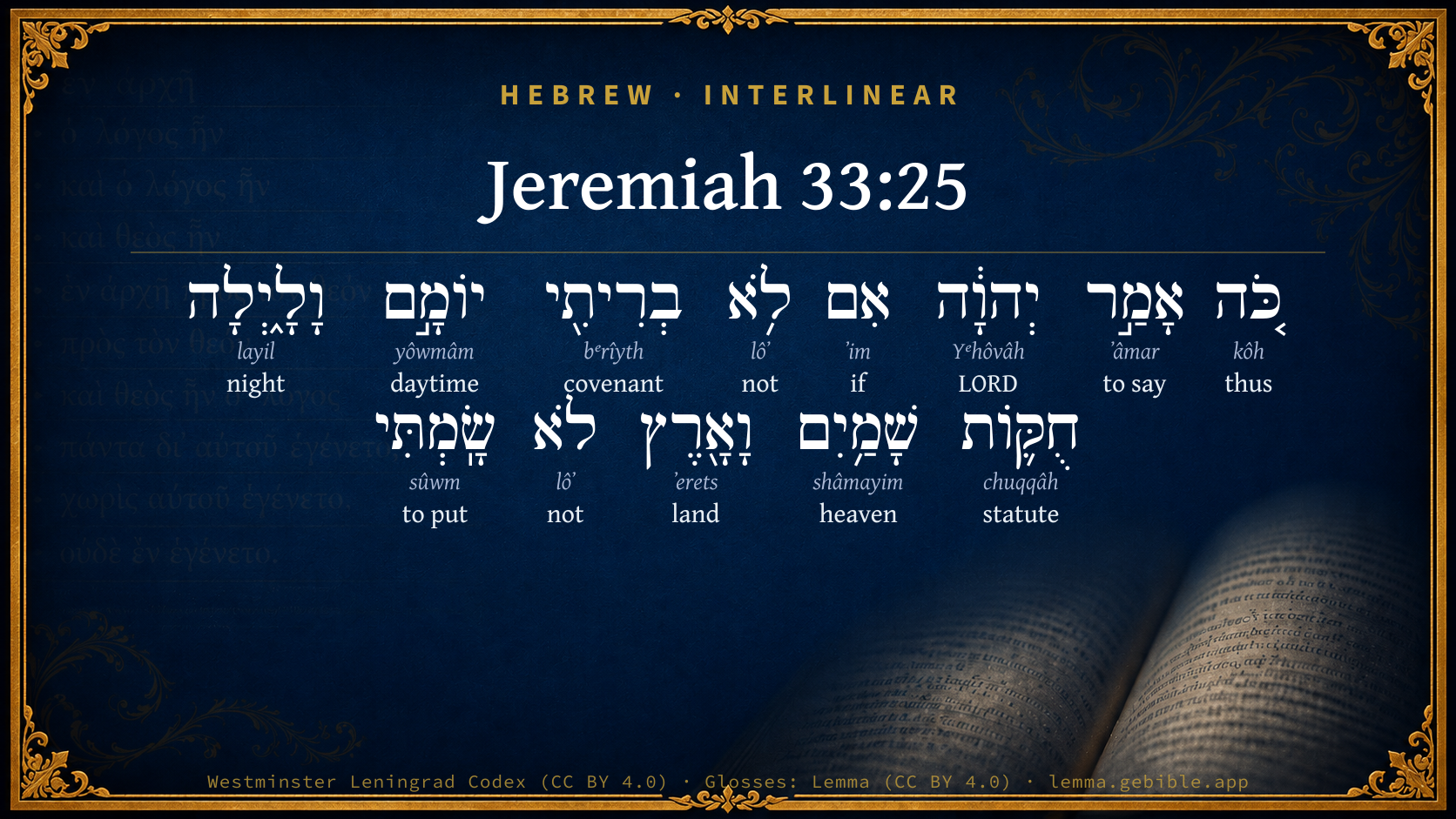
Hebrew (Westminster Leningrad Codex) Jeremiah 33:25 appears in the Hebrew Old Testament. The text above is from the Westminster Leningrad Codex. Each word links to its Strong’s number, a concise gloss, and parsing drawn from the Open Scriptures Hebrew Bible morphology. Click any word for its full Brown-Driver-Briggs (BDB) entry.
Download image
Cite this verse

Jeremiah 33:25 (World English Bible). Public Domain. Lemma interlinear Bible study tool, https://lemma.gebible.app/v/jeremiah/33/25.

Show BibTeX & RIS
BibTeX
RIS
English Translation
Thus says Yahweh: If my covenant of day and night fails, if I have not appointed the ordinances of heaven and earth;
World English Bible · Public Domain
Download a study sheet

One document with this verse’s original text, its word-by-word gloss line, the meaning frame, cross-references with their text, attributed commentary, and full source and license credits — printable, and it pastes into notes with its structure intact.

This verse Autodidact and up

Study sheet (.html) Plain text (.txt)

A passage Seminary Student

Up to 50 verses in one chapter. A passage sheet keeps up to 6 commentary sources and 12 cross-references per verse, in the order this page ranks them, and says so on the sheet whenever that leaves anything out. Ask for a single verse and you get the Autodidact verse sheet above.

Everything on this page stays free to read, with no account — the sheet is a download of what is already on screen, not access to it.

Want to remove ads? Support Godless Engineer
Compare translations 3

The same verse in 3 English versions, stacked beneath the original-language interlinear above. Click any original word for its lexicon entry.

Each is an independent rendering of the whole verse — the interlinear is not word-aligned to these translations.

Highlighted words mark where these versions differ — a whole-verse word diff, not a word-by-word alignment.

  • World English Bible Public Domain
    Thus says Yahweh: If my covenant of day and night fails, if I have not appointed the ordinances of heaven and earth;
  • King James Version Public Domain
    Thus saith the LORD; If my covenant be not with day and night, and if I have not appointed the ordinances of heaven and earth;
  • unfoldingWord Literal Text CC BY-SA 4.0
    I, Yahweh, say this, ‘If I have not established the covenant of day and night, and if I have not fixed the laws of heaven and earth,

unfoldingWord Literal Text — © unfoldingWord, licensed CC BY-SA 4.0. Word-aligned USFM3 via Door43 (git.door43.org/unfoldingWord/en_ult).

Versions to compare (up to 4)

3 of 4 selected

Show all 18 translations

Every available English version of this verse, each an independent rendering of the whole verse.

  • World English Bible Public Domain
    Thus says Yahweh: If my covenant of day and night fails, if I have not appointed the ordinances of heaven and earth;
  • Berean Standard Bible Public Domain
    This is what the LORD says: If I have not established My covenant with the day and the night and the fixed order of heaven and earth,
  • Majority Standard Bible Public Domain
    This is what the LORD says: If I have not established My covenant with the day and the night and the fixed order of heaven and earth,
  • King James Version Public Domain
    Thus saith the LORD; If my covenant be not with day and night, and if I have not appointed the ordinances of heaven and earth;
  • American Standard Version (1901) Public Domain
    Thus saith Jehovah: If my covenant of day and night `stand' not, if I have not appointed the ordinances of heaven and earth;
  • Revised Version (1885) Public Domain
    Thus saith the LORD: If my covenant of day and night stand not, if I have not appointed the ordinances of heaven and earth;
  • Geneva Bible (1599) Public Domain
    Thus sayth the Lord, If my couenant be not with day and night, and if I haue not appointed the order of heauen and earth,
  • Douay-Rheims (1899) Public Domain
    Thus saith the Lord: If I have not set my covenant between day and night, and laws to heaven and earth:
  • Young's Literal Translation Public Domain
    Thus said Jehovah: If My covenant `is' not daily and nightly, The statutes of heaven and earth I have not appointed --
  • Literal Standard Version CC BY-SA 4.0
    Thus said YHWH: “If My covenant [is] not with day and night, || [And if] I have not appointed the statutes of the heavens and earth—
  • Unlocked Literal Bible CC BY-SA 4.0
    I, Yahweh, say this, 'If I have not established the covenant of day and night, and if I have not fixed the laws of heaven and earth,
  • unfoldingWord Literal Text CC BY-SA 4.0
    I, Yahweh, say this, ‘If I have not established the covenant of day and night, and if I have not fixed the laws of heaven and earth,
  • Darby Bible Public Domain
    Thus saith Jehovah: If my covenant of day and night [stand] not, if I have not appointed the ordinances of the heavens and the earth,
  • World Messianic Bible Public Domain
    The LORD says: “If my covenant of day and night fails, if I have not appointed the ordinances of heaven and earth,
  • Webster's Bible Public Domain
    Thus saith the LORD; If my covenant is not with day and night, and if I have not appointed the ordinances of heaven and earth;
  • Free Bible Version CC BY-SA 4.0
    This is what the Lord says: Just as I can't break my agreement with the day and the night and the laws that regulate heaven and earth,
  • Bible in Basic English Public Domain
    The Lord has said, If I have not made day and night, and if the limits of heaven and earth have not been fixed by me,
  • JPS Tanakh (1917) Public Domain
    Thus saith the LORD: If My covenant be not with day and night, if I have not appointed the ordinances of heaven and earth;

Literal Standard Version (2020), Covenant Press — licensed CC BY-SA 4.0. Text via the HelloAO Bible API (eBible.org). Unlocked Literal Bible (unfoldingWord) — licensed CC BY-SA 4.0. Text via the HelloAO Bible API (eBible.org). unfoldingWord Literal Text — © unfoldingWord, licensed CC BY-SA 4.0. Word-aligned USFM3 via Door43 (git.door43.org/unfoldingWord/en_ult). Free Bible Version, Dr. Jonathan Gallagher — licensed CC BY-SA 4.0. Text via the HelloAO Bible API (eBible.org).

Word by word

More ways to search: Search by grammar → Find every occurrence → Compare this word →

Practice this passage: Drill this verse → Learn its vocabulary →

About this verse

These counts appear in no published source. They are computed here, from the morphology-tagged text and Lemma’s own curated glosses. What Lemma adds →

13
words
12
distinct lemmas
Prophets
section

Shared distinctive vocabulary

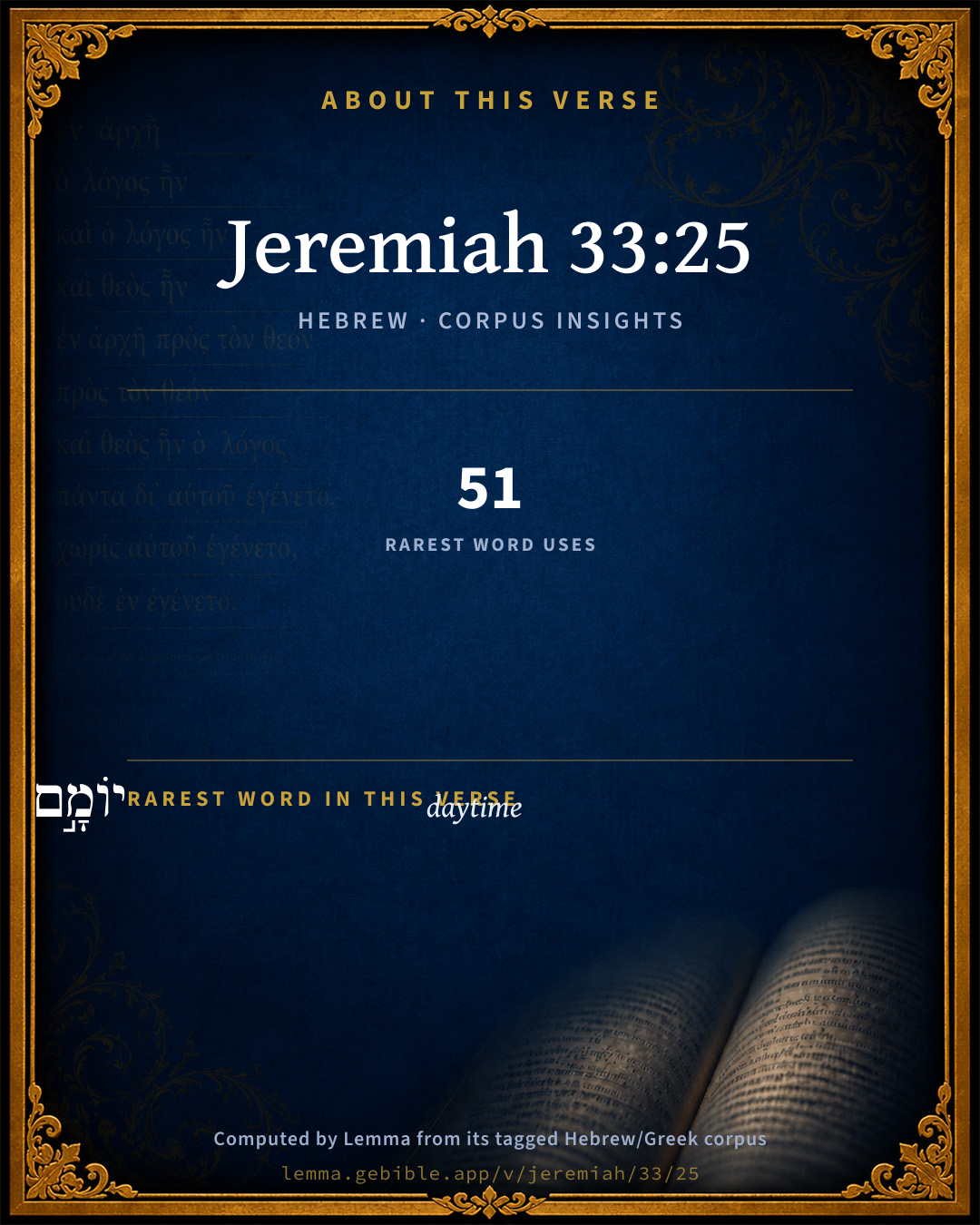
יוֹמָ֣ם daytime H3119 occurs in 50 verses of the Hebrew Bible. Also found in:

Grammatical profile

  • 2 verbs
  • 6 nouns
  • 1 conjunction
  • 2 adverbs
  • 2 particles

Verb forms

  • אָמַ֣ר Qal · Perfect
  • שָֽׂמְתִּי Qal · Perfect

Repetition

A word recurs within this verse — often emphatic in Hebrew:

Cross-references

6

Topical passages linked to Jeremiah 33:25 in the Treasury of Scripture Knowledge — connected by theme and wording, ordered by reader-vote popularity; previews shown in the World English Bible.

  • Psalms 74:16–17 The day is yours, the night is also yours. You have prepared the light and the sun.
  • Jeremiah 31:35–36 Thus says Yahweh, who gives the sun for a light by day, and the ordinances of the moon and of the stars for a light by night, who stirs up the sea, so that the waves of it roar; Yahweh of hosts is his name:
  • Jeremiah 33:20 Thus says Yahweh: If you can break my covenant of the day, and my covenant of the night, so that there shall not be day and night in their season;
  • Psalms 104:19 He appointed the moon for seasons. The sun knows when to set.
  • Genesis 8:22 While the earth remains, seed time and harvest, and cold and heat, and summer and winter, and day and night shall not cease."
  • Genesis 9:9–17 "As for me, behold, I establish my covenant with you, and with your offspring after you,

Cross-references courtesy of OpenBible.info (CC BY 4.0).

Hebrew and Greek witnesses Masoretic Hebrew ↔ Greek Septuagint

The same verse in the two great witnesses to the Old Testament, shown verse-for-verse.

These are two independent witnesses, not word-aligned to each other, and the Septuagint is shown in lemma (dictionary) form.

Hebrew Jeremiah 33:25 Masoretic · Westminster Leningrad Codex

כֹּ֚ה אָמַ֣ר יְהוָ֔ה אִם לֹ֥א בְרִיתִ֖י יוֹמָ֣ם וָלָ֑יְלָה חֻקּ֛וֹת שָׁמַ֥יִם וָאָ֖רֶץ לֹא שָֽׂמְתִּי

Thus says Yahweh: If my covenant of day and night fails, if I have not appointed the ordinances of heaven and earth;

World English Bible · Public Domain

Greek LXX Structure differs

In the Septuagint, Jeremiah is about an eighth shorter than the Hebrew and arranges its material differently — the Oracles Against the Nations (Hebrew chapters 46–51) appear in the middle of the Greek book, after 25:13. Because the chapter and verse boundaries do not line up, a verse-for-verse comparison with the Hebrew is not shown.

A verse-for-verse comparison isn’t shown here because the chapters and verses don’t line up. Switch to the LXX edition with the MT / LXX toggle above to read the Greek directly.

Hebrew: Westminster Leningrad Codex (CC BY 4.0). Greek: Septuagint (public domain); English from a public-domain English Septuagint. How the Septuagint differs from the Hebrew →

Targum (Aramaic paraphrase)

1

The Targum is the ancient Jewish Aramaic paraphrase of the Hebrew Scriptures — an interpretive translation, not the Hebrew text itself. Onkelos (literal) and Pseudo-Jonathan (expansive) render the Torah, and Jonathan the Prophets. Coverage is partial: where no permissively-licensed English translation exists for a verse, only the Aramaic is shown. This is verse-level text, not a word-by-word alignment to the Hebrew.

  1. Targum Jonathan Prophets (Joshua–Malachi)
    כִּדְנַן אֲמַר יְיָ כְּמָא דְלֵית אֶפְשַׁר דִיבַטֵיל קְיָמִי דַאֲקִימֵית עִם יְמָמָא וְעִם לֵילְיָא כֵּן גְזֵירַת שְׁמַיָא וְאַרְעָא לָא שַׁוִיתוּן דְיֶעְדוֹן:

    (no public-domain English translation for this verse)

    Targum Jonathan — Aramaic: “Mikraot Gedolot” (public domain). English: “Sefaria Community Translation” (CC0 1.0 (public-domain dedication)); “London "Chaldee Paraphrase," 1871” (public domain). Text via Sefaria.

Commentary

Notes on Jeremiah 33:25 from classic Christian and Jewish commentators (each source and its license shown beneath its notes). The classic Christian expositions comment on the surrounding passage and are grouped to its opening verse, so a note may address several verses; the Jewish commentaries on the Tanakh (Rashi and others) are per-verse, so they appear only where the commentator wrote on this verse.

Lemma curates 59 commentaries, every one of them public domain or Creative Commons licensed, each selected and text-cleaned for this edition rather than reprinted as found. About our sources →

Trapp's Complete Commentary

John Trapp

Jer 33:25 Thus saith the LORD; If my covenant [be] not with day and night, [and if] I have not appointed the ordinances of heaven and earth;

Ver. 25. If my covenant be not with day and night.] See on Jer 33:20. If there be not a constant intercourse of either.

John Trapp, A Commentary or Exposition upon All the Books of the Old and New Testament (1647–1656) — public domain. Text from a community e-Sword module.

Jamieson, Fausset & Brown

Robert Jamieson, A. R. Fausset & David Brown

(Jer 31:35-36; Gen 8:22; Psa 74:16-17). I who have established the laws of nature am the same God who has made a covenant with the Church.

Jamieson, Fausset & Brown — Commentary Critical and Explanatory on the Whole Bible (1871) — public domain (CC PDM 1.0). Text via the HelloAO Bible API.

John Calvin's Commentaries

Here God opposes the constancy of his faithfulness to their perverse murmurings, of which he had complained; and he again adduces the similitude previously brought forward: “lf, then, I have not fixed my covenant, or if there is no covenant as to the day and the night, — if there are no laws as to heaven and earth, then I shall now cast away the seed of Jacob and the seed of David: but if my constancy is ever conspicuous as to the laws of nature, how is it that ye ascribe not to me my due honor? For I am the same God, who created the heaven and the earth, who fixed all the laws of nature which remain unchangeable, and who also have made a covenant with my Church. If my faithfulness as to the laws of nature changes not, wily should it change as to that sacred covenant which I have made with my chosen people?”

We now see the reason why God so often confirmed a thing in itself sufficiently clear, even because the contest with the obstinate hopelessness of the people was difficult. For they thought that they were rejected without any hope of deliverance, when God punished them only for a time for their wickedness, as they deemed their exile to be without a return.

John Calvin's Commentaries (1540-1563) — public domain. Text from the Calvin Translation Society English edition (1840s-50s) via the Christian Classics Ethereal Library (ccel.org). Calvin's coverage is partial (roughly two-thirds of the Bible); uncommented books and verses are honest gaps, never fabricated. The 19th-century editor's footnotes and remarks are omitted so the notes are faithfully Calvin's own voice.

The Cambridge Bible for Schools and Colleges

gen. ed. J. J. S. Perowne

25. stand] The absence of a verb in this clause to balance “have … appointed” in the next has led to Du.’s emendation, adopted also by Co., to read by a very slight change in the Hebrew for “If my covenant,” If I have not created. The alteration to the present text might have easily been made by a scribe who was influenced by “my covenant” of Jer_33:20.

The Cambridge Bible for Schools and Colleges (gen. ed. J. J. S. Perowne; Cambridge University Press, 1878–1918) — public domain. Text from a community e-Sword module.

John Gill's Exposition

Thus saith the Lord,.... In answer to the above calumny:

if my covenant be not with day and night; that is, if it should not stand; if it should be broken; or there should be no longer a succession of day and night:

and if I have not appointed the ordinances of heaven and earth; concerning the course of the sun, moon, and stars, and the influence of the heavenly bodies; and concerning the fruits of the earth, the seasons of the year, seedtime and harvest, summer and winter; if these are not settled and fixed, and do not appear according to appointment and promise.

John Gill's Exposition of the Whole Bible (1746–1763) — public domain (CC PDM 1.0). Text via the HelloAO Bible API.

Albert Barnes' Notes on the Bible

The ordinances of heaven and earth - i. e., the whole order of nature Nature is not more firmly established than God’s purposes in grace.

Albert Barnes' Notes on the Bible (1834–1885) — public domain. Text from a community e-Sword/MySword module.

Whedon's Commentary on the Bible

Daniel D. Whedon

25. If my covenant be not with day and night — The repetition ofthis appeal to the established laws of nature shows the warmth and emphasis of the passage.

Daniel D. Whedon (gen. ed.), Commentary on the Old and New Testaments (1874–1909) — public domain. Text from a community e-Sword module.

unfoldingWord translationNotes

Door43 World Missions Community

If I have not established ... and if I have not fixed ... then I will reject ... and not bring

This is a hypothetical situation that Yahweh never expects to be true. AT: "I have established ... and I have fixed ... so I will never reject ... and I will bring" (See: Hypothetical Situations)

I will restore their fortunes

"I will cause things to go well for them again" or "I will cause them to live well again" See how similar words are translated in Jeremiah 29:14.

show mercy to

Translate as "have compassion on" is translated in (Jeremiah 30:18).

translationWords

earth

Jacob

David

Abraham

Isaac

unfoldingWord translationNotes — © Distant Shores Media and the Door43 World Missions Community, licensed CC BY-SA 4.0. Source: git.door43.org/Door43/en_tn.

Rashi

Rabbi Shlomo Yitzchaki (Rashi)

If not My covenant, etc. If it is possible that the covenant that I formed with day and night to be in their time should be abolished, and if it is possible for the statutes of heaven and earth to be abolished as though I had not placed them, also the seed of Jacob, etc. Our Sages, however, expounded it in regard to the covenant of the Torah and circumcision, to derive from here that because of them heaven and earth were created. But this Midrash does not fit the sequence of the verses.

Rashi on the Tanakh — English translations: “The Judaica Press complete Tanach with Rashi, translated by A. J. Rosenberg” (CC BY 4.0); “Pentateuch with Rashi's commentary by M. Rosenbaum and A.M. Silbermann, 1929-1934” (public domain); “The Metsudah Tanach series, Lakewood, N.J” (CC BY 4.0); and “The Book of Joshua, Metsudah Publications, 1997” (CC BY 4.0). Text via Sefaria.

Lesson kit

Teaching starters — assembled from the data on this page, not authored interpretation. Every prompt links to the verse data it draws on. Edit before teaching.

Jeremiah, in the Prophets, opens this verse with 13 words (12 distinct Hebrew lemmas). Its most distinctive word is yôwmâm (“daytime”). A historical commentator’s framing appears above. Read the whole chapter for the surrounding context.

Discussion questions

  1. The word yôwmâm carries the sense “daytime.” How does it shape the verse?
  2. Exodus 13:21 shares the word «daytime» with this verse. How do the two illuminate each other?
  3. “not” occurs 2× in this one verse. What is the effect of the repetition?
  4. These translations render this verse differently; the difference is in the English rendering, not the original. What questions does that raise?
  5. The verb «אָמַ֣ר» is Qal Perfect. How does its form color the action?
  6. Reading how Trapp's Complete Commentary and Jamieson, Fausset & Brown read this verse, where do the two commentators agree and where do they part?

Things to notice

Reading settings

Reading text

Shown beneath each verse's original-language words.

Old Testament
Old Testament edition

Read the OT as the Masoretic Hebrew (MT) or the Greek Septuagint (LXX).

English shown for the Greek Septuagint (in the Hebrew ↔ Greek comparison).

Comparing translations? Open the Compare panel on any verse page to stack up to four side by side.