
Micah 6:16

Hebrew (Westminster Leningrad Codex) Micah 6:16 appears in the Hebrew Old Testament. The text above is from the Westminster Leningrad Codex. Each word links to its Strong’s number, a concise gloss, and parsing drawn from the Open Scriptures Hebrew Bible morphology. Click any word for its full Brown-Driver-Briggs (BDB) entry.
Download image
Cite this verse

Micah 6:16 (World English Bible). Public Domain. Lemma interlinear Bible study tool, https://lemma.gebible.app/v/micah/6/16.

Show BibTeX & RIS
BibTeX
RIS
English Translation
For the statutes of Omri are kept, And all the works of the house of Ahab. You walk in their counsels, That I may make you a ruin, And her inhabitants a hissing; And you will bear the reproach of my people."
World English Bible · Public Domain
Download a study sheet

One document with this verse’s original text, its word-by-word gloss line, the meaning frame, cross-references with their text, attributed commentary, and full source and license credits — printable, and it pastes into notes with its structure intact.

This verse Autodidact and up

Study sheet (.html) Plain text (.txt)

A passage Seminary Student

Up to 50 verses in one chapter. A passage sheet keeps up to 6 commentary sources and 12 cross-references per verse, in the order this page ranks them, and says so on the sheet whenever that leaves anything out. Ask for a single verse and you get the Autodidact verse sheet above.

Everything on this page stays free to read, with no account — the sheet is a download of what is already on screen, not access to it.

Want to remove ads? Support Godless Engineer
Compare translations 3

The same verse in 3 English versions, stacked beneath the original-language interlinear above. Click any original word for its lexicon entry.

Each is an independent rendering of the whole verse — the interlinear is not word-aligned to these translations.

Highlighted words mark where these versions differ — a whole-verse word diff, not a word-by-word alignment.

  • World English Bible Public Domain
    For the statutes of Omri are kept, And all the works of the house of Ahab. You walk in their counsels, That I may make you a ruin, And her inhabitants a hissing; And you will bear the reproach of my people."
  • King James Version Public Domain
    For the statutes of Omri are kept, and all the works of the house of Ahab, and ye walk in their counsels; that I should make thee a desolation, and the inhabitants thereof an hissing: therefore ye shall bear the reproach of my people.
  • unfoldingWord Literal Text CC BY-SA 4.0
    For the statutes of Omri are kept, and all the deeds of the house of Ahab, and you have walked in their counsels, so that I may make you a desolation, and her inhabitants a hissing, and the reproach of my people you will bear.”

unfoldingWord Literal Text — © unfoldingWord, licensed CC BY-SA 4.0. Word-aligned USFM3 via Door43 (git.door43.org/unfoldingWord/en_ult).

Versions to compare (up to 4)

3 of 4 selected

Show all 18 translations

Every available English version of this verse, each an independent rendering of the whole verse.

  • World English Bible Public Domain
    For the statutes of Omri are kept, And all the works of the house of Ahab. You walk in their counsels, That I may make you a ruin, And her inhabitants a hissing; And you will bear the reproach of my people."
  • Berean Standard Bible Public Domain
    You have kept the statutes of Omri and all the practices of Ahab’s house; you have followed their counsel. Therefore I will make you a desolation, and your inhabitants an object of contempt; you will bear the scorn of the nations.”
  • Majority Standard Bible Public Domain
    You have kept the statutes of Omri and all the practices of Ahab’s house; you have followed their counsel. Therefore I will make you a desolation, and your inhabitants an object of contempt; you will bear the scorn of the nations.”
  • King James Version Public Domain
    For the statutes of Omri are kept, and all the works of the house of Ahab, and ye walk in their counsels; that I should make thee a desolation, and the inhabitants thereof an hissing: therefore ye shall bear the reproach of my people.
  • American Standard Version (1901) Public Domain
    For the statutes of Omri are kept, and all the works of the house of Ahab, and ye walk in their counsels; that I may make thee a desolation, and the inhabitants thereof a hissing: and ye shall bear the reproach of my people.
  • Revised Version (1885) Public Domain
    For the statutes of Omri are kept, and all the works of the house of Ahab, and ye walk in their counsels: that I should make thee a desolation, and the inhabitants thereof an hissing; and ye shall bear the reproach of my people.
  • Geneva Bible (1599) Public Domain
    For the statutes of Omri are kept, and all the maner of the house of Ahab, and ye walke in their counsels, that I should make thee waste, and the inhabitants thereof an hissing: therefore ye shall beare the reproche of my people.
  • Douay-Rheims (1899) Public Domain
    Thou shalt eat, but shalt not be filled: and thy humiliation shall be in the midst of thee: and thou shalt take hold, but shalt not save: and those whom thou shalt save, I will give up to the sword.
  • Young's Literal Translation Public Domain
    And kept habitually are the statutes of Omri, And all the work of the house of Ahab, And ye do walk in their counsels, For My giving thee for a desolation, And its inhabitants for a hissing, And the reproach of My people ye do bear!
  • Literal Standard Version CC BY-SA 4.0
    And the statutes of Omri are kept habitually, || And all the work of the house of Ahab, || And you walk in their counsels, || For My giving you for a desolation, || And its inhabitants for a hissing, || And you bear the reproach of My people!”
  • Unlocked Literal Bible CC BY-SA 4.0
    The regulations made by Omri have been kept, and all the deeds of the house of Ahab. You walk by their advice. So I will make you, city, a ruin, and you inhabitants an object of hissing, and you will bear the reproach of my people.”
  • unfoldingWord Literal Text CC BY-SA 4.0
    For the statutes of Omri are kept, and all the deeds of the house of Ahab, and you have walked in their counsels, so that I may make you a desolation, and her inhabitants a hissing, and the reproach of my people you will bear.”
  • Darby Bible Public Domain
    For the statutes of Omri are kept, and all the works of the house of Ahab; and ye walk in their counsels: that I should make thee a desolation, and the inhabitants thereof a hissing; and ye shall bear the reproach of my people.
  • World Messianic Bible Public Domain
    For the statutes of Omri are kept, and all the works of Ahab’s house. You walk in their counsels, that I may make you a ruin, and your inhabitants a hissing. You will bear the reproach of my people.”
  • Webster's Bible Public Domain
    For the statutes of Omri are kept, and all the works of the house of Ahab, and ye walk in their counsels; that I should make thee a desolation, and the inhabitants thereof an hissing: therefore ye shall bear the reproach of my people.
  • Free Bible Version CC BY-SA 4.0
    You have kept the laws of Omri, and adopted all the practices of the house of Ahab, you have followed their ways. So I will make your country desolate and the people who live there an object of scorn; you will bear the shame of my people.
  • Bible in Basic English Public Domain
    For you have kept the laws of Omri and all the works of the family of Ahab, and you have been guided by their designs: so that I might make you a cause of wonder and your people a cause of hisses; and the shame of my people will be on you.
  • JPS Tanakh (1917) Public Domain
    For the statutes of Omri are kept, and all the works of the house of Ahab, and ye walk in their counsels; that I may make thee an astonishment, and the inhabitants thereof a hissing; and ye shall bear the reproach of My people.

Literal Standard Version (2020), Covenant Press — licensed CC BY-SA 4.0. Text via the HelloAO Bible API (eBible.org). Unlocked Literal Bible (unfoldingWord) — licensed CC BY-SA 4.0. Text via the HelloAO Bible API (eBible.org). unfoldingWord Literal Text — © unfoldingWord, licensed CC BY-SA 4.0. Word-aligned USFM3 via Door43 (git.door43.org/unfoldingWord/en_ult). Free Bible Version, Dr. Jonathan Gallagher — licensed CC BY-SA 4.0. Text via the HelloAO Bible API (eBible.org).

Word by word

More ways to search: Search by grammar → Find every occurrence → Compare this word →

Practice this passage: Drill this verse → Learn its vocabulary →

בְּמֹֽעֲצוֹתָ֑ם
môwʻêtsâh
H4156
“in/at · counsels · their”
Preposition + Noun, Common, Feminine, Plural, Construct + Suffix, Personal, 3rd Person, Masculine, Plural
Part of Speech
Preposition + Noun
Type
Common
Gender
Feminine
Number
Plural
State
Construct
Full BDB Definition

Origin: from H3289

TWOT: 887b

counsel, plan, principal, device
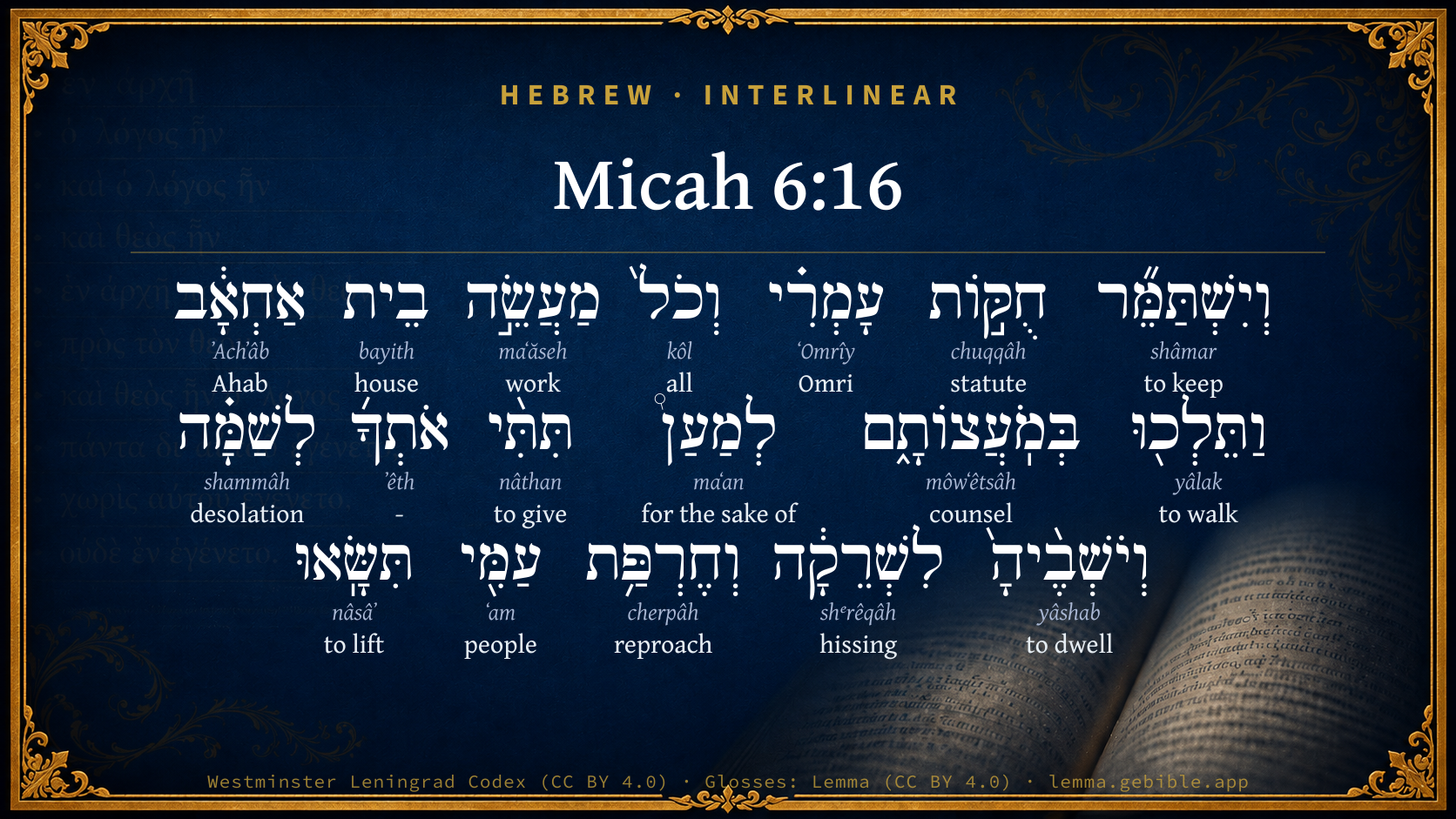
  1. וְיִשְׁתַּמֵּ֞ר shâmar H8104 “and · to keep” Conjunction + Verb, Hithpael, Imperfect, 3rd Person, Masculine, Singular
  2. חֻקּ֣וֹת chuqqâh H2708 “statutes of” Noun, Common, Both, Plural, Construct
  3. עָמְרִ֗י ʻOmrîy H6018 “Omri” Noun, Proper
  4. וְכֹל֙ kôl H3605 “and · all of” Conjunction + Noun, Common, Masculine, Singular, Construct
  5. מַעֲשֵׂ֣ה maʻăseh H4639 “work of” Noun, Common, Masculine, Singular, Construct
  6. בֵית bayith H1004 “house of” Noun, Common, Masculine, Singular, Construct
  7. אַחְאָ֔ב ʼAchʼâb H256 “Ahab” Noun, Proper
  8. וַתֵּלְכ֖וּ yâlak H3212 “and · to walk” Conjunction + Verb, Qal, Sequential Imperfect, 2nd Person, Masculine, Plural
  9. לְמַעַן֩ maʻan H4616 “for the sake of” Preposition
  10. תִּתִּ֨י nâthan H5414 “to give · me” Verb, Qal, Infinitive Construct + Suffix, Personal, 1st Person, Common, Singular
  11. אֹתְךָ֜ ʼêth H853 “- · you” Particle, Direct Object + Suffix, Personal, 2nd Person, Masculine, Singular
  12. לְשַׁמָּ֗ה shammâh H8047 “to/for · desolation” Preposition + Noun, Common, Feminine, Singular, Absolute
  13. וְיֹשְׁבֶ֨יהָ֙ yâshab H3427 “and · dwelling · her” Conjunction + Verb, Qal, Participle Active, Masculine, Plural, Construct + Suffix, Personal, 3rd Person, Feminine, Singular
  14. לִשְׁרֵקָ֔ה shᵉrêqâh H8322 “to/for · hissing” Preposition + Noun, Common, Feminine, Singular, Absolute
  15. וְחֶרְפַּ֥ת cherpâh H2781 “and · reproach of” Conjunction + Noun, Common, Feminine, Singular, Construct
  16. עַמִּ֖י ʻam H5971 “people · my” Noun, Common, Masculine, Singular, Construct + Suffix, Personal, 1st Person, Common, Singular
  17. תִּשָּֽׂאוּ nâsâʼ H5375 “to lift” Verb, Qal, Imperfect, 2nd Person, Masculine, Plural

About this verse

These counts appear in no published source. They are computed here, from the morphology-tagged text and Lemma’s own curated glosses. What Lemma adds →

18
words
18
distinct lemmas
Prophets
section

Notable vocabulary

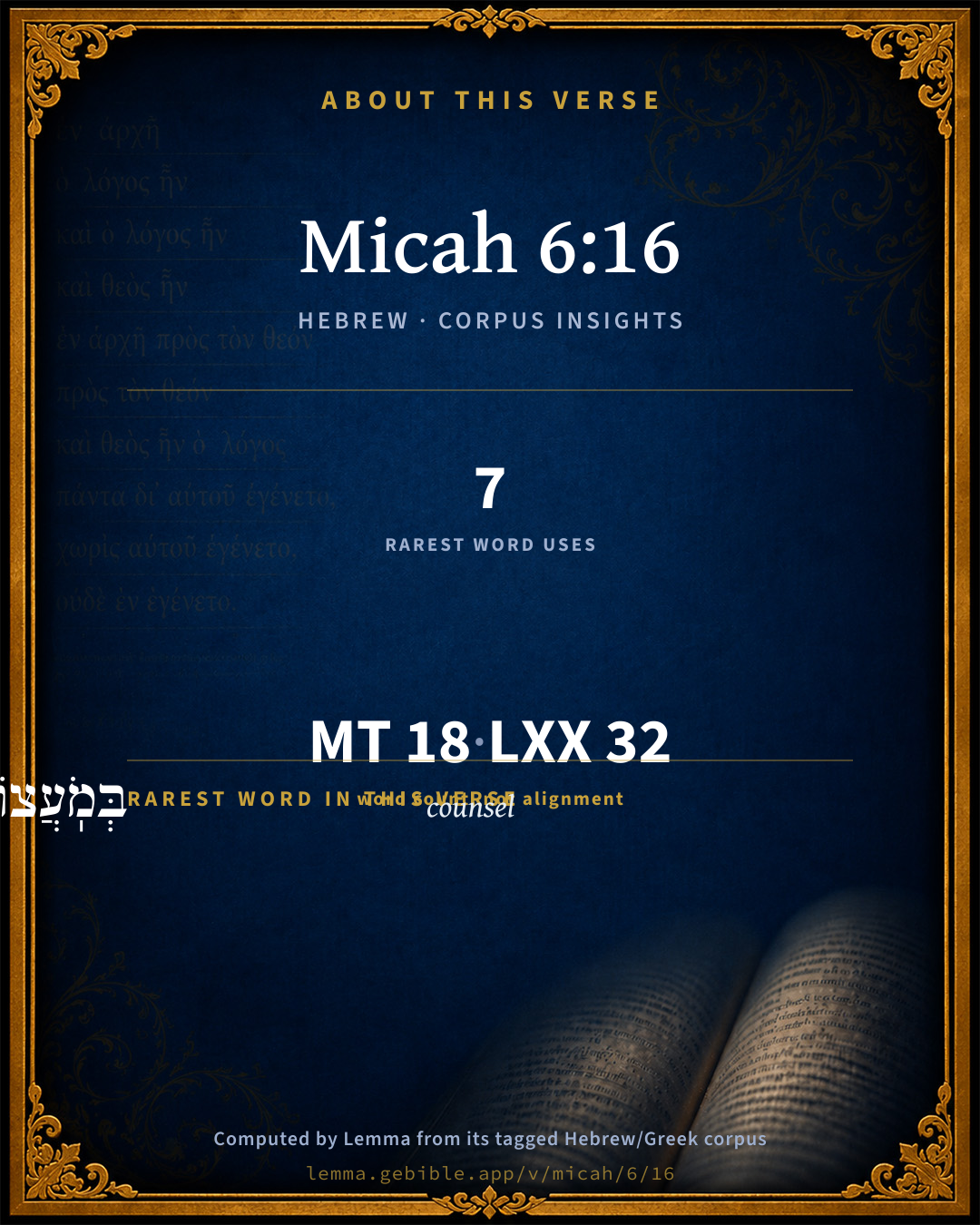
The rarest word here is בְּמֹֽעֲצוֹתָ֑ם counsel H4156 — appearing just 7 times in the whole Hebrew Bible.

Shared distinctive vocabulary

בְּמֹֽעֲצוֹתָ֑ם counsel H4156 occurs in 7 verses of the Hebrew Bible. Also found in:

Grammatical profile

  • 5 verbs
  • 11 nouns
  • 1 preposition
  • 1 particle

Verb forms

  • וְיִשְׁתַּמֵּ֞ר Hithpael · Imperfect
  • וַתֵּלְכ֖וּ Qal · Sequential Imperfect
  • תִּתִּ֨י Qal · Infinitive Construct
  • וְיֹשְׁבֶ֨יהָ֙ Qal · Participle Active
  • תִּשָּֽׂאוּ Qal · Imperfect

Hebrew & Septuagint length

In English translation the verse runs 42 words from the Hebrew and 49 from the Septuagint (LXX English) — closely comparable.

A rough comparison of the two English renderings, which tokenize alike — not a word-level alignment.

Word counts can differ between the Hebrew and the Greek without any difference in meaning — e.g. the Hebrew direct-object marker אֵת has no separate Greek word, and Greek often adds the article ὁ.

In the original languages it is 18 Hebrew tokens and 32 Greek tokens — but the two are counted differently (Hebrew bundles its prefixes and suffixes into one token; the Greek is in lemma form), so that isn’t a like-for-like length.

Cross-references

24

Topical passages linked to Micah 6:16 in the Treasury of Scripture Knowledge — connected by theme and wording, ordered by reader-vote popularity; previews shown in the World English Bible.

  • Jeremiah 51:51 We are confounded, because we have heard reproach; confusion has covered our faces: for strangers are come into the sanctuaries of Yahweh's house.
  • 1 Kings 16:25–33 Omri did that which was evil in the sight of Yahweh, and dealt wickedly above all who were before him.
  • Psalms 44:13 You make us a reproach to our neighbors, A scoffing and a derision to those who are around us.
  • Isaiah 25:8 He has swallowed up death forever; and the Lord Yahweh will wipe away tears from off all faces; and the reproach of his people will he take away from off all the earth: for Yahweh has spoken it.
  • Jeremiah 7:24 But they didn't listen nor turn their ear, but walked in [their own] counsels [and] in the stubbornness of their evil heart, and went backward, and not forward.
  • 1 Kings 21:25–26 (But there was none like Ahab, who did sell himself to do that which was evil in the sight of Yahweh, whom Jezebel his wife stirred up.
  • Jeremiah 19:8 I will make this city an astonishment, and a hissing; everyone who passes thereby shall be astonished and hiss because of all the plagues of it.
  • 1 Kings 9:8 Though this house is so high, yet shall everyone who passes by it be astonished, and shall hiss; and they shall say, Why has Yahweh done thus to this land, and to this house?
  • 1 Kings 18:4 for it was so, when Jezebel cut off the prophets of Yahweh, that Obadiah took one hundred prophets, and hid them by fifty in a cave, and fed them with bread and water.)
  • 2 Kings 16:3 But he walked in the way of the kings of Israel, yes, and made his son to pass through the fire, according to the abominations of the nations, whom Yahweh cast out from before the children of Israel.
  • 2 Kings 21:3 For he built again the high places which Hezekiah his father had destroyed; and he reared up altars for Baal, and made an Asherah, as did Ahab king of Israel, and worshiped all the host of the sky, and served them.
  • 2 Chronicles 29:8–9 Therefore the wrath of Yahweh was on Judah and Jerusalem, and he has delivered them to be tossed back and forth, to be an astonishment, and a hissing, as you see with your eyes.
  • 2 Chronicles 34:25 Because they have forsaken me, and have burned incense to other gods, that they might provoke me to anger with all the works of their hands; therefore is my wrath poured out on this place, and it shall not be quenched.
  • Psalms 1:1 Blessed is the man who doesn't walk in the counsel of the wicked, Nor stand in the way of sinners, Nor sit in the seat of scoffers;
  • Isaiah 9:16 For those who lead this people cause them to err; and those who are led of them are destroyed.
  • Jeremiah 18:15–16 For my people have forgotten me, they have burned incense to false [gods]; and they have been made to stumble in their ways, in the ancient paths, to walk in byways, in a way not built up;
  • Jeremiah 21:8–9 To this people you shall say, Thus says Yahweh: Behold, I set before you the way of life and the way of death.
  • Jeremiah 25:9 behold, I will send and take all the families of the north, says Yahweh, and [I will send] to Nebuchadrezzar the king of Babylon, my servant, and will bring them against this land, and against the inhabitants of it, and against all these nations round about; and I will utterly destroy them, and make them an astonishment, and a hissing, and perpetual desolations.
  • Lamentations 5:1 Remember, Yahweh, what has come on us: Look, and see our reproach.
  • Ezekiel 8:17–18 Then he said to me, Have you seen [this], son of man? Is it a light thing to the house of Judah that they commit the abominations which they commit here? for they have filled the land with violence, and have turned again to provoke me to anger: and, behold, they put the branch to their nose.
  • Ezekiel 39:26 They shall bear their shame, and all their trespasses by which they have trespassed against me, when they shall dwell securely in their land, and none shall make them afraid;
  • Daniel 9:16 Lord, according to all your righteousness, let your anger and please let your wrath be turned away from your city Jerusalem, your holy mountain; because for our sins, and for the iniquities of our fathers, Jerusalem and your people are become a reproach to all who are round about us.
  • Hosea 5:11 Ephraim is oppressed, He is crushed in judgment; Because he is intent in his pursuit of idols.
  • Revelation 2:20 But I have this against you, that you tolerate your woman, Jezebel, who calls herself a prophetess. She teaches and seduces my servants to commit sexual immorality, and to eat things sacrificed to idols.

Cross-references courtesy of OpenBible.info (CC BY 4.0).

Hebrew and Greek witnesses Masoretic Hebrew ↔ Greek Septuagint

The same verse in the two great witnesses to the Old Testament, shown verse-for-verse.

These are two independent witnesses, not word-aligned to each other, and the Septuagint is shown in lemma (dictionary) form.

Hebrew Micah 6:16 Masoretic · Westminster Leningrad Codex

וְיִשְׁתַּמֵּ֞ר חֻקּ֣וֹת עָמְרִ֗י וְכֹל֙ מַעֲשֵׂ֣ה בֵית אַחְאָ֔ב וַתֵּלְכ֖וּ בְּמֹֽעֲצוֹתָ֑ם לְמַעַן֩ תִּתִּ֨י אֹתְךָ֜ לְשַׁמָּ֗ה וְיֹשְׁבֶ֨יהָ֙ לִשְׁרֵקָ֔ה וְחֶרְפַּ֥ת עַמִּ֖י תִּשָּֽׂאוּ

For the statutes of Omri are kept, And all the works of the house of Ahab. You walk in their counsels, That I may make you a ruin, And her inhabitants a hissing; And you will bear the reproach of my people."

World English Bible · Public Domain

Greek LXX Micah 6:16 Septuagint · lemma form

καί φυλάσσω ὁ δικαίωμα ζαμβρι καί πᾶς ὁ ἔργον οἶκος αχααβ καί πορεύομαι ἐν ὁ βουλή αὐτός ὅπως παραδίδωμι σύ εἰς ἀφανισμός καί ὁ καταοἰκέω αὐτός εἰς συρισμός καί ὄνειδος λαός λαμβάνω

For you have kept the statues of Zambri, and done all the works of the house of Achaab; and you⌃ have walked in their ways, that I might deliver you to utter destruction, and those that inhabit the city to hissing: and you⌃ shall bear the reproach of nations.

LXX2012 (modern English Septuagint) · Public Domain

On this verse, Whedon's Commentary on the Bible discusses the Septuagint’s reading. Read the note in Commentary ↓

Hebrew: Westminster Leningrad Codex (CC BY 4.0). Greek: Septuagint (public domain); English from LXX2012 (modern English Septuagint) (Public Domain). How the Septuagint differs from the Hebrew →

Targum (Aramaic paraphrase)

1

The Targum is the ancient Jewish Aramaic paraphrase of the Hebrew Scriptures — an interpretive translation, not the Hebrew text itself. Onkelos (literal) and Pseudo-Jonathan (expansive) render the Torah, and Jonathan the Prophets. Coverage is partial: where no permissively-licensed English translation exists for a verse, only the Aramaic is shown. This is verse-level text, not a word-by-word alignment to the Hebrew.

  1. Targum Jonathan Prophets (Joshua–Malachi)
    וְעַל דִי נְטַרְתּוּן גְזִירַת בֵּית עָמְרִי וַעֲבַדְתּוּן עוֹבָדֵי בֵּית אַחְאָב וְהַלַכְתּוּן בְּנִימוֹסֵיהוֹן בְּדִיל לְמִמְסַר יָתָךְ לְצָדוּ וְיָתְבָאָה לְאִשְׁתְּמָמוּ וַחֲסִידֵי עַמִי תְּקַבְּלוּן:

    (no public-domain English translation for this verse)

    Targum Jonathan — Aramaic: “Mikraot Gedolot” (public domain). English: “Sefaria Community Translation” (CC0 1.0 (public-domain dedication)); “London "Chaldee Paraphrase," 1871” (public domain). Text via Sefaria.

Commentary

Notes on Micah 6:16 from classic Christian and Jewish commentators (each source and its license shown beneath its notes). The classic Christian expositions comment on the surrounding passage and are grouped to its opening verse, so a note may address several verses; the Jewish commentaries on the Tanakh (Rashi and others) are per-verse, so they appear only where the commentator wrote on this verse.

Lemma curates 59 commentaries, every one of them public domain or Creative Commons licensed, each selected and text-cleaned for this edition rather than reprinted as found. About our sources →

Trapp's Complete Commentary

John Trapp

Mic 6:16 For the statutes of Omri are kept, and all the works of the house of Ahab, and ye walk in their counsels; that I should make thee a desolation, and the inhabitants thereof an hissing: therefore ye shall bear the reproach of my people.

Ver. 16. For the statutes of Omri are kept] Subest verbis hisce sarcasmus. Here the prophet taunteth them for their idolatry; and telleth them plainly what will be the issue of it: q.d. You think you deal wisely and take a safe course for yourselves, that together with Ephraim you are joined to idols, and have such great names as Omri and Ahab to countenance you therein. Omri’s statutes can be observed when mine lie neglected.

“ Haec tibi pro vili, sub pedibusque iacent ”( Ovid).

The works of the house of Ahab, that non-such, can be imitated, and their counsels embraced, when my work lies undone, and my counsel is rejected, Luk 7:30. "Full well" (καλως, sane, bene) "ye reject the commandment of God" (being ingrati gratiae Dei, unthankful of the grace of God, as Ambrose speaketh), "that ye may keep your own tradition," Mar 7:9. And do not the Papists even the very same at this day. The Pope’s canons are kept exactly, and all the rites of the Church of Rome; they walk in the track of the Trent conventicle, and hold it worse to deface an idol than to kill a man; to eat flesh or eggs on a fasting day than to commit incest; to work on a holy day than to break the sabbath. There is no command of the moral law but they can dispense with it; but none of their ceremonial laws. Let God (say they, profanely) look to the breach of his own law; we will look to ours.

That I should make thee a desolation] Luther here observeth, that oppression and other violations of the second table God usually punisheth with war, famine, and pestilence; but breaches of the first table, and especially idolatry, with utter desolation. This is a land destroying sin, Jer 22:7-9.

Therefore ye shall bear the reproach of my people] That is, of such as had been my people, if you could have held you so; but you are now Loammi, disprivileged. Or, that which I threatened in the law long since to bring upon you, if ye carried not yourselves as my people; or, that which you deserved for having profaned the name and title of being my people, Eze 36:20; Eze 36:28 Rom 2:24 cf. Luk 12:47.

John Trapp, A Commentary or Exposition upon All the Books of the Old and New Testament (1647–1656) — public domain. Text from a community e-Sword module.

The Biblical Illustrator

Joseph S. Exell

Mic_6:16

And the statutes of Omri are kept

Omri and Ahab: lessons worth study

On the long dark roll of human infamy there are but few darker names than those of Omri and Ahab.

Learn--

I. The religious sentiment in man is often terribly perverted. Omri and Ahab were not idolaters themselves, but they established idolatry in their country. The religious sentiment in man is perhaps the substratum element of his nature. Man is made to worship, and to worship the one true and living God only. But so blinded is his intellect, so debased his nature, so utterly corrupt, that, instead of worshipping the infinitely great, he falls down before the infinitely contemptible. The perversity of the religious sentiment--

1. Explains the errors, crimes, and miseries of the world. Mans strongest love is the spring of all his activities, the fontal source of all his influence. When this is directed to an idol, the whole of his life is corrupted.

2. Reveals mans absolute need of the Gospel. There is nothing bug the Gospel of Christ that can give this sentiment a right direction.

II. That obedience to human sovereigns is sometimes a great crime. The worship of Baal was enacted by the statutes of Omri, and enforced by the practice of Ahab. A human law, enacted by the greatest sovereign in the world in connection with the most illustrious statesmen, if it is not in accord with the eternal principles of justice and truth, as revealed in Gods Word, should be repudiated, renounced, and transgressed. Whether it is right to obey God rather than men, judge ye.

III. That the crimes of even two men may exert a corrupting influence upon millions in future generations. The reigns of Omri and Ahab were ages before the time when Micah lived. Notwithstanding, their enactments were still obeyed, their examples were still followed, and their practices were still pursued. The wickedness of these two men was now, ages after, perpetrated by a whole nation. How great the influence of man for good or evil! Verily, one sinner destroyeth much good. (Homilist.)

.

The Biblical Illustrator, edited by Joseph S. Exell (c. 1880s–1900s) — public domain. Text from a community e-Sword module.

Joseph Benson's Commentary

Mic 6:16. For the statutes of Omri are kept — An idolatrous king, of whom it is said, 1Ki 16:25, that he did worse than all that were before him, and therefore we may judge of the corruption of the people who imitated the example, and followed the institutions of such a one. By his statutes, seem to be intended some idolatrous rites, which he instituted while he was king of Israel. And all the works of the house of Ahab, &c. — Ahab was the son of Omri, and exceeded his father and all his predecessors in impiety. He did more (it is said, 1Ki 16:33) to provoke the Lord God than all the kings of Israel that were before him. For he not only walked in the sins of Jeroboam, who instituted the worship of the golden calves, under which idolatrous representation Jehovah was worshipped, but he also went and served Baal, a false god, and built a house, or temple, and erected an altar for him in Samaria, &c., 1Ki 16:30-33. But, impious as Ahab was, he found imitators, not only in Israel, where he had power to command, but also in Judah. It is said, The works of the house of Ahab, because all his posterity followed his example in idolatry. And we learn, 2Ki 21:3, that even the king of Judah, Manasseh, reared up an altar for Baal, and made a grove, as did Ahab king of Israel. That I should make thee a desolation — The event will be, that the country and city shall be laid desolate; and the inhabitants thereof a hissing — That is, a subject of scorn and derision to their enemies. Therefore ye shall bear the reproach of my people — This is addressed to the rich men, spoken of Mic 6:12, and the meaning is, that the people in general should reproach them with being the principal cause of their calamities and desolation.

Joseph Benson's Commentary on the Old and New Testaments (1811–1818) — public domain. Text from a community e-Sword module.

Whedon's Commentary on the Bible

Daniel D. Whedon

Mic_6:16 sums up the sin and punishment of the people.

The statutes of Omri are kept — This is perhaps the best that can be done with the present Hebrew text, but the context and among the ancient versions LXX. and Peshitto suggest a slight change, so that it will read “thou didst keep,” and this is probably the original. The reign of Omri, one of the greatest kings of the northern kingdom, is passed over very briefly in 1Ki_16:21-28, but the statement is made that he dealt more wickedly than any king that went before him. The words of Micah are not to be understood as meaning that Omri actually made statutes enjoining wrongdoing, or that the people followed such statutes, but that they followed his example which exerted as much influence upon their conduct as written law could have done. “All the works of the house of Ahab” is similar in meaning to “statutes of Omri.” Ahab was condemned by his great contemporary Elijah for two reasons: (1) He tolerated and even encouraged the worship of Baal (1Ki_16:31-32); (2) he oppressed the poor and robbed them of their ancestral holdings (1 Kings 21). Micah has little to say about idolatry; it is rather oppression, violence, injustice, that he condemns. Hence “statutes of Omri” and “ways of the house of Ahab” are to be understood as referring not so much to religious apostasy as to the conduct of these kings illustrated in Ahab’s dealings with Naboth.

Ye walk — The change to the plural, here and in the last clause of the verse, is peculiar. If the plural is original it may be used to indicate that the individuals in the community are singled out and addressed personally; it is not impossible, however, that the change is due to the mistake of a copyist.

In their counsels — As expressed in their conduct.

From the sin the prophet turns to the judgment.

That I should make — They might have known better, and did know better; nevertheless they persisted in their iniquity, challenging, by their very conduct, Jehovah to do his worst (see on Amo_2:7). Of the three pronouns, “thee,” “thereof” (of it), “ye,” two are masculine in the original, one is feminine; two are singular, one is plural. It will be necessary, therefore, to distinguish between the persons addressed: “thee” refers to the nation (see on Mic_6:13); “thereof” to Jerusalem or, some think with less probability, to “desolation” — desolated land; “ye” to the individuals constituting the nation (see above). This seems a satisfactory explanation; others, however, alter the text so as to bring the pronouns in agreement with one another.

Desolation — While this is one meaning of the word, in parallelism with “hissing” the meaning suggested in the margin, “astonishment,” is to be preferred, or still better, “object of astonishment” or “of horror” (compare Deu_28:37; Jer_25:9; Jer_51:37).

Hissing — An object of hissing or derision.

The reproach of my people — The reproach which Israel, the chosen people of Jehovah, must bear when the heathen nations will triumph over it; for such a triumph will be to the conquerors a clear proof of Jehovah’s inability or unwillingness to help. LXX. reads, “the reproach of the nations,” that is, the reproach brought upon Israel by the surrounding nations. The latter may be the original reading (see on Joe_2:17).

Daniel D. Whedon (gen. ed.), Commentary on the Old and New Testaments (1874–1909) — public domain. Text from a community e-Sword module.

Keil & Delitzsch

C. F. Keil & F. Delitzsch

This trouble the people bring upon themselves by their ungodly conduct. With this thought the divine threatening is rounded off and closed. Mic 6:16. "And they observe the statutes of Omri, and all the doings of the house of Ahab, and so ye walk in their counsels; that I may make thee a horror, and her inhabitants a hissing, and the reproach of my people shall ye bear." The verse is attached loosely to what precedes by Vav. The first half corresponds to Mic 6:10-12, the second to Mic 6:13-15, and each has three clauses. השׁתּמּר, as an intensive form of the piel, is the strongest expression for שׁמר, and is not to be taken as a passive, as Ewald and others suppose, but in a reflective sense: "It (or one) carefully observes for itself the statutes of Omri instead of the statutes of the Lord" (Lev 20:23; Jer 10:3). All that is related of Omri, is that he was worse than all his predecessors (Kg1 16:25). His statutes are the Baal-worship which his son and successor Ahab raised into the ruling national religion (Kg1 16:31-32), and the introduction of which is attributed to Omri as the founder of the dynasty. In the same sense is Athaliah, who was a daughter of Jezebel, called a daughter of Omri in Ch2 22:2. All the doing of the house of Ahab: i.e., not only its Baal-worship, but also its persecution of the Lord's prophets (Kg1 18:4; Kg1 22:27), and the rest of its sins, e.g., the robbery and murder committed upon Naboth (1 Kings 21). With ותּלכוּ the description passes over into a direct address; not into the preterite, however, for the imperfect with Vav rel. does not express here what has been the custom in both the past and present, but is simply the logical deduction from what precedes, "that which continually occurs." The suffix attached to בּמעצותם refers to Ahab and Omri. By למען the punishment is represented as intentionally brought about by the sinners themselves, to give prominence to the daring with which men lived on in godlessness and unrighteousness. In אתך the whole nation is addressed: in the second clause, the inhabitants of the capital as the principal sinners; and in the third, the nation again in its individual members. שׁמּה does not mean devastation here; but in parallelism with שׁרקה, horror, or the object of horror, as in Deu 28:37; Jer 25:9; Jer 51:37, and Ch2 29:8. Cherpath ‛ammı̄: the shame which the nation of God, as such, have to bear from the heathen, when they are given up into their power (see Eze 36:20). This shame will have to be borne by the several citizens, the present supporters of the idea of the nation of God.

Keil & Delitzsch — Biblical Commentary on the Old Testament (1861–1891) — public domain (CC PDM 1.0). Text via the HelloAO Bible API. (Old Testament only.)

Tyndale Open Study Notes

Tyndale Open Resources

6:16 evil King Omri . . . wicked King Ahab: These kings began perhaps the most rebellious dynasty to reign in northern Israel (885–841 BC; 1 Kgs 16:23—2 Kgs 10:17), and Elijah condemned them to annihilation (2 Kgs 10:17). No northern kings of Israel followed the laws of Moses (cp. Mic 1:5-6). Omri and his son Ahab were the epitome of evil kings (e.g., 1 Kgs 18:4; 21:1-26). Omri’s dynasty was destroyed in 841 BC (2 Kgs 9:14–10:17), and the people of Israel who followed their evil example would similarly be destroyed.

Tyndale Open Study Notes — © Tyndale Open Resources, licensed CC BY-SA 4.0. Text via the HelloAO Bible API.

Geneva Bible (1599)

Geneva Bible translators

You have received all the corruption and idolatry, wherewith the ten tribes were infected under Omri and Ahab his son: and to excuse your doings, you allege the King’s authority by his statutes, and also wisdom and policy in so doing, but you shall not escape punishment: but as I have shown you great favor, and taken you for my people, so shall your plagues be accordingly, Luke 12:47.

Geneva Bible (1599) marginal notes — public domain. Text via Bolls.life.

Jamieson, Fausset & Brown

Robert Jamieson, A. R. Fausset & David Brown

statutes of Omri--the founder of Samaria and of Ahab's wicked house; and a supporter of Jeroboam's superstitions (Kg1 16:16-28). This verse is a recapitulation of what was more fully stated before, Judah's sin and consequent punishment. Judah, though at variance with Israel on all things else, imitated her impiety.

works of . . . Ahab-- (Kg1 21:25-26).

ye walk in their counsels--Though these superstitions were the fruit of their king's "counsels" as a master stroke of state policy, yet these pretexts were no excuse for setting at naught the counsels and will of God.

that I should make thee a desolation--Thy conduct is framed so, as if it was thy set purpose "that I should make thee a desolation."

inhabitants thereof--namely, of Jerusalem.

hissing-- (Lam 2:15).

the reproach of my people--The very thing ye boast of, namely, that ye are "My people," will only increase the severity of your punishment. The greater My grace to you, the greater shall be your punishment for having despised it, Your being God's people in name, while walking in His love, was an honor; but now the name, without the reality, is only a "reproach" to you.

Next: Micah Chapter 7

Jamieson, Fausset & Brown — Commentary Critical and Explanatory on the Whole Bible (1871) — public domain (CC PDM 1.0). Text via the HelloAO Bible API.

Adam Clarke's Commentary

Verse 16. The statutes of Omri are kept] Omri, king of Israel, the father of Ahab, was one of the worst kings the Israelites ever had; and Ahab followed in his wicked father's steps. The statutes of those kings were the very grossest idolatry. Jezebel, wife of the latter, and daughter of Ithobaal, king of Tyre, had no fellow on earth. From her Shakespeare seems to have drawn the character of Lady Macbeth; a woman, like her prototype, mixed up of tigress and fiend, without addition. Omri Ahab, and Jezebel, were the models followed by the Israelites in the days of this prophet.

The inhabitants thereof a hissing] לשרקה lishrekah, "for a shriek;" because those who should see them should be both astonished and affrighted at them.

There are few chapters in the prophets, or in the Bible, superior to this for genuine worth and importance. The structure is as elegant as it is impressive; and it is every way worthy of the Spirit of God.

Adam Clarke's Commentary on the Bible (1810–1826) — public domain. Text from a community e-Sword/MySword module.

John Calvin's Commentaries

Some read the words in the future tense, “And they will observe the statutes of Omri,” etc., and gather this meaning, — that the Prophet now foresees by the Spirit, that the people would continue so perverse in their sins, as to exclude every hope that they could be reformed by any punishments. The meaning then would be, “The Lord has indeed determined to punish sharply and severely the wickedness of this people; but they will not repent; they will nevertheless remain stupid in their obstinacy, and go on in their superstitions, which they have learned from the kings of Israel.” There is however another view, and one more generally approved and that is, — that the Jews, having forsaken God, and despised his Law, had turned aside to the superstitions of the kingdom of Israel. Hence he says, that observed were the decrees of Omri, and every work of the house of Ahab Omri was the father of Ahab, who was made king by the election of the soldiers, when Zimri, who had slain the king, was rejected. When Omri bought Samaria, he built there a city; and to secure honor to it, he added a temple; and hence idolatry increased. Afterwards his son Ahab abandoned himself to every kind of superstition. Thus matters became continually worse. Hence the Prophet, by mentioning here king Omri and his posterity, (included in the words, “the house of Ahab”) clearly means, that the Jews who had purely worshipped God, at length degenerated, and were now wholly unlike Israelites, as they had embraced all those abominations which Omri and his son Ahab had devised. True religion as yet prevailed in the tribe of Judah, though the kingdom of Israel was become corrupt, and filthy superstitions had gained the ascendancy: but in course of time the Jews became also implicated in similar superstitions. Of this sin the Prophet now accuses them; that is, that they made themselves associates with the Israelites: Observed then are the edicts of Omri, and the whole work of the house of Ahab: Ye walk, he says, (the future here means a continued act, as often elsewhere,) ye walk in their counsels.

It must be observed, that the Prophet here uses respectable terms, when he says that הקעת, chekut, statutes or decrees, were observed; and when he adds, “the counsels” of the kings of Israel: but yet this is in no way stated as an excuse for them; for though men may not only be pleased with, but also highly commend, their own devices, yet the Lord abominates them all. The Prophet no doubt designedly adopted these words, in order to show that those pretenses were frivolous and of no account, which superstitious men adduce, either to commend or to excuse their own inventions. They ever refer to public authority, — “This has been received by the consent of all; that has been decreed; it is not the mistake of one or two men; but the whole Church has so determined: and kings also thus command; it would be a great sin not to show obedience to them.” Hence the Prophet, in order to show how puerile are such excuses, says, “I indeed allow that your superstitions are by you honorably distinguished, for they are approved by the edicts of your kings, and are received by the consent of the many, and they seem not to have been inconsiderately and unadvisedly, but prudently contrived, even by great men, who were become skillful through long experience.” But how much soever they might have boasted of their statutes and counsels, and however plausibly they might have referred to prudence and power in order to disguise their idolatries, yet all those things were of no account before God. By counsels, the Prophet no doubt meant that false kind of wisdom which always shines forth in the traditions of men; and by statutes, he meant the kingly authority.

We hence see that it is a vain thing to color over what is idolatrous, by alleging power on the one hand in its favor, and wisdom on the other. — How so? Because God will not allow dishonor to be done to him by such absurd things; but he commands us to worship him according to what is prescribed in his Word.

And now a denunciation of punishment follows, That I should deliver thee to desolation, and its inhabitants, etc. There is a change of person; the Prophet continually addresses the land, and under that name, the people, — that I should then deliver thee to exile, or desolation, and thine inhabitants to hissing It is a quotation from Moses: and by hissing he means the reproach and mockery to which men in a miserable state are exposed.

At last he adds, Ye shall bear the reproach of my people Some take the word, people, in a good sense, as though the Prophet had said here, that God would punish the wrongs which the rich had done to the distressed common people; but this view, in my judgment, is too confined. Others understand this by the reproach of God’s people, — that nothing would be more reproachful to the Jews, than that they had been the people of God; for it would redound to their dishonor and disgrace, that they, who had been honored by such an honorable name, were afterwards given up to so great miseries. But the passage may be otherwise explained: we may understand by the people of God the Israelites; as though the Prophet said, “Do ye not perceive how the Israelites have been treated? Were they not a part of my people? They were descendants from the race of Abraham as well as you; nor can you boast of a higher dignity: They were then equal to you in the opinion of all; and yet this privilege did not hinder my judgment, did not prevent me from visiting them as they deserved.” Such a view harmonizes with the passage: but there is, as I think, something ironical in the expression, “my people;” as though he said, “The confidence, that ye have been hitherto my people, hardens you: but this false and wicked boasting shall increase your punishment; for I will not inflict on you an ordinary punishment, as on heathens and strangers; but I shall punish your wickedness much more severely; for it is necessary, that your punishment should bear proportion to my favor, which has been so shamefully and basely despised by you.” Hence, by the reproach of God’s people, I understand the heavier judgments, which were justly prepared for all the ungodly, whom God had favored with such special honor, as to regard them as his people: for the servant, who knew his master’s will, and did it not, was on that account more severely corrected, Luke 12:47. Let us now proceed —

John Calvin's Commentaries (1540-1563) — public domain. Text from the Calvin Translation Society English edition (1840s-50s) via the Christian Classics Ethereal Library (ccel.org). Calvin's coverage is partial (roughly two-thirds of the Bible); uncommented books and verses are honest gaps, never fabricated. The 19th-century editor's footnotes and remarks are omitted so the notes are faithfully Calvin's own voice.

Ellicott's Commentary for English Readers

(16) The statutes of Omri.—The people of Judah, instead of keeping the commandments of the Lord diligently, adopted the statutes of the house of Omri, the founder of the idolatrous dynasty of Ahab. They reproduced the sins of the northern kingdom, and their conduct was aggravated by the advantages vouchsafed to them. The greatness of their reproach should therefore be in proportion to the greatness of the glory which properly belonged to them as the people of God.

A Bible Commentary for English Readers, edited by Charles John Ellicott (1878–1897) — public domain. Text from a community e-Sword module.

The Cambridge Bible for Schools and Colleges

gen. ed. J. J. S. Perowne

16. the statutes of Omri] ‘Statutes’ is here used in a religious sense = ceremonies or rules of worship (as Jer_10:3, Lev_20:7, 2Ki_17:34). Omri is said to have ‘done worse than all [the kings] that were before him.’ Little more is recorded of him in 1 Kings, but the Assyrians always associated his name with that of his kingdom: the northern realm has for its Assyrian name Bit Khumri ‘place of Omri.’ ‘The statutes of Omri’ and ‘the works of the house of Ahab’ (Omri’s son) are of course the worship of Baal (comp. 1Ki_16:31-32). ‘The separation of the kingdoms had not broken the subtle links that connected Judah with the greater Israel of the north’ (Prof. Robertson Smith, The Old Testament in the Jewish Church, p. 345). Hence the low religious state of the kingdom of Israel reacted most injuriously on the kingdom of Judah.

in their counsels] i.e. in those of Omri and Ahab. It is singular that these two should be the only kings of N. Israel mentioned in the prophetical books.

the reproach of my people] i.e. the reproach which attaches to the people of Jehovah when it is cast out of ‘Jehovah’s land’ (Hos_9:3). Most probably, however, we should read, ‘the reproach of the peoples’ (comp. Eze_34:29; Eze_36:6). The final m may have dropped out, or the sign of abbreviation may have been overlooked.

This latter part of the verse assumes a different form in the versions. Upon what text they are based is uncertain; but they all agree in rendering “fearers of (his) name” (the pronoun is omitted in Targ.), and (except Targ.) ‘tribe’ for ‘rod.’ Hence Ewald renders, ‘Hear, O tribe, and thou who summonest it.’ The Septuagint also changes the ‘yet’ of Mic_6:10 into ‘city,’ and connects it with Mic_6:9. Following up these traces of what he conceives to be the original reading, Roorda restores, ‘And they that fear his name have heard wisdom. He hath declared who is he that stirreth up his rod.’

The Cambridge Bible for Schools and Colleges (gen. ed. J. J. S. Perowne; Cambridge University Press, 1878–1918) — public domain. Text from a community e-Sword module.

John Gill's Exposition

For the statutes of Omri are kept,.... Who of a captain of the army was made king of Israel, and proved a wicked prince; he built Samaria, and set up idolatrous worship there, after the example of Jeroboam, in whose ways he walked, and, as it seems, established the same by laws and edicts; and which were everyone of them observed by the Israelites, in the times of the prophet, though at the distance of many years from the first making of them, which aggravated their sin; nor would it be any excuse of them that what they practised was enjoined by royal authority, since it was contrary to the command of God; for the breach of which, and their observance of the statutes of such a wicked prince, they are threatened with the judgments of God; see Kg1 16:16;

and all the works of the house of Ahab; who was the son of Omri, and introduced the worship of Baal, and added to the idolatry of the calves, which he and his family practised; and the same works were now done by the people of Israel:

and ye walk in their counsels; as they advised and directed the people to do in their days:

that I should make thee a desolation; the city of Samaria, the metropolis of Israel, or the whole land, which was made a desolation by Shalmaneser, an instrument in the hand of God; and this was not the intention and design of their walking in the counsels and after the example of their idolatrous kings, but the consequence and event of so doing:

and the inhabitants thereof an hissing; either of Samaria, or of all the land, who should become the scorn and derision of men, when brought to ruin for their sins:

therefore ye shall bear the reproach of my people; that which was threatened in the law to the people of God, when disobedient to him; or shameful punishment for profaning the name and character of the people of God they bore; or for reproaching and ill using the poor among the people of God; and so it is directed to the rich men before spoken of, and signifies the shame and ignominy they should bear, by being carried captive into a foreign land for their sins.

Next: Micah Chapter 7

John Gill's Exposition of the Whole Bible (1746–1763) — public domain (CC PDM 1.0). Text via the HelloAO Bible API.

Albert Barnes' Notes on the Bible

For the statutes of Omri are kept - Rather, (like the English margin he doth much keep,) And he doth keep diligently for himself. Both ways express much diligence in evil . To “keep God’s commandments” was the familiar phrase, in which Israel was exhorted, by every motive of hope and fear, to obedience to God. “I know him,” God says of Abraham, “that he will command his children and his household after him, and they shall keep the way of the Lord, to do judgment and justice” Gen 18:19. This was the fundamental commandment immediately after the deliverance from Eyypt upon their first murmuring. “The Lord made there” (at Marah) “for them a statute and ordinance, and said, If thou wilt diligently hearken to the voice of the Lord thy God, and wilt do that which is right in His sight, and wilt give ear to His commandments and keep all His statutes, I will put none of these diseases upon thee which I have brought upon the Egyptians” Exo 15:25-26.

In this character Ha revealed Himself on Mount Sinai, as “shewing mercy unto thousands of them that love Me and keep My commandments” Exo 20:6. This was their covenant, “Thou hast avouched the Lord this day to be thy God and to walk in His ways, and to keep His statutes and His commandments and His judgments and to hearken unto His voice” Deu 26:17. This was so often enforced upon them in the law, as the condition upon which they should hold their land, if they kept the covenant (Exo 19:5; the words of this covenant, Deu 29:9), the commmandments Lev 22:31; Lev 26:3; Deu 4:2; Deu 6:17; Deu 7:11; Deu 8:6, Deu 8:11; Deu 10:13; Deu 11:1, Deu 11:8, Deu 11:22; Deu 13:5; Deu 15:5; Deu 19:9; Deu 27:1; Deu 28:9; Deu 30:10, the judgments Lev 18:5, Lev 18:26; Lev 20:22; Deu 7:11; Deu 8:11; Deu 11:1, the statutes (Lev 18:5, Lev 18:26; Lev 20:8, Lev 20:22; Deu 4:40; Deu 6:17; Deu 7:11; Deu 10:13; Deu 11:1; Deu 30:10), the testimonies Deu 6:17, the charge Lev 18:30; Deu 11:1 of the Lord. Under this term all the curses of the law were threatened, if they “hearkened not unto the voice of the Lord their God, to keep His commandments and His statutes which He commanded them” Deu 28:15.

Under this again the future of good and evil was, in Solomon, set before the house of David; of unbroken succession on his throne, if “thou wilt keep My commandments; but contrariwise, if ye or your children will not keep My commandments and My statutes” 1Ki 9:4-6, banishment, destruction of the temple, and themselves to be “a proverb and a byword among all people” This was the object of their existence, 1Ki 9:7. “that they might keep His statutes and observe His laws” Psa 105:45. This was the summary of their disobedience, “they kept not the covenant of God” Psa 78:11. And now was come the contrary to all this. They had not kept the commandments of God; and those commandments of man which were the most contrary to the commandments of God, they had kept and did keep diligently. Alas! that the Christian world should be so like them! What iron habit or custom of man, what fashion, is not kept, if it is against the law of God? How few are not more afraid of man than God? Had God’s command run, Speak evil one of another, brethren, would it not have been the best kept of all His commandments? God says, speak not evil; custom, the conversation around, fear of man, say, speak evil; man’s commandment is kept; God’s is not kept. And no one repents or makes restitution; few even cease from the sin.

Scripture does not record, what was the special aggravation of the sin of Omri, since the accursed worship of Baal was brought in by Ahab , his son. But, as usual, “like father, like son.” The son developed the sins of the father. Some special sinfulness of Omri is implied, in that Athaliah, the murderess of her children, is called after her grandfather, Omri, not after her father, Ahab 2Ki 8:26; 2Ch 22:2. Heresiarchs have a deeper guilt than their followers, although the heresy itself is commonly developed later. Omri settled for a while the kingdom of Israel, after the anarchy which followed on the murder of Elah, and slew Zimri, his murderer.

Yet before God, he did worse than all before him, and be walked in all the way of Jeroboam 1Ki 16:25-26. Yet this too did not suffice Judah; for it follows, And all the doings of the house of Ahab, who again “did evil in the sight of the Lord above all that were before him and served Baal” 1 Kings 30–33; Ahab, to whom none “was like in sin, who did sell himself to work wickedness in the sight of the Lord” 1Ki 21:25. These were they, whose statutes Judah now kept, as diligently and accurately as if it had been a religious act. They kept, not the statutes of the Lord, “but the statutes of Omri;” they kept, as their pattern before their eyes, all the doings of the house of Ahab, his luxury, oppression, the bloodshedding of Naboth; and they walked onward, not, as God bade them, humbly with Him, but in their counsels. And what must be the end of all this? that I should make thee a desolation. They acted, as though the very end and object of all their acts were that, wherein they ended, their own destruction and reproach .

Therefore ye shall bear the reproach of My people - The title of the people of God must be a glory or a reproach. Judah had gloried in being God’s people, outwardly, by His covenant and protection; they Were envied for the outward distinction. They refused to be so inwardly, and gave themselves to the hideous, desecrating, worship of Baal. Now then what had been their pride, should be the aggravation of their punishment. Now too we hear of people everywhere zealous for a system, which their deeds belie. Faith, without love, (such as their character had been,) feels any insult to the relation to God, which by its deeds it disgraces. Though they had themselves neglected God, yet it was a heavy burden to them to bear the triumph of the pagan over them, that God was unable to help them, or had cast them off “These are the people of the Lord and are gone forth, out of His land” Eze 36:20. “Wherefore should they say among the pagan, where is their God?” (see the notes at Joe 2:17). “We are confounded, because we have heard reproach, shame hath covered our faces, for strangers are come into the sanctuaries of the Lord’s house” Jer 51:51. “We are become a reproach to our neighbors, a scorn and derision to them that are round about us” Psa 79:4. “Thou makest us a reproach to our neighbors, a scorn and derision to them that are round about us. Thou makest us a byword among the pagan, a shaking of the head among the people. My confusion is daily before me, and the shame of my face hath covered me, for the voice of him that slandereth and blasphemeth, by reason of the enemy and the avenger” Psa 44:13-16.

The words, “the reproach of My people,” may also include “the reproach wherewith God in the law Deu 28:36 threatened His people if they should forsake Him,” which indeed comes to the same thing, the one being the prophecy, the other the fulfillment. The word hissing in itself recalled the threat to David’s house in Solomon; “At this house, which is high, every one that passeth by it shall be astonished and hiss” 1Ki 9:8. Micah’s phrase became a favorite expression of Jeremiah . So only do God’s prophets denounce. It is a marvelous glimpse into man’s religious history, that faith, although it had been inoperative and was trampled upon without, should still survive; nay, that God, whom in prosperity they had forsaken and forgotten, should be remembered, when He seemed to forget and to forsake them. Had the captive Jews abandoned their faith, the reproach would have ceased. The words, “ye shall bear the reproach” of My people are,” at once, a prediction of their deserved suffering for the profanation of God’s Name by their misdeeds, and of their persverance in that faith which, up to that Time, they had mostly neglected.

Albert Barnes' Notes on the Bible (1834–1885) — public domain. Text from a community e-Sword/MySword module.

Haydock's Catholic Bible Commentary

The statutes of Amri, &c. The wicked ways of Amri and Achab, idolatrous kings. (Challoner) --- They were the most infamous of Israel, 3 Kings xvi. 25, 30. (Worthington) --- Hebrew, "the statutes of Amri are kept." Septuagint, "The precepts (ami) of my people shall parish" (Haydock) --- You, rich men. (Calmet) --- Septuagint, "you shall receive the reproach of people." (Haydock)

George Leo Haydock (1774–1849), Haydock's Catholic Family Bible and Commentary, 1859 edition — public domain. Excludes Psalms (Douay-Rheims chapter numbering differs from Protestant) and Deuterocanonical books (Catholic canon only).

Matthew Poole's English Annotations

The statutes of Omri; of which you read, 1Ki 16:25-28. He built Samaria, to be a royal city, and seat of religion brought in by Jeroboam; thus he both strengthened and put more credit upon the idolatrous worship, which was set up by Omri in a royal city. whereas by Jeroboam it was set up in places of meaner account.

Are kept; diligently, very much. All the works of the house of Ahab; summed up, in establishing Jeroboam’s idolatry, introducing the idolatrous worship of Baal, 1Ki 16:31-33, cutting off the prophets of the Lord, 1Ki 18:4; 19:10,14, and abolishing the true worship of God; besides the barbarous contriving the death of the innocent, and seizing the estate, 1Ki 21:8,9, &c.

And ye, of the house of Israel, though under the government of families which had no great reason to value the house of Ahab, yet you have done their works of idolatry and oppression, and you also of the house of Judah have degenerated and done like their works.

Ye walk in their counsels; literally fulfilled in Jehoram’s reign, acts, and counsels, 2Ki 8:17,18; and in Ahaziah’s, who was son of Jehoram, and grandson of Jehoshaphat, 2Ki 8:27; and so did Jehu, and his successors, all persist in the idolatry of the calf-worship, and in oppression of the poor: thus instead of walking humbly with God, they did openly depart from him, contrary to what God required of them.

That I should make thee, & c. eventually this was the end, or in necessary tendency it could not end otherwise, though they did not intend this, nor did God will them to do so that it might so end.

A desolation; an utter waste, such as should astonish those that saw it.

The inhabitants thereof, of the city or land, a hissing, in token of abhorrence and derision, Deu 28:37; Jer 25:9,18; 29:18.

Therefore ye shall bear the reproach of my people; the reproach threatened in the law, if my people forsake me; or, Jerusalem shall be as much reproached as Samaria; or as Eze 36:20.

Matthew Poole's English Annotations on the Holy Bible (1683–1685) — public domain. Text from a community e-Sword/MySword module.

The Pulpit Commentary

The threatening is closed by repeating its cause: the punishment is the just reward of ungodly conduct. The first part of the verse corresponds to vers. 10-12, the second part to vers. 13-15. The statutes of Omri. The statutes are the rules of worship prescribed by him of whom it is said (1Ki_16:25) that he "wrought evil in the eyes of the Lord, and did worse than all that were before him." No special "statutes" of his are anywhere mentioned; but he is named here as the founder of that evil dynasty which gave Ahab to Israel, and the murderess Athaliah (who is called in 2Ki_8:26, "the daughter of Omri to Judah. The people keep his statutes instead of the Lord"s. (Lev_20:22) The works of the house of Ahab are their crimes and sins, especially the idolatrous practices observed by that family, such as the worship of Baal, which became the national religion. (1Ki_16:31, etc.) Such apostasy had a disastrous effect upon the neighbouring kingdom of Judah. (2Ki_8:18) Walk in their counsels. Take your tone and policy from them. That I should make thee. "The punishment was as certainly connected with the sin, in the purpose of God, as if its infliction had been the end at which they aimed" (Henderson). The prophet hero threatens a threefold penalty, as he had mentioned a threefold guiltiness. A desolation; afanismon (Septuagint); perditionem (Vulgate). According to Keil, "an object of horror," as Deu_28:37 Jer_25:9. Micah addresses Jerusalem itself in the first clause, its inhabitants in the second, and the whole nation in the last. A hissing; i.e. an object of derision, as Jer_19:8 Jer_25:18, etc. Therefore (and) ye shall bear the reproach of my people. Ye shall have to hear yourselves reproached at the mouth of the heathen, in that, though ye were the Lord"s peculiar people, ye were cast out and given into the hands of your enemies. The Septuagint, from a different reading, renders, Kai oneidh lawn lhqesye , "Ye shall receive the reproaches of nations," which is like Eze_34:29 Eze_36:6, Eze_36:15.

The influence of evil men.

These are the last recorded words of Micah declarative of coming judgment; and they are deeply impressive as setting forth the influence exerted by evil men.

I ITS PERPETUITY. "For the statutes of Omri are kept, and all the works of the house of Ahab, and ye walk in their counsels" (ver. 16). God had separated this people from among the nations, and had specially favoured them with a revelation of his will. He had given unto them his pure Law. Their fathers had gathered in the olden time at Sinai, that "Separate from the world, their breast Might duly take and strongly keep The print of heaven to be exprest Ere long on Zion"s steep. (Keble.)

God had conferred signal honour upon them in constituting them the depositaries of his truth, and his witnesses unto the ends of the earth. They were bound by the most sacred obligations, the most solemn vows repeatedly renewed, and by pains and penalties too, "to keep his statues" and "to obey his commandments." But they lamentably failed to fulfil their high mission, and the failure is in no small degree traced in these records to the influence of their kings. Jeroboam, Omri, and Ahab stand out conspicuously in the history of the kingdom of Israel as having sinned and caused Israel to sin, and the evil influence thus exerted spread to the kingdom of Judah, and descended from generation to generation. One hundred and seventy years had passed since the death of Ahab, nearly two hundred since the death of Omri, and about two hundred and thirty since the death of Jeroboam; yet their pernicious influence was still felt, and the people were keeping their statutes instead of God"s, and walking in their ways instead of in "the way of holiness." It is clear, then, that, whilst we may by a true life be helpers, even to those who come after us, in all that is good, we may also, by the perversion of this power, prove hinderers to them, and keep them back from the highest bliss. Evil deeds as well as good actions have the stamp of permanence upon them. "Being dead," men "yet speak" for ill as for good. You cannot limit the influence of wrong doing to the men who commit it. Generations yet unborn will experience the dire effects of the sins men are committing now. "For the statutes of Omri" (ver. 16).

II ITS PERNICIOUSNESS. "That I should make thee," etc. (ver. 16). The injurious effects thus wrought in a nation are here specially set forth.

1. It leads on to national decay. "That I should make thee a desolation" (ver. 16).

2. It excites the contempt of the adversaries. "And the inhabitants thereof a hissing" (ver. 16).

3. It lays spiritual honour in the very dust, and causes the foes of God and of his truth to blaspheme. "Therefore ye shall bear the reproach of my people". (ver. 16; Eze_36:20 Psa_89:4 Psa_44:13-16)

Omri and Ahab: lessons worth study.

"For the statutes of Omri are kept, and all the works of the house of Ahab, and ye walk in their counsels; that I should make thee a desolation, and the inhabitants thereof a hissing: therefore ye shall bear the reproach of my people." On the long dark roll of human infamy there are few darker names than those of Omri and Ahab. The former, who at first was an officer in the army of Israel, (1Ki_16:30) through blood and slaughter took possession of the throne of Israel, which he held polluted and disgraced for twelve long years. He built Samaria and made it the capital of the ten tribes. Ahab was his son and his successor, and rivaled even his father in immorality and impiety. He established the worship of Baal as the national religion. I draw three lessons from this passage.

I THAT THE RELIGIOUS SENTIMENT IN MAN IS OFTEN TERRIBLY PERVERTED. Omri and Ahab were not only idolaters themselves, but established idolatry in their country. They worshipped Baal, the god that was worshipped by the Carthaginians, the Babylonians, the Assyrians, and others the, god, it is supposed, who is sometimes called Moloch, to whom the Ammonites made their cruel and bloody sacrifices. For the service of this god Ahab established a numerous hierarchy of priests. The religious sentiment in man is perhaps the fundamental element of his nature. Man is made to worship, and to worship the one true and living God only. But so blinded is his intellect, so debased his nature, so utterly corrupt, that, instead of worshipping the infinitely Great, he falls down before the infinitely contemptible. The perversity of the religious sentiment:

1. Explains the errors, crimes, and miseries of the world. Man"s strongest love is the spring of all his activities, the fontal source of all his influence. When this is directed to an idol, the whole of his life is corrupted.

2. Reveals mans absolute need of the gospel. There is nothing but the gospel of Christ that can give this sentiment a right direction.

II THAT OBEDIENCE TO HUMAN SOVEREIGNS IS SOMETIMES A GREAT CRIME. The worship of Baal was enacted by the "statutes" of Omri and enforced by the practice of Ahab. If the establishment of a religion by law can make it right, it was right that the people should worship Baal. But it was not right; it was wrong. A human law, enacted by the greatest sovereign in the world with the sanction of the most illustrious statesmen, if it is not in accord with the eternal principles of justice and truth, as revealed in God"s Word, should be repudiated, renounced, and transgressed. "Whether it is right to obey God rather than man, judge ye.

III THAT THE CRIMES OF EVEN TWO MEN MAY EXERT A CORRUPTING INFLUENCE UPON MILLIONS IN FUTURE GENERATIONS. The reigns of Omri and Ahab were ages before the time when Micah lived. Notwithstanding, their enactments were still obeyed, their examples were still followed, and their practices were still pursued. The wickedness of these two men was now, ages after, perpetrated by a whole nation. How great the influence of man for good or evil! Verily one sinner destroyeth much good. From one corrupt source may flow a stream of polluting influence that shall roll down all future times, widen and deepen in its course, and bear thousands on its bosom to crime and ruin. "Our many deeds, the thoughts that we have thought, They go out from us thronging every home; And in them all is folded up a power That on the earth doth move them to and fro: And mighty are the marvels they have wrought In hearts we know not and may never know. (F.W. Faber.) D.T.

The Pulpit Commentary (1880–1919), ed. H.D.M. Spence-Jones & Joseph S. Exell — public domain. Text from a community e-Sword module.

John Wesley's Explanatory Notes

The statutes - The idolatrous worship was set up by Omri in the royal city. Ye - O house of Israel. That I should make thee - This will be the event. Thereof - Of the land. The reproach - The reproach threatened in the law, if my people forsake me.

John Wesley, Explanatory Notes Upon the Whole Bible (1754–1765) — public domain. Text via the GEBible commentary corpus.

unfoldingWord translationNotes

Door43 World Missions Community

General Information:

Yahweh continues speaking to the people of Israel.

The regulations made by Omri have been kept, and all the deeds of the house of Ahab

This can be translated in active form, and you may need to supply the words that the ellipsis omitted. AT: "You have done what Omri commanded, and you have done the same things the house of Ahab did" (See: Active or Passive)

Omri ... Ahab

Both of these men were kings over the northern kingdom of Israel. God considered both of them to be very wicked. (See: How to Translate Names)

house of Ahab

The word "house" is a metonym for the family that lives in the house. AT: "the descendants of Ahab"

You walk by their advice

Walking on a path is a metaphor for how a person lives his life. AT: "You do what Omri and Ahab told the people to do" (See: Metaphor)

I will make you, city, a ruin, and you inhabitants an object of hissing

Micah speaks to the people of the city, who can hear him, as if he were speaking to the city itself, which cannot hear him. You may need to make explicit the words that the ellipsis omits. AT: "I will make your city a ruin, and I will make you inhabitants an object of hissing" or "I will make you, city, a ruin, and I will cause everyone who sees you, inhabitants of the city, to hiss at you" or "I will make the city a ruin, and I will make people hiss at the inhabitants" (See: Apostrophe)

you will bear the reproach of my people

"you will suffer because my people will reproach you"

translationWords

works

house

Ahab

walk

mock

people of God

unfoldingWord translationNotes — © Distant Shores Media and the Door43 World Missions Community, licensed CC BY-SA 4.0. Source: git.door43.org/Door43/en_tn.

Rashi

Rabbi Shlomo Yitzchaki (Rashi)

And the statutes of Omri shall be observed—I know that you will not obey Me, but through you and your children will all the statutes of Omri and Ahab [the evil kings of Israel] be observed.

and the disgrace of My people you shall bear—You shall bear the iniquity for the disgrace that the peoples of the world deride My people, for the Torah admonished them concerning (Deut. 25:14): “You shall not have in your house two kinds of ephah,” but they do not keep it.

Rashi on the Tanakh — English translations: “The Judaica Press complete Tanach with Rashi, translated by A. J. Rosenberg” (CC BY 4.0); “Pentateuch with Rashi's commentary by M. Rosenbaum and A.M. Silbermann, 1929-1934” (public domain); “The Metsudah Tanach series, Lakewood, N.J” (CC BY 4.0); and “The Book of Joshua, Metsudah Publications, 1997” (CC BY 4.0). Text via Sefaria.

Lesson kit

Teaching starters — assembled from the data on this page, not authored interpretation. Every prompt links to the verse data it draws on. Edit before teaching.

Micah, in the Prophets, opens this verse with 18 words (18 distinct Hebrew lemmas). Its most distinctive word is môwʻêtsâh (“counsel”). A historical commentator’s framing appears above. Read the whole chapter for the surrounding context.

Discussion questions

  1. The word môwʻêtsâh carries the sense “counsel.” How does it shape the verse?
  2. How does Psalms 5:10, which shares the word «counsel», read alongside this verse?
  3. The translations on this page render this verse differently — a whole-verse word diff, not a word-by-word alignment. What might account for the different wordings?
  4. «וְיִשְׁתַּמֵּ֞ר» is a Hithpael Imperfect verb. How does that grammatical form shape the action described?
  5. Compare how Trapp's Complete Commentary and The Biblical Illustrator read this verse. Where do they agree or differ?

Things to notice

Reading settings

Reading text

Shown beneath each verse's original-language words.

Old Testament
Old Testament edition

Read the OT as the Masoretic Hebrew (MT) or the Greek Septuagint (LXX).

English shown for the Greek Septuagint (in the Hebrew ↔ Greek comparison).

Comparing translations? Open the Compare panel on any verse page to stack up to four side by side.