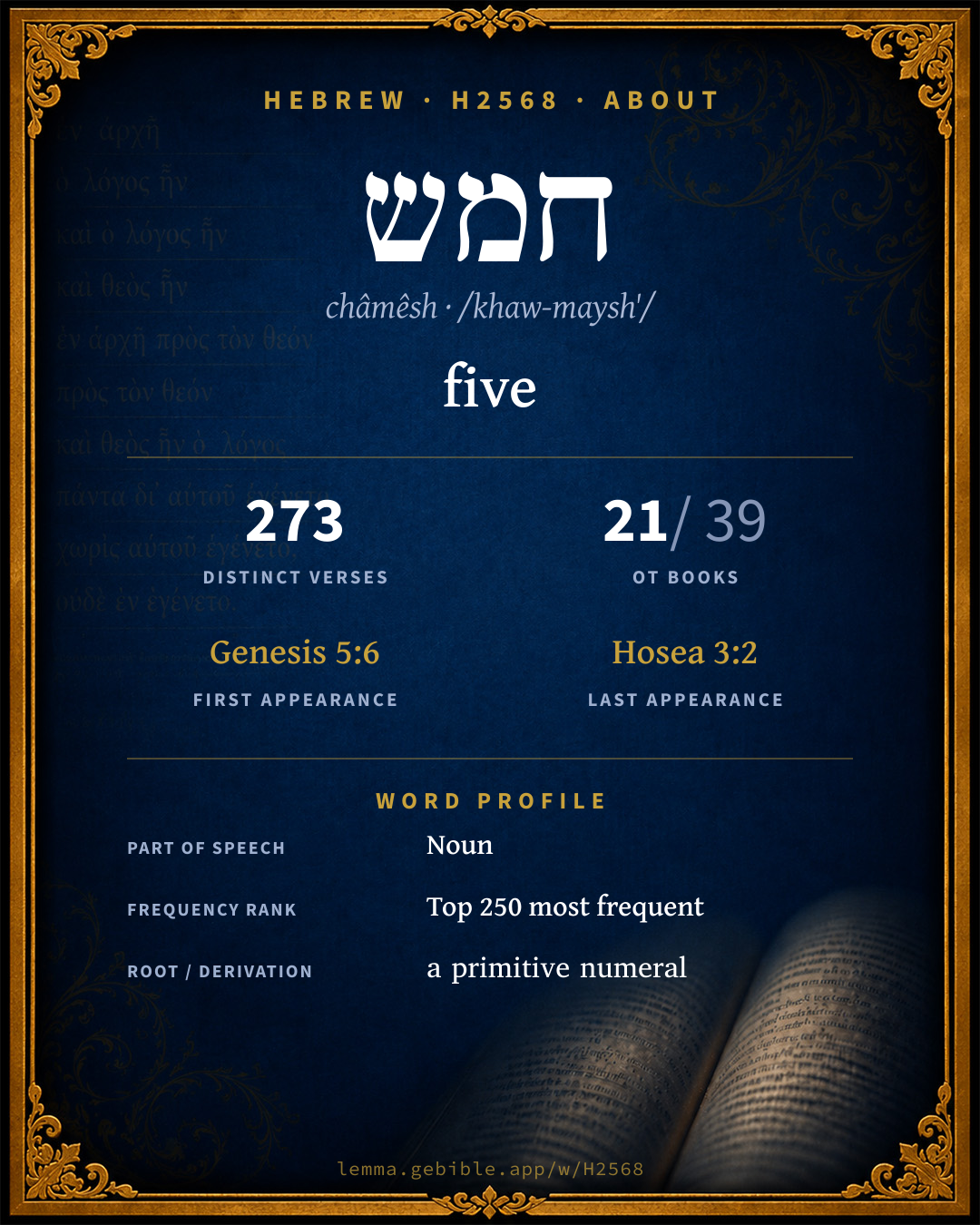
חָמֵשׁ
five
‘five’ is one of 4 main senses fuller range ↓
Full lexicon entry — Brown-Driver-Briggs (BDB)
From Brown-Driver-Briggs (BDB)
Where this word appears
Grammar key — what these labels mean
Part of speech
- Adjective
- A word that describes or qualifies a noun.
State
- Absolute
- The independent form of a noun, not bound to a following word.
- Construct
- A noun bound to a following noun in a possessive / “of” relationship (the construct chain).
Gender
- Feminine
- Grammatically feminine.
- Masculine
- Grammatically masculine.
Number
- Singular
- One.
Every verse where H2568 appears in the Book of Exodus — 25 distinct verses. Click any verse to open its interlinear word-by-word view. Verse text shown in the World English Bible for context — . Each verse’s Hebrew form is shown with its reference; the English is not keyword-highlighted, since the data carries no word-level English alignment. Use “Compare translations” on any verse to read it across multiple English versions. This concordance covers the Hebrew Bible; Septuagint (Greek Old Testament) occurrences are not indexed here.
Exodus
- Exodus 16:1 בַּ/חֲמִשָּׁ֨ה prep det + Adjective Cardinal number ms They took their journey from Elim, and all the congregation of the children of Israel came to the wilderness of Sin, which is between Elim and Sinai, on the fifteenth day of the second month after their departing out of the land of Egypt.
- Exodus 22:1 חֲמִשָּׁ֣ה adj Cardinal number ms "If a man steals an ox or a sheep, and kills it, or sells it; he shall pay five oxen for an ox, and four sheep for a sheep.
- Exodus 26:3 חֲמֵ֣שׁ וְ/חָמֵ֤שׁ adj Cardinal number fs conj + Adjective Cardinal number fs Five curtains shall be coupled together one to another; and the other five curtains shall be coupled one to another.
- Exodus 26:9 חֲמֵ֤שׁ adj Cardinal number fs You shall couple five curtains by themselves, and six curtains by themselves, and shall double over the sixth curtain in the forefront of the tent.
- Exodus 26:26 חֲמִשָּׁ֕ה adj Cardinal number ms "You shall make bars of acacia wood: five for the boards of the one side of the tent,
- Exodus 26:27 וַ/חֲמִשָּׁ֣ה וַ/חֲמִשָּׁ֣ה conj + Adjective Cardinal number ms conj + Adjective Cardinal number ms and five bars for the boards of the other side of the tent, and five bars for the boards of the side of the tent, for the far part westward.
- Exodus 26:37 חֲמִשָּׁה֙ חֲמִשָּׁ֖ה adj Cardinal number ms adj Cardinal number ms You shall make for the screen five pillars of acacia, and overlay them with gold: their hooks shall be of gold: and you shall cast five sockets of brass for them.
- Exodus 27:1 חָמֵשׁ֩ וְ/חָמֵ֧שׁ adj Cardinal number fs conj + Adjective Cardinal number fs "You shall make the altar of acacia wood, five cubits long, and five cubits broad; the altar shall be foursquare: and its height shall be three cubits.
- Exodus 27:14 וַ/חֲמֵ֨שׁ conj + Adjective Cardinal number fs The hangings for the one side of the gate shall be fifteen cubits; their pillars three, and their sockets three.
- Exodus 27:15 חְמֵ֥שׁ adj Cardinal number fs For the other side shall be hangings of fifteen cubits; their pillars three, and their sockets three.
- Exodus 27:18 חָמֵ֥שׁ adj Cardinal number fs The length of the court shall be one hundred cubits, and the breadth fifty every where, and the height five cubits, of fine twined linen, and their sockets of brass.
- Exodus 30:23 חֲמֵ֣שׁ adj Cardinal number fs "Also take fine spices: of liquid myrrh, five hundred shekels; and of fragrant cinnamon half as much, even two hundred and fifty; and of fragrant cane, two hundred and fifty;
- Exodus 30:24 חֲמֵ֥שׁ adj Cardinal number fs and of cassia five hundred, after the shekel of the sanctuary; and a hin of olive oil.
- Exodus 36:10 חֲמֵ֣שׁ וְ/חָמֵ֤שׁ adj Cardinal number fs conj + Adjective Cardinal number fs He coupled five curtains to one another, and the other five curtains he coupled one to another.
- Exodus 36:16 חֲמֵ֥שׁ adj Cardinal number fs He coupled five curtains by themselves, and six curtains by themselves.
- Exodus 36:31 חֲמִשָּׁ֕ה adj Cardinal number ms He made bars of acacia wood; five for the boards of the one side of the tent,
- Exodus 36:32 וַ/חֲמִשָּׁ֣ה וַ/חֲמִשָּׁ֤ה conj + Adjective Cardinal number ms conj + Adjective Cardinal number ms and five bars for the boards of the other side of the tent, and five bars for the boards of the tent for the hinder part westward.
- Exodus 36:38 חֲמִשָּׁה֙ חֲמִשָּׁ֖ה adj Cardinal number ms adj Cardinal number ms and the five pillars of it with their hooks. He overlaid their capitals and their fillets with gold, and their five sockets were of brass.
- Exodus 38:1 חָמֵשׁ֩ וְ/חָֽמֵשׁ adj Cardinal number fs conj + Adjective Cardinal number fs He made the altar of burnt offering of acacia wood. It was square. Its length was five cubits, its breadth was five cubits, and its height was three cubits.
- Exodus 38:14 חֲמֵשׁ adj Cardinal number fs The hangings for the one side were fifteen cubits; their pillars three, and their sockets three;
- Exodus 38:15 חֲמֵ֥שׁ adj Cardinal number fs and so for the other side: on this hand and that hand by the gate of the court were hangings of fifteen cubits; their pillars three, and their sockets three.
- Exodus 38:18 חָמֵ֣שׁ adj Cardinal number fs The screen for the gate of the court was the work of the embroiderer, of blue, purple, scarlet, and fine twined linen. Twenty cubits was the length, and the height in the breadth was five cubits, like to the hangings of the court.
- Exodus 38:25 וַ/חֲמִשָּׁ֧ה conj + Adjective Cardinal number ms The silver of those who were numbered of the congregation was one hundred talents, and one thousand seven hundred seventy-five shekels, after the shekel of the sanctuary:
- Exodus 38:26 וַ/חֲמֵ֥שׁ conj + Adjective Cardinal number fs a beka a head, that is, half a shekel, after the shekel of the sanctuary, for everyone who passed over to those who were numbered, from twenty years old and upward, for six hundred three thousand five hundred fifty men.
- Exodus 38:28 וַ/חֲמִשָּׁ֣ה conj + Adjective Cardinal number ms Of the one thousand seven hundred seventy-five shekels he made hooks for the pillars, overlaid their capitals, and made fillets for them.
About this entry
At a glance — auto-summarized from this page’s data, not written by a person. Every figure links to its source below. This summary describes the numbers; it doesn’t interpret them.
חמש — transliterated châmêsh — is a Hebrew noun carrying the sense “five.” The lexicon spreads it across several senses; see its full sense range. With 273 verses in 21 books, it is a common word in the Hebrew Bible. Debuting at Genesis 5:6, it then recurs through the corpus. Sharing its root, it stands alongside חמישי, חמש and חמשים. See the sense tree, 273-verse concordance, and the renderings breakdown below.
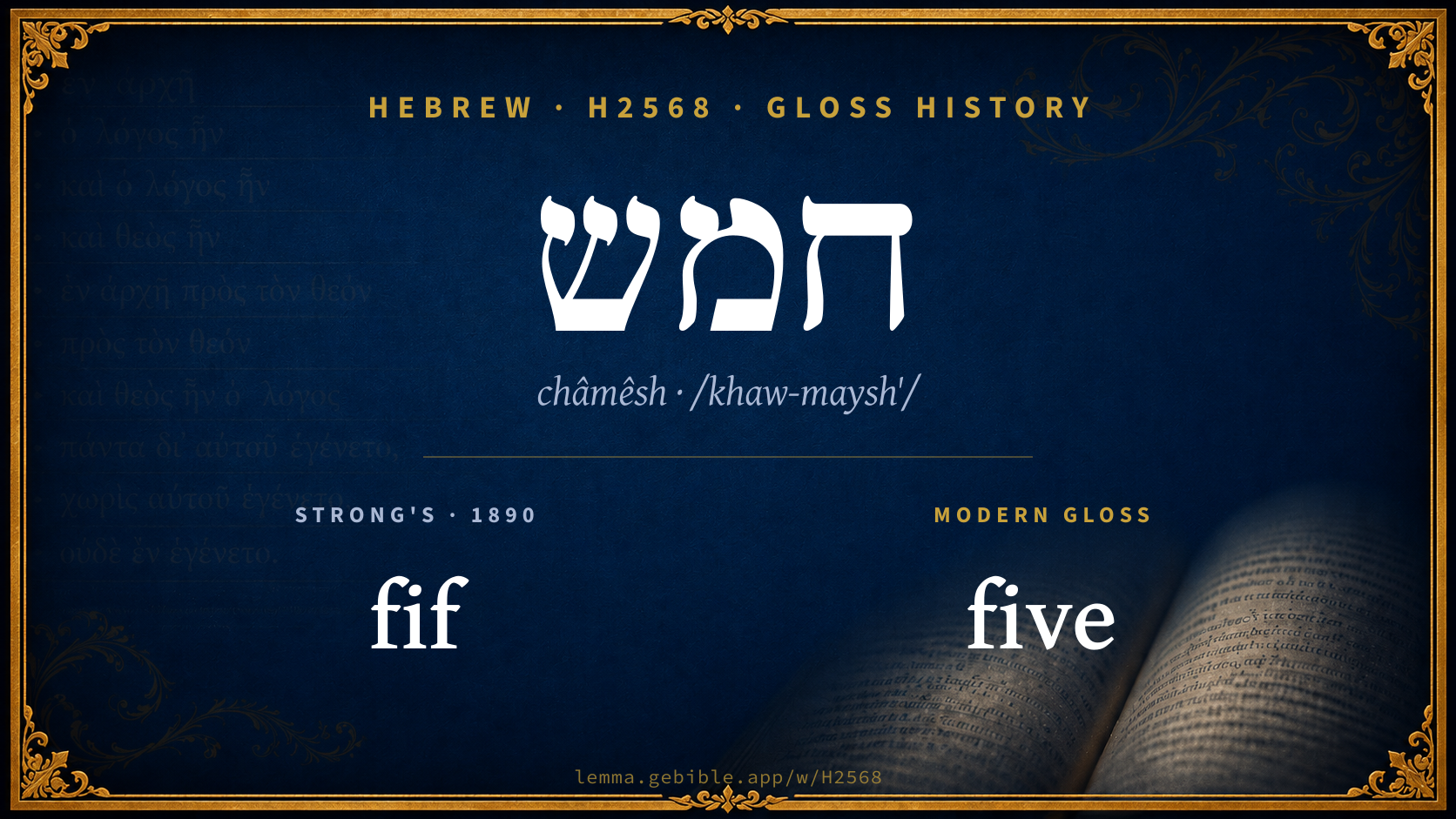
Gloss history
Strong's 1890 vs modern scholarship
About this word
Strong's H2568 catalogs a Hebrew word from the Hebrew Old Testament.
These counts are not copied from any lexicon or concordance. They are computed here, from the morphology-tagged Hebrew Old Testament. What Lemma adds →
- 273
- distinct verses
- The word appears in 273 distinct verses.
- 21 / 39
- OT books
- The word appears in 21 of 39 Old Testament books.
- #143
- by frequency
- Top 250 most frequent Hebrew words (rank 143 of 8,640 Hebrew words by occurrence).
View all 273 occurrences in the concordance →
By section of the Old Testament
By traditional corpus
Conventional, traditional groupings — biblical authorship is debated, so this is a traditional corpus grouping, not an authorship claim. Each share is this word’s portion of its verses in that division of the Hebrew canon. Each figure is a share of the word’s 273 distinct verses.
- Prophets (Nevi'im) 114 verses · 42%
- Torah (Pentateuch) 102 verses · 37%
- Writings (Ketuvim) 57 verses · 21%
How translations render this word
Counts come from each version’s own published word-to-Strong’s tagging or interlinear alignment — an approximate guide to how each version renders this word, not a word-level alignment the data otherwise carries. Because each total is that version’s own tagged count, the per-version totals vary from one another and need not match the appearance or distinct-verse counts above. These counts may also differ from a printed concordance because Lemma counts each distinctly tagged rendering and does not collapse phrase taggings into a single head-word total. This is a fixed set of word-tagged versions (KJV, ASV, BSB, ULT) and does not change with the reading translation you choose elsewhere. Each version’s license is shown beside its name below (and on Sources).
- King James Version: Five 249×, Was five 15×, Fifteenth 14×
- American Standard Version: Five 240×, Was five 14×, Fifteenth 12×
- Berean Standard Bible: Five 142×, Fifteenth 16×, Fifteen 11×
- unfoldingWord Literal Text: Five 160×, Were 24×, And 14×
King James Version Public Domain
Renders H2568 across 335 tagged occurrences — most commonly:
Plus 28 renderings that appear only once — usually multi-word phrases or single function words the recovered tagging swept in, not distinct renderings. Not rendered by a distinct English word in 8 further occurrences.
American Standard Version Public Domain
Renders H2568 across 334 tagged occurrences — most commonly:
Plus 36 renderings that appear only once — usually multi-word phrases or single function words the recovered tagging swept in, not distinct renderings.
Berean Standard Bible Public Domain
Renders H2568 across 216 tagged occurrences — most commonly:
Plus 24 renderings that appear only once — usually multi-word phrases or single function words the recovered tagging swept in, not distinct renderings. Not rendered by a distinct English word in 126 further occurrences.
unfoldingWord Literal Text CC BY-SA 4.0
Renders H2568 across 280 tagged occurrences — most commonly:
Plus other, less common renderings. Plus 11 renderings that appear only once — usually multi-word phrases or single function words the recovered tagging swept in, not distinct renderings. Not rendered by a distinct English word in 82 further occurrences.
22 senses and sub-senses in the full BDB
What do BDB’s symbols mean?
BDB uses these scholarly abbreviations:
| Symbol | Meaning |
|---|---|
| 𝔊 | the Septuagint (the ancient Greek translation, LXX) |
| 𝔙 | the Vulgate (the Latin translation) |
| 𝔖 | the Syriac version (the Peshitta) |
| 𝔗 | the Targum (the Aramaic translation) |
| ψ | the Psalms |
| √ | root (the underlying root or stem) |
| ‖ | parallel passage (a synonymous or contrasted parallel) |
| † | the dagger: every passage where the word occurs is cited |
The 22 senses and sub-senses the full Brown-Driver-Briggs lexicon distinguishes for this word, in lexicon order (not ranked by frequency), with BDB’s own verbatim wording and sub-sense lettering. Shown in Hebrew script with BDB’s own scholarly abbreviations. The condensed entry is in the Lexicon Entry tab. See also the Forms in the corpus table below.
- 1. without other numeral:
- a. חָמֵשׁ, before fpl. noun Gn 43:34 + 35 times; before n. coll. ח׳ צאן 1 S 25:18; v. also ח׳ בָּאַמָּה five in cubit(s) = five cubits 1 K 7:23; 1 Ch 11:23; 2 Ch 4:2; after noun (late) 2 K 8:16 (בִּשְׁנַת חָמֵשׁ לְיוֹרָם = in the fifth year) + 6 times Ch; no noun expr. 1 K 7:39(×2), 49(×2) 1 Ch 3:20; 2 Ch 4:7(×2). e.g. Genesis 43:34
- b. חֲמִשָּׁה before mpl. noun Gn 47:2 + 18 times; after noun Ex 36:38 + 36 times Nu (all P); no noun expr. Gn 14:9 (only here c. art.) + 20 times e.g. Genesis 47:2
- c. חֲמֵשׁ before noun (usually defined; except מֵאוֹת, אֲלָפִים, v. 3, 4) Ex 26:3, 9; 36:10, 16 + Ez 42:16 ח׳ אַמּוֹת Kt, but Qr ח׳ מאות, v. infr. e.g. Exodus 26:3
- d. חֲמֵשֶׁת חַמְּלָכִים Jos 10:5 + 5 times; \ Ju 18:7, 14, 17; ח׳ שׁקלים Nu 18:16; also, distrib., ח׳ ח׳ שְׁקָלִים 3:47; ח׳ הַסְּרָנִים Jos 13:3; Ju 3:3; 1 S 6:18; ח׳ בני מ׳ 2 S 21:8. e.g. Joshua 10:5
- e. = ordinal, בִּשְׁנַת חָמֵשׁ ליורם 2 K 8:16 the fifth (year) of Joram; בַּחֲמִשָּׁה לַחֹדֶשׁ on the fifth (day) of the month Ez 1:1, 2; 8:1; 33:21; (so also 15th, 25th, etc.) e.g. 2 Kings 8:16
- 2. ח׳ combined with עשׂר, עשׂרה ten = fifteen:
- a. חֲמֵשׁ עֶשְׂרֵה (c. n.f.) Gn 5:10; 7:20; Ex 27:14, 15; 38:14, 15; 2 K 14:17, 23; 20:6; 2 Ch 15:10; 25:25; Is 38:5. e.g. Genesis 5:10
- b. חֲמִשָּׁה עָשָׂר (c. n.m.), (1) after noun Est 9:21; (2) before noun Ex 16:1 (= ordinal fifteenth, so Lv 23:6 +) Ho 3:2 +. e.g. Esther 9:21
- c. חֲמֵשֶׁת עָשָׂר before n. 2 S 19:18 +. e.g. 2 Samuel 19:18
- d. חֲמֵשֶׁת עָשָׂר, without n. = ordinal fifteenth 1 Ch 24:14 + 4 times + Ez 45:12 (read חֲמִשִּׁים A Hi Co). e.g. 1 Chronicles 24:14
- 3. חֲמֵשׁ מֵאוֹת = 500 Gn 5:30, 32 + 49 times + Ez 42:16 Qr e.g. Genesis 5:30
- 4. חֲמֵשֶׁת אֲלָפִים = 5000 Nu 31:32; Jos 8:12; Ju 20:45; 1 S 17:5; Ez 45:6; 48:15; 1 Ch 29:7; 2 Ch 35:9; Ezr 1:11; 2:69;—in 25,000, 35,000 etc. חֲמִשָּׁה (usually without א׳) precedes the 20,000, 30,000, etc. e.g. Numbers 31:32
- 5. with other numerals:
- a. חָמֵשׁ before larger numeral: (1) noun repeated Gn 5:6 + 4 times; (2) noun with 2nd num. only, Gn 5:17 + 8 times + Ez 45:3 Kt; (3) noun c. בְּ with 2nd num. Ez 40:21 + 2 times e.g. Genesis 5:6
- b. חָמֵשׁ after larger num.: (1) noun repeated Gn 25:7; (2) noun foll. ח׳ (only) Ju 14:10 + (especially in expressions of age and duration); (3) noun before both num., st. abs., 2 Ch 3:15; st. cstr. 2 Ch 15:19. e.g. Genesis 25:7
- c. no noun expr., ח׳ between other num., e.g. שֵׁשׁ מאות ח׳ ושׁבעים Nu 31:37. e.g. Numbers 31:37
- d. חֲמִשָּׁה before larger num., noun foll. larger num. Nu 1:25 + 22 times e.g. Numbers 1:25
- e. ח׳ follows, and (1) is foll. by noun Ju 20:35 + 7 times; (2) noun precedes both 1 K 7:3; Je 52:30. e.g. Judges 20:35
- f. ח׳ precedes, no noun expr. 1 K 5:12. e.g. 1 Kings 5:12
- g. ח׳ follows, no noun expr. Gn 18:28 +. e.g. Genesis 18:28
- h. no noun expr. ח׳ between other num. Ex 38:28; Ezr 2:5. e.g. Exodus 38:28
Senses from the full Brown-Driver-Briggs lexicon (Brown, Driver, Briggs; Oxford 1906 — public domain), digitized via Sefaria, supplemented by the OpenScriptures HebrewLexicon (CC BY 4.0). Full attribution on Sources.
Word origin
n.m. and f. five (NH id., id.; Aramaic חֲמֵשׁ, חַמְשָׁא, ܚܰܡܶܫ, ܚܰܡܶܫܬܳܐ; Ph. חמשת; Palm. חמשא, c. n. masc., ReckendorfZMG 1888, 408; Assyrian ḫamšu, ḫamiltu Dl§ 75; Ethiopic ኀምስ, ኀምስቱ Arabic خَمْسٌ, خَمْسَةٌ; Sab. & Liḥyân. חֿמס DHMZMG xxix, 613; Epigr. Denkm. 71, 73);—m. (c. n.f.) abs. חָמֵשׁ Gn 5:6 + 94 times + Ez 40:30 (del. 𝔊B Hi-Sm Co; Co del. also in v 25, 29, 33, 36) + Ez 45:3 Kt (where read f. with Qr); cstr. חֲמֵשׁ Gn 5:10 + 67 times + Ez 48:16 Kt; f. (c. n.m.) abs. חֲמִשָּׁה v. LagBN 80 Gn 18:28 + 139 times (incl. Ez 8:16 del. B Co al.); cstr. חֲמֵשֶׁת Nu 3:47(×2) + 26 times;—on pl. חֲמִשִּׂים fifty, see below;—five, in Hex chiefly P;—
— Brown-Driver-Briggs (Oxford 1906, public domain), digitized via Sefaria, supplemented by the OpenScriptures HebrewLexicon (CC BY 4.0). See Sources.
Origin: a primitive numeral
Jastrow Dictionary
A second Hebrew/Aramaic lexicon for comparison, covering Aramaic and post-biblical (Talmudic, Targumic, Midrashic) usage that the biblical-Hebrew BDB does not. Matched by lemma rather than by Strong’s number, so a lemma may carry more than one Jastrow headword (shown separately below), and the entries cover usage well beyond the Bible.
חָמֵשׁ
- (b. h.) five (numeral letter ה׳). Snh. V, 3 בחמש (sub. שעות) during the fifth hour of the day. Ib. בחמשה (sub. ימים) on the fifth of the month.—Sabb. 77ᵇ חמשה אימות וכ׳ (sub. מִינֵי), v. אֵימָה. B. Mets. IV, 9 תשלומי ארבעה וח׳ fines of the fourfold or fivefold value (Ex. XXI, 37); a. v. fr.—Pl. חֲמִשִּׁים (נ׳) fifty. R. Hash. 21ᵇ. Ab. V, 21 בן ח׳ at the age of fifty years; a. v. fr.—Denom. חִמֵּשׁ to divide into five.—Part. pass. מְחוּמָּשׁ; f. מְחוּמֶּשֶׁת, pl. מְחוּמָּשׁוֹת. B. Bath. 150ᵃ ובלבד שיהו מח׳ provided the minimum of wool required is equally divided between the five lambs.—חֲמֵשׁ עֶשְׂרֵה f.; חֲמִשָּׁה עָשָׂר m. (ט"ו) fifteen. Y. Sabb. VI, 8ᵇ (ref. to וחמשים, Ex. XIII, 18) בח׳ ע׳ מיני וכ׳ with fifteen kinds of arms. Taan. IV, 8 כח׳ ע׳ באב like the celebration of the fifteenth of Ab; a. fr.—Constr. of חֲמִשָּׁה; חֲמֵשֶׁת. Kidd. 30ᵃ ח׳ אלפים five thousand; a. fr. e.g. Exodus 21:37
חֲמֵשׁ
- Targ. Gen. XLV, 11. Ib. XLVII, 2; a. fr.—Yoma 84ᵃ ח׳ ומעלי וכ׳ on Thursday and on Friday; a. fr.—Pl. חַמְשִׁין fifty. Targ. Num. XXXI, 47; a. fr.—B. Mets. 51ᵃ; a. fr.—חֲמֵישַׁת עַשְׂרָה (חֲמֵישְׁתְּ) fifteen. Targ. O. Lev. XXIII, 6; a. fr.; v. חֲמֵיסַר.
A Dictionary of the Targumim, the Talmud Babli and Yerushalmi, and the Midrashic Literature (Marcus Jastrow; London, Luzac, 1903) — Public Domain. Digitized via Sefaria. Digitized via Sefaria. Full attribution on Sources.
Forms in the corpus
The 85 distinct written forms H2568 takes in the Hebrew Bible, most frequent first — each parse links to that state’s occurrences in the concordance. Hebrew forms include their vowel points and cantillation, so a single lemma takes many written forms.
The 60 most common forms are shown; 25 rarer forms follow in the full concordance.
Same root — word family
Other BDB entries built from the same root as H2568, grouped by Strong’s listed origin. These share a root / origin per the lexicon — not necessarily a shared meaning. Each links to that word’s own entry.
Derived from this word
Compare all same-root words → They share a root, not necessarily a meaning.
Septuagint verse parallels
This word appears in 258 verses that also exist in the Greek Old Testament (Septuagint), out of the 273 Hebrew verses it occurs in. You can read those verses in Greek by switching the Old Testament edition to the Septuagint.
Read these verses in the Septuagint
- Genesis 5:6
- Exodus 16:1
- Leviticus 23:6
- Numbers 1:21
- Joshua 8:12
- Judges 3:3
- 1 Samuel 6:4
- 2 Samuel 4:4
- 1 Kings 6:6
- 2 Kings 6:25
- 1 Chronicles 2:4
- 2 Chronicles 3:11
This is a verse-level parallel only — the same verses exist in both the Hebrew and Greek Old Testaments. No word-level Hebrew↔Greek correspondence is claimed: the data carries no such alignment, so no Greek word is shown as this Hebrew word’s translation. Coverage is not total — the Septuagint omits the deuterocanon and renumbers the Psalms, so some Hebrew verses have no direct Greek parallel.