Ezekiel 45:12

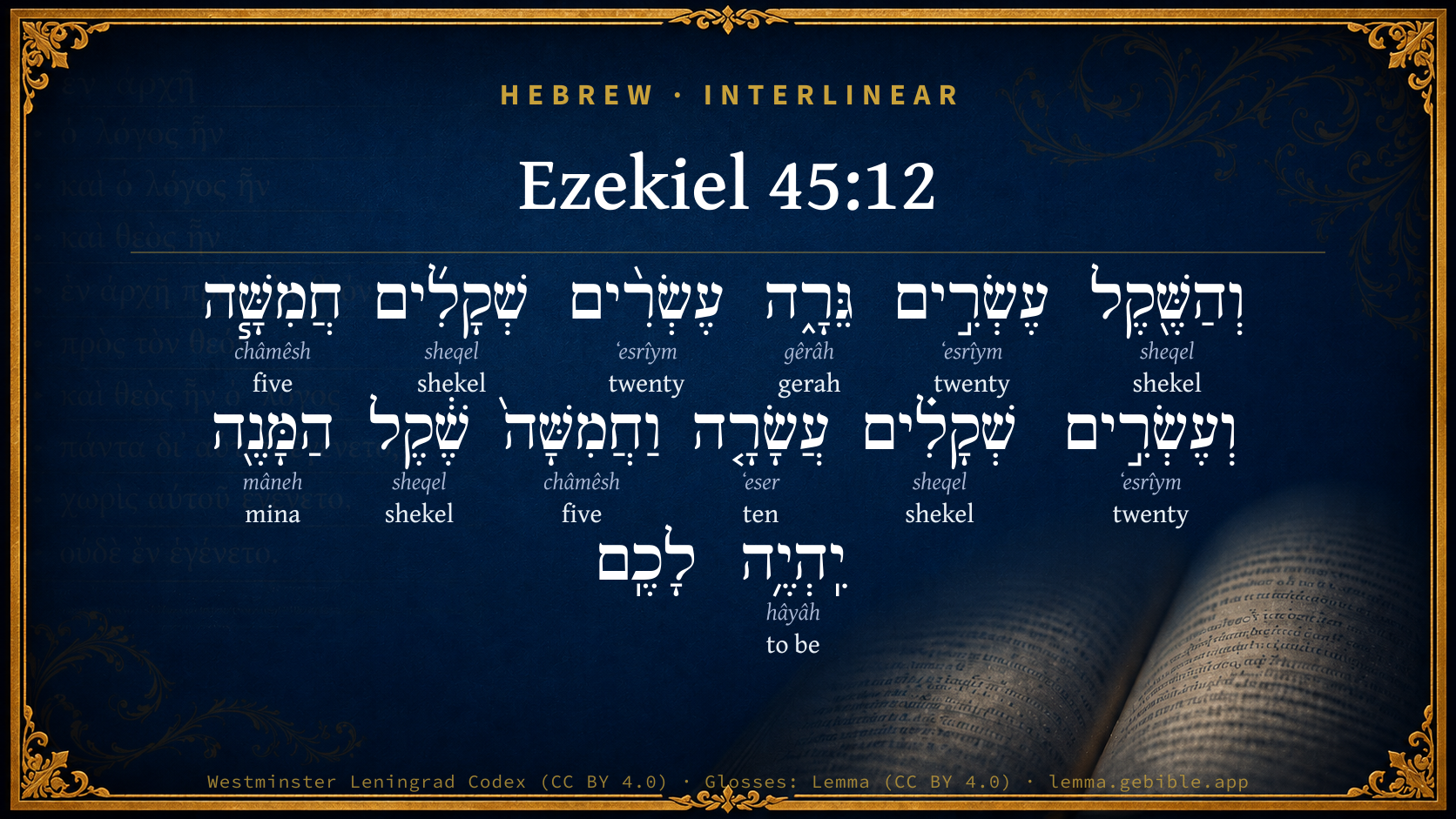
Hebrew (Westminster Leningrad Codex) Ezekiel 45:12 appears in the Hebrew Old Testament. The text above is from the Westminster Leningrad Codex. Each word links to its Strong’s number, a concise gloss, and parsing drawn from the Open Scriptures Hebrew Bible morphology. Click any word for its full Brown-Driver-Briggs (BDB) entry.
Download image
Cite this verse

Ezekiel 45:12 (World English Bible). Public Domain. Lemma interlinear Bible study tool, https://lemma.gebible.app/v/ezekiel/45/12.

Show BibTeX & RIS
BibTeX
RIS
English Translation
The shekel shall be twenty gerahs. Twenty shekels plus twenty-five shekels plus fifteen shekels shall be your mina.
World English Bible · Public Domain
Download a study sheet

One document with this verse’s original text, its word-by-word gloss line, the meaning frame, cross-references with their text, attributed commentary, and full source and license credits — printable, and it pastes into notes with its structure intact.

This verse Autodidact and up

Study sheet (.html) Plain text (.txt)

A passage Seminary Student

Up to 50 verses in one chapter. A passage sheet keeps up to 6 commentary sources and 12 cross-references per verse, in the order this page ranks them, and says so on the sheet whenever that leaves anything out. Ask for a single verse and you get the Autodidact verse sheet above.

Everything on this page stays free to read, with no account — the sheet is a download of what is already on screen, not access to it.

Want to remove ads? Support Godless Engineer
Compare translations 3

The same verse in 3 English versions, stacked beneath the original-language interlinear above. Click any original word for its lexicon entry.

Each is an independent rendering of the whole verse — the interlinear is not word-aligned to these translations.

Highlighted words mark where these versions differ — a whole-verse word diff, not a word-by-word alignment.

  • World English Bible Public Domain
    The shekel shall be twenty gerahs. Twenty shekels plus twenty-five shekels plus fifteen shekels shall be your mina.
  • King James Version Public Domain
    And the shekel shall be twenty gerahs: twenty shekels, five and twenty shekels, fifteen shekels, shall be your maneh.
  • unfoldingWord Literal Text CC BY-SA 4.0
    The shekel will be twenty gerahs; sixty shekels will make a mina for you.

unfoldingWord Literal Text — © unfoldingWord, licensed CC BY-SA 4.0. Word-aligned USFM3 via Door43 (git.door43.org/unfoldingWord/en_ult).

Versions to compare (up to 4)

3 of 4 selected

Show all 18 translations

Every available English version of this verse, each an independent rendering of the whole verse.

  • World English Bible Public Domain
    The shekel shall be twenty gerahs. Twenty shekels plus twenty-five shekels plus fifteen shekels shall be your mina.
  • Berean Standard Bible Public Domain
    The shekel will consist of twenty gerahs. Twenty shekels plus twenty-five shekels plus fifteen shekels will equal one mina.
  • Majority Standard Bible Public Domain
    The shekel will consist of twenty gerahs. Twenty shekels plus twenty-five shekels plus fifteen shekels will equal one mina.
  • King James Version Public Domain
    And the shekel shall be twenty gerahs: twenty shekels, five and twenty shekels, fifteen shekels, shall be your maneh.
  • American Standard Version (1901) Public Domain
    And the shekel shall be twenty gerahs; twenty shekels, five and twenty shekels, fifteen shekels, shall be your maneh.
  • Revised Version (1885) Public Domain
    And the shekel shall be twenty gerahs: twenty shekels, five and twenty shekels, fifteen shekels, shall be your maneh.
  • Geneva Bible (1599) Public Domain
    And the shekel shalbe twentie gerahs, and twentie shekels, and fiue and twentie shekels and fifteene shekels shalbe your Maneh.
  • Douay-Rheims (1899) Public Domain
    And the sicle hath twenty obols. Now twenty sides, and five and twenty sides, and fifteen sides make a mna.
  • Young's Literal Translation Public Domain
    And, the shekel `is' twenty gerah: twenty shekels, five and twenty shekels, fifteen shekels -- is your maneh.
  • Literal Standard Version CC BY-SA 4.0
    And the shekel [is] twenty gerah: twenty shekels, twenty-five shekels, fifteen shekels—is your maneh.
  • Unlocked Literal Bible CC BY-SA 4.0
    The shekel will be twenty gerahs; sixty shekels will make a mina for you.
  • unfoldingWord Literal Text CC BY-SA 4.0
    The shekel will be twenty gerahs; sixty shekels will make a mina for you.
  • Darby Bible Public Domain
    And the shekel shall be twenty gerahs; twenty shekels, five and twenty shekels, fifteen shekels, shall be your maneh.
  • World Messianic Bible Public Domain
    The shekel shall be twenty gerahs. Twenty shekels plus twenty-five shekels plus fifteen shekels shall be your mina.
  • Webster's Bible Public Domain
    And the shekel shall be twenty gerahs: twenty shekels, five and twenty shekels, fifteen shekels, shall be your maneh.
  • Free Bible Version CC BY-SA 4.0
    Twenty gerahs make one shekel. Sixty shekels make one mina.
  • Bible in Basic English Public Domain
    And the shekel is to be twenty gerahs: five shekels are five, and ten shekels are ten, and your maneh is to be fifty shekels
  • JPS Tanakh (1917) Public Domain
    And the shekel shall be twenty gerahs; twenty shekels, five and twenty shekels, ten, and five shekels, shall be your maneh.

Literal Standard Version (2020), Covenant Press — licensed CC BY-SA 4.0. Text via the HelloAO Bible API (eBible.org). Unlocked Literal Bible (unfoldingWord) — licensed CC BY-SA 4.0. Text via the HelloAO Bible API (eBible.org). unfoldingWord Literal Text — © unfoldingWord, licensed CC BY-SA 4.0. Word-aligned USFM3 via Door43 (git.door43.org/unfoldingWord/en_ult). Free Bible Version, Dr. Jonathan Gallagher — licensed CC BY-SA 4.0. Text via the HelloAO Bible API (eBible.org).

Word by word

More ways to search: Search by grammar → Find every occurrence → Compare this word →

Practice this passage: Drill this verse → Learn its vocabulary →

גֵּרָ֑ה
gêrâh
H1626
“gerah”
Noun, Common, Feminine, Singular, Absolute
Part of Speech
Noun
Type
Common
Gender
Feminine
Number
Singular
State
Absolute
Full BDB Definition

Origin: from H1641 (as in H1625 )

TWOT: 386b

gerah, a weight, a 20th part of a shekel, equal to the weight of 16 barley grains or 4 to 5 carob beans
  1. וְהַשֶּׁ֖קֶל sheqel H8255 “and · the · shekel” Conjunction + Particle, Definite Article + Noun, Common, Masculine, Singular, Absolute
  2. עֶשְׂרִ֣ים ʻesrîym H6242 “twenty” Adjective, Cardinal number, Both, Plural, Absolute
  3. עֶשְׂרִ֨ים ʻesrîym H6242 “twenty” Adjective, Cardinal number, Both, Plural, Absolute
  4. שְׁקָלִ֜ים sheqel H8255 “shekels” Noun, Common, Masculine, Plural, Absolute
  5. חֲמִשָּׁ֧ה châmêsh H2568 “five” Adjective, Cardinal number, Masculine, Singular, Absolute
  6. וְעֶשְׂרִ֣ים ʻesrîym H6242 “and · twenty” Conjunction + Adjective, Cardinal number, Both, Plural, Absolute
  7. שְׁקָלִ֗ים sheqel H8255 “shekels” Noun, Common, Masculine, Plural, Absolute
  8. עֲשָׂרָ֤ה ʻeser H6235 “ten” Adjective, Cardinal number, Masculine, Singular, Absolute
  9. וַחֲמִשָּׁה֙ châmêsh H2568 “and · five” Conjunction + Adjective, Cardinal number, Masculine, Singular, Absolute
  10. שֶׁ֔קֶל sheqel H8255 “shekel” Noun, Common, Masculine, Singular, Absolute
  11. הַמָּנֶ֖ה mâneh H4488 “the · mina” Particle, Definite Article + Noun, Common, Masculine, Singular, Absolute
  12. יִֽהְיֶ֥ה hâyâh H1961 “to be” Verb, Qal, Imperfect, 3rd Person, Masculine, Singular

About this verse

These counts appear in no published source. They are computed here, from the morphology-tagged text and Lemma’s own curated glosses. What Lemma adds →

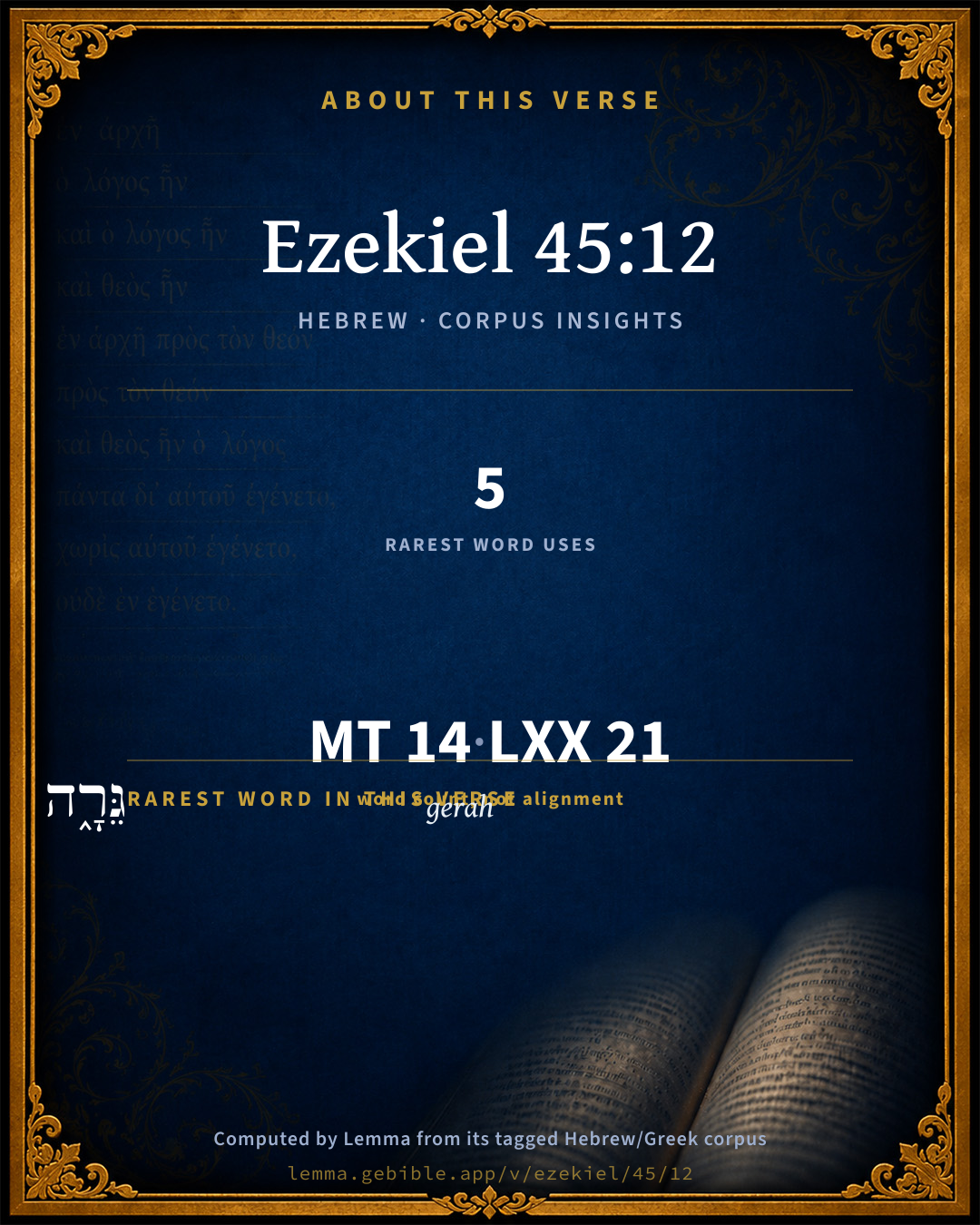
14
words
7
distinct lemmas
Prophets
section

Notable vocabulary

The rarest word here is גֵּרָ֑ה gerah H1626 — appearing just 5 times in the whole Hebrew Bible.

Shared distinctive vocabulary

גֵּרָ֑ה gerah H1626 occurs in 5 verses of the Hebrew Bible. Also found in:

Grammatical profile

  • 1 verb
  • 6 nouns
  • 6 adjectives
  • 1 preposition

Verb forms

  • יִֽהְיֶ֥ה Qal · Imperfect

Repetition

Words recur within this verse — often emphatic in Hebrew:

  • וְהַשֶּׁ֖קֶל shekel H8255 ×4
  • עֶשְׂרִ֣ים twenty H6242 ×3
  • חֲמִשָּׁ֧ה five H2568 ×2

Hebrew & Septuagint length

In English translation the verse runs 18 words from the Hebrew and 18 from the Septuagint (LXX English) — the same length.

A rough comparison of the two English renderings, which tokenize alike — not a word-level alignment.

Word counts can differ between the Hebrew and the Greek without any difference in meaning — e.g. the Hebrew direct-object marker אֵת has no separate Greek word, and Greek often adds the article ὁ.

In the original languages it is 14 Hebrew tokens and 21 Greek tokens — but the two are counted differently (Hebrew bundles its prefixes and suffixes into one token; the Greek is in lemma form), so that isn’t a like-for-like length.

Cross-references

3

Topical passages linked to Ezekiel 45:12 in the Treasury of Scripture Knowledge — connected by theme and wording, ordered by reader-vote popularity; previews shown in the World English Bible.

  • Exodus 30:13 They shall give this, everyone who passes over to those who are numbered, half a shekel after the shekel of the sanctuary; (the shekel is twenty gerahs;) half a shekel for an offering to Yahweh.
  • Leviticus 27:25 All your valuations shall be according to the shekel of the sanctuary: twenty gerahs to the shekel.
  • Numbers 3:47 you shall take five shekels apiece for each one; after the shekel of the sanctuary you shall take them (the shekel is twenty gerahs):

Cross-references courtesy of OpenBible.info (CC BY 4.0).

Hebrew and Greek witnesses Masoretic Hebrew ↔ Greek Septuagint

The same verse in the two great witnesses to the Old Testament, shown verse-for-verse.

These are two independent witnesses, not word-aligned to each other, and the Septuagint is shown in lemma (dictionary) form.

Hebrew Ezekiel 45:12 Masoretic · Westminster Leningrad Codex

וְהַשֶּׁ֖קֶל עֶשְׂרִ֣ים גֵּרָ֑ה עֶשְׂרִ֨ים שְׁקָלִ֜ים חֲמִשָּׁ֧ה וְעֶשְׂרִ֣ים שְׁקָלִ֗ים עֲשָׂרָ֤ה וַחֲמִשָּׁה֙ שֶׁ֔קֶל הַמָּנֶ֖ה יִֽהְיֶ֥ה לָכֶֽם

The shekel shall be twenty gerahs. Twenty shekels plus twenty-five shekels plus fifteen shekels shall be your mina.

World English Bible · Public Domain

Greek LXX Ezekiel 45:12 Septuagint · lemma form

καί ὁ στάθμιον εἴκοσι ὀβολός ὁ πέντε σίκλος πέντε καί ὁ δέκα σίκλος δέκα καί πεντήκοντα σίκλος ὁ μνᾶ εἰμί σύ

And the weights shall be twenty oboli, your pound shall be five shekels, fifteen shekels and fifty shekels.

LXX2012 (modern English Septuagint) · Public Domain

On this verse, Jamieson, Fausset & Brown discusses the Septuagint’s reading. Read the note in Commentary ↓

Hebrew: Westminster Leningrad Codex (CC BY 4.0). Greek: Septuagint (public domain); English from LXX2012 (modern English Septuagint) (Public Domain). How the Septuagint differs from the Hebrew →

Targum (Aramaic paraphrase)

1

The Targum is the ancient Jewish Aramaic paraphrase of the Hebrew Scriptures — an interpretive translation, not the Hebrew text itself. Onkelos (literal) and Pseudo-Jonathan (expansive) render the Torah, and Jonathan the Prophets. Coverage is partial: where no permissively-licensed English translation exists for a verse, only the Aramaic is shown. This is verse-level text, not a word-by-word alignment to the Hebrew.

  1. Targum Jonathan Prophets (Joshua–Malachi)
    וְסַלְעָא עַסְרִין מָעִין תִּלְתּוּת מָנַיָא עַסְרִין סַלְעִין מָנֵי כַסְפָּא עַסְרִין וַחֲמֵשׁ סַלְעִין רִבְעוּת מָנַיָא חֲמֵשׁ עַסְרֵי סַלְעִין כּוּלְהוֹן שִׁתִּין מָנִין וּמָנֵי רַבָּא קוּדְשָׁא יְהֵי לְכוֹן:

    (no public-domain English translation for this verse)

    Targum Jonathan — Aramaic: “Mikraot Gedolot” (public domain). English: “Sefaria Community Translation” (CC0 1.0 (public-domain dedication)); “London "Chaldee Paraphrase," 1871” (public domain). Text via Sefaria.

Commentary

Notes on Ezekiel 45:12 from classic Christian and Jewish commentators (each source and its license shown beneath its notes). The classic Christian expositions comment on the surrounding passage and are grouped to its opening verse, so a note may address several verses; the Jewish commentaries on the Tanakh (Rashi and others) are per-verse, so they appear only where the commentator wrote on this verse.

Lemma curates 59 commentaries, every one of them public domain or Creative Commons licensed, each selected and text-cleaned for this edition rather than reprinted as found. About our sources →

Trapp's Complete Commentary

John Trapp

Eze 45:12 And the shekel [shall be] twenty gerahs: twenty shekels, five and twenty shekels, fifteen shekels, shall be your maneh.

Ver. 12. And the shekel shall be twenty gerahs] Exo 30:13 Lev 27:25 Num 3:47.

Fifteen shekels, shall be your maneh.] Or, μνα, mina, pound weight.

John Trapp, A Commentary or Exposition upon All the Books of the Old and New Testament (1647–1656) — public domain. Text from a community e-Sword module.

Geneva Bible (1599)

Geneva Bible translators

That is, three-score shekels make a weight called Mina, for he joineth these three parts to a Mina.

Geneva Bible (1599) marginal notes — public domain. Text via Bolls.life.

Jamieson, Fausset & Brown

Robert Jamieson, A. R. Fausset & David Brown

The standard weights were lost when the Chaldeans destroyed the temple. The threefold enumeration of shekels (twenty, twenty-five, fifteen) probably refers to coins of different value, representing respectively so many shekels, the three collectively making up a maneh. By weighing these together against the maneh, a test was afforded whether they severally had their proper weight: sixty shekels in all, containing one coin a fourth of the whole (fifteen shekels), another a third (twenty shekels), another a third and a twelfth (twenty-five shekels) [MENOCHIUS]. The Septuagint reads, "fifty shekels shall be your maneh."

Jamieson, Fausset & Brown — Commentary Critical and Explanatory on the Whole Bible (1871) — public domain (CC PDM 1.0). Text via the HelloAO Bible API.

Ellicott's Commentary for English Readers

(12) The shekel.—The first part of this verse is merely a re-statement of the old law (Exo_30:13; Lev_27:25; Num_3:47) that the shekel should be of the value of twenty gerahs, or of the estimated weight of 220 grains; but the latter part of the verse is extremely obscure. The maneh is mentioned elsewhere only in 1Ki_10:17; Ezr_2:69; Neh. vii 71, and is translated in our version pound. Its actual value is unknown. If the text as it stands is correct, it is possible that in Ezekiel’s time three different manehs were in use, of the values respectively assigned to them; but of this there is no other evidence.

A Bible Commentary for English Readers, edited by Charles John Ellicott (1878–1897) — public domain. Text from a community e-Sword module.

The Cambridge Bible for Schools and Colleges

gen. ed. J. J. S. Perowne

12. Cf. Exo_30:13; Lev_27:25; Num_3:47; Num_18:16. The verse at present is without meaning. Read after LXX. (cod. Alex.): and the shekel shall be twenty gerahs; five (shekels) shall be five, and ten shekels ten, and fifty shekels shall be your maneh (mina). The text is grammatically suspicious, and the way in which “fifteen” is supposed to be expressed, viz. “ten and five” is without parallel. The statement that “five shekels shall be five,” &c., does not imply that there were five and ten shekel pieces, but means that just weighing of money shall prevail, and five go for five, no more and no less. The passage has been fully discussed by Bertheau (Zur Gesch. der Israeliten, pp. 8–14), whose table of money weights may be given (p. 14):

Talent

1

Maneh

60

1

Shekel

3,000

50

1

Beka

6,000

100

2

1

Gera

60,000

1,000

20

10

1.

Cf. Exo_38:25; Lev_27:3; Lev_27:6; Jos_7:21; 1Ki_10:17; Ezr_2:69; Neh_7:71.

The Cambridge Bible for Schools and Colleges (gen. ed. J. J. S. Perowne; Cambridge University Press, 1878–1918) — public domain. Text from a community e-Sword module.

John Gill's Exposition

And the shekel shall be twenty gerahs,.... This is a rule for money or coin; the shekel was a silver coin, and is generally reckoned about the value of two shillings and six pence of our money, so a gerah about three half pennies: Bishop Cumberland reckons the shekel more exactly at two shillings and four pence farthing, and a little more, and the gerah at eleven grains of silver; see Lev 27:25,

twenty shekels, five and twenty shekels, fifteen shekels, shall be your maneh; these were several pieces of money; one was a twenty shekel piece, which according to the common account was fifty shillings of our money; another was a five and twenty shekel piece, which was three pounds, two shillings, and sixpence; and a third was a fifteen shekel piece, which was one pound thirteen and sixpence; and together made a maneh or pound, which consisted of sixty shekels, or seven pounds, ten shillings; by which the other pieces should be tried, whether they were of just weight: the sense of the whole is, that no adulteration of coin should be made, which is very prejudicial in civil affairs.

John Gill's Exposition of the Whole Bible (1746–1763) — public domain (CC PDM 1.0). Text via the HelloAO Bible API.

Albert Barnes' Notes on the Bible

The shekel - See the marginal reference.

The “maneh” shall be of true weight, but it would seem that in Ezekiel’s time there were “manehs” of different value.

Albert Barnes' Notes on the Bible (1834–1885) — public domain. Text from a community e-Sword/MySword module.

Haydock's Catholic Bible Commentary

Sicles. It would be shorter to say, "sixty sicles make a mna."

George Leo Haydock (1774–1849), Haydock's Catholic Family Bible and Commentary, 1859 edition — public domain. Excludes Psalms (Douay-Rheims chapter numbering differs from Protestant) and Deuterocanonical books (Catholic canon only).

Matthew Poole's English Annotations

Having laid down the standard for weight and measure in less valuable things, and that are sold for money, now the standard is set down for the current coin which passed among them, and the valuation of which was part of the prince’s prerogative. The first mentioned in the text is the shekel, which, saith the text, contained

twenty gerahs; now every gerah was one penny halfpenny English value: the shekel then was two shillings and sixpence. The twenty shekels was two pounds ten shillings, the fifteen shekels was one pound seventeen shillings and sixpence, and twenty-five was three pounds two shillings and six pence.

Maneh: some say it is one pound, and that the pound was either least, middle, or greatest, according as there were more or fewer shekels in it; the least or common pound was but seventeen shillings and sixpence; the next, which was the royal, was fifty shillings; and the greatest, or pound of the sanctuary, was sixty-two shillings and six pence.

Matthew Poole's English Annotations on the Holy Bible (1683–1685) — public domain. Text from a community e-Sword/MySword module.

Whedon's Commentary on the Bible

Daniel D. Whedon

12. The LXX. is to be preferred, “And the shekel shall be for you twenty gerah, five shekels a V; and ten shekels a X; and fifty shekels the maneh.” This was according to the old Hebrew usage. In later times, according to Professor Peters, there were sixty shekels in the maneh (Journal of Biblical Literature, xii), but Kautzsch considers this to be the earlier usage, and thinks Ezekiel here changes from the old sexagesimal to the new decimal system. Coined money was certainly used elsewhere in this century (see Introduction to Daniel, III, 2, 3), and perhaps this marks the time of its introduction among the Hebrews. Dr. Davidson quotes from Bertheau the following table of values: —

Talent1Maneh601Shekel3,000501Beka6,00010021Gera60,0001,00020101

Toy calculates the Hebrew silver shekel to have been worth about fifty-five cents, though its purchasing power was at least ten times as great, and quotes Dr. G.A. Reisner’s opinion, that the ratio of gold and silver among the old Babylonians was not 1:13½, or 1:16, but about 1:30. It has been proved from many examples of Babylonian weights, of Ezekiel’s day and earlier, digged up in recent years, that there were several systems in use — the light maneh, for example, only weighing about half as much as the heavy maneh — so there was great need of a corrected scale such as the above.

Daniel D. Whedon (gen. ed.), Commentary on the Old and New Testaments (1874–1909) — public domain. Text from a community e-Sword module.

The Pulpit Commentary

The shekel shall be twenty garahs. This ordained that the standard for money weights should remain as it had been fixed by the Law. (Exo_30:13; Lev_27:25; Num_3:47) The "shekel" (or "weight," from lqv "to weigh;" compare the Italian lira, the French livre out of the Latin libra, and the English Found sterling) was a piece of silver whose value, originally determined by weight, became gradually fixed at the definite sum of twenty "gerahs," beans, or grains (from rrG "to roll"). The "gerah," value two pence, was the smallest silver coin; the "shekel," therefore, was forty pence, or 3s. 4d. Commentators are divided as to how the second half of this verse should be understood: twenty shekel, five and twenty shekels, fifteen shekels shall be your maneh.

The "maneh" (or "portion," from hn; m; "to be divided"), which occurs only here and in 1Ki_10:17; Ezr_2:69; and Neh_7:71, 72 is to say, only in books written during the Captivity or subsequentto it" (Keil) was probably the same coin as the Greek rains (mna), though its weight may have somewhat differed. A comparison of 1Ki_10:17 with 2Ch_9:16 shows that a maneh was equal to a hundred shekels, which cannot be made to harmonize with the statement in this verse without supposing either that an error has crept in through transcription, or that the chronicler has employed the late Greek style of reckoning, in which one mina is equivalent to a hundred drachmas. Again, the Hebrew and Attic talents, when ex-stained, fail to solve the problem as to how the text should be rendered. The Hebrew talent, rKKi, contained 3000 sacred or Mosaic shekels according to Exo_38:25, Exo_38:26; and the Attic talon 60 minas, each of 100 drachmas, i.e. 6000 drachmas, or 3000 drachmas, each of which again was equal to a Hebrew shekel. Hence the Attic mina must have been one-sixtieth part of 3000, i.e. 50 shekels, which once more fails to correspond with Ezekiel"s notation. What this notation is depends on how the clauses should be connected. If with "and," as Ewald, following the Targumists, thinks, Ezekiel is supposed to have ordained that in the future the maneh should be, not 50, but 60 (20 + 25 1- 15) shekels the weight of the "Babylonian mana ("Records of the Past," 4:97, second series); only, if he so intended, one sees not why he should have adopted this roundabout method of expression instead of simply stating that henceforth the maneh should be sixty shekels If with "or," as Michaelis, Gesenius, Hitzig, and Hengstenberg prefer, then the prophet is regarded as asserting that in the future three manehs of varying values should be current one of gold, another of silver, and a third of copper (Hitzig), or all of the same metal, but of different magnitudes (Michaelis); and this arrangement might well have been appointed for the future, although no historical trace can be found of any such manehs of twenty, twenty-five, and fifteen shekels respectively having been in circulation either among the Hebrews or among foreign peoples. Kliefoth pronounces both solutions unsatisfactory, but has nothing better to offer. Keil supposes a corruption of the text of old standing, for the correction of which we are as yet without materials. Bertheau and Havernick follow the LXX (Cod. Alex.), OiJ pente sikloi pente kaika sikloi deka kaikonta sikloi hJ mna ejstai uJmin, The five shekel (piece) shall be five shekels, and the ten shekel (piece) shall be tea shekels, end fifty shekels shall your maneh be;" but Hitzig"s judgment on this proposal, with which Kliefoth and Keil agree, will most likely be deemed correct, that "it carries on the face of it the probability of its resting upon nothing more than an attempt to bring the text into harmony with the ordinary value of the maneh."

The Pulpit Commentary (1880–1919), ed. H.D.M. Spence-Jones & Joseph S. Exell — public domain. Text from a community e-Sword module.

John Wesley's Explanatory Notes

Twenty gerahs - A gerah was one penny half-penny, the shekel then was two shillings and six-pence, twenty shekels was two pounds ten shillings, fifteen shekels was one pound seventeen shillings and six-pence, and twenty five was three pound two shillings and six-pence. Maneh - It seems there was the small, the middle, and the great Maneh.

John Wesley, Explanatory Notes Upon the Whole Bible (1754–1765) — public domain. Text via the GEBible commentary corpus.

Rashi

Rabbi Shlomo Yitzchaki (Rashi)

And the shekel is twenty gerah Twenty “ma’ah.”

twenty shekels, twenty-five shekels, and fifteen shekels totaling sixty shekels.

shall the maneh be to you Le zent in O. F., the 100 (zuz weight). Menahem, however, connected it to the word מִנְיָן, a number (p. 118). We have here 240 “zuz,” [four zuz to a shekel]. From here we derive that the “maneh” of the Sanctuary was double, and they added a sixth to it in Ezekiel’s time, totaling 240 [zuz] (Men. 77a). When Scripture divided it into three parts and did not write simply, “sixty shekels shall the maneh be for you,” it commanded to make from it a weight one third of it, and a weight equaling a fourth of it, and a weight of the ordinary “maneh” as it was originally. So too did Jonathan paraphrase: a third of the “maneh” shall be twenty “selaim” of silver; a “maneh” of silver twenty-five “selaim”; a fourth of a “maneh”fifteen “selaim”; altogether, sixty “selaim”; and the great “maneh” of the Sanctuary shall be for you.

Rashi on the Tanakh — English translations: “The Judaica Press complete Tanach with Rashi, translated by A. J. Rosenberg” (CC BY 4.0); “Pentateuch with Rashi's commentary by M. Rosenbaum and A.M. Silbermann, 1929-1934” (public domain); “The Metsudah Tanach series, Lakewood, N.J” (CC BY 4.0); and “The Book of Joshua, Metsudah Publications, 1997” (CC BY 4.0). Text via Sefaria.

Lesson kit

Teaching starters — assembled from the data on this page, not authored interpretation. Every prompt links to the verse data it draws on. Edit before teaching.

Ezekiel, in the Prophets, opens this verse with 14 words (7 distinct Hebrew lemmas). Its most distinctive word is gêrâh (“gerah”). A historical commentator’s framing appears above. Read the whole chapter for the surrounding context.

Discussion questions

  1. What does “gerah” (gêrâh) contribute to the verse as a whole?
  2. How does Exodus 30:13, which shares the word «gerah», read alongside this verse?
  3. What does the repetition of “shekel” (4× in this one verse) do in this verse?
  4. These translations render this verse differently; the difference is in the English rendering, not the original. What questions does that raise?
  5. «יִֽהְיֶ֥ה» is a Qal Imperfect verb. How does that grammatical form shape the action described?
  6. Compare how Trapp's Complete Commentary and Geneva Bible (1599) read this verse. Where do they agree or differ?

Things to notice

Reading settings

Reading text

Shown beneath each verse's original-language words.

Old Testament
Old Testament edition

Read the OT as the Masoretic Hebrew (MT) or the Greek Septuagint (LXX).

English shown for the Greek Septuagint (in the Hebrew ↔ Greek comparison).

Comparing translations? Open the Compare panel on any verse page to stack up to four side by side.