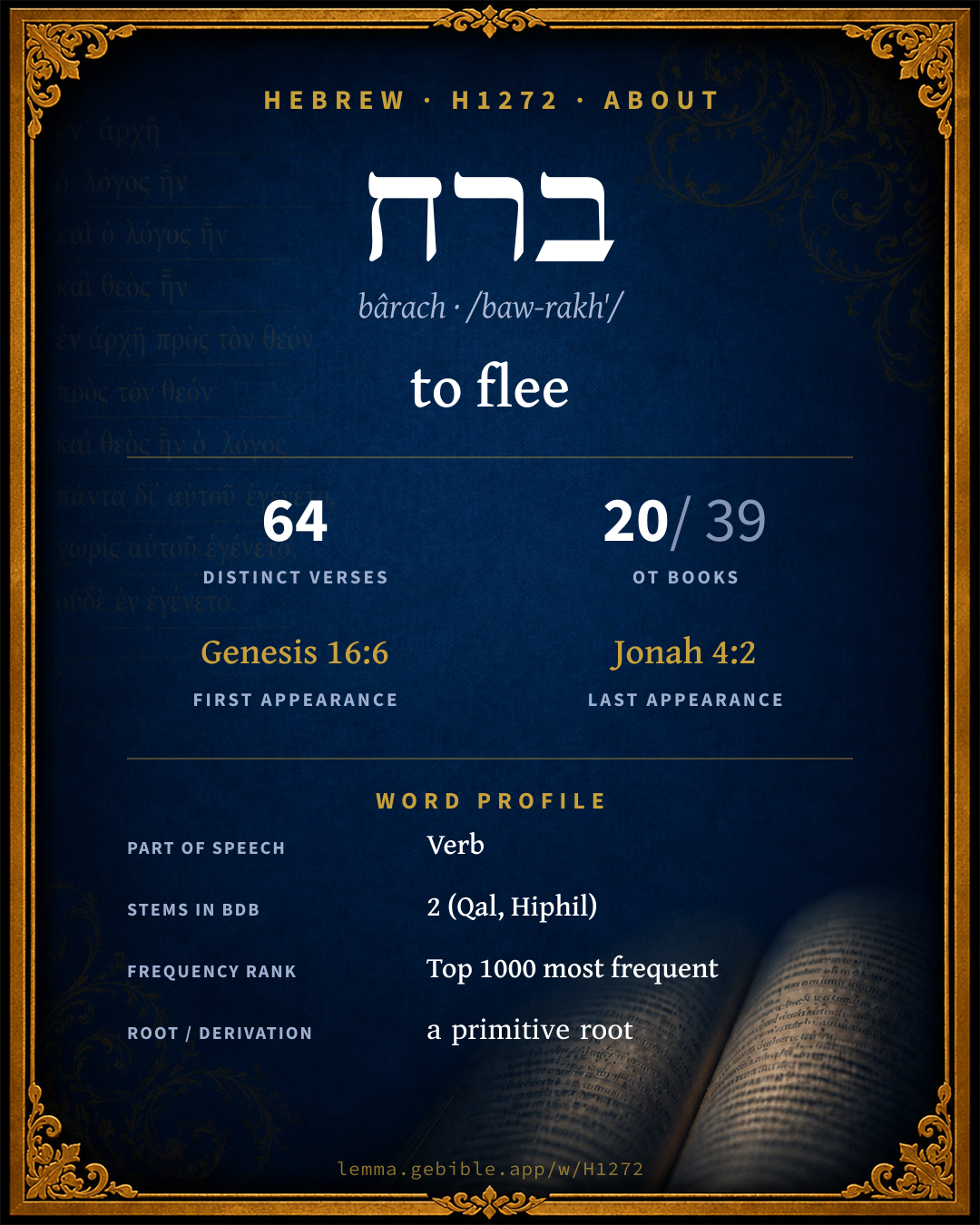
בָּרַח
to flee
‘to flee’ is one of 7 main senses fuller range ↓
Full lexicon entry — Brown-Driver-Briggs (BDB)
From Brown-Driver-Briggs (BDB)
Where this word appears
See every Qal verb in the Hebrew Bible →
Grammar key — what these labels mean
Part of speech
- Verb
- An action or state-of-being word.
Stem
- Qal
- The basic, simple active stem — the plain form of the verb (“he wrote”). Here: ‘go or pass through’
- Hiphil
- The causative active stem (“he caused / brought about”). Here: ‘pass through’
Form
- Sequential Imperfect
- An imperfect with prefixed waw — the standard past-narrative form (waw-consecutive imperfect).
- Perfect
- A completed action or state — Hebrew marks aspect (completeness) more than strict tense (“he wrote”).
- Infinitive Construct
- A bound verbal noun, frequently with prepositions (“to write / in writing”).
- Imperative
- A direct command (“write!”).
- Imperfect
- An incomplete, ongoing, or future action (“he will / would write”).
- Participle Active
- A verbal adjective expressing ongoing or characteristic action (“writing / one who writes”).
- Cohortative
- A first-person volitional form expressing wish or resolve (“let me / let us write”).
- Infinitive Absolute
- An unbound verbal noun, often intensifying or standing in for a finite verb.
State
- Absolute
- The independent form of a noun, not bound to a following word.
Person
- 3rd Person
- The one spoken about (“he / she / it / they”).
- 2nd Person
- The one addressed (“you”).
- 1st Person
- The speaker (“I / we”).
Gender
- Masculine
- Grammatically masculine.
- Common
- Either gender — not distinguished for this form.
- Feminine
- Grammatically feminine.
Number
- Singular
- One.
- Plural
- More than one (in Hebrew, generally three or more).
Grammatical forms 20 distinct
- Verb, Qal, Sequential Imperfect, 3rd Person, Masculine, Singular 14 times (22%)
- Verb, Qal, Perfect, 3rd Person, Masculine, Singular 10 times (15%)
- Verb, Qal, Infinitive Construct 10 times (15%)
- Verb, Qal, Sequential Imperfect, 3rd Person, Masculine, Plural 5 times (8%)
- Verb, Qal, Imperative, 2nd Person, Masculine, Singular 4 times (6%)
- Verb, Qal, Imperfect, 3rd Person, Masculine, Singular 3 times (5%)
- Verb, Qal, Participle Active, Masculine, Singular, Absolute 3 times (5%)
- Verb, Qal, Perfect, 3rd Person, Common, Plural 2 times (3%)
+12 more forms (14 occurrences)
Parsed forms decoded from the imported morphology (morphhb / Westminster Leningrad Codex — WLC text public domain, morphhb tagging CC BY 4.0), counted across 65 parsed occurrences — not distinct verses.
Every verse where H1272 appears — 64 distinct verses across 20 books. Click any verse to open its interlinear word-by-word view. Verse text shown in the World English Bible for context — . Each verse’s Hebrew form is shown with its reference; the English is not keyword-highlighted, since the data carries no word-level English alignment. Use “Compare translations” on any verse to read it across multiple English versions. This concordance covers the Hebrew Bible; Septuagint (Greek Old Testament) occurrences are not indexed here.
Genesis 9 verses
- Genesis 16:6 וַ/תִּבְרַ֖ח conj + Qal wimpf 3fs But Abram said to Sarai, "Behold, your maid is in your hand. Do to her whatever is good in your eyes." Sarai dealt harshly with her, and she fled from her face.
- Genesis 16:8 בֹּרַֽחַת Qal ptcp.act fs He said, "Hagar, Sarai's handmaid, where did you come from? Where are you going?" She said, "I am fleeing from the face of my mistress Sarai."
- Genesis 27:43 בְּרַח Qal impv 2ms Now therefore, my son, obey my voice. Arise, flee to Laban, my brother, in Haran.
- Genesis 31:20 בֹרֵ֖חַ Qal ptcp.act ms Jacob deceived Laban the Syrian, in that he didn't tell him that he was running away.
- Genesis 31:21 וַ/יִּבְרַ֥ח conj + Qal wimpf 3ms So he fled with all that he had. He rose up, passed over the River, and set his face toward the mountain of Gilead.
- Genesis 31:22 בָרַ֖ח Qal pf 3ms Laban was told on the third day that Jacob had fled.
- Genesis 31:27 לִ/בְרֹ֔חַ prep + Qal inf.cs Why did you flee secretly, and deceive me, and didn't tell me, that I might have sent you away with mirth and with songs, with tambourine and with harp;
- Genesis 35:1 בְּ/בָרְחֲ/ךָ֔ prep + Qal inf.cs + sfx pers 2ms God said to Jacob, "Arise, go up to Bethel, and live there. Make there an altar to God, who appeared to you when you fled from the face of Esau your brother."
- Genesis 35:7 בְּ/בָרְח֖/וֹ prep + Qal inf.cs + sfx pers 3ms He built an altar there, and called the place El Beth El; because there God was revealed to him, when he fled from the face of his brother.
Exodus 4 verses
- Exodus 2:15 וַ/יִּבְרַ֤ח conj + Qal wimpf 3ms Now when Pharaoh heard this thing, he sought to kill Moses. But Moses fled from the face of Pharaoh, and lived in the land of Midian, and he sat down by a well.
- Exodus 14:5 בָרַ֖ח Qal pf 3ms It was told the king of Egypt that the people had fled; and the heart of Pharaoh and of his servants was changed towards the people, and they said, "What is this we have done, that we have let Israel go from serving us?"
- Exodus 26:28 מַבְרִ֕חַ Hiphil ptcp.act ms The middle bar in the midst of the boards shall pass through from end to end.
- Exodus 36:33 לִ/בְרֹ֨חַ֙ prep + Qal inf.cs He made the middle bar to pass through in the midst of the boards from the one end to the other.
Numbers 1 verse
Judges 2 verses
- Judges 9:21 וַ/יִּבְרַ֖ח conj + Qal wimpf 3ms Jotham ran away, and fled, and went to Beer, and lived there, for fear of Abimelech his brother.
- Judges 11:3 וַ/יִּבְרַ֤ח conj + Qal wimpf 3ms Then Jephthah fled from his brothers, and lived in the land of Tob: and there were gathered vain fellows to Jephthah, and they went out with him.
1 Samuel 8 verses
- 1 Samuel 19:12 וַ/יִּבְרַ֖ח conj + Qal wimpf 3ms So Michal let David down through the window: and he went, and fled, and escaped.
- 1 Samuel 19:18 בָּרַ֜ח Qal pf 3ms Now David fled, and escaped, and came to Samuel to Ramah, and told him all that Saul had done to him. He and Samuel went and lived in Naioth.
- 1 Samuel 20:1 וַ/יִּבְרַ֣ח conj + Qal wimpf 3ms David fled from Naioth in Ramah, and came and said before Jonathan, "What have I done? What is my iniquity?" and "What is my sin before your father, that he seeks my life?"
- 1 Samuel 21:10 וַ/יִּבְרַ֥ח conj + Qal wimpf 3ms David arose, and fled that day for fear of Saul, and went to Achish the king of Gath.
- 1 Samuel 22:17 בֹרֵ֣חַ Qal ptcp.act ms The king said to the guard who stood about him, Turn, and kill the priests of Yahweh; because their hand also is with David, and because they knew that he fled, and didn't disclose it to me. But the servants of the king wouldn't put forth their hand to fall on the priests of Yahweh.
- 1 Samuel 22:20 וַ/יִּבְרַ֖ח conj + Qal wimpf 3ms One of the sons of Ahimelech, the son of Ahitub, named Abiathar, escaped, and fled after David.
- 1 Samuel 23:6 בִּ֠/בְרֹחַ prep + Qal inf.cs It happened, when Abiathar the son of Ahimelech fled to David to Keilah, that he came down with an ephod in his hand.
- 1 Samuel 27:4 בָרַ֥ח Qal pf 3ms It was told Saul that David was fled to Gath: and he sought no more again for him.
2 Samuel 6 verses
- 2 Samuel 4:3 וַ/יִּבְרְח֥וּ conj + Qal wimpf 3mp and the Beerothites fled to Gittaim, and have lived as foreigners there until this day).
- 2 Samuel 13:34 וַ/יִּבְרַ֖ח conj + Qal wimpf 3ms But Absalom fled. The young man who kept the watch lifted up his eyes, and looked, and, behold, there came much people by the way of the hill-side behind him.
- 2 Samuel 13:37 בָּרַ֔ח Qal pf 3ms But Absalom fled, and went to Talmai the son of Ammihur, king of Geshur. [David] mourned for his son every day.
- 2 Samuel 13:38 בָּרַ֖ח Qal pf 3ms So Absalom fled, and went to Geshur, and was there three years.
- 2 Samuel 15:14 וְ/נִבְרָ֔חָה conj + Qal coh 1cp David said to all his servants who were with him at Jerusalem, Arise, and let us flee; for else none of us shall escape from Absalom: make speed to depart, lest he overtake us quickly, and bring down evil on us, and strike the city with the edge of the sword.
- 2 Samuel 19:9 בָּרַ֥ח Qal pf 3ms All the people were at strife throughout all the tribes of Israel, saying, The king delivered us out of the hand of our enemies, and he saved us out of the hand of the Philistines; and now he is fled out of the land from Absalom.
1 Kings 6 verses
- 1 Kings 2:7 בְּ/בָרְחִ֕/י prep + Qal inf.cs + sfx pers 1cs But show kindness to the sons of Barzillai the Gileadite, and let them be of those who eat at your table; for so they came to me when I fled from Absalom your brother.
- 1 Kings 2:39 וַ/יִּבְרְח֤וּ conj + Qal wimpf 3mp It happened at the end of three years, that two of the servants of Shimei ran away to Achish, son of Maacah, king of Gath. They told Shimei, saying, Behold, your servants are in Gath.
- 1 Kings 11:17 וַ/יִּבְרַ֣ח conj + Qal wimpf 3ms that Hadad fled, he and certain Edomites of his father's servants with him, to go into Egypt, Hadad being yet a little child.
- 1 Kings 11:23 בָּרַ֗ח Qal pf 3ms God raised up [another] adversary to him, Rezon the son of Eliada, who had fled from his lord Hadadezer king of Zobah.
- 1 Kings 11:40 וַ/יִּבְרַ֤ח conj + Qal wimpf 3ms Solomon sought therefore to kill Jeroboam; but Jeroboam arose, and fled into Egypt, to Shishak king of Egypt, and was in Egypt until the death of Solomon.
- 1 Kings 12:2 בָּרַ֔ח Qal pf 3ms It happened, when Jeroboam the son of Nebat heard of it (for he was yet in Egypt, where he had fled from the presence of king Solomon, and Jeroboam lived in Egypt,
1 Chronicles 2 verses
- 1 Chronicles 8:13 הִבְרִ֖יחוּ Hiphil pf 3cp and Beriah, and Shema, who were heads of fathers' [houses] of the inhabitants of Aijalon, who put to flight the inhabitants of Gath;
- 1 Chronicles 12:15 וַ/יַּבְרִ֨יחוּ֙ conj + Hiphil wimpf 3mp These are those who went over the Jordan in the first month, when it had overflowed all its banks; and they put to flight all them of the valleys, both toward the east, and toward the west.
2 Chronicles 1 verse
Nehemiah 3 verses
- Nehemiah 6:11 יִבְרָ֔ח Qal impf 3ms I said, Should such a man as I flee? and who is there that, being such as I, would go into the temple to save his life? I will not go in.
- Nehemiah 13:10 וַ/יִּבְרְח֧וּ conj + Qal wimpf 3mp I perceived that the portions of the Levites had not been given them; so that the Levites and the singers, who did the work, were fled everyone to his field.
- Nehemiah 13:28 וָ/אַבְרִיחֵ֖/הוּ conj + Hiphil wimpf 1cs + sfx pers 3ms One of the sons of Joiada, the son of Eliashib the high priest, was son-in-law to Sanballat the Horonite: therefore I chased him from me.
Job 5 verses
- Job 9:25 בָּֽ֝רְח֗וּ Qal pf 3cp "Now my days are swifter than a runner. They flee away, they see no good,
- Job 14:2 וַ/יִּבְרַ֥ח conj + Qal wimpf 3ms He comes forth like a flower, and is cut down. He also flees like a shadow, and doesn't continue.
- Job 20:24 יִ֭בְרַח Qal impf 3ms He shall flee from the iron weapon. The bronze arrow shall strike him through.
- Job 27:22 בָּר֥וֹחַ יִבְרָֽח Qal inf.abs Qal impf 3ms For it hurls at him, and does not spare, As he flees away from his hand.
- Job 41:28 יַבְרִיחֶ֥/נּוּ Hiphil impf 3ms + sfx pers 3ms The arrow can't make him flee. Sling stones are like chaff to him.
Psalms 3 verses
- Psalms 3:1 בְּ֝/בָרְח֗/וֹ prep + Qal inf.cs + sfx pers 3ms Yahweh, how my adversaries have increased! Many are those who rise up against me.
- Psalms 57:1 בְּ/בָרְח֥/וֹ prep + Qal inf.cs + sfx pers 3ms Be merciful to me, God, be merciful to me, For my soul takes refuge in you. Yes, in the shadow of your wings, I will take refuge, Until disaster has passed.
- Psalms 139:7 אֶבְרָֽח Qal impf 1cs Where could I go from your Spirit? Or where could I flee from your presence?
Proverbs 1 verse
Song of Solomon 1 verse
Isaiah 2 verses
- Isaiah 22:3 בָּרָֽחוּ Qal pf 3cp All your rulers fled away together, they were bound by the archers; all who were found of you were bound together; they fled afar off.
- Isaiah 48:20 בִּרְח֣וּ Qal impv 2mp Go you forth from Babylon, flee you from the Chaldeans; with a voice of singing declare you, tell this, utter it even to the end of the earth: say you, Yahweh has redeemed his servant Jacob.
Jeremiah 4 verses
- Jeremiah 4:29 בֹּרַ֨חַת֙ Qal ptcp.act fs Every city flees for the noise of the horsemen and archers; they go into the thickets, and climb up on the rocks: every city is forsaken, and not a man dwells therein.
- Jeremiah 26:21 וַ/יִּבְרַ֖ח conj + Qal wimpf 3ms and when Jehoiakim the king, with all his mighty-men, and all the princes, heard his words, the king sought to put him to death; but when Uriah heard it, he was afraid, and fled, and went into Egypt:
- Jeremiah 39:4 וַֽ֠/יִּבְרְחוּ conj + Qal wimpf 3mp It happened that, when Zedekiah the king of Judah and all the men of war saw them, then they fled, and went forth out of the city by night, by the way of the king's garden, through the gate between the two walls; and he went out toward the Arabah.
- Jeremiah 52:7 יִבְרְחוּ֩ Qal impf 3mp Then a breach was made in the city, and all the men of war fled, and went forth out of the city by night by the way of the gate between the two walls, which was by the king's garden; (now the Chaldeans were against the city round about;) and they went toward the Arabah.
Daniel 1 verse
Hosea 1 verse
Amos 1 verse
Jonah 3 verses
- Jonah 1:3 לִ/בְרֹ֣חַ prep + Qal inf.cs But Jonah rose up to flee to Tarshish from the presence of Yahweh. He went down to Joppa, and found a ship going to Tarshish; so he paid its fare, and went down into it, to go with them to Tarshish from the presence of Yahweh.
- Jonah 1:10 בֹרֵ֔חַ Qal ptcp.act ms Then were the men exceedingly afraid, and said to him, "What is this that you have done?" For the men knew that he was fleeing from the presence of Yahweh, because he had told them.
- Jonah 4:2 לִ/בְרֹ֣חַ prep + Qal inf.cs He prayed to Yahweh, and said, "Please, Yahweh, wasn't this what I said when I was still in my own country? Therefore I hurried to flee to Tarshish, for I knew that you are a gracious God, and merciful, slow to anger, and abundant in loving kindness, and you repent of the evil.
About this entry
At a glance — auto-summarized from this page’s data, not written by a person. Every figure links to its source below. This summary describes the numbers; it doesn’t interpret them.
“to flee” is the headline sense of the Hebrew verb ברח (bârach). Scripture first uses it in Genesis 16:6. With 64 verses in 20 books, it is a moderately common word in the Hebrew Bible. As a verb its force shifts by stem, across 2 stems (Qal, Hiphil, and more). From the same root come בריח, בריח and מברח. The sections below give every sense, occurrence, and version rendering.
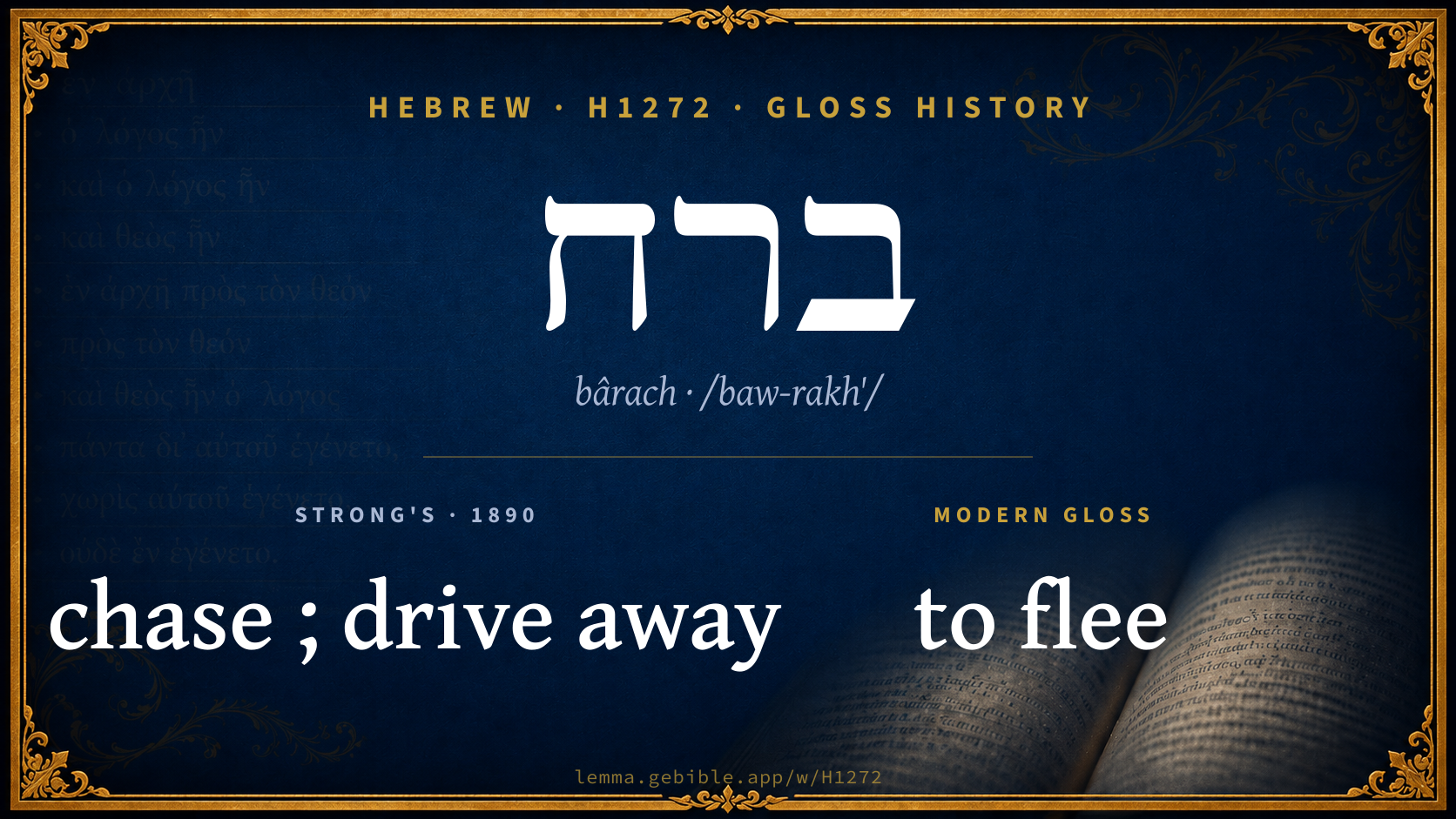
Gloss history
Strong's 1890 vs modern scholarship
About this word
Strong's H1272 catalogs a Hebrew word from the Hebrew Old Testament.
These counts are not copied from any lexicon or concordance. They are computed here, from the morphology-tagged Hebrew Old Testament. What Lemma adds →
- 64
- distinct verses
- The word appears in 64 distinct verses.
- 20 / 39
- OT books
- The word appears in 20 of 39 Old Testament books.
- #597
- by frequency
- Top 1000 most frequent Hebrew words (rank 597 of 8,640 Hebrew words by occurrence).
View all 64 occurrences in the concordance →
By section of the Old Testament
By traditional corpus
Conventional, traditional groupings — biblical authorship is debated, so this is a traditional corpus grouping, not an authorship claim. Each share is this word’s portion of its verses in that division of the Hebrew canon. Each figure is a share of the word’s 64 distinct verses.
- Prophets (Nevi'im) 33 verses · 52%
- Writings (Ketuvim) 17 verses · 27%
- Torah (Pentateuch) 14 verses · 22%
How translations render this word
Counts come from each version’s own published word-to-Strong’s tagging or interlinear alignment — an approximate guide to how each version renders this word, not a word-level alignment the data otherwise carries. Because each total is that version’s own tagged count, the per-version totals vary from one another and need not match the appearance or distinct-verse counts above. These counts may also differ from a printed concordance because Lemma counts each distinctly tagged rendering and does not collapse phrase taggings into a single head-word total. This is a fixed set of word-tagged versions (KJV, ASV, BSB, ULT) and does not change with the reading translation you choose elsewhere. Each version’s license is shown beside its name below (and on Sources).
- King James Version: Fled 19×, He fled 7×, Flee 4×
- American Standard Version: Fled 16×, Flee 4×, He fled 3×
- Berean Standard Bible: Fled 10×, Had fled 7×, He fled 6×
- unfoldingWord Literal Text: Fled 16×, Flee 10×, And 6×
King James Version Public Domain
Renders H1272 across 65 tagged occurrences — most commonly:
Plus 27 renderings that appear only once — usually multi-word phrases or single function words the recovered tagging swept in, not distinct renderings.
American Standard Version Public Domain
Renders H1272 across 63 tagged occurrences — most commonly:
Plus 32 renderings that appear only once — usually multi-word phrases or single function words the recovered tagging swept in, not distinct renderings.
Berean Standard Bible Public Domain
Renders H1272 across 63 tagged occurrences — most commonly:
Plus 29 renderings that appear only once — usually multi-word phrases or single function words the recovered tagging swept in, not distinct renderings. Not rendered by a distinct English word in 2 further occurrences.
unfoldingWord Literal Text CC BY-SA 4.0
Renders H1272 across 80 tagged occurrences — most commonly:
Plus 27 renderings that appear only once — usually multi-word phrases or single function words the recovered tagging swept in, not distinct renderings.
7 senses and sub-senses in the full BDB
Hebrew verbs can shift meaning by stem (binyan): Qal is the basic action, Niphal is often passive or reflexive, Piel often intensifies or makes it factitive, and Hiphil is typically causative. The senses below are grouped under the stem BDB assigns to each.
What do BDB’s symbols mean?
BDB uses these scholarly abbreviations:
| Symbol | Meaning |
|---|---|
| 𝔊 | the Septuagint (the ancient Greek translation, LXX) |
| 𝔙 | the Vulgate (the Latin translation) |
| 𝔖 | the Syriac version (the Peshitta) |
| 𝔗 | the Targum (the Aramaic translation) |
| ψ | the Psalms |
| √ | root (the underlying root or stem) |
| ‖ | parallel passage (a synonymous or contrasted parallel) |
| † | the dagger: every passage where the word occurs is cited |
The 7 senses and sub-senses the full Brown-Driver-Briggs lexicon distinguishes for this word, in lexicon order (not ranked by frequency), with BDB’s own verbatim wording and sub-sense lettering. Shown in Hebrew script with BDB’s own scholarly abbreviations. The condensed entry is in the Lexicon Entry tab. See also the Forms in the corpus table below.
Qal
- Pf. בָּרַח Gn 31:22 + 9 times, בָּֽרְחוּ Jb 9:25, בָּרָ֑חוּ Is 22:3; Impf. יִבְרַח Jb 20:24, יִבְרָ֑ח Jb 27:22 Ne 6:11 וַיִּבְרַח Gn 31:21 + 13 times; 3 fs. וַתִּבְרַח Gn 16:6, אֶבְרָ֑ח ψ 139:7, יִבְרְחוּ Je 52:7, וַיִּבְרְחוּ 2 S 4:3 + 4 times, נִבְרָ֑חָה 2 S 15:14; Imv. בְּרַח Gn 27:43 + 3 times, בִּרְחוּ Is 48:20; Inf. abs. בָּרוֹחַ Jb 27:22; cstr. בְּרֹחַ 1 S 23:6 + 3 times, בְּרוֹחַ Jon 1:3; sf. בָּרְחִי 1 K 2:7, בָּרְחֲךָ Gn 31:5, בָּרְחוֹ Gn 35:7 + 2 times;— e.g. Genesis 31:22
- 1. go or pass through, of bar, וַיַּעַשׂ אֶת־הַבְּרִיחַ … לִבְרֹחַ Ex 36:33 (P). e.g. Exodus 36:33
- 2. flee Gn 31:20, 21, 22 (E) Ex 14:5 (J) Ju 9:21; 1 S 19:12, 18; 22:17; 2 S 13:34, 37, 38 (del. Dr cf. We) 15:14; Is 22:3; Je 4:29; 26:21; 39:4; 52:7; Ne 6:11; fig. of days fleeing away Jb 9:25; of man, like a shadow Jb 14:2; c. מִן flee from a place 1 S 20:1; 2 S 19:10 (+ מֵעַל pers.) Is 48:20, a weapon Jb 20:24; a person, c. מֵאֵת 1 K 11:23, usually c. מִפְּנֵי Gn 16:6, 8; 31:27; 35:1, 7; Ex 2:15 (all JE) Ju 11:3; 2 S 21:11; 1 K 2:7; 12:2 = 2 Ch 10:2 ψ 3:1; 57:1 (titles) 139:7 Jon 1:10; מִיַּד י׳ fig. Jb 27:22; flee to, c. acc. place 1 S 27:4; 1 K 11:40; Ho 12:13; c. place & לְ Ne 13:10; c. place & ָה loc. Jon 1:3; 4:2 2 S 4:3; c. place & אֶל־ Nu 24:11 Am 7:12; c. אֶל־ & pers. 1 S 23:6 Gn 27:43 (J) 1 K 2:39 1 K 11:40; אַחֲרֵי & pers. 1 S 22:20; flee, sq. inf. 1 K 11:17 Dn 10:7. e.g. Genesis 31:20
- 3. flee = hasten, come quickly Ct 8:14. e.g. Song of Solomon 8:14
Hiphil
- Pf. הִבְרִיחוּ 1 Ch 8:13; Impf. יַבְרִיחַ Pr 19:26; sf. יַבְרִיחֶנּוּ Jb 41:20, וָאַבְרִחֵהוּ Ne 13:28, וַיַּבְרִיחוּ 1 Ch 12:15; Pt. מַבְרִחַ Ex 26:28;— e.g. 1 Chronicles 8:13
- 1. pass through, lit. Ex 26:28 (P) cf. Qal. e.g. Exodus 26:28
- 2. cause to flee, put to flight, animal Jb 41:20, men 1 Ch 8:13; 12:16; drive away Pr 19:26 Ne 13:28 (sq. מֵעָלַי). e.g. Job 41:20
Senses from the full Brown-Driver-Briggs lexicon (Brown, Driver, Briggs; Oxford 1906 — public domain), digitized via Sefaria, supplemented by the OpenScriptures HebrewLexicon (CC BY 4.0). Full attribution on Sources.
Word origin
vb. go through, flee (cf. Germ. durchgehen) (Arabic بَرِحَ go away, withdraw, flee)—
— Brown-Driver-Briggs (Oxford 1906, public domain), digitized via Sefaria, supplemented by the OpenScriptures HebrewLexicon (CC BY 4.0). See Sources.
Origin: a primitive root
Jastrow Dictionary
A second Hebrew/Aramaic lexicon for comparison, covering Aramaic and post-biblical (Talmudic, Targumic, Midrashic) usage that the biblical-Hebrew BDB does not. Matched by lemma rather than by Strong’s number, so a lemma may carry more than one Jastrow headword (shown separately below), and the entries cover usage well beyond the Bible.
בָּרַח
- , v. ברר)
- 1. to break through, pass through (Ex. XXXVI, 33). Denom. בָּרִיחַ. e.g. Exodus 36:33
- 2. to flee. Erub. 13ᵇ הבּוֹרֵחַ מן הגדולה he who flees office. Y. Yeb. XIII, 13ᶜ, a. e. בְּרַח מן ג׳ וכ׳ shun three things. Y. Taan. IV, 69ᵇ top, v. בָּקַע; a. fr.
- 1. to cause to flee, drive out, exclude. Y. Yeb. XV, 15ᵃ top להַבְרִיחוֹ מנכסיו to force him to flee and abandon his property. Y. Gitt. V, 47ᵃ אדם מַבְרִיחַ עצמו מן השבועה one will try to shirk the responsibilities of a guardian on account of the oath (which the court asks of him) but one will not do so on account of payment (to which he may eventually be subjected, v. Tosaf. to B. Kam. 39ᵇ).
- 2. to abstract, steal, defraud. B. Kam. 113ᵃ ה׳ את המכס to smuggle. Y. Keth. VI, beg. 30ᶜ שלא תהא מַבְרֶחֶת משל וכ׳ that she should not take stealthily something which belongs to her husband.
- to be chased, scattered. Lam. R. to I, 21 הוּבְרְחוּ ענני וכ׳ the clouds of glory were withdrawn (R. Hash. 3ᵃ נסתלקו).
בְּרַח
- Af. אַבְרַח as preced. Hif., to withhold. B. Kam. 88ᵇ לאברוחינהו לנכסיה מניה in order to withhold his property from &c., i.e. to disinherit.
- to be driven off, withheld. Targ. Job VI, 13 (h. text נדחה).
A Dictionary of the Targumim, the Talmud Babli and Yerushalmi, and the Midrashic Literature (Marcus Jastrow; London, Luzac, 1903) — Public Domain. Digitized via Sefaria. Digitized via Sefaria. Full attribution on Sources.
Forms in the corpus
The 49 distinct written forms H1272 takes in the Hebrew Bible, most frequent first — each parse links to that stem’s occurrences in the concordance. Hebrew forms include their vowel points and cantillation, so a single lemma takes many written forms.
Same root — word family
Other BDB entries built from the same root as H1272, grouped by Strong’s listed origin. These share a root / origin per the lexicon — not necessarily a shared meaning. Each links to that word’s own entry.
Derived from this word
Compare all same-root words → They share a root, not necessarily a meaning.
Septuagint verse parallels
This word appears in 57 verses that also exist in the Greek Old Testament (Septuagint), out of the 64 Hebrew verses it occurs in. You can read those verses in Greek by switching the Old Testament edition to the Septuagint.
Read these verses in the Septuagint
- Genesis 16:6
- Exodus 2:15
- Numbers 24:11
- Judges 9:21
- 1 Samuel 19:12
- 2 Samuel 4:3
- 1 Kings 2:7
- 1 Chronicles 8:13
- 2 Chronicles 10:2
- Job 9:25
- Psalms 3:1
- Proverbs 19:26
This is a verse-level parallel only — the same verses exist in both the Hebrew and Greek Old Testaments. No word-level Hebrew↔Greek correspondence is claimed: the data carries no such alignment, so no Greek word is shown as this Hebrew word’s translation. Coverage is not total — the Septuagint omits the deuterocanon and renumbers the Psalms, so some Hebrew verses have no direct Greek parallel.