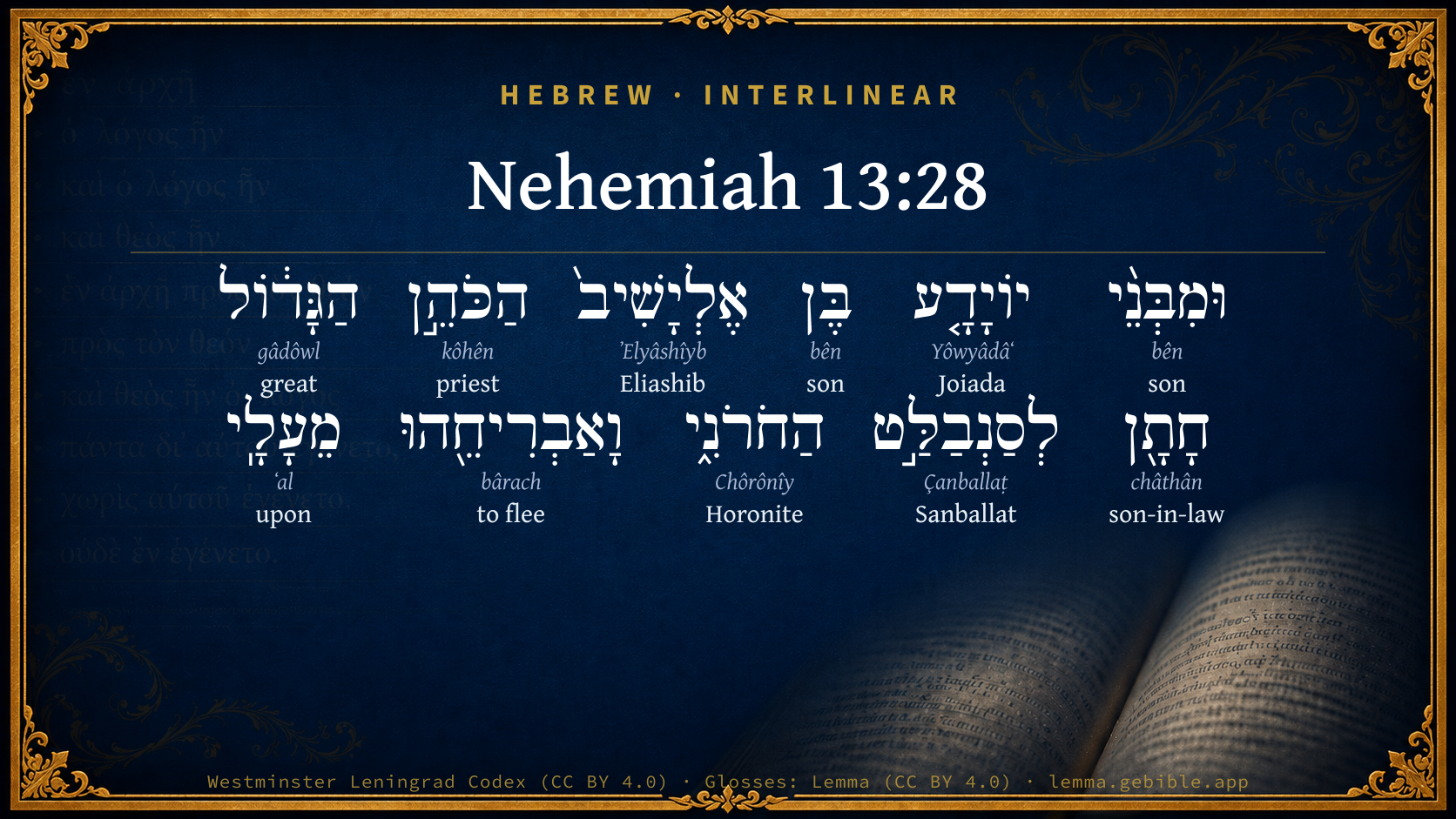
Nehemiah 13:28

Hebrew (Westminster Leningrad Codex) Nehemiah 13:28 appears in the Hebrew Old Testament. The text above is from the Westminster Leningrad Codex. Each word links to its Strong’s number, a concise gloss, and parsing drawn from the Open Scriptures Hebrew Bible morphology. Click any word for its full Brown-Driver-Briggs (BDB) entry.
Download image
Cite this verse

Nehemiah 13:28 (World English Bible). Public Domain. Lemma interlinear Bible study tool, https://lemma.gebible.app/v/nehemiah/13/28.

Show BibTeX & RIS
BibTeX
RIS
English Translation
One of the sons of Joiada, the son of Eliashib the high priest, was son-in-law to Sanballat the Horonite: therefore I chased him from me.
World English Bible · Public Domain
Download a study sheet

One document with this verse’s original text, its word-by-word gloss line, the meaning frame, cross-references with their text, attributed commentary, and full source and license credits — printable, and it pastes into notes with its structure intact.

This verse Autodidact and up

Study sheet (.html) Plain text (.txt)

A passage Seminary Student

Up to 50 verses in one chapter. A passage sheet keeps up to 6 commentary sources and 12 cross-references per verse, in the order this page ranks them, and says so on the sheet whenever that leaves anything out. Ask for a single verse and you get the Autodidact verse sheet above.

Everything on this page stays free to read, with no account — the sheet is a download of what is already on screen, not access to it.

Want to remove ads? Support Godless Engineer
Compare translations 3

The same verse in 3 English versions, stacked beneath the original-language interlinear above. Click any original word for its lexicon entry.

Each is an independent rendering of the whole verse — the interlinear is not word-aligned to these translations.

Highlighted words mark where these versions differ — a whole-verse word diff, not a word-by-word alignment.

  • World English Bible Public Domain
    One of the sons of Joiada, the son of Eliashib the high priest, was son-in-law to Sanballat the Horonite: therefore I chased him from me.
  • King James Version Public Domain
    And one of the sons of Joiada, the son of Eliashib the high priest, was son in law to Sanballat the Horonite: therefore I chased him from me.
  • unfoldingWord Literal Text CC BY-SA 4.0
    And one from the sons of Joiada, the son of Eliashib the high priest, was son-in-law to Sanballat the Horonite. And I caused him to flee from beside me.

unfoldingWord Literal Text — © unfoldingWord, licensed CC BY-SA 4.0. Word-aligned USFM3 via Door43 (git.door43.org/unfoldingWord/en_ult).

Versions to compare (up to 4)

3 of 4 selected

Show all 18 translations

Every available English version of this verse, each an independent rendering of the whole verse.

  • World English Bible Public Domain
    One of the sons of Joiada, the son of Eliashib the high priest, was son-in-law to Sanballat the Horonite: therefore I chased him from me.
  • Berean Standard Bible Public Domain
    Even one of the sons of Jehoiada son of Eliashib the high priest had become a son-in-law to Sanballat the Horonite. Therefore I drove him away from me.
  • Majority Standard Bible Public Domain
    Even one of the sons of Jehoiada son of Eliashib the high priest had become a son-in-law to Sanballat the Horonite. Therefore I drove him away from me.
  • King James Version Public Domain
    And one of the sons of Joiada, the son of Eliashib the high priest, was son in law to Sanballat the Horonite: therefore I chased him from me.
  • American Standard Version (1901) Public Domain
    And one of the sons of Joiada, the son of Eliashib the high priest, was son-in-law to Sanballat the Horonite: therefore I chased him from me.
  • Revised Version (1885) Public Domain
    And one of the sons of Joiada, the son of Eliashib the high priest, was son in law to Sanballat the Horonite: therefore I chased him from me.
  • Geneva Bible (1599) Public Domain
    And one of the sonnes of Ioiada the sonne of Eliashib the hie Priest was the sonne in law of Sanballat the Horonite: but I chased him from me.
  • Douay-Rheims (1899) Public Domain
    And one of the sons of Joiada the son of Eliasib the high priest, was son in law to Sanaballat the Horonite, and I drove him from me.
  • Young's Literal Translation Public Domain
    And `one' of the sons of Joiada son of Eliashib the high priest, `is' son-in-law to Sanballat the Horonite, and I cause him to flee from off me.
  • Literal Standard Version CC BY-SA 4.0
    And [one] of the sons of Joiada son of Eliashib the high priest, [is] son-in-law to Sanballat the Horonite, and I cause him to flee from off me.
  • Unlocked Literal Bible CC BY-SA 4.0
    One of the sons of Joiada son of Eliashib the high priest was son-in-law to Sanballat the Horonite. Therefore I caused him to flee from my presence.
  • unfoldingWord Literal Text CC BY-SA 4.0
    And one from the sons of Joiada, the son of Eliashib the high priest, was son-in-law to Sanballat the Horonite. And I caused him to flee from beside me.
  • Darby Bible Public Domain
    And [one] of the sons of Joiada, the son of Eliashib the high priest, was son-in-law to Sanballat the Horonite; and I chased him from me.
  • World Messianic Bible Public Domain
    One of the sons of Joiada, the son of Eliashib the high priest, was son-in-law to Sanballat the Horonite; therefore I chased him from me.
  • Webster's Bible Public Domain
    And one of the sons of Joiada, the son of Eliashib the high priest, was son-in-law to Sanballat the Horonite: therefore I chased him from me.
  • Free Bible Version CC BY-SA 4.0
    Even one of the sons of Jehoiada, son of Eliashib the high priest, had become a son-in-law to Sanballat the Horonite. So I expelled him.
  • Bible in Basic English Public Domain
    And one of the sons of Joiada, the son of Eliashib, the chief priest, was son-in-law to Sanballat the Horonite: so I sent him away from me.
  • JPS Tanakh (1917) Public Domain
    And one of the sons of Joiada, the son of Eliashib the high priest, was son-in-law to Sanballat the Horonite; therefore I chased him from me.

Literal Standard Version (2020), Covenant Press — licensed CC BY-SA 4.0. Text via the HelloAO Bible API (eBible.org). Unlocked Literal Bible (unfoldingWord) — licensed CC BY-SA 4.0. Text via the HelloAO Bible API (eBible.org). unfoldingWord Literal Text — © unfoldingWord, licensed CC BY-SA 4.0. Word-aligned USFM3 via Door43 (git.door43.org/unfoldingWord/en_ult). Free Bible Version, Dr. Jonathan Gallagher — licensed CC BY-SA 4.0. Text via the HelloAO Bible API (eBible.org).

Word by word

More ways to search: Search by grammar → Find every occurrence → Compare this word →

Practice this passage: Drill this verse → Learn its vocabulary →

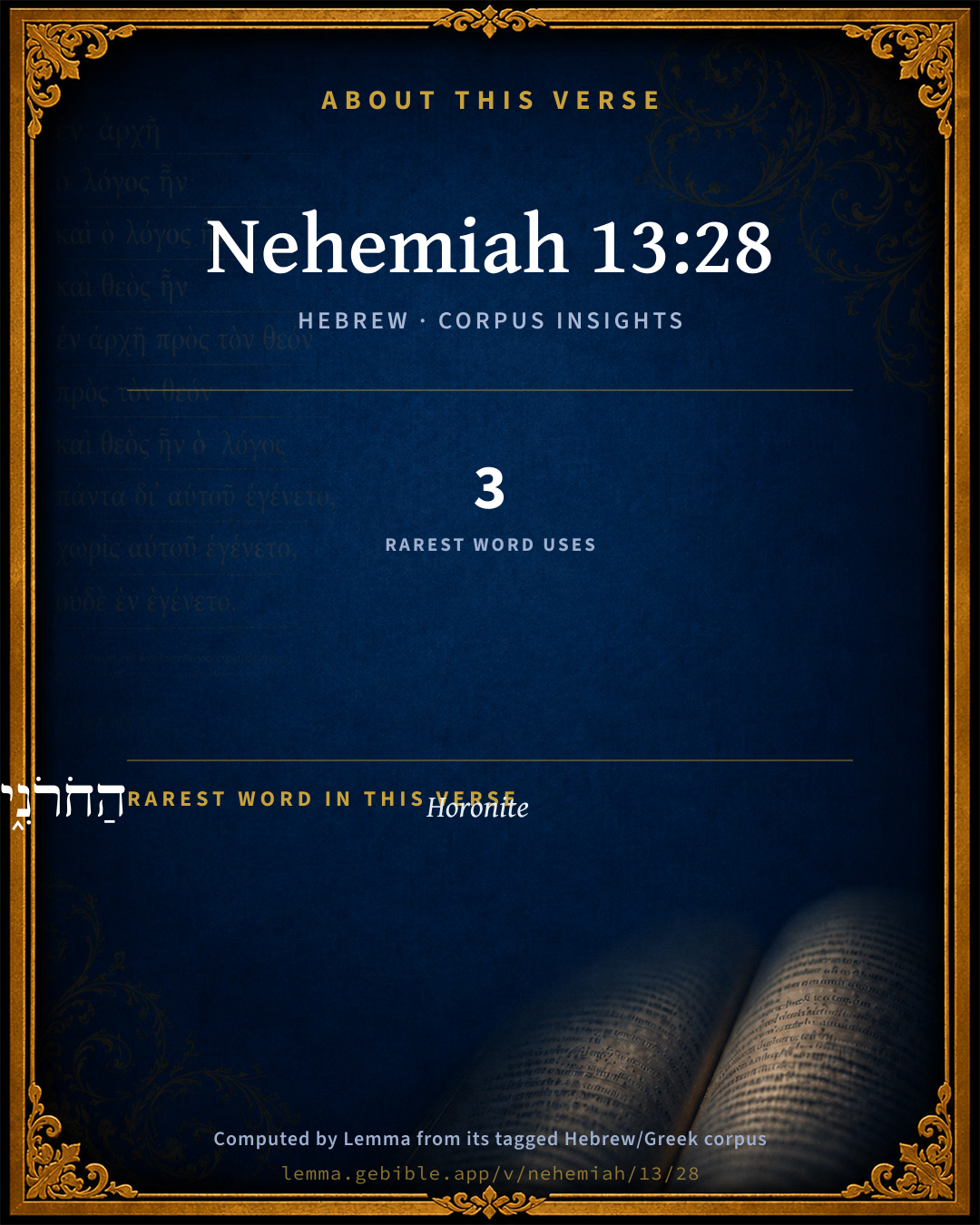
הַחֹרֹנִ֑י
Chôrônîy
H2772
“the · Horonite”
Particle, Definite Article + Noun, Gentilic, Masculine, Singular, Absolute
Part of Speech
Particle + Noun
Type
Gentilic
Gender
Masculine
Number
Singular
State
Absolute
Full BDB Definition

Origin: from H2773

TWOT: None

Horonite = "native of Horonaim" - an inhabitant of Horonaim in Moab - the designation of Sanballat, the opponent of Nehemiah
  1. וּמִבְּנֵ֨י bên H1121 “and · from · sons of” Conjunction + Preposition + Noun, Common, Masculine, Plural, Construct
  2. יוֹיָדָ֤ע Yôwyâdâʻ H3111 “Joiada” Noun, Proper
  3. בֶּן bên H1121 “son of” Noun, Common, Masculine, Singular, Construct
  4. אֶלְיָשִׁיב֙ ʼElyâshîyb H475 “Eliashib” Noun, Proper
  5. הַכֹּהֵ֣ן kôhên H3548 “the · priest” Particle, Definite Article + Noun, Common, Masculine, Singular, Absolute
  6. הַגָּד֔וֹל gâdôwl H1419 “the · great” Particle, Definite Article + Adjective, Adjective, Masculine, Singular, Absolute
  7. חָתָ֖ן châthân H2860 “son-in-law” Noun, Common, Masculine, Singular, Absolute
  8. לְסַנְבַלַּ֣ט Çanballaṭ H5571 “to/for · Sanballat” Preposition + Noun, Proper
  9. וָאַבְרִיחֵ֖הוּ bârach H1272 “and · to flee · him” Conjunction + Verb, Hiphil, Sequential Imperfect, 1st Person, Common, Singular + Suffix, Personal, 3rd Person, Masculine, Singular
  10. מֵעָלָֽי ʻal H5921 “from · upon · me” Preposition + Preposition + Suffix, Personal, 1st Person, Common, Singular

About this verse

These counts appear in no published source. They are computed here, from the morphology-tagged text and Lemma’s own curated glosses. What Lemma adds →

11
words
10
distinct lemmas
Historical
section

Notable vocabulary

The rarest word here is הַחֹרֹנִ֑י Horonite H2772 — appearing just 3 times in the whole Hebrew Bible.

Shared distinctive vocabulary

הַחֹרֹנִ֑י Horonite H2772 occurs in 3 verses of the Hebrew Bible. Also found in:

Grammatical profile

  • 1 verb
  • 8 nouns
  • 1 adjective
  • 1 preposition

Verb forms

  • וָאַבְרִיחֵ֖הוּ Hiphil · Sequential Imperfect

Repetition

A word recurs within this verse — often emphatic in Hebrew:

  • וּמִבְּנֵ֨י son H1121 ×2

Cross-references

12

Topical passages linked to Nehemiah 13:28 in the Treasury of Scripture Knowledge — connected by theme and wording, ordered by reader-vote popularity; previews shown in the World English Bible.

  • Nehemiah 2:19 But when Sanballat the Horonite, and Tobiah the servant, the Ammonite, and Geshem the Arabian, heard it, they ridiculed us, and despised us, and said, What is this thing that you do? will you rebel against the king?
  • Nehemiah 2:10 When Sanballat the Horonite, and Tobiah the servant, the Ammonite, heard of it, it grieved them exceedingly, because a man had come to seek the welfare of the children of Israel.
  • Nehemiah 3:1 Then Eliashib the high priest rose up with his brothers the priests, and they built the sheep gate; they sanctified it, and set up the doors of it; even to the tower of Hammeah they sanctified it, to the tower of Hananel.
  • Nehemiah 6:17–19 Moreover in those days the nobles of Judah sent many letters to Tobiah, and [the letters] of Tobiah came to them.
  • Nehemiah 12:10 Jeshua became the father of Joiakim, and Joiakim became the father of Eliashib, and Eliashib became the father of Joiada,
  • Nehemiah 12:22 As for the Levites, in the days of Eliashib, Joiada, and Johanan, and Jaddua, there were recorded the heads of fathers' [houses]; also the priests, in the reign of Darius the Persian.
  • Nehemiah 13:4–5 Now before this, Eliashib the priest, who was appointed over the chambers of the house of our God, being allied to Tobiah,
  • Nehemiah 13:25 I contended with them, and cursed them, and struck certain of them, and plucked off their hair, and made them swear by God, [saying], You shall not give your daughters to their sons, nor take their daughters for your sons, or for yourselves.
  • Psalms 101:8 Morning by morning, I will destroy all the wicked of the land; To cut off all the workers of iniquity from Yahweh's city.
  • Proverbs 20:8 A king who sits on the throne of judgment Scatters away all evil with his eyes.
  • Proverbs 20:26 A wise king winnows out the wicked, And drives the threshing wheel over them.
  • Romans 13:3–4 For rulers are not a terror to the good work, but to the evil. Do you desire to have no fear of the authority? Do that which is good, and you will have praise from the same,

Cross-references courtesy of OpenBible.info (CC BY 4.0).

Hebrew and Greek witnesses Masoretic Hebrew ↔ Greek Septuagint

The same verse in the two great witnesses to the Old Testament, shown verse-for-verse.

These are two independent witnesses, not word-aligned to each other, and the Septuagint is shown in lemma (dictionary) form.

Hebrew Nehemiah 13:28 Masoretic · Westminster Leningrad Codex

וּמִבְּנֵ֨י יוֹיָדָ֤ע בֶּן אֶלְיָשִׁיב֙ הַכֹּהֵ֣ן הַגָּד֔וֹל חָתָ֖ן לְסַנְבַלַּ֣ט הַחֹרֹנִ֑י וָאַבְרִיחֵ֖הוּ מֵעָלָֽי

One of the sons of Joiada, the son of Eliashib the high priest, was son-in-law to Sanballat the Horonite: therefore I chased him from me.

World English Bible · Public Domain

Greek LXX Structure differs

The Septuagint has no separate book of Nehemiah. Its Greek text is the second half of Esdras B (2 Esdras), chapters 11–23; Ezra is the first half (1–10).

A verse-for-verse comparison isn’t shown here because the chapters and verses don’t line up. Switch to the LXX edition with the MT / LXX toggle above to read the Greek directly.

On this verse, The Cambridge Bible for Schools and Colleges discusses the Septuagint’s reading. Read the note in Commentary ↓

Hebrew: Westminster Leningrad Codex (CC BY 4.0). Greek: Septuagint (public domain); English from a public-domain English Septuagint. How the Septuagint differs from the Hebrew →

Commentary

Notes on Nehemiah 13:28 from classic Christian and Jewish commentators (each source and its license shown beneath its notes). The classic Christian expositions comment on the surrounding passage and are grouped to its opening verse, so a note may address several verses; the Jewish commentaries on the Tanakh (Rashi and others) are per-verse, so they appear only where the commentator wrote on this verse.

Lemma curates 59 commentaries, every one of them public domain or Creative Commons licensed, each selected and text-cleaned for this edition rather than reprinted as found. About our sources →

Trapp's Complete Commentary

John Trapp

Neh 13:28 And [one] of the sons of Joiada, the son of Eliashib the high priest, [was] son in law to Sanballat the Horonite: therefore I chased him from me.

Ver. 28. And one of the sons of Joiada] His grandson Manasses, brother to Jaddua the high priest, a vile apostate, and first author of that famous schism and deadly feud between the Samaritans and Jews, Joh 4:20 (Joseph. lib. xi.).

Was son-in-law to Sanballat] Who, to keep him to his wife, built a fair temple on Mount Gerizim, hard by the city of Sychem, and made Manasses chief priest thereof.

Therefore I chased him from me] I caused him to be excommunicated, and banished from amongst us.

Remember them, O my God] For evil, as me for good, Neh 13:31, and in both remember the relation that is between thee and my soul. Woe be to those whom God’s people do thus turn over to him to be punished.

Because they have defiled the priesthood] Corruptio optimi pessima: as sweetest wine makes the sourest vinegar. A wicked priest is the worst creature upon earth.

And the covenant, &c.] {See Trapp on "Mal 2:4"}

John Trapp, A Commentary or Exposition upon All the Books of the Old and New Testament (1647–1656) — public domain. Text from a community e-Sword module.

Tyndale Open Study Notes

Tyndale Open Resources

13:28 Even the family of the high priest, who were supposed to be Israel’s spiritual leaders, had participated in the sin of intermarriage with unbelieving foreigners (cp. Lev 21:14). Nehemiah banished the offender, stripping him of status and removing his rights in the Jewish community.

Tyndale Open Study Notes — © Tyndale Open Resources, licensed CC BY-SA 4.0. Text via the HelloAO Bible API.

Adam Clarke's Commentary

Verse 28. One of the sons of Joiada] This was Manasseh, brother of Jaddua, son of Joiada, and grandson of Eliashib the high priest.

I chased him from me.] Struck him off the list of the priests, and deemed him utterly unworthy of all connection and intercourse with truly religious people.

Adam Clarke's Commentary on the Bible (1810–1826) — public domain. Text from a community e-Sword/MySword module.

Ellicott's Commentary for English Readers

(28) I chased him from me.—Eliashib himself was allied by marriage to Tobiah, and one of his grandsons was now brought into prominence as married to Sanballat. Him Nehemiah drove into exile.

A Bible Commentary for English Readers, edited by Charles John Ellicott (1878–1897) — public domain. Text from a community e-Sword module.

The Cambridge Bible for Schools and Colleges

gen. ed. J. J. S. Perowne

28. one of the sons of Joiada] We should gather that Eliashib the grandfather was still alive, since the emphasis lies on the relationship of the offender to the high-priest. ‘Joiada.’ Cf. Neh_12:10. On Eliashib see note on Neh_13:4.

son in law to Sanballat the Horonite] For Sanballat, cf. Neh_2:10, Neh 3:33, Neh_4:1, Neh_6:1. The marriage of the high-priest’s grandson with Sanballat’s daughter was an offence in every way. (1) It showed treasonable alliance with Israel’s bitterest foe, (2) it violated the rule laid down in Ezra’s time against mixed marriages, (3) it compromised the purity of the high-priestly house (Lev_21:6 ff.).

therefore I chased him from me] LXX. ἐξέβρασα. Obviously because he was contumacious, and refused to put away his wife. Rashi’s explanation that Nehemiah chased him away for fear of his playing the spy and reporting the means of entering and leaving the city, is strangely inadequate. Josephus relates a story so similar to this that it should probably be referred to the same events, although he must have obtained it from some other source. According to Josephus (Ant. xi. 7, 8) a certain Manasse, the brother of Jaddua and son of John or Johanan (and therefore grandson not son of Joiada) took to wife Nikaso, the daughter of the Cuthaean Sanballat. Refusing to put her away, he was expelled from Jerusalem by the Jewish nobles, and took refuge with the Samaritans, among whom, as a member of the high-priestly family, he set up upon Mt Gerizim a rival temple and priesthood. It will be seen that Josephus assigns this to the period of Alexander the Great. But there it is probable that Josephus is at fault; for he completely fails to realize the interval of time between the Return from the Exile and the Age of Alexander; and it is to this chronological confusion rather than to a mistake of ‘Jaddua’ for ‘Joiada’ that we should ascribe the cause of his principal variation from the Memoirs of Nehemiah. For (1) in Alexander’s time the organization of the Samaritan worship had long been fully established, (2) it is very improbable that a repetition of such a striking incident should occur just a century after Nehemiah’s time.

The Cambridge Bible for Schools and Colleges (gen. ed. J. J. S. Perowne; Cambridge University Press, 1878–1918) — public domain. Text from a community e-Sword module.

John Gill's Exposition

And for the wood offering, at times appointed,.... Of which see Neh 10:34. Levites were appointed to receive the wood that was brought at the times and by the persons fixed, and lay it up in its proper place, and carry it to the altar when wanted:

and for the first fruits; to receive and take care of them, and distribute them to the persons to whom they belonged:

remember me, O my God, for good; to bless him with all good things, temporal and spiritual, to keep him faithful, to make him useful in church and state, and protect him from all his enemies: or rather this may respect what goes before, that as to the wood offering and the firstfruits, that God would graciously remember him as to them, since the one was as necessary to the altar as the other was to those that minister at it.

Next: Esther Introduction

John Gill's Exposition of the Whole Bible (1746–1763) — public domain (CC PDM 1.0). Text via the HelloAO Bible API.

Haydock's Catholic Bible Commentary

One. Manasses, brother of Jaddus. (Josephus, [Antiquities?] xi. 8.) --- Sanaballet, noted for his enmity towards the Jews, chap. vi. 1. He obtained leave of Alexander to build the famous temple on Garizim, for this son-in-law. He must have been 150 yeas old when Alexander laid siege to Tyre, the year of the world 3672. Esdras and Nehemias were noted for their great age. Yet some would suppose that there were two of the name of Sanaballet; and Josephus says that the one in question was appointed governor of Samaria by Darius, the last king of the Persians. This opinion is adopted by Usher, the year of the world 3972. (Tirinus, &c.) --- But there is still a difficulty to know whether it be necessary. (Calmet) --- From me. In revenge he set up an opposition altar. (Haydock) --- He had contracted a marriage, which was unlawful for all, and entailed degradation upon priests.

George Leo Haydock (1774–1849), Haydock's Catholic Family Bible and Commentary, 1859 edition — public domain. Excludes Psalms (Douay-Rheims chapter numbering differs from Protestant) and Deuterocanonical books (Catholic canon only).

Matthew Poole's English Annotations

Joiada; said by Josephus to be that Manasses who by Sanballat’s interest procured liberty to build the Samaritan temple in Mount Gerizim; to which those priests who had married strange wives, or been otherwise criminal, betook themselves, and with or after them others of the people in the same or like circumstances.

I chased him from me, i.e. from my presence and court, and from the city and temple, and all the privileges of the priesthood, and from the whole congregation and church of Israel, whereof I am a member.

Matthew Poole's English Annotations on the Holy Bible (1683–1685) — public domain. Text from a community e-Sword/MySword module.

Whedon's Commentary on the Bible

Daniel D. Whedon

28. One of the sons of Joiada — Not Jonathan or Johanan, (Neh_12:11; Neh_12:22,) but a younger and less prominent member of the high priest’s family. The fact, however, that he was a son of the high priest made the matter of his foreign marriage the more notorious, and called for the greater severity on the part of the governor.

Sanballat — See on chapter Neh_2:10.

I chased him from me — Expelled and banished him from the province of Judea. Josephus (Antiq., Neh_11:7; Neh_11:2) relates this incident of Manasseh, a brother of Jaddua, and places it in the reign of Darius Codomannus the last king of Persia. In this, as in some other things, he seems to have fallen into a confusion of names and dates. He also relates how the excommunicated priest went over to Sanballat and became high priest of the Samaritan temple which was built upon Mount Gerizim.

Daniel D. Whedon (gen. ed.), Commentary on the Old and New Testaments (1874–1909) — public domain. Text from a community e-Sword module.

The Pulpit Commentary

One of the sons of Joiada, the son of Eliashib. See Neh_12:10. Eliashib seems to have been still living, though one of his grandsons was of age to contract a marriage. Was son-in-law to Sanballat, the Horonite. Had therefore married one of his daughters, while Eliashib himself was connected by marriage with Tobiah. The defection of the high priestly family from those principles which Ezra and Nehemiah regarded as vital is only too apparent. I chased him from me . i.e. I forced him to quit the country and become an exile. We may suppose that he refused to repudiate his foreign wife, and preferred to take refuge with Sanballat in Samaria.

The Pulpit Commentary (1880–1919), ed. H.D.M. Spence-Jones & Joseph S. Exell — public domain. Text from a community e-Sword module.

John Wesley's Explanatory Notes

And one, &c. - Said by Josephus to be that Manasses, who by Sanballat's interest procured liberty to build the Samaritan temple in mount Gerizim; to which those priests who had married strange wives, or been otherwise criminal, betook themselves, and with, or after them, others of the people in the same or like circumstances. Chased - From my presence and court, from the city and temple, and from the congregation and church of Israel.

John Wesley, Explanatory Notes Upon the Whole Bible (1754–1765) — public domain. Text via the GEBible commentary corpus.

Keil & Delitzsch

C. F. Keil & F. Delitzsch

Nehemiah acted with greater severity towards one of the sons of Joiada the high priest, and son-in-law of Sanballat. He drove him from him (מעלי, that he might not be a burden to me). The reason for this is not expressly stated, but is involved in the fact that he was son-in-law to Sanballat, i.e., had married a daughter of Sanballat the Horonite (Neh 2:10), who was so hostile to Nehemiah and to the Jewish community in general, and would not comply with the demand of Nehemiah that he should dismiss this wife. In this case, Nehemiah was obliged to interfere with authority. For this marriage was a pollution of the priesthood, and a breach of the covenant of the priesthood and the Levites. Hence he closes the narrative of this occurrence with the wish, Neh 13:29, that God would be mindful of them (להם, of those who had done such evil) on account of this pollution, etc., i.e., would punish or chastise them for it. גּאלי, stat. constr. pl. from גּאל, pollution (plurale tant.). It was a pollution of the priesthood to marry a heathen woman, such marriage being opposed to the sacredness of the priestly office, which a priest was to consider even in the choice of a wife, and because of which he might marry neither a whore, nor a feeble nor a divorced woman, while the high priest mighty marry only a virgin of his own people (Lev 21:7, Lev 21:14). The son of Joiada who had married a daughter of Sanballat was not indeed his presumptive successor (Johanan, Neh 12:11), for then he would have been spoken of by name, but a younger son, and therefore a simple priest; he was, however, so nearly related to the high priest, that by his marriage with a heathen woman the holiness of the high-priestly house was polluted, and therewith also "the covenant of the priesthood," i.e., not the covenant of the everlasting priesthood which God granted to Phinehas for his zeal (Num 25:13), but the covenant which God concluded with the tribe of Levi, the priesthood, and the Levites, by choosing the tribe of Levi, and of that tribe Aaron and his descendants, to be His priest (לו לכהנו, Exo 28:1). This covenant required, on the part of the priests, that they should be "holy to the Lord" (Lev 21:6, Lev 21:8), who had chosen them to be ministers of His sanctuary and stewards of His grace.

Josephus (Ant. xi. 7. 2) relates the similar fact, that Manasseh, a brother of the high priest Jaddua, married Nikaso, a daughter of the satrap Sanballat, a Cuthite; that when the Jewish authorities on that account excluded him from the priesthood, he established, by the assistant of his father-in-law, the temple and worship on Mount Gerizim (xi. 8. 2-4), and that many priests made common cause with him. Now, though Josephus calls this Manasseh a brother of Jaddua, thus making him a grandson of Joiada, and transposing the establishment of the Samaritan worship on Gerizim to the last years of Darius Codomannus and the first of Alexander of Macedon, it can scarcely be misunderstood that, notwithstanding these discrepancies, the same occurrence which Nehemiah relates in the present verses is intended by Josephus. The view of older theologians, to which also Petermann (art. Samaria in Herzog's Realenc. xiii. p. 366f.) assents, that there were two Sanballats, one in the days of Nehemiah, the other in the time of Alexander the Great, and that both had sons-in-law belonging to the high-priestly family, is very improbable; and the transposition of the fact by Josephus to the times of Darius Codomannus and Alexander accords with the usual and universally acknowledged incorrectness of his chronological combinations. He makes, e.g., Nehemiah arrive at Jerusalem in the twenty-fifth year of Xerxes, instead of the twentieth of Artaxerxes, while Xerxes reigned only twenty years.

Keil & Delitzsch — Biblical Commentary on the Old Testament (1861–1891) — public domain (CC PDM 1.0). Text via the HelloAO Bible API. (Old Testament only.)

unfoldingWord translationNotes

Door43 World Missions Community

Joiada ... Eliashib ... Sanballat

These are the names of men. (See: How to Translate Names)

the Horonite

This refers to a person from the city of Beth Horon. (See: How to Translate Names)

I caused him to flee from my presence

"I chased him away" or "I made him leave Jerusalem"

Call them to mind

"Think about them" or "Remember what they have done." See how you translated a similar phrase in Nehemiah 13:14.

they have defiled the priesthood, and the covenant of the priesthood and the Levites

Causing the priesthood to be dishonored and breaking the covenant is spoken of as if they made the priesthood and covenant physically unclean. AT: "they have dishonored the priesthood and broken the covenant you made with the priests and Levites" (See: Metaphor)

translationWords

son

high priest

call

mind

God

defile

priest

covenant

Levi

unfoldingWord translationNotes — © Distant Shores Media and the Door43 World Missions Community, licensed CC BY-SA 4.0. Source: git.door43.org/Door43/en_tn.

Rashi

Rabbi Shlomo Yitzchaki (Rashi)

And [one] of the sons of Joiada...was the son in law of Sanballat One of the sons of Joiada was the son-in-law of Sanballat, the adversary of the Jews; thus, I drove him away from me so that he should not frequent Jerusalem because of his son-in-law, to see the city and the ways to enter and leave it.

Rashi on the Tanakh — English translations: “The Judaica Press complete Tanach with Rashi, translated by A. J. Rosenberg” (CC BY 4.0); “Pentateuch with Rashi's commentary by M. Rosenbaum and A.M. Silbermann, 1929-1934” (public domain); “The Metsudah Tanach series, Lakewood, N.J” (CC BY 4.0); and “The Book of Joshua, Metsudah Publications, 1997” (CC BY 4.0). Text via Sefaria.

Lesson kit

Teaching starters — assembled from the data on this page, not authored interpretation. Every prompt links to the verse data it draws on. Edit before teaching.

Nehemiah, in the Historical, opens this verse with 11 words (10 distinct Hebrew lemmas). Its most distinctive word is Chôrônîy (“Horonite”). A historical commentator’s framing appears above. Read the whole chapter for the surrounding context.

Discussion questions

  1. The word Chôrônîy carries the sense “Horonite.” How does it shape the verse?
  2. How does Nehemiah 2:10, which shares the word «Horonite», read alongside this verse?
  3. What does the repetition of “son” (2× in this one verse) do in this verse?
  4. These translations render this verse differently; the difference is in the English rendering, not the original. What questions does that raise?
  5. «וָאַבְרִיחֵ֖הוּ» is a Hiphil Sequential Imperfect verb. How does that grammatical form shape the action described?
  6. Compare how Trapp's Complete Commentary and Tyndale Open Study Notes read this verse. Where do they agree or differ?

Things to notice

Reading settings

Reading text

Shown beneath each verse's original-language words.

Old Testament
Old Testament edition

Read the OT as the Masoretic Hebrew (MT) or the Greek Septuagint (LXX).

English shown for the Greek Septuagint (in the Hebrew ↔ Greek comparison).

Comparing translations? Open the Compare panel on any verse page to stack up to four side by side.