
Song of Solomon 8:14

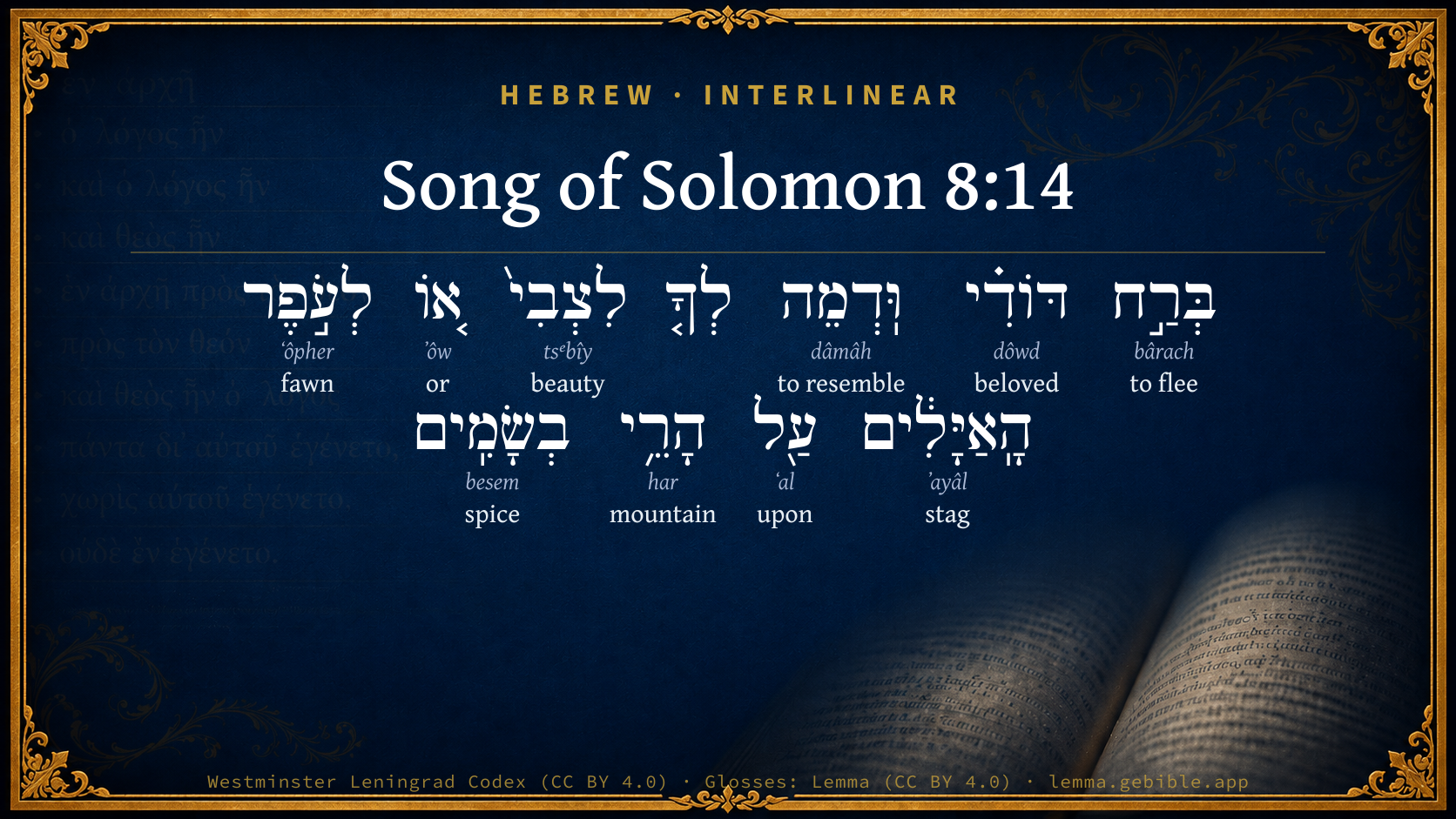
Hebrew (Westminster Leningrad Codex) Song of Solomon 8:14 appears in the Hebrew Old Testament. The text above is from the Westminster Leningrad Codex. Each word links to its Strong’s number, a concise gloss, and parsing drawn from the Open Scriptures Hebrew Bible morphology. Click any word for its full Brown-Driver-Briggs (BDB) entry.
Download image
Cite this verse

Song of Solomon 8:14 (World English Bible). Public Domain. Lemma interlinear Bible study tool, https://lemma.gebible.app/v/song-of-solomon/8/14.

Show BibTeX & RIS
BibTeX
RIS
English Translation
Come away, my beloved! Be like a gazelle or a young stag on the mountains of spices!
World English Bible · Public Domain
Download a study sheet

One document with this verse’s original text, its word-by-word gloss line, the meaning frame, cross-references with their text, attributed commentary, and full source and license credits — printable, and it pastes into notes with its structure intact.

This verse Autodidact and up

Study sheet (.html) Plain text (.txt)

A passage Seminary Student

Up to 50 verses in one chapter. A passage sheet keeps up to 6 commentary sources and 12 cross-references per verse, in the order this page ranks them, and says so on the sheet whenever that leaves anything out. Ask for a single verse and you get the Autodidact verse sheet above.

Everything on this page stays free to read, with no account — the sheet is a download of what is already on screen, not access to it.

Want to remove ads? Support Godless Engineer
Compare translations 3

The same verse in 3 English versions, stacked beneath the original-language interlinear above. Click any original word for its lexicon entry.

Each is an independent rendering of the whole verse — the interlinear is not word-aligned to these translations.

Highlighted words mark where these versions differ — a whole-verse word diff, not a word-by-word alignment.

  • World English Bible Public Domain
    Come away, my beloved! Be like a gazelle or a young stag on the mountains of spices!
  • King James Version Public Domain
    Make haste, my beloved, and be thou like to a roe or to a young hart upon the mountains of spices.
  • unfoldingWord Literal Text CC BY-SA 4.0
    Flee, my beloved, and resemble a gazelle or a young stag on the mountains of spices.

unfoldingWord Literal Text — © unfoldingWord, licensed CC BY-SA 4.0. Word-aligned USFM3 via Door43 (git.door43.org/unfoldingWord/en_ult).

Versions to compare (up to 4)

3 of 4 selected

Show all 18 translations

Every available English version of this verse, each an independent rendering of the whole verse.

  • World English Bible Public Domain
    Come away, my beloved! Be like a gazelle or a young stag on the mountains of spices!
  • Berean Standard Bible Public Domain
    Come away, my beloved, and be like a gazelle or a young stag on the mountains of spices.
  • Majority Standard Bible Public Domain
    Come away, my beloved, and be like a gazelle or a young stag on the mountains of spices.
  • King James Version Public Domain
    Make haste, my beloved, and be thou like to a roe or to a young hart upon the mountains of spices.
  • American Standard Version (1901) Public Domain
    Make haste, my beloved, And be thou like to a roe or to a young hart Upon the mountains of spices.
  • Revised Version (1885) Public Domain
    Make haste, my beloved, and be thou like to a roe or to a young hart upon the mountains of spices.
  • Geneva Bible (1599) Public Domain
    O my welbeloued, flee away, and be like vnto the roe, or to the yong harte vpon ye mountaines of spices.
  • Douay-Rheims (1899) Public Domain
    Flee away, O my beloved, and be like to the roe, and to the young hart upon the mountains of aromatical spices.
  • Young's Literal Translation Public Domain
    Or to a young one of the harts on mountains of spices!
  • Literal Standard Version CC BY-SA 4.0
    Or to a young one of the harts on mountains of spices!
  • Unlocked Literal Bible CC BY-SA 4.0
    Hurry, my beloved, and be like a gazelle or a young stag on the mountains of spices.
  • unfoldingWord Literal Text CC BY-SA 4.0
    Flee, my beloved, and resemble a gazelle or a young stag on the mountains of spices.
  • Darby Bible Public Domain
    Haste, my beloved, And be thou like a gazelle or a young hart Upon the mountains of spices.
  • World Messianic Bible Public Domain
    Come away, my beloved! Be like a gazelle or a young stag on the mountains of spices!
  • Webster's Bible Public Domain
    Make haste, my beloved, and be thou like a roe or a young hart upon the mountains of spices.
  • Free Bible Version CC BY-SA 4.0
    Come quickly, my love! Be like a gazelle or a young deer on the mountains of spices.
  • Bible in Basic English Public Domain
    Come quickly, my loved one, and be like a roe on the mountains of spice.
  • JPS Tanakh (1917) Public Domain
    Make haste, my beloved, and be thou like to a gazelle or to a young hart upon the mountains of spices.

Literal Standard Version (2020), Covenant Press — licensed CC BY-SA 4.0. Text via the HelloAO Bible API (eBible.org). Unlocked Literal Bible (unfoldingWord) — licensed CC BY-SA 4.0. Text via the HelloAO Bible API (eBible.org). unfoldingWord Literal Text — © unfoldingWord, licensed CC BY-SA 4.0. Word-aligned USFM3 via Door43 (git.door43.org/unfoldingWord/en_ult). Free Bible Version, Dr. Jonathan Gallagher — licensed CC BY-SA 4.0. Text via the HelloAO Bible API (eBible.org).

Word by word

More ways to search: Search by grammar → Find every occurrence → Compare this word →

Practice this passage: Drill this verse → Learn its vocabulary →

לְעֹ֣פֶר
ʻôpher
H6082
“to/for · fawn of”
Preposition + Noun, Common, Masculine, Singular, Construct
Part of Speech
Preposition + Noun
Type
Common
Gender
Masculine
Number
Singular
State
Construct
Full BDB Definition

Origin: from H6080

TWOT: 1665a

deer, fawn, stag, young hart
  1. בְּרַ֣ח bârach H1272 “flee” Verb, Qal, Imperative, 2nd Person, Masculine, Singular
  2. דּוֹדִ֗י dôwd H1730 “beloved · my” Noun, Common, Masculine, Singular, Construct + Suffix, Personal, 1st Person, Common, Singular
  3. וּֽדְמֵה dâmâh H1819 “and · resemble” Conjunction + Verb, Qal, Imperative, 2nd Person, Masculine, Singular
  4. לִצְבִי֙ tsᵉbîy H6643 “to/for · beauty” Preposition + Noun, Common, Both, Singular, Absolute
  5. א֚וֹ ʼôw H176 “or” Conjunction
  6. הָֽאַיָּלִ֔ים ʼayâl H354 “the · stags” Particle, Definite Article + Noun, Common, Both, Plural, Absolute
  7. עַ֖ל ʻal H5921 “upon” Preposition
  8. הָרֵ֥י har H2022 “mountains of” Noun, Common, Masculine, Plural, Construct
  9. בְשָׂמִֽים besem H1314 “spices” Noun, Common, Masculine, Plural, Absolute

About this verse

These counts appear in no published source. They are computed here, from the morphology-tagged text and Lemma’s own curated glosses. What Lemma adds →

11
words
10
distinct lemmas
Wisdom
section

Notable vocabulary

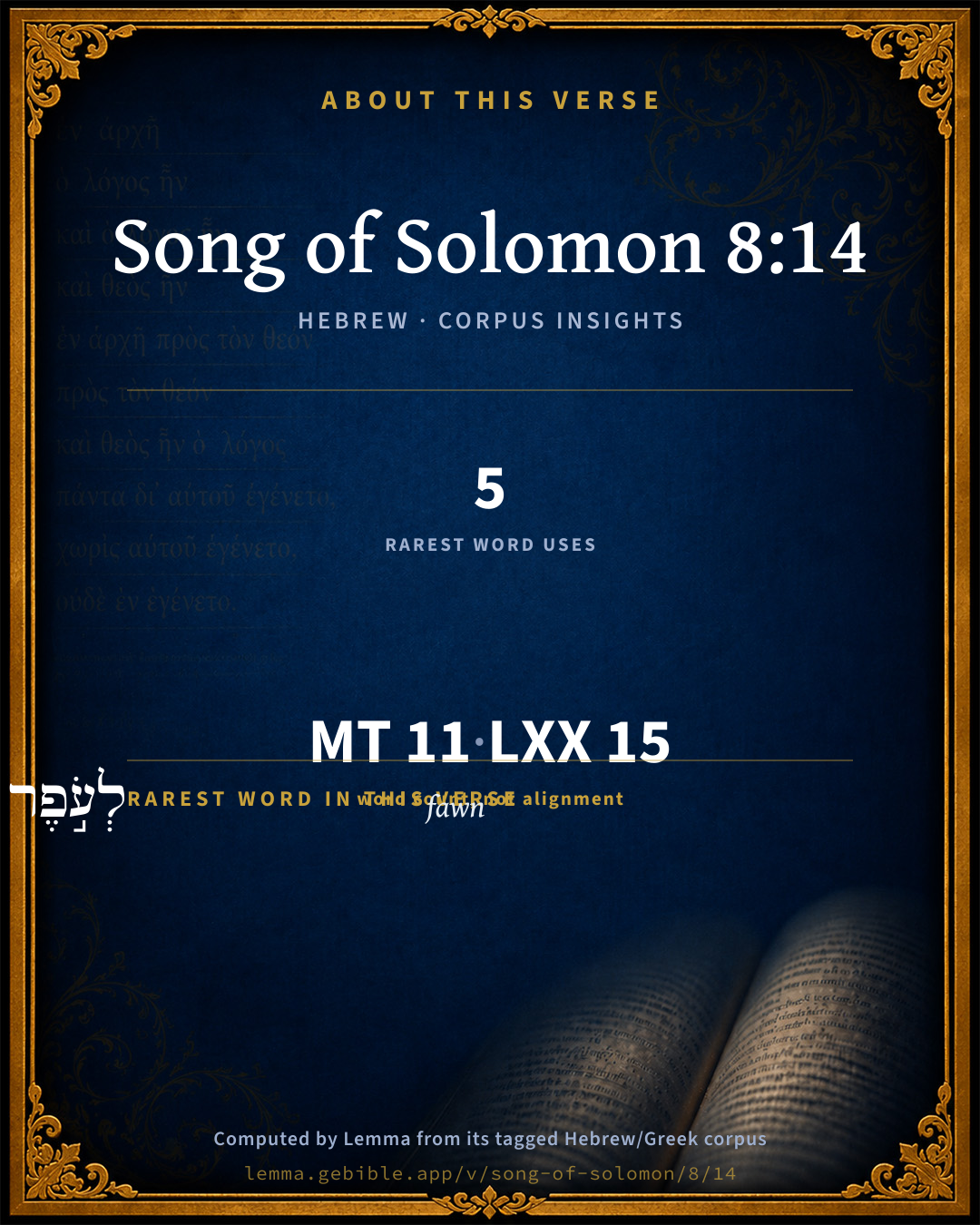
The rarest word here is לְעֹ֣פֶר fawn H6082 — appearing just 5 times in the whole Hebrew Bible.

Shared distinctive vocabulary

לְעֹ֣פֶר fawn H6082 occurs in 5 verses of the Hebrew Bible. Also found in:

Grammatical profile

  • 2 verbs
  • 6 nouns
  • 2 prepositions
  • 1 conjunction

Verb forms

  • בְּרַ֣ח Qal · Imperative
  • וּֽדְמֵה Qal · Imperative

Hebrew & Septuagint length

In English translation the verse runs 17 words from the Hebrew and 16 from the Septuagint (LXX English) — closely comparable.

A rough comparison of the two English renderings, which tokenize alike — not a word-level alignment.

Word counts can differ between the Hebrew and the Greek without any difference in meaning — e.g. the Hebrew direct-object marker אֵת has no separate Greek word, and Greek often adds the article ὁ.

In the original languages it is 11 Hebrew tokens and 15 Greek tokens — but the two are counted differently (Hebrew bundles its prefixes and suffixes into one token; the Greek is in lemma form), so that isn’t a like-for-like length.

Cross-references

7

Topical passages linked to Song of Solomon 8:14 in the Treasury of Scripture Knowledge — connected by theme and wording, ordered by reader-vote popularity; previews shown in the World English Bible.

  • Song of Solomon 2:17 Until the day is cool, and the shadows flee away, Turn, my beloved, And be like a roe or a young hart on the mountains of Bether.
  • Revelation 22:20 He who testifies these things says, "Yes, I come quickly." Amen! Yes, come, Lord Jesus.
  • Song of Solomon 2:9 My beloved is like a roe or a young hart. Behold, he stands behind our wall! He looks in at the windows. He glances through the lattice.
  • Revelation 22:17 The Spirit and the bride say, "Come!" He who hears, let him say, "Come!" He who is thirsty, let him come. He who desires, let him take the water of life freely.
  • Song of Solomon 4:6 Until the day is cool, and the shadows flee away, I will go to the mountain of myrrh, To the hill of frankincense.
  • Luke 19:12 He said therefore, "A certain nobleman went into a far country to receive for himself a kingdom, and to return.
  • Philippians 1:23 But I am in a dilemma between the two, having the desire to depart and be with Christ, which is far better.

Cross-references courtesy of OpenBible.info (CC BY 4.0).

Hebrew and Greek witnesses Masoretic Hebrew ↔ Greek Septuagint

The same verse in the two great witnesses to the Old Testament, shown verse-for-verse.

These are two independent witnesses, not word-aligned to each other, and the Septuagint is shown in lemma (dictionary) form.

Hebrew Song of Solomon 8:14 Masoretic · Westminster Leningrad Codex

בְּרַ֣ח דּוֹדִ֗י וּֽדְמֵה לְךָ֤ לִצְבִי֙ א֚וֹ לְעֹ֣פֶר הָֽאַיָּלִ֔ים עַ֖ל הָרֵ֥י בְשָׂמִֽים

Come away, my beloved! Be like a gazelle or a young stag on the mountains of spices!

World English Bible · Public Domain

Greek LXX Song of Solomon 8:14 Septuagint · lemma form

φεύγω ἀδελφιδός ἐγώ καί ὁμοιόω ὁ δορκάς ἤ ὁ νεβρός ὁ ἔλαφος ἐπί ὄρος ἄρωμα

Away, my kinsman, and be like a doe or a fawn on the mountains of spices.

LXX2012 (modern English Septuagint) · Public Domain

Hebrew: Westminster Leningrad Codex (CC BY 4.0). Greek: Septuagint (public domain); English from LXX2012 (modern English Septuagint) (Public Domain). How the Septuagint differs from the Hebrew →

Commentary

Notes on Song of Solomon 8:14 from classic Christian and Jewish commentators (each source and its license shown beneath its notes). The classic Christian expositions comment on the surrounding passage and are grouped to its opening verse, so a note may address several verses; the Jewish commentaries on the Tanakh (Rashi and others) are per-verse, so they appear only where the commentator wrote on this verse.

Lemma curates 59 commentaries, every one of them public domain or Creative Commons licensed, each selected and text-cleaned for this edition rather than reprinted as found. About our sources →

Ellicott's Commentary for English Readers

(14) Make haste, my beloved.—Son_8:14 recalls the answer made at last to the sighs. It repeats the metaphor of Son_2:17, where we see that the Authorised Version, make haste, is more correct than the margin. Thus the poem ends with two short verses that compress into them all that has been over and over again related under different figures: the wooing and the wedding of two happy souls.

A Bible Commentary for English Readers, edited by Charles John Ellicott (1878–1897) — public domain. Text from a community e-Sword module.

Trapp's Complete Commentary

John Trapp

Son 8:14 Make haste, my beloved, and be thou like to a roe or to a young hart upon the mountains of spices.

Ver. 14. Make haste, my beloved.] Heb., Flee, or speed thee away, as Amaziah said to Amos, "Go, flee thee away into the land of Judah." {Amo 7:12} And as a senator of Hala in Suevia wrote to Brentius, Fuge, fuge, Brenti, cito citius citissime, Make all possible speed, haste, haste, haste; so the Church is at it here, with her "Come, Lord Jesus, come quickly." {Rev 22:20} O mora! Christe, veni. Oh delay, Christ come. Thus, as this book began with a wish, so it ends. Tota vita boni Christiani sanctum desiderium est: {a} The whole life of a good Christian is a holy wish. He loves, and longs, and looks for Christ’s second appearance, and even spends and exhales himself in continual sallies and egressions of affection unto him in the meanwhile. He hath taken some turns with Christ upon those "mountains of spices," - so heaven is called for its unconceivable height and sweetness; he hath tasted of the grapes of this celestial Canaan; hence he is as eager after it as once the Gauls were after Italy, when they had once tasted of the sweet wine of those grapes that grew there. {b} The old character of God’s people was, they waited for the consolation of Israel, Christ’s first coming. Now they long as much for his second as the espoused maid doth after the marriage, as the apprentice for his freedom, the captive for his ransom, the traveller for his inn, the mariner for the haven, "looking for, and hasting {c} the coming of that day of God." {2Pe 3:12}

{a} Augustine

{b} Plut. in Vita. Camilli.

{c} σπευδοντας την παρουσιαν, see /LXXE Isa 16:5, Septuag.

Soli Deo gloria aeternum

John Trapp, A Commentary or Exposition upon All the Books of the Old and New Testament (1647–1656) — public domain. Text from a community e-Sword module.

The Biblical Illustrator

Joseph S. Exell

Son_8:14

Make haste, my Beloved, and be Thou like to a roe or to a young hart upon the mountains of spices.

Come, my Beloved

The Song of Songs describes the love of Jesus Christ to His people, and it ends with an intense desire on the part of the Church that the Lord Jesus should come back to her. The last word of the lover to the beloved one is, Speed thy return; make haste and come back.

I. Notice, first, what the church here calls her lord. Observe, the spouse first calls her Lord, Beloved, and secondly, My Beloved. Christ is our Beloved. This is a word of affection; and our Lord Jesus Christ is the object of affection to us. Brethren, true religion has many sides to it; true religion is practical, it is also contemplative; but it is not true religion at all if it is not full of love and affection. Jesus must reign in your heart, or else, though you may give Him what place you like in your head, you have not truly received Him. To Jesus, beyond all others, is applicable this title of the -Beloved, for they who know Him love Him. My Beloved. If nobody else loves Him, I do. This is a distinguishing affection; and I love Him because He belongs to me; He is mine, He has given Himself to me; and I have chosen Him because He first chose me; He is my Beloved. I am not ashamed to put Him in front of all others; and when men say, What is thy Beloved more than another beloved? I can tell them that My Beloved is more than all the earthly beloveds put together.

II. Now I will lead you on to the second division of my subject. I have shown you what the Church calls her Lord; now, in the second place, I will tell you whence she calls him. Make haste, my Beloved, and be Thou like to a roe or to a young hart upon the mountains of spices. What does that mean? She cries to Him to come from the place where He now is, which she calls the mountains of spices. What are these spices? Are they not Christs infinite merits, which perfume heaven and earth The foul corruption of our sins is not perceptible, because of the mountains of spices. Behold this wondrous sanitary power of Divine grace; these mountains of spices more than nullify the foulness of our sins. Christs merit is perpetually before the eye of His Father, so that no longer does He perceive our sins. What shall I say next of these mountains of spices? Are they not our Lords perpetual and prevailing prayers? He intercedes for His people before the throne of God. Now, this is where Jesus is now; not here, in this foul, polluted world, but up yonder. He rests in the mountains of spices; and the prayer of His Church continually is, Come, my Beloved! Make haste, my Beloved! Be Thou like to a roe or a young hart upon the mountains of spices.

III. We have noticed what the Church calls her Lord, and whence she calls Him; now, thirdly, note how she calls Him. She says, Make haste, my Beloved, make haste. Why is it that all the Church of God, and each individual Christian in particular, should be found anxious for the speedy coming of our Lord Jesus Christ? I think, surely, that this is the result of true love, If we love our Lord, we shall long for His appearing; be you sure of that, it is the natural result of ardent affection. But, notwithstanding this, beloved, we sometimes need certain incentives to stir up our souls to cry for our Lords return. One reason that ought to make the believer long for Christs coming is that it will end this conflict. Our lot is cast in a wretched time, when many things are said and done that grieve and vex Gods Holy Spirit, and all who are in sympathy with Him. Come, Lord! Make haste, my Beloved! Come to the rescue of Thy weak and feeble servants; come, come, come, we beseech Thee! Put yourself into this great fight for the faith; and if you have to bear the brunt of the battle, you will soon be as eager as I am that Jesus should make haste, and come to your relief. You also will cry, Make haste, my Beloved, when you think what wonders He will work at His coming. What will Christ do at His coming? He will raise the dead. Mine eyes shall see Him in that day. I know that my Redeemer liveth, etc. And when He comes, beloved, remember that then shall be the time of the glory of His people: Then shall the righteous shine forth as the sun in the kingdom of their Father. Slander will be rolled away in the day when Christ cometh. The wicked shall awake to everlasting contempt, but the righteous to an everlasting, justification. Still, there is another reason why we say, Make haste, my Beloved. It is this. We desire to share in Christs glory; but our chief desire is that our Lord may be glorified. To every loyal soldier of King Jesus, this is the best thought in connection with His Second Advent, that when He comes, it will be to be admired in His saints, and to be glorified in all them that believe. Then shall there be universal acclamations to Him, and His enemies shall hide their heads in shame and dismay. (C. H. Spurgeon.)

The Biblical Illustrator, edited by Joseph S. Exell (c. 1880s–1900s) — public domain. Text from a community e-Sword module.

Joseph Benson's Commentary

Son 8:14. Make haste, my beloved — Seeing we must part for a time, make haste, O my beloved bridegroom, and speedily finish the work which thou hast to do in the world, that so thou mayest take me to thyself, that I may live in thine everlasting embraces.

Joseph Benson's Commentary on the Old and New Testaments (1811–1818) — public domain. Text from a community e-Sword module.

Tyndale Open Study Notes

Tyndale Open Resources

8:14 Come away, my love! She invites him to follow her, and he chases her with all the robust and exhilarating speed of a gazelle (see 2:8-10). • mountains of spices: Cp. 4:6.

Tyndale Open Study Notes — © Tyndale Open Resources, licensed CC BY-SA 4.0. Text via the HelloAO Bible API.

Geneva Bible (1599)

Geneva Bible translators

The Church desireth Christ that if he depart from them, yet that he would haste to help them in their troubles.

Geneva Bible (1599) marginal notes — public domain. Text via Bolls.life.

Adam Clarke's Commentary

Verse 14. Make haste, my beloved] These appear to be the words of the bride giving permission, but entreating him to speed his return. What these mountains of spices were, we cannot particularly tell; but they must have been thus named from their producing the trees on which the spices grew. They might have been the same as the mountains of Bether, So 2:17, or the mountains of myrrh, So 4:6; where see the notes. See Clarke on So 4:6.

Here ends the seventh night of the marriage week.

Thus ends this most singular book; the oldest pastoral in the world, if it may be ranked among this species of writing. To whatever species of composition it belongs, it is, beyond all controversy, the finest, the most sublime for imagery and colouring, that ever came from the pen of man.

In the preceding notes I have carefully avoided all attempts to spiritualize this song. My reasons I have already given in the introduction; and in the course of writing these short notes I have seen no cause to alter my opinion. Any man may allegorize it; that is an easy matter; for when he once considers it to be an allegory, his own creed will furnish him with enough to say, write, or preach, upon the spiritual meanings of every part, which will be an exhibition of his own confession of faith! But when he has finished his work, the question will recur, By what authority do you give it these meanings? And till the day of judgment none shall be able to say, "I have the authority of God for my exposition."

MASORETIC NOTES

Number of verses in Canticles, 117.

Middle verse So 4:14.

See Ancillary data for Targum or Chaldee paraphrase, on the Song of Songs.

Also

See Ancillary data for The Gitagovinda or the Songs of Jayadeva

Adam Clarke's Commentary on the Bible (1810–1826) — public domain. Text from a community e-Sword/MySword module.

The Cambridge Bible for Schools and Colleges

gen. ed. J. J. S. Perowne

14. She sings this verse in answer to this demand.

Make haste] This should be flee. Oettli thinks this implies that as the bridegroom thought her voice lovely, and asked her to exhibit it to his friends, so she also desired him to shew his elastic gait. But probably the object of the verse is to end the poem with a repetition of the bride’s answer in Son_2:17, when he formerly asked her to let him hear her voice. When he calls upon her to let his companions hear her voice, she sings the request she had formerly made to him in similar circumstances.

The Cambridge Bible for Schools and Colleges (gen. ed. J. J. S. Perowne; Cambridge University Press, 1878–1918) — public domain. Text from a community e-Sword module.

Haydock's Catholic Bible Commentary

Flee. The Church consents that her beloved should ascend to heaven, as he still remains with her. (Ven. Bede; St. Bernard, ser. ix.) Qui habitat. (Calmet) --- The whole Church militant requests that he would ascend thither, for the good of all his servants, begging for an abundant supply of grace, that we may ascend the high mountains of perfect charity, and zeal for God’s honour; and that eh would make our souls such hills and gardens, adorned with all the flowers and fruits of virtue, in which he may vouchsafe to dwell. Amen. (Worthington) --- Flee to heaven, and draw me with thee, chap. i. 4. (Menochius)

George Leo Haydock (1774–1849), Haydock's Catholic Family Bible and Commentary, 1859 edition — public domain. Excludes Psalms (Douay-Rheims chapter numbering differs from Protestant) and Deuterocanonical books (Catholic canon only).

Matthew Poole's English Annotations

Seeing we must part for a time, make haste, O my beloved Bridegroom, and speedily finish the work which thou hast to do in the world, that so thou mayst take me to thyself, that I may live in thine everlasting embraces. The words of this verse are borrowed from Son 2:17. where they are explained.

Matthew Poole's English Annotations on the Holy Bible (1683–1685) — public domain. Text from a community e-Sword/MySword module.

Whedon's Commentary on the Bible

Daniel D. Whedon

14. To this she replies that there need be no delay. The Beloved may haste to assume the character of bridegroom. The lively, simple imagery, now so familiar, is kept to the last —

“Wouldst thou the poet rightly understand,

Go thou and wander through his native land.”

The graceful forms of the gazelle and the young hart, the hills set with spicy groves like those of “Araby the blest,” the bride amid her companions, the bridegroom coming out of his chamber in the prime of his manly beauty — with this picture, simple, yet richly set with many a charm, the Song concludes. No wonder that the rabbi, in language still preserved in the Talmud, pronounced it a legend of the beautiful, a comfort and a blessing.

Daniel D. Whedon (gen. ed.), Commentary on the Old and New Testaments (1874–1909) — public domain. Text from a community e-Sword module.

The Pulpit Commentary

Make haste, my beloved, and be thou like to a roe or to a young hart upon the mountains of spices. This is a snatch of the old love songs which the bride used to sing when love was fresh and young. She sings it now at the request of her bridegroom himself, and in the delighted ears of her companions. She goes forth from among, them leaning on her beloved, to rejoice in the beautiful scenery and rural pleasures with him whose presence heightens every joy, the life of her life, the soul of her soul, "all her salvation, all her desire." The bridegroom and the bride are seen disappearing together over the flowery hills; and the music of the Song of Songs dies away in the sweet fragrance of that closing scene; the vision of love has, gazelle-like, leapt from point to point, and vanishes away at last among the mountains of spices. It is well to notice that what were before "mountains of Berber," that is, of "separation," are now "mountains of Besamin balsam mountains. There is no more word of separation. Henceforth the only note is one of peaceful enjoyment. My beloved is mine, and I am his. " Our home and haunt is the same. The concluding words, we cannot doubt, are intended to open a perfect future to the eye. Yet the poet, with consummate art, connects that future with the past and the present by the voice of the bride heard singing the love song with which she first expressed her love, now lifted up into anticipation of the everlasting hills of fragrant and joyful life.

The Pulpit Commentary (1880–1919), ed. H.D.M. Spence-Jones & Joseph S. Exell — public domain. Text from a community e-Sword module.

John Wesley's Explanatory Notes

Make haste - Seeing we must part for a time, make haste, O my beloved bridegroom, and speedily finish the work which thou hast to do in the world, that so thou mayest take me to thyself, that I may live in thine everlasting embraces.

John Wesley, Explanatory Notes Upon the Whole Bible (1754–1765) — public domain. Text via the GEBible commentary corpus.

unfoldingWord translationNotes

Door43 World Missions Community

my beloved

This phrase refers to the man whom the woman loves. In some languages it may be more natural for her to refer to him as "my lover." See how you translated this in Song of Songs 1:13. AT: "my dear one" or "my lover"

like a gazelle or a young stag

See how you translated this in Song of Songs 2:9.

gazelle

a type of slender deer-like animal with long curved horns

stag

an adult male deer

the mountains of spices

"the mountains that have spices all over them." The woman uses this metaphor to invite the man to make love to her. See how the man uses the metaphor of a mountain of myrrh and a hill of frankincense in Song of Songs 4:6. (See: Metaphor)

translationWords

beloved

unfoldingWord translationNotes — © Distant Shores Media and the Door43 World Missions Community, licensed CC BY-SA 4.0. Source: git.door43.org/Door43/en_tn.

Rashi

Rabbi Shlomo Yitzchaki (Rashi)

Flee, my beloved from this exile and redeem us from among them.

and liken yourself to a gazelle to hasten the redemption and to cause Your Shechinah to rest. on the spice mountains This is Mount Moriah and the Temple, may it be built speedily and in our days, Amen.

Rashi on the Tanakh — English translations: “The Judaica Press complete Tanach with Rashi, translated by A. J. Rosenberg” (CC BY 4.0); “Pentateuch with Rashi's commentary by M. Rosenbaum and A.M. Silbermann, 1929-1934” (public domain); “The Metsudah Tanach series, Lakewood, N.J” (CC BY 4.0); and “The Book of Joshua, Metsudah Publications, 1997” (CC BY 4.0). Text via Sefaria.

Lesson kit

Teaching starters — assembled from the data on this page, not authored interpretation. Every prompt links to the verse data it draws on. Edit before teaching.

Song of Solomon, in the Wisdom, opens this verse with 11 words (10 distinct Hebrew lemmas). Its most distinctive word is ʻôpher (“fawn”). A historical commentator’s framing appears above. Read the whole chapter for the surrounding context.

Discussion questions

  1. What does “fawn” (ʻôpher) contribute to the verse as a whole?
  2. Song of Solomon 2:9 shares the word «fawn» with this verse. How do the two illuminate each other?
  3. These translations render this verse differently; the difference is in the English rendering, not the original. What questions does that raise?
  4. The verb «בְּרַ֣ח» is Qal Imperative. How does its form color the action?
  5. Reading how Ellicott's Commentary for English Readers and Trapp's Complete Commentary read this verse, where do the two commentators agree and where do they part?

Things to notice

Reading settings

Reading text

Shown beneath each verse's original-language words.

Old Testament
Old Testament edition

Read the OT as the Masoretic Hebrew (MT) or the Greek Septuagint (LXX).

English shown for the Greek Septuagint (in the Hebrew ↔ Greek comparison).

Comparing translations? Open the Compare panel on any verse page to stack up to four side by side.