
Job 14:2

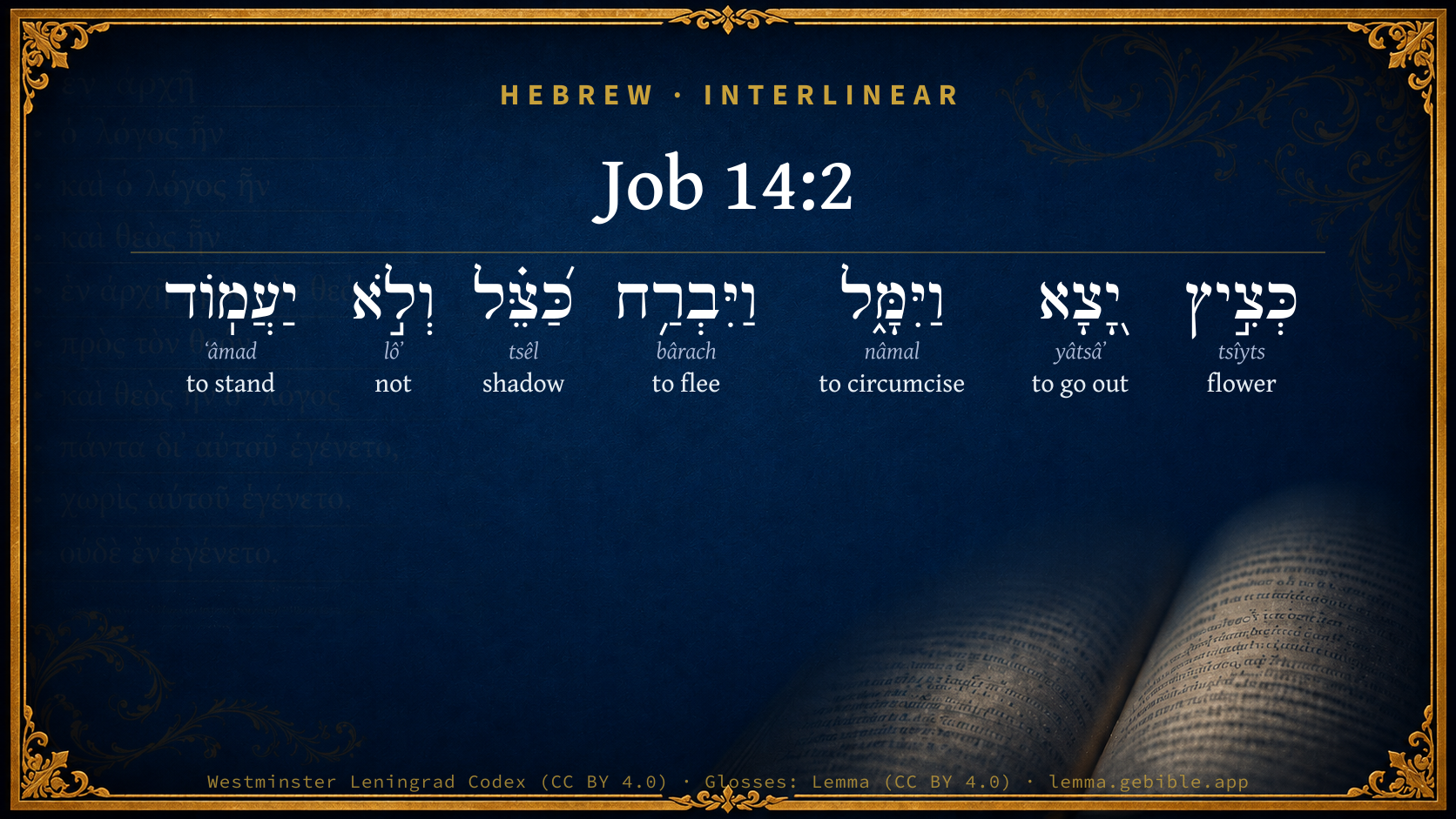
Hebrew (Westminster Leningrad Codex) Job 14:2 appears in the Hebrew Old Testament. The text above is from the Westminster Leningrad Codex. Each word links to its Strong’s number, a concise gloss, and parsing drawn from the Open Scriptures Hebrew Bible morphology. Click any word for its full Brown-Driver-Briggs (BDB) entry.
Download image
Cite this verse

Job 14:2 (World English Bible). Public Domain. Lemma interlinear Bible study tool, https://lemma.gebible.app/v/job/14/2.

Show BibTeX & RIS
BibTeX
RIS
English Translation
He comes forth like a flower, and is cut down. He also flees like a shadow, and doesn't continue.
World English Bible · Public Domain
Download a study sheet

One document with this verse’s original text, its word-by-word gloss line, the meaning frame, cross-references with their text, attributed commentary, and full source and license credits — printable, and it pastes into notes with its structure intact.

This verse Autodidact and up

Study sheet (.html) Plain text (.txt)

A passage Seminary Student

Up to 50 verses in one chapter. A passage sheet keeps up to 6 commentary sources and 12 cross-references per verse, in the order this page ranks them, and says so on the sheet whenever that leaves anything out. Ask for a single verse and you get the Autodidact verse sheet above.

Everything on this page stays free to read, with no account — the sheet is a download of what is already on screen, not access to it.

Want to remove ads? Support Godless Engineer
Compare translations 3

The same verse in 3 English versions, stacked beneath the original-language interlinear above. Click any original word for its lexicon entry.

Each is an independent rendering of the whole verse — the interlinear is not word-aligned to these translations.

Highlighted words mark where these versions differ — a whole-verse word diff, not a word-by-word alignment.

  • World English Bible Public Domain
    He comes forth like a flower, and is cut down. He also flees like a shadow, and doesn't continue.
  • King James Version Public Domain
    He cometh forth like a flower, and is cut down: he fleeth also as a shadow, and continueth not.
  • unfoldingWord Literal Text CC BY-SA 4.0
    Like a flower, he comes forth and withers, and like a shadow, he flees and does not stand.

unfoldingWord Literal Text — © unfoldingWord, licensed CC BY-SA 4.0. Word-aligned USFM3 via Door43 (git.door43.org/unfoldingWord/en_ult).

Versions to compare (up to 4)

3 of 4 selected

Show all 18 translations

Every available English version of this verse, each an independent rendering of the whole verse.

  • World English Bible Public Domain
    He comes forth like a flower, and is cut down. He also flees like a shadow, and doesn't continue.
  • Berean Standard Bible Public Domain
    Like a flower, he comes forth, then withers away; like a fleeting shadow, he does not endure.
  • Majority Standard Bible Public Domain
    Like a flower, he comes forth, then withers away; like a fleeting shadow, he does not endure.
  • King James Version Public Domain
    He cometh forth like a flower, and is cut down: he fleeth also as a shadow, and continueth not.
  • American Standard Version (1901) Public Domain
    He cometh forth like a flower, and is cut down: He fleeth also as a shadow, and continueth not.
  • Revised Version (1885) Public Domain
    He cometh forth like a flower, and is cut down: he fleeth also as a shadow, and continueth not.
  • Geneva Bible (1599) Public Domain
    He shooteth foorth as a flowre, and is cut downe: he vanisheth also as a shadowe, and continueth not.
  • Douay-Rheims (1899) Public Domain
    Who cometh forth like a flower, and is destroyed, and fleeth as a shadow, and never continueth in the same state.
  • Young's Literal Translation Public Domain
    As a flower he hath gone forth, and is cut off, And he fleeth as a shadow and standeth not.
  • Literal Standard Version CC BY-SA 4.0
    As a flower he has gone forth, and is cut off, || And he flees as a shadow and does not stand.
  • Unlocked Literal Bible CC BY-SA 4.0
    He sprouts from the ground like a flower and is cut down; he flees like a shadow and does not last.
  • unfoldingWord Literal Text CC BY-SA 4.0
    Like a flower, he comes forth and withers, and like a shadow, he flees and does not stand.
  • Darby Bible Public Domain
    He cometh forth like a flower, and is cut down; and he fleeth as a shadow, and continueth not.
  • World Messianic Bible Public Domain
    He grows up like a flower, and is cut down. He also flees like a shadow, and doesn’t continue.
  • Webster's Bible Public Domain
    He cometh forth like a flower, and is cut down: he fleeth also as a shadow, and continueth not.
  • Free Bible Version CC BY-SA 4.0
    like a flower that blooms and withers, like a passing shadow that soon disappears.
  • Bible in Basic English Public Domain
    He comes out like a flower, and is cut down: he goes in flight like a shade, and is never seen again.
  • JPS Tanakh (1917) Public Domain
    He cometh forth like a flower, and withereth; he fleeth also as a shadow, and continueth not.

Literal Standard Version (2020), Covenant Press — licensed CC BY-SA 4.0. Text via the HelloAO Bible API (eBible.org). Unlocked Literal Bible (unfoldingWord) — licensed CC BY-SA 4.0. Text via the HelloAO Bible API (eBible.org). unfoldingWord Literal Text — © unfoldingWord, licensed CC BY-SA 4.0. Word-aligned USFM3 via Door43 (git.door43.org/unfoldingWord/en_ult). Free Bible Version, Dr. Jonathan Gallagher — licensed CC BY-SA 4.0. Text via the HelloAO Bible API (eBible.org).

Word by word

More ways to search: Search by grammar → Find every occurrence → Compare this word →

Practice this passage: Drill this verse → Learn its vocabulary →

About this verse

These counts appear in no published source. They are computed here, from the morphology-tagged text and Lemma’s own curated glosses. What Lemma adds →

7
words
7
distinct lemmas
Wisdom
section

Notable vocabulary

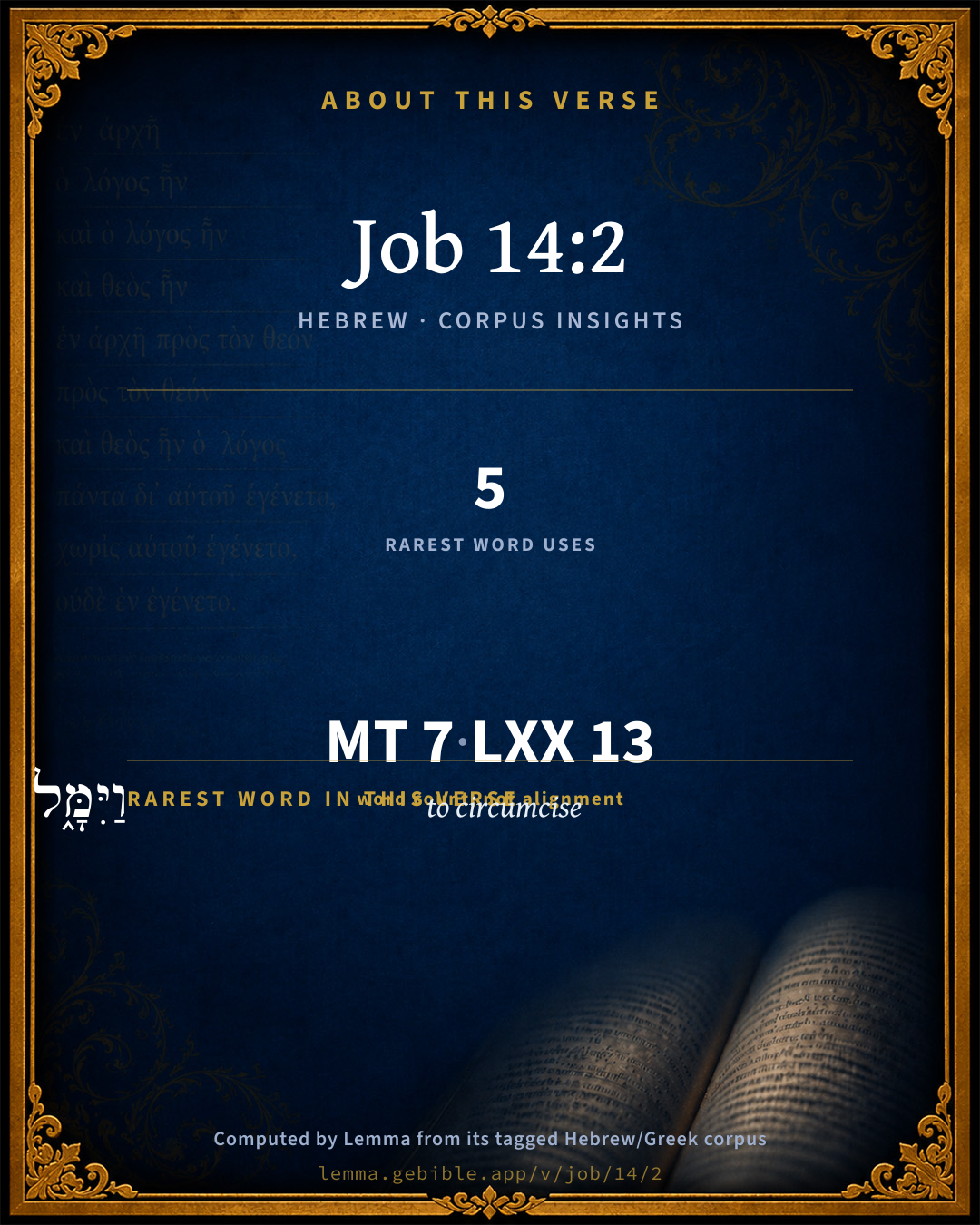
The rarest word here is וַיִּמָּ֑ל to circumcise H5243 — appearing just 5 times in the whole Hebrew Bible.

Shared distinctive vocabulary

וַיִּמָּ֑ל to circumcise H5243 occurs in 5 verses of the Hebrew Bible. Also found in:

Grammatical profile

  • 4 verbs
  • 2 nouns
  • 1 particle

Verb forms

  • יָ֭צָא Qal · Perfect
  • וַיִּמָּ֑ל Qal · Sequential Imperfect
  • וַיִּבְרַ֥ח Qal · Sequential Imperfect
  • יַעֲמֽוֹד Qal · Imperfect

Hebrew & Septuagint length

In English translation the verse runs 19 words from the Hebrew and 18 from the Septuagint (LXX English) — closely comparable.

A rough comparison of the two English renderings, which tokenize alike — not a word-level alignment.

Word counts can differ between the Hebrew and the Greek without any difference in meaning — e.g. the Hebrew direct-object marker אֵת has no separate Greek word, and Greek often adds the article ὁ.

In the original languages it is 7 Hebrew tokens and 13 Greek tokens — but the two are counted differently (Hebrew bundles its prefixes and suffixes into one token; the Greek is in lemma form), so that isn’t a like-for-like length.

Cross-references

14

Topical passages linked to Job 14:2 in the Treasury of Scripture Knowledge — connected by theme and wording, ordered by reader-vote popularity; previews shown in the World English Bible.

  • Isaiah 40:6–8 The voice of one saying, Cry. One said, What shall I cry? All flesh is grass, and all the glory of it is as the flower of the field.
  • 1 Peter 1:24 For, "All flesh is like grass, And all of man's glory like the flower in the grass. The grass withers, and its flower falls;
  • Job 8:9 (For we are but of yesterday, and know nothing, Because our days on earth are a shadow.)
  • Psalms 103:15–16 As for man, his days are like grass. As a flower of the field, so he flourishes.
  • 1 Chronicles 29:15 For we are strangers before you, and foreigners, as all our fathers were: our days on the earth are as a shadow, and there is no abiding.
  • James 4:14 Whereas you don't know what your life will be like tomorrow. For what is your life? For you are a vapor, that appears for a little time, and then vanishes away.
  • James 1:10–11 and the rich, in that he is made humble, because like the flower in the grass, he will pass away.
  • Psalms 144:4 Man is like a breath. His days are like a shadow that passes away.
  • Psalms 102:11 My days are like a long shadow. I have withered like grass.
  • Job 9:25–26 "Now my days are swifter than a runner. They flee away, they see no good,
  • Psalms 92:12 The righteous shall flourish like the palm tree. He will grow like a cedar in Lebanon.
  • Ecclesiastes 8:13 But it shall not be well with the wicked, neither shall he lengthen days like a shadow; because he doesn't fear God.
  • Psalms 90:5–9 You sweep them away as they sleep. In the morning they sprout like new grass.
  • Psalms 92:7 Though the wicked spring up as the grass, And all the evil-doers flourish, They will be destroyed forever.

Cross-references courtesy of OpenBible.info (CC BY 4.0).

Hebrew and Greek witnesses Masoretic Hebrew ↔ Greek Septuagint

The same verse in the two great witnesses to the Old Testament, shown verse-for-verse.

These are two independent witnesses, not word-aligned to each other, and the Septuagint is shown in lemma (dictionary) form.

Hebrew Job 14:2 Masoretic · Westminster Leningrad Codex

כְּצִ֣יץ יָ֭צָא וַיִּמָּ֑ל וַיִּבְרַ֥ח כַּ֝צֵּ֗ל וְלֹ֣א יַעֲמֽוֹד

He comes forth like a flower, and is cut down. He also flees like a shadow, and doesn't continue.

World English Bible · Public Domain

Greek LXX Job 14:2 Septuagint · lemma form

ἤ ὥσπερ ἄνθος ἀνθέω ἐκπίπτω ἀποδιδράσκω δέ ὥσπερ σκιά καί οὐ μή ἵστημι

Or he falls like a flower that has bloomed; and he departs like a shadow, and can’t continue.

LXX2012 (modern English Septuagint) · Public Domain

Hebrew: Westminster Leningrad Codex (CC BY 4.0). Greek: Septuagint (public domain); English from LXX2012 (modern English Septuagint) (Public Domain). How the Septuagint differs from the Hebrew →

Commentary

Notes on Job 14:2 from classic Christian and Jewish commentators (each source and its license shown beneath its notes). The classic Christian expositions comment on the surrounding passage and are grouped to its opening verse, so a note may address several verses; the Jewish commentaries on the Tanakh (Rashi and others) are per-verse, so they appear only where the commentator wrote on this verse.

Lemma curates 59 commentaries, every one of them public domain or Creative Commons licensed, each selected and text-cleaned for this edition rather than reprinted as found. About our sources →

Trapp's Complete Commentary

John Trapp

Job 14:2 He cometh forth like a flower, and is cut down: he fleeth also as a shadow, and continueth not.

Ver. 2. He cometh forth like a flower] What he had asserted concerning the shortness of man’s life is here illustrated by two elegant similitudes, frequently used, not in Scripture only, but in heathen authors, as were easy to instance, Isa 28:1; Isa 40:6 Jas 1:10-11 1Pe 1:24. A flower hath a spring and a fall; so have men their times and their turns; their rise and their ruin. Why and how man in his flourish is like to a flower; see Psa 103:15-16, where he is compared to a flower of the field (which lies open to all inconvenience), not of the garden, which is much sheltered from sharp winds, fenced from the teeth and feet of beasts, from the hands of children, strangers, &c.

And is cut down] Heb. Cut around, or circumcised, sc. by some nipping or blasting wind, such as that east wind, Gen 41:23, or some cropping hand, or its own fading nature; and then it is not, saith David, Psa 103:16, that is, it neither continues any longer in being, nor returns any more into being; no more doth man, though in his time never so flourishing.

He fleeth also] With post haste, as one that fleeth for life; so doth he from life, every moment yielding somewhat unto death: Orimur, morimur, finisque ab origine pendet; life, as fast as it increaseth, decreaseth. It is improper, saith one, to ask when we shall die, but rather when we shall make an end of dying?

As a shadow] As the shadow of a dial, our lives are continually hasting to their period, and never make stop. By these, and many the like comparisons (common in this Book and other Scriptures), we see how much God desireth that we should mind our mortality; to blame, then, are those who have one leg in the grave and the other in hell, and yet do put far away thoughts of death, and under gray hairs nourish green hopes and desires; neither may young men be excused who bind upon long life, and boast of tomorrow, Pro 27:1, since they know not what a great bellied day may bring forth. Vitae summa brevis spem nos vetat inchoare longam (Hor. i.). The Jews have a proverb, that many times old camels carry young camels’ skins to the market. And how often see we elder folk carry men’s and children’s bodies to the grave?

And continueth not] Heb. Standeth not, as a pillar, but vanisheth as a shadow, yea, as a dream of a shadow, as the Greek poet hath it, τιδε τις; τιδ ουτις; σκιας οναρ ανθρωπος (Pindar). The Vulgate translateth, He continueth not in the same state. To have no shadow of turning, noteth the perfection of God, Jas 1:17.

John Trapp, A Commentary or Exposition upon All the Books of the Old and New Testament (1647–1656) — public domain. Text from a community e-Sword module.

Joseph Benson's Commentary

Job 14:2. He cometh forth like a flower — Tender and delicate, fair and beautiful, his faculties and members opening and expanding themselves by degrees; and is cut down — By the scythe of some spreading malady; or cropped by the rude hand of some ruthless distemper; or nipped and withered by the frost of some wasting weakness and decay. He fleeth also as a shadow — Which, being caused by the sun, follows its motions, and is in perpetual variation, until, at last, it quite vanishes and disappears. “The flower,” says Henry, “is fading, and all its beauty soon withers and is gone. The shadow is fleeting, and its very being will soon be lost in the shadows of night. Of neither do we make any account, in neither do we put any confidence.”

Joseph Benson's Commentary on the Old and New Testaments (1811–1818) — public domain. Text from a community e-Sword module.

Jamieson, Fausset & Brown

Robert Jamieson, A. R. Fausset & David Brown

(Psa 90:6; see on Job 8:9).

Jamieson, Fausset & Brown — Commentary Critical and Explanatory on the Whole Bible (1871) — public domain (CC PDM 1.0). Text via the HelloAO Bible API.

Adam Clarke's Commentary

Verse 2. He cometh forth like a flower] This is a frequent image both in the Old and New Testament writers; I need not quote the places here, as the readers will find them all in the margin.

He fleeth also as a shadow] Himself, as he appears among men, is only the shadow of his real, substantial, and eternal being. He is here compared to a vegetable; he springs up, bears his flower is often nipped by disease, blasted by afflictions and at last cut down by death. The bloom of youth, even in the most prosperous state, is only the forerunner of hoary hairs, enfeebled muscles, impaired senses, general debility, anility, and dissolution. All these images are finely embodied, and happily expressed, in the beautiful lines of a very nervous and correct poet, too little known, but whose compositions deserve the first place among what may be called the minor poets of Britain. See at the end of the chapter. See Clarke on Job 14:22.

Adam Clarke's Commentary on the Bible (1810–1826) — public domain. Text from a community e-Sword/MySword module.

The Cambridge Bible for Schools and Colleges

gen. ed. J. J. S. Perowne

2. and is cut down] Rather, and withereth, cf. similar figures Isa_40:6 seq.; Psa_37:2; Psa_90:6; Psa_103:15 seq.

The Cambridge Bible for Schools and Colleges (gen. ed. J. J. S. Perowne; Cambridge University Press, 1878–1918) — public domain. Text from a community e-Sword module.

John Gill's Exposition

He cometh forth like a flower, and is cut down,.... As the flower comes from the earth, so does man; as it comes out of the stalk, so man out of his mother's womb; as the flower flourishes for a while, and looks gay and beautiful, so man while in youth, in health and prosperity. Job, doubtless, has respect to his own case before his troubles came upon him, when he was possessed of all that substance, which made him the greatest man of the east; when his children were like olive plants around his table, and his servants at his command, and he in perfect health of body: and as a flower flourishes for a little while, and then withers; no sooner is it come to its full blow, but presently decays; such is the goodliness of man, it fades away whenever God blows a blast upon it; yea, he is easily and quickly cut down by death, like a beautiful flower cut with the knife, or cropped by the hand, or trampled upon by the foot, see Psa 103:15;

he fleeth also as a shadow, and continueth not; either as the shadow of the evening, which is lost when night comes on; or the shadow on a dial plate, which is continually moving on; or, as the Jewish Rabbins say, as the shadow of a bird flying, which stays not, whereas the shadow of a wall, or of a tree, continues: a shadow is an empty thing, without substance, dark and obscure, variable and uncertain, declining, fleeting, and passing away; and so fitly resembles the life of a man, which is but a vapour, a bubble, yea, as nothing with God; is full of darkness, of ignorance, and of adversity, very fickle, changeable, and inconstant, and at most but of a short continuance.

John Gill's Exposition of the Whole Bible (1746–1763) — public domain (CC PDM 1.0). Text via the HelloAO Bible API.

Albert Barnes' Notes on the Bible

He cometh forth like a flower, and is cut down - Nothing can be more obvious and more beautiful than this, and the image has been employed by writers in all ages, but nowhere with more beauty, or with more frequency than in the Bible; see Isa 40:6; Psa 37:2; Psa 90:6; Psa 103:15. Next to the Bible, it is probable that Shakespeare has employed the image with the most exquisite beauty of any poet:

This is the state of man; today he puts forth

The tender leaves of hope, tomorrow blossoms,

And bears his blushing honors thick upon him;

The third day comes a frost a killing frost,

And - when he thinks, good easy man, full surely

His greatness is a ripening - nips his root,

And then he falls.

Henry viii. Act iii. Sc. 2.

He fleeth also as a shadow - Another exquisite figure, and as true as it is beautiful. So the Psalmist:

My days are like a shadow that declineth.

Psa 102:11.

Man is like to vanity;

His days are as a shadowy that passeth away.

Psa 144:4.

The idea of Job is, that there is no substance, nothing that is permanent. A shadow moves on gently and silently, and is soon gone. It leaves no trace of its being, and returns no more. They who have watched the beautiful shadow of a cloud on a landscape, and have seen how rapidly it passes ever meadows and fields of grain, and rolls up the mountain side and disappears, will have a vivid conception of this figure. How gently yet how rapidly it moves. How soon it is gone. How void of impression is its course. Who can track its way; who can reach it? So man moves on. Soon he is gone; he leaves no trace of his being, and returns no more.

Albert Barnes' Notes on the Bible (1834–1885) — public domain. Text from a community e-Sword/MySword module.

Haydock's Catholic Bible Commentary

Shadow. Pulvis et umbra sumus. (Horace iv. Ode 7.) "Come then, ye men, whom nature condemns to spend your days in darkness, ye who resemble the leaves, are of little strength, formed of mud, shadow-like,...of a day’s duration, miserable mortals, men like dreams, attend to the immortals." (Aristophanes, Avib.) --- Most of these expressions occur in Job, Psalm ci. 12., Wisdom ii. 5., and Ecclesiastes ii. 23., &c.

George Leo Haydock (1774–1849), Haydock's Catholic Family Bible and Commentary, 1859 edition — public domain. Excludes Psalms (Douay-Rheims chapter numbering differs from Protestant) and Deuterocanonical books (Catholic canon only).

Matthew Poole's English Annotations

He cometh forth out of his mother’s womb, Job 1:21.

Like a flower; which quickly groweth up and maketh a fair show, but soon withereth, or is cut down.

As a shadow; which being made by the sun, follows its motions, and is in perpetual variation, until at last it quite vanish and disappear.

Matthew Poole's English Annotations on the Holy Bible (1683–1685) — public domain. Text from a community e-Sword/MySword module.

Whedon's Commentary on the Bible

Daniel D. Whedon

2. Like a flower — But as for the flowers and their perfumes, nature has given them birth but for a day — a mighty lesson to man. (PLINY, Hist., xxi, chap. 1.) The flower rises from the dark recesses of its mother earth; so man cometh forth from eternity, which in like manner is עולם, hidden and dark. Ever frail and perishable, they both abide, for a little while, the sport of change and storm, and at last sink into the unknown whence they came. (Compare Ecc_6:4.)

Is cut down — Withereth. Aristotle defined man to be “the spoil of time,” and St. Augustine compares his frailty to the fragility of glass.

A shadow — “What shadows we are, what shadows we pursue.” — Edmund Burke. (See note Job_4:19.)

Daniel D. Whedon (gen. ed.), Commentary on the Old and New Testaments (1874–1909) — public domain. Text from a community e-Sword module.

The Pulpit Commentary

He cometh forth like a flower, and is cut down. Few similes are more frequently used in Scripture, (comp. Psa_103:15 Isa_28:1, 4 40:6, 7 Jam_1:10, 11 1Pe_1:24) and certainly none could have more poetic beauty. Eastern flowers do not often last much more than a day. He fleeth also as a shadow, and continueth not. (comp. Job_7:2 Job_8:9 1Ch_29:15 Psa_102:11 Psa_109:23 Ecc_6:12, etc.) Shadows are always changing; but the shadows which flee away the fastest, and which Job has probably in his mind, are those of clouds, or other moving objects, which seem to chase each other over the earth, and never to continue for a single minute in one stay.

Man as a flower.

I IN HIS ORIGIN. He springeth from the ground.

II IN HIS CONSTITUTION. He is composed of dust.

III IN HIS STRUCTURE. His physical organism is as beautiful and delicate as that of a flower.

IV IN HIS FRAILTY. He is as easily destroyed as a flower.

V IN HIS EVANESCENCE. He is as short-lived as a flower.

VI IN HIS END. Like a flower, he returns to the dust.

LESSONS.

1. Lowly thoughts of self.

2. Care of the body.

3. Preparation for the end.

The Pulpit Commentary (1880–1919), ed. H.D.M. Spence-Jones & Joseph S. Exell — public domain. Text from a community e-Sword module.

John Wesley's Explanatory Notes

Flower - The flower is fading, and all its beauty soon withers and is gone. The shadow is fleeting, and its very being will soon be lost in the shadows of night. Of neither do we make any account, in neither do we put any confidence.

John Wesley, Explanatory Notes Upon the Whole Bible (1754–1765) — public domain. Text via the GEBible commentary corpus.

Lesson kit

Teaching starters — assembled from the data on this page, not authored interpretation. Every prompt links to the verse data it draws on. Edit before teaching.

Job, in the Wisdom, opens this verse with 7 words (7 distinct Hebrew lemmas). Its most distinctive word is nâmal (“to circumcise”). A historical commentator’s framing appears above. Read the whole chapter for the surrounding context.

Discussion questions

  1. How does “to circumcise” (nâmal) shape what this verse is saying?
  2. Genesis 17:11 shares the word «to circumcise» with this verse. How do the two illuminate each other?
  3. The translations on this page render this verse differently — a whole-verse word diff, not a word-by-word alignment. What might account for the different wordings?
  4. The verb «יָ֭צָא» is Qal Perfect. How does its form color the action?
  5. Reading how Trapp's Complete Commentary and Joseph Benson's Commentary read this verse, where do the two commentators agree and where do they part?

Things to notice

Reading settings

Reading text

Shown beneath each verse's original-language words.

Old Testament
Old Testament edition

Read the OT as the Masoretic Hebrew (MT) or the Greek Septuagint (LXX).

English shown for the Greek Septuagint (in the Hebrew ↔ Greek comparison).

Comparing translations? Open the Compare panel on any verse page to stack up to four side by side.