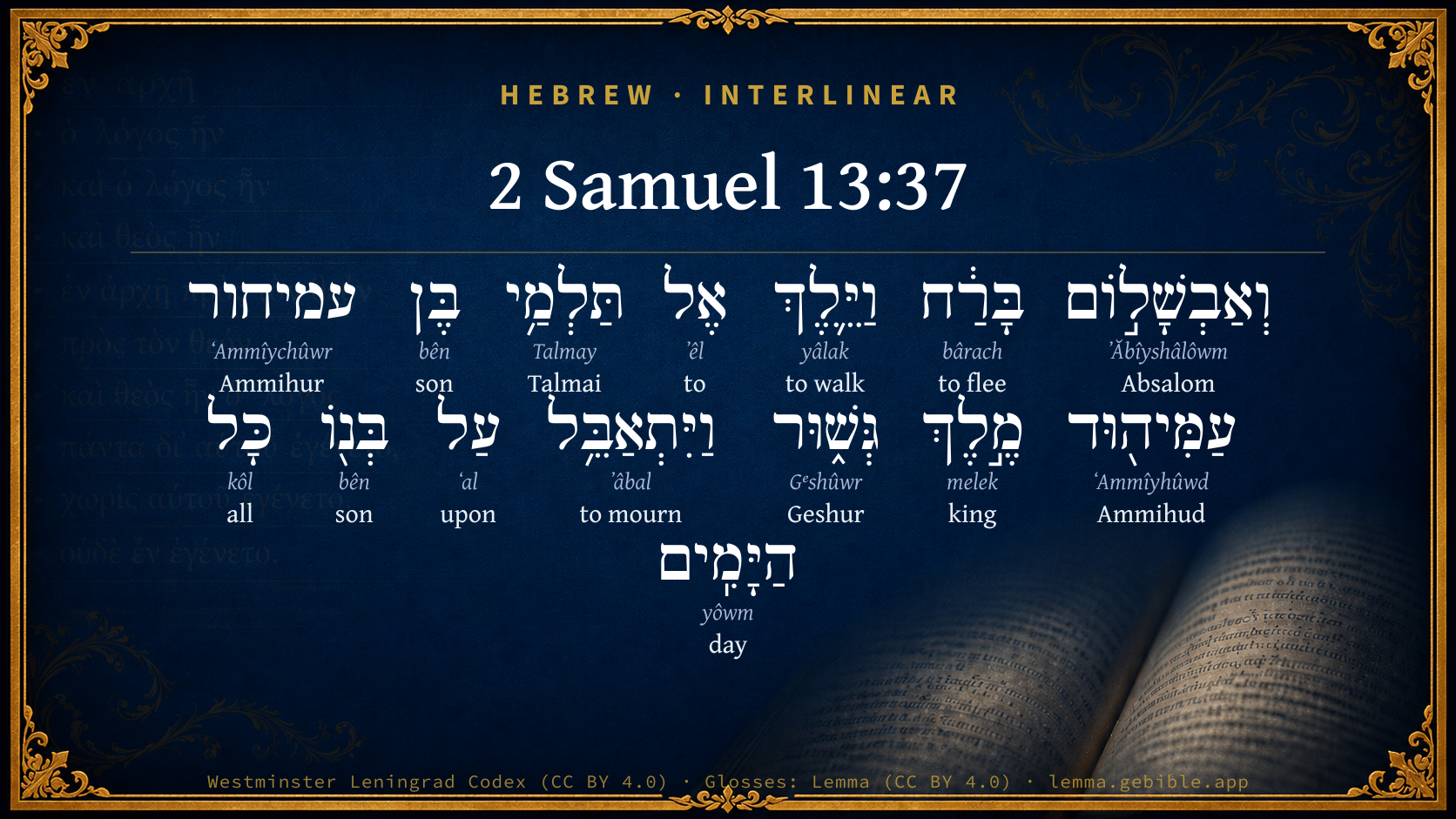
2 Samuel 13:37

Hebrew (Westminster Leningrad Codex) 2 Samuel 13:37 appears in the Hebrew Old Testament. The text above is from the Westminster Leningrad Codex. Each word links to its Strong’s number, a concise gloss, and parsing drawn from the Open Scriptures Hebrew Bible morphology. Click any word for its full Brown-Driver-Briggs (BDB) entry.
Download image
Cite this verse

2 Samuel 13:37 (World English Bible). Public Domain. Lemma interlinear Bible study tool, https://lemma.gebible.app/v/2-samuel/13/37.

Show BibTeX & RIS
BibTeX
RIS
English Translation
But Absalom fled, and went to Talmai the son of Ammihur, king of Geshur. [David] mourned for his son every day.
World English Bible · Public Domain
Highlights
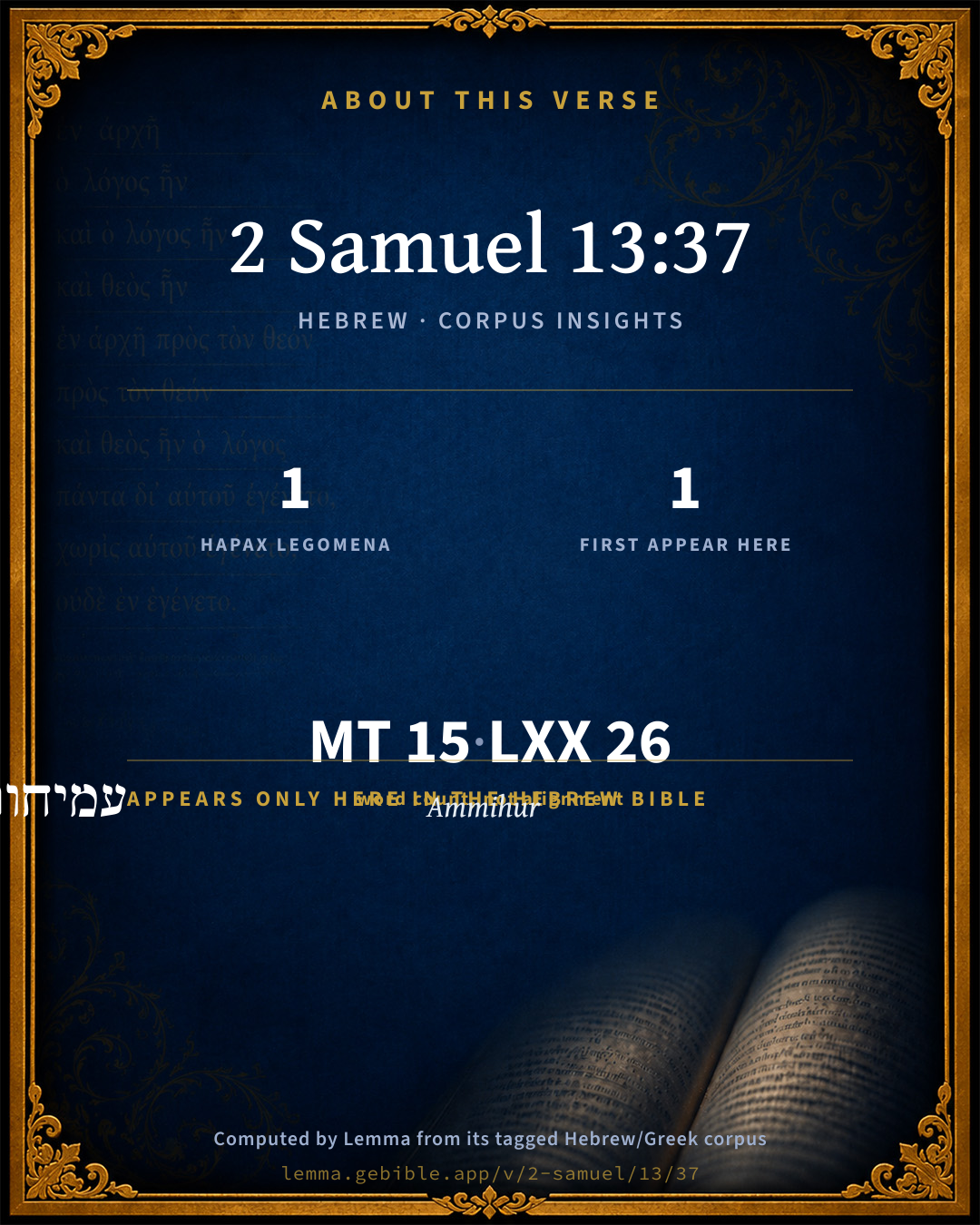
  • 1 hapax legomenon — only here in the Hebrew Bible
  • 1 first appearance in the Hebrew Bible
Full analysis ↓
Download a study sheet

One document with this verse’s original text, its word-by-word gloss line, the meaning frame, cross-references with their text, attributed commentary, and full source and license credits — printable, and it pastes into notes with its structure intact.

This verse Autodidact and up

Study sheet (.html) Plain text (.txt)

A passage Seminary Student

Up to 50 verses in one chapter. A passage sheet keeps up to 6 commentary sources and 12 cross-references per verse, in the order this page ranks them, and says so on the sheet whenever that leaves anything out. Ask for a single verse and you get the Autodidact verse sheet above.

Everything on this page stays free to read, with no account — the sheet is a download of what is already on screen, not access to it.

Want to remove ads? Support Godless Engineer
Compare translations 3

The same verse in 3 English versions, stacked beneath the original-language interlinear above. Click any original word for its lexicon entry.

Each is an independent rendering of the whole verse — the interlinear is not word-aligned to these translations.

Highlighted words mark where these versions differ — a whole-verse word diff, not a word-by-word alignment.

  • World English Bible Public Domain
    But Absalom fled, and went to Talmai the son of Ammihur, king of Geshur. [David] mourned for his son every day.
  • King James Version Public Domain
    But Absalom fled, and went to Talmai, the son of Ammihud, king of Geshur. And David mourned for his son every day.
  • unfoldingWord Literal Text CC BY-SA 4.0
    But Absalom fled, and he went to Talmai, the son of Ammihud, the king of Geshur. And David mourned for his son all of the days.

unfoldingWord Literal Text — © unfoldingWord, licensed CC BY-SA 4.0. Word-aligned USFM3 via Door43 (git.door43.org/unfoldingWord/en_ult).

Versions to compare (up to 4)

3 of 4 selected

Show all 18 translations

Every available English version of this verse, each an independent rendering of the whole verse.

  • World English Bible Public Domain
    But Absalom fled, and went to Talmai the son of Ammihur, king of Geshur. [David] mourned for his son every day.
  • Berean Standard Bible Public Domain
    Now Absalom fled and went to Talmai son of Ammihud, the king of Geshur. But David mourned for his son every day.
  • Majority Standard Bible Public Domain
    Now Absalom fled and went to Talmai son of Ammihud, the king of Geshur. But David mourned for his son every day.
  • King James Version Public Domain
    But Absalom fled, and went to Talmai, the son of Ammihud, king of Geshur. And David mourned for his son every day.
  • American Standard Version (1901) Public Domain
    But Absalom fled, and went to Talmai the son of Ammihur, king of Geshur. And `David' mourned for his son every day.
  • Revised Version (1885) Public Domain
    But Absalom fled, and went to Talmai the son of Ammihur, king of Geshur. And David mourned for his son every day.
  • Geneva Bible (1599) Public Domain
    But Absalom fled away, and went to Talmai the sonne of Ammihur King of Geshur: and Dauid mourned for his sonne euery day.
  • Douay-Rheims (1899) Public Domain
    But Absalom fled, and went to Tholomai the son of Ammiud the king of Gessur. And David mourned for his son every day.
  • Young's Literal Translation Public Domain
    And Absalom hath fled, and goeth unto Talmai, son of Ammihud, king of Geshur, and `David' mourneth for his son all the days.
  • Literal Standard Version CC BY-SA 4.0
    And Absalom has fled, and goes to Talmai, son of Ammihud, king of Geshur, and [David] mourns for his son all the days.
  • Unlocked Literal Bible CC BY-SA 4.0
    But Absalom fled and went to Talmai son of Ammihud, the king of Geshur. David mourned for his son every day.
  • unfoldingWord Literal Text CC BY-SA 4.0
    But Absalom fled, and he went to Talmai, the son of Ammihud, the king of Geshur. And David mourned for his son all of the days.
  • Darby Bible Public Domain
    And Absalom fled, and went to Talmai, the son of Ammihud, king of Geshur. And [David] mourned for his son every day.
  • World Messianic Bible Public Domain
    But Absalom fled and went to Talmai the son of Ammihur, king of Geshur. David mourned for his son every day.
  • Webster's Bible Public Domain
    But Absalom fled, and went to Talmai, the son of Ammihud, king of Geshur. And David mourned for his son every day.
  • Free Bible Version CC BY-SA 4.0
    Absalom ran away to Talmai, son of Ammihud, the king of Geshur. Every day David mourned for his son Amnon.
  • Bible in Basic English Public Domain
    So Absalom went in flight and came to Talmai, the son of Ammihud, the king of Geshur, where he was for three years.
  • JPS Tanakh (1917) Public Domain
    But Absalom fled, and went to Talmai the son of Ammihud, king of Geshur. And David mourned for his son every day.

Literal Standard Version (2020), Covenant Press — licensed CC BY-SA 4.0. Text via the HelloAO Bible API (eBible.org). Unlocked Literal Bible (unfoldingWord) — licensed CC BY-SA 4.0. Text via the HelloAO Bible API (eBible.org). unfoldingWord Literal Text — © unfoldingWord, licensed CC BY-SA 4.0. Word-aligned USFM3 via Door43 (git.door43.org/unfoldingWord/en_ult). Free Bible Version, Dr. Jonathan Gallagher — licensed CC BY-SA 4.0. Text via the HelloAO Bible API (eBible.org).

Word by word

More ways to search: Search by grammar → Find every occurrence → Compare this word →

Practice this passage: Drill this verse → Learn its vocabulary →

עמיחור
ʻAmmîychûwr
H5991
“Ammihur”
Noun, Proper
Part of Speech
Noun
Type
Proper
Full BDB Definition

Origin: from H5971 and H2353

TWOT: None

Ammihud = "people of majesty" - a ruler of Syria
  1. וְאַבְשָׁל֣וֹם ʼĂbîyshâlôwm H53 “and · Absalom” Conjunction + Noun, Proper
  2. בָּרַ֔ח bârach H1272 “to flee” Verb, Qal, Perfect, 3rd Person, Masculine, Singular
  3. וַיֵּ֛לֶךְ yâlak H3212 “and · to walk” Conjunction + Verb, Qal, Sequential Imperfect, 3rd Person, Masculine, Singular
  4. אֶל ʼêl H413 “to” Preposition
  5. תַּלְמַ֥י Talmay H8526 “Talmai” Noun, Proper
  6. בֶּן bên H1121 “son of” Noun, Common, Masculine, Singular, Construct
  7. עַמִּיה֖וּד ʻAmmîyhûwd H5989 “Ammihud” Noun, Proper
  8. מֶ֣לֶךְ melek H4428 “king of” Noun, Common, Masculine, Singular, Construct
  9. גְּשׁ֑וּר Gᵉshûwr H1650 “Geshur” Noun, Proper
  10. וַיִּתְאַבֵּ֥ל ʼâbal H56 “and · to mourn” Conjunction + Verb, Hithpael, Sequential Imperfect, 3rd Person, Masculine, Singular
  11. עַל ʻal H5921 “upon” Preposition
  12. בְּנ֖וֹ bên H1121 “son · his” Noun, Common, Masculine, Singular, Construct + Suffix, Personal, 3rd Person, Masculine, Singular
  13. כָּל kôl H3605 “all of” Noun, Common, Masculine, Singular, Construct
  14. הַיָּמִֽים yôwm H3117 “the · days” Particle, Definite Article + Noun, Common, Masculine, Plural, Absolute

About this verse

These counts appear in no published source. They are computed here, from the morphology-tagged text and Lemma’s own curated glosses. What Lemma adds →

15
words
14
distinct lemmas
Historical
section

Notable vocabulary

1 hapax legomenon — a word that appears only here in the entire Hebrew Bible:

  • עמיחור Ammihur H5991

First appearance in Scripture

This word makes its first canonical appearance in the Hebrew Bible here:

  • עמיחור Ammihur H5991

Shared distinctive vocabulary

תַּלְמַ֥י Talmai H8526 occurs in 6 verses of the Hebrew Bible. Also found in:

Grammatical profile

  • 3 verbs
  • 10 nouns
  • 2 prepositions

Verb forms

  • בָּרַ֔ח Qal · Perfect
  • וַיֵּ֛לֶךְ Qal · Sequential Imperfect
  • וַיִּתְאַבֵּ֥ל Hithpael · Sequential Imperfect

Repetition

A word recurs within this verse — often emphatic in Hebrew:

Hebrew & Septuagint length

In English translation the verse runs 21 words from the Hebrew and 27 from the Septuagint (LXX English) — closely comparable.

A rough comparison of the two English renderings, which tokenize alike — not a word-level alignment.

Word counts can differ between the Hebrew and the Greek without any difference in meaning — e.g. the Hebrew direct-object marker אֵת has no separate Greek word, and Greek often adds the article ὁ.

In the original languages it is 15 Hebrew tokens and 26 Greek tokens — but the two are counted differently (Hebrew bundles its prefixes and suffixes into one token; the Greek is in lemma form), so that isn’t a like-for-like length.

Cross-references

5

Topical passages linked to 2 Samuel 13:37 in the Treasury of Scripture Knowledge — connected by theme and wording, ordered by reader-vote popularity; previews shown in the World English Bible.

  • 2 Samuel 3:3 and his second, Chileab, of Abigail the wife of Nabal the Carmelite; and the third, Absalom the son of Maacah the daughter of Talmai king of Geshur;
  • 2 Samuel 14:23 So Joab arose and went to Geshur, and brought Absalom to Jerusalem.
  • 2 Samuel 13:34 But Absalom fled. The young man who kept the watch lifted up his eyes, and looked, and, behold, there came much people by the way of the hill-side behind him.
  • 2 Samuel 14:32 Absalom answered Joab, Behold, I sent to you, saying, Come here, that I may send you to the king, to say, Why am I come from Geshur? it were better for me to be there still. Now therefore let me see the king's face; and if there be iniquity in me, let him kill me.
  • 1 Chronicles 3:2 the third, Absalom the son of Maacah the daughter of Talmai king of Geshur; the fourth, Adonijah the son of Haggith;

Cross-references courtesy of OpenBible.info (CC BY 4.0).

Hebrew and Greek witnesses Masoretic Hebrew ↔ Greek Septuagint

The same verse in the two great witnesses to the Old Testament, shown verse-for-verse.

These are two independent witnesses, not word-aligned to each other, and the Septuagint is shown in lemma (dictionary) form.

Hebrew 2 Samuel 13:37 Masoretic · Westminster Leningrad Codex

וְאַבְשָׁל֣וֹם בָּרַ֔ח וַיֵּ֛לֶךְ אֶל תַּלְמַ֥י בֶּן עמיחור עַמִּיה֖וּד מֶ֣לֶךְ גְּשׁ֑וּר וַיִּתְאַבֵּ֥ל עַל בְּנ֖וֹ כָּל הַיָּמִֽים

But Absalom fled, and went to Talmai the son of Ammihur, king of Geshur. [David] mourned for his son every day.

World English Bible · Public Domain

Greek LXX 2 Samuel 13:37 Septuagint · lemma form

καί αβεσσαλωμ φεύγω καί πορεύομαι πρός θολμαι υἱός εμιουδ βασιλεύς γεδσουρ εἰς γῆ μαχαδ καί πενθέω ὁ βασιλεύς δαυίδ ἐπί ὁ υἱός αὐτός πᾶς ὁ ἡμέρα

But Abessalom fled, and went to Tholmi son of Emiud the king of Gedsur to the land of Chamaachad: and king David mourned for his son continually.

LXX2012 (modern English Septuagint) · Public Domain

On this verse, Keil & Delitzsch discusses the Septuagint’s reading. Read the note in Commentary ↓

Hebrew: Westminster Leningrad Codex (CC BY 4.0). Greek: Septuagint (public domain); English from LXX2012 (modern English Septuagint) (Public Domain). How the Septuagint differs from the Hebrew →

Targum (Aramaic paraphrase)

1

The Targum is the ancient Jewish Aramaic paraphrase of the Hebrew Scriptures — an interpretive translation, not the Hebrew text itself. Onkelos (literal) and Pseudo-Jonathan (expansive) render the Torah, and Jonathan the Prophets. Coverage is partial: where no permissively-licensed English translation exists for a verse, only the Aramaic is shown. This is verse-level text, not a word-by-word alignment to the Hebrew.

  1. Targum Jonathan Prophets (Joshua–Malachi)
    וְאַבְשָׁלוֹם עֲרַק וַאֲזַל לְוַת תַּלְמַי בַּר עֲמִיהוּד מַלְכָּא דִגְשׁוּר וְאִתְאַבַּל עַל בְּרֵיהּ כָּל יוֹמַיָא:

    (no public-domain English translation for this verse)

    Targum Jonathan — Aramaic: “Mikraot Gedolot” (public domain). English: “Sefaria Community Translation” (CC0 1.0 (public-domain dedication)); “London "Chaldee Paraphrase," 1871” (public domain). Text via Sefaria.

Commentary

Notes on 2 Samuel 13:37 from classic Christian and Jewish commentators (each source and its license shown beneath its notes). The classic Christian expositions comment on the surrounding passage and are grouped to its opening verse, so a note may address several verses; the Jewish commentaries on the Tanakh (Rashi and others) are per-verse, so they appear only where the commentator wrote on this verse.

Lemma curates 59 commentaries, every one of them public domain or Creative Commons licensed, each selected and text-cleaned for this edition rather than reprinted as found. About our sources →

Jamieson, Fausset & Brown

Robert Jamieson, A. R. Fausset & David Brown

ABSALOM FLEES TO TALMAI. (Sa2 13:37-39)

Absalom fled, and went to Talmai--The law as to premeditated murder (Num 35:21) gave him no hope of remaining with impunity in his own country. The cities of refuge could afford him no sanctuary, and he was compelled to leave the kingdom, taking refuge at the court of Geshur, with his maternal grandfather, who would, doubtless, approve of his conduct.

Next: 2 Samuel Chapter 14

Jamieson, Fausset & Brown — Commentary Critical and Explanatory on the Whole Bible (1871) — public domain (CC PDM 1.0). Text via the HelloAO Bible API.

Trapp's Complete Commentary

John Trapp

2Sa 13:37 But Absalom fled, and went to Talmai, the son of Ammihud, king of Geshur. And [David] mourned for his son every day.

Ver. 37. And went to Talmai.] His grandfather by the mother’s side, to whom he was the welcomer, because he had slain Amnon, who had deflowered his niece Tamar.

John Trapp, A Commentary or Exposition upon All the Books of the Old and New Testament (1647–1656) — public domain. Text from a community e-Sword module.

Joseph Benson's Commentary

2Sa 13:37. David mourned for his son every day — Either for the murder of Amnon, or for Absalom, who was lost as to any comfort he could have from him. “Thus did God, by withdrawing his restraining grace from Amnon, and leaving him a prey to his own passions, raise up evil to David out of his own house; a daughter ravished by her own brother; that brother murdered by another brother; and that other in exile on that account; and soon to perish by a fate yet more deplorable, had it not been more deserved! And now began another and more dreadful prophecy of Nathan to be fulfilled upon David, before his eyes: the sword was now first brought in upon his house, attended with this dreadful assurance of never departing from it.” — Delaney.

Joseph Benson's Commentary on the Old and New Testaments (1811–1818) — public domain. Text from a community e-Sword module.

Whedon's Commentary on the Bible

Daniel D. Whedon

ABSALOM’S FLIGHT TO GESHUR, 2Sa_13:37-39.

37. Absalom fled — When the other sons of the king arose and fled, he took advantage of the confusion and escaped out of the land. 2Sa_13:29; 2Sa_13:34.

Went to Talmai — His maternal grandfather. 2Sa_3:3.

Geshur — A province belonging, at the time of Absalom’s flight, to Syria.

2Sa_15:8. It was on the northern border of Bashan, and adjoining the province of Argob. See Deu_3:14; Jos_12:5. “It is a remarkable fact — and it shows how little change three thousand years have produced on this eastern land — that Bashan is still the refuge of all offenders. If a man can only reach it, no matter what may have been his crimes or his failings, he is safe; the officers of government dare not follow him, and the avenger of blood even turns away in despair. During a short tour in Bashan, I met more than a dozen refugees, who, like Absalom in Geshur; awaited in security some favourable turn of events.” — Porter.

Daniel D. Whedon (gen. ed.), Commentary on the Old and New Testaments (1874–1909) — public domain. Text from a community e-Sword module.

Tyndale Open Study Notes

Tyndale Open Resources

13:37 fled to his grandfather: See 3:3. • Geshur was in Aram, northeast of Israel’s territory (see 15:8; Josh 13:13).

Tyndale Open Study Notes — © Tyndale Open Resources, licensed CC BY-SA 4.0. Text via the HelloAO Bible API.

Geneva Bible (1599)

Geneva Bible translators

For Maacah his mother was the daughter of this Talmai, 2 Sam. 3:3.

Geneva Bible (1599) marginal notes — public domain. Text via Bolls.life.

Adam Clarke's Commentary

Verse 37. Absalom fled] As he had committed wilful murder, he could not avail himself of a city of refuge, and was therefore obliged to leave the land of Israel, and take refuge with Talmai, king of Geshur, his grandfather by his mother's side. See 2Sa 3:3.

Adam Clarke's Commentary on the Bible (1810–1826) — public domain. Text from a community e-Sword/MySword module.

Ellicott's Commentary for English Readers

(37) Went to Talmai.—His maternal grandfather. (See Note on 2Sa_3:2-5.) This verse may be considered parenthetical:—The king’s sons came . . . and wept sore. (“Only Absalom fled and went to . . . Geshur.”) In this case the omission of “David” in the latter clause of the verse is explained, as the nominative is easily supplied from 2Sa_13:36.

For his son every day.—Amnon is certainly the son here meant, for whom David continually mourned until his grief was gradually assuaged by the lapse of time.

A Bible Commentary for English Readers, edited by Charles John Ellicott (1878–1897) — public domain. Text from a community e-Sword module.

The Cambridge Bible for Schools and Colleges

gen. ed. J. J. S. Perowne

37. But Absalom fled, &c.] Now Absalom had fled and gone to Talmai. The narrative goes back to 2Sa_13:34. Talmai was Absalom’s grandfather. See note on ch. 2Sa_3:3.

And David mourned] David has fallen out of the Heb. text, but is found in the Sept. and Vulg., and is clearly necessary to the sense.

for his son] Amnon, not Absalom, is meant. His first feeling towards Absalom was one of anger.

The Cambridge Bible for Schools and Colleges (gen. ed. J. J. S. Perowne; Cambridge University Press, 1878–1918) — public domain. Text from a community e-Sword module.

John Gill's Exposition

But Absalom fled,.... As before related, but here repeated for the sake of what follows:

and went to Talmai, the son of Ammihud, king of Geshur: his mother's father, see Sa2 3:3, where he might hope for protection and safety:

and David mourned for his son every day; or "all the days" (q), i.e. of the three years Absalom was in Geshur, about the end of which he was comforted concerning Amnon, as the following verses show. Some think it was for Absalom he mourned, but rather for Amnon. The reason why he mourned for him, when he did not for his child by Bathsheba, who died, because that was an infant, this a grown man, and heir to his crown, and was slain by the sword of his brother, and so fulfilled a threatening to himself on account of his own sin, which, hereby no doubt, was brought fresh to his mind.

(q) "cunctis diebus", V. L. "omnibus diebus", Pagninus, Montanus.

John Gill's Exposition of the Whole Bible (1746–1763) — public domain (CC PDM 1.0). Text via the HelloAO Bible API.

Albert Barnes' Notes on the Bible

See the marginal reference.

Ammihur (see the margin) is found as a Punic name.

Albert Barnes' Notes on the Bible (1834–1885) — public domain. Text from a community e-Sword/MySword module.

Haydock's Catholic Bible Commentary

Tholomai, or Tholmai, (Haydock; chap. iii. 3.) his maternal grandfather. (Calmet)

George Leo Haydock (1774–1849), Haydock's Catholic Family Bible and Commentary, 1859 edition — public domain. Excludes Psalms (Douay-Rheims chapter numbering differs from Protestant) and Deuterocanonical books (Catholic canon only).

Matthew Poole's English Annotations

Talmai, the son of Ammihud; his mother’s father, 2Sa 3:3; that he might have present protection and sustenance from him; and that by his mediation he might obtain his father’s pardon and favour.

Matthew Poole's English Annotations on the Holy Bible (1683–1685) — public domain. Text from a community e-Sword/MySword module.

The Pulpit Commentary

Vers. 37, 38. So Absalom fled. The triple repetition of these words, and the fragmentary style, make it probable that we have hero an abridgment of a longer narrative. So in ver. 35 the words probably are a summary of a more circumstantial account of Absalom"s doings after his young men had slain Amnon. (On Talmai and Geshur, see notes on 2Sa_3:3)

The Pulpit Commentary (1880–1919), ed. H.D.M. Spence-Jones & Joseph S. Exell — public domain. Text from a community e-Sword module.

John Wesley's Explanatory Notes

Talmai - His mother's father, that he might have present protection and sustenance from him; and that by his mediation he might obtain his father's pardon.

John Wesley, Explanatory Notes Upon the Whole Bible (1754–1765) — public domain. Text via the GEBible commentary corpus.

Keil & Delitzsch

C. F. Keil & F. Delitzsch

"Only Absalom had fled and gone to Talmai the son of Ammihud, the king of Geshur." These words form a circumstantial clause, which the writer has inserted as a parenthesis, to define the expression "the king's sons" more particularly. If we take these words as a parenthesis, there will be no difficulty in explaining the following word "mourned," as the subject (David) may very easily be supplied from the preceding words "the king," etc. (Sa2 13:36). To the remark that David mourned all his life for his son (Amnon), there is attached, just as simply and quite in accordance with the facts, the more precise information concerning Absalom's flight, that he remained in Geshur three years. The repetition of the words "Absalom had fled and gone to Geshur" may be accounted for from the general diffuseness of the Hebrew style. Talmai the king of Geshur was the father of Maacah, Absalom's mother (Sa2 3:3). The lxx thought it necessary expressly to indicate this by inserting εἰς γῆν Χαμαχάαδ (al. γῆν Μαχάδ).

Keil & Delitzsch — Biblical Commentary on the Old Testament (1861–1891) — public domain (CC PDM 1.0). Text via the HelloAO Bible API. (Old Testament only.)

Scofield Reference Notes

C. I. Scofield

But Absalom fled, and went to Talmai 1Sa 27:8. David, in the years of his wanderings, made a savage raid upon Geshur, and evidently bore away Maacah, daughter of the king of Geshur. Of her was born Absalom, and in him was her wild Bedouin blood, and the blood of a father who had been the reckless chief of a handful of desperate men.; 2Sa 3:3; 2Sa 23:8-39 and whom only the divine love could tame. 2Sa 22:36. In Absalom David reaped from his own sowing.

The Scofield Reference Bible (1917 edition), notes by C. I. Scofield — public domain. Text from a community e-Sword module.

unfoldingWord translationNotes

Door43 World Missions Community

Talmai ... Ammihud

These are the names of men. (See: How to Translate Names)

for his son

"for his son Amnon"

where he was for three years

"where he stayed for three years"

The mind of King David longed

Here David is referred to by his mind to emphasize his thoughts. AT: "King David longed" (See: Synecdoche)

for he was comforted concerning Amnon and his death

"because he was no longer grieving about Amnon being dead." This refers to three years after Absalom fled to Geshur.

translationWords

Geshur

mourn

mind

comfort

unfoldingWord translationNotes — © Distant Shores Media and the Door43 World Missions Community, licensed CC BY-SA 4.0. Source: git.door43.org/Door43/en_tn.

Lesson kit

Teaching starters — assembled from the data on this page, not authored interpretation. Every prompt links to the verse data it draws on. Edit before teaching.

2 Samuel, in the Historical, opens this verse with 15 words (14 distinct Hebrew lemmas). Its most distinctive word is ʻAmmîychûwr (“Ammihur”). A historical commentator’s framing appears above. Read the whole chapter for the surrounding context.

Discussion questions

  1. The word ʻAmmîychûwr carries the sense “Ammihur.” How does it shape the verse?
  2. 1 word here appears nowhere else in the Hebrew Bible. Why might the author reach for such rare wording?
  3. This is the first place “Ammihur” appears in Scripture (first appears here). What does its debut here establish?
  4. How does Numbers 13:22, which shares the word «Talmai», read alongside this verse?
  5. What does the repetition of “son” (2× in this one verse) do in this verse?
  6. These translations render this verse differently. What is at stake in choosing one wording over another?
  7. «בָּרַ֔ח» is a Qal Perfect verb. How does that grammatical form shape the action described?
  8. Compare how Jamieson, Fausset & Brown and Trapp's Complete Commentary read this verse. Where do they agree or differ?

Things to notice

  • 1 word in this verse appears nowhere else in the Hebrew Bible.
  • 1 word makes its first canonical appearance in Scripture here.
  • This verse counts 15 Hebrew ↔ 26 Greek words.
  • These translations choose different wording for 6 words in this verse.
  • “son” occurs 2× in this single verse.

Reading settings

Reading text

Shown beneath each verse's original-language words.

Old Testament
Old Testament edition

Read the OT as the Masoretic Hebrew (MT) or the Greek Septuagint (LXX).

English shown for the Greek Septuagint (in the Hebrew ↔ Greek comparison).

Comparing translations? Open the Compare panel on any verse page to stack up to four side by side.