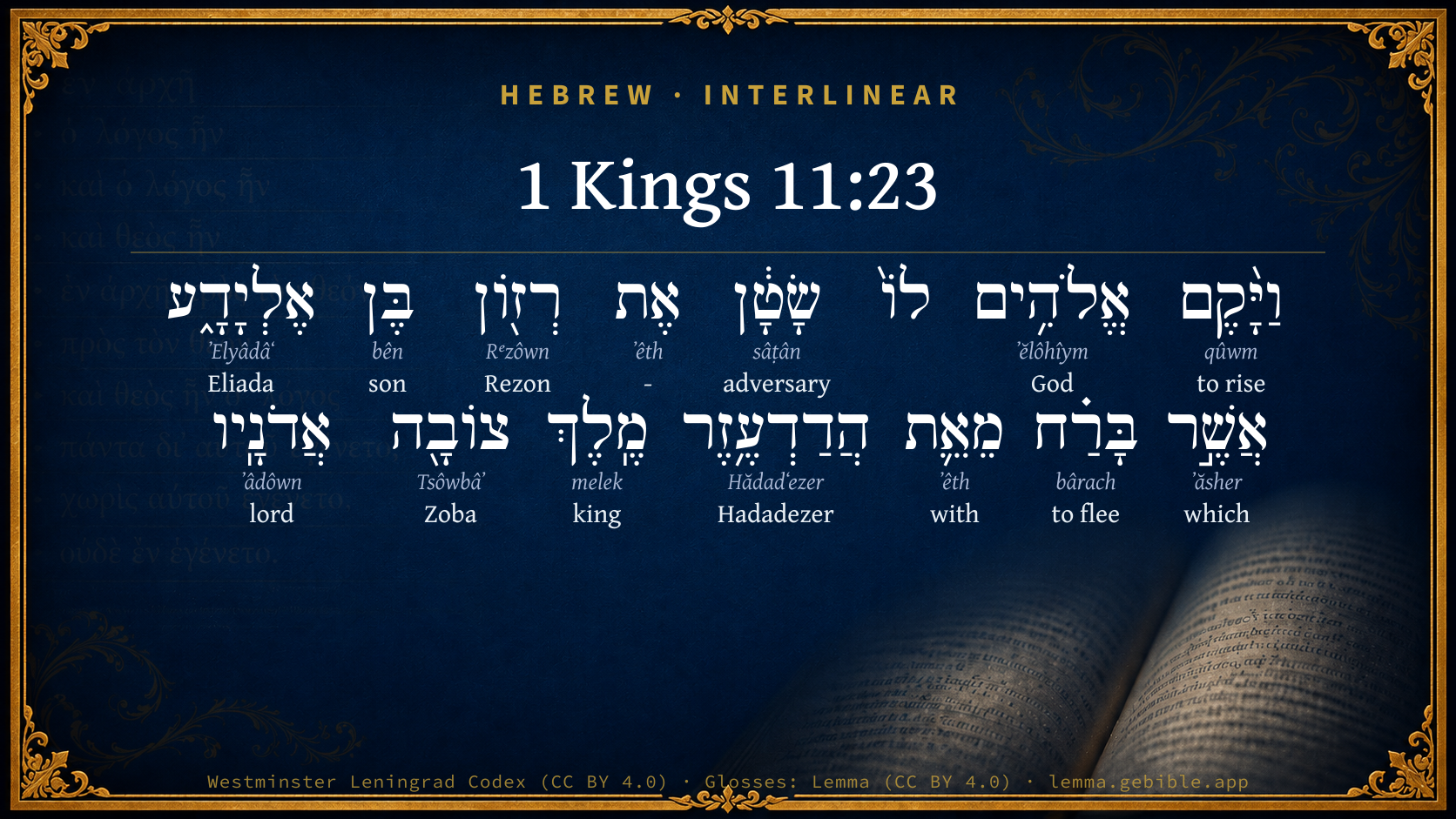
1 Kings 11:23

Hebrew (Westminster Leningrad Codex) 1 Kings 11:23 appears in the Hebrew Old Testament. The text above is from the Westminster Leningrad Codex. Each word links to its Strong’s number, a concise gloss, and parsing drawn from the Open Scriptures Hebrew Bible morphology. Click any word for its full Brown-Driver-Briggs (BDB) entry.
Download image
Cite this verse

1 Kings 11:23 (World English Bible). Public Domain. Lemma interlinear Bible study tool, https://lemma.gebible.app/v/1-kings/11/23.

Show BibTeX & RIS
BibTeX
RIS
English Translation
God raised up [another] adversary to him, Rezon the son of Eliada, who had fled from his lord Hadadezer king of Zobah.
World English Bible · Public Domain
Highlights
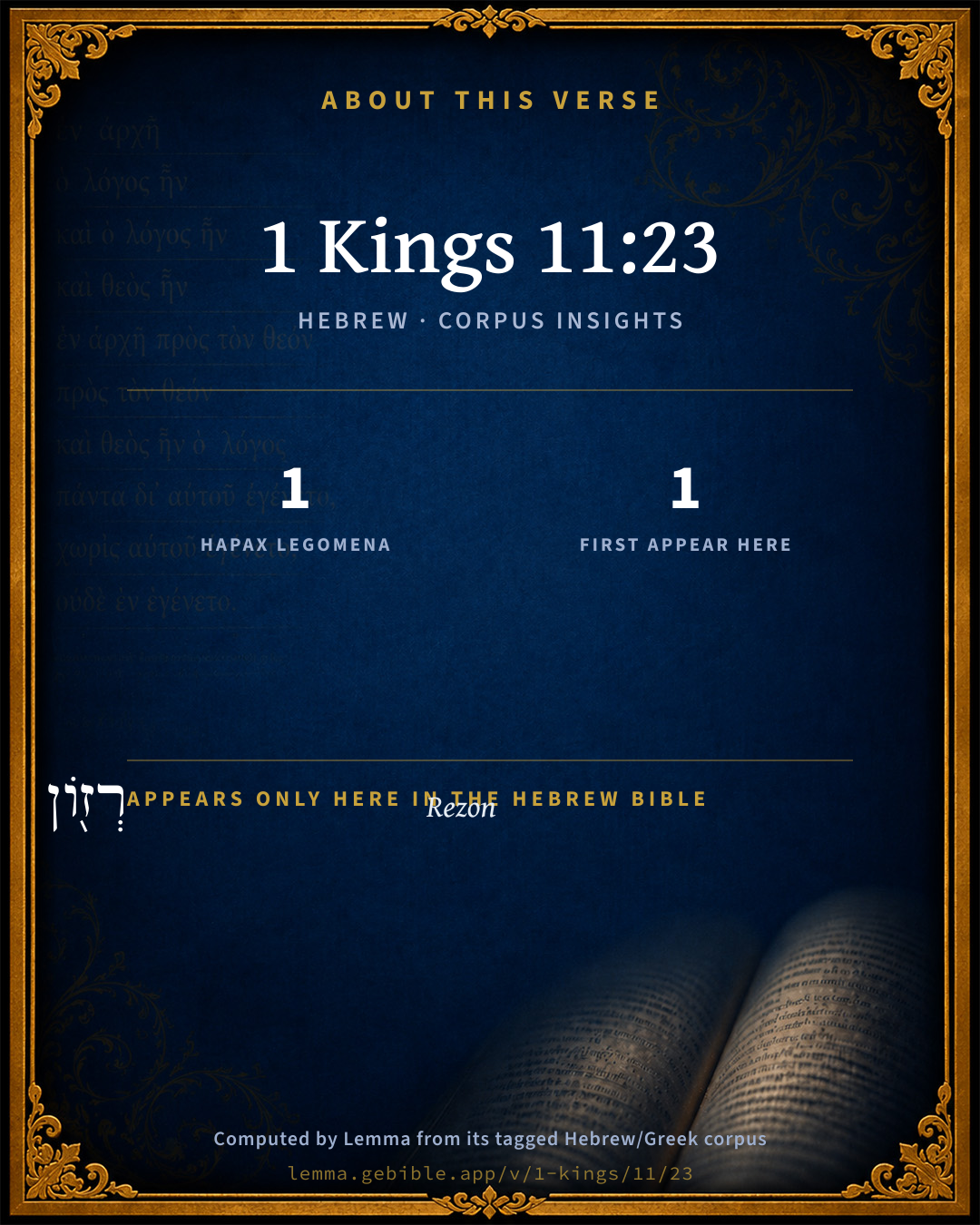
  • 1 hapax legomenon — only here in the Hebrew Bible
  • 1 first appearance in the Hebrew Bible
Full analysis ↓
Download a study sheet

One document with this verse’s original text, its word-by-word gloss line, the meaning frame, cross-references with their text, attributed commentary, and full source and license credits — printable, and it pastes into notes with its structure intact.

This verse Autodidact and up

Study sheet (.html) Plain text (.txt)

A passage Seminary Student

Up to 50 verses in one chapter. A passage sheet keeps up to 6 commentary sources and 12 cross-references per verse, in the order this page ranks them, and says so on the sheet whenever that leaves anything out. Ask for a single verse and you get the Autodidact verse sheet above.

Everything on this page stays free to read, with no account — the sheet is a download of what is already on screen, not access to it.

Want to remove ads? Support Godless Engineer
Compare translations 3

The same verse in 3 English versions, stacked beneath the original-language interlinear above. Click any original word for its lexicon entry.

Each is an independent rendering of the whole verse — the interlinear is not word-aligned to these translations.

Highlighted words mark where these versions differ — a whole-verse word diff, not a word-by-word alignment.

  • World English Bible Public Domain
    God raised up [another] adversary to him, Rezon the son of Eliada, who had fled from his lord Hadadezer king of Zobah.
  • King James Version Public Domain
    And God stirred him up another adversary, Rezon the son of Eliadah, which fled from his lord Hadadezer king of Zobah:
  • unfoldingWord Literal Text CC BY-SA 4.0
    And God raised up an adversary against him, Rezon, the son of Eliada, who had fled from Hadadezer, the king of Zobah, his master.

unfoldingWord Literal Text — © unfoldingWord, licensed CC BY-SA 4.0. Word-aligned USFM3 via Door43 (git.door43.org/unfoldingWord/en_ult).

Versions to compare (up to 4)

3 of 4 selected

Show all 18 translations

Every available English version of this verse, each an independent rendering of the whole verse.

  • World English Bible Public Domain
    God raised up [another] adversary to him, Rezon the son of Eliada, who had fled from his lord Hadadezer king of Zobah.
  • Berean Standard Bible Public Domain
    And God raised up against Solomon another adversary, Rezon the son of Eliada, who had fled from his master, Hadadezer king of Zobah,
  • Majority Standard Bible Public Domain
    And God raised up against Solomon another adversary, Rezon the son of Eliada, who had fled from his master, Hadadezer king of Zobah,
  • King James Version Public Domain
    And God stirred him up another adversary, Rezon the son of Eliadah, which fled from his lord Hadadezer king of Zobah:
  • American Standard Version (1901) Public Domain
    And God raised up `another' adversary unto him, Rezon the son of Eliada, who had fled from his lord Hadadezer king of Zobah.
  • Revised Version (1885) Public Domain
    And God raised up another adversary unto him, Rezon the son of Eliada, which had fled from his lord Hadadezer king of Zobah:
  • Geneva Bible (1599) Public Domain
    And God stirred him vp another aduersarie, Rezon the sonne of Eliada, which fled from his lorde Hadadezer King of Zobah.
  • Douay-Rheims (1899) Public Domain
    God also raised up against him an adversary, Razon the son of Eliada, 'who had fled from his master Adarezer the king of Soba:
  • Young's Literal Translation Public Domain
    And God raiseth to him an adversary, Rezon son of Eliadah, who hath fled from Hadadezer king of Zobah, his lord,
  • Literal Standard Version CC BY-SA 4.0
    And God raises an adversary against him, Rezon son of Eliadah, who has fled from Hadadezer king of Zobah, his lord,
  • Unlocked Literal Bible CC BY-SA 4.0
    God also raised up another adversary to Solomon, Rezon son of Eliada, who had fled from his master Hadadezer king of Zobah.
  • unfoldingWord Literal Text CC BY-SA 4.0
    And God raised up an adversary against him, Rezon, the son of Eliada, who had fled from Hadadezer, the king of Zobah, his master.
  • Darby Bible Public Domain
    God stirred him up yet an adversary, Rezon the son of Eliada, who had fled from Hadadezer king of Zobah, his lord.
  • World Messianic Bible Public Domain
    God raised up an adversary to him, Rezon the son of Eliada, who had fled from his lord, Hadadezer king of Zobah.
  • Webster's Bible Public Domain
    And God stirred him up another adversary, Rezon the son of Eliadah, who fled from his lord Hadadezer king of Zobah:
  • Free Bible Version CC BY-SA 4.0
    God also encouraged Rezon, son of Eliada, to oppose Solomon. He had run away from his master Hadadezer, king of Zobah. After David had destroyed Zobah's army,
  • Bible in Basic English Public Domain
    And God sent another trouble-maker, Rezon, the son of Eliada, who had gone in flight from his lord, Hadadezer, king of Zobah:
  • JPS Tanakh (1917) Public Domain
    And God raised up another adversary unto him, Rezon the son of Eliada, who had fled from his lord Hadadezer king of Zobah.

Literal Standard Version (2020), Covenant Press — licensed CC BY-SA 4.0. Text via the HelloAO Bible API (eBible.org). Unlocked Literal Bible (unfoldingWord) — licensed CC BY-SA 4.0. Text via the HelloAO Bible API (eBible.org). unfoldingWord Literal Text — © unfoldingWord, licensed CC BY-SA 4.0. Word-aligned USFM3 via Door43 (git.door43.org/unfoldingWord/en_ult). Free Bible Version, Dr. Jonathan Gallagher — licensed CC BY-SA 4.0. Text via the HelloAO Bible API (eBible.org).

Word by word

More ways to search: Search by grammar → Find every occurrence → Compare this word →

Practice this passage: Drill this verse → Learn its vocabulary →

רְז֖וֹן
Rᵉzôwn
H7331
“Rezon”
Noun, Proper
Part of Speech
Noun
Type
Proper
Full BDB Definition

Origin: from H7336

TWOT: None

Rezon = "prince" - son of Eliadah, a Syrian, who lead a band of freebooters and established a petty kingdom at Damascus in the time of David and Solomon
  1. וַיָּ֨קֶם qûwm H6965 “and · to rise” Conjunction + Verb, Hiphil, Sequential Imperfect, 3rd Person, Masculine, Singular
  2. אֱלֹהִ֥ים ʼĕlôhîym H430 “God(s)” Noun, Common, Masculine, Plural, Absolute
  3. שָׂטָ֔ן sâṭân H7854 “adversary” Noun, Common, Masculine, Singular, Absolute
  4. אֶת ʼêth H853 “-” Particle, Direct Object
  5. בֶּן bên H1121 “son of” Noun, Common, Masculine, Singular, Construct
  6. אֶלְיָדָ֑ע ʼElyâdâʻ H450 “Eliada” Noun, Proper
  7. אֲשֶׁ֣ר ʼăsher H834 “which” Particle, Relative
  8. בָּרַ֗ח bârach H1272 “to flee” Verb, Qal, Perfect, 3rd Person, Masculine, Singular
  9. מֵאֵ֛ת ʼêth H854 “from · with” Preposition + Preposition
  10. הֲדַדְעֶ֥זֶר Hădadʻezer H1909 “Hadadezer” Noun, Proper
  11. מֶֽלֶךְ melek H4428 “king of” Noun, Common, Masculine, Singular, Construct
  12. צוֹבָ֖ה Tsôwbâʼ H6678 “Zoba” Noun, Proper
  13. אֲדֹנָֽיו ʼâdôwn H113 “lords · his” Noun, Common, Masculine, Plural, Construct + Suffix, Personal, 3rd Person, Masculine, Singular

About this verse

These counts appear in no published source. They are computed here, from the morphology-tagged text and Lemma’s own curated glosses. What Lemma adds →

15
words
14
distinct lemmas
Historical
section

Notable vocabulary

1 hapax legomenon — a word that appears only here in the entire Hebrew Bible:

  • רְז֖וֹן Rezon H7331

First appearance in Scripture

This word makes its first canonical appearance in the Hebrew Bible here:

  • רְז֖וֹן Rezon H7331

Shared distinctive vocabulary

אֶלְיָדָ֑ע Eliada H450 occurs in 4 verses of the Hebrew Bible. Also found in:

Grammatical profile

  • 2 verbs
  • 9 nouns
  • 2 prepositions
  • 2 particles

Verb forms

  • וַיָּ֨קֶם Hiphil · Sequential Imperfect
  • בָּרַ֗ח Qal · Perfect

Hebrew & Septuagint length

In English translation the verse runs 22 words from the Hebrew and 29 from the Septuagint (LXX English) — closely comparable.

A rough comparison of the two English renderings, which tokenize alike — not a word-level alignment.

Word counts can differ between the Hebrew and the Greek without any difference in meaning — e.g. the Hebrew direct-object marker אֵת has no separate Greek word, and Greek often adds the article ὁ.

Cross-references

14

Topical passages linked to 1 Kings 11:23 in the Treasury of Scripture Knowledge — connected by theme and wording, ordered by reader-vote popularity; previews shown in the World English Bible.

  • 2 Samuel 8:3 David struck also Hadadezer the son of Rehob, king of Zobah, as he went to recover his dominion at the River.
  • 1 Kings 11:14 Yahweh raised up an adversary to Solomon, Hadad the Edomite: he was of the king's seed in Edom.
  • 2 Samuel 10:8 The children of Ammon came out, and put the battle in array at the entrance of the gate: and the Syrians of Zobah and of Rehob, and the men of Tob and Maacah, were by themselves in the field.
  • 2 Samuel 10:15–18 When the Syrians saw that they were put to the worse before Israel, they gathered themselves together.
  • 2 Samuel 16:11 David said to Abishai, and to all his servants, Behold, my son, who came forth from my bowels, seeks my life: how much more [may] this Benjamite now [do it]? let him alone, and let him curse; for Yahweh has invited him.
  • 1 Chronicles 18:3–9 David struck Hadarezer king of Zobah to Hamath, as he went to establish his dominion by the river Euphrates.
  • 1 Chronicles 19:6 When the children of Ammon saw that they had made themselves odious to David, Hanun and the children of Ammon sent one thousand talents of silver to hire them chariots and horsemen out of Mesopotamia, and out of Arammaacah, and out of Zobah.
  • 1 Chronicles 19:16–19 When the Syrians saw that they were put to the worse before Israel, they sent messengers, and drew forth the Syrians who were beyond the River, with Shophach the captain of the host of Hadarezer at their head.
  • Ezra 1:1 Now in the first year of Cyrus king of Persia, that the word of Yahweh by the mouth of Jeremiah might be accomplished, Yahweh stirred up the spirit of Cyrus king of Persia, so that he made a proclamation throughout all his kingdom, and [put it] also in writing, saying,
  • Psalms 60:1 God, you have rejected us. You have broken us down. You have been angry. Restore us, again.
  • Isaiah 13:17 Behold, I will stir up the Medes against them, who shall not regard silver, and as for gold, they shall not delight in it.
  • Isaiah 37:26 Have you not heard how I have done it long ago, and formed it of ancient times? now have I brought it to pass, that it should be your to lay waste fortified cities into ruinous heaps.
  • Isaiah 45:5 I am Yahweh, and there is none else; besides me there is no God. I will gird you, though you have not known me;
  • Ezekiel 38:16 and you shall come up against my people Israel, as a cloud to cover the land: it shall happen in the latter days, that I will bring you against my land, that the nations may know me, when I shall be sanctified in you, Gog, before their eyes.

Cross-references courtesy of OpenBible.info (CC BY 4.0).

Hebrew and Greek witnesses Masoretic Hebrew ↔ Greek Septuagint

The same verse in the two great witnesses to the Old Testament, shown verse-for-verse.

These are two independent witnesses, not word-aligned to each other, and the Septuagint is shown in lemma (dictionary) form.

Hebrew 1 Kings 11:23 Masoretic · Westminster Leningrad Codex

וַיָּ֨קֶם אֱלֹהִ֥ים לוֹ֙ שָׂטָ֔ן אֶת רְז֖וֹן בֶּן אֶלְיָדָ֑ע אֲשֶׁ֣ר בָּרַ֗ח מֵאֵ֛ת הֲדַדְעֶ֥זֶר מֶֽלֶךְ צוֹבָ֖ה אֲדֹנָֽיו

God raised up [another] adversary to him, Rezon the son of Eliada, who had fled from his lord Hadadezer king of Zobah.

World English Bible · Public Domain

Greek LXX 1 Kings 11:23 Septuagint · lemma form
So Ader returned to his country; this is the mischief which Ader did, and he was a bitter enemy of Israel, and he reigned in the land of Edom.

LXX2012 (modern English Septuagint) · Public Domain

Hebrew: Westminster Leningrad Codex (CC BY 4.0). Greek: Septuagint (public domain); English from LXX2012 (modern English Septuagint) (Public Domain). How the Septuagint differs from the Hebrew →

Targum (Aramaic paraphrase)

1

The Targum is the ancient Jewish Aramaic paraphrase of the Hebrew Scriptures — an interpretive translation, not the Hebrew text itself. Onkelos (literal) and Pseudo-Jonathan (expansive) render the Torah, and Jonathan the Prophets. Coverage is partial: where no permissively-licensed English translation exists for a verse, only the Aramaic is shown. This is verse-level text, not a word-by-word alignment to the Hebrew.

  1. Targum Jonathan Prophets (Joshua–Malachi)
    וַאֲקֵם יְיָ לֵיהּ סָטָן יַת רְזוֹן בַּר אֶלְיָדָע דַעֲרַק מִן קֳדָם הֲדַדְעֶזֶר מַלְכָּא דְצוֹבָה רִבּוֹנֵיהּ:

    (no public-domain English translation for this verse)

    Targum Jonathan — Aramaic: “Mikraot Gedolot” (public domain). English: “Sefaria Community Translation” (CC0 1.0 (public-domain dedication)); “London "Chaldee Paraphrase," 1871” (public domain). Text via Sefaria.

Commentary

Notes on 1 Kings 11:23 from classic Christian and Jewish commentators (each source and its license shown beneath its notes). The classic Christian expositions comment on the surrounding passage and are grouped to its opening verse, so a note may address several verses; the Jewish commentaries on the Tanakh (Rashi and others) are per-verse, so they appear only where the commentator wrote on this verse.

Lemma curates 59 commentaries, every one of them public domain or Creative Commons licensed, each selected and text-cleaned for this edition rather than reprinted as found. About our sources →

Trapp's Complete Commentary

John Trapp

1Ki 11:23 And God stirred him up [another] adversary, Rezon the son of Eliadah, which fled from his lord Hadadezer king of Zobah:

Ver. 23. And God stirred him up, &c.] See on 1Ki 11:14.

Which fled from his lord Hadadezer.] Whom David had beaten. {2Sa 10:18; 2Sa 8:3-4} False friends will be the causes, but not companions of calamity.

John Trapp, A Commentary or Exposition upon All the Books of the Old and New Testament (1647–1656) — public domain. Text from a community e-Sword module.

Joseph Benson's Commentary

1Ki 11:23-24. Which fled from his lord Hadadezer — When David had defeated him. King of Zobah — A part of Syria, between Damascus and Euphrates. And he gathered men unto him — Some of those that fled when David defeated Hadadezer, 2Sa 10:18. And became captain over a band — Who listed themselves under him as their commander, with others, who readily joined them, and lived by robbery, as many Arabians did. And they went to Damascus — And took it while Solomon was wallowing in luxury: David had put a garrison into Damascus, and brought the people under tribute, 2Sa 8:5-6; and so they probably continued during his life, and were subject to Solomon after his death, till that prince, doting upon strange women, minded not the defence of his conquests. This Rezon took advantage of, and invaded and got possession of Damascus, and reigned there, as Hadad did in Edom.

Joseph Benson's Commentary on the Old and New Testaments (1811–1818) — public domain. Text from a community e-Sword module.

Tyndale Open Study Notes

Tyndale Open Resources

11:23-25 Solomon’s second adversary was Rezon, an Aramean who had served under King Hadadezer of Aram-zobah. When David had defeated Hadadezer (2 Sam 8:3-7), Rezon escaped, gained a group of followers, and went to Damascus. He maintained himself there when Solomon campaigned in Hamath-zobah (2 Chr 8:3-4) and eventually became king of Damascus. Like Hadad, Rezon remained a bitter enemy of Israel and was troublesome to Solomon.

Tyndale Open Study Notes — © Tyndale Open Resources, licensed CC BY-SA 4.0. Text via the HelloAO Bible API.

Geneva Bible (1599)

Geneva Bible translators

When David had discomfited Hadadezer and his army.

Geneva Bible (1599) marginal notes — public domain. Text via Bolls.life.

Adam Clarke's Commentary

Verse 23. Rezon the son of Eliadah] Thus God fulfilled his threatening by the prophet Nathan: If he commit iniquity, I will chasten him with the rod of men, and with the stripes of the children of men; 2Sa 7:14.

Adam Clarke's Commentary on the Bible (1810–1826) — public domain. Text from a community e-Sword/MySword module.

Ellicott's Commentary for English Readers

(23) Rezon the son of Eliadah.—The name Rezon, which is not unlike the “Rezin” of 2 Kings 16, appears to signify “prince,” and might naturally mark the founder of a new power. In 1Ki_20:18 we read of a Hezion, king of Damascus, who would belong to this generation, and may be identical with Rezon. The tradition quoted by Josephus (Ant. vii. 5, 2) from Nicolaus of Damascus, that for ten generations from the days of David, all the kings of Syria bore the name of Hadad, probably means only that the title Hadad was the official title of the monarchy.

A Bible Commentary for English Readers, edited by Charles John Ellicott (1878–1897) — public domain. Text from a community e-Sword module.

The Cambridge Bible for Schools and Colleges

gen. ed. J. J. S. Perowne

23–25. Another adversary raised up against Solomon (Not in Chronicles)

23. And God stirred him up another adversary] R.V. raised up, as in 1Ki_11:14. There it is said ‘the Lord (i.e. Jehovah)’ raised up the adversary; here it is ‘God (Elohim)’ who does it. There are some who see in this variation an indication of two different sources for the text, the earlier using ‘Elohim,’ the later ‘Jehovah.’ Such an interchange might well be found in a text written even in the days of Solomon, much more so, at the date when this narrative was set down, and is much too slender a thread of evidence to hang so serious a judgement upon.

Rezon the son of Eliadah] The latter name should be written Eliada (as R.V.). There is nothing more known with certainty about this Rezon. The events to which allusion is made in this verse are related 2Sa_8:3-8. There Hadadezer is called ‘the son of Rehob.’ He was thoroughly defeated by David, who thereupon put garrisons in Syria of Damascus. It cannot therefore have been immediately after the overthrow of Hadadezer that Rezon and his party established themselves in Damascus. For a time, at all events (2Sa_8:6), ‘the Syrians became servants to David and brought gifts.’ Rezon most likely escaped when his master was defeated, and waited till a convenient opportunity offered, and then tried, as here narrated, to establish himself as king over Syria. Henceforth for centuries Syria was the determined foe of Israel. In a later chapter (1Ki_15:18) Benhadad, a subsequent king of Syria, in Asa’s time, is described as a grandson of Hezion. The name Hezion חזיון is not very unlike Rezon רזון in the characters of the original. Hence some have conjectured that they are the same person. But there seems no sufficient foundation for the opinion.

fled from his lord] This flight may have taken place before David’s attack on Hadadezer, though what has been said in the previous note seems more probable.

king of Zobah] This kingdom is mentioned in the reigns of Saul, David, and Solomon, but then is heard of no more. It comprised the country east of Cœle-Syria, and extended northward and eastward towards the Euphrates. See 1Sa_14:47; 2Sa_8:3; 2Sa_23:36; 1Ch_18:3; 1Ch_19:6; 2Ch_8:3.

The Cambridge Bible for Schools and Colleges (gen. ed. J. J. S. Perowne; Cambridge University Press, 1878–1918) — public domain. Text from a community e-Sword module.

John Gill's Exposition

And he gathered men unto him,.... Perhaps some of the scattered forces of his master:

and became captain over a band, when David slew them of Zobah; some that escaped enlisted under this man, and lived by plunder the remainder of David's reign, and so in the reign of Solomon unto his old age, when his heart was turned away from God to idols, by his wives:

and they went to Damascus, and dwelt therein, and reigned in Damascus; Rezon and his men went thither, not in David's time, for he put a garrison there, Sa2 8:6 but towards the close of Solomon's days, and when Hadad set up in Edom, which gave him the hint to do the same at Damascus, of which he became king, and was the founder of that kingdom; after him there was a long race of kings there.

John Gill's Exposition of the Whole Bible (1746–1763) — public domain (CC PDM 1.0). Text via the HelloAO Bible API.

Albert Barnes' Notes on the Bible

Rezon - Possibly the same as the Hezion of 1Ki 15:18; but probably one who interrupted the royal line of the Damascene Hadads, which was restored after his death. We may arrange the Damascus-kings of this period as follows:

RE-DO THE NEXT PARAGRAPH!

Hadadezer (or Hadad I), about 1040 B.C. (conquered by David).

Rezon (usurper) was contemporary with Solomon.

Hezion (Hadad II) was contemporary with Rehoboam.

Tabrimon (Hadad III) was contemporary with Abijam.

Ben-hadad (Hadad IV) was contemporary with Asa.

Albert Barnes' Notes on the Bible (1834–1885) — public domain. Text from a community e-Sword/MySword module.

Haydock's Catholic Bible Commentary

Razon. He must have been now about 94 years old; unless this was the son of Aderezer’s general. (Salien) (Menochius)

George Leo Haydock (1774–1849), Haydock's Catholic Family Bible and Commentary, 1859 edition — public domain. Excludes Psalms (Douay-Rheims chapter numbering differs from Protestant) and Deuterocanonical books (Catholic canon only).

Matthew Poole's English Annotations

When David had defeated him: see 2Sa 10:10, &c.

Zobah; a part of Syria between Damascus and Euphrates; of which see 1Sa 14:47; 2Ch 8:3; Psa 60:1.

Matthew Poole's English Annotations on the Holy Bible (1683–1685) — public domain. Text from a community e-Sword/MySword module.

Whedon's Commentary on the Bible

Daniel D. Whedon

23. Rezon — What office or position under Hadadezer he held, to what particular part of his dominions he belonged, or what instigated his revolt from his lord, does not clearly appear. Possibly he belonged to that “border at the river Euphrates,” which revolted from the king of Zobah while he went to assist the Ammonites. See 2Sa_8:3; 2Sa_10:6, and notes there.

Daniel D. Whedon (gen. ed.), Commentary on the Old and New Testaments (1874–1909) — public domain. Text from a community e-Sword module.

The Pulpit Commentary

And God stirred him up another adversary almost identical with ver. 14, Rezon the son of Eliadah Often identified with the Hezion of 1Ki_15:18, but on insufficient grounds. Whether he was a usurper, who had dethroned Hadad (see Jos., Ant., 6:5. 2), or an officer of Hadadezer"s, who escaped either before or after the battle of, 2Sa_8:3-5, is uncertain. The following words agree equally well with either supposition which fled from his lord Hadadezer king of Zobah .

The Pulpit Commentary (1880–1919), ed. H.D.M. Spence-Jones & Joseph S. Exell — public domain. Text from a community e-Sword module.

John Wesley's Explanatory Notes

Who fled - When David had defeated him. Zobah - A part of Syria, between Damascus and Euphrates.

John Wesley, Explanatory Notes Upon the Whole Bible (1754–1765) — public domain. Text via the GEBible commentary corpus.

unfoldingWord translationNotes

Door43 World Missions Community

Rezon ... Eliada ... Hadadezer

These are the names of men. (See: How to Translate Names)

Zobah ... Damascus ... Aram

These are the name of locations. (See: How to Translate Names)

when David defeated

Here "David" refers to David and his army. AT: "when David's army overcame" (See: Synecdoche)

all the days of Solomon

"during the time that Solomon was alive" or "all the days of Solomon's life"

Rezon abhorred Israel

"Rezon hated Israel very much"

translationWords

God

raise

adversary

Solomon

lord

king

Damascus

life

Israel

trouble

reign

Aram

unfoldingWord translationNotes — © Distant Shores Media and the Door43 World Missions Community, licensed CC BY-SA 4.0. Source: git.door43.org/Door43/en_tn.

Rashi

Rabbi Shlomo Yitzchaki (Rashi)

And God raised up a rival against him [Shlomo]. Against Shlomo. And this is what Noson the prophet said to Dovid, “so that when he goes astray, I will chasten him with the rod of men.”

Rashi on the Tanakh — English translations: “The Judaica Press complete Tanach with Rashi, translated by A. J. Rosenberg” (CC BY 4.0); “Pentateuch with Rashi's commentary by M. Rosenbaum and A.M. Silbermann, 1929-1934” (public domain); “The Metsudah Tanach series, Lakewood, N.J” (CC BY 4.0); and “The Book of Joshua, Metsudah Publications, 1997” (CC BY 4.0). Text via Sefaria.

Lesson kit

Teaching starters — assembled from the data on this page, not authored interpretation. Every prompt links to the verse data it draws on. Edit before teaching.

1 Kings, in the Historical, opens this verse with 15 words (14 distinct Hebrew lemmas). Its most distinctive word is Rᵉzôwn (“Rezon”). A historical commentator’s framing appears above. Read the whole chapter for the surrounding context.

Discussion questions

  1. The word Rᵉzôwn carries the sense “Rezon.” How does it shape the verse?
  2. This verse holds 1 word here found nowhere else in the Hebrew Bible. What might the rare word draw attention to?
  3. The word “Rezon” first appears here in Scripture. What is being introduced at this debut?
  4. 2 Samuel 5:16 shares the word «Eliada» with this verse. How do the two illuminate each other?
  5. The translations on this page render this verse differently — a whole-verse word diff, not a word-by-word alignment. What might account for the different wordings?
  6. The verb «וַיָּ֨קֶם» is Hiphil Sequential Imperfect. How does its form color the action?
  7. Reading how Trapp's Complete Commentary and Joseph Benson's Commentary read this verse, where do the two commentators agree and where do they part?

Things to notice

  • 1 word in this verse appears nowhere else in the Hebrew Bible.
  • 1 word makes its first canonical appearance in Scripture here.
  • These translations choose different wording for 11 words in this verse.
  • 14 distinct Hebrew lemmas span 15 words in this verse.

Reading settings

Reading text

Shown beneath each verse's original-language words.

Old Testament
Old Testament edition

Read the OT as the Masoretic Hebrew (MT) or the Greek Septuagint (LXX).

English shown for the Greek Septuagint (in the Hebrew ↔ Greek comparison).

Comparing translations? Open the Compare panel on any verse page to stack up to four side by side.