
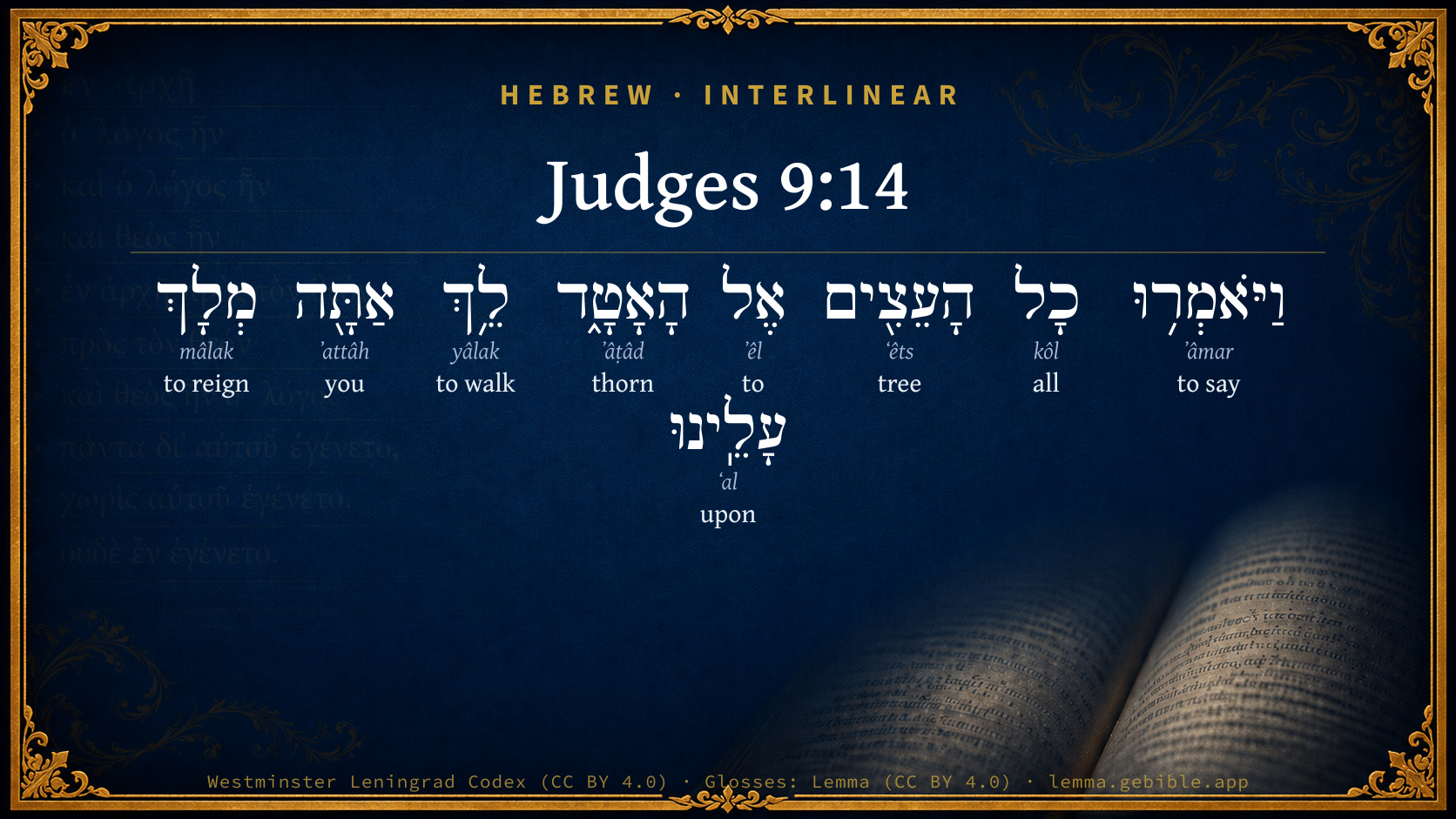
Judges 9:14

Hebrew (Westminster Leningrad Codex) Judges 9:14 appears in the Hebrew Old Testament. The text above is from the Westminster Leningrad Codex. Each word links to its Strong’s number, a concise gloss, and parsing drawn from the Open Scriptures Hebrew Bible morphology. Click any word for its full Brown-Driver-Briggs (BDB) entry.
Download image
Cite this verse

Judges 9:14 (World English Bible). Public Domain. Lemma interlinear Bible study tool, https://lemma.gebible.app/v/judges/9/14.

Show BibTeX & RIS
BibTeX
RIS
English Translation
Then said all the trees to the bramble, Come you, and reign over us.
World English Bible · Public Domain
Download a study sheet

One document with this verse’s original text, its word-by-word gloss line, the meaning frame, cross-references with their text, attributed commentary, and full source and license credits — printable, and it pastes into notes with its structure intact.

This verse Autodidact and up

Study sheet (.html) Plain text (.txt)

A passage Seminary Student

Up to 50 verses in one chapter. A passage sheet keeps up to 6 commentary sources and 12 cross-references per verse, in the order this page ranks them, and says so on the sheet whenever that leaves anything out. Ask for a single verse and you get the Autodidact verse sheet above.

Everything on this page stays free to read, with no account — the sheet is a download of what is already on screen, not access to it.

Want to remove ads? Support Godless Engineer
Compare translations 3

The same verse in 3 English versions, stacked beneath the original-language interlinear above. Click any original word for its lexicon entry.

Each is an independent rendering of the whole verse — the interlinear is not word-aligned to these translations.

Highlighted words mark where these versions differ — a whole-verse word diff, not a word-by-word alignment.

  • World English Bible Public Domain
    Then said all the trees to the bramble, Come you, and reign over us.
  • King James Version Public Domain
    Then said all the trees unto the bramble, Come thou, and reign over us.
  • unfoldingWord Literal Text CC BY-SA 4.0
    So all of the trees said to the thornbush, ‘Come, you reign over us.’

unfoldingWord Literal Text — © unfoldingWord, licensed CC BY-SA 4.0. Word-aligned USFM3 via Door43 (git.door43.org/unfoldingWord/en_ult).

Versions to compare (up to 4)

3 of 4 selected

Show all 18 translations

Every available English version of this verse, each an independent rendering of the whole verse.

  • World English Bible Public Domain
    Then said all the trees to the bramble, Come you, and reign over us.
  • Berean Standard Bible Public Domain
    Finally all the trees said to the thornbush, ‘Come and reign over us.’
  • Majority Standard Bible Public Domain
    Finally all the trees said to the thornbush, ‘Come and reign over us.’
  • King James Version Public Domain
    Then said all the trees unto the bramble, Come thou, and reign over us.
  • American Standard Version (1901) Public Domain
    Then said all the trees unto the bramble, Come thou, and reign over us.
  • Revised Version (1885) Public Domain
    Then said all the trees unto the bramble, Come thou, and reign over us.
  • Geneva Bible (1599) Public Domain
    Then said all the trees vnto the bramble, Come thou, and reigne ouer vs.
  • Douay-Rheims (1899) Public Domain
    And all the trees said to the bramble: Come thou and reign over us.
  • Young's Literal Translation Public Domain
    And all the trees say unto the bramble, Come thou, reign over us.
  • Literal Standard Version CC BY-SA 4.0
    And all the trees say to the bramble, Come, reign over us.
  • Unlocked Literal Bible CC BY-SA 4.0
    Then said all the trees to the thornbush, 'Come and reign over us.'
  • unfoldingWord Literal Text CC BY-SA 4.0
    So all of the trees said to the thornbush, ‘Come, you reign over us.’
  • Darby Bible Public Domain
    Then all the trees said to the bramble, 'Come you, and reign over us.'
  • World Messianic Bible Public Domain
    “Then all the trees said to the bramble, ‘Come and reign over us.’
  • Webster's Bible Public Domain
    Then said all the trees to the bramble, Come thou, and reign over us.
  • Free Bible Version CC BY-SA 4.0
    Then all the trees asked the thorn bush, ‘You come and be our king.’
  • Bible in Basic English Public Domain
    Then all the trees said to the thorn, You come and be king over us.
  • JPS Tanakh (1917) Public Domain
    Then said all the trees unto the bramble: Come thou, and reign over us.

Literal Standard Version (2020), Covenant Press — licensed CC BY-SA 4.0. Text via the HelloAO Bible API (eBible.org). Unlocked Literal Bible (unfoldingWord) — licensed CC BY-SA 4.0. Text via the HelloAO Bible API (eBible.org). unfoldingWord Literal Text — © unfoldingWord, licensed CC BY-SA 4.0. Word-aligned USFM3 via Door43 (git.door43.org/unfoldingWord/en_ult). Free Bible Version, Dr. Jonathan Gallagher — licensed CC BY-SA 4.0. Text via the HelloAO Bible API (eBible.org).

Word by word

More ways to search: Search by grammar → Find every occurrence → Compare this word →

Practice this passage: Drill this verse → Learn its vocabulary →

הָאָטָ֑ד
ʼâṭâd
H329
“the · thorn”
Particle, Definite Article + Noun, Common, Masculine, Singular, Absolute
Part of Speech
Particle + Noun
Type
Common
Gender
Masculine
Number
Singular
State
Absolute
Full BDB Definition

Origin: from an unused root probably meaning to pierce or make fast

TWOT: 71a

bramble, thorn, buckthorn - the threshing Atad, meaning thorn, also called Abelmizraim and afterwards called Bethhogla was located on the west of Jordan between the Jordan and Jericho
  1. וַיֹּאמְר֥וּ ʼâmar H559 “and · to say” Conjunction + Verb, Qal, Sequential Imperfect, 3rd Person, Masculine, Plural
  2. כָל kôl H3605 “all of” Noun, Common, Masculine, Singular, Construct
  3. הָעֵצִ֖ים ʻêts H6086 “the · trees” Particle, Definite Article + Noun, Common, Masculine, Plural, Absolute
  4. אֶל ʼêl H413 “to” Preposition
  5. לֵ֥ךְ yâlak H3212 “walk” Verb, Qal, Imperative, 2nd Person, Masculine, Singular
  6. אַתָּ֖ה ʼattâh H859 “you” Pronoun, Personal, 2nd Person, Masculine, Singular
  7. מְלָךְ mâlak H4427 “reign” Verb, Qal, Imperative, 2nd Person, Masculine, Singular
  8. עָלֵֽינוּ ʻal H5921 “upon · us” Preposition + Suffix, Personal, 1st Person, Common, Plural

About this verse

These counts appear in no published source. They are computed here, from the morphology-tagged text and Lemma’s own curated glosses. What Lemma adds →

9
words
9
distinct lemmas
Historical
section

Notable vocabulary

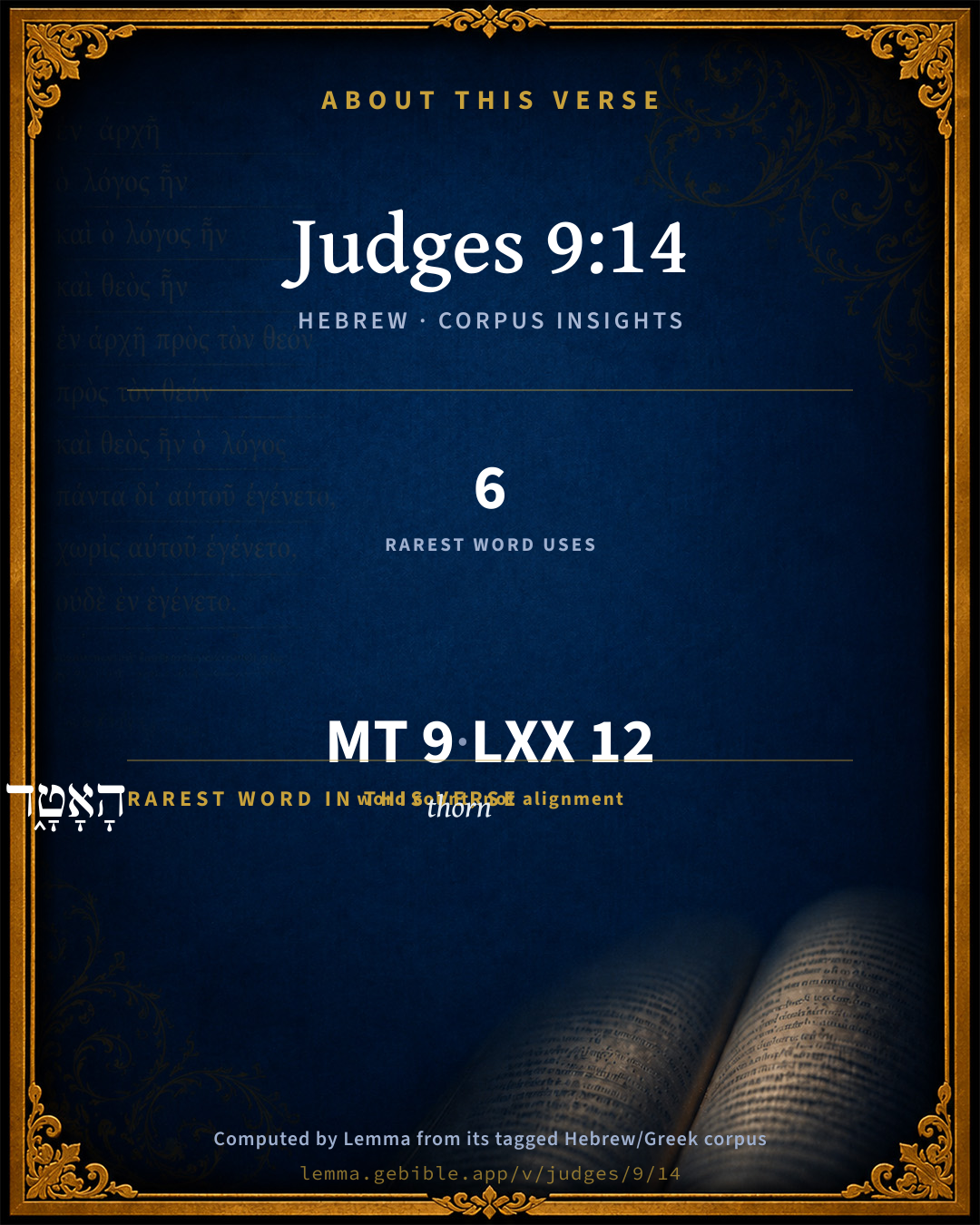
The rarest word here is הָאָטָ֑ד thorn H329 — appearing just 6 times in the whole Hebrew Bible.

Shared distinctive vocabulary

הָאָטָ֑ד thorn H329 occurs in 5 verses of the Hebrew Bible. Also found in:

Grammatical profile

  • 3 verbs
  • 3 nouns
  • 1 pronoun
  • 2 prepositions

Verb forms

  • וַיֹּאמְר֥וּ Qal · Sequential Imperfect
  • לֵ֥ךְ Qal · Imperative
  • מְלָךְ Qal · Imperative

Hebrew & Septuagint length

In English translation the verse runs 14 words from the Hebrew and 14 from the Septuagint (LXX English) — the same length.

A rough comparison of the two English renderings, which tokenize alike — not a word-level alignment.

Word counts can differ between the Hebrew and the Greek without any difference in meaning — e.g. the Hebrew direct-object marker אֵת has no separate Greek word, and Greek often adds the article ὁ.

In the original languages it is 9 Hebrew tokens and 12 Greek tokens — but the two are counted differently (Hebrew bundles its prefixes and suffixes into one token; the Greek is in lemma form), so that isn’t a like-for-like length.

Cross-references

1

Topical passages linked to Judges 9:14 in the Treasury of Scripture Knowledge — connected by theme and wording, ordered by reader-vote popularity; previews shown in the World English Bible.

  • 2 Kings 14:9 Jehoash the king of Israel sent to Amaziah king of Judah, saying, The thistle that was in Lebanon sent to the cedar that was in Lebanon, saying, Give your daughter to my son as wife: and there passed by a wild animal that was in Lebanon, and trod down the thistle.

Cross-references courtesy of OpenBible.info (CC BY 4.0).

Hebrew and Greek witnesses Masoretic Hebrew ↔ Greek Septuagint

The same verse in the two great witnesses to the Old Testament, shown verse-for-verse.

These are two independent witnesses, not word-aligned to each other, and the Septuagint is shown in lemma (dictionary) form.

Hebrew Judges 9:14 Masoretic · Westminster Leningrad Codex

וַיֹּאמְר֥וּ כָל הָעֵצִ֖ים אֶל הָאָטָ֑ד לֵ֥ךְ אַתָּ֖ה מְלָךְ עָלֵֽינוּ

Then said all the trees to the bramble, Come you, and reign over us.

World English Bible · Public Domain

Greek LXX Judges 9:14 Septuagint · lemma form

καί εἶπον πᾶς ὁ ξύλον ὁ ῥάμνος δεῦρο σύ βασιλεύω ἐπί ἐγώ

Then all the trees said to the bramble, Come you and reign over us.

LXX2012 (modern English Septuagint) · Public Domain

On this verse, The Cambridge Bible for Schools and Colleges discusses the Septuagint’s reading. Read the note in Commentary ↓

Hebrew: Westminster Leningrad Codex (CC BY 4.0). Greek: Septuagint (public domain); English from LXX2012 (modern English Septuagint) (Public Domain). How the Septuagint differs from the Hebrew →

Targum (Aramaic paraphrase)

1

The Targum is the ancient Jewish Aramaic paraphrase of the Hebrew Scriptures — an interpretive translation, not the Hebrew text itself. Onkelos (literal) and Pseudo-Jonathan (expansive) render the Torah, and Jonathan the Prophets. Coverage is partial: where no permissively-licensed English translation exists for a verse, only the Aramaic is shown. This is verse-level text, not a word-by-word alignment to the Hebrew.

  1. Targum Jonathan Prophets (Joshua–Malachi)
    וַאֲמַרוּ כָל אִילָנַיָא לְאַטָדָא אִיתָא אַתְּ מְלוֹךְ עֲלָנָא:

    (no public-domain English translation for this verse)

    Targum Jonathan — Aramaic: “Mikraot Gedolot” (public domain). English: “Sefaria Community Translation” (CC0 1.0 (public-domain dedication)); “London "Chaldee Paraphrase," 1871” (public domain). Text via Sefaria.

Commentary

Notes on Judges 9:14 from classic Christian and Jewish commentators (each source and its license shown beneath its notes). The classic Christian expositions comment on the surrounding passage and are grouped to its opening verse, so a note may address several verses; the Jewish commentaries on the Tanakh (Rashi and others) are per-verse, so they appear only where the commentator wrote on this verse.

Lemma curates 59 commentaries, every one of them public domain or Creative Commons licensed, each selected and text-cleaned for this edition rather than reprinted as found. About our sources →

Trapp's Complete Commentary

John Trapp

Jdg 9:14 Then said all the trees unto the bramble, Come thou, [and] reign over us.

Ver. 14. Then said all the trees unto the bramble.] Or, Thistle, or teazle; which is not a tree but a shrub, prickly, barren, base, abject, good-for-nothing but to stop gaps, or kindle a fire. Abimelech was a right bramble indeed, who grew in the base hedgerow of a concubine, and scratched and drew blood to purpose, when once he had scrambled up to be king of Israel.

John Trapp, A Commentary or Exposition upon All the Books of the Old and New Testament (1647–1656) — public domain. Text from a community e-Sword module.

Joseph Benson's Commentary

Jdg 9:14-15. Then said all the trees unto the bramble, &c. — Or thorn, fitly representing Abimelech, the son of a concubine, and a person of small use and great cruelty. If in truth ye anoint me king — If you deal truly and justly in making me king. Then trust — Then you may expect protection under my government. Devour the cedars — Instead of protection, you shall receive destruction by me; especially you cedars, that is, nobles, such as the house of Millo, who have been most forward in this work. By this fable Jotham signified to the Shechemites that the most worthy men in Israel, figured by the olive, the fig-tree, and the vine, which bear the most useful and excellent fruits, had not aimed at kingly dominion over them; and that his father Gideon had even refused it, when offered to him. By the bramble, the most worthless of shrubs, accepting the offer of the trees to be their king, and calling to them to put their trust in its shadow, though by its nature it could afford no shadow or protection to them, he shows what a worthless choice they had made. The speech of the bramble represents how foolish Abimelech was, in imagining he should be able to maintain the authority of a king, as he could by no means, any more than the bramble, afford the shade or protection he had promised: and the threat of the bramble seems to indicate the cruelty of Abimelech’s temper, that he would destroy the Shechemites, if he found them unfaithful.

Joseph Benson's Commentary on the Old and New Testaments (1811–1818) — public domain. Text from a community e-Sword module.

Geneva Bible (1599)

Geneva Bible translators

Or, thistle, or brier.

Geneva Bible (1599) marginal notes — public domain. Text via Bolls.life.

Adam Clarke's Commentary

Verse 14. Then said all the trees unto the bramble] The word אטד atad, which we translate bramble, is supposed to mean the rhamnus, which is the largest of thorns, producing dreadful spikes, similar to darts. See Theodoret on Ps 58:10.

There is much of the moral of this fable contained in the different kinds of trees mentioned.

1. The olive; the most profitable tree to its owner, having few equals either for food or medicine.

2. The fig tree; one of the most fruitful of trees, and yielding one of the most delicious fruits, and superior to all others for sweetness.

3. The vine, which alone yields a liquor that, when properly prepared, and taken in strict moderation, is friendly both to the body and mind of man, having a most direct tendency to invigorate both.

4. The bramble or thorn, which, however useful as a hedge, is dangerous to come near; and is here the emblem of an impious, cruel, and oppressive king.

As the olive, fig, and vine, are said in this fable to refuse the royalty, because in consequence, they intimate, they should lose their own privileges, we learn that to be invested with power for the public good can be no privilege to the sovereign. If he discharge the office faithfully, it will plant his pillow with thorns, fill his soul with anxious cares, rob him of rest and quiet, and, in a word, will be to him a source of distress and misery. All this is represented here under the emblem of the trees losing their fatness, their sweetness and good fruits, and their cheering influence. In short, we see from this most sensible fable that the beneficent, benevolent, and highly illuminated mind, is ever averse from the love of power; and that those who do seek it are the thoughtless, the vain, the ambitious, and those who wish for power merely for the purpose of self-gratification; persons who have neither the disposition nor the knowledge to use power for the advantage of the community; and who, while they boast great things, and make great pretensions and promises, are the tyrants of the people, and often through their ambition, like the bramble in the fable kindle a flame of foreign or domestic war, in which their subjects are consumed.

The sleepless nights and corroding cares of sovereignty, are most forcibly described by a poet of our own, whose equal in describing the inward workings of the human heart, in all varieties of character and circumstances, has never appeared either in ancient or modern times. Hear what he puts in the mouth of two of his care-worn kings: -

"How many thousand of my poorest subjects

Are at this hour asleep? - Sleep, gentle sleep,

Nature's soft nurse! how have I frighted thee,

That thou no more wilt weigh my eyelids down,

And steep my senses in forgetfulness?

Why rather, sleep, liest thou in smoky cribs,

Upon uneasy pallets stretching thee,

And hush'd with buzzing night-flies to thy slumber

Than in the perfumed chambers of the great,

Under the canopies of costly state,

And lull'd with sounds of sweetest melody?

O thou dull god! why liest thou with the vile

In loathsome beds; and leav'st the kingly couch

A watch-case, or a common 'larum bell?

Wilt thou upon the high and giddy mast

Seal up the ship-boy's eyes, and rock his brains

In cradle of the rude imperious surge;

And in the visitation of the winds,

Who take the ruffian billows by the top,

Curling their monstrous heads and hanging them,

With deafening clamours, in the slippery clouds,

That, with the hurly, death itself awakes?

Canst thou, O partial sleep! give thy repose

To the wet sea-boy, in an hour so rude;

And, in the calmest and most stillest night,

With all appliances and means to boot,

Deny it to a king? Then, happy low, lie down!

Uneasy lies the head that wears a crown."____

"O hard condition! twin-born with greatness,

Subjected to the breath of every fool,

Whose sense no more can feel but his own wringing!

What infinite heart's ease must kings neglect,

That private men enjoy!

And what have kings, that privates have not too,

Save ceremony, save general ceremony?"____

"'Tis not the balm, the sceptre, and the ball,

The sword, the mace, the crown imperial,

The intertissued robe of gold and pearl,

The farced title running 'fore the king,

The throne he sits on, nor the tide of pomp

That beats upon the high shore of this world,

No, not all these, thrice gorgeous ceremony,

Not all these, laid in bed majestical,

Can sleep so soundly as the wretched slave."

SHAKESPEARE

This is precisely the sentiment expressed in the denial of the olive, fig tree, and vine.

Adam Clarke's Commentary on the Bible (1810–1826) — public domain. Text from a community e-Sword/MySword module.

Ellicott's Commentary for English Readers

(14) Unto the bramble.—Despairing of their best, they avail themselves of the unscrupulous ambition of their worst. The bramble—atad—is rather the rhamnus, or buckthorn, which Dioscorides calls the Cartha ginian atadin. There seems to be an echo of this fable in Æsop’s fable of the fox and the thorn, where the fox is dreadfully rent by taking hold of the thorn to save himself from a fall, and the thorn asks him what else he could expect.

Reign over us.—They seem to address the thorn in a less ceremonious imperative—not mâlekah, as to the olive, or mûlekî, as to the fig-tree and vine, but a mere blunt melâk!

A Bible Commentary for English Readers, edited by Charles John Ellicott (1878–1897) — public domain. Text from a community e-Sword module.

The Cambridge Bible for Schools and Colleges

gen. ed. J. J. S. Perowne

14. the bramble] LXX, Vulgate rhamnus, the common, worthless thornbush, the very opposite of the noble trees just mentioned.

The Cambridge Bible for Schools and Colleges (gen. ed. J. J. S. Perowne; Cambridge University Press, 1878–1918) — public domain. Text from a community e-Sword module.

John Gill's Exposition

Then said all the trees unto the bramble,.... Perceiving they could not prevail upon any of the useful and fruitful trees to take the government of them, they unite in a request to a bramble, scarce to be called a tree, and however a very barren and fruitless one, yea, hurtful and distressing:

come thou, and reign over us; this respects Abimelech, and describes him as a mean person, the son of a concubine, as having no goodness in him, not any good qualifications to recommend him to government, but all the reverse, cruel, tyrannical, and oppressive; and this exposes the folly of the Shechemites, and their eagerness to have a king at any rate, though ever so mean and despicable, useless and pernicious.

John Gill's Exposition of the Whole Bible (1746–1763) — public domain (CC PDM 1.0). Text via the HelloAO Bible API.

Haydock's Catholic Bible Commentary

Bramble. Septuagint rhamnos, "the white, or hawthorn." Some suppose that atad means "a wild rose, (Vatable) thistle," &c. (Calmet) --- It is here put for any base and ambitious man. (Worthington)

George Leo Haydock (1774–1849), Haydock's Catholic Family Bible and Commentary, 1859 edition — public domain. Excludes Psalms (Douay-Rheims chapter numbering differs from Protestant) and Deuterocanonical books (Catholic canon only).

Matthew Poole's English Annotations

The bramble, or thorn; a mean, and barren, and hurtful tree, fitly representing Abimelech, the son of a concubine, and a person of small use, and great cruelty.

Matthew Poole's English Annotations on the Holy Bible (1683–1685) — public domain. Text from a community e-Sword/MySword module.

Whedon's Commentary on the Bible

Daniel D. Whedon

14. All the trees — Not one of all the trees was willing to be king, but all were willing that the bramble should rule over them — a stinging reflection on the Shechemites. {We understand Gideon and his sons, under the refusal of royalty, (Jdg_8:23,) to be represented by the olive and the vine, and Abimelech by the bramble. The bramble does not refuse to be king. Jotham sarcastically makes the bramble invite them to come under his shade, as an image of the felicity? of the Shechemites if they have done well in their choice. But if, as he believes, they have done wickedly, their bramble will prove a torch to burn their very cedars of Lebanon, the tallest of the Shechemite nobility.}

The bramble — The word אשׂד, atad, occurs elsewhere only in Psa_58:9, where it is rendered thorns, and Gen_50:10, where it is rendered as a proper name. “It is generally thought to denote the southern buckthorn, a brier bush indigenous in Egypt and Syria, shooting up from the root in many branches, (ten to fifteen feet high,) armed with spines, and bearing leaves resembling those of the olive, but light coloured and more slender, with little whitish blossoms that eventually produce small, black, bitter berries. The Arabs still call it atad. Rauwolf found it growing at Jerusalem.” — M’Clintock and Strong’s Cyclopaedia. From this same bush it is supposed the Saviour’s crown of thorns was made. Compare note on Mat_27:29.

Daniel D. Whedon (gen. ed.), Commentary on the Old and New Testaments (1874–1909) — public domain. Text from a community e-Sword module.

The Pulpit Commentary

The bramble. A prickly shrub; in Greek ramnov , Rhamnus, "the southern buckthorn" (Gesenins). The same plant as is mentioned in Psa_58:9 (thorns, A.V) as used to make fires with (see note to ver. 7).

The Pulpit Commentary (1880–1919), ed. H.D.M. Spence-Jones & Joseph S. Exell — public domain. Text from a community e-Sword module.

John Wesley's Explanatory Notes

Bramble - Or, thorn, fitly representing Abimelech, the son of a concubine, and a person of small use, and great cruelty.

John Wesley, Explanatory Notes Upon the Whole Bible (1754–1765) — public domain. Text via the GEBible commentary corpus.

Rashi

Rabbi Shlomo Yitzchaki (Rashi)

The thornbush. "epine" in old French.

Rashi on the Tanakh — English translations: “The Judaica Press complete Tanach with Rashi, translated by A. J. Rosenberg” (CC BY 4.0); “Pentateuch with Rashi's commentary by M. Rosenbaum and A.M. Silbermann, 1929-1934” (public domain); “The Metsudah Tanach series, Lakewood, N.J” (CC BY 4.0); and “The Book of Joshua, Metsudah Publications, 1997” (CC BY 4.0). Text via Sefaria.

Lesson kit

Teaching starters — assembled from the data on this page, not authored interpretation. Every prompt links to the verse data it draws on. Edit before teaching.

Judges, in the Historical, opens this verse with 9 words (9 distinct Hebrew lemmas). Its most distinctive word is ʼâṭâd (“thorn”). A historical commentator’s framing appears above. Read the whole chapter for the surrounding context.

Discussion questions

  1. What does “thorn” (ʼâṭâd) contribute to the verse as a whole?
  2. Genesis 50:10 shares the word «thorn» with this verse. How do the two illuminate each other?
  3. The translations on this page render this verse differently — a whole-verse word diff, not a word-by-word alignment. What might account for the different wordings?
  4. The verb «וַיֹּאמְר֥וּ» is Qal Sequential Imperfect. How does its form color the action?
  5. Reading how Trapp's Complete Commentary and Joseph Benson's Commentary read this verse, where do the two commentators agree and where do they part?

Things to notice

Reading settings

Reading text

Shown beneath each verse's original-language words.

Old Testament
Old Testament edition

Read the OT as the Masoretic Hebrew (MT) or the Greek Septuagint (LXX).

English shown for the Greek Septuagint (in the Hebrew ↔ Greek comparison).

Comparing translations? Open the Compare panel on any verse page to stack up to four side by side.