
Judges 9:16

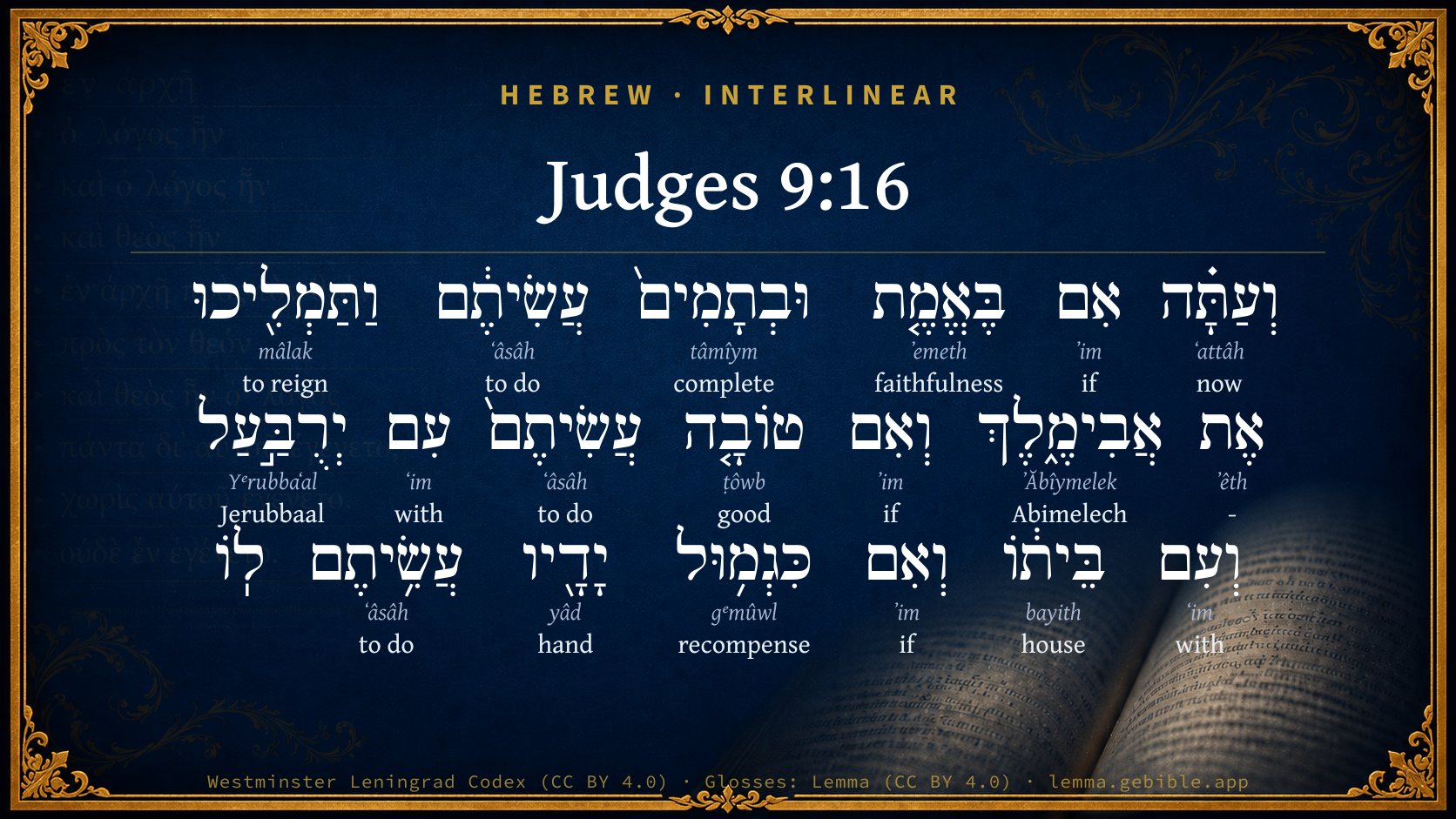
Hebrew (Westminster Leningrad Codex) Judges 9:16 appears in the Hebrew Old Testament. The text above is from the Westminster Leningrad Codex. Each word links to its Strong’s number, a concise gloss, and parsing drawn from the Open Scriptures Hebrew Bible morphology. Click any word for its full Brown-Driver-Briggs (BDB) entry.
Download image
Cite this verse

Judges 9:16 (World English Bible). Public Domain. Lemma interlinear Bible study tool, https://lemma.gebible.app/v/judges/9/16.

Show BibTeX & RIS
BibTeX
RIS
English Translation
Now therefore, if you have dealt truly and righteously, in that you have made Abimelech king, and if you have dealt well with Jerubbaal and his house, and have done to him according to the deserving of his hands
World English Bible · Public Domain
Highlights
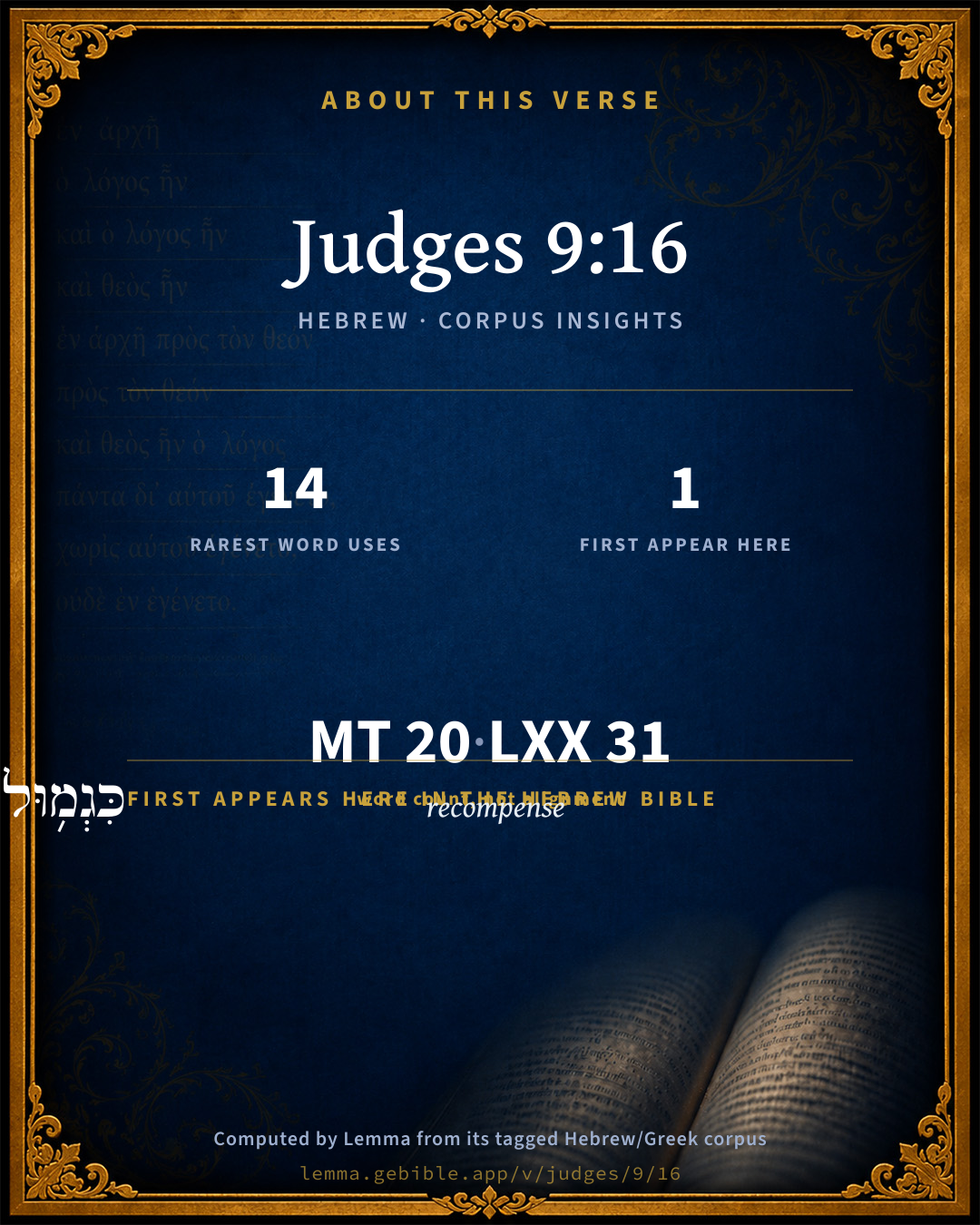
  • 1 first appearance in the Hebrew Bible
Full analysis ↓
Download a study sheet

One document with this verse’s original text, its word-by-word gloss line, the meaning frame, cross-references with their text, attributed commentary, and full source and license credits — printable, and it pastes into notes with its structure intact.

This verse Autodidact and up

Study sheet (.html) Plain text (.txt)

A passage Seminary Student

Up to 50 verses in one chapter. A passage sheet keeps up to 6 commentary sources and 12 cross-references per verse, in the order this page ranks them, and says so on the sheet whenever that leaves anything out. Ask for a single verse and you get the Autodidact verse sheet above.

Everything on this page stays free to read, with no account — the sheet is a download of what is already on screen, not access to it.

Want to remove ads? Support Godless Engineer
Compare translations 3

The same verse in 3 English versions, stacked beneath the original-language interlinear above. Click any original word for its lexicon entry.

Each is an independent rendering of the whole verse — the interlinear is not word-aligned to these translations.

Highlighted words mark where these versions differ — a whole-verse word diff, not a word-by-word alignment.

  • World English Bible Public Domain
    Now therefore, if you have dealt truly and righteously, in that you have made Abimelech king, and if you have dealt well with Jerubbaal and his house, and have done to him according to the deserving of his hands
  • King James Version Public Domain
    Now therefore, if ye have done truly and sincerely, in that ye have made Abimelech king, and if ye have dealt well with Jerubbaal and his house, and have done unto him according to the deserving of his hands;
  • unfoldingWord Literal Text CC BY-SA 4.0
    So now, if you have acted in truth and in integrity and made Abimelech reign, and if you have done good with Jerubbaal and with his house, and if according to the deserving of his hands you have done to him,

unfoldingWord Literal Text — © unfoldingWord, licensed CC BY-SA 4.0. Word-aligned USFM3 via Door43 (git.door43.org/unfoldingWord/en_ult).

Versions to compare (up to 4)

3 of 4 selected

Show all 18 translations

Every available English version of this verse, each an independent rendering of the whole verse.

  • World English Bible Public Domain
    Now therefore, if you have dealt truly and righteously, in that you have made Abimelech king, and if you have dealt well with Jerubbaal and his house, and have done to him according to the deserving of his hands
  • Berean Standard Bible Public Domain
    Now if you have acted faithfully and honestly in making Abimelech king, if you have done well by Jerubbaal and his family, and if you have done to him as he deserves—
  • Majority Standard Bible Public Domain
    Now if you have acted faithfully and honestly in making Abimelech king, if you have done well by Jerubbaal and his family, and if you have done to him as he deserves—
  • King James Version Public Domain
    Now therefore, if ye have done truly and sincerely, in that ye have made Abimelech king, and if ye have dealt well with Jerubbaal and his house, and have done unto him according to the deserving of his hands;
  • American Standard Version (1901) Public Domain
    Now therefore, if ye have dealt truly and uprightly, in that ye have made Abimelech king, and if ye have dealt well with Jerubbaal and his house, and have done unto him according to the deserving of his hands;
  • Revised Version (1885) Public Domain
    Now therefore, if ye have dealt truly and uprightly, in that ye have made Abimelech king, and if ye have dealt well with Jerubbaal and his house, and have done unto him according to the deserving of his hands;
  • Geneva Bible (1599) Public Domain
    Now therefore, if ye doe truely and vncorruptly to make Abimelech King, and if ye haue delt well with Ierubbaal and with his house, and haue done vnto him according to the deseruing of his handes,
  • Douay-Rheims (1899) Public Domain
    Now therefore if you have done well, and without sin in appointing Abimelech king over you, and have dealt well with Jerobaal, and with his house, and have made a suitable return for the benefits of him, who fought for you,
  • Young's Literal Translation Public Domain
    `And, now, if in truth and in sincerity ye have acted, when ye make Abimelech king; and if ye have done good with Jerubbaal, and with his house; and if according to the deed of his hands ye have done to him --
  • Literal Standard Version CC BY-SA 4.0
    And now, if you have acted in truth and in sincerity when you make Abimelech king; and if you have done good with Jerubba‘al, and with his house; and if you have done to him according to the deed of his hands—
  • Unlocked Literal Bible CC BY-SA 4.0
    Now therefore, if you have acted in truth and honesty, when you made Abimelech king, and if you have done well concerning Jerub Baal and his house, and if you have punished him as he deserves—
  • unfoldingWord Literal Text CC BY-SA 4.0
    So now, if you have acted in truth and in integrity and made Abimelech reign, and if you have done good with Jerubbaal and with his house, and if according to the deserving of his hands you have done to him,
  • Darby Bible Public Domain
    "Now therefore, if you acted in good faith and honor when you made Abim'elech king, and if you have dealt well with Jerubba'al and his house, and have done to him as his deeds deserved--
  • World Messianic Bible Public Domain
    “Now therefore, if you have dealt truly and righteously, in that you have made Abimelech king, and if you have dealt well with Jerubbaal and his house, and have done to him according to the deserving of his hands
  • Webster's Bible Public Domain
    Now therefore, if ye have done truly and sincerely, in that ye have made Abimelech king, and if ye have dealt well with Jerubbaal and his house, and have done to him according to the deserving of his hands:
  • Free Bible Version CC BY-SA 4.0
    Have you acted sincerely and honestly by making Abimelech your king? Have you acted honorably towards Jerub-baal and his family? Have you respected him for all that he accomplished?
  • Bible in Basic English Public Domain
    So now, if you have done truly and uprightly in making Abimelech king, and if you have done well to Jerubbaal and his house in reward for the work of his hands;
  • JPS Tanakh (1917) Public Domain
    Now therefore, if ye have dealt truly and uprightly, in that ye have made Abimelech king, and if ye have dealt well with Jerubbaal and his house, and have done unto him according to the deserving of his hands —

Literal Standard Version (2020), Covenant Press — licensed CC BY-SA 4.0. Text via the HelloAO Bible API (eBible.org). Unlocked Literal Bible (unfoldingWord) — licensed CC BY-SA 4.0. Text via the HelloAO Bible API (eBible.org). unfoldingWord Literal Text — © unfoldingWord, licensed CC BY-SA 4.0. Word-aligned USFM3 via Door43 (git.door43.org/unfoldingWord/en_ult). Free Bible Version, Dr. Jonathan Gallagher — licensed CC BY-SA 4.0. Text via the HelloAO Bible API (eBible.org).

Word by word

More ways to search: Search by grammar → Find every occurrence → Compare this word →

Practice this passage: Drill this verse → Learn its vocabulary →

יְרֻבַּ֣עַל
Yᵉrubbaʻal
H3378
“Jerubbaal”
Noun, Proper
Part of Speech
Noun
Type
Proper
Full BDB Definition

Origin: from H7378 and H1168

TWOT: None

Jerubbaal = "let Baal contend" - name given to Gideon by his father when he destroyed the altar of Baal
  1. וְעַתָּ֗ה ʻattâh H6258 “and · now” Conjunction + Adverb
  2. אִם ʼim H518 “if” Conjunction
  3. בֶּאֱמֶ֤ת ʼemeth H571 “in/at · faithfulness” Preposition + Noun, Common, Feminine, Singular, Absolute
  4. וּבְתָמִים֙ tâmîym H8549 “and · in/at · complete” Conjunction + Preposition + Adjective, Adjective, Masculine, Singular, Absolute
  5. עֲשִׂיתֶ֔ם ʻâsâh H6213 “to do” Verb, Qal, Perfect, 2nd Person, Masculine, Plural
  6. וַתַּמְלִ֖יכוּ mâlak H4427 “and · to reign” Conjunction + Verb, Hiphil, Sequential Imperfect, 2nd Person, Masculine, Plural
  7. אֶת ʼêth H853 “-” Particle, Direct Object
  8. אֲבִימֶ֑לֶךְ ʼĂbîymelek H40 “Abimelech” Noun, Proper
  9. וְאִם ʼim H518 “and · if” Conjunction + Conjunction
  10. טוֹבָ֤ה ṭôwb H2896 “good” Adjective, Adjective, Feminine, Singular, Absolute
  11. עֲשִׂיתֶם֙ ʻâsâh H6213 “to do” Verb, Qal, Perfect, 2nd Person, Masculine, Plural
  12. עִם ʻim H5973 “with” Preposition
  13. וְעִם ʻim H5973 “and · with” Conjunction + Preposition
  14. בֵּית֔וֹ bayith H1004 “house · his” Noun, Common, Masculine, Singular, Construct + Suffix, Personal, 3rd Person, Masculine, Singular
  15. וְאִם ʼim H518 “and · if” Conjunction + Conjunction
  16. כִּגְמ֥וּל gᵉmûwl H1576 “like/as · recompense of” Preposition + Noun, Common, Masculine, Singular, Construct
  17. יָדָ֖יו yâd H3027 “hands · his” Noun, Common, Both, Dual, Construct + Suffix, Personal, 3rd Person, Masculine, Singular
  18. עֲשִׂ֥יתֶם ʻâsâh H6213 “to do” Verb, Qal, Perfect, 2nd Person, Masculine, Plural

About this verse

These counts appear in no published source. They are computed here, from the morphology-tagged text and Lemma’s own curated glosses. What Lemma adds →

20
words
14
distinct lemmas
Historical
section

Notable vocabulary

The rarest word here is יְרֻבַּ֣עַל Jerubbaal H3378 — appearing just 14 times in the whole Hebrew Bible.

First appearance in Scripture

This word makes its first canonical appearance in the Hebrew Bible here:

  • כִּגְמ֥וּל recompense H1576

Shared distinctive vocabulary

יְרֻבַּ֣עַל Jerubbaal H3378 occurs in 13 verses of the Hebrew Bible. Also found in:

Grammatical profile

  • 4 verbs
  • 6 nouns
  • 2 adjectives
  • 3 prepositions
  • 3 conjunctions
  • 1 adverb
  • 1 particle

Verb forms

  • עֲשִׂיתֶ֔ם Qal · Perfect
  • וַתַּמְלִ֖יכוּ Hiphil · Sequential Imperfect
  • עֲשִׂיתֶם֙ Qal · Perfect
  • עֲשִׂ֥יתֶם Qal · Perfect

Repetition

Words recur within this verse — often emphatic in Hebrew:

  • עֲשִׂיתֶ֔ם to do H6213 ×3
  • אִם if H518 ×3
  • עִם with H5973 ×2

Hebrew & Septuagint length

In English translation the verse runs 39 words from the Hebrew and 42 from the Septuagint (LXX English) — closely comparable.

A rough comparison of the two English renderings, which tokenize alike — not a word-level alignment.

Word counts can differ between the Hebrew and the Greek without any difference in meaning — e.g. the Hebrew direct-object marker אֵת has no separate Greek word, and Greek often adds the article ὁ.

In the original languages it is 20 Hebrew tokens and 31 Greek tokens — but the two are counted differently (Hebrew bundles its prefixes and suffixes into one token; the Greek is in lemma form), so that isn’t a like-for-like length.

Cross-references

1

Topical passages linked to Judges 9:16 in the Treasury of Scripture Knowledge — connected by theme and wording, ordered by reader-vote popularity; previews shown in the World English Bible.

  • Judges 8:35 neither shown they kindness to the house of Jerubbaal, [who is] Gideon, according to all the goodness which he had shown to Israel.

Cross-references courtesy of OpenBible.info (CC BY 4.0).

Hebrew and Greek witnesses Masoretic Hebrew ↔ Greek Septuagint

The same verse in the two great witnesses to the Old Testament, shown verse-for-verse.

These are two independent witnesses, not word-aligned to each other, and the Septuagint is shown in lemma (dictionary) form.

Hebrew Judges 9:16 Masoretic · Westminster Leningrad Codex

וְעַתָּ֗ה אִם בֶּאֱמֶ֤ת וּבְתָמִים֙ עֲשִׂיתֶ֔ם וַתַּמְלִ֖יכוּ אֶת אֲבִימֶ֑לֶךְ וְאִם טוֹבָ֤ה עֲשִׂיתֶם֙ עִם יְרֻבַּ֣עַל וְעִם בֵּית֔וֹ וְאִם כִּגְמ֥וּל יָדָ֖יו עֲשִׂ֥יתֶם לֽוֹ

Now therefore, if you have dealt truly and righteously, in that you have made Abimelech king, and if you have dealt well with Jerubbaal and his house, and have done to him according to the deserving of his hands

World English Bible · Public Domain

Greek LXX Judges 9:16 Septuagint · lemma form

καί νῦν εἰ ἐν ἀλήθεια καί τελειότης ποιέω καί βασιλεύω ὁ αβιμελεχ καί εἰ ἀγαθωσύνη ποιέω μετά ιεροβααλ καί μετά ὁ οἶκος αὐτός καί εἰ ὡς ἀνταπόδοσις χείρ αὐτός ποιέω αὐτός

And now, if you⌃ have done it in truth and integrity, and have made Abimelech king, and if you⌃ have wrought well with Jerobaal, and with his house, and if you⌃ have done to him according to the reward of his hand,

LXX2012 (modern English Septuagint) · Public Domain

Hebrew: Westminster Leningrad Codex (CC BY 4.0). Greek: Septuagint (public domain); English from LXX2012 (modern English Septuagint) (Public Domain). How the Septuagint differs from the Hebrew →

Targum (Aramaic paraphrase)

1

The Targum is the ancient Jewish Aramaic paraphrase of the Hebrew Scriptures — an interpretive translation, not the Hebrew text itself. Onkelos (literal) and Pseudo-Jonathan (expansive) render the Torah, and Jonathan the Prophets. Coverage is partial: where no permissively-licensed English translation exists for a verse, only the Aramaic is shown. This is verse-level text, not a word-by-word alignment to the Hebrew.

  1. Targum Jonathan Prophets (Joshua–Malachi)
    וּכְעַן אִם בְּקוּשְׁטָא וּבִשְׁלֶמְתָּא עֲבַדְתּוּן וְאַמְלַכְתּוּן יַת אֲבִימֶלֶךְ וְאִם טַבְתָא עֲבַדְתּוּן עִם יְרוּבַּעַל וְעִם בֵּיתֵיהּ וְאִם כְּגוּמְלָא דִידוֹהִי עֲבַדְתּוּן לֵיהּ:

    (no public-domain English translation for this verse)

    Targum Jonathan — Aramaic: “Mikraot Gedolot” (public domain). English: “Sefaria Community Translation” (CC0 1.0 (public-domain dedication)); “London "Chaldee Paraphrase," 1871” (public domain). Text via Sefaria.

Commentary

Notes on Judges 9:16 from classic Christian and Jewish commentators (each source and its license shown beneath its notes). The classic Christian expositions comment on the surrounding passage and are grouped to its opening verse, so a note may address several verses; the Jewish commentaries on the Tanakh (Rashi and others) are per-verse, so they appear only where the commentator wrote on this verse.

Lemma curates 59 commentaries, every one of them public domain or Creative Commons licensed, each selected and text-cleaned for this edition rather than reprinted as found. About our sources →

Ellicott's Commentary for English Readers

(16) Now therefore.—Here follows the epimuthion. or application of the fable. Jdg_9:16-18 are the protasis of the sentence, which is a long and parenthetic series of premisses; the conclusion, or apodosis, follows in Jdg_9:19.

If ye have done truly and sincerely.—A bitterly ironical supposition with a side glance at the phrase used by the bramble (see Jdg_9:15).

A Bible Commentary for English Readers, edited by Charles John Ellicott (1878–1897) — public domain. Text from a community e-Sword module.

Trapp's Complete Commentary

John Trapp

Jdg 9:16 Now therefore, if ye have done truly and sincerely, in that ye have made Abimelech king, and if ye have dealt well with Jerubbaal and his house, and have done unto him according to the deserving of his hands;

Ver. 16. Now therefore.] This is the επιμυθιον, the explication and application of the parable, the key to it, and use of it, bringing it home to the hearers.

If ye have done truly and sincerely.] With God, whose government ye have rejected: and if candidly and gratefully with my father, who jeoparded his life for you, then much happiness may you have in your new choice. But, alas! he that hath but half an eye may see the contrary, and foresee the mischief that will follow upon it.

John Trapp, A Commentary or Exposition upon All the Books of the Old and New Testament (1647–1656) — public domain. Text from a community e-Sword module.

Joseph Benson's Commentary

Jdg 9:16. Now therefore if ye have done truly and sincerely, &c. — In these and the following words, Jotham applies his parable to the Shechemites, and signifies, if they had dealt sincerely, and done that which was right to the family of Gideon, in slaying all his legitimate sons, and making the son of his concubine their king, that then he wished they might be happy in Abimelech as their king; but if they had done that which was unjust and ungenerous, (as they certainly had,) he prays that mutual jealousies might break out between them, and that they might plague, injure, and destroy each other. And this prayer, we find, was heard, for it is said expressly in the 23d verse, that within three years God sent an evil spirit between Abimelech and the men of Shechem; and the men of Shechem dealt treacherously with Abimelech.

Joseph Benson's Commentary on the Old and New Testaments (1811–1818) — public domain. Text from a community e-Sword module.

Keil & Delitzsch

C. F. Keil & F. Delitzsch

In Jdg 9:16-20 Jotham gives the application of his fable, for there was no necessity for any special explanation of it, since it was perfectly clear and intelligible in itself. These verses form a long period, the first half of which is so extended by the insertion of parentheses introduced as explanations (Jdg 9:17, Jdg 9:18), that the commencement of it (Jdg 9:16) is taken up again in Jdg 9:19 for the purpose of attaching the apodosis. "If ye have acted in truth and sincerity, and (i.e., when he) made Abimelech king; if ye have done well to Jerubbaal and his house, and if ye have done to him according to the doing of his hands ... as my father fought for you ... but ye have risen up to-day against my father's house, and have slain ... if (I say) ye have acted in truth and sincerity to Jerubbaal and his house this day: then rejoice in Abimelech ...." נפשׁו השׁליך, to throw away his life, i.e., expose to death. מנּגד, "from before him," serves to strengthen the השׁליך. Jotham imputes the slaying of his brothers to the citizens of Shechem, as a crime which they themselves had committed (Jdg 9:18), because they had given Abimelech money out of their temple of Baal to carry out his designs against the sons of Jerubbaal (Jdg 9:4). In this reproach he had, strictly speaking, already pronounced sentence upon their doings. When, therefore, he proceeds still further in Jdg 9:19, "If ye have acted in truth towards Jerubbaal ... then rejoice," etc., this turn contains the bitterest scorn at the faithlessness manifested towards Jerubbaal. In that case nothing could follow but the fulfilment of the threat and the bursting forth of the fire. In carrying out this point the application goes beyond the actual meaning of the parable itself. Not only will fire go forth from Abimelech and consume the lords of Shechem and the inhabitants of Millo, but fire will also go forth from them and devour Abimelech himself. The fulfilment of this threat was not long delayed, as the following history shows (Jdg 9:23.).

Keil & Delitzsch — Biblical Commentary on the Old Testament (1861–1891) — public domain (CC PDM 1.0). Text via the HelloAO Bible API. (Old Testament only.)

John Gill's Exposition

Now therefore, if ye have done truly and sincerely, in that ye have made Abimelech king,.... If they had done this conscientiously, and in the uprightness of their hearts, to take such a base man, and a murderer, and make him their king, which Jotham doubted, and put it in this manner to them, that they might consider of it themselves:

if ye have dealt well with Jerubbaal, and his house; if they could think so, which surely they could not, when they reflected upon the murder of his family they had consented to:

and have done unto him according to the deserving of his hands; to his memory, and to his family, according to the merit of his works which he had performed on their account, next mentioned.

John Gill's Exposition of the Whole Bible (1746–1763) — public domain (CC PDM 1.0). Text via the HelloAO Bible API.

Whedon's Commentary on the Bible

Daniel D. Whedon

16. Now therefore — Jotham proceeds to apply his fable, so that no one can possibly fail to see and feel its force.

Truly and sincerely — Literally, in truth and integrity. These words, repeated again in Jdg_9:19, when taken in connection with the mention of the debt of gratitude which the Shechemites owed to Jotham’s father, contain a most scornful and caustic rebuke for all the men of Shechem, and implied, as surely as he spake by inspiration, that their lack of truth and integrity would bring upon them swift destruction.

Daniel D. Whedon (gen. ed.), Commentary on the Old and New Testaments (1874–1909) — public domain. Text from a community e-Sword module.

The Pulpit Commentary

Vers. 16-20. Now therefore, etc. The fable being ended, now comes the forcible and bitter application. The simple reference to Gideon"s great actions, and the juxtaposition of the base and bloody deed in which the Shechemites and the men of the house of Millo had made themselves accomplices by choosing Abimelech for their king, formed an indictment which could not be answered. With lofty scorn and irony he wishes well to them if they had acted honourably; but if not, he predicts the inevitable Nemesis of an alliance founded in bloodshed and treachery and wrong, viz., the mutual hatred and destruction of the contracting parties. Observe how "the house of Millo" is consistently spoken of as a separate community from "the men of Shechem."

The Pulpit Commentary (1880–1919), ed. H.D.M. Spence-Jones & Joseph S. Exell — public domain. Text from a community e-Sword module.

Lesson kit

Teaching starters — assembled from the data on this page, not authored interpretation. Every prompt links to the verse data it draws on. Edit before teaching.

Judges, in the Historical, opens this verse with 20 words (14 distinct Hebrew lemmas). Its most distinctive word is Yᵉrubbaʻal (“Jerubbaal”). A historical commentator’s framing appears above. Read the whole chapter for the surrounding context.

Discussion questions

  1. How does “Jerubbaal” (Yᵉrubbaʻal) shape what this verse is saying?
  2. The word “recompense” first appears here in Scripture. What is being introduced at this debut?
  3. Judges 6:32 shares the word «Jerubbaal» with this verse. How do the two illuminate each other?
  4. “to do” occurs 3× in this one verse. What is the effect of the repetition?
  5. These translations render this verse differently. What is at stake in choosing one wording over another?
  6. The verb «עֲשִׂיתֶ֔ם» is Qal Perfect. How does its form color the action?
  7. Reading how Ellicott's Commentary for English Readers and Trapp's Complete Commentary read this verse, where do the two commentators agree and where do they part?

Things to notice

Reading settings

Reading text

Shown beneath each verse's original-language words.

Old Testament
Old Testament edition

Read the OT as the Masoretic Hebrew (MT) or the Greek Septuagint (LXX).

English shown for the Greek Septuagint (in the Hebrew ↔ Greek comparison).

Comparing translations? Open the Compare panel on any verse page to stack up to four side by side.