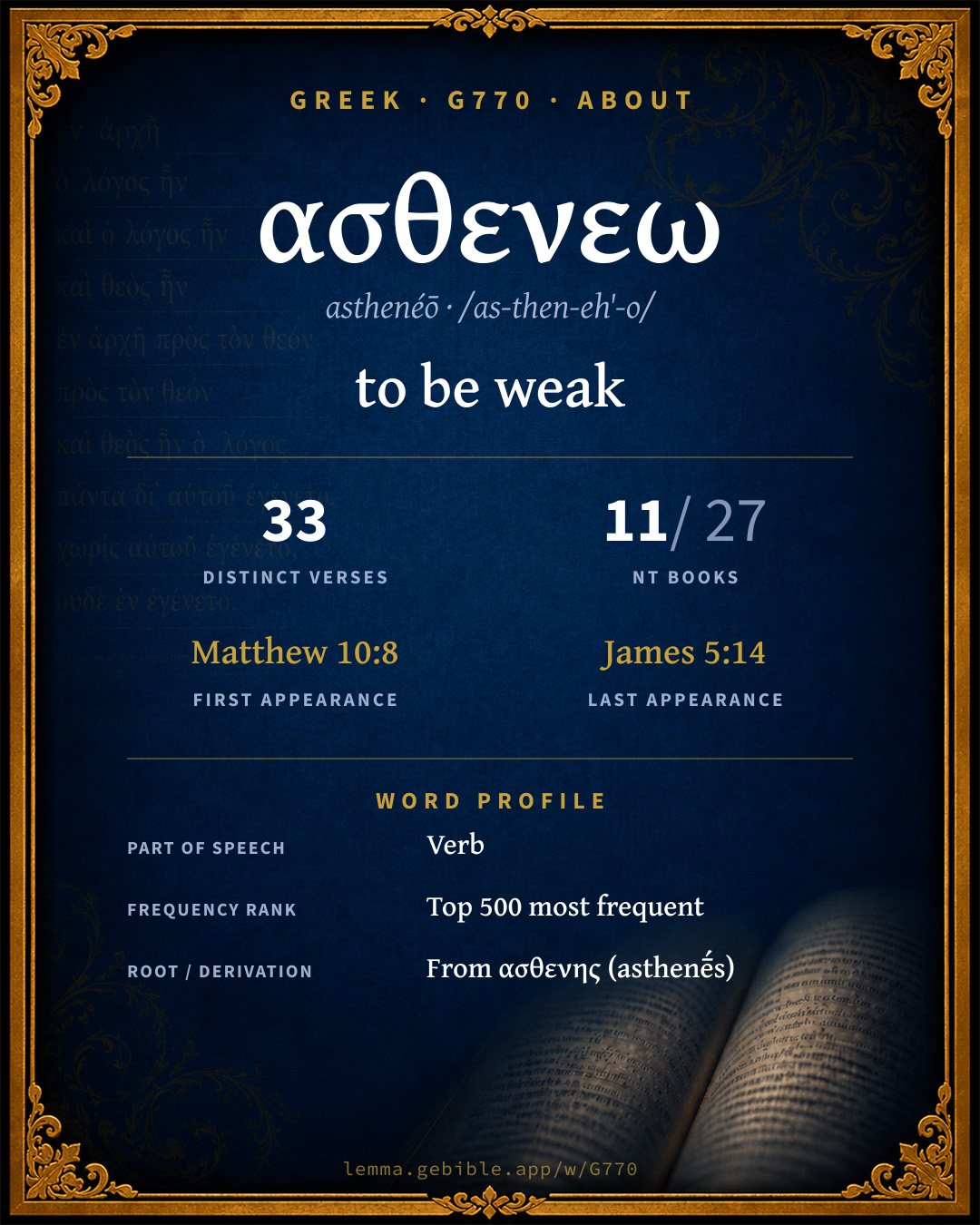
ἀσθενέω
to be weak
also: feeble, powerless fuller range ↓
Full lexicon entry — Thayer's Greek Lexicon
From Thayer's Greek Lexicon
Where this word appears
See every Present-tense verb in the Greek New Testament →
Grammar key — what these labels mean
Part of speech
- Verb
- An action or state-of-being word.
Tense
- Present
- Ongoing or general action in present time (imperfective aspect).
- Imperfect
- Continuous or repeated action in past time (“was writing”).
- Aorist
- Action viewed as a simple whole, without regard to duration — often past (perfective aspect).
- Perfect
- A completed past action with continuing present results.
Voice
- Active
- The subject performs the action.
Mood
- Indicative
- States a fact or asks a factual question (the mood of reality).
- Participle
- A verbal adjective (“writing,” “having written”).
- Subjunctive
- Expresses probability, purpose, or possibility (the mood of contingency).
Case
- Nominative
- The case of the subject (and the predicate nominative).
- Accusative
- The case of the direct object and of extent.
- Genitive
- The case of source, possession, or “of” — answers “whose / from what.”
Person
- 3rd person
- The one spoken about (“he / she / it / they”).
- 1st person
- The speaker (“I / we”).
Gender
- Masculine
- Grammatically masculine.
- Feminine
- Grammatically feminine.
Number
- Singular
- One.
- Plural
- More than one.
7 verses where G770 appears in the Present tense in the Book of John. Filtered view — show all forms. Click any verse to open its interlinear word-by-word view. Verse text shown in the World English Bible for context — . Each verse’s Greek form is shown with its reference; the English is not keyword-highlighted, since the data carries no word-level English alignment. Use “Compare translations” on any verse to read it across multiple English versions. This concordance covers the Greek New Testament; Septuagint (Greek Old Testament) occurrences of this word are not indexed here.
John
- John 5:3 ἀσθενούντων pres act ptcp gen pl masc In these lay a great multitude of those who were sick, blind, lame, or paralyzed, waiting for the moving of the water;
- John 5:7 ἀσθενῶν pres act ptcp nom sg masc The sick man answered him, "Sir, I have no one to put me into the pool when the water is stirred up, but while I'm coming, another steps down before me."
- John 5:13 ἀσθενῶν pres act ptcp nom sg masc But he who was healed didn't know who it was, for Jesus had withdrawn, a crowd being in the place.
- John 6:2 ἀσθενούντων pres act ptcp gen pl masc A great multitude followed him, because they saw his signs which he did on those who were sick.
- John 11:1 ἀσθενῶν pres act ptcp nom sg masc Now a certain man was sick, Lazarus from Bethany, of the village of Mary and her sister, Martha.
- John 11:3 ἀσθενεῖ pres act ind 3sg The sisters therefore sent to him, saying, "Lord, behold, he for whom you have great affection is sick."
- John 11:6 ἀσθενεῖ pres act ind 3sg When therefore he heard that he was sick, he stayed two days in the place where he was.
About this entry
At a glance — auto-summarized from this page’s data, not written by a person. Every figure links to its source below. This summary describes the numbers; it doesn’t interpret them.
“to be weak” is the headline sense of the Greek verb ασθενεω (asthenéō). Its earliest occurrence is Matthew 10:8. The Greek New Testament uses it across 33 verses — moderately common. More than a quarter of its appearances fall in John. Lexicons map it across 3 senses — beyond “to be weak” it also covers “feeble” and “powerless”. The sections below give every sense, occurrence, and version rendering.
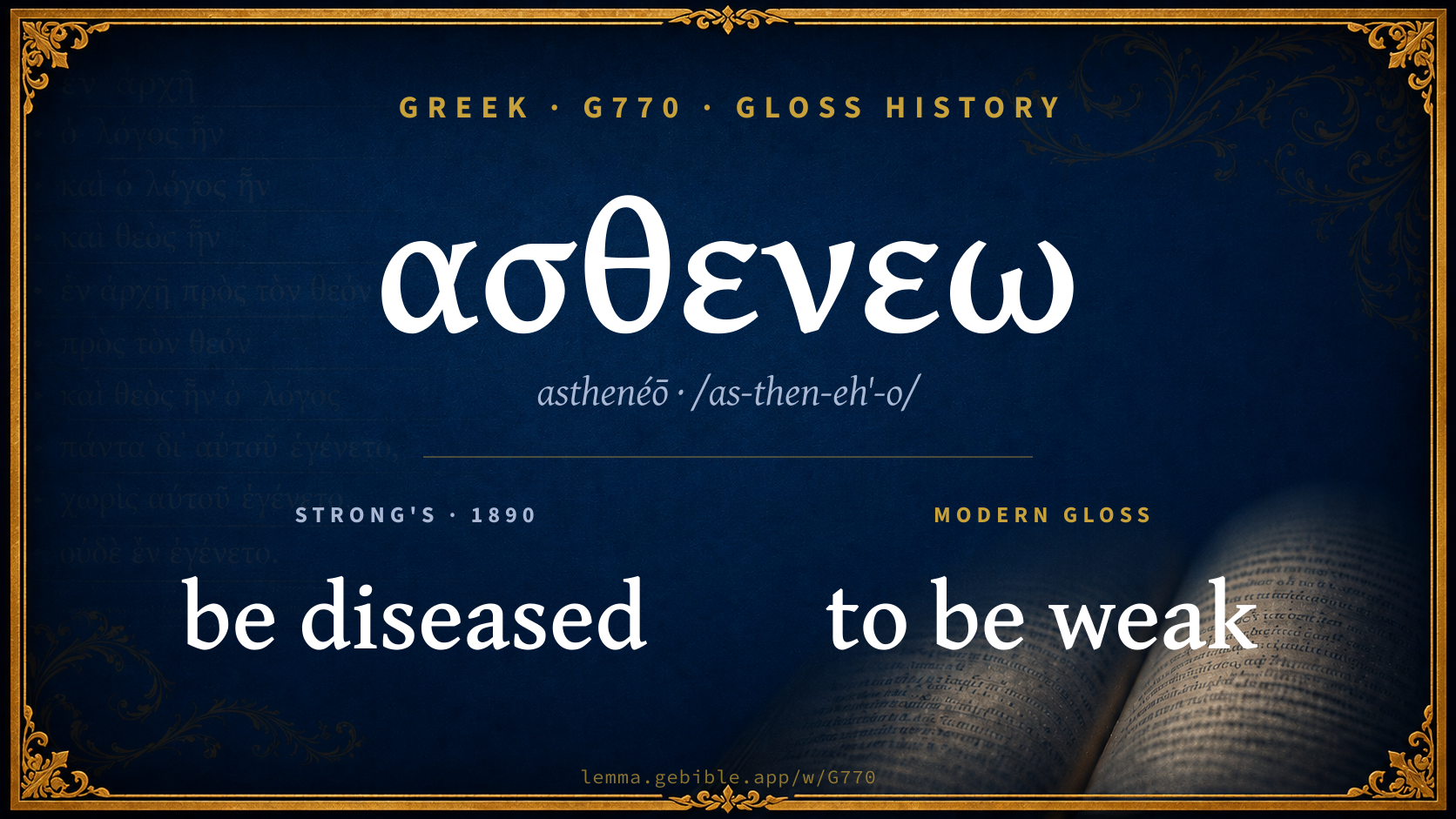
Gloss history
Strong's 1890 vs modern scholarship
About this word
Strong's G770 catalogs a Greek word from the Greek New Testament.
These counts are not copied from any lexicon or concordance. They are computed here, from the morphology-tagged Greek New Testament. What Lemma adds →
- 33
- distinct verses
- The word appears in 33 distinct verses.
- 11 / 27
- NT books
- The word appears in 11 of 27 New Testament books.
- #424
- by frequency
- Top 500 most frequent Greek words (rank 424 of 5,347 Greek words by occurrence).
View all 33 occurrences in the concordance →
Most concentrated in
- John 9 verses 27%
- 2 Corinthians 6 verses 18%
- Romans 4 verses 12%
By section of the New Testament
By traditional corpus
Conventional, traditional groupings — biblical authorship is debated, so this is a traditional corpus grouping, not an authorship claim. Some books belong to more than one corpus (Luke is in both the Gospels and the Lukan corpus, and so on), so these shares overlap and need not total 100%. Each figure is a share of the word’s 33 distinct verses.
- Pauline corpus 15 verses · 45%
- Gospels 14 verses · 42%
- Johannine 9 verses · 27%
- Lukan (Luke–Acts) 4 verses · 12%
- General (Catholic) Epistles 1 verse · 3%
How translations render this word
Counts come from each version’s own published word-to-Strong’s tagging or interlinear alignment — an approximate guide to how each version renders this word, not a word-level alignment the data otherwise carries. Because each total is that version’s own tagged count, the per-version totals vary from one another and need not match the appearance or distinct-verse counts above. These counts may also differ from a printed concordance because Lemma counts each distinctly tagged rendering and does not collapse phrase taggings into a single head-word total. This is a fixed set of word-tagged versions (KJV, ASV, BSB, ULT) and does not change with the reading translation you choose elsewhere. Each version’s license is shown beside its name below (and on Sources).
- King James Version: Sick 7×, Weak 6×, Is weak 3×
- American Standard Version: Sick 7×, He was sick 3×, Is weak 3×
- Berean Standard Bible: Sick 9×, Weak 4×, Is weak 3×
- unfoldingWord Literal Text: Being weak 4×, Sick 4×, Being sick 3×
King James Version Public Domain
Renders G770 across 39 tagged occurrences — most commonly:
Plus 15 renderings that appear only once — usually multi-word phrases or single function words the recovered tagging swept in, not distinct renderings.
American Standard Version Public Domain
Renders G770 across 38 tagged occurrences — most commonly:
Plus 18 renderings that appear only once — usually multi-word phrases or single function words the recovered tagging swept in, not distinct renderings.
Berean Standard Bible Public Domain
Renders G770 across 33 tagged occurrences — most commonly:
Plus 15 renderings that appear only once — usually multi-word phrases or single function words the recovered tagging swept in, not distinct renderings.
unfoldingWord Literal Text CC BY-SA 4.0
Renders G770 across 39 tagged occurrences — most commonly:
Plus 14 renderings that appear only once — usually multi-word phrases or single function words the recovered tagging swept in, not distinct renderings.
Senses in Thayer's
The 3 senses Thayer's distinguishes for this word, in lexicon order (not ranked by frequency or importance). The full entry — with sub-senses — is in the Lexicon Entry tab.
- to be weak, feeble, to be without strength, powerless
- to be weak in means, needy, poor
- to be feeble, sick
Word origin
Derived from ασθενης (asthenḗs) (G772) — weak.
From G772 ; to be feeble (in any sense): - be diseased impotent folk (man) (be) sick (be be made) weak.
— Strong’s Exhaustive Concordance (1890), public domain.
Forms in the corpus
The 15 distinct written forms G770 takes in the Greek New Testament, most frequent first — each parse links to that tense’s occurrences in the concordance.
Same root — word family
Other Thayer's entries built from the same root as G770, grouped by Strong’s listed origin. These share a root / origin per the lexicon — not necessarily a shared meaning. Each links to that word’s own entry.
Derives from
Shares the same root
Derived from this word
Compare all same-root words → They share a root, not necessarily a meaning.
Septuagint usage
The same Greek word ασθενεω appears 55 times in the Greek Old Testament (Septuagint), across 52 verses in 17 books.
- 55
- LXX occurrences
- Tagged occurrences of this Greek word in the Septuagint.
- 52
- verses
- Distinct Septuagint verses containing this word.
- 17 / 39
- OT books
- The word appears in 17 of the 39 Old Testament books.
Sample Septuagint occurrences
- Judges 6:15 ἀσθενέω
- 1 Samuel 2:4 ἀσθενέω
- 2 Samuel 3:1 ἀσθενέω
- 2 Kings 19:26 ἀσθενέω
- 2 Chronicles 28:15 ἀσθενέω
- Job 4:4 ἀσθενέω
- Psalms 9:4 ἀσθενέω
- Proverbs 24:16 ἀσθενέω
- Isaiah 7:4 ἀσθενέω
- Jeremiah 6:21 ἀσθενέω
- Lamentations 1:14 ἀσθενέω
- Ezekiel 17:6 ἀσθενέω
Septuagint occurrences (same lexeme)
Every verse where the same Strong’s number (G770) appears in the Greek Septuagint — showing the first 50 of 52. Verse text shown in the World English Bible for context; the Greek form is the matched word — the English is not keyword-highlighted.
- Judges 6:15 ἀσθενέω He said to him, Oh, Lord, with which shall I save Israel? behold, my family is the poorest in Manasseh, and I am the least in my father's house.
- Judges 16:7 ἀσθενέω Samson said to her, If they bind me with seven green cords that were never dried, then shall I become weak, and be as another man.
- Judges 16:11 ἀσθενέω He said to her, If they only bind me with new ropes with which no work has been done, then shall I become weak, and be as another man.
- Judges 16:17 ἀσθενέω He told her all his heart, and said to her, "No razor has ever come on my head; for I have been a Nazirite to God from my mother's womb. If I am shaved, then my strength will go from me, and I will become weak, and be like any other man."
- Judges 19:9 ἀσθενέω When the man rose up to depart, he, and his concubine, and his servant, his father-in-law, the young lady's father, said to him, Behold, now the day draws toward evening, please stay all night: behold, the day grows to an end, lodge here, that your heart may be merry; and tomorrow get you early on your way, that you may go home.
- 1 Samuel 2:4 ἀσθενέω The bows of the mighty men are broken; Those who stumbled are girded with strength.
- 1 Samuel 2:5 ἀσθενέω Those who were full have hired out themselves for bread; Those who were hungry have ceased [to hunger]: Yes, the barren has borne seven; She who has many children languishes.
- 2 Samuel 3:1 ἀσθενέω Now there was long war between the house of Saul and the house of David: and David grew stronger and stronger, but the house of Saul grew weaker and weaker.
- 2 Kings 19:26 ἀσθενέω Therefore their inhabitants were of small power, they were dismayed and confounded; they were as the grass of the field, and as the green herb, as the grass on the housetops, and as grain blasted before it is grown up.
- 2 Chronicles 28:15 ἀσθενέω The men who have been mentioned by name rose up, and took the captives, and with the spoil clothed all who were naked among them, and arrayed them, and shod them, and gave them to eat and to drink, and anointed them, and carried all the feeble of them on donkeys, and brought them to Jericho, the city of palm trees, to their brothers: then they returned to Samaria.
- Job 4:4 ἀσθενέω Your words have supported him who was falling, You have made firm the feeble knees.
- Job 28:4 ἀσθενέω He breaks open a shaft away from where people live. They are forgotten by the foot. They hang far from men, they swing back and forth.
- Psalms 9:4 ἀσθενέω For you have maintained my just cause. You sit on the throne judging righteously.
- Psalms 17:37 ἀσθενέω
- Psalms 25:1 ἀσθενέω To you, Yahweh, do I lift up my soul.
- Psalms 26:2 ἀσθενέω Examine me, Yahweh, and prove me. Try my heart and my mind.
- Psalms 30:11 ἀσθενέω You have turned my mourning into dancing for me. You have removed my sackcloth, and clothed me with gladness,
- Psalms 57:8 ἀσθενέω Wake up, my glory! Wake up, psaltery and harp! I will wake up the dawn.
- Psalms 67:10 ἀσθενέω
- Psalms 87:10 ἀσθενέω
- Psalms 106:12 ἀσθενέω Then they believed his words. They sang his praise.
- Psalms 108:24 ἀσθενέω
- Proverbs 24:16 ἀσθενέω For a righteous man falls seven times, and rises up again; But the wicked are overthrown by calamity.
- Isaiah 7:4 ἀσθενέω Tell him, 'Be careful, and keep calm. Don't be afraid, neither let your heart be faint because of these two tails of smoking firebrands, for the fierce anger of Rezin and Syria, and of the son of Remaliah.
- Isaiah 28:20 ἀσθενέω For the bed is shorter than that a man can stretch himself on it; and the covering narrower than that he can wrap himself in it.
- Isaiah 29:4 ἀσθενέω You shall be brought down, and shall speak out of the ground, and your speech shall be low out of the dust; and your voice shall be as of one who has a familiar spirit, out of the ground, and your speech shall whisper out of the dust.
- Isaiah 32:4 ἀσθενέω The heart of the rash shall understand knowledge, and the tongue of the stammerers shall be ready to speak plainly.
- Isaiah 44:12 ἀσθενέω The smith [makes] an axe, and works in the coals, and fashions it with hammers, and works it with his strong arm: yes, he is hungry, and his strength fails; he drinks no water, and is faint.
- Jeremiah 6:21 ἀσθενέω Therefore thus says Yahweh, Behold, I will lay stumbling-blocks before this people; and the fathers and the sons together shall stumble against them; the neighbor and his friend shall perish.
- Jeremiah 18:15 ἀσθενέω For my people have forgotten me, they have burned incense to false [gods]; and they have been made to stumble in their ways, in the ancient paths, to walk in byways, in a way not built up;
- Jeremiah 26:6 ἀσθενέω then will I make this house like Shiloh, and will make this city a curse to all the nations of the earth.
- Jeremiah 26:12 ἀσθενέω Then spoke Jeremiah to all the princes and to all the people, saying, Yahweh sent me to prophesy against this house and against this city all the words that you have heard.
- Jeremiah 26:16 ἀσθενέω Then said the princes and all the people to the priests and to the prophets: This man is not worthy of death; for he has spoken to us in the name of Yahweh our God.
- Jeremiah 27:32 ἀσθενέω
- Lamentations 1:14 ἀσθενέω The yoke of my transgressions is bound by his hand; They are knit together, they are come up on my neck; he has made my strength to fail: The Lord has delivered me into their hands, against whom I am not able to stand.
- Lamentations 2:8 ἀσθενέω Yahweh has purposed to destroy the wall of the daughter of Zion; He has stretched out the line, he has not withdrawn his hand from destroying; He has made the rampart and wall to lament; they languish together.
- Lamentations 5:13 ἀσθενέω The young men bare the mill; The children stumbled under the wood.
- Ezekiel 17:6 ἀσθενέω It grew, and became a spreading vine of low stature, whose branches turned toward him, and the roots of it were under him: so it became a vine, and brought forth branches, and shot forth sprigs.
- Ezekiel 21:20 ἀσθενέω You shall appoint a way for the sword to come to Rabbah of the children of Ammon, and to Judah in Jerusalem the fortified.
- Ezekiel 34:4 ἀσθενέω You haven't strengthened the diseased, neither have you healed that which was sick, neither have you bound up that which was broken, neither have you brought back that which was driven away, neither have you sought that which was lost; but with force and with rigor have you ruled over them.
- Daniel 8:27 ἀσθενέω I, Daniel, fainted, and was sick certain days; then I rose up, and did the king's business: and I wondered at the vision, but none understood it.
- Daniel 10:17 ἀσθενέω For how can the servant of this my lord talk with this my lord? for as for me, immediately there remained no strength in me, neither was there breath left in me.
- Hosea 4:5 ἀσθενέω You will stumble in the day, And the prophet will also stumble with you in the night; And I will destroy your mother.
- Hosea 5:5 ἀσθενέω The pride of Israel testifies to his face. Therefore Israel and Ephraim will stumble in their iniquity. Judah also will stumble with them.
- Hosea 11:6 ἀσθενέω The sword will fall on their cities, And will consume their gate bars, And will put an end to their plans.
- Hosea 14:2 ἀσθενέω Take words with you, and return to Yahweh. Tell him, "Forgive all our sins, And accept that which is good: So we offer like bulls our lips.
- Hosea 14:10 ἀσθενέω
- Nahum 2:6 ἀσθενέω The gates of the rivers are opened, and the palace is dissolved.
- Nahum 3:3 ἀσθενέω the horseman mounting, and the flashing sword, the glittering spear, and a multitude of slain, and a great heap of corpses, and there is no end of the bodies. They stumble on their bodies,
- Zechariah 12:8 ἀσθενέω In that day Yahweh will defend the inhabitants of Jerusalem. He who is feeble among them at that day will be like David, and the house of David will be like God, like the angel of Yahweh before them.
These are occurrences of the same Greek lexeme (G770) in the Septuagint — not a translation of any one Hebrew word. The store carries no word-level Hebrew↔Greek alignment, so no Hebrew original is asserted here. Counts come from the recovered LXX Strong's tagging — high-frequency vocabulary is well covered, while rare or late forms may be untagged — so they reflect tagged occurrences and may slightly undercount.