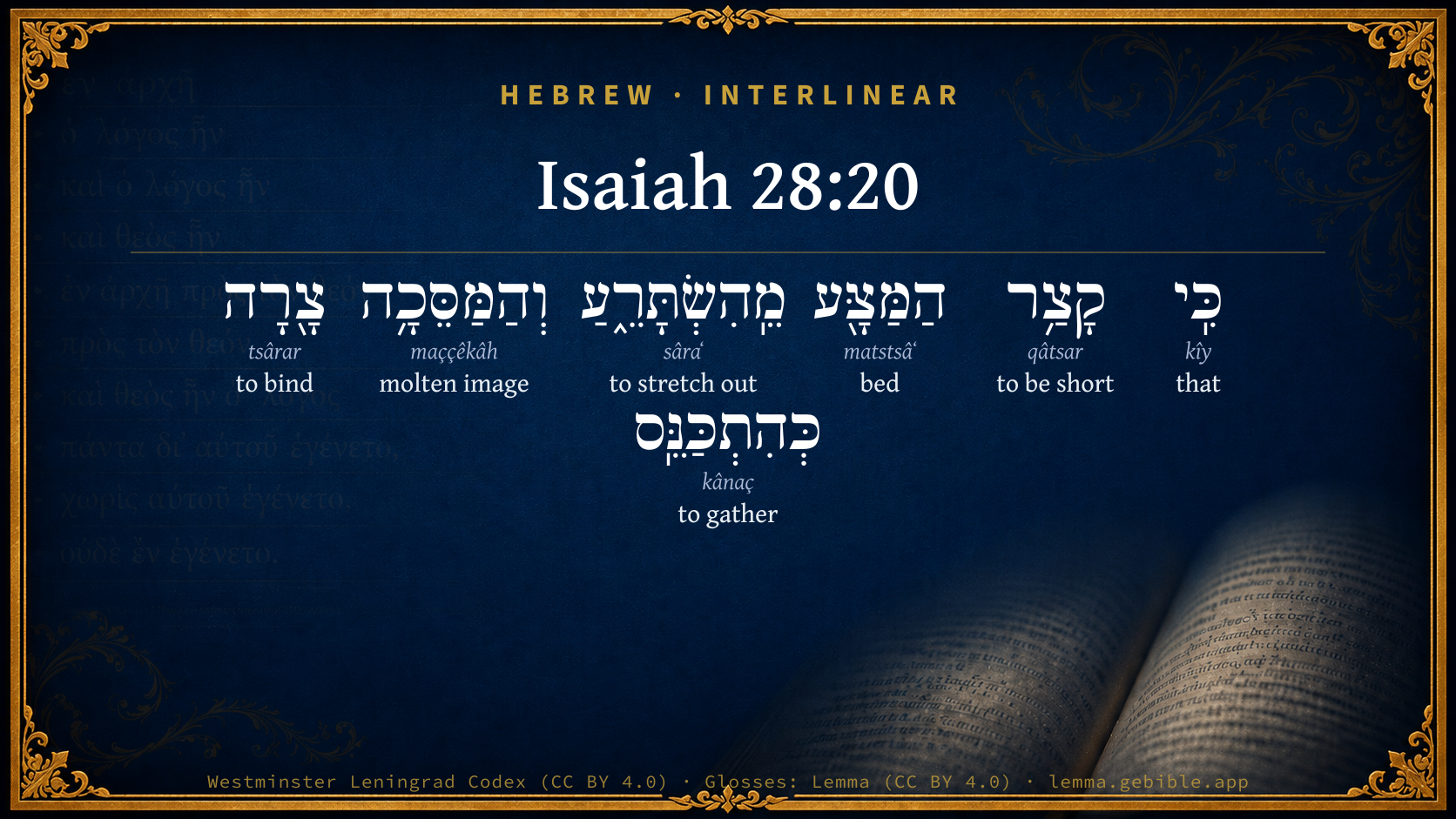
Isaiah 28:20

Hebrew (Westminster Leningrad Codex) Isaiah 28:20 appears in the Hebrew Old Testament. The text above is from the Westminster Leningrad Codex. Each word links to its Strong’s number, a concise gloss, and parsing drawn from the Open Scriptures Hebrew Bible morphology. Click any word for its full Brown-Driver-Briggs (BDB) entry.
Download image
Cite this verse

Isaiah 28:20 (World English Bible). Public Domain. Lemma interlinear Bible study tool, https://lemma.gebible.app/v/isaiah/28/20.

Show BibTeX & RIS
BibTeX
RIS
English Translation
For the bed is shorter than that a man can stretch himself on it; and the covering narrower than that he can wrap himself in it.
World English Bible · Public Domain
Highlights Full analysis ↓
Download a study sheet

One document with this verse’s original text, its word-by-word gloss line, the meaning frame, cross-references with their text, attributed commentary, and full source and license credits — printable, and it pastes into notes with its structure intact.

This verse Autodidact and up

Study sheet (.html) Plain text (.txt)

A passage Seminary Student

Up to 50 verses in one chapter. A passage sheet keeps up to 6 commentary sources and 12 cross-references per verse, in the order this page ranks them, and says so on the sheet whenever that leaves anything out. Ask for a single verse and you get the Autodidact verse sheet above.

Everything on this page stays free to read, with no account — the sheet is a download of what is already on screen, not access to it.

Want to remove ads? Support Godless Engineer
Compare translations 3

The same verse in 3 English versions, stacked beneath the original-language interlinear above. Click any original word for its lexicon entry.

Each is an independent rendering of the whole verse — the interlinear is not word-aligned to these translations.

Highlighted words mark where these versions differ — a whole-verse word diff, not a word-by-word alignment.

  • World English Bible Public Domain
    For the bed is shorter than that a man can stretch himself on it; and the covering narrower than that he can wrap himself in it.
  • King James Version Public Domain
    For the bed is shorter than that a man can stretch himself on it: and the covering narrower than that he can wrap himself in it.
  • unfoldingWord Literal Text CC BY-SA 4.0
    For the bed is too short to stretch oneself out, and the blanket is narrow as to wrap oneself.

unfoldingWord Literal Text — © unfoldingWord, licensed CC BY-SA 4.0. Word-aligned USFM3 via Door43 (git.door43.org/unfoldingWord/en_ult).

Versions to compare (up to 4)

3 of 4 selected

Show all 18 translations

Every available English version of this verse, each an independent rendering of the whole verse.

  • World English Bible Public Domain
    For the bed is shorter than that a man can stretch himself on it; and the covering narrower than that he can wrap himself in it.
  • Berean Standard Bible Public Domain
    Indeed, the bed is too short to stretch out on, and the blanket too small to wrap around you.
  • Majority Standard Bible Public Domain
    Indeed, the bed is too short to stretch out on, and the blanket too small to wrap around you.
  • King James Version Public Domain
    For the bed is shorter than that a man can stretch himself on it: and the covering narrower than that he can wrap himself in it.
  • American Standard Version (1901) Public Domain
    For the bed is shorter than that a man can stretch himself on it; and the covering narrower than that he can wrap himself in it.
  • Revised Version (1885) Public Domain
    For the bed is shorter than that a man can stretch himself on it; and the covering narrower than that he can wrap himself in it.
  • Geneva Bible (1599) Public Domain
    For the bed is streight that it can not suffice, and the couering narowe that one can not wrappe himselfe.
  • Douay-Rheims (1899) Public Domain
    For the bed is straitened, so that one must fall out, and a short covering can- not cover both.
  • Young's Literal Translation Public Domain
    For shorter hath been the bed Than to stretch one's self out in, And the covering hath been narrower Than to wrap one's self up in.
  • Literal Standard Version CC BY-SA 4.0
    For the bed has been shorter || Than to stretch one’s self out in, || And the covering has been narrower || Than to wrap one’s self up in.
  • Unlocked Literal Bible CC BY-SA 4.0
    For the bed is too short for a man to stretch out on, and the blanket too narrow for him to wrap himself in.”
  • unfoldingWord Literal Text CC BY-SA 4.0
    For the bed is too short to stretch oneself out, and the blanket is narrow as to wrap oneself.
  • Darby Bible Public Domain
    For the bed is too short to stretch oneself on, and the covering too narrow when he would wrap himself in it.
  • World Messianic Bible Public Domain
    For the bed is too short to stretch out on, and the blanket is too narrow to wrap oneself in.
  • Webster's Bible Public Domain
    For the bed is shorter than that a man can stretch himself on it: and the covering narrower than that he can wrap himself in it.
  • Free Bible Version CC BY-SA 4.0
    The bed is too short so you can't stretch out; the blanket is too narrow so you can't cover yourself.
  • Bible in Basic English Public Domain
    For the bed is not long enough for a man to be stretched out on: and the cover is not wide enough for him to be covered with.
  • JPS Tanakh (1917) Public Domain
    For the bed is too short for a man to stretch himself; and the covering too narrow when he gathereth himself up.

Literal Standard Version (2020), Covenant Press — licensed CC BY-SA 4.0. Text via the HelloAO Bible API (eBible.org). Unlocked Literal Bible (unfoldingWord) — licensed CC BY-SA 4.0. Text via the HelloAO Bible API (eBible.org). unfoldingWord Literal Text — © unfoldingWord, licensed CC BY-SA 4.0. Word-aligned USFM3 via Door43 (git.door43.org/unfoldingWord/en_ult). Free Bible Version, Dr. Jonathan Gallagher — licensed CC BY-SA 4.0. Text via the HelloAO Bible API (eBible.org).

Word by word

More ways to search: Search by grammar → Find every occurrence → Compare this word →

Practice this passage: Drill this verse → Learn its vocabulary →

About this verse

These counts appear in no published source. They are computed here, from the morphology-tagged text and Lemma’s own curated glosses. What Lemma adds →

7
words
7
distinct lemmas
Prophets
section

Notable vocabulary

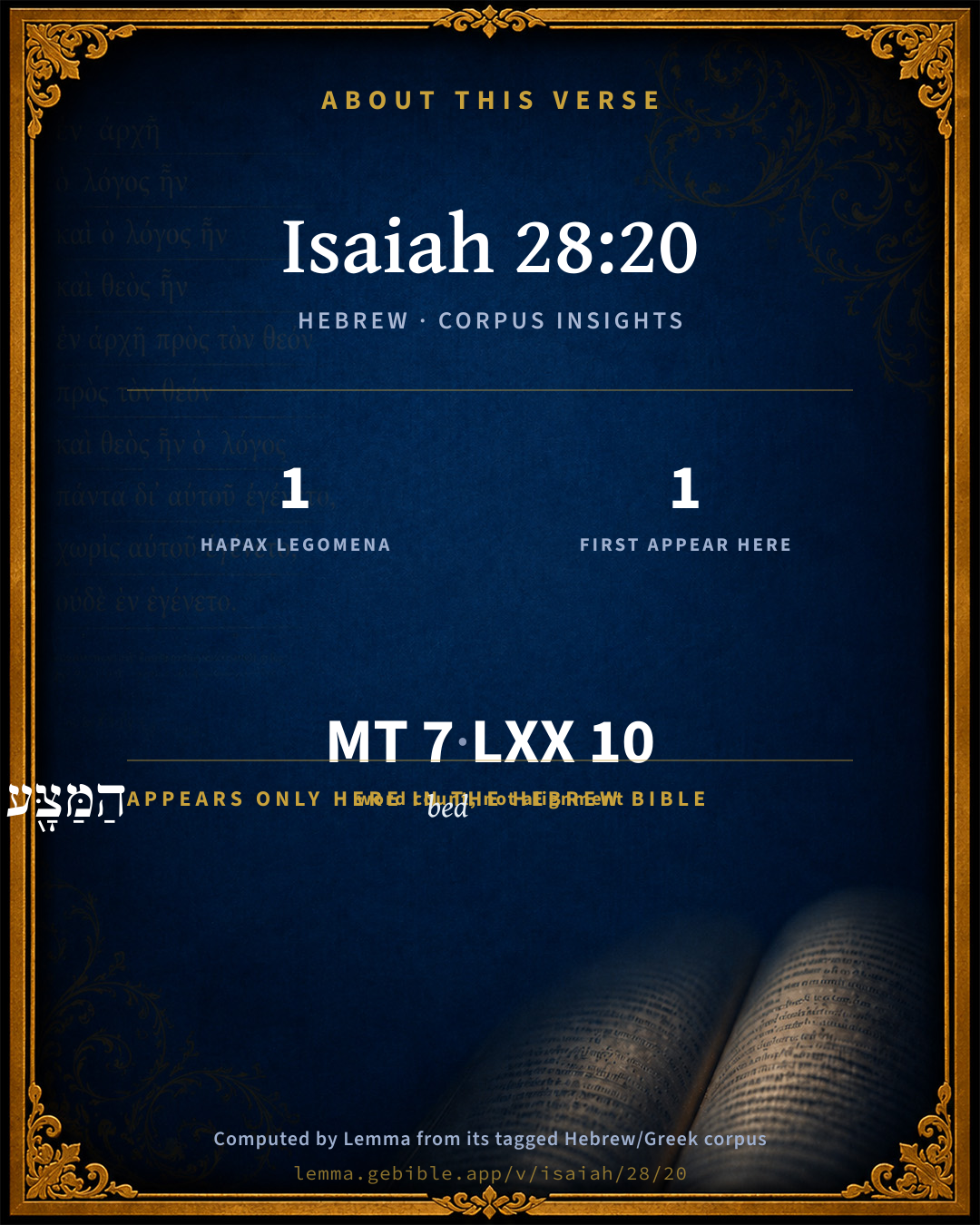
1 hapax legomenon — a word that appears only here in the entire Hebrew Bible:

  • הַמַּצָּ֖ע bed H4702

First appearance in Scripture

This word makes its first canonical appearance in the Hebrew Bible here:

  • הַמַּצָּ֖ע bed H4702

Shared distinctive vocabulary

מֵֽהִשְׂתָּרֵ֑עַ to stretch out H8311 occurs in 3 verses of the Hebrew Bible. Also found in:

Grammatical profile

  • 4 verbs
  • 2 nouns
  • 1 conjunction

Verb forms

  • קָצַ֥ר Qal · Perfect
  • מֵֽהִשְׂתָּרֵ֑עַ Hithpael · Infinitive Construct
  • צָ֖רָה Qal · Perfect
  • כְּהִתְכַּנֵּֽס Hithpael · Infinitive Construct

Hebrew & Septuagint length

In English translation the verse runs 26 words from the Hebrew and 18 from the Septuagint (LXX English) — the Septuagint runs noticeably shorter here. See the side-by-side →

A rough comparison of the two English renderings, which tokenize alike — not a word-level alignment.

Word counts can differ between the Hebrew and the Greek without any difference in meaning — e.g. the Hebrew direct-object marker אֵת has no separate Greek word, and Greek often adds the article ὁ.

In the original languages it is 7 Hebrew tokens and 10 Greek tokens — but the two are counted differently (Hebrew bundles its prefixes and suffixes into one token; the Greek is in lemma form), so that isn’t a like-for-like length.

Cross-references

7

Topical passages linked to Isaiah 28:20 in the Treasury of Scripture Knowledge — connected by theme and wording, ordered by reader-vote popularity; previews shown in the World English Bible.

  • Isaiah 64:6 For we are all become as one who is unclean, and all our righteousness are as a polluted garment: and we all do fade as a leaf; and our iniquities, like the wind, take us away.
  • 1 Corinthians 1:18–31 For the word of the cross is foolishness to those who are dying, but to us who are saved it is the power of God.
  • Romans 9:30–32 What shall we say then? That the Gentiles, who didn't follow after righteousness, attained to righteousness, even the righteousness which is of faith;
  • Isaiah 57:12–13 I will declare your righteousness; and as for your works, they shall not profit you.
  • Isaiah 59:5–6 They hatch adders' eggs, and weave the spider's web: he who eats of their eggs dies; and that which is crushed breaks out into a viper.
  • Isaiah 66:3–6 He who kills an ox is as he who kills a man; he who sacrifices a lamb, as he who breaks a dog's neck; he who offers an offering, [as he who offers] pig's blood; he who burns frankincense, as he who blesses an idol. Yes, they have chosen their own ways, and their soul delights in their abominations:
  • Jeremiah 7:8–10 Behold, you trust in lying words, that can't profit.

Cross-references courtesy of OpenBible.info (CC BY 4.0).

Hebrew and Greek witnesses Masoretic Hebrew ↔ Greek Septuagint

The same verse in the two great witnesses to the Old Testament, shown verse-for-verse.

Here the Septuagint runs noticeably shorter than the Hebrew — LXX2012 (modern English Septuagint) 18 words vs World English Bible 26. A rough length comparison of the two English translations, not a word-level alignment — read both below.

These are two independent witnesses, not word-aligned to each other, and the Septuagint is shown in lemma (dictionary) form.

Hebrew Isaiah 28:20 Masoretic · Westminster Leningrad Codex

כִּֽי קָצַ֥ר הַמַּצָּ֖ע מֵֽהִשְׂתָּרֵ֑עַ וְהַמַּסֵּכָ֥ה צָ֖רָה כְּהִתְכַּנֵּֽס

For the bed is shorter than that a man can stretch himself on it; and the covering narrower than that he can wrap himself in it.

World English Bible · Public Domain

Greek LXX Isaiah 28:20 Septuagint · lemma form

στενοχωρέω οὐ δύναμαι μάχομαι αὐτός δέ ἀσθενέω ὁ ἐγώ συνἄγω

you⌃ that are distressed; we can’t fight, but we are ourselves too weak for you to be gathered.

LXX2012 (modern English Septuagint) · Public Domain

Hebrew: Westminster Leningrad Codex (CC BY 4.0). Greek: Septuagint (public domain); English from LXX2012 (modern English Septuagint) (Public Domain). How the Septuagint differs from the Hebrew →

Targum (Aramaic paraphrase)

1

The Targum is the ancient Jewish Aramaic paraphrase of the Hebrew Scriptures — an interpretive translation, not the Hebrew text itself. Onkelos (literal) and Pseudo-Jonathan (expansive) render the Torah, and Jonathan the Prophets. Coverage is partial: where no permissively-licensed English translation exists for a verse, only the Aramaic is shown. This is verse-level text, not a word-by-word alignment to the Hebrew.

  1. Targum Jonathan Prophets (Joshua–Malachi)
    אֲרֵי יִתְקַצַר חֵילֵיהוֹן מִשִׁעְבּוּד תַּקִיף וְשִׁלְטוֹן בַּבְלָאֵי מְעִיק יִסְגֵי מֵרְוָא:

    For their strength shall be diminished by reason of mighty slavery; and the government of the oppressor shall increase their subjection.

    Targum Jonathan — Aramaic: “Mikraot Gedolot” (public domain). English: “Sefaria Community Translation” (CC0 1.0 (public-domain dedication)); “London "Chaldee Paraphrase," 1871” (public domain). Text via Sefaria.

Commentary

Notes on Isaiah 28:20 from classic Christian and Jewish commentators (each source and its license shown beneath its notes). The classic Christian expositions comment on the surrounding passage and are grouped to its opening verse, so a note may address several verses; the Jewish commentaries on the Tanakh (Rashi and others) are per-verse, so they appear only where the commentator wrote on this verse.

Lemma curates 59 commentaries, every one of them public domain or Creative Commons licensed, each selected and text-cleaned for this edition rather than reprinted as found. About our sources →

Trapp's Complete Commentary

John Trapp

Isa 28:20 For the bed is shorter than that [a man] can stretch himself [on it]: and the covering narrower than that he can wrap himself [in it].

Ver. 20. For the bed is short.] Here the prophet seemeth to some to threaten them for their lectulorum luxus {Amo 6:4} their beds of ivory, whereon, when well whittled, they once stretched themselves at full length, and slept out their drunkenness; but when brought to Babylon, the case should be otherwise with them. Diodate saith that these are figurative and proverbial terms, importing that all means and devices they can use will no way defend them. God’s wrath is such as none can avert or avoid.

John Trapp, A Commentary or Exposition upon All the Books of the Old and New Testament (1647–1656) — public domain. Text from a community e-Sword module.

The Biblical Illustrator

Joseph S. Exell

Isa_28:20

For the bed is shorter than that a man can stretch himself on it

The short bed and the narrow covering

The Jewish beds were only mattresses, laid on the floor; and the cover was s sheet, or carpet, laid over it, in which the person wrapped himself.

In this adage, there is an allusion to the condition of one who, being weary and inclined to rest, goes to bed, that he may get refreshing repose. Having betaken himself to a bed that is too short for him, and having got a covering that is too narrow to wrap himself in, he is disappointed of the comfortable rest that he expected to enjoy; and, instead of getting agreeable warmth and refreshment, he becomes cold, restless, and uneasy. This painful state represents the distressed, disappointed condition of those who hide themselves under falsehood and refuges of lies, in order to obtain either temporal or spiritual deliverance. The truth of this aphorism, thus explained, was exemplified in the Jews, who resorted to other expedients for safety than Divine wisdom had ordained, and found all their expectations frustrated. (R. Macculloch.)

The growth of religious conception

This proverb of Isaiah about the growth of religious conception has had many applications. Again and again it has happened since Isaiahs time that the framework of theological theory formed by the intellect has become too narrow for the growing knowledge and spirit of man; and there has followed the discomfort, the strain, the struggle, the stretching or the dissolution of conventional beliefs, and out of them the reconstruction on a larger scale of a theology that somewhat inadequately expresses the actual revelation to man of the Unseen and the Divine. The foundations of religion are ever the same--the elementary force in the heart of man, the sense of weakness, of sin, of fear; the upward reaching of man to the unattainable God, and the blessed shining downwards of God into the heart of man. But the speculations, the imagery, the language of theology have varied with human knowledge, and are varying now before our eyes. (J. M. Wilson, D. D.)

The expansion of the Jewish conception of God

It was in Isaiahs age that, for the first time, the Jews became pressingly conscious of their own littleness compared with the vast nations that pressed on them from either side. They lay between the vast continental empires of Assyria and Egypt, and in the grasp of these great barbaric, almost inhuman forces, they felt themselves as nothing. There was, for the first time, a painful contrast between the political insignificance of the Jews and their boundless pretensions to the favour of Jehovah, the Lord of hosts. They were stricken with terror. But Isaiah was inspired with heavenly wisdom to see that the agony of the terror sprang rather from the theology of the Jews than from the might of their enemies, for their theology was, in brief, this--that Jehovah was the God of the Jews only, and that the Assyrian was the foe of God. They now saw that he might be the victorious foe. To them the victory of the Assyrian would be the defeat of God and the shattering of their faith, and it seemed inevitable. It was the undivine, the material, relentlessly crushing God that they deemed Divine; it led straight to practical atheism, Now, Isaiah dared to think and to see that God was the God of the Assyrians also, that He wielded their forces in His hand, and that His one supreme aim was righteousness, and not favour to Israel; it was an extension of their theology, beyond what they could bear. It was not only latitudinarian; it was absurd. They ridiculed him and his message, and finally, it is said they put him to death. But, nevertheless, Isaiah had a vision of a truth which the world has now made its own--that Gods providence extends to all mankind, and that no nation and no Church can monopolise Gods blessing and protection, and that God has one moral aim only--the growth of righteousness and the coming of His kingdom on earth. He thus extended his conception of God. (J. M. Wilson, D. D.)

Present day need: a larger conception of God

The terror of our time to those who feel it is the aggregate of the brute unspiritual powers of nature, whether of human passion or material force, in whose ceaseless whirl man seems to be a mere plaything. Our Assyria is materialism. We may learn from Isaiah how to meet it,--not by denying the existence of these forces, or underrating them or their mystery, but by enlarging our conception of God. Perhaps if God would give England an Isaiah now, his message would be the consecration of natural forces, a declaration that all things are working towards spiritual end for the coming of the kingdom of God. (J. M. Wilson, D. D.)

Expansion in theology and religion

We need to expand also our whole conception of theology and of religion, giving it a wider foundation in human nature and in facts, and thus making faith more obviously compatible with intellectual honesty. (J. M. Wilson, D. D.)

The lengthening of the bed

The lengthening of the bed, the widening of the covering, is generally effected without a fracture or a rent. It is altered partly by the infusion of new life and meaning by the spiritual interpretation of what were thought to be physical and scientific statements, partly by the transference of emphasis from worship to life, partly by the ever-varying meaning assigned to old words and old forms. Jehovah did not cease to be Jehovah when the Jews ceased to regard Him as the God of the Jews only. (J. M. Wilson, D. D.)

A word of caution to the enthusiast for an enlarged and scientific theology

A word of caution to the enthusiast for an enlarged and scientific theology and for what might seem to him a rational religion. It cannot be invented prematurely; it must grow as daylight grows, and this is a very slow and gradual process. (J. M. Wilson, D. D.)

The bed and its covering

God has so made men, that there are two things essential for their comfort, if not for their very existence, namely, sleep and clothing. Mans body is, after all, only a picture of his inner being; just what the body needs materially, that the soul needs spiritually. It requires rest, which is pictured to us in sleep. And it needs covering; the naked soul would be unhappy, noxious to the eye of God, and utterly miserable in itself.

I. MEN TRY TO MAKE BEDS ON WHICH THEIR SOULS MAY REST. One of the most uncomfortable things in the world, I should think, would be a spare bed--a bed so spare that a man should not have room to stretch himself on it. But that is just the condition of all men while they are seeking a rest anywhere else but in the rest that remaineth for the people of God.

1. As to the present world, how many beds are there of mans own invention.

(1) One man has made himself a bedstead of gold; the pillars thereof are of silver, the covering thereof is of Tyrian purple, the pillows are filled with down, such as only much fine gold could buy him; the hangings he hath embroidered with threads of gold and silver, and the curtains are drawn upon rings of ivory. Lo, this man hath ransacked creation for luxuries, and invented to himself all manner of sumptuous delights. He becomes a merchant prince, a millionaire, and he says unto himself, Soul, take thine ease; eat, drink, and be merry; thou hast much goods laid up for many years. If he makes riches his God, and seeks in them his happiness, you never find the man has money enough, his lands are still too narrow and his estate too small The soul is wider than creation, broader than space; give it all, it would be still unsatisfied, and man would not find rest.

(2) Other men have been ambitious. Oh, says one, if I might be famous, what would I not do? Oh, if my name might be handed down to posterity, as having done something, and having been somebody, a man of note, how satisfied would I be! And the man has so acted, that he has at last made for himself a bed of honour. He has become famous. But did you ever read the history of famous men, or hear them tell their tale in secret? Uneasy lies the head that wears the crown, even though it be the laurel coronet of honour. When the man is known, it is not enough; he asks for wider praise.

(3) There is another bed on which man thinks he could rest. There is a witch, a painted harlot, who wears the richest gems in her ears, and a necklace of precious things about her neck. Her name is Madam Wanton. She keeps a house wherein she feasteth men, and maketh them drunken with the wine of pleasure, which is as honey to the taste, but is venom to the soul This witch, when she can, entices men into her bed.

(4) You may have all the vices and pleasure and mirth of this metropolis, and when you have it all you will find it does not equal your expectation nor satisfy your desires. When the devil is bringing you one cup of spiced wine, you will be asking him next time to spice it higher; and he will flavour it to your fiery taste, but you will be dissatisfied still, until at last, if he were to bring you a cup hot as damnation, it would fall tasteless on your palate. Now think of the Christian, and see the picture reversed. In the Christian religion there is a rest that no one can enjoy elsewhere. And now let me stretch myself upon this bed. Let me think of the largest desire that heart ever had, and I find it not at all greater than this bed. I pant to be Gods child, I have it here. I pant to be rich to all intents of bliss, I have the promise here, and I shall have the fruition of it hereafter. I long for perfection. Is not that a stretch indeed? And that I have, perfect in Christ Jesus.

2. Now, think of this bed in the sense of another world. And here we may say of all the sinners hope, that it is a bed shorter than that he can stretch himself upon it. Let conscience strain you, let death put you on the rack, and pull you out a little, and the bed is not long enough for you. You are uneasy. There is no man who has a solid peace, a perfect satisfaction in his own mind, but the man who believes in the Lord Jesus Christ, trusts Him entirely for his souls salvation, and puts his hopes and his expectations only in the Lord his God.

II. MEN MUST HAVE A COVERING. And here we are told that there are some people who make a covering, but it is narrower than they can wrap themselves in it. There is one garment that never is too narrow, though the sinner be the hugest sinner that ever trod this earth, and that is the perfect righteousness of our Lord Jesus Christ. (C. H. Spurgeon.)

The short bed and its scanty covering

You can hardly imagine a more unpleasant position for a man to find himself in. A traveller has just come a long journey, weary, footsore, cramped; he longs for tired natures sweet restorer, balmy sleep. On reaching his bed, however, he finds it altogether inadequate for purposes of rest. Man has been so constituted by his Almighty Creator that sleep and clothing are essential to his existence. Angels, for aught we know to the contrary, may be eternal watchers, sleepless workers. They rest not day and night, saying, Holy, holy, holy, Lord God Almighty. It is otherwise with man. He must sleep or die. Inability to sleep has often been the punishment inflicted by the Almighty Avenger upon the murderer, as foretaste of the pains of hell. Between him and placid sleep a great gulf has been fixed. Pausanias, from the hour Cleonice fell pierced by his sword, is a haunted man. Sleep no more, is the dread fiat of Him who maketh inquisition for blood. The spectre of his victim, says the historian, disturbed him every night. Now, as every reader of the Bible knows well, God has seen fit to illustrate and set forth the needs of the soul by referring to the well-known wants and necessities of the body. Therefore, just as mans corporeal frame needs sleep and clothing, so the seal, the spiritual part of man, needs rest and covering, without which it can be neither happy nor safe. The prophets complaint in the context is not that man seeks for these things if haply he may find them, but seeks for them in wrong places, and in wrong ways--fashions for himself beds which are too short to give him comfortable repose, and weaves coverings which are too narrow to conceal his spiritual nakedness. Favour me with your company while I walk forth and watch some of these spiritual bed makers. We have not gone very far before our steps are arrested by the spectacle of a man who is fashioning for himself a golden bed. A very splendid piece of workmanship it is, and we can hardly wonder at the incredulous look and compassionate smile with which the maker turns upon us when we whisper, Too short, youll never be able to find soul rest there! Solomon lay in just such a bed as that, and he tossed and rolled from side to side, exclaiming, All is vanity and vexation of spirit. Over the front of this bed is written a text out of the Bible: Money answereth all things. Wait a moment: the splendid piece of upholstery is just receiving its finishing touch, the owner will lie down on it presently, and we shall hear what he thinks of his work. Hush! what is that you say, sir? No rest, no peace! Sleep is a shy goddess, which all this magnificence cannot woo. Do you really mean to tell us that you slumbered more peacefully and soundly when, a poor apprentice lad, you lay beneath the counter of your masters shop, ere you had heaped up all these thousands of gold and silver? Ay, ay, he says, it is even so. Oh, replies one of my hearers, I think I should be happy and satisfied if I only had a little more. Keep the wolf of poverty at a respectable distance from my door, give me all the necessaries of life, and a few of its comforts, and I should be as happy as the day is long. I must be rude enough to contradict you; you would not, you do not know yourself. If your affections and desires are of the earth, earthy, you would find your appetite growing with every fresh indulgence. The human heart is like the horse leech, ever crying, Give, give. Did you not assure me that your ambition would be satisfied with a revenue of one hundred thousand crowns? said Charles the Ninth, to a lordly abbot who was begging further preferment. Having been already made Bishop of Auxerre, Grand Almoner of France, and holder of numerous rich abbacies, the king thought his greed was inexcusable. How suggestive the reply of the insatiable pluralist: True, sire, but there are some appetites which grow as you feed them. Oh, here another dainty looking couch, it belongs to the man of ambition, worldly ambition. This man is an enemy to all greed and avarice. He says public opinion serves the money grubber right, when it fixes on him the stigma of miser, which, being interpreted, is wretch. Thank God, he says, I can give, and spend, and lend. The accursed thirst for gold has not struck its fangs into me. No, this man despises money, but he pants for fame. Oh, he says, that I could become famous. If my name were only handed down to posterity as the great , I should be satisfied. He thirsts for fame as the fever-stricken patient thirsts for the cool refreshing fountain. Well, after a while his wish is granted. The world gladly prepares his bed of honour, and bids her favourite lie down and rest. But, lo! the thorns are there. Uneasy lies the head that wears a crown, although it be the laurel coronet of honour and worldly fame. Oh, he says, these thorns, they pierce to the very quick--let me return to my original obscurity. I can get no rest here, the bed is too short, the covering is too narrow! Let them pursue the history of Alexander the Great; the life of Napoleon Buonaparte, of whom it was said by a companion in arms, when at the very zenith of his prosperity, He has gained everything, and yet he is unhappy; the life of Cardinal Wolsey, whose advice to Cromwell might well have been, as our great poet represents it, I charge thee, fling away ambition. By that sin fell the angels; how can man then, the image of his Maker, hope to win by it? and whose dying regret was that he had not served his God as faithfully as he had served the king who had forsaken him, and left him to die unhonoured and unwept. The truth is, the soul cannot live upon the incense of human applause any more than the body can exist upon the fumes of smoking frankincense. But look once more. See this pretty and, one would think, sleep-enticing couch, the bed of worldly pleasure. There are men who despise saving and hoarding, nor do they care to climb the slippery ladder of earthly fame. The cares of popularity are not for them. But they are seeking rest too, and they hope to find it in the pleasures of the world. Let us eat and drink, is their maxim, for tomorrow we die. A short life and a merry one. is their motto. Let us have our fill of pleasure. Let the most successful pleasure seekers relate their experience. Suppose we take the evidence of the celebrated Chesterfield. He was no fox crying sour grapes because the fruit was out of his reach. Probably s more fortunate man, so far as this world is concerned, never lived. He was high-born, wealthy, and honoured. In almost everything he undertook he was successful He was one of the most brilliant speakers in the House of Lords, a most accomplished gentleman, and one of the best scholars of the day. He had troops of friends, honours were showered upon him, ribbons, royal approbation, and diplomatic appointments. Prime ministers honoured him as the ablest of their supporters; princesses and peeresses gave him their smiles, and called him the greatest of men. In all history there is no greater instance of worldly success. All that the world could give of pleasure--he had good measure, shaken together, pressed down, and running over--men poured into his bosom. Did he fine] rest on this sumptuous couch? Hear his own testimony. I have recently read Solomon with a kind of sympathetic feeling. I have been as wicked and vain, though not as wise, as he; but I feel the truth of his reflection, All is vanity and vexation of spirit. I have been behind the worlds gaudy scenes, have smelt the tallow candies, and seen all the clumsy machinery by which the raree-show is worked, and the spectators deceived; I have no desire to repeat the nauseous dose. I have tried both services, God and the world, said Captain Hedley Vicars, who perished gallantly leading on his regiment in the war with Russia. For twenty-four years I lived under the yoke of sin. The retrospect of my past life is now miserable to me, and yet I thought and called it a life of pleasure. The very name, when applied to sin, makes my heart sicken; even then? could never enjoy reviewing the occupations of a single day. All who have tried this daintily spread couch assure us that soul rest comes not there. Is there a couch in all this wide world whereon man, wearied, deceived, disappointed, can find repose? There is a bed on which the sinner, were he as tall as the pole, and as broad as the earth, could not fail to find rest. Rest and peace are only to be found in God. In that dread yet sweet name is found the answer to mans sin, mans sorrow, and mans yearnings after something better, truer, and holier. Believe me, you will find that rest nowhere else. What a comfort it must be to stretch ones self upon this bed and to feel that all is well, for time and for eternity. (W. H. Langhorne.)

Delusive expectations

A proverb contains soul of truth for every age and people. The words apply to--

I. THE WORLDS OFFERS OF SATISFACTION TO MANS NATURE.

II. FALSE CONFIDENCES.

1. Self. In the expression self-help there is much that is commonly suggestive; but when it comes to religious interests we may soon make mistakes. Sin is too much for a man.

2. Mere formal religion.

3. Comparison with others. Common sins I shudder at; the self, indulgent, disgraceful life of many I hate. I love culture; am a good husband--wife--sister--brother. God looks at the heart.

III. SELF-EXCUSES.

1. Temptation was so subtle and my nature weak. Remember, the key of the door is inside. You must consent. Did you pray?

2. I was surrounded by bad examples and influences. But were there no times when conscience corrected and truth attracted? no means by which you may have been fortified?

3. I have no time for piety. If piety consisted in a succession of onerous duties this plea might stand. But it is the spirit of a life, the heart centred in Christ.

4. I have no power for self-renewal. Have you availed your self of impressions; allowed the attractions of Christ on your heart?

IV. VAIN HOPES.

1. After all, it may be otherwise than preachers say. Will a man be so mad as to trust his life to a peradventure?

2. I may feel more inclined as I advance in life. Are you likely to do so in resistance of impressions?

3. I may repent at the last. That is, you will sin no more when you have no more power to sin. May not accident or disease suddenly overtake you? Can anyone who has a spark of generosity or right feeling think such conduct a fit return to Christ? (G. MMichael, B. A.)

The Biblical Illustrator, edited by Joseph S. Exell (c. 1880s–1900s) — public domain. Text from a community e-Sword module.

Joseph Benson's Commentary

Isa 28:20-21. For the bed is shorter, &c. — For those lying refuges, to which you trust, will not be able to give you that protection which you expect from them, no more than a man can stretch himself upon a bed that is too short for him. For the Lord shall rise up as in mount Perazim — Where he fought against the Philistines, 2Sa 5:20. He shall be wroth as in Gibeon — Where he fought against the Canaanites, (Jos 10:10, &c.,) and afterward against the Philistines, 1Ch 14:16. That he may do his strange work — For this work of bringing total destruction upon Israel was contrary to the benignity of his own nature, and to the usual way of dealing with his people. The calamities and alarms occasioned by the Assyrian invasion under Sennacherib were a partial accomplishment of this prophecy. It was still more fully accomplished in the destruction of Jerusalem by Nebuchadnezzar, and the Babylonish captivity: but certainly it did not receive its perfect fulfilment till the destruction of that city, and of the church and state of the Jews by the Romans, after their obstinate rejection of their Messiah, the corner- stone, here spoken of. This alone fully answers the import of these awful predictions of divine wrath and vengeance.

Joseph Benson's Commentary on the Old and New Testaments (1811–1818) — public domain. Text from a community e-Sword module.

The Preacher's Complete Homiletical Commentary

Joseph S. Exell (gen. ed.)

THE SHORT BED AND THE NARROW COVERING

Isa_28:20. For the bed is shorter, &c.

Of all the striking images made use of in this chapter, none was so likely to catch the ear, and impress itself on the memory, and become a seed of useful reflection, as that embodied in this proverbial saying. Epigrams have done much to guide popular movements. Lord Bacon speaks of them as “the edge-tools which cut and penetrate the knots of business and affairs.” The adage before us is homely, but forcible and expressive. To a fastidious taste and a false refinement it may appear undignified; but where one has to deal with reckless folly and obstinacy, he selects what best serves his purpose of exposing it. Lifted out of the occasions which gave them birth, these pithy and sententious sayings admit of manifold applications. They refute error, and make truth visible.

I. Apply this aphorism to the shifts of diplomacy. This is the use which the prophet makes of it. No words could better expose the folly of the Egyptian alliance. The “scornful” politicians of Jerusalem “had not only secured themselves by a treaty with that personification of death and hell, the Assyrian, but they had outwitted him; for what chance could a mere barbarian soldier have against the deep-laid policy of an old, long-civilised state? They were in communication with Egypt and Ethiopia, and at the proper time would bring the armies of Tirhakeh to free them from the power of Sennacherib.” This was the plausible but imprudent and deceitful scheme which the prophet denounced; and all such measures will in due time land their short-sighted and dishonest authors in the short bed with the narrow covering.

II. Apply it to the dishonesties of trade and the reckless extravagances of living. The rash speculator and the careless spendthrift will soon find out its truth. If they do not live within their means, and regulate dress and diet according to their income, they will soon find themselves in the short bed, vainly seeking warmth and comfort under a scanty covering. How much society has suffered from reckless speculation! Many a promising youth has foolishly squandered his means, and has grown so enormously in his luxurious habits, that he has no room to stretch himself on the short bed of his income. Visions of sequestration disturb his repose; pinching poverty hinders his comfort.

III. The same imprudent miscalculation is seen in the plans of worldly-minded men. Their purpose is to make a fortune, and then retire to enjoy it. They imagine that thus they shall have constructed an ample bed with abundant covering, in which they may comfortably spend the evening of life’s day. But they have made their bed without measuring its occupant at his full height. Providing for the body, but neglecting the soul, they are cribbed and confined within the narrow boundaries of time, and it will be well for them if they discover their mistake when the chill frosts of old age seize upon their uncovered limbs.

IV. Apply it to the expedients by which men seek spiritual rest. There are many short beds on which they seek repose, and narrow coverings in which they try to wrap themselves. What apologies do they find for their sin!—how earnestly they work out a righteousness of their own in which to find shelter, forgetting that “all have sinned and come short,” and “the one thing” they lack is a fatal defect! They will soon shiver with cold under this insufficient covering. Nothing but the saving work of Christ can answer man’s need as a sinful creature. Here is both room and warmth (Mat_11:28). As the fond mother lays her child to sleep, so will He provide for our comfort (Isa_66:13). The word “hap” is dear to a Scotch ear, expressing “the care with which the bedclothes are laid upon the little forms, and carefully tucked in about the round sleeping cheeks.” Seek rest in Christ. He will support you in sickness and soothe you in pain; and when laid down on your last bed, rejoicing in the fulness and all-sufficiency of His grace, you will fall asleep in Him. A common proverb runs, “He has made his bed, and now he must lie on it,” sometimes harshly used, yet expressing a solemn truth (Gal_6:7; Isa_50:11).—William Guthrie, M.A.

An end is proposed to be accomplished; the first consideration will be the suitability and sufficiency of means. The kingdom of Judah was trusting in inadequate defences against the Assyrians, whose approach was feared. False gods. Words of false prophets. Alliance with Egypt. Warned against all these. True defence in faithful adherence to God as covenant God. If they continued to look elsewhere they would find themselves in the position of a man in a bed too short for him, or with a covering too narrow to wrap himself. Instead of comfort and rest, weariness, discomfort, unrest. The bed does not answer its end. It is inadequate.

This thought is capable of another application. Men’s religious beliefs and practices may be inadequate. A religion for man must be true in itself, be evidenced as true, be adapted to and sufficient for his religious necessities, capacities, and susceptibilities. Otherwise, it is inadequate.

Point out the inadequacy of some religious ideas that are in vogue.

I. Scepticism is inadequate. There is not only the unbelief that denies the truth of Christianity, but the more subtle unbelief which refuses to affirm while it does not exactly deny. It says we know nothing, and may act on the assumption that there is nothing—as to God, Christ, a future state. Now we might show that there is sufficient evidence, but at present only show that this theory is not adequate to the demands of human nature. It is a fair inference from the almost universal experience of mankind that the doctrines of God, conscience, responsibility, prayer, a future state of existence, are congenial to human nature. Education does not account for them, although it may give them shape. Without them human nature is short of something which it needs. It is adapted to them. Without them its deepest needs are inadequately supplied.

The religion of the Bible supplies the need of man in all these respects. It reveals the Divine Being and character. It tells of a Father on whom, in his helplessness, man may call. It guides his conscience so that it may fitly guide him. It acquaints us with the nature of the life to come.

II. Self-righteousness is inadequate. There are necessities which did not exist in man’s original constitution, self-created necessities. The state of sinfulness is a second nature, super-induced on the original nature. Overlooking this, many imagine the Divine favour can be won and the religious life prosecuted by obedience to God and kindness to man. They proceed on the supposition that it is only necessary to continue such a course from any given commencement. If the sinful part is recognised, it is assumed that it will be condoned in consideration of the new service. It is assumed that the long-standing debt of former sin will be gradually paid by goodness in excess of ordinary demands, or that God, in some unknown way, will remit it.

This bed is too short. This covering too narrow. The religion for a fallen creature must deal seriously with the state of sin, guilt, condemnation. The question meets you at the outset, if every farthing of your present income is absolutely required to meet your barest necessities, how can you out of it pay back debts? Does not the law require a perfect obedience? Do you at present render more than it requires? Do you ever, with your best endeavour, come up to the law?

It is hopelessly inadequate. The religion for man must provide a free forgiveness; one also honourable to God. It is not in our power. It is in God. And He has made such a provision. The Gospel of the Lord Jesus Christ is that provision. His obedience, death, righteousness. Freely given without works to the believing sinner. This is the only adequate ground. This bed is long enough. This covering wide enough.

III. Ceremonialism is inadequate. Human nature is impure. It needs cleansing as well as pardon. Some imagine this is accomplished by sacramental grace, through baptism, which is supposed to regenerate; and the mysterious influence of the consecrated bread and wine. All this is inadequate. No outward rite can effect an inward and spiritual change. There must be a new nature. There must be a love of holiness and a living growth into holiness. There must be a new birth. There must be the conviction of sinfulness; the acceptance of Christ; the surrender to the authority of Christ. For this the Gospel provision is adequate. There is the word of God which proclaims the mercy and offers the inducement. There is the Holy Spirit which changes the heart.

Be not satisfied with inadequate religion. Remember the solemn importance of possessing an adequate religion.—J. Rawlinson.

The Preacher's Complete Homiletical Commentary (gen. ed. Joseph S. Exell; Funk & Wagnalls, c. 1892) — public domain (pre-1929). A full-Bible homiletical/sermon-outline anthology covering 65 of 66 books (2 John is absent from the source module). Text from a community e-Sword module.

Tyndale Open Study Notes

Tyndale Open Resources

28:20 The bed. . . . The blankets: The leaders were ill-prepared for God’s coming in judgment.

Tyndale Open Study Notes — © Tyndale Open Resources, licensed CC BY-SA 4.0. Text via the HelloAO Bible API.

Geneva Bible (1599)

Geneva Bible translators

Your affliction shall be so sore, that you are not able to endure it.

Geneva Bible (1599) marginal notes — public domain. Text via Bolls.life.

Jamieson, Fausset & Brown

Robert Jamieson, A. R. Fausset & David Brown

Proverbial, for they shall find all their sources of confidence fail them; all shall be hopeless perplexity in their affairs.

Jamieson, Fausset & Brown — Commentary Critical and Explanatory on the Whole Bible (1871) — public domain (CC PDM 1.0). Text via the HelloAO Bible API.

Adam Clarke's Commentary

Verse 20. For the bed is shorter] A mashal or proverbial saying, the meaning of which is, that they will find all means of defence and protection insufficient to secure them, and cover them from the evils coming upon them. מסך massek, Isa 22:8, the covering, is used for the outworks of defense, the barrier of the country; and here, in the allegorical sense, it means much the same thing. Their beds were only mattresses laid on the floor; and the coverlet a sheet, or in the winter a carpet, laid over it, in which the person wrapped himself. For כהתכנס kehithcannes, it ought probably to be מהתכנס mehithcannes. Houbigant, Secker.

Adam Clarke's Commentary on the Bible (1810–1826) — public domain. Text from a community e-Sword/MySword module.

Ellicott's Commentary for English Readers

(20) For the bed is shorter . . .—The image represents vividly a policy that ended in failure. Hezekiah’s counsellors had “made their bed,” and would have to lie on it, in their Egyptian alliance, but it would not meet their wants. Bed and blankets would be all too scanty, and leave them in a restless disquietude.

A Bible Commentary for English Readers, edited by Charles John Ellicott (1878–1897) — public domain. Text from a community e-Sword module.

The Cambridge Bible for Schools and Colleges

gen. ed. J. J. S. Perowne

20. A proverbial expression for the intolerable situation which the politicians are preparing for themselves and their country.

The Cambridge Bible for Schools and Colleges (gen. ed. J. J. S. Perowne; Cambridge University Press, 1878–1918) — public domain. Text from a community e-Sword module.

John Gill's Exposition

For the Lord shall rise up as in Mount Perazim,.... Where the Lord broke forth on David's enemies the Philistines, as the breach of waters; see Isa 28:17 and destroyed them, from whence the place had the name of Baalperazim, Sa2 5:20. The Targum is,

"for as the mountain which moved when the glory of the Lord was revealed in the days of Uzziah the king;''

referring to the earthquake in his time, Amo 1:1,

he shall be wroth as in the valley of Gibeon; Josephus Ben Gorion (b) makes mention of the valley of Gibeon, where a battle was fought between Cestius the Roman general and the Jews, in which the latter got the victory, and says it was about six miles from Jerusalem: here the Philistines were smitten, returning again after they had been vanquished before, Ch1 14:16 though it is more generally thought that this refers to the discomfiture of the Canaanites in the times of Joshua, when also hailstones fell upon them, and destroyed many; see Isa 28:17 and when the sun and moon stood still till Israel were avenged on their enemies, and which showed the power and presence of God with them, Jos 10:10 and so the Targum, which adds,

"and in the miracles which he (the Lord) did for Joshua, in the valley of Gibeon;''

and these instances are mentioned as proofs of the divine power and vengeance, and to assure the Jews that the Lord would rise up in the same wrath and indignation against them, and consume them:

that he may do his work, his strange work, and bring to pass his act, his strange act; which may be called so, because in the above mentioned instances he fought for his people Israel, but in this he would fight against them; and because this was a work and act of strict justice and awful severity, and not so agreeable to him as acts of mercy, grace, and goodness, in which he delights; or rather, because it was an unusual one, marvellous and surprising, and would be so to the Jews themselves, and even to their enemies, and to all the world, as the destruction of Jerusalem was, especially as by the Romans; see Hab 1:5. Vitringa, besides this, adds the calling of the Gentiles, the seizing of the inheritance of the world, and the destruction of the kingdom of Satan in the Roman empire. The Targum interprets this in a very contrary sense, of such as do strange works, idolatry, for which they are consumed.

(b) L. 6. c. 5. p. 559. Vid. Joseph. de Bello Jud. l. 2. c. 19. sect. 1.

John Gill's Exposition of the Whole Bible (1746–1763) — public domain (CC PDM 1.0). Text via the HelloAO Bible API.

Albert Barnes' Notes on the Bible

For the bed is shorter ... - This is evidently a proverbial saying, and means that they would find all their places of defense insufficient to secure them. They seek repose and security - as a man lies down to rest at night. But they find neither. His bed furnishes no rest; his scanty covering furnishes no security from the chills of the night. So it would be with those who sought protection in idols, in the promises of false prophets, and in the aid which might be obtained from Egypt. So it is with sinners. Their vain refuges shall not shield them. The bed on which they seek rest shall give them no repose; the covering with which they seek to clothe themselves shall not defend them from the wrath of God.

Albert Barnes' Notes on the Bible (1834–1885) — public domain. Text from a community e-Sword/MySword module.

Haydock's Catholic Bible Commentary

Straitened. It is too narrow to hold two: God will have the bed of our heart all to himself. (Challoner) (1 Corinthians x. 20., and 2 Corinthians vi. 14.) (St. Jerome, &c.) --- The Jews explain it of the utmost distress, to which the people would be reduced, so that they would not be able to assist a friend, Amos iii. 12. (Forcr.[Forerius?]) (Calmet)

George Leo Haydock (1774–1849), Haydock's Catholic Family Bible and Commentary, 1859 edition — public domain. Excludes Psalms (Douay-Rheims chapter numbering differs from Protestant) and Deuterocanonical books (Catholic canon only).

Matthew Poole's English Annotations

For those lying refuges to which you trust will not be able to give you that protection and comfort which you expect from them, no more than a man can stretch himself (as these luxurious Israelites used to do, Amo 6:4) upon a bed which is too narrow for him, or wrap or keep himself warm with a covering or bed-clothes which are not large enough for him.

Matthew Poole's English Annotations on the Holy Bible (1683–1685) — public domain. Text from a community e-Sword/MySword module.

Whedon's Commentary on the Bible

Daniel D. Whedon

20. Bed is shorter — A proverb whose core of meaning is, insufficiency, no rest; hence, it implies no security in their plans of defence.

Daniel D. Whedon (gen. ed.), Commentary on the Old and New Testaments (1874–1909) — public domain. Text from a community e-Sword module.

The Pulpit Commentary

For the bed, etc. We have a proverb, "As a man makes his bed, so must he lie in it." The Jews will have made themselves a bed in which they can have no comfort or ease, and consequently no rest. But they will only have themselves to blame for it.

Man"s inability to order his own life.

This verse is very possibly a popular proverb, which suggested a condition of painful uneasiness. Matthew Henry gives, briefly and suggestively, its meaning as used here by Isaiah, and as applicable to us: "Those that do not build upon Christ as their Foundation, but rest in a righteousness of their own, will prove in the end thus to have deceived themselves; they never can be easy, safe, or warm; the led is too short, the covering is too narrow." This line of thought may be followed out, and duly illustrated.

First make a fair and true picture of a human life fashioned by the man himself. Let him win good measures of success; and let him stand forth the envy of his fellows. Let us see the bed he makes for himself to lie on; and the coverlet with which he proposes to wrap himself up a fine bed, a beautiful coverlet. But all life-creations have to be tested; they must be tried so as by fire." Let us see this human life tested. Time tests; success tests; trouble tests; the true Man, Christ Jesus, as our standard, tests; the future tests. How does the self-ordered life stand these testings? It is plain

I THAT THE SELF-ORDERED LIFE ONLY MEETS THE BODILY NEEDS, AND PROVES SHORT FOR THESE.

II IT ONLY MEETS THE MENTAL NEEDS, AND IS SHORT FOR THESE.

III IT ONLY MEETS THE SOCIAL NEEDS, AND IS SHORT FOR THESE.

IV IT MAKES NO PROVISIONS FOR THE SPIRITUAL AND ETERNAL NEEDS, and every advancing year makes these more and more the supremely important ones. Verify "it is not in man that walketh to direct his steps." Then what can he do? What should he do? R.T. (see Isa_27:5)

The Pulpit Commentary (1880–1919), ed. H.D.M. Spence-Jones & Joseph S. Exell — public domain. Text from a community e-Sword module.

John Wesley's Explanatory Notes

For - For those lying refuges, to which you trust, will not be able to give you that protection, which you expect from them; no more than a man can stretch himself upon a bed that is too short for him.

John Wesley, Explanatory Notes Upon the Whole Bible (1754–1765) — public domain. Text via the GEBible commentary corpus.

J. A. Alexander on Isaiah

Joseph Addison Alexander

“For the bed is too short to stretch one’s self, and the covering too narrow to wrap one’s self.” This is probably a proverbial description of a perplexed and comfortless condition.—The connection with the foregoing verse is this: you cannot fully understand the lessons which I teach you now until your bed becomes too short, etc.

Joseph Addison Alexander, The Prophecies of Isaiah (1846–1847; New York: Scribner, 1870–1878) — public domain. Text from a community e-Sword module.

unfoldingWord translationNotes

Door43 World Missions Community

General Information:

Yahweh continues to speak to the people of Jerusalem.

For the bed is too short for a man to stretch out on, and the blanket too narrow for him to wrap himself in

This was probably a proverb that the people knew at the time. It means that what they believe will keep them safe from Yahweh's punishment will disappoint them like a bed that is too short or a blanket that is too narrow. (See: Proverbs)

Yahweh will rise up

Yahweh preparing to act is spoken of as if he were sitting and then rising up. (See: Idiom)

Mount Perazim ... Valley of Gibeon

These refer to places where God miraculously defeated enemy armies. (See: Assumed Knowledge and Implicit Information and How to Translate Names)

he will rouse himself

"he will become very angry"

his strange work ... his strange deed

These two phrases mean the same thing. This work is strange because God is using a foreign army to defeat the people of Jerusalem rather than helping the people of Jerusalem defeat their enemies. (See: Doublet)

translationWords

Yahweh

Gibeon

works

unfoldingWord translationNotes — © Distant Shores Media and the Door43 World Missions Community, licensed CC BY-SA 4.0. Source: git.door43.org/Door43/en_tn.

Rashi

Rabbi Shlomo Yitzchaki (Rashi)

For the bed is too short for one to stretch When I bring the enemy upon you, he shall press you so that you will not be able to supply his work. When he spreads out his bed upon you, it will be too short for the one who lies on it to stretch.

to stretch (מֵהִשְׂתָּרֵעַ) to lengthen one’s limbs, estandejlejjr in O.F.

and the ruler it shall be narrow (וְהַמַּסֵּכָה) The prince who will rule over you - your place will be cramped for him when he enters it. Our Rabbis, however, expounded it as referring to the idol that Manasseh brought into the heichal, (the Temple proper) (II Chron. 33:7). This bed is too short מֵהִשְׂתָּרֵעַ, for two friends to rule over it. I explained it according to its simple meaning, and in this manner Jonathan rendered it. The Midrashic interpretation of our Rabbis, however, can be reconciled with the context. I.e., why do I bring this retribution upon you? Because the bed is too narrow for Me alone to stretch out on it, as it is said (I Kings 8:27): “Behold the heaven and the heaven of heavens cannot contain You.” Surely, when you bring in a molten image with Me, so to speak, the place is too narrow for us.

Rashi on the Tanakh — English translations: “The Judaica Press complete Tanach with Rashi, translated by A. J. Rosenberg” (CC BY 4.0); “Pentateuch with Rashi's commentary by M. Rosenbaum and A.M. Silbermann, 1929-1934” (public domain); “The Metsudah Tanach series, Lakewood, N.J” (CC BY 4.0); and “The Book of Joshua, Metsudah Publications, 1997” (CC BY 4.0). Text via Sefaria.

Ibn Ezra

Rabbi Abraham ibn Ezra

המצע The mattress, which is underneath in the bed.

מהשתרע than that a man can stretch himself on it. Comp. שרוע superfluous too long (Lev. 22:23).

המכסה═המסכה The covering.

בהתכנס It is Infinitive of כנס to assemble; comp. כנוס gather together (Est. 4:16); and means When many gather together under it. The figure refers to the people and its rulers.

Ibn Ezra on the Tanakh — English translations: “Sefaria Community Translation” (CC0 1.0 (public-domain dedication)); “Yalkut, Sifsei Chachomim Chumash, Metsudah Publications, 2009” (CC BY 4.0); and “Commentary of Ibn Ezra on Isaiah - trans. by M. Friedlander, 1873” (public domain). Text via Sefaria.

Lesson kit

Teaching starters — assembled from the data on this page, not authored interpretation. Every prompt links to the verse data it draws on. Edit before teaching.

Isaiah, in the Prophets, opens this verse with 7 words (7 distinct Hebrew lemmas). Its most distinctive word is matstsâʻ (“bed”). The Greek Septuagint runs shorter here. A historical commentator’s framing appears above. Read the whole chapter for the surrounding context.

Discussion questions

  1. The word matstsâʻ carries the sense “bed.” How does it shape the verse?
  2. 1 word here appears nowhere else in the Hebrew Bible. Why might the author reach for such rare wording?
  3. This is the first place “bed” appears in Scripture (first appears here). What does its debut here establish?
  4. How does Leviticus 21:18, which shares the word «to stretch out», read alongside this verse?
  5. The Septuagint runs shorter here than the Hebrew. What might account for the difference?
  6. These translations render this verse differently; the difference is in the English rendering, not the original. What questions does that raise?
  7. «קָצַ֥ר» is a Qal Perfect verb. How does that grammatical form shape the action described?
  8. Compare how Trapp's Complete Commentary and The Biblical Illustrator read this verse. Where do they agree or differ?

Things to notice

Reading settings

Reading text

Shown beneath each verse's original-language words.

Old Testament
Old Testament edition

Read the OT as the Masoretic Hebrew (MT) or the Greek Septuagint (LXX).

English shown for the Greek Septuagint (in the Hebrew ↔ Greek comparison).

Comparing translations? Open the Compare panel on any verse page to stack up to four side by side.