Jeremiah 26:6

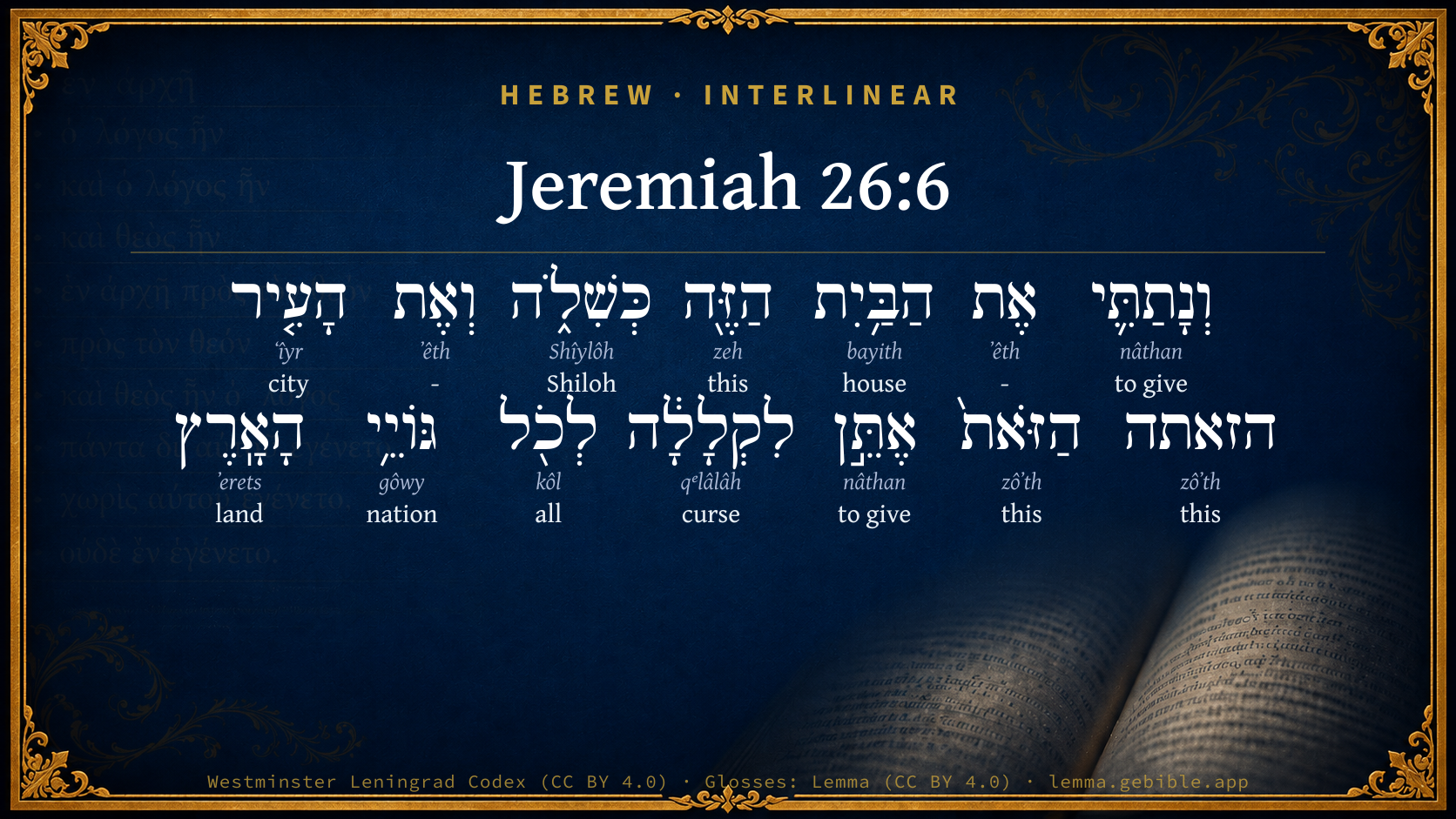
Hebrew (Westminster Leningrad Codex) Jeremiah 26:6 appears in the Hebrew Old Testament. The text above is from the Westminster Leningrad Codex. Each word links to its Strong’s number, a concise gloss, and parsing drawn from the Open Scriptures Hebrew Bible morphology. Click any word for its full Brown-Driver-Briggs (BDB) entry.
Download image
Cite this verse

Jeremiah 26:6 (World English Bible). Public Domain. Lemma interlinear Bible study tool, https://lemma.gebible.app/v/jeremiah/26/6.

Show BibTeX & RIS
BibTeX
RIS
English Translation
then will I make this house like Shiloh, and will make this city a curse to all the nations of the earth.
World English Bible · Public Domain
Download a study sheet

One document with this verse’s original text, its word-by-word gloss line, the meaning frame, cross-references with their text, attributed commentary, and full source and license credits — printable, and it pastes into notes with its structure intact.

This verse Autodidact and up

Study sheet (.html) Plain text (.txt)

A passage Seminary Student

Up to 50 verses in one chapter. A passage sheet keeps up to 6 commentary sources and 12 cross-references per verse, in the order this page ranks them, and says so on the sheet whenever that leaves anything out. Ask for a single verse and you get the Autodidact verse sheet above.

Everything on this page stays free to read, with no account — the sheet is a download of what is already on screen, not access to it.

Want to remove ads? Support Godless Engineer
Compare translations 3

The same verse in 3 English versions, stacked beneath the original-language interlinear above. Click any original word for its lexicon entry.

Each is an independent rendering of the whole verse — the interlinear is not word-aligned to these translations.

Highlighted words mark where these versions differ — a whole-verse word diff, not a word-by-word alignment.

  • World English Bible Public Domain
    then will I make this house like Shiloh, and will make this city a curse to all the nations of the earth.
  • King James Version Public Domain
    Then will I make this house like Shiloh, and will make this city a curse to all the nations of the earth.
  • unfoldingWord Literal Text CC BY-SA 4.0
    then I will make this house like Shiloh, and this city I will make as a curse for all the nations of the earth.”

unfoldingWord Literal Text — © unfoldingWord, licensed CC BY-SA 4.0. Word-aligned USFM3 via Door43 (git.door43.org/unfoldingWord/en_ult).

Versions to compare (up to 4)

3 of 4 selected

Show all 18 translations

Every available English version of this verse, each an independent rendering of the whole verse.

  • World English Bible Public Domain
    then will I make this house like Shiloh, and will make this city a curse to all the nations of the earth.
  • Berean Standard Bible Public Domain
    then I will make this house like Shiloh, and I will make this city an object of cursing among all the nations of the earth.’”
  • Majority Standard Bible Public Domain
    then I will make this house like Shiloh, and I will make this city an object of cursing among all the nations of the earth.’”
  • King James Version Public Domain
    Then will I make this house like Shiloh, and will make this city a curse to all the nations of the earth.
  • American Standard Version (1901) Public Domain
    then will I make this house like Shiloh, and will make this city a curse to all the nations of the earth.
  • Revised Version (1885) Public Domain
    then will I make this house like Shiloh, and will make this city a curse to all the nations of the earth.
  • Geneva Bible (1599) Public Domain
    Then will I make this House like Shiloh, and will make this citie a curse to all the nations of the earth.
  • Douay-Rheims (1899) Public Domain
    I will make this house like Silo: and I will make this city a curse to all the nations of the earth.
  • Young's Literal Translation Public Domain
    Then I have given up this house as Shiloh, and this city I give up for a reviling to all nations of the earth.'
  • Literal Standard Version CC BY-SA 4.0
    then I have given up this house as Shiloh, and this city I give up for a reviling to all nations of the earth.”
  • Unlocked Literal Bible CC BY-SA 4.0
    then I will make this house like Shiloh; I will turn this city into a curse in the sight of all the nations on earth.'”
  • unfoldingWord Literal Text CC BY-SA 4.0
    then I will make this house like Shiloh, and this city I will make as a curse for all the nations of the earth.”
  • Darby Bible Public Domain
    -- then will I make this house like Shiloh, and will make this city a curse to all the nations of the earth.
  • World Messianic Bible Public Domain
    then I will make this house like Shiloh, and will make this city a curse to all the nations of the earth.’”
  • Webster's Bible Public Domain
    Then will I make this house like Shiloh, and will make this city a curse to all the nations of the earth.
  • Free Bible Version CC BY-SA 4.0
    then I will destroy this Temple like I did Shiloh, and I will make this city a curse word used by everyone on earth.
  • Bible in Basic English Public Domain
    Then I will make this house like Shiloh, and will make this town a curse to all the nations of the earth.
  • JPS Tanakh (1917) Public Domain
    then will I make this house like Shiloh, and will make this city a curse to all the nations of the earth.'

Literal Standard Version (2020), Covenant Press — licensed CC BY-SA 4.0. Text via the HelloAO Bible API (eBible.org). Unlocked Literal Bible (unfoldingWord) — licensed CC BY-SA 4.0. Text via the HelloAO Bible API (eBible.org). unfoldingWord Literal Text — © unfoldingWord, licensed CC BY-SA 4.0. Word-aligned USFM3 via Door43 (git.door43.org/unfoldingWord/en_ult). Free Bible Version, Dr. Jonathan Gallagher — licensed CC BY-SA 4.0. Text via the HelloAO Bible API (eBible.org).

Word by word

More ways to search: Search by grammar → Find every occurrence → Compare this word →

Practice this passage: Drill this verse → Learn its vocabulary →

כְּשִׁלֹ֑ה
Shîylôh
H7887
“like/as · Shiloh”
Preposition + Noun, Proper
Part of Speech
Preposition + Noun
Type
Proper
Full BDB Definition

Origin: from the same as H7886

TWOT: 2376

Shiloh = "place of rest" - a city in Ephraim and temporary home of the Ark of the Covenant and the Tabernacle, the place where Samuel grew up
  1. וְנָתַתִּ֛י nâthan H5414 “and · to give” Conjunction + Verb, Qal, Sequential Perfect, 1st Person, Common, Singular
  2. אֶת ʼêth H853 “-” Particle, Direct Object
  3. הַבַּ֥יִת bayith H1004 “the · house” Particle, Definite Article + Noun, Common, Masculine, Singular, Absolute
  4. הַזֶּ֖ה zeh H2088 “the · this” Particle, Definite Article + Pronoun, Demonstrative, Masculine, Singular
  5. וְאֶת ʼêth H853 “and · -” Conjunction + Particle, Direct Object
  6. הָעִ֤יר ʻîyr H5892 “the · city” Particle, Definite Article + Noun, Common, Feminine, Singular, Absolute
  7. הזאתה zôʼth H2063 “the · this” Particle, Definite Article + Pronoun, Demonstrative, Feminine, Singular
  8. הַזֹּאת֙ zôʼth H2063 “the · this” Particle, Definite Article + Pronoun, Demonstrative, Feminine, Singular
  9. אֶתֵּ֣ן nâthan H5414 “to give” Verb, Qal, Imperfect, 1st Person, Common, Singular
  10. לִקְלָלָ֔ה qᵉlâlâh H7045 “to/for · curse” Preposition + Noun, Common, Feminine, Singular, Absolute
  11. לְכֹ֖ל kôl H3605 “to/for · all of” Preposition + Noun, Common, Masculine, Singular, Construct
  12. גּוֹיֵ֥י gôwy H1471 “nations of” Noun, Common, Masculine, Plural, Construct
  13. הָאָֽרֶץ ʼerets H776 “the · land” Particle, Definite Article + Noun, Common, Both, Singular, Absolute

About this verse

These counts appear in no published source. They are computed here, from the morphology-tagged text and Lemma’s own curated glosses. What Lemma adds →

14
words
11
distinct lemmas
Prophets
section

Shared distinctive vocabulary

כְּשִׁלֹ֑ה Shiloh H7887 occurs in 30 verses of the Hebrew Bible. Also found in:

Grammatical profile

  • 2 verbs
  • 7 nouns
  • 3 pronouns
  • 2 particles

Verb forms

  • וְנָתַתִּ֛י Qal · Sequential Perfect
  • אֶתֵּ֣ן Qal · Imperfect

Repetition

Words recur within this verse — often emphatic in Hebrew:

  • וְנָתַתִּ֛י to give H5414 ×2
  • הזאתה this H2063 ×2

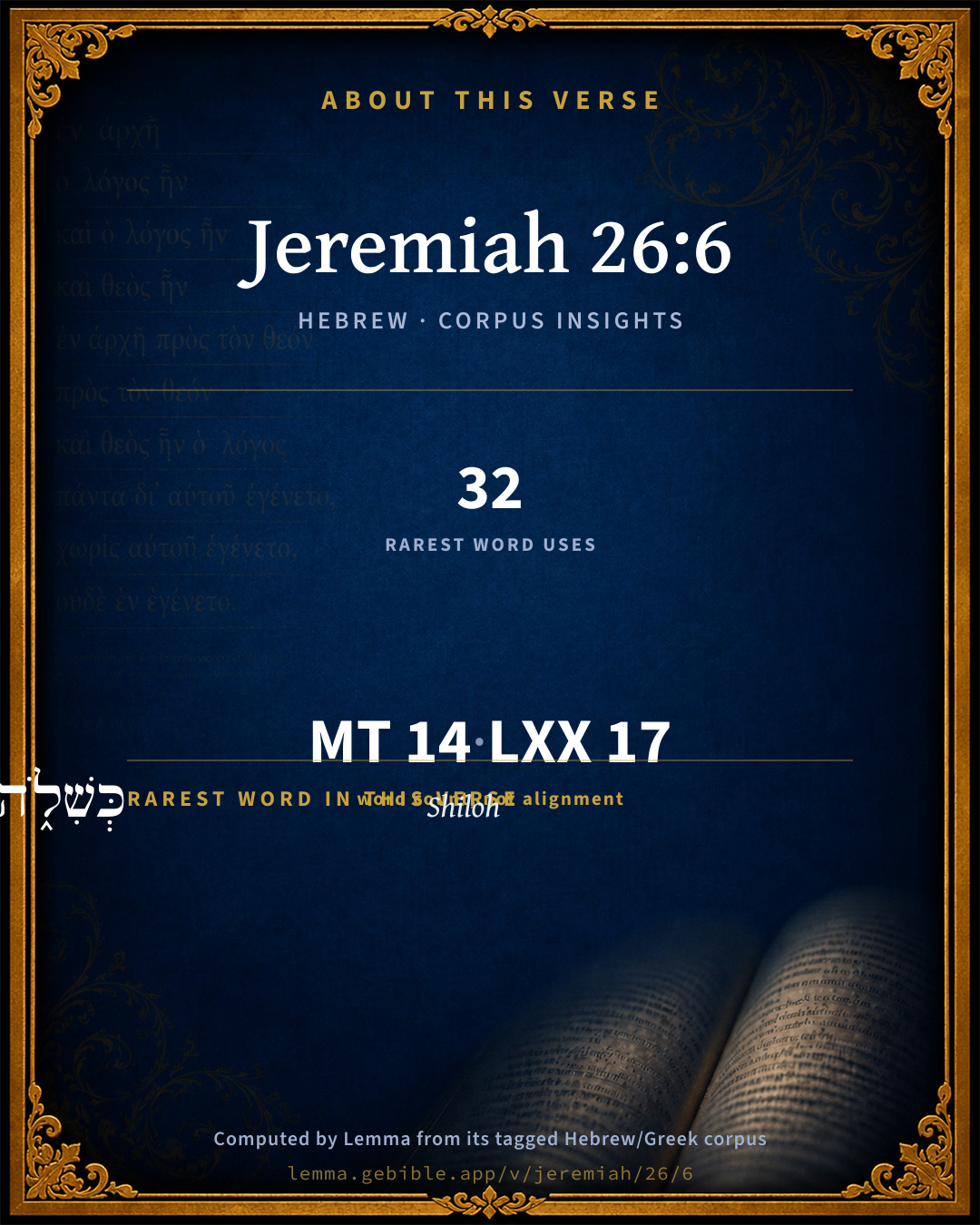
Hebrew & Septuagint length

In the original languages it is 14 Hebrew tokens and 17 Greek tokens — but the two are counted differently (Hebrew bundles its prefixes and suffixes into one token; the Greek is in lemma form), so that isn’t a like-for-like length.

Cross-references

16

Topical passages linked to Jeremiah 26:6 in the Treasury of Scripture Knowledge — connected by theme and wording, ordered by reader-vote popularity; previews shown in the World English Bible.

  • 2 Kings 22:19 because your heart was tender, and you did humble yourself before Yahweh, when you heard what I spoke against this place, and against the inhabitants of it, that they should become a desolation and a curse, and have torn your clothes, and wept before me; I also have heard you, says Yahweh.
  • Jeremiah 24:9 I will even give them up to be tossed back and forth among all the kingdoms of the earth for evil; to be a reproach and a proverb, a taunt and a curse, in all places where I shall drive them.
  • Isaiah 65:15 You shall leave your name for a curse to my chosen; and the Lord Yahweh will kill you; and he will call his servants by another name:
  • Jeremiah 25:18 [to wit], Jerusalem, and the cities of Judah, and the kings of it, and the princes of it, to make them a desolation, an astonishment, a hissing, and a curse, as it is this day;
  • 1 Samuel 4:10–12 The Philistines fought, and Israel was struck, and they fled every man to his tent: and there was a very great slaughter; for there fell of Israel thirty thousand footmen.
  • 1 Samuel 4:19–22 His daughter-in-law, Phinehas' wife, was with child, near to be delivered: and when she heard the news that the ark of God was taken, and that her father-in-law and her husband were dead, she bowed herself and brought forth; for her pains came on her.
  • Psalms 78:60–64 So that he forsook the tent of Shiloh, The tent which he placed among men;
  • Jeremiah 7:12–14 But go you now to my place which was in Shiloh, where I caused my name to dwell at the first, and see what I did to it for the wickedness of my people Israel.
  • Daniel 9:11 Yes, all Israel have transgressed your law, even turning aside, that they should not obey your voice: therefore has the curse been poured out on us, and the oath that is written in the law of Moses the servant of God; for we have sinned against him.
  • Joshua 18:1 The whole congregation of the children of Israel assembled themselves together at Shiloh, and set up the tent of meeting there: and the land was subdued before them.
  • Isaiah 43:28 Therefore I will profane the princes of the sanctuary; and I will make Jacob a curse, and Israel a reviling.
  • Jeremiah 29:22 and of them shall be taken up a curse by all the captives of Judah who are in Babylon, saying, Yahweh make you like Zedekiah and like Ahab, whom the king of Babylon roasted in the fire;
  • Jeremiah 42:18 For thus says Yahweh of Hosts, the God of Israel: As my anger and my wrath has been poured forth on the inhabitants of Jerusalem, so shall my wrath be poured forth on you, when you shall enter into Egypt; and you shall be an object of horror, and an astonishment, and a curse, and a reproach; and you shall see this place no more.
  • Jeremiah 44:8–12 in that you provoke me to anger with the works of your hands, burning incense to other gods in the land of Egypt, where you are gone to sojourn; that you may be cut off, and that you may be a curse and a reproach among all the nations of the earth?
  • Jeremiah 44:22 so that Yahweh could no longer bear, because of the evil of your doings, and because of the abominations which you have committed; therefore is your land become a desolation, and an astonishment, and a curse, without inhabitant, as it is this day.
  • Malachi 4:6 He will turn the hearts of the fathers to the children, and the hearts of the children to their fathers, lest I come and strike the earth with a curse."

Cross-references courtesy of OpenBible.info (CC BY 4.0).

Hebrew and Greek witnesses Masoretic Hebrew ↔ Greek Septuagint

The same verse in the two great witnesses to the Old Testament, shown verse-for-verse.

These are two independent witnesses, not word-aligned to each other, and the Septuagint is shown in lemma (dictionary) form.

Hebrew Jeremiah 26:6 Masoretic · Westminster Leningrad Codex

וְנָתַתִּ֛י אֶת הַבַּ֥יִת הַזֶּ֖ה כְּשִׁלֹ֑ה וְאֶת הָעִ֤יר הזאתה הַזֹּאת֙ אֶתֵּ֣ן לִקְלָלָ֔ה לְכֹ֖ל גּוֹיֵ֥י הָאָֽרֶץ

then will I make this house like Shiloh, and will make this city a curse to all the nations of the earth.

World English Bible · Public Domain

Greek LXX Structure differs

In the Septuagint, Jeremiah is about an eighth shorter than the Hebrew and arranges its material differently — the Oracles Against the Nations (Hebrew chapters 46–51) appear in the middle of the Greek book, after 25:13. Because the chapter and verse boundaries do not line up, a verse-for-verse comparison with the Hebrew is not shown.

A verse-for-verse comparison isn’t shown here because the chapters and verses don’t line up. Switch to the LXX edition with the MT / LXX toggle above to read the Greek directly.

Hebrew: Westminster Leningrad Codex (CC BY 4.0). Greek: Septuagint (public domain); English from a public-domain English Septuagint. How the Septuagint differs from the Hebrew →

Targum (Aramaic paraphrase)

1

The Targum is the ancient Jewish Aramaic paraphrase of the Hebrew Scriptures — an interpretive translation, not the Hebrew text itself. Onkelos (literal) and Pseudo-Jonathan (expansive) render the Torah, and Jonathan the Prophets. Coverage is partial: where no permissively-licensed English translation exists for a verse, only the Aramaic is shown. This is verse-level text, not a word-by-word alignment to the Hebrew.

  1. Targum Jonathan Prophets (Joshua–Malachi)
    וְאֶתֵּן יַת בֵּיתָא הָדֵין כְּשִׁלוֹ וְיַת קַרְתָּא הָדָא אֶתֵּן לִלְוָטָא לְכָל עַמְמֵי אַרְעָא:

    (no public-domain English translation for this verse)

    Targum Jonathan — Aramaic: “Mikraot Gedolot” (public domain). English: “Sefaria Community Translation” (CC0 1.0 (public-domain dedication)); “London "Chaldee Paraphrase," 1871” (public domain). Text via Sefaria.

Commentary

Notes on Jeremiah 26:6 from classic Christian and Jewish commentators (each source and its license shown beneath its notes). The classic Christian expositions comment on the surrounding passage and are grouped to its opening verse, so a note may address several verses; the Jewish commentaries on the Tanakh (Rashi and others) are per-verse, so they appear only where the commentator wrote on this verse.

Lemma curates 59 commentaries, every one of them public domain or Creative Commons licensed, each selected and text-cleaned for this edition rather than reprinted as found. About our sources →

Trapp's Complete Commentary

John Trapp

Jer 26:6 Then will I make this house like Shiloh, and will make this city a curse to all the nations of the earth.

Ver. 6. Then will I make this house like Shiloh.] This same threat Jeremiah had uttered in good Josiah’s days, {Jer 7:12-14} and no harm ensued. Now, tempora mutantur, truth breedeth hatred; and the prophet is in danger, for discharging his conscience, to be murdered; as were Rogers, Bradford, Taylor, and other famous preachers in those dog days of Queen Mary.

John Trapp, A Commentary or Exposition upon All the Books of the Old and New Testament (1647–1656) — public domain. Text from a community e-Sword module.

Geneva Bible (1599)

Geneva Bible translators

Read Jer. 7:12.

So that when they would curse any, they shall say, God do to thee as to Jerusalem.

Geneva Bible (1599) marginal notes — public domain. Text via Bolls.life.

Jamieson, Fausset & Brown

Robert Jamieson, A. R. Fausset & David Brown

like Shiloh--(see on Jer 7:12; Jer 7:14; Sa1 4:10-12; Psa 78:60).

curse-- (Jer 24:9; Isa 65:15).

Jamieson, Fausset & Brown — Commentary Critical and Explanatory on the Whole Bible (1871) — public domain (CC PDM 1.0). Text via the HelloAO Bible API.

John Calvin's Commentaries

Then will I make, etc.: the copulative is to be rendered here as an adverb of time. What had been just said, “but ye have not hearkened,” was by way of anticipation; for the Jews, swelling with great arrogance, might have immediately said, “Oh! what new thing dost thou bring? Except ye hearken to my voice, saith Jehovah, to walk in my Law, which I have set before you, as though all this were not well known even to children among us; and yet thou pretendest to be the herald of some extraordinary prophecy; certainly such boasting will be deemed puerile by all wise men.” Thus then they might have spoken, but the Prophet here briefly checks the insolence of such a foolish censure, but ye have not hearkened; as though he had said, that he had not been sent in vain to speak of a thing as it were new and unusual, because the Jews had corrupted the whole Law, had become disobedient, unteachable, and unbelieving, and had despised both the Law of God and his Prophets.

John Calvin's Commentaries (1540-1563) — public domain. Text from the Calvin Translation Society English edition (1840s-50s) via the Christian Classics Ethereal Library (ccel.org). Calvin's coverage is partial (roughly two-thirds of the Bible); uncommented books and verses are honest gaps, never fabricated. The 19th-century editor's footnotes and remarks are omitted so the notes are faithfully Calvin's own voice.

Ellicott's Commentary for English Readers

(6) I will make this house like Shiloh.—See Notes on Jer_7:14. The surprise and anger with which the announcement was received indicate that it was now heard for the first time, and so far confirms the view that we have here a summary of the discourse given in extenso, and probably edited, as it were, with many additions, in Jeremiah 7-10

A Bible Commentary for English Readers, edited by Charles John Ellicott (1878–1897) — public domain. Text from a community e-Sword module.

The Cambridge Bible for Schools and Colleges

gen. ed. J. J. S. Perowne

6. Shiloh] See on Jer_7:12.

will make this city a curse to] will make all nations use it as an example when imprecating curses on their enemies. Cp. Jer_24:9 and contrast Gen_12:3; Gen_22:18.

The Cambridge Bible for Schools and Colleges (gen. ed. J. J. S. Perowne; Cambridge University Press, 1878–1918) — public domain. Text from a community e-Sword module.

John Gill's Exposition

Then will I make this house like Shiloh,.... Where the ark was until it was taken by the Philistines; and then the Lord forsook his tabernacle there, Psa 78:60; and so he threatens to do the like to the temple at Jerusalem, should they continue in their disobedience to him; See Gill on Jer 7:12 and See Gill on Jer 7:14;

and will make this city a curse to all the nations of the earth; that is, the city of Jerusalem, which should be taken up, and used proverbially in all countries; who, when they would curse anyone, should say, the Lord make thee as Jerusalem, or do unto thee as he has done to Jerusalem.

John Gill's Exposition of the Whole Bible (1746–1763) — public domain (CC PDM 1.0). Text via the HelloAO Bible API.

Haydock's Catholic Bible Commentary

Silo. Chap. vii. 12. (Calmet) --- Curse. No greater punishment could be threatened or endured in this world. (Haydock)

George Leo Haydock (1774–1849), Haydock's Catholic Family Bible and Commentary, 1859 edition — public domain. Excludes Psalms (Douay-Rheims chapter numbering differs from Protestant) and Deuterocanonical books (Catholic canon only).

Matthew Poole's English Annotations

Shiloh was the city where the tabernacle was pitched, and the ark, the symbol of God’s presence, was, Jdg 18:31; 21:19 1Sa 1:3,9,24; 3:21. Out of it the ark was carried, 1Sa 4:3, when it was taken by the Philistines, and was carried no more thither, but rested in Kirjath-jearim, 1Sa 7:2, where it rested twenty years. David fetched it from thence, 2Sa 6:2. So that, as the psalmist tells us, Psa 78:60,61, God forsook the tabernacle of Shiloh; here he threateneth to do the like as to the temple, because of which they had such a confidence. Jeremiah, Jer 7:12, had spoken much the same thing; it is a threatening that God would deprive them of his ordinances. To which he addeth a threatening of destruction to the city, to that degree, that when men should curse any place, they should say, God do unto thee as he did to Jerusalem. We had the like phrase Jer 24:9, and have it again Jer 29:18,22, &c.

Matthew Poole's English Annotations on the Holy Bible (1683–1685) — public domain. Text from a community e-Sword/MySword module.

Whedon's Commentary on the Bible

Daniel D. Whedon

6. Shiloh — Where God once dwelt. Compare Jer_7:14. Once the sanctuary of the people, even as Jerusalem, but now a desolation.

Daniel D. Whedon (gen. ed.), Commentary on the Old and New Testaments (1874–1909) — public domain. Text from a community e-Sword module.

The Pulpit Commentary

Spiritual prerogative not inalienable.

The utterance of these words is the chief charge against the prophet; only, as in the case of Stephen, (Act_6:13) the statement is mutilated in the accusation, the condition of the prophecy being entirely ignored (vers. 9, 11). The principle of indestructible consecration is still clung to by many in the face of the plainest declarations of Scripture. It may be well, therefore, to discuss its bearings in the present instance.

I THE CIRCUMSTANCES OF ITS BESTOWAL. It was Divine grace to which it was due; but for this Jerusalem would have been like other cities. This favor had to be continued from moment to moment, being indeed only secured by the continued indwelling of the Holy Spirit. What was due to grace could be freely withdrawn by its Donor. As a matter of history, the most sacred places of Israel were repeatedly ruined and profaned. This destruction is matter of ancient prophecy, as in the present instance. (Dan_9:26 Mar_13:2)

II THE TERMS OF ITS TENURE. The repeated warnings and injunctions given prove that the consecration of the sacred places depended upon their occupancy by God"s Spirit, and this in turn upon the faithfulness of his people. Either these had no meaning or the grace could be taken away. Jeremiah said, "If ye will not hearken to me, then will I make this house like Shiloh." The testimony of 1Ki_9:6-8 is precisely similar. (Psa_78:60 Jer_7:12)

III ITS OWN ESSENTIAL NATURE. Strictly speaking, all things made by God are good and holy, but they may be desecrated, in a secondary sense, by being misused, profaned, or defiled. Institutions, buildings, or material or mechanical structures of any sort, are at best but secondary receptacles of Divine grace. "God dwelleth not in temples made with hands." It is the person occupying these who is the true temple, and when he is defiled by sin or unfaithfulness there can be no virtue inherent in the places which he frequents. Consecration is alone transmissible through the operation and presence of the Holy Spirit, and ceases with the withdrawal of the same. It consists primarily in the personal character through which it is expressed, and only secondarily in places and things, through the uses and practices carried on by holy men in connection with them. To the unholy, therefore, every place and thing will be unholy, and vice versa. (Tit_1:15) Material edifices, organization, and official prerogative, are nothing apart from this personal consecration associated with them; and the loss of that involves the loss of usefulness, of peace, and of sacredness, even in connection with that with which they have been most identified. M.

The Pulpit Commentary (1880–1919), ed. H.D.M. Spence-Jones & Joseph S. Exell — public domain. Text from a community e-Sword module.

Lesson kit

Teaching starters — assembled from the data on this page, not authored interpretation. Every prompt links to the verse data it draws on. Edit before teaching.

Jeremiah, in the Prophets, opens this verse with 14 words (11 distinct Hebrew lemmas). Its most distinctive word is Shîylôh (“Shiloh”). A historical commentator’s framing appears above. Read the whole chapter for the surrounding context.

Discussion questions

  1. How does “Shiloh” (Shîylôh) shape what this verse is saying?
  2. How does Joshua 18:1, which shares the word «Shiloh», read alongside this verse?
  3. What does the repetition of “to give” (2× in this one verse) do in this verse?
  4. «וְנָתַתִּ֛י» is a Qal Sequential Perfect verb. How does that grammatical form shape the action described?
  5. Compare how Trapp's Complete Commentary and Geneva Bible (1599) read this verse. Where do they agree or differ?

Things to notice

Reading settings

Reading text

Shown beneath each verse's original-language words.

Old Testament
Old Testament edition

Read the OT as the Masoretic Hebrew (MT) or the Greek Septuagint (LXX).

English shown for the Greek Septuagint (in the Hebrew ↔ Greek comparison).

Comparing translations? Open the Compare panel on any verse page to stack up to four side by side.