
Psalms 57:8

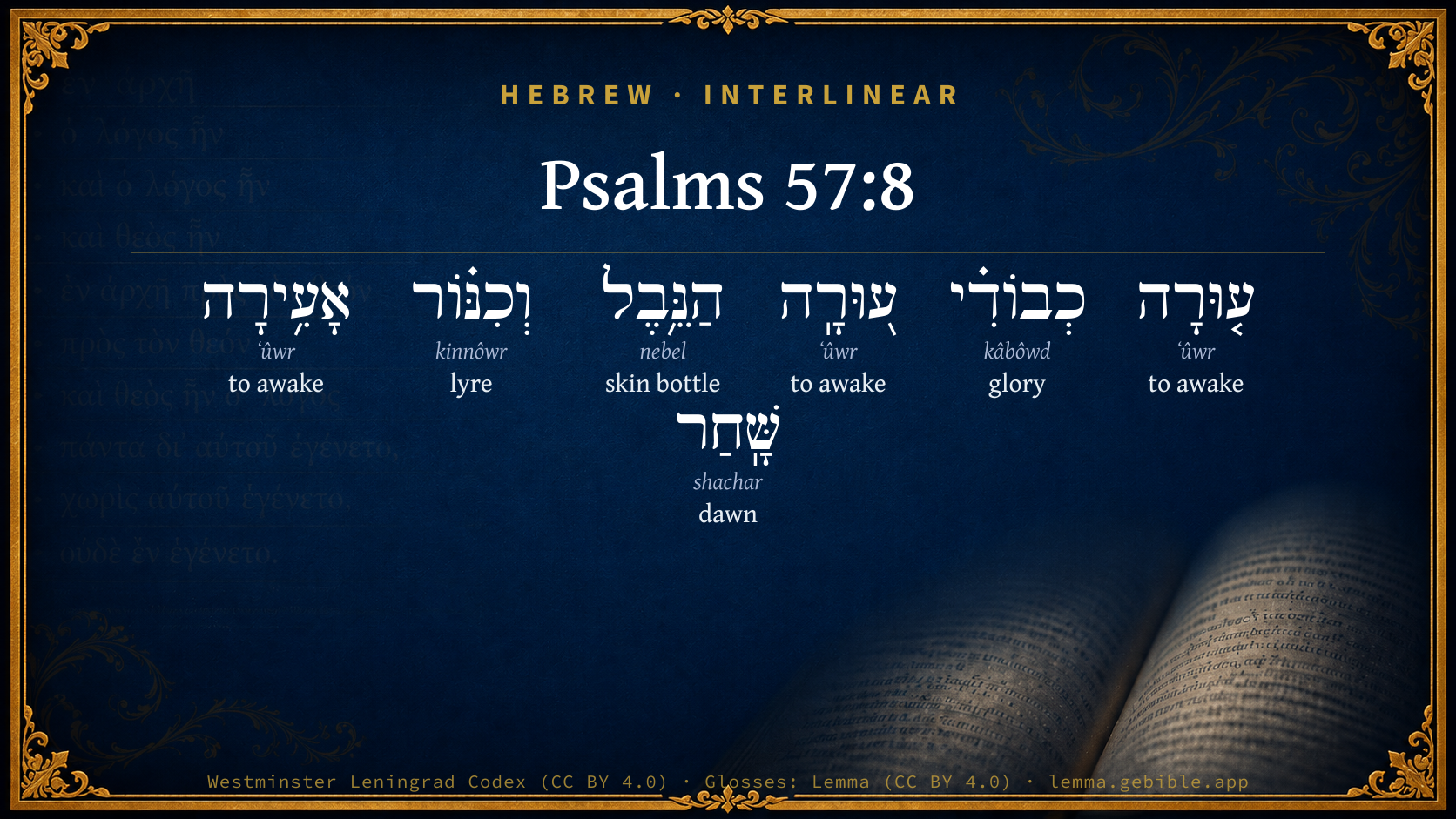
Hebrew (Westminster Leningrad Codex) Psalms 57:8 appears in the Hebrew Old Testament. The text above is from the Westminster Leningrad Codex. Each word links to its Strong’s number, a concise gloss, and parsing drawn from the Open Scriptures Hebrew Bible morphology. Click any word for its full Brown-Driver-Briggs (BDB) entry.
Download image
Cite this verse

Psalms 57:8 (World English Bible). Public Domain. Lemma interlinear Bible study tool, https://lemma.gebible.app/v/psalms/57/8.

Show BibTeX & RIS
BibTeX
RIS
English Translation
Wake up, my glory! Wake up, psaltery and harp! I will wake up the dawn.
World English Bible · Public Domain
Download a study sheet

One document with this verse’s original text, its word-by-word gloss line, the meaning frame, cross-references with their text, attributed commentary, and full source and license credits — printable, and it pastes into notes with its structure intact.

This verse Autodidact and up

Study sheet (.html) Plain text (.txt)

A passage Seminary Student

Up to 50 verses in one chapter. A passage sheet keeps up to 6 commentary sources and 12 cross-references per verse, in the order this page ranks them, and says so on the sheet whenever that leaves anything out. Ask for a single verse and you get the Autodidact verse sheet above.

Everything on this page stays free to read, with no account — the sheet is a download of what is already on screen, not access to it.

Want to remove ads? Support Godless Engineer
Compare translations 3

The same verse in 3 English versions, stacked beneath the original-language interlinear above. Click any original word for its lexicon entry.

Each is an independent rendering of the whole verse — the interlinear is not word-aligned to these translations.

Highlighted words mark where these versions differ — a whole-verse word diff, not a word-by-word alignment.

  • World English Bible Public Domain
    Wake up, my glory! Wake up, psaltery and harp! I will wake up the dawn.
  • King James Version Public Domain
    Awake up, my glory; awake, psaltery and harp: I myself will awake early.
  • unfoldingWord Literal Text CC BY-SA 4.0
    Awake, my glory! Awake, lyre and harp! Let me awaken the dawn.

unfoldingWord Literal Text — © unfoldingWord, licensed CC BY-SA 4.0. Word-aligned USFM3 via Door43 (git.door43.org/unfoldingWord/en_ult).

Versions to compare (up to 4)

3 of 4 selected

Show all 18 translations

Every available English version of this verse, each an independent rendering of the whole verse.

  • World English Bible Public Domain
    Wake up, my glory! Wake up, psaltery and harp! I will wake up the dawn.
  • Berean Standard Bible Public Domain
    Awake, my glory! Awake, O harp and lyre! I will awaken the dawn.
  • Majority Standard Bible Public Domain
    Awake, my glory! Awake, O harp and lyre! I will awaken the dawn.
  • King James Version Public Domain
    Awake up, my glory; awake, psaltery and harp: I myself will awake early.
  • American Standard Version (1901) Public Domain
    Awake up, my glory; awake, psaltery and harp: I myself will awake right early.
  • Revised Version (1885) Public Domain
    Awake up, my glory; awake, psaltery and harp: I myself will awake right early.
  • Geneva Bible (1599) Public Domain
    Awake my tongue, awake viole and harpe: I wil awake early.
  • Douay-Rheims (1899) Public Domain
    My heart is ready, O God, my heart is ready: I will Sing, and rehearse a psalm.
  • Young's Literal Translation Public Domain
    Awake, mine honour, awake, psaltery and harp, I awake the morning dawn.
  • Literal Standard Version CC BY-SA 4.0
    Awake, my glory, awake, stringed instrument and harp, || I awake the morning dawn.
  • Unlocked Literal Bible CC BY-SA 4.0
    Wake up, my honored heart; wake up, lute and harp; I will wake up the dawn.
  • unfoldingWord Literal Text CC BY-SA 4.0
    Awake, my glory! Awake, lyre and harp! Let me awaken the dawn.
  • Darby Bible Public Domain
    Awake, my glory; awake, lute and harp: I will wake the dawn.
  • World Messianic Bible Public Domain
    Wake up, my glory! Wake up, lute and harp! I will wake up the dawn.
  • Webster's Bible Public Domain
    \\57:7\\My heart is fixed, O God, my heart is fixed: I will sing and give praise.
  • Free Bible Version CC BY-SA 4.0
    I say to myself, “Wake up!” Wake up, harp and lyre! I will wake up the dawn!
  • Bible in Basic English Public Domain
    You are my glory; let the instruments of music be awake; I myself will be awake with the dawn.
  • JPS Tanakh (1917) Public Domain
    (57-9) Awake, my glory; awake, psaltery and harp; I will awake the dawn.

Literal Standard Version (2020), Covenant Press — licensed CC BY-SA 4.0. Text via the HelloAO Bible API (eBible.org). Unlocked Literal Bible (unfoldingWord) — licensed CC BY-SA 4.0. Text via the HelloAO Bible API (eBible.org). unfoldingWord Literal Text — © unfoldingWord, licensed CC BY-SA 4.0. Word-aligned USFM3 via Door43 (git.door43.org/unfoldingWord/en_ult). Free Bible Version, Dr. Jonathan Gallagher — licensed CC BY-SA 4.0. Text via the HelloAO Bible API (eBible.org).

Word by word

More ways to search: Search by grammar → Find every occurrence → Compare this word →

Practice this passage: Drill this verse → Learn its vocabulary →

About this verse

These counts appear in no published source. They are computed here, from the morphology-tagged text and Lemma’s own curated glosses. What Lemma adds →

7
words
5
distinct lemmas
Wisdom
section

Notable vocabulary

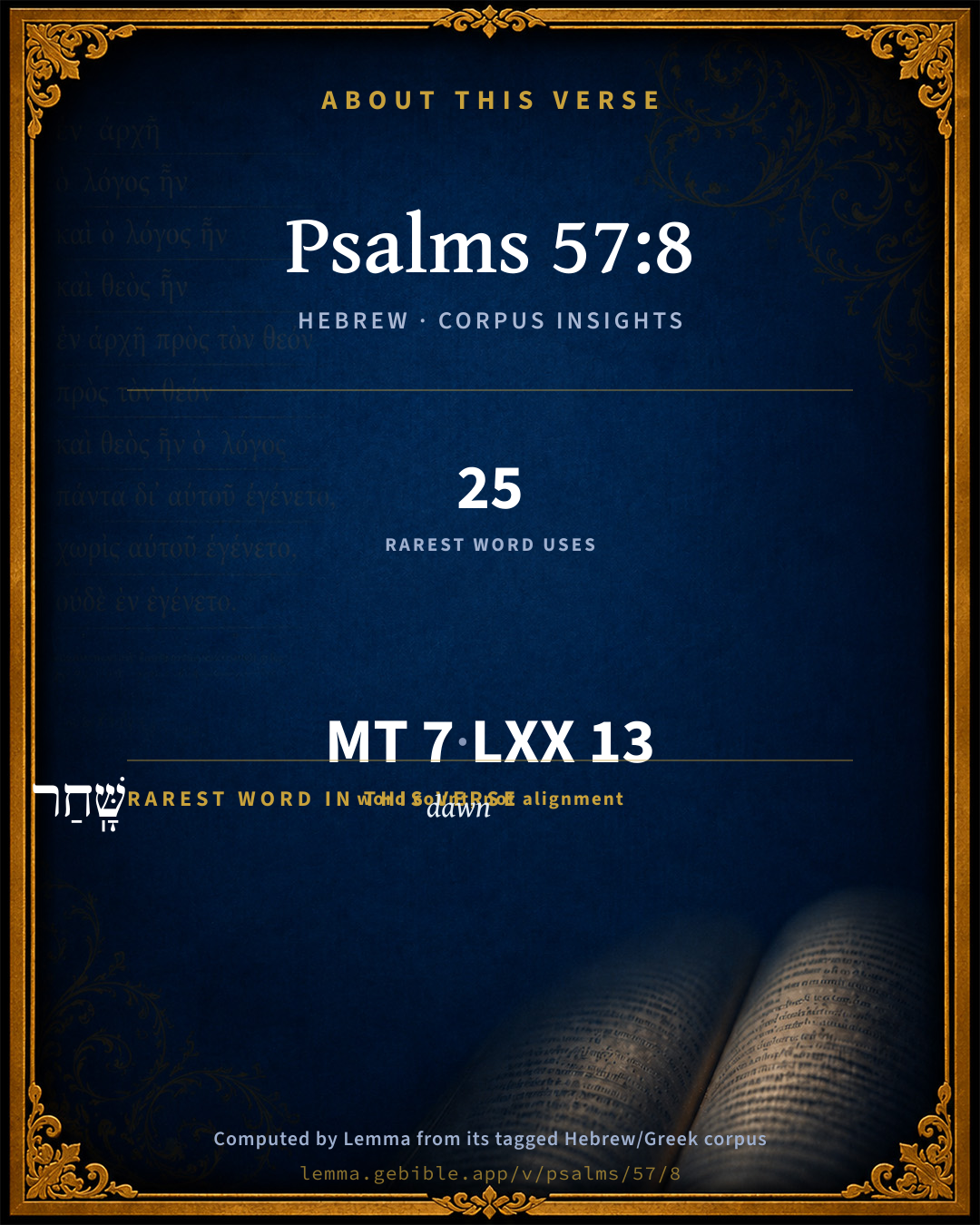
The rarest word here is שָּֽׁחַר dawn H7837 — appearing just 25 times in the whole Hebrew Bible.

Shared distinctive vocabulary

שָּֽׁחַר dawn H7837 occurs in 24 verses of the Hebrew Bible. Also found in:

Grammatical profile

  • 3 verbs
  • 4 nouns

Verb forms

  • ע֤וּרָה Qal · Imperative
  • ע֭וּרָֽה Qal · Imperative
  • אָעִ֥ירָה Hiphil · Cohortative

Repetition

A word recurs within this verse — often emphatic in Hebrew:

  • ע֤וּרָה to awake H5782 ×3

Hebrew & Septuagint length

In English translation the verse runs 15 words from the Hebrew and 11 from the Septuagint (LXX English) — closely comparable.

A rough comparison of the two English renderings, which tokenize alike — not a word-level alignment.

Word counts can differ between the Hebrew and the Greek without any difference in meaning — e.g. the Hebrew direct-object marker אֵת has no separate Greek word, and Greek often adds the article ὁ.

In the original languages it is 7 Hebrew tokens and 13 Greek tokens — but the two are counted differently (Hebrew bundles its prefixes and suffixes into one token; the Greek is in lemma form), so that isn’t a like-for-like length.

Cross-references

8

Topical passages linked to Psalms 57:8 in the Treasury of Scripture Knowledge — connected by theme and wording, ordered by reader-vote popularity; previews shown in the World English Bible.

  • Psalms 16:9 Therefore my heart is glad, and my tongue rejoices. My body shall also dwell in safety.
  • Psalms 30:12 To the end that my heart may sing praise to you, and not be silent. Yahweh my God, I will give thanks to you forever!
  • Judges 5:12 Awake, awake, Deborah; Awake, awake, utter a song: Arise, Barak, and lead away your captives, you son of Abinoam.
  • Psalms 108:1–3 My heart is steadfast, God. I will sing and I will make music with my soul.
  • Isaiah 52:1 Awake, awake, put on your strength, Zion; put on your beautiful garments, Jerusalem, the holy city: for henceforth there shall no more come into you the uncircumcised and the unclean.
  • Acts 2:26 Therefore my heart was glad, and my tongue rejoiced. Moreover my flesh also will dwell in hope;
  • Psalms 150:3 Praise him with the sounding of the trumpet! Praise him with harp and lyre!
  • Isaiah 52:9 Break forth into joy, sing together, you waste places of Jerusalem; for Yahweh has comforted his people, he has redeemed Jerusalem.

Cross-references courtesy of OpenBible.info (CC BY 4.0).

Hebrew and Greek witnesses Masoretic Hebrew ↔ Greek Septuagint

The same verse in the two great witnesses to the Old Testament, shown verse-for-verse.

You’re reading Greek Psalm 56 (Hebrew Psalm 57). The Septuagint counts the superscription, so verse numbers can differ from the Hebrew — chapter-level alignment, not verse-by-verse. Numbering follows Rahlfs.

These are two independent witnesses, not word-aligned to each other, and the Septuagint is shown in lemma (dictionary) form.

Hebrew Psalms 57:8 Masoretic · Westminster Leningrad Codex

ע֤וּרָה כְבוֹדִ֗י ע֭וּרָֽה הַנֵּ֥בֶל וְכִנּ֗וֹר אָעִ֥ירָה שָּֽׁחַר

Wake up, my glory! Wake up, psaltery and harp! I will wake up the dawn.

World English Bible · Public Domain

Greek LXX Greek Psalm 56:8 Septuagint · lemma form

ἕτοιμος ὁ καρδία ἐγώ ὁ θεός ἕτοιμος ὁ καρδία ἐγώ ᾄδω καί ψάλλω

Awake, my glory; awake, lute and harp: I will awake early.

LXX2012 (modern English Septuagint) · Public Domain

Hebrew: Westminster Leningrad Codex (CC BY 4.0). Greek: Septuagint (public domain); English from LXX2012 (modern English Septuagint) (Public Domain). How the Septuagint differs from the Hebrew →

Commentary

Notes on Psalms 57:8 from classic Christian and Jewish commentators (each source and its license shown beneath its notes). The classic Christian expositions comment on the surrounding passage and are grouped to its opening verse, so a note may address several verses; the Jewish commentaries on the Tanakh (Rashi and others) are per-verse, so they appear only where the commentator wrote on this verse.

Lemma curates 59 commentaries, every one of them public domain or Creative Commons licensed, each selected and text-cleaned for this edition rather than reprinted as found. About our sources →

Trapp's Complete Commentary

John Trapp

Psa 57:8 Awake up, my glory; awake, psaltery and harp: I [myself] will awake early.

Ver. 8. Awake up, my glory] He rouseth himself out of his natural drowsiness, as Samson once went forth and shook himself.

I myself will awake early] Or, I will awaken the morning, as the cock, by his early crowing, is said to do.

Non vigil ales ibi cristati cantibus oris

Evocat auroram - (Ovid. Metam. lib. 11).

John Trapp, A Commentary or Exposition upon All the Books of the Old and New Testament (1647–1656) — public domain. Text from a community e-Sword module.

The Biblical Illustrator

Joseph S. Exell

Psa_57:8

Awake, psaltery and harp: I myself will awake early.

Art and worship

Art and Worship--these stand in our day like two rival spirits, contending for the mastery in the religious life of this country. In all our churches, alike in country parishes as in our great cities, where popular concerts and music for the million has done so much to raise the standard of taste, there is everywhere the same sense of unquiet. To some, music is the heavenly maid, and the more elaborate and artistic the more their soul is dissolved, as Milton describes his in ecstasies under Church music--

There let the pealing organ blow

To the full-voiced choir below,

In service high, and anthems clear,

So may with sweetness through mine ear

Dissolve me into ecstasies,

And bring all heaven before mine eyes.

But all men have not this sensibility to sound. The inner spirit is not reached in this way by concord of sweet sounds. There are some to whom music is only the least disagreeable of noises. But putting aside the two extremes of the highly-trained ear, delicately strung to vibrate within at the least note of music, and the ear dull, if not deaf, to its sweet influences, the vast majority of mankind are in the middle state on the subject. They think of music very much as the lady who, when asked how she liked the art, made answer that music was good when it was good. Now, though that sounds very much like a truism, it conveys an important thought, which is this--that music only answers the end it was intended for when it stirs the soul by quickening the sensibilities. What I mean is, that through the sense of hearing a quiver of emotion is borne in on the soul, nameless and undefined, and that this taken up into the soul is there translated into thought and clothed in some intelligible form. I pity the car which is unable to be the channel through which impressions of this kind pass which enter the soul as sound, and are there transmuted into spiritual impressions. But I know that many are not impressionable enough to be set thinking in this way on high and heavenly themes. On the contrary, elaborate music acts on them almost as a disturbing element in devotion, and they are set thinking not so much of the words of the Te Deum, as of the execution of the choir. To the choir let me say that the higher the class of the music the more carefully it should be executed. It is an infliction to a trained ear to hear high symphonies and sonatas where tune is secondary, and the stress depends on time and tone, rendered amiss by a careless and half-trained choir. Now let me say a word to the congregation, and particularly to the least musical portion, as I assume the majority to be. Ought there not, in the first place, to be some give and take on your part? A service has three parts--the prayers, which are for all, without exception; the praise, which is also for all who can follow to take part in; and the sermon, in which the preacher alone speaks, and all listen with as much attention and interest as he can draw out. Awake up, lute and harp; I myself will awake right early. The psalmist first calls up sounds of praise from wood and wire--the mere mechanical instruments of music. But does he stop there? If so, we should never rise above the mere externals of worship. Our churches would be no better than concert halls, and our services only oratorios. But not to end thus, he goes on to say, I myself will awake right early. He means that the praise which began with mechanical effort, as of lute and harp, shall go on and rise into the higher region of spiritual service. I myself will awake, and that, too, right early--i.e. with all my soul and strength. If music does not go on to this it fails of its object, and does harm instead of good. Our aim, then, should be to spiritualize our services. The senses are to buoy up the spirit, as a Santa Philomela, borne aloft on a network of the expanded wings of swans. This may be a fancy, but it symbolizes a great thought of the relation of art to worship. We shall never fully reach it on this side of eternity. But in heaven the hallelujah of the long thanksgiving psalm will be the perfect marriage and union of art and worship. (J. B. Heard, M. A.)

I myself will awake early.

The Alarum

The proper subject of such a text as this would be the excellence of early rising, especially when we would serve God. The dew of dawn should be consecrated to devotion. In the original it is, I will awaken the morning. Early rising is an economy of time, an aid to health, and thus it doubly lengthens life. Our first hours are our best. But we wish to speak now rather of the awakening than to plead for the early. It is bad to awake late, but what shall be said of those who never awake at all? Better late than never, but with some, it is to be feared, it will be never. Therefore I would ring the alarm-bell till the sluggard cries, with new-born determination, I myself will awake. In the world people are, and must be, awake; let it be likewise in the Church.

I. When we would praise God. Our text is connected with the duty of praise. Let us be awake in such praise, both in private and in public. How often do we hear half-awake singing! We shall not praise at all if our souls be not awake. Sleeping birds sing not. When the three holy children sung in the fire their song was sweet indeed; yet had they not been thoroughly in earnest, they had poured forth no holy hymn.

II. Wakefulness is a great need in the entire spiritual life. It is a great want of the Church now. Slumber is so natural to us. Our talk about the things of God is very much like the talk of sleepers. Yet, says one, I hope we act consistently. I trust you do, but there are many people who walk in their sleep, and, alas! I know some Christian professors who appear to he trying very hazardous feats of sleep-walking just now. Some somnambulists have been able to walk in places where, had they been awake, they never would have been able to endure the dizzy height; and I see some Christians running awful risks, which I think they would never venture upon unless Shay had fallen into the deep sleep of carnal security. Dissenting Churches I know best about, and there are many where the minister preaches in his sleep, where prayer is offered in sleep, and even the communion is celebrated amid a profound spiritual slumber. Adam slept soundly when the taking away of his rib did not awaken him, but what shall we say of those who startle not though they are losing all the strength and glory of their souls? But we must wake up, for we are in an enemys country. Did not the Master say, Watch?

III. Certain ways of keeping yourselves awake. Make it a matter of prayer. Use means; set the alarum of a good conscience, and mind you never tamper with it: attend an earnest ministry; let in the sunlight upon your souls, the light of the Sun of Righteousness; take example from the activity of the world. I cannot sleep after such an hour, says one, for I hear the tramp of those who are going into the city, and the grind of the street traffic. Read the biographies of eminent servants of Christ who have been full of zeal for Him. They will shame us out of our sloth. Above all, hear the trumpet of the second coming, Behold, the bridegroom cometh, go ye out to meet him. Let that awaken and keep us awake.

IV. The great and urgent need that the unconverted sinner should awake. A deep and horrible sleep holds you fast. If it were not so, you would perceive your danger and be alarmed. God has many ways of waking His elect ones. See Paul. The garden at Philippi. Augustine. Have a care lest you awake too late. (C. H. Spurgeon.)

The Biblical Illustrator, edited by Joseph S. Exell (c. 1880s–1900s) — public domain. Text from a community e-Sword module.

The Treasury of David

Charles H. Spurgeon

Ver. 8. Awake up, my glory. Let the noblest powers of my nature bestir themselves: the intellect which conceives thought, the tongue which expresses it, and the inspired imagination which beautifies it --let all be on the alert now that the hour for praise has come.

Awake, psaltery and harp. Let all the music with which I am familiar be well attuned for the hallowed service of praise.

I myself will awake early. I will awake the dawn with my joyous notes. No sleepy verses and weary notes shall be heard from me; I will thoroughly arouse myself for this high employ. When we are at our best we fall short of the Lord's deserts, let us, therefore, make sure that what we bring him is our best, and, if marred with infirmity, at least let it not be deteriorated by indolence. Three times the psalmist calls upon himself to awake. Do we need so much arousing, and for such work? Then let us not spare it, for the engagement is too honourable, too needful to be left undone or ill done for want of arousing ourselves.

Ver. 8. Awake up, my glory; awake, psaltery and harp: I myself will awake early. We must prevent God by early praise as well as prayer: "The God of my mercy shall prevent me, "sings David; and every child of David must prevent God again with his songs. Jehoshaphat delighted God with instruments of music before his deliverance. Faith must tune an epinikion, a psalm of victory, before the triumph. Praise is the ingenious mother of future mercies; as the Virgin Mary sang at Hebron before the birth of her son at Bethlehem. Oh, heavenly contention between mercy and duty! Samuel Lee, 1625-1691.

Ver. 8. Awake up, my glory, etc. We must sing with excited grace. Not only with grace habitual, but with excited and actual: the musical instrument delights not but when it is played upon. In this duty we must follow Paul's advice to Timothy (2Ti 1:6), anazwpurein, stir up the grace that is in us, and cry out as David, Awake love, awake delight. Ps 57:8. The clock must be wound up before it can guide our time; the bird pleaseth not in her nest, but in her notes; the chimes only make music when they are going. Let us therefore beg the Spirit to blow upon our garden, that the spices thereof may flow out, when we set upon this joyous service. God loves active grace in duty, that the soul should be ready trimmed when it presents itself to Christ in any worship. John Wells, in "Morning Exercises, "1674.

Ver. 8. I will awake early. Literally, `I will awake the dawn.' a bold figure of poetry, as if the writer had said, --The morning shall not awake me to praise; but in my songs I will anticipate the dawn. R. T. Society's Notes.

Ver. 8. It will answer our purpose to take notice, first, of the terms David uses, and then, secondly, press the exhortation. Of the terms he uses:

1. My glory. That is my soul (say some) because the spirit of a man is the glory of a man, whereby he is dignified and raised so much above the brutes, as to be but a "little lower than the angels, "nay, to be akin to God himself, "the Father of spirits." My musical skill, say others, the glory of the artist above the unskilful; and that wherein David had the glory of excelling, as Jubal had of the first invention. My tongue, say others; for this is also the glory of a man above the dumb creatures, and the glory of a wise man above a fool. And as the tongue is the glory of a man, so the glory of the tongue is to glorify God. Praise is the glory of all other uses to which the tongue is employed; and the tongue is, in the body, that "temple of the Holy Ghost, "what the silver trumpet was in the temple of Solomon; to sound the high praises of God, and express the raised affections of our souls.

2. Awake, psaltery and harp. The one for a psalm, the other for a spiritual song or hymn; that is to say, all my musical instruments and skill I will employ in and consecrate to the glory of him who "puts new songs into my mouth." He first teaches my fingers to fight, and then to play the epinikion, or song of triumph. Sound, then, my psaltery and harp, emulous of those that are around the throne above; your melody can soften my cares, lay my fears, and turn my cave into a choir. As to these instruments in the worship of God, they were doubtless allowed to David, and to the church in his time. They were agreeable to the state of that church and people, who were led very much by their senses; and whose infant and less discerning condition made it needful for the natural man to have something to fasten upon and be entertained with in the worship of God and to sweeten and take off from the labour and burden of that service. But as the gospel worship and appointments are a more spiritual, pleasant, and reasonable service, and need them less, so in the gospel institution we find no footsteps of them; and we know who first brought them into the church, as well as who first brought them into the world. It is not my business here to dispute this matter; and he must at any time do it but indifferently, whose inclination is against him all the while, and whose genius tempts him to wish himself solidly confuted in all he can advance. But since I find these instruments in my text, and since the sound of such texts as these is made use of to turn the public worship so frequently into concerts of music, I shall leave them with this remark: that to let them alone, especially in public worship, though one thought them tolerable, has a much better grace with it than to declare them "sorely displeasing to God, and that they filthily defile his holy house and place of prayer."

3. I myself will awake early. And without this, all the rest have been an empty sound; there would have been no melody to the Lord, whatsoever good music he might have made to himself. He would not put God off with a sacrifice of mere air. He summons the attendance of all his powers. Himself is the offering; and his music plays to the sacrifice, as it goes up in holy affections and spiritual joys; and unless these accompany the song, the mere breath of an organ, or the trembling of the strings of an harp is as good devotion and less offensive to God. Consider the nature and excellency of the duty. Singing psalms is a compound of several other duties. It contains prayer to a very great advantage: the stretch of the voice does humour and lead on the earnest reaching of the mind after the desired blessing. It is the very element and breath of praise; and the apostle tells us that "teaching and admonishing one another" is performed in singing "psalms and hymns and spiritual songs." For when we sing of judgment, it is awakening to sinners; and when we sing of mercy, it is comforting to all. Meditation cannot have a better help. The solemn movement of the time gives room for the mind to compass the full sense of the matter, and to impress it deep; and while the tongue is making the pause, the heart may make the elevation. In short, it gives an accent to all duty; it is the music of all other ordinances; it is adapted and suited to all circumstances; as appears from the psalms composed upon all occasions and subjects, doctrinal, prophetical, oratory, and historical; of praise and prayer, of grief and joy, in the penitential and complaining, in the triumphal and rejoicing; as if singing of psalms could stand for everything, and, like the manna in the wilderness, gives a taste of all the other food we enjoy in the house of God.

Benjamin Grosvenor, D.D. (1675-1758), in "An Exhortation to the Duty of Singing, " Eastcheap Lectures, 1810.

Ver. 8. The psaltery was a stringed instrument, usually with twelve strings, and played with the fingers. The harp or lyre was a stringed instrument, usually consisting of ten strings. Josephus says that it was struck or played with a key. It appears, however, that it was sometimes played with the fingers. Albert Barnes.

Ver. 8. I myself will awake early. I will sleep lightly, for I am in an enemy's country; I will ask God to arouse me; I will set the alarm of watchfulness; I will hear the cock of providential warning; the light of the Sun shall arouse me; the activities of the church, the trumpet of my foes, and the bell of duty shall combine to awaken me.

Psalms 57:9*

Charles H. Spurgeon's The Treasury of David (1869–1885) — public domain. Psalms only. Text from a community e-Sword/MySword module.

J. A. Alexander on Psalms

Joseph Addison Alexander

9. (Psa 57:8.) Awake, my glory! awake, lute and harp! I will awaken morning. The same idea is now expressed in the form of a poetical apostrophe. By glory most interpreters understand the soul, as the glory of the whole man, but some the tongue, as the glory of the body. See above, on Psa 7:5; Psa 16:9, and below, on Psa 108:1. It is possible, however, that it here means that in which he gloried, his inspiration as a sacred poet, and which he personifies, as the heathen poets invoked the muse. Lute and harp is the translation in the Prayer Book. Any other combination, denoting two familiar instruments, such as harp and lyre, would be here appropriate. The verb in the last clause is a causative of that in the first, and is related to it as the English verb awaken to awake. Strictly translated, this clause contains a bold but beautiful poetical conception, that of awakening the dawn instead of being awakened by it, in other words, preventing or anticipating it by early praises. In like manner, Ovid says the crowing of the cock evocat auroram. We thus obtain the same sense, in a far more striking form than is expressed by the inexact and prosaic version, I will awake early. The intransitive sense given to the verb, and the adverbial sense given to the noun, are both without sufficient authority in usage. From this verse some have inferred, that the psalm was expressly designed to be an even-song; but he does not say, I will do thus tomorrow. The meaning rather is that he will do it daily. See above, on Psa 17:15. The summons to the harp and lyre, may be understood as implying, that they have long slept without occasion for such praise as they are now to utter.

Joseph Addison Alexander, The Psalms Translated and Explained (1850) — public domain. Text from a community e-Sword module.

Geneva Bible (1599)

Geneva Bible translators

He showeth that both his heart shall praise God, and his tongue shall confess him, and also he will use other means to provoke himself forward to the same.

Geneva Bible (1599) marginal notes — public domain. Text via Bolls.life.

Jamieson, Fausset & Brown

Robert Jamieson, A. R. Fausset & David Brown

Hence--he addresses his glory, or tongue (Psa 16:9; Psa 30:12), and his psaltery, or lute, and harp.

I myself . . . early--literally, "I will awaken dawn," poetically expressing his zeal and diligence.

Jamieson, Fausset & Brown — Commentary Critical and Explanatory on the Whole Bible (1871) — public domain (CC PDM 1.0). Text via the HelloAO Bible API.

Adam Clarke's Commentary

Verse 8. Awake up, my glory] Instead of כבודי kebodi, "my glory," one MS., and the Syriac, have כנורי kinnori, "my harp." Dr. Kennicott reads כבורי kebori, which he supposes to be some instrument of music; and adds that the instrument used in church-music by the Ethiopians is now called כבר kaber. I think the Syriac likely to be the true reading: "Awake up, my harp; awake, psaltery and harp: I will awake early." Such repetitions are frequent in the Hebrew poets. If we read my glory, it may refer either to his tongue; or, which is more likely, to his skill in composition, and in playing on different instruments. The five last verses of this Psalm are nearly the same with the five first verses of Ps 108:1-5. The reason of this may be, the notes or memoranda from the psalmist's diary were probably, through mistake, twice copied. The insertion at the beginning of the 108th Psalm seems to bear no relation to the rest of that ode.

Rabbi Solomon Jarchi tells us that David had a harp at his bed's head, which played of itself when the north wind blew on it; and then David arose to give praise to God. This account has been treated as a ridiculous fable by grave Christian writers. I would however hesitate, and ask one question: Does not the account itself point out an instrument then well known, similar to the comparatively lately discovered AEolian harp? Was not this the instrument hung at David's bed's head, which, when the night breeze (which probably blew at a certain time) began to act upon the cords, sent forth those dulcet, those heavenly sounds, for which the AEolian harp is remarkable? "Awake, my harp, at the due time: I will not wait for thee now, I have the strongest cause for gratitude; I will awake earlier than usual to sing the praises of my God."

Adam Clarke's Commentary on the Bible (1810–1826) — public domain. Text from a community e-Sword/MySword module.

John Calvin's Commentaries

8. Awake up, my tongue David here expresses, in poetical terms, the ardor with which his soul was inspired. He calls upon tongue, psaltery, and harp, to prepare for the celebration of the name of God. The word כבוד, cabod, which I have translated tongue, some have rendered glory; but although this is its more common signification, it bears the other in the sixteenth psalm, and in numerous places of Scripture. The context proves this to be its signification here, David intimating that he would celebrate the praises of God both with the voice and with instrumental music. He assigns the first place to the heart, the second to declaration with the mouth, the third to such accompaniments as stimulate to greater ardor in the service. It matters little whether we render the verb אעירה, airah, I will be awaked, or transitively, I will awake myself by dawn of day. But one who is really awaked to the exercise of praising God, we are here taught will be unremitting in every part of the duty.

John Calvin's Commentaries (1540-1563) — public domain. Text from the Calvin Translation Society English edition (1840s-50s) via the Christian Classics Ethereal Library (ccel.org). Calvin's coverage is partial (roughly two-thirds of the Bible); uncommented books and verses are honest gaps, never fabricated. The 19th-century editor's footnotes and remarks are omitted so the notes are faithfully Calvin's own voice.

Ellicott's Commentary for English Readers

(8) My glory.—See Note, Psa_7:5.

I myself will awake early.—Perhaps, rather, I will rouse the dawn. Comp Ovid. Met. xi. 597, where the cock is said evocare Auroram; and Milton, still more nearly:

“Oft listening how the hounds and horn,

Cheerily rouse the slumbering morn”—L’Allegro.)

A Bible Commentary for English Readers, edited by Charles John Ellicott (1878–1897) — public domain. Text from a community e-Sword module.

The Cambridge Bible for Schools and Colleges

gen. ed. J. J. S. Perowne

8. Awake up] A common summons to action. Cp. Jdg_5:12; Isa_51:9; Isa_51:17; Isa_52:1.

my glory] So the soul is designated, either as the noblest part of man, or as the image of the divine glory. Cp. Psa_7:5; Psa_16:9; Psa_30:12.

psaltery and harp] Stringed instruments, often coupled together (Psa_33:2; 1Sa_10:5; 2Sa_6:5; 1Ki_10:12; Isa_5:12).

I myself will awake early] Better, as R.V. marg., I will awake the dawn. A bold and beautiful poetical figure. The dawn is often personified (Job_41:18; Psa_139:9). Usually it is the dawn that awakes men: he will awake the dawn by his praises before daylight. Cp. Milton, L’Allegro, l. 53,

“Oft listening how the hounds and horn

Cheerly rouse the slumbering morn.”

and Ovid, Metam. xi.597,

“Non vigil ales ibi cristati cantibus oris

Evocat auroram.”

The Cambridge Bible for Schools and Colleges (gen. ed. J. J. S. Perowne; Cambridge University Press, 1878–1918) — public domain. Text from a community e-Sword module.

John Gill's Exposition

Awake up, my glory,.... Meaning his soul, whom Jacob calls his honour, Gen 49:6; it being the most honourable, glorious, and excellent part of man; is the breath of God, of his immediate production; is a spirit incorporeal and immortal; is possessed of glorious powers and faculties; had the image of God stamped upon it, which made man the glory of God, Co1 11:7; and has the image of Christ on it in regenerated persons; and is that with which God and Christ are glorified; and is, upon all accounts, of great worth and value, even of more worth than the whole world: and this sometimes in the saints is as it were asleep, and needs awaking; not in a literal sense; for it is incapable of natural sleep, being incorporeal; but in a figurative and spiritual sense, as when grace is dormant, and not in exercise; when the soul is backward to and slothful in duty, unconcerned about divine things, and lukewarm and indifferent to them; which is occasioned by prevailing corruptions and worldly cares; and sometimes it becomes dull, and heavy, and inactive, through an over pressure by sorrows and troubles, as the disciples of Christ were found sleeping for sorrow, Luk 22:45; which seems to have been the case of the psalmist here; he had been in great distress, his soul was bowed down, Psa 57:6; he had hung his harp upon the willow, and could not sing one of the Lord's songs in the place and circumstances be was in; but now he calls upon his soul, and arouses all the powers and faculties of it, and stirs up himself to the work of praise, just as Deborah did, Jdg 5:12; some by his glory understand his tongue, as in Psa 16:9 compared with Act 2:26; and so may design vocal singing here, as instrumental music in the next clause:

awake, psaltery and harp; which, by a prosopopoeia, are represented as persons; as if they were animate, sensible, and living: these had been laid aside for some time as useless; but now the psalmist determines to take them up and employ them in the service of praising God: these are fitly put together, because psalms were sung to harps; and so with the Greeks a psalm is said to be properly the sound of the harp (s);

I myself will awake early; in the morning, when salvation and joy come; and so soon cause his voice to be heard, as in prayer, so in praise; or "I will awaken the morning": so Jarchi; be up before the sun rises, the morning appears, or day dawns: this is taking the wings of the morning, and even preventing that. The Targum is,

"I will awake to the morning prayer.''

(s) Scholia in Aristoph. Aves, p. 551.

John Gill's Exposition of the Whole Bible (1746–1763) — public domain (CC PDM 1.0). Text via the HelloAO Bible API.

Albert Barnes' Notes on the Bible

Awake up, my glory - By the word “glory” here some understand the tongue; others understand the soul itself, as the glory of man. The “word” properly refers to that which is weighty, or important; then, anything valuable, splendid, magnificent. Here it seems to refer to all that David regarded as glorious and honorable in himself - his noblest powers of soul - all in him that “could” be employed in the praise of God. The occasion was one on which it was proper to call all his powers into exercise; all that was noble in him as a man. The words “awake up” are equivalent to “arouse;” a solemn appeal to put forth all the powers of the soul.

Awake, psaltery and harp - In regard to these instruments, see the notes at Isa 5:12. The instrument denoted by the word “psaltery” - נבל nebel - was a stringed instrument, usually with twelve strings, and played with the fingers. See the notes at Psa 33:2. The “harp” or “lyre” - כנור kinnôr - was also a stringed instrument, usually consisting of ten strings. Josephus says that it was struck or played with a key. From 1Sa 16:23; 1Sa 18:10; 1Sa 19:9, it appears, however, that it was sometimes played with the fingers.

I myself will awake early - That is, I will awake early in the morning to praise God; I will arouse myself from slumber to do this; I will devote the first moments - the early morning - to his worship. These words do not imply that this was an evening psalm, and that he would awake on the morrow - the next day - to praise God; but they refer to what he intended should be his general habit - that he would devote the early morning (arousing himself for that purpose) to the praise of God. No time in the day is more appropriate for worship than the early morning; no object is more worthy to rouse us from our slumbers than a desire to praise God; in no way can the day be more appropriately begun than by prayer and praise; and nothing will conduce more to keep up the flame of piety - the life of religion in the soul - than the habit of devoting the early morning to the worship of God; to prayer; to meditation; to praise.

Albert Barnes' Notes on the Bible (1834–1885) — public domain. Text from a community e-Sword/MySword module.

Matthew Poole's English Annotations

My glory; either,

1. My soul; or rather,

2. My tongue, the instrument of singing, which he was now about to do, Psa 57:7,9.

I myself will awake early; I will rouse up and employ all the powers of my soul and body to set forth God’s praises.

Matthew Poole's English Annotations on the Holy Bible (1683–1685) — public domain. Text from a community e-Sword/MySword module.

Whedon's Commentary on the Bible

Daniel D. Whedon

8. Awake up, my glory—Arouse, my soul. כבדי, (kebodee,) here rendered glory, is sometimes used for the soul as the most honourable and excellent part of man. It is used synonymously with נפשׁ, (nephesh,) soul, by the law of parallelism, (Gen_49:6; Psa_7:5,) and in the text it answers to I, myself. In Psa_57:6 his soul is “bowed down,” now he calls upon himself to “awake,” arouse. See notes on Psa_16:9; Psa_30:12.

Awake early—Literally, I will awake the dawn. See on Psa_63:1, where this is fulfilled while David was in the same region. This preceding the literal daybreak was not only helpful to praise and worship, but evidence of a willing and joyful heart.

Daniel D. Whedon (gen. ed.), Commentary on the Old and New Testaments (1874–1909) — public domain. Text from a community e-Sword module.

The Pulpit Commentary

Awake up, my glory; i.e. "my soul". (comp. Psa_16:9 Psa_30:12) The psalmist stirs his soul to earnest, heartfelt devotion. Awake, psaltery and harp; i. e. awake, my musical instruments and my musical powers, which have slept, as it were, while I was in affliction. I myself will awake early; or, "will awaken the dawn" (comp. Ovid, "Metaph.," 11:597, "Vigil ales evocat auroram;" and Milton, "Cheerly rouse the slumbering morn."

The Pulpit Commentary (1880–1919), ed. H.D.M. Spence-Jones & Joseph S. Exell — public domain. Text from a community e-Sword module.

John Wesley's Explanatory Notes

My glory - My tongue, the instrument of singing. Awake - I will employ all the powers of my soul and body.

John Wesley, Explanatory Notes Upon the Whole Bible (1754–1765) — public domain. Text via the GEBible commentary corpus.

Rashi

Rabbi Shlomo Yitzchaki (Rashi)

My heart is steadfast with God, my heart is steadfast Faithful to You in the Divine standard of justice and faithful to You in the Divine standard of mercy.

Rashi on the Tanakh — English translations: “The Judaica Press complete Tanach with Rashi, translated by A. J. Rosenberg” (CC BY 4.0); “Pentateuch with Rashi's commentary by M. Rosenbaum and A.M. Silbermann, 1929-1934” (public domain); “The Metsudah Tanach series, Lakewood, N.J” (CC BY 4.0); and “The Book of Joshua, Metsudah Publications, 1997” (CC BY 4.0). Text via Sefaria.

Lesson kit

Teaching starters — assembled from the data on this page, not authored interpretation. Every prompt links to the verse data it draws on. Edit before teaching.

Psalms, in the Wisdom, opens this verse with 7 words (5 distinct Hebrew lemmas). Its most distinctive word is shachar (“dawn”). A historical commentator’s framing appears above. Read the whole chapter for the surrounding context.

Discussion questions

  1. The word shachar carries the sense “dawn.” How does it shape the verse?
  2. Genesis 19:15 shares the word «dawn» with this verse. How do the two illuminate each other?
  3. “to awake” occurs 3× in this one verse. What is the effect of the repetition?
  4. The translations on this page render this verse differently — a whole-verse word diff, not a word-by-word alignment. What might account for the different wordings?
  5. The verb «ע֤וּרָה» is Qal Imperative. How does its form color the action?
  6. Reading how Trapp's Complete Commentary and The Biblical Illustrator read this verse, where do the two commentators agree and where do they part?

Things to notice

Reading settings

Reading text

Shown beneath each verse's original-language words.

Old Testament
Old Testament edition

Read the OT as the Masoretic Hebrew (MT) or the Greek Septuagint (LXX).

English shown for the Greek Septuagint (in the Hebrew ↔ Greek comparison).

Comparing translations? Open the Compare panel on any verse page to stack up to four side by side.