
Psalms 26:2

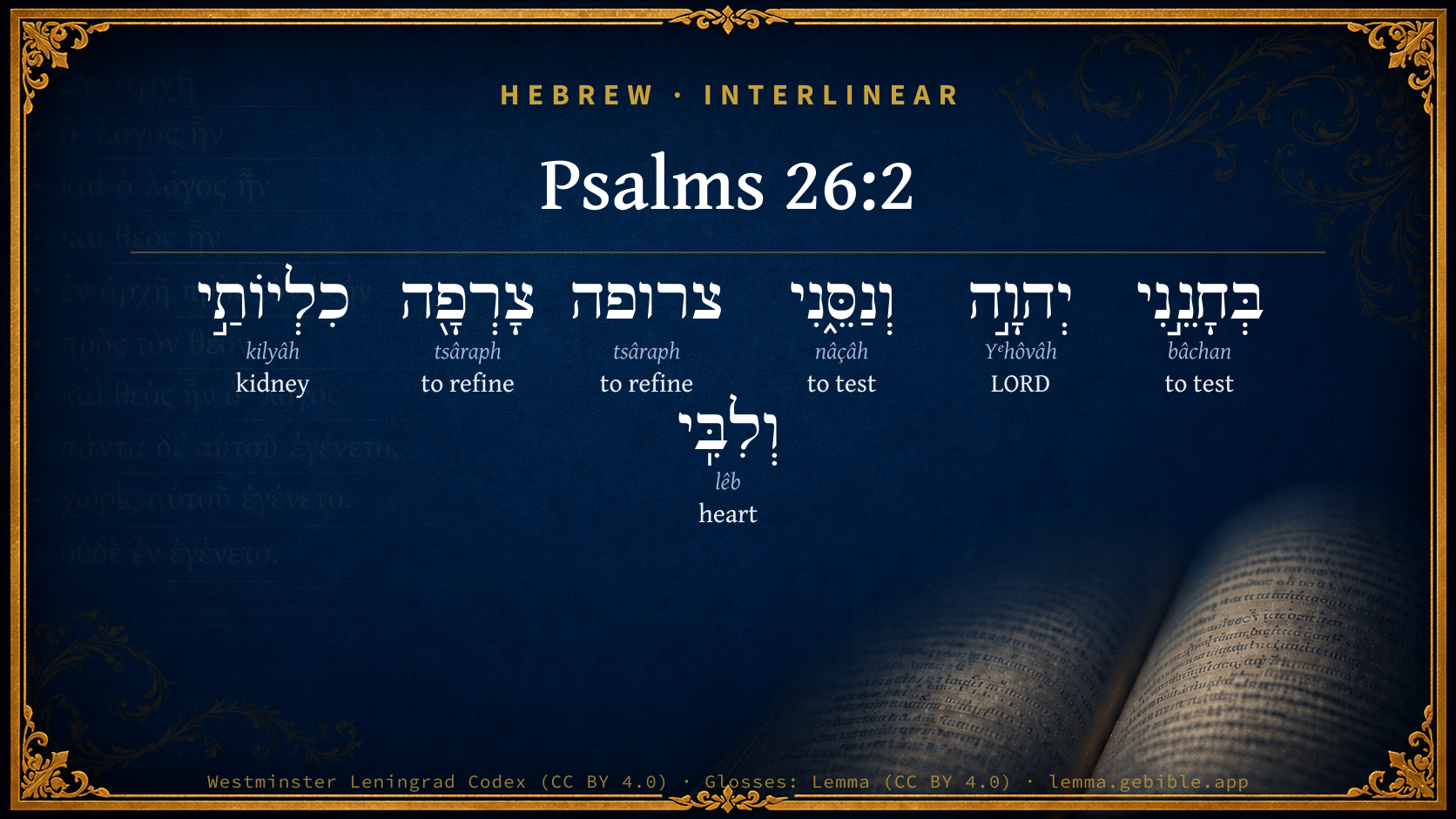
Hebrew (Westminster Leningrad Codex) Psalms 26:2 appears in the Hebrew Old Testament. The text above is from the Westminster Leningrad Codex. Each word links to its Strong’s number, a concise gloss, and parsing drawn from the Open Scriptures Hebrew Bible morphology. Click any word for its full Brown-Driver-Briggs (BDB) entry.
Download image
Cite this verse

Psalms 26:2 (World English Bible). Public Domain. Lemma interlinear Bible study tool, https://lemma.gebible.app/v/psalms/26/2.

Show BibTeX & RIS
BibTeX
RIS
English Translation
Examine me, Yahweh, and prove me. Try my heart and my mind.
World English Bible · Public Domain
Download a study sheet

One document with this verse’s original text, its word-by-word gloss line, the meaning frame, cross-references with their text, attributed commentary, and full source and license credits — printable, and it pastes into notes with its structure intact.

This verse Autodidact and up

Study sheet (.html) Plain text (.txt)

A passage Seminary Student

Up to 50 verses in one chapter. A passage sheet keeps up to 6 commentary sources and 12 cross-references per verse, in the order this page ranks them, and says so on the sheet whenever that leaves anything out. Ask for a single verse and you get the Autodidact verse sheet above.

Everything on this page stays free to read, with no account — the sheet is a download of what is already on screen, not access to it.

Want to remove ads? Support Godless Engineer
Compare translations 3

The same verse in 3 English versions, stacked beneath the original-language interlinear above. Click any original word for its lexicon entry.

Each is an independent rendering of the whole verse — the interlinear is not word-aligned to these translations.

Highlighted words mark where these versions differ — a whole-verse word diff, not a word-by-word alignment.

  • World English Bible Public Domain
    Examine me, Yahweh, and prove me. Try my heart and my mind.
  • King James Version Public Domain
    Examine me, O LORD, and prove me; try my reins and my heart.
  • unfoldingWord Literal Text CC BY-SA 4.0
    Examine me, Yahweh, and test me; try my kidneys and my heart.

unfoldingWord Literal Text — © unfoldingWord, licensed CC BY-SA 4.0. Word-aligned USFM3 via Door43 (git.door43.org/unfoldingWord/en_ult).

Versions to compare (up to 4)

3 of 4 selected

Show all 18 translations

Every available English version of this verse, each an independent rendering of the whole verse.

  • World English Bible Public Domain
    Examine me, Yahweh, and prove me. Try my heart and my mind.
  • Berean Standard Bible Public Domain
    Test me, O LORD, and try me; examine my heart and mind.
  • Majority Standard Bible Public Domain
    Test me, O LORD, and try me; examine my heart and mind.
  • King James Version Public Domain
    Examine me, O LORD, and prove me; try my reins and my heart.
  • American Standard Version (1901) Public Domain
    Examine me, O Jehovah, and prove me; Try my heart and my mind.
  • Revised Version (1885) Public Domain
    Examine me, O LORD, and prove me; try my reins and my heart.
  • Geneva Bible (1599) Public Domain
    Proue me, O Lord, and trie mee: examine my reines, and mine heart.
  • Douay-Rheims (1899) Public Domain
    Prove me, O Lord, and try me; burn my reins and my heart.
  • Young's Literal Translation Public Domain
    Try me, O Jehovah, and prove me, Purified `are' my reins and my heart.
  • Literal Standard Version CC BY-SA 4.0
    Try me, O YHWH, and prove me, || My reins and my heart [are] purified,
  • Unlocked Literal Bible CC BY-SA 4.0
    Examine me, Yahweh, and test me; test the purity of my inner parts and my heart!
  • unfoldingWord Literal Text CC BY-SA 4.0
    Examine me, Yahweh, and test me; try my kidneys and my heart.
  • Darby Bible Public Domain
    Prove me, Jehovah, and test me; try my reins and my heart:
  • World Messianic Bible Public Domain
    Examine me, LORD, and prove me. Try my heart and my mind.
  • Webster's Bible Public Domain
    Examine me, O LORD, and prove me; try my reins and my heart.
  • Free Bible Version CC BY-SA 4.0
    Examine me, Lord, test me; investigate my thoughts and intentions.
  • Bible in Basic English Public Domain
    Put me in the scales, O Lord, so that I may be tested; let the fire make clean my thoughts and my heart.
  • JPS Tanakh (1917) Public Domain
    Examine me, O LORD, and try me; test my reins and my heart.

Literal Standard Version (2020), Covenant Press — licensed CC BY-SA 4.0. Text via the HelloAO Bible API (eBible.org). Unlocked Literal Bible (unfoldingWord) — licensed CC BY-SA 4.0. Text via the HelloAO Bible API (eBible.org). unfoldingWord Literal Text — © unfoldingWord, licensed CC BY-SA 4.0. Word-aligned USFM3 via Door43 (git.door43.org/unfoldingWord/en_ult). Free Bible Version, Dr. Jonathan Gallagher — licensed CC BY-SA 4.0. Text via the HelloAO Bible API (eBible.org).

Word by word

More ways to search: Search by grammar → Find every occurrence → Compare this word →

Practice this passage: Drill this verse → Learn its vocabulary →

בְּחָנֵ֣נִי
bâchan
H974
“test · me”
Verb, Qal, Imperative, 2nd Person, Masculine, Singular + Suffix, Personal, 1st Person, Common, Singular
Part of Speech
Verb
Stem
Qal
Form
Imperative
Person
2nd Person
Gender
Masculine
Number
Singular
Full BDB Definition

Origin: a primitive root

TWOT: 230

to examine, try, prove - (Qal) - to examine, scrutinise - to test, prove, try (of gold, persons, the heart, man of God) - (Niphal) to be tried, proved - (Pual) to make a trial
  1. יְהוָ֣ה Yᵉhôvâh H3068 “LORD” Noun, Proper
  2. וְנַסֵּ֑נִי nâçâh H5254 “and · test · me” Conjunction + Verb, Piel, Imperative, 2nd Person, Masculine, Singular + Suffix, Personal, 1st Person, Common, Singular
  3. צרופה tsâraph H6884 “refine” Verb, Qal, Imperative, 2nd Person, Masculine, Singular + Suffix, h
  4. צָרְפָ֖ה tsâraph H6884 “refine” Verb, Qal, Imperative, 2nd Person, Masculine, Singular + Suffix, h
  5. כִלְיוֹתַ֣י kilyâh H3629 “kidneys · my” Noun, Common, Feminine, Plural, Construct + Suffix, Personal, 1st Person, Common, Singular
  6. וְלִבִּֽי lêb H3820 “and · heart · my” Conjunction + Noun, Common, Masculine, Singular, Construct + Suffix, Personal, 1st Person, Common, Singular

About this verse

These counts appear in no published source. They are computed here, from the morphology-tagged text and Lemma’s own curated glosses. What Lemma adds →

7
words
6
distinct lemmas
Wisdom
section

Shared distinctive vocabulary

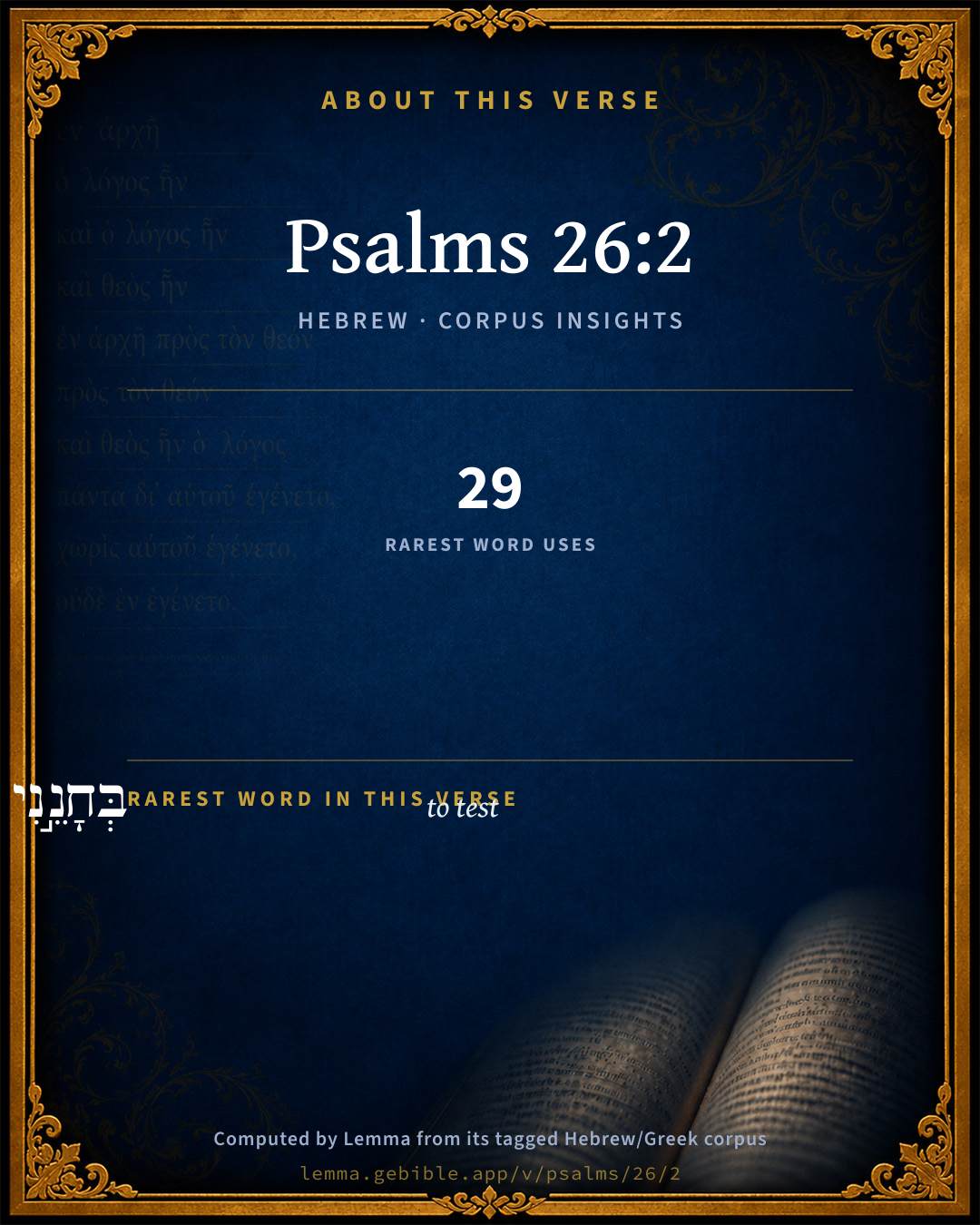
בְּחָנֵ֣נִי to test H974 occurs in 28 verses of the Hebrew Bible. Also found in:

Grammatical profile

  • 4 verbs
  • 3 nouns

Verb forms

  • בְּחָנֵ֣נִי Qal · Imperative
  • וְנַסֵּ֑נִי Piel · Imperative
  • צרופה Qal · Imperative
  • צָרְפָ֖ה Qal · Imperative

Repetition

A word recurs within this verse — often emphatic in Hebrew:

  • צרופה to refine H6884 ×2

Hebrew & Septuagint length

In English translation the verse runs 12 words from the Hebrew and 16 from the Septuagint (LXX English) — closely comparable.

A rough comparison of the two English renderings, which tokenize alike — not a word-level alignment.

Word counts can differ between the Hebrew and the Greek without any difference in meaning — e.g. the Hebrew direct-object marker אֵת has no separate Greek word, and Greek often adds the article ὁ.

Cross-references

8

Topical passages linked to Psalms 26:2 in the Treasury of Scripture Knowledge — connected by theme and wording, ordered by reader-vote popularity; previews shown in the World English Bible.

  • Psalms 139:23–24 Search me, God, and know my heart. Try me, and know my thoughts.
  • Psalms 7:9 Oh let the wickedness of the wicked come to an end, But establish the righteous; Their minds and hearts are searched by the righteous God.
  • Psalms 17:3 You have proved my heart; you have visited me in the night; You have tried me, and found nothing; I have resolved that my mouth shall not disobey.
  • Zechariah 13:9 I will bring the third part into the fire, And will refine them as silver is refined, And will test them like gold is tested. They will call on my name, and I will hear them. I will say, 'It is my people;' And they will say, 'Yahweh is my God.'"
  • Job 13:23 How many are my iniquities and sins? Make me know my disobedience and my sin.
  • Job 31:4–6 Doesn't he see my ways, And number all my steps?
  • Psalms 66:10 For you, God, have tested us. You have refined us, as silver is refined.
  • Jeremiah 20:12 But, Yahweh of Hosts, who tests the righteous, who sees the heart and the mind, let me see your vengeance on them; for to you have I revealed my cause.

Cross-references courtesy of OpenBible.info (CC BY 4.0).

Hebrew and Greek witnesses Masoretic Hebrew ↔ Greek Septuagint

The same verse in the two great witnesses to the Old Testament, shown verse-for-verse.

You’re reading Greek Psalm 25 (Hebrew Psalm 26). The Septuagint counts the superscription, so verse numbers can differ from the Hebrew — chapter-level alignment, not verse-by-verse. Numbering follows Rahlfs.

These are two independent witnesses, not word-aligned to each other, and the Septuagint is shown in lemma (dictionary) form.

Hebrew Psalms 26:2 Masoretic · Westminster Leningrad Codex

בְּחָנֵ֣נִי יְהוָ֣ה וְנַסֵּ֑נִי צרופה צָרְפָ֖ה כִלְיוֹתַ֣י וְלִבִּֽי

Examine me, Yahweh, and prove me. Try my heart and my mind.

World English Bible · Public Domain

Greek LXX Greek Psalm 25:2 Septuagint · lemma form

δοκιμάζω ἐγώ κύριος καί πειράζω ἐγώ πυρόω ὁ νεφρός ἐγώ καί ὁ καρδία ἐγώ

Prove me, O Lord, and try me; purify as with fire my reins and my heart.

LXX2012 (modern English Septuagint) · Public Domain

On this verse, Ellicott's Commentary for English Readers discusses the Septuagint’s reading. Read the note in Commentary ↓

Hebrew: Westminster Leningrad Codex (CC BY 4.0). Greek: Septuagint (public domain); English from LXX2012 (modern English Septuagint) (Public Domain). How the Septuagint differs from the Hebrew →

Commentary

Notes on Psalms 26:2 from classic Christian and Jewish commentators (each source and its license shown beneath its notes). The classic Christian expositions comment on the surrounding passage and are grouped to its opening verse, so a note may address several verses; the Jewish commentaries on the Tanakh (Rashi and others) are per-verse, so they appear only where the commentator wrote on this verse.

Lemma curates 59 commentaries, every one of them public domain or Creative Commons licensed, each selected and text-cleaned for this edition rather than reprinted as found. About our sources →

Trapp's Complete Commentary

John Trapp

Psa 26:2 Examine me, O LORD, and prove me; try my reins and my heart.

Ver. 2. Examine me, O Lord, and prove me] It must needs be a good conscience that thus boldly offereth itself to God’s trial; so Job 31:6.

Try my reins and my heart] i.e. Mine affections and thoughts; for these are sibi mutuo causae. While I mused the fire kindled, Psa 39:3. David was neither ambitious nor factious, as his adversaries represented him.

John Trapp, A Commentary or Exposition upon All the Books of the Old and New Testament (1647–1656) — public domain. Text from a community e-Sword module.

The Biblical Illustrator

Joseph S. Exell

Psa_26:2

Examine me, O Lord, and prove me; try my reins and my heart.

Our need of Divine scrutiny

I. It is possible that we may try ourselves by false principles. Self-examination is an all-important duty, but when we have searched most diligently we need that God should examine us. Now, we are prone to err in regard to our repentance, our faith, and our obedience--these which are the grand requisites for salvation.

II. We are prone to be partial to ourselves,--to make allowances where we should not.

III. And our motives in our conduct are so difficult to ascertain by any but God.

IV. And when we discover imperfections we cannot correct them, even by that Divine grace which He is willing to bestow.

V. The Divine judgment will determine the decisions of the last day. What we think, or our fellow men believe, will not avail then.

VI. What is needed to prepare for heaven. (S. Morell.)

Examinations

(A talk with children):--As a rule, children are not very anxious for examinations. They do not see what possible good can come out of them. If most of them had their wishes, they never would have one at all. Yet in days to come these children will see that of all things that they did in their school days perhaps the most important were these very examinations. Now, David here asked God to examine him; he asked a very keen examiner to take the task in hand. He knew what that meant: he knew that no weakness, no ignorance, no sin would remain hidden; but that everything would be known, not only to God, but also largely to David himself. And that was one of the reasons why he wanted to he examined.

I. Now, observe that the word examine here is a very forcible word. It means to examine by fire, and, therefore, by that which shall burn up all the dross, and only leave behind that which can pass through fire. Again, the word try is further expressive. The Hebrew word means melting by fire; in other words, it means examine by fire to the point of melting. Thus the examination the Psalmist asked for was an examination by fire--an examination that should burn away everything that was impure.

II. The result of an examination to a large extent is to make one know oneself. If it were not for the examinations which children get, some of them would get, very conceited, and would think that they knew everything. When anyone begins a study he is convinced in a week or so that he knows all about it. If you see him again in a twelvemonth he begins to doubt it; but if you see him in two years be is quite convinced he knows very little. Now, examinations are very helpful in that way. The condition of learning is just to learn, first of all, that we know next to nothing, and thus to be dissatisfied with ourselves. Then, and then only, we shall make an effort.

III. Failure in examination has very often led to determination on the part of a boy or girl never to fail again; thus failure has been one of the greatest blessings they have had in life. David felt sure that if God examined him he would know very much more of his own poor miserable self than he did before, and some path of sin which had escaped his notice would be revealed to him. Indeed, he was anxious that the Lord should not conceal from him anything that was evil in him. To be conscious of ones error is the first step necessary to avoid repeating it.

IV. Again, there was another feeling on the part of David, namely, that thorough as God was as an examiner, and thorough as the exposure would be by such an examination, God was nevertheless very kind; for David says in the following verse, For Thy loving kindnesses are before mine eyes. Our best loved teachers have been those who, though they saw all our failings, all our mistakes, very clearly, yet did not hold us up to ridicule, but sympathised with our difficulties and put the best construction on all our actions. So it is with our Lord. He knows our hearts, and reads every thought before we express it in words. Hidden desires are all known to Him. But then, He is so kind, so loving, so forgiving, we can leave ourselves in His hands. (D. Davies.)

Self-examination examined

Self-examination is to many disciples a kind of first point in practical religion. It is heard and read on all sides. But there are only two Scripture passages which can be at all cited for it, one of which (2Co_13:5) certainly has no such meaning; and the other (1Co_11:28) carries no sufficient authority for the practice. Scripture sends us to God: Examine me, O Lord; Search me, O God; The Lord trieth the heart.

I. God certainly can examine us, and we cannot in any but the most superficial and incomplete sense examine ourselves. For--

1. Our memory is too short and scant to recall or restore the conception of one in a hundred million of the acts that make up our lives.

2. Even if we could recall them, everyone, we could never go over the survey of such vast materials, so as to form any judgment of them or of ourselves.

3. And since the understanding of our present state is impossible without understanding all the causes in our action that have fashioned the character and shaped its figure, our faculty is even shorter here than before. Omniscience only is equal to the task.

II. In what is frequently understood by self-examination there is something mistaken or deceitful which needs to be carefully resisted.

1. It is a kind of artificial state, in which the soul is drawn off from its objects and works, and its calls of love and sacrifice, to engage itself in acts of self-inspection.

2. He may even be so engrossed in self-examination as to become morbidly selfish in it; for nothing is more selfish than to be always boring into ones self.

III. How much is implied in a hearty willingness or desire to have God examine us and prove us. A mind seeking after truth, ready to receive it; more, a soul already found to be in Gods friendship, sealed with the witness of His acceptance.

IV. There is a way of coming at the verdict of God whatever it may be. God designs always to give us the benefit of His own knowledge of our state. He never intended us for, and never puts us to, the task of testing ourselves. He expects to do this for us. We are complete only in Him. He is, and is ever to be, our Light, and we only know ourselves in Him. God is manifested in the consciousness of them that love Him and are right towards Him. They will know God by an immediate knowledge or revelation. They will have His Spirit witnessing with theirs. God has planned our life so as to bring us into a perception of the many defects and errors lurking in us, and to set us in the same judgment of them that He has Himself, proving us at every turn, trying even the reins and heart, that our most secret things may be revealed. If there should be any legitimate place for self-examination it is in the field where we go to discover our faults and the sins that require to be forsaken or put away. (Horace Bushnell, D. D.)

Morbid self-inspection kills love

Many years ago I knew an excellent much esteemed Christian mother, who had become morbidly introverted, and could not find her love to God. Seeing at once that she was stifling it by her own self-inspecting engrossment, which would not allow her to so much as think of Gods loveliness, I said to her, But you love your son, you have no doubt of that. Of course I love him, why should I not? To show her, then, how she was killing her love to God, I said, But take one week now for the trial, and make thorough examination of your love to your son, and it will be strange if, at the end of the week, you do not tell me that you have serious doubt of it. I returned at the time, to be dreadfully shocked by my too cruel experiment. No, she said, I do not love him; I abhor him. She was fallen off the edge, and her self-examination was become her insanity! (Horace Bushnell, D. D.)

God trying the reins and the heart

It is wonderful to see with what skill God has adjusted all our experiences, in this mortal life, so as to make us sensible of our errors and defects. As the invisible ink is brought out in a distinct colour by holding what is written to the fire, so God brings out all our faults and our sins by the scorches of experience through which we are ever passing in the fiery trials of life. If we are proud, He has a way to make us see it, and to break down our pride. If we cherish any subtle grudge or animosity, He will somehow call it out and make us see it. If we are selfish, or covetous, or jealous, or frivolous, or captious, or self-indulgent, or sensual, or self-confident, or fanatical, or self-righteous, or partial, or obstinate, or prejudiced, or uncharitable, or censorious,--whatever fault we have in us, whether it be in the mind, or the head, or the body, or I might almost say the bones, no matter how subtle, or how ingeniously covered it may be, He has us in the furnace of trial and correction, where He is turning us round and round, lifting us in prosperity, crushing us in adversity, subduing us with affliction, tempting out our faults and then chastising them humbling us, correcting us, softening, tempering, soothing, fortifying, refining, healing, and so managing us, as to detect all our drossy and bad qualities, and separate them from us. He sits as a refiner and purifier of silver, and allows nothing to escape either His discovery or our correction. No self-examination we could make would discover, at all, what He is continually bringing to the light, and exposing to our detection. (Horace Bushnell, D. D.)

The Biblical Illustrator, edited by Joseph S. Exell (c. 1880s–1900s) — public domain. Text from a community e-Sword module.

Joseph Benson's Commentary

Psa 26:2-3. Examine me, and prove me — Because it is possible I may deceive myself, and be partial in my cause, or, at least, mine enemies will so judge of me: I appeal to thee, O thou Judge of hearts, and beg that thou wouldst search and try me by such ways and means as thou seest fit, and make me known to myself and to the world, and convince mine enemies of mine integrity. For thy lovingkindness is before mine eyes — I have a true and deep sense of thy loving-kindness upon my heart, by which I have been obliged, and in a manner constrained to love and obey thee, and, in all things, to approve my heart and ways to thee, and consequently to abstain from all such evil practices as mine enemies charge me with. And hence it is, that I dare appeal to thee with this confidence. My experience of and trust in thy goodness fully satisfy me that I do not need to use, and so supports me that I do not use, any indirect or irregular courses for my relief. I have walked in thy truth — That is, according to thy word, believing its promises, and observing its precepts and directions; and not according to the course of this world.

Joseph Benson's Commentary on the Old and New Testaments (1811–1818) — public domain. Text from a community e-Sword module.

J. A. Alexander on Psalms

Joseph Addison Alexander

2. (Psa 26:2) Try me, Jehovah, and prove me; assay my reins and my heart. The first verb is supposed by etymologists to signify originally trial by touch, the second by smell, and the third by fire. In usage, however, the second is constantly applied to moral trial or temptation, while the other two are frequently applied to the testing of metals by the touchstone or the furnace. This is indeed the predominant usage of the third verb, which may there-fore be represented by the technical metallurgic term, assay. See above, on Psa 17:3, where two of the same verbs occur.—Reins and heart are joined, as seats of the affections. See above, on Psa 7:10 (9).—The prayer of this verse is an appeal to God's omniscience for the psalmist's integrity of purpose, which agrees much better with the context than the explanation of hpvrc as a participle, and of the last clause as an affirmation, purified (or purged) are my reins and my heart.

2. To publish with a thankful voice, without expressing what.

Joseph Addison Alexander, The Psalms Translated and Explained (1850) — public domain. Text from a community e-Sword module.

Geneva Bible (1599)

Geneva Bible translators

My very affections and inward motions of the heart.

Geneva Bible (1599) marginal notes — public domain. Text via Bolls.life.

Jamieson, Fausset & Brown

Robert Jamieson, A. R. Fausset & David Brown

He asks the most careful scrutiny of his affections and thoughts (Psa 7:9), or motives.

Jamieson, Fausset & Brown — Commentary Critical and Explanatory on the Whole Bible (1871) — public domain (CC PDM 1.0). Text via the HelloAO Bible API.

Adam Clarke's Commentary

Verse 2. Examine me, O Lord] To thee I appeal; and feel no hesitation in wishing to have all the motives of my heart dissected and exposed to thy view, and to that of the world.

Adam Clarke's Commentary on the Bible (1810–1826) — public domain. Text from a community e-Sword/MySword module.

John Calvin's Commentaries

2. Prove me, The primary signification of the Hebrew word צרף, tsaraph is to try as the refiner tries his gold by dissolving and melting it, In this sense it is used in Psalm 66:10, “Thou hast tried us as silver is tried.”

John Calvin's Commentaries (1540-1563) — public domain. Text from the Calvin Translation Society English edition (1840s-50s) via the Christian Classics Ethereal Library (ccel.org). Calvin's coverage is partial (roughly two-thirds of the Bible); uncommented books and verses are honest gaps, never fabricated. The 19th-century editor's footnotes and remarks are omitted so the notes are faithfully Calvin's own voice.

Ellicott's Commentary for English Readers

(2) Try.—Rather, purify, according to the right reading. LXX., try by fire.

A Bible Commentary for English Readers, edited by Charles John Ellicott (1878–1897) — public domain. Text from a community e-Sword module.

The Cambridge Bible for Schools and Colleges

gen. ed. J. J. S. Perowne

2. God knows him already (Psa_17:3); and fearlessly he offers himself for a fresh scrutiny. This prayer attests at once the clearness of his conscience, and his desire that if aught of evil remains, it may be purged away. Cp. Psa_139:23-24. Three words are used to express the thoroughness of the scrutiny. Examine me, as the refiner assays his metal to test its fineness; prove me, by bringing me into circumstances in which the reality of my faith may be demonstrated; try me, as the refiner smelts gold to get rid of any remaining dross. So God ‘proved’ Abraham (Gen_22:1); and Israel (Deu_8:2; Deu_8:16). The purpose of such heart-searching is ‘to give every man according to his ways’ (Jer_17:10).

my reins and my heart] The reins are the seat of the affections, the heart of thought and will. Cp. Psa_7:9; Psa_11:4.

The Cambridge Bible for Schools and Colleges (gen. ed. J. J. S. Perowne; Cambridge University Press, 1878–1918) — public domain. Text from a community e-Sword module.

John Gill's Exposition

Examine me, O Lord,.... His cause, his integrity, and trust in the Lord, as silver and gold are examined by the touchstone, the word of God, which is the standard of faith and practice;

and prove me; or "tempt me" (r); as Abraham was tempted by the Lord; and his faith in him, and fear of him, and love to him, were proved to be true and genuine;

try my reins and my heart; the thoughts, desires, and affections of it, as gold and silver are tried in the furnace; and so God sometimes tries the faith and patience of his people by afflictive providences; and this examination, probation, and trial, are made by him, not for his own sake, who knows the hearts and ways of all men; but for the sake of others, to make known either to themselves or others the truth of grace that is in them, and the uprightness of their hearts and ways; and it was on this account the psalmist desired to pass under such an examination.

(r) "tenta me", Pagninus, Montanus, Junius & Tremellius, &c.

John Gill's Exposition of the Whole Bible (1746–1763) — public domain (CC PDM 1.0). Text via the HelloAO Bible API.

Albert Barnes' Notes on the Bible

Examine me, O Lord - The meaning of this verse is, that he asked of God a strict and rigid examination of his case. To express this, the psalmist uses three words - “examine; prove; try.” These words are designed to include the modes in which the reality of anything is tested, and they imply together that he wished the most “thorough” investigation to be made; he did not shrink from any test. He evidently felt that it was essential to his welfare that the most rigid examination should be made; that the exact truth should be known; that if he was deceived, it was best for himself that he should not be left under the delusion, but that, understanding his own case, he might be led to secure his salvation. The word rendered “examine” means, “to try, to prove,” and is applicable especially to metals: Jer 9:7; Zec 13:9. It means here, “Apply to me such tests as are applied to metals in order to determine their genuineness and their value.”

And prove me - A word of similar import. In the original meaning of the word there is a reference to “smell;” to try by the smell; to ascertain the qualities of an object by the smell. Hence, it comes to be used in a more general sense to denote any way of ascertaining the quality of an object.

Try my reins - The word here rendered “try” (test) is one that is most commonly applied to metals; and the three words together express the earnest desire of the psalmist that God would examine into the evidences of his piety - those evidences to which he immediately refers - and apply the proper kind of tests to determine whether that piety was genuine. The word rendered “reins” means properly the “kidneys,” and hence, it is used to denote the inward part, the mind, the soul - the seat of the desires and the affections. See Psa 7:9, note; Psa 16:7, note. We speak now of the “heart” as the seat of the affections or of love. The Hebrews more commonly spoke of the heart as the seat of intelligence or knowledge, and the reins or the “bowels” as the seat of the affections. In itself there was no more impropriety in their speaking of the reins or kidneys as the seat of the affections than there is of our speaking of the heart in that manner. Neither of them is strictly correct; and both modes of speech are founded on popular usage.

Albert Barnes' Notes on the Bible (1834–1885) — public domain. Text from a community e-Sword/MySword module.

Matthew Poole's English Annotations

Because it is possible that I may deceive myself, and be partial in my cause, or at least mine enemies will so judge of me, I appeal to thee, O thou Judge of hearts, and beg that thou wouldst search and try me by such ways and means as thou seest fit, and make me known to myself, and to the world, and convince mine enemies of mine integrity.

Matthew Poole's English Annotations on the Holy Bible (1683–1685) — public domain. Text from a community e-Sword/MySword module.

The Treasury of David

Charles H. Spurgeon

Ver. 2. There are three modes of trial here challenged, which are said in the original to refer to trial by touch, trial by smell, and trial by fire. The psalmist was so clear from the charge laid against him, that he submitted himself unconditionally to any form of examination which the Lord might see fit to employ. Examine me, O Lord. Look me through and through; make a minute survey; put me to the question, cross examine my evidence. And prove me. Put me again to trial; and see if I would follow such wicked designs as my enemies impute to me. Try my reins and my heart. Assay me as metals are assayed in the furnace, and do this to my most secret parts, where my affections hold their court; see, O God, whether or no I love murder, and treason, and deceit. All this is a very bold appeal, and made by a man like David, who feared the Lord exceedingly, it manifests a most solemn and complete conviction of innocence. The expressions here used should teach us the thoroughness of the divine judgment, and the necessity of being in all things profoundly sincere, lest we be found wanting at the last. Our enemies are severe with us with the severity of spite, and this a brave man endures without fear; but God's severity is that of unswerving right. Who shall stand against such a trial? The sweet singer says "Who can stand before his cold?" and we may well enquire, "Who can stand before the heat of his justice?"

Ver. 2. The psalmist uses three words, examine, prove, try. These words are designed to include all the modes in which the reality of anything is tested; and they imply together that he wished the most thorough investigation to be made; he did not shrink from any test. Albert Barnes.

Ver. 2. Examine prove try. As gold, by fire, is severed and parted from dross, so singleness of heart and true Christian simplicity is best seen and made most evident in troubles and afflictions. In prosperity every man will seem godly, but afflictions do draw out of the heart whatsoever is there, whether it be good or bad. Robert Cawdray.

Ver. 2. Prove me. The work of conscience within us doth prove us. God hath set up a light within us, and when this is enlightened by the Word, then it makes a man's breast full of light. Now a faithful godly man loveth that this should be tender, active, speaking out of God's Word for every duty, and against every sin. You see the quickness of it in David, when it is said, "His heart smote him; "and 1 John 3., "If thy heart condemn thee, God is greater than thy heart." Alas! if thou within thine own self judgest thyself to sin thus and thus, God doth much more. Try thy integrity; art thou willing to have a tender conscience, and an informed conscience? Dost thou love to hear what that speaks out of God's Word? whether peace or duty? this is comfortable. But on the other side, if thou art a man that rebellest against the light of it, wouldst fain put out the sting of it, wouldst be glad to feel no such living thing in thy breast, then thou hast cause to suspect thyself. Oh, it is to be feared that there are many that give themselves to lusts, and carnal pleasures, that so they may put a foggy mist between their conscience and themselves. Others dig into the world, labouring to become senseless, that so there may be an eclipse of this light by the interposition of the earth. Others run to damnable heresies, denying Scriptures, God, heaven, hell; pleading for an universal salvation of all. What are these but refuges of guilty consciences? We must distinguish between our carnal concupiscence, and conscience; between deluded imaginations, and conscience; between an erroneous and scrupulous conscience, and a well grounded and truly informed conscience; and when we have done so, we must follow conscience as far as that follows the Word. Anthony Burgess.

Ver. 2. Reins...heart. The "reins, "as the seat of the lower animal passions; the "heart, "as comprising not only the higher affections, but also the will and the conscience. He thus desires to keep nothing back; he will submit himself to the searching flame of the Great Refiner, that all dross of self deception may be purged away. J. J. Stewart Perowne.

Ver. 2. Divine examinations. Their variety, severity, searching nature, accuracy, certainty: when to be desired, and when to be dreaded.

Psalms 26:3*

Charles H. Spurgeon's The Treasury of David (1869–1885) — public domain. Psalms only. Text from a community e-Sword/MySword module.

Whedon's Commentary on the Bible

Daniel D. Whedon

2. Examine me—Search me, try me as metals in the fire, as the word denotes. He invites the Searcher of hearts to institute the closest scrutiny, so self-conscious was he of upright intentions.

Reins… heart—An intensive form of speech denoting the innermost thoughts and feelings. He uncovers all his thoughts before God, and submits himself to the divine mercy and judgment. See on Psa_16:7; Psa_25:6

Daniel D. Whedon (gen. ed.), Commentary on the Old and New Testaments (1874–1909) — public domain. Text from a community e-Sword module.

The Pulpit Commentary

Examine me, O Lord, and prove me. He desires to be examined and proved tested, as a metal is tested (comp. Psa_17:3) that his sincerity may fully appear. Try my reins and my heart; i.e. my emotional and my intellectual natures.

Faith"s bold request.

"Examine me," etc. A very bold prayer. The image is taken from the testing and purifying of gold in the furnace, to which the word rendered "try" properly applies. It is as if the gold begged to be cast into the furnace. (Job 23 10) Who can say, if this prayer is to be answered, how hot the furnace may need to be? But "we have boldness". (Eph_3:12) There are cases in which this bold prayer may be justifiable, wise, needful. It includes

I A RECOGNITION OF GOD"S ALL-SEARCHING KNOWLEDGE. (Psa_139:1 Jer_17:10 Rev_2:23) God"s free, forgiving mercy is represented under the image of his forgetting our sins. (Heb_8:12, etc.) This must not make us lose sight of the fact of his actual knowledge. (Heb_4:13) If men see faults where God does not, it is their blindness, not their keenness.

II THE APPEAL OF CONSCIOUS INTEGRITY, from men"s slander or misjudgment to the righteous judgment of God. Such an appeal is perfectly consistent with true humility and a deep sense of sinfulness before God. (cf. Act_23:1 Act_24:16 1Co_4:3-5 with 1Ti_1:12-15) At the same time, we can hardly suppose David could have composed this psalm after his great and shameful fall. Regarded apart from that dark passage of his life, we see a man, with the faults, it is true, of an ardent, passionate temperament, but conscious of honest purpose, high sense of duty, fervent love to God, and true desire to rule God"s people well; yet we must bear in mind (what Bishop Perowne has well expressed) that "the full depth and iniquity of sin was not disclosed to the saints of the Old Testament. Sin could only appear to be sin in all its blackness and malignity when it was brought into the full light of the cross of Christ. And it is only as any man grasps that cross that he can bear to look into the pollution which cleaves to his nature" (Perowne, ad loc.).

III PRAYER AGAINST SELF-DECEPTION. An appeal not only from the unfair judgments of men, but from our own ignorance of ourselves. (Psa_19:12 Psa_139:23, Psa_139:24) Peter"s boastful, self-ignorant self-confidence was the immediate forerunner of his fall. (Mat_26:33, Mat_26:35)

IV SUBMISSION TO GOD"S METHODS OF TRIAL. These may be severe, the faithful severity of love. It needs the courage of faith undoubting confidence in God"s love to enable us to offer this prayer with full thought of all it may mean in our case. Christ sits as a Refiner. (Mal_3:2, Mal_3:3) God searches by his Word, (Heb_4:12) by his Spirit, (Joh_15:8) by the dealings of his providence and outward trials, (1Pe_1:6, 1Pe_1:7) even by the permitted temptations of the evil one. (Luk_22:31, Luk_22:32)

Thus a prayer which would be the height of rash presumption, offered in the spirit of self-righteous self-confidence, becomes a wise, safe, and fitting prayer, offered in the spirit of humble, childlike faith.

The Pulpit Commentary (1880–1919), ed. H.D.M. Spence-Jones & Joseph S. Exell — public domain. Text from a community e-Sword module.

Lesson kit

Teaching starters — assembled from the data on this page, not authored interpretation. Every prompt links to the verse data it draws on. Edit before teaching.

Psalms, in the Wisdom, opens this verse with 7 words (6 distinct Hebrew lemmas). Its most distinctive word is bâchan (“to test”). A historical commentator’s framing appears above. Read the whole chapter for the surrounding context.

Discussion questions

  1. The word bâchan carries the sense “to test.” How does it shape the verse?
  2. Genesis 42:15 shares the word «to test» with this verse. How do the two illuminate each other?
  3. “to refine” occurs 2× in this one verse. What is the effect of the repetition?
  4. The translations on this page render this verse differently — a whole-verse word diff, not a word-by-word alignment. What might account for the different wordings?
  5. The verb «בְּחָנֵ֣נִי» is Qal Imperative. How does its form color the action?
  6. Reading how Trapp's Complete Commentary and The Biblical Illustrator read this verse, where do the two commentators agree and where do they part?

Things to notice

  • These translations choose different wording for 8 words in this verse.
  • “to refine” occurs 2× in this single verse.
  • 6 distinct Hebrew lemmas span 7 words in this verse.

Reading settings

Reading text

Shown beneath each verse's original-language words.

Old Testament
Old Testament edition

Read the OT as the Masoretic Hebrew (MT) or the Greek Septuagint (LXX).

English shown for the Greek Septuagint (in the Hebrew ↔ Greek comparison).

Comparing translations? Open the Compare panel on any verse page to stack up to four side by side.