
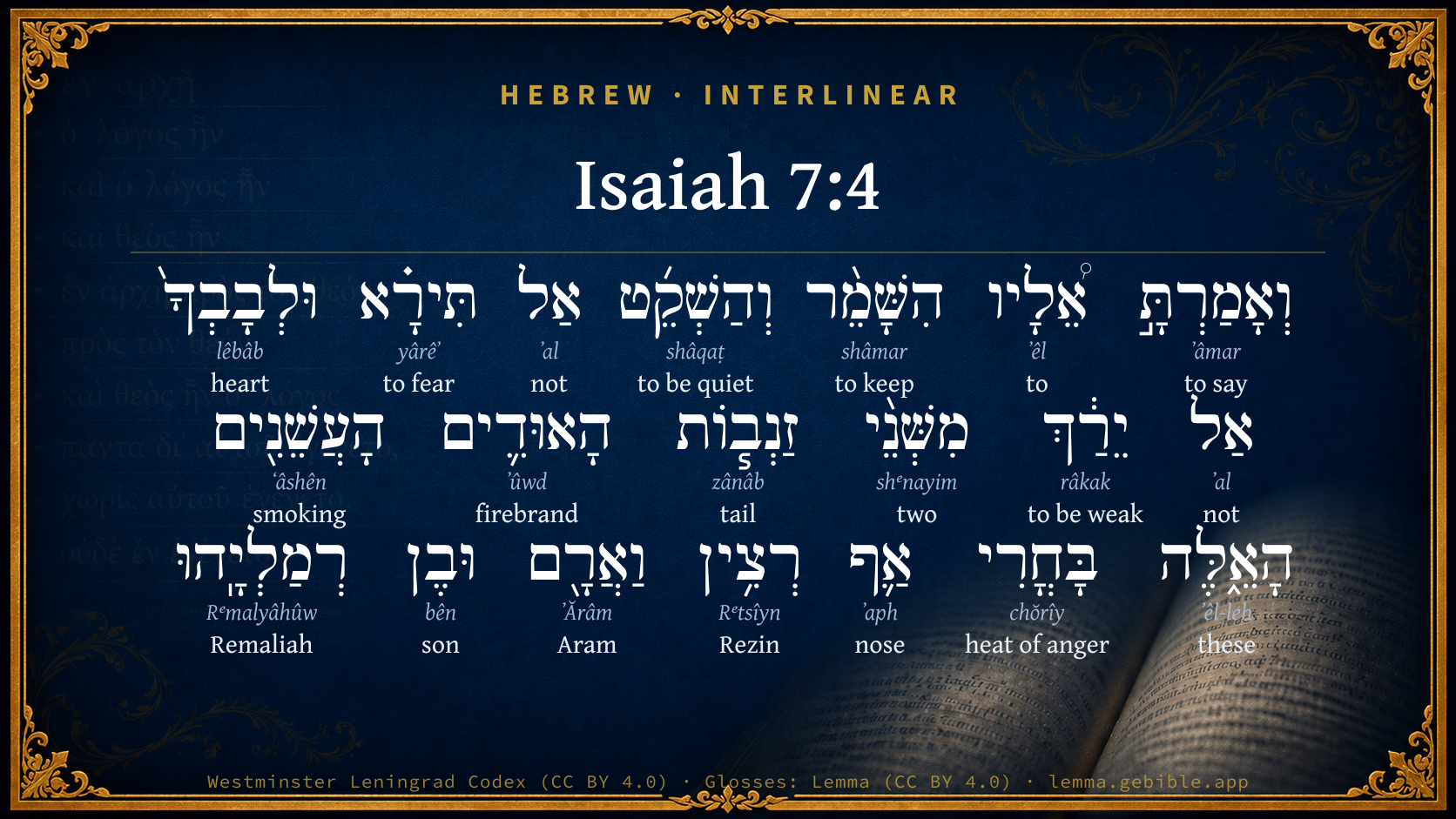
Isaiah 7:4

Hebrew (Westminster Leningrad Codex) Isaiah 7:4 appears in the Hebrew Old Testament. The text above is from the Westminster Leningrad Codex. Each word links to its Strong’s number, a concise gloss, and parsing drawn from the Open Scriptures Hebrew Bible morphology. Click any word for its full Brown-Driver-Briggs (BDB) entry.
Download image
Cite this verse

Isaiah 7:4 (World English Bible). Public Domain. Lemma interlinear Bible study tool, https://lemma.gebible.app/v/isaiah/7/4.

Show BibTeX & RIS
BibTeX
RIS
English Translation
Tell him, 'Be careful, and keep calm. Don't be afraid, neither let your heart be faint because of these two tails of smoking firebrands, for the fierce anger of Rezin and Syria, and of the son of Remaliah.
World English Bible · Public Domain
Highlights
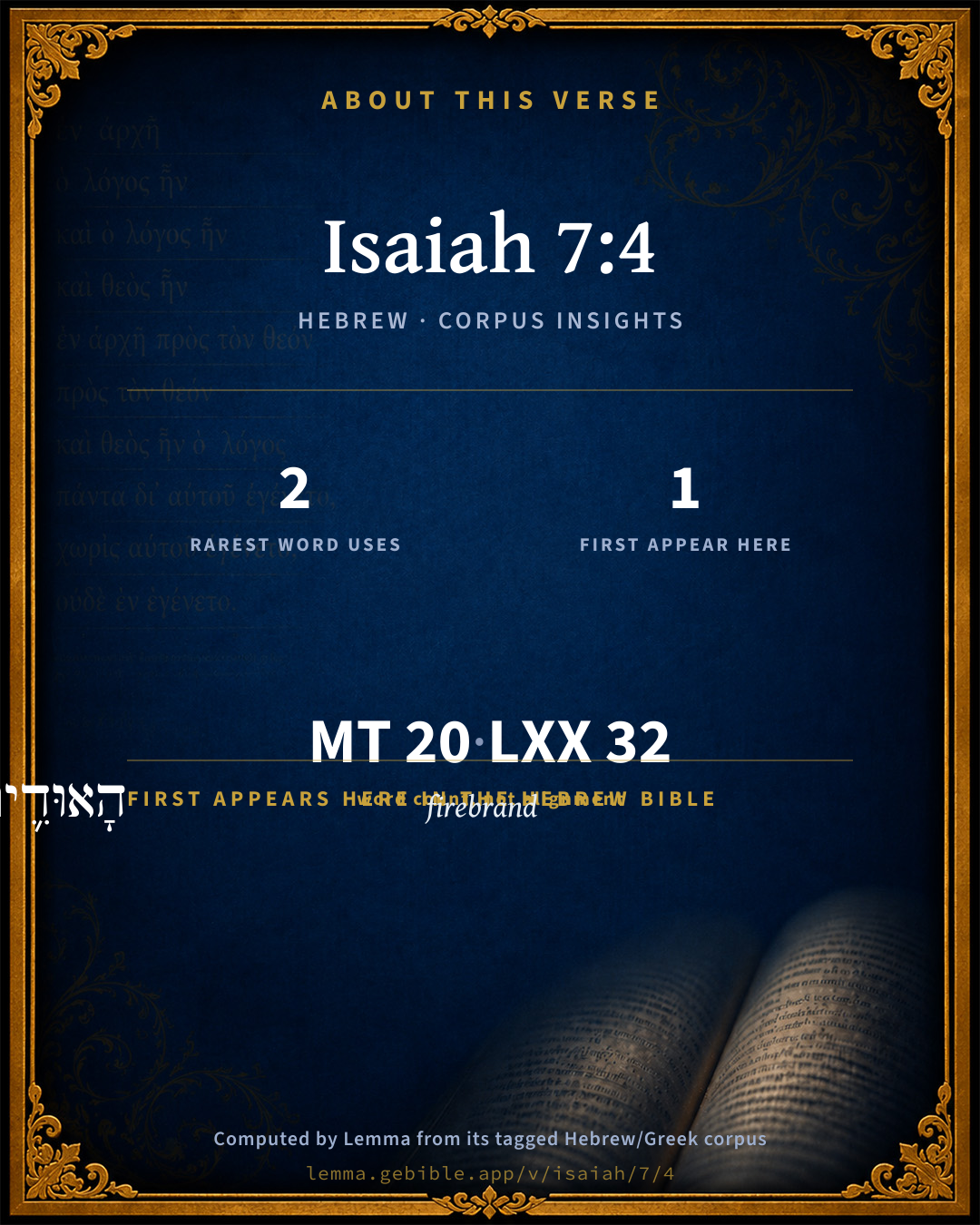
  • 1 first appearance in the Hebrew Bible
Full analysis ↓
Download a study sheet

One document with this verse’s original text, its word-by-word gloss line, the meaning frame, cross-references with their text, attributed commentary, and full source and license credits — printable, and it pastes into notes with its structure intact.

This verse Autodidact and up

Study sheet (.html) Plain text (.txt)

A passage Seminary Student

Up to 50 verses in one chapter. A passage sheet keeps up to 6 commentary sources and 12 cross-references per verse, in the order this page ranks them, and says so on the sheet whenever that leaves anything out. Ask for a single verse and you get the Autodidact verse sheet above.

Everything on this page stays free to read, with no account — the sheet is a download of what is already on screen, not access to it.

Want to remove ads? Support Godless Engineer
Compare translations 3

The same verse in 3 English versions, stacked beneath the original-language interlinear above. Click any original word for its lexicon entry.

Each is an independent rendering of the whole verse — the interlinear is not word-aligned to these translations.

Highlighted words mark where these versions differ — a whole-verse word diff, not a word-by-word alignment.

  • World English Bible Public Domain
    Tell him, 'Be careful, and keep calm. Don't be afraid, neither let your heart be faint because of these two tails of smoking firebrands, for the fierce anger of Rezin and Syria, and of the son of Remaliah.
  • King James Version Public Domain
    And say unto him, Take heed, and be quiet; fear not, neither be fainthearted for the two tails of these smoking firebrands, for the fierce anger of Rezin with Syria, and of the son of Remaliah.
  • unfoldingWord Literal Text CC BY-SA 4.0
    And you shall say to him, ‘Guard yourself and be quiet. May you not fear and may your heart not soften from the two of these smoking stubs of firewood, by the burning of the nose of Rezin and Aram and the son of Remaliah.

unfoldingWord Literal Text — © unfoldingWord, licensed CC BY-SA 4.0. Word-aligned USFM3 via Door43 (git.door43.org/unfoldingWord/en_ult).

Versions to compare (up to 4)

3 of 4 selected

Show all 18 translations

Every available English version of this verse, each an independent rendering of the whole verse.

  • World English Bible Public Domain
    Tell him, 'Be careful, and keep calm. Don't be afraid, neither let your heart be faint because of these two tails of smoking firebrands, for the fierce anger of Rezin and Syria, and of the son of Remaliah.
  • Berean Standard Bible Public Domain
    and say to him: Calm down and be quiet. Do not be afraid or disheartened over these two smoldering stubs of firewood—over the fierce anger of Rezin and Aram and of the son of Remaliah.
  • Majority Standard Bible Public Domain
    and say to him: Calm down and be quiet. Do not be afraid or disheartened over these two smoldering stubs of firewood—over the fierce anger of Rezin and Aram and of the son of Remaliah.
  • King James Version Public Domain
    And say unto him, Take heed, and be quiet; fear not, neither be fainthearted for the two tails of these smoking firebrands, for the fierce anger of Rezin with Syria, and of the son of Remaliah.
  • American Standard Version (1901) Public Domain
    and say unto him, Take heed, and be quiet; fear not, neither let thy heart be faint, because of these two tails of smoking firebrands, for the fierce anger of Rezin and Syria, and of the son of Remaliah.
  • Revised Version (1885) Public Domain
    and say unto him, Take heed, and be quiet; fear not, neither let thine heart be faint, because of these two tails of smoking firebrands, for the fierce anger of Rezin and Syria, and of the son of Remaliah.
  • Geneva Bible (1599) Public Domain
    And say vnto him, Take heede, and be still: feare not, neither be faint hearted for the two tailes of these smoking firebrands, for the furious wrath of Rezin and of Aram, and of Remaliahs sonne:
  • Douay-Rheims (1899) Public Domain
    And thou shalt say to him: See thou be quiet: fear not, and let not thy heart be afraid of the two tails of these fire brands, smoking with the wrath of the fury of Rasin king of Syria, end of the son of Romelia.
  • Young's Literal Translation Public Domain
    and thou hast said unto him: `Take heed, and be quiet, fear not, And let not thy heart be timid, Because of these two tails of smoking brands, For the fierceness of the anger of Rezin and Aram, And the son of Remaliah.
  • Literal Standard Version CC BY-SA 4.0
    and you have said to him: Take heed, and be quiet, do not fear, || And do not let your heart be timid, || Because of these two tails of smoking brands, || For the fierceness of the anger of Rezin and Aram, || And the son of Remaliah.
  • Unlocked Literal Bible CC BY-SA 4.0
    Tell him, 'Be careful, remain calm, do not be afraid or intimidated by these two smoldering firebrands, by the fierce anger of Rezin and Aram, and of Pekah son of Remaliah.
  • unfoldingWord Literal Text CC BY-SA 4.0
    And you shall say to him, ‘Guard yourself and be quiet. May you not fear and may your heart not soften from the two of these smoking stubs of firewood, by the burning of the nose of Rezin and Aram and the son of Remaliah.
  • Darby Bible Public Domain
    and thou shalt say unto him, Take heed and be quiet; fear not, and let not thy heart faint before these two ends of smoking firebrands, because of the fierce anger of Rezin and Syria, and of the son of Remaliah.
  • World Messianic Bible Public Domain
    Tell him, ‘Be careful, and keep calm. Don’t be afraid, neither let your heart be faint because of these two tails of smoking torches, for the fierce anger of Rezin and Syria, and of the son of Remaliah.
  • Webster's Bible Public Domain
    And say to him, Take heed, and be quiet; fear not, neither be faint-hearted for the two tails of these smoking fire-brands, for the fierce anger of Rezin with Syria, and of the son of Remaliah.
  • Free Bible Version CC BY-SA 4.0
    Tell him, ‘Calm down and keep quiet. Don't be afraid or scared over a couple of smoldering bits of firewood, over the burning anger of Rezin and Aram, and of Remaliah's son.
  • Bible in Basic English Public Domain
    And say to him, Take care and be quiet; have no fear, and do not let your heart be feeble, because of these two ends of smoking fire-wood, because of the bitter wrath of Rezin and Aram, and of the son of Remaliah.
  • JPS Tanakh (1917) Public Domain
    and say unto him: Keep calm, and be quiet; fear not, neither let thy heart be faint, because of these two tails of smoking firebrands, for the fierce anger of Rezin and Aram, and of the son of Remaliah.

Literal Standard Version (2020), Covenant Press — licensed CC BY-SA 4.0. Text via the HelloAO Bible API (eBible.org). Unlocked Literal Bible (unfoldingWord) — licensed CC BY-SA 4.0. Text via the HelloAO Bible API (eBible.org). unfoldingWord Literal Text — © unfoldingWord, licensed CC BY-SA 4.0. Word-aligned USFM3 via Door43 (git.door43.org/unfoldingWord/en_ult). Free Bible Version, Dr. Jonathan Gallagher — licensed CC BY-SA 4.0. Text via the HelloAO Bible API (eBible.org).

Word by word

More ways to search: Search by grammar → Find every occurrence → Compare this word →

Practice this passage: Drill this verse → Learn its vocabulary →

הָעֲשֵׁנִ֖ים
ʻâshên
H6226
“the · smoking”
Particle, Definite Article + Adjective, Adjective, Masculine, Plural, Absolute
Part of Speech
Particle + Adjective
Type
Adjective
Gender
Masculine
Number
Plural
State
Absolute
Full BDB Definition

Origin: from H6225

TWOT: 1712b

smoking
  1. וְאָמַרְתָּ֣ ʼâmar H559 “and · to say” Conjunction + Verb, Qal, Sequential Perfect, 2nd Person, Masculine, Singular
  2. אֵ֠לָיו ʼêl H413 “to · him” Preposition + Suffix, Personal, 3rd Person, Masculine, Singular
  3. הִשָּׁמֵ֨ר shâmar H8104 “keep” Verb, Niphal, Imperative, 2nd Person, Masculine, Singular
  4. וְהַשְׁקֵ֜ט shâqaṭ H8252 “and · be quiet” Conjunction + Verb, Hiphil, Imperative, 2nd Person, Masculine, Singular
  5. אַל ʼal H408 “not” Particle, Negative
  6. תִּירָ֗א yârêʼ H3372 “to fear” Verb, Qal, Jussive, 2nd Person, Masculine, Singular
  7. וּלְבָבְךָ֙ lêbâb H3824 “and · heart · your” Conjunction + Noun, Common, Masculine, Singular, Construct + Suffix, Personal, 2nd Person, Masculine, Singular
  8. אַל ʼal H408 “not” Particle, Negative
  9. יֵרַ֔ךְ râkak H7401 “to be weak” Verb, Qal, Jussive, 3rd Person, Masculine, Singular
  10. מִשְּׁנֵ֨י shᵉnayim H8147 “from · two” Preposition + Adjective, Cardinal number, Masculine, Dual, Construct
  11. זַנְב֧וֹת zânâb H2180 “tails of” Noun, Common, Masculine, Plural, Construct
  12. הָאוּדִ֛ים ʼûwd H181 “the · firebrands” Particle, Definite Article + Noun, Common, Masculine, Plural, Absolute
  13. הָאֵ֑לֶּה ʼêl-leh H428 “the · these” Particle, Definite Article + Pronoun, Demonstrative, Common, Plural
  14. בָּחֳרִי chŏrîy H2750 “in/at · heat of anger of” Preposition + Noun, Common, Masculine, Singular, Construct
  15. אַ֛ף ʼaph H639 “nose” Particle, Accusative
  16. רְצִ֥ין Rᵉtsîyn H7526 “Rezin” Noun, Proper
  17. וַאֲרָ֖ם ʼĂrâm H758 “and · Aram” Conjunction + Noun, Proper
  18. וּבֶן bên H1121 “and · son of” Conjunction + Noun, Common, Masculine, Singular, Construct
  19. רְמַלְיָֽהוּ Rᵉmalyâhûw H7425 “Remaliah” Noun, Proper

About this verse

These counts appear in no published source. They are computed here, from the morphology-tagged text and Lemma’s own curated glosses. What Lemma adds →

20
words
19
distinct lemmas
Prophets
section

Notable vocabulary

The rarest word here is הָעֲשֵׁנִ֖ים smoking H6226 — appearing just 2 times in the whole Hebrew Bible.

First appearance in Scripture

This word makes its first canonical appearance in the Hebrew Bible here:

  • הָאוּדִ֛ים firebrand H181

Shared distinctive vocabulary

הָעֲשֵׁנִ֖ים smoking H6226 occurs in 2 verses of the Hebrew Bible. Also found in:

Grammatical profile

  • 5 verbs
  • 8 nouns
  • 2 adjectives
  • 1 pronoun
  • 1 preposition
  • 3 particles

Verb forms

  • וְאָמַרְתָּ֣ Qal · Sequential Perfect
  • הִשָּׁמֵ֨ר Niphal · Imperative
  • וְהַשְׁקֵ֜ט Hiphil · Imperative
  • תִּירָ֗א Qal · Jussive
  • יֵרַ֔ךְ Qal · Jussive

Repetition

A word recurs within this verse — often emphatic in Hebrew:

  • אַל not H408 ×2

Hebrew & Septuagint length

In English translation the verse runs 38 words from the Hebrew and 37 from the Septuagint (LXX English) — closely comparable.

A rough comparison of the two English renderings, which tokenize alike — not a word-level alignment.

Word counts can differ between the Hebrew and the Greek without any difference in meaning — e.g. the Hebrew direct-object marker אֵת has no separate Greek word, and Greek often adds the article ὁ.

In the original languages it is 20 Hebrew tokens and 32 Greek tokens — but the two are counted differently (Hebrew bundles its prefixes and suffixes into one token; the Greek is in lemma form), so that isn’t a like-for-like length.

Cross-references

20

Topical passages linked to Isaiah 7:4 in the Treasury of Scripture Knowledge — connected by theme and wording, ordered by reader-vote popularity; previews shown in the World English Bible.

  • Isaiah 35:4 Tell those who are of a fearful heart, Be strong, don't be afraid: behold, your God will come [with] vengeance, [with] the recompense of God; he will come and save you.
  • Lamentations 3:26 It is good that a man should hope and quietly wait for the salvation of Yahweh.
  • Deuteronomy 20:3 and shall tell them, Hear, Israel, you draw near this day to battle against your enemies: don't let your heart faint; don't be afraid, nor tremble, neither be scared of them;
  • Isaiah 30:15 For thus said the Lord Yahweh, the Holy One of Israel, In returning and rest shall you be saved; in quietness and in confidence shall be your strength. You would not:
  • Matthew 24:6 You will hear of wars and rumors of wars. See that you aren't troubled, for all this must happen, but the end is not yet.
  • Exodus 14:13–14 Moses said to the people, "Don't be afraid. Stand still, and see the salvation of Yahweh, which he will work for you today: for the Egyptians whom you have seen today, you shall never see them again.
  • Zechariah 3:2 Yahweh said to Satan, "Yahweh rebuke you, Satan! Yes, Yahweh who has chosen Jerusalem rebuke you! Isn't this a burning stick plucked out of the fire?"
  • 2 Chronicles 20:17 You shall not need to fight in this [battle]: set yourselves, stand you still, and see the salvation of Yahweh with you, O Judah and Jerusalem; don't be afraid, nor be dismayed: tomorrow go out against them: for Yahweh is with you.
  • Isaiah 51:12–13 I, even I, am he who comforts you: who are you, that you are afraid of man who shall die, and of the son of man who shall be made as grass;
  • 1 Samuel 17:32 David said to Saul, Let no man's heart fail because of him; your servant will go and fight with this Philistine.
  • 2 Kings 15:29–30 In the days of Pekah king of Israel came Tiglath Pileser king of Assyria, and took Ijon, and Abel Beth Maacah, and Janoah, and Kedesh, and Hazor, and Gilead, and Galilee, all the land of Naphtali; and he carried them captive to Assyria.
  • Isaiah 7:8 For the head of Syria is Damascus, and the head of Damascus is Rezin; and within sixty-five years Ephraim shall be broken in pieces, so that it shall not be a people;
  • Isaiah 8:11–14 For Yahweh spoke thus to me with a strong hand, and instructed me not to walk in the way of this people, saying,
  • Isaiah 10:24 Therefore thus says the Lord, Yahweh of Hosts, my people who dwell in Zion, don't be afraid of the Assyrian, though he strike you with the rod, and lift up his staff against you, after the manner of Egypt.
  • Isaiah 30:7 For Egypt helps in vain, and to no purpose: therefore have I called her Rahab who sits still.
  • Amos 4:11 "I have overthrown some of you, As when God overthrew Sodom and Gomorrah, And you were like a burning stick plucked out of the fire; Yet you haven't returned to me," says Yahweh.
  • Isaiah 8:4 For before the child shall have knowledge to cry, My father, and, My mother, the riches of Damascus and the spoil of Samaria shall be carried away before the king of Assyria.
  • Isaiah 41:14 Don't be afraid, you worm Jacob, and you men of Israel; I will help you, says Yahweh, and your Redeemer is the Holy One of Israel.
  • Matthew 10:28 Don't be afraid of those who kill the body, but are not able to kill the soul. Rather, fear him who is able to destroy both soul and body in Gehenna.
  • Isaiah 7:1 It happened in the days of Ahaz the son of Jotham, the son of Uzziah, king of Judah, that Rezin the king of Syria, and Pekah the son of Remaliah, king of Israel, went up to Jerusalem to war against it, but could not prevail against it.

Cross-references courtesy of OpenBible.info (CC BY 4.0).

Hebrew and Greek witnesses Masoretic Hebrew ↔ Greek Septuagint

The same verse in the two great witnesses to the Old Testament, shown verse-for-verse.

These are two independent witnesses, not word-aligned to each other, and the Septuagint is shown in lemma (dictionary) form.

Hebrew Isaiah 7:4 Masoretic · Westminster Leningrad Codex

וְאָמַרְתָּ֣ אֵ֠לָיו הִשָּׁמֵ֨ר וְהַשְׁקֵ֜ט אַל תִּירָ֗א וּלְבָבְךָ֙ אַל יֵרַ֔ךְ מִשְּׁנֵ֨י זַנְב֧וֹת הָאוּדִ֛ים הָעֲשֵׁנִ֖ים הָאֵ֑לֶּה בָּחֳרִי אַ֛ף רְצִ֥ין וַאֲרָ֖ם וּבֶן רְמַלְיָֽהוּ

Tell him, 'Be careful, and keep calm. Don't be afraid, neither let your heart be faint because of these two tails of smoking firebrands, for the fierce anger of Rezin and Syria, and of the son of Remaliah.

World English Bible · Public Domain

Greek LXX Isaiah 7:4 Septuagint · lemma form

καί εἶπον αὐτός φυλάσσω ὁ ἡσυχάζω καί μή φοβέω μηδέ ὁ ψυχή σύ ἀσθενέω ἀπό ὁ δύο ξύλον ὁ δαλός ὁ καπνίζω οὗτος ὅταν γάρ ὀργή ὁ θυμός ἐγώ γίγνομαι πάλιν ἰάομαι

And you shall say to him, Take care to be quiet, and fear not, neither let your soul be disheartened because of these two smoking firebrands: for when my fierce anger is over, I will heal again.

LXX2012 (modern English Septuagint) · Public Domain

On this verse, John Gill's Exposition discusses the Septuagint’s reading. Read the note in Commentary ↓

Hebrew: Westminster Leningrad Codex (CC BY 4.0). Greek: Septuagint (public domain); English from LXX2012 (modern English Septuagint) (Public Domain). How the Septuagint differs from the Hebrew →

Targum (Aramaic paraphrase)

1

The Targum is the ancient Jewish Aramaic paraphrase of the Hebrew Scriptures — an interpretive translation, not the Hebrew text itself. Onkelos (literal) and Pseudo-Jonathan (expansive) render the Torah, and Jonathan the Prophets. Coverage is partial: where no permissively-licensed English translation exists for a verse, only the Aramaic is shown. This is verse-level text, not a word-by-word alignment to the Hebrew.

  1. Targum Jonathan Prophets (Joshua–Malachi)
    וְתֵימַר לֵיהּ אִסְתַּמַר וְנוּחַ לָא תִדְחַל וְלִבָּךְ לָא יָזוּעַ מִן קֳדָם תְּרֵין רַבְרְבַיָא דְאִינוּן כְּאוּדַיָא מַתְנְנַיָא הָאִלֵין בִּתְקוֹף רְגַז רְצִין וַאֲרָם וּבַר רְמַלְיָהוּ:

    And say unto him, Take heed, and be quiet; fear not, and let not thy heart be moved for the two kings, which are as smoking firebrands, for the strength of the anger of Rezin with Syria, and of the son of Remaliah.

    Targum Jonathan — Aramaic: “Mikraot Gedolot” (public domain). English: “Sefaria Community Translation” (CC0 1.0 (public-domain dedication)); “London "Chaldee Paraphrase," 1871” (public domain). Text via Sefaria.

Commentary

Notes on Isaiah 7:4 from classic Christian and Jewish commentators (each source and its license shown beneath its notes). The classic Christian expositions comment on the surrounding passage and are grouped to its opening verse, so a note may address several verses; the Jewish commentaries on the Tanakh (Rashi and others) are per-verse, so they appear only where the commentator wrote on this verse.

Lemma curates 59 commentaries, every one of them public domain or Creative Commons licensed, each selected and text-cleaned for this edition rather than reprinted as found. About our sources →

Trapp's Complete Commentary

John Trapp

Isa 7:4 And say unto him, Take heed, and be quiet; fear not, neither be fainthearted for the two tails of these smoking firebrands, for the fierce anger of Rezin with Syria, and of the son of Remaliah.

Ver. 4. Take heed, and be quiet.] Cave et quiesce; or as others render it, Vide ut sileas, see that thou say nothing; fret not, faint not, send no message to the Assyrian, rest by faith upon the Lord of hosts, get a blessed Sabbath of spirit, a well composed frame of soul, for in quietness and confidence consisteth thy safety, as Isa 30:15.

Fear not, neither be fainthearted.] See on Isa 7:2.

For the two tails of these smoking firebrands.] By a most elegant metaphor, he nameth not one of these two potentates as not worth naming, but calleth them in contempt a couple of firebrands, such as would do mischief but cannot, because but smoking and not burning, and but the tails of smoking firebrands neither, such as are smoking their last, and shall shortly be utterly extinct. In a word, they have more pride than power, being a mere flash.

John Trapp, A Commentary or Exposition upon All the Books of the Old and New Testament (1647–1656) — public domain. Text from a community e-Sword module.

The Biblical Illustrator

Joseph S. Exell

Isa_7:4

Take heed and be quiet

Take heed, and be quiet

That is, be on your guard and do not act precipitately, rather keep at rest.

I. A WARNING AGAINST SELF-WILLED ACTING.

II. AN EXHORTATION TO UNDISMAYED EQUANIMITY. (P. Delitzsch. D. D.)

The true attitude of life

This is the attitude we should observe in all this human life--on the one hand, vigilance, determination, earnestness; and on the other silence, resignation, hope. Just as we observe in due proportion the active and passive aspects of life will our character become complete and our heart find rest.

I. ALL TRUE LIFE IS A LISTENING.

1. Take heed, i.e., be attentive, alert, susceptible. Light will not come to careless, inattentive souls. We must hearken, which really means the concentration of all the powers of the soul that we may detect the significance of things.

(1) This is true in relation to nature. The light does not shine into our soul irrespective of our gazing; the secret does not disclose itself to us irrespective of our listening.

(2) This is true in relation to revelation. The Bible is a great whispering gallery; but Gods whisper is often lost because men come with souls full of noises, or because they do not lend their ear patiently and systematically.

(3) It is so with our personal life. Our personal history is a revelation of the mind of God; but we often miss the precious instructions.

2. And when you have given full place to observation and reflection, be quiet, for you will find plenty of room and reason for suspense, resignation, silence. When you have carried criticism to its final limit, see that no place is left in your heart for anxiety, unbelief, and despair.

II. ALL TRUE LIFE IS A WATCHING. Take heed. Be cautious, vigilant, circumspect. There is no room in life for presumption. But when we have felt the need of earnest prayer, when we have cultivated the habit of prayerful watchfulness, let us be quiet. Many Christians feel the need of walking softly, of being on the alert, their soul is full of solemn caution; but they never know how to combine with this that strong confidence in God which brings the sensitive heart assurance and peace. Let us remember that when we have done our best God will do the rest.

III. ALL TRUE LIFE IS A STRIVING. Take heed. Life must be full of effort, aspiration, strenuousness, perseverance. The policy of many is the policy of drift. But this is not the true idea of life. We are perpetually called upon to consider, to discriminate, to decide, to act. And yet with all this we are to be quiet. Calm amid tumult, tranquil in severest effort, full of peace and confidence when life is most difficult and denying. Let us remember this--

(1) In all our worldly life. God has not promised the things of this life to the lazy. We must be earnest, discreet, economical, prudent, painstaking. But when we have done our best to provide honest things we must be quiet. No painful, misgiving thoughts or words.

(2) In all our religious life. We shall never moon and dream ourselves into spiritual knowledge, strength, beauty, completeness. But having given ourselves to Gods service and glory with a single, purposeful heart, let us for the rest be quiet. (W. L. Watkinson.)

The crooked serpent

True rationalism not only investigates, but is cautious, reticent, patient, hopeful. Much about us is very mysterious and bewildering.

1. It is so with nature. Ages ago the patriarch Job found this out. By His Spirit He hath garnished the heavens; His hand hath formed the crooked serpent. Garnished the heavens!--that we can understand, that we can admire. The vast, the balanced, the magnificent, the beautiful, the benign--this is what we expected from the wise and generous Source of allthings. His hand hath formed the crooked serpent. Nature contains the mean, the unharmonious, the dark, the grotesque, the bloody; and this we did not expect. The thoughtful man is sorely puzzled in the presence of these confusions and contradictions.

2. It is so with revelation. We are often greatly delighted with the contents of the Bible. It is a firmament full of stars of light, speaking to us eloquently of the glory of God. We cry with rapture as we scan successive constellations which gleam with truth and love and righteousness. By His Spirit He hath garnished the heavens. But it is not long before the problems of nature reappear in revelation; there are teachings obscure and painful, in fact, the crooked serpent wriggles across the page. People who read cursorily-and think loosely may glide over such pages, but thoughtful souls are often sorely troubled.

3. It is the same in our personal history. There are times in our life when all things go smoothly with us--our health is good, in business we are in the swim, we are socially popular, and, full of gratitude and thanksgiving, we wonder how anybody can ever be fretful, or call into question the government of God; we feel that the Spirit that garnished the heavens has brought order and beauty into our persona! lot. But soon circumstances change: our health fails, we are called to attend two or three creditors meetings, our popularity wanes; and then we are staggered, and begin to ask sceptical questions touching the ways of heaven. What is the matter? The crooked serpent crawls across our path of roses. Now what are we to do when these dark enigmas reward our study, when we witness the contradictions of nature, the tragedy of history, when we endure the pathos of our own life? Are we to take refuge in scepticism, cynicism, despair? Surely not. Be quiet. (W. L. Watkinson.)

A New Years motto

I. A WORD OF CAUTION. Take heed. It is as though Isaiah called a halt; as though, to use another metaphor, he swung the red light in front of the rushing train as though he put a detonator on the rails in the time of mist and fog. Saith he, Take heed; you are very busily preparing, your mind is filled with a multitude of thoughts. He does not speak ill of these preparations and these plans, but he does say, Proceed with caution; look before you leap, think before you act. Do nothing till you have thought it over and prayed about it. You will discover, Ahaz, that whereas some of your precautions are legitimate, others of them are dishonouring to God and to the throne of David. Well now, is there not a word for you and for me just here? Take heed!--do not rush blindly on, wait to be guided, slip your hand into Gods. Ye people of God, take heed! Worldliness is gradually creeping into the Church and fastening its fangs upon her. Doctrine of all sorts is at a discount, except false doctrine. Take heed lest you sip of the poisoned cup or ever you are aware. And ye shepherds of the flock, take heed! Ministers are too busy nowadays getting up this, that, and the other Be it ours to bring the blessing down. Sunday school teachers, take heed that you do not merely amuse or only instruct the children. Win them for Christ. Take heed, ye who profess to follow Jesus! Look where you are going; ponder the paths of your steps.

II. THEN THE PROPHET RECOMMENDED QUIET. Be quiet. It is not the easiest thing in the world to be quiet, especially when there are two confederate armies coming up against you. It is ever easier to assault than to sit tight. I do not believe there is anything that more honours our holy religion than self-possession in the time of stress and storm. It is then that the worldling says, Why, I could not do that! What is the secret of that wonderful composure! The secret is God. That heart is kept quiet that is stayed on Him.

III. Then Isaiah says, FEAR NOT. He has spoken of the outward attitude and action; now he refers to the reward emotion. Know you not that fear is fatal? I suppose that, humanly speaking, almost as many people die of fear as of anything else. Many of our best hopes are thwarted, not because there was any real necessity they should suffer so, but because we were afraid from the first that they would. Many of our high ambitions come to nought because we were never very confident that they would have any other ending if the work be of God, trust God to see it through. We may have our fears, but we must not cherish them. There were words of cheer accompanying this message. The prophet said, These great flaming firebrands that you fear are going out. Already they are smoking. They are only the tails of firebrands. A little patience and you will see an end of this trouble. We do not ask a sign of God that Ha will give us the victory in our warfare, and success in our work for Him. He gives it without asking. We would believe without a sign. Blessed are they that have not seen, and yet have believed. But if God offers us a sign we do not refuse it. Ahaz did. He said--suddenly posing as a saint--No, I will not tempt God. When God offers us a sign it is not reverence to refuse it; it is gross irreverence. But He has granted us the best sign of all, the sign to which I do not doubt that Isaiah made reference. Christ has come; nay, God has come, for Christ is God. If ye will not believe, surely ye shall not be established. John Bunyan used to call unbelief a white devil. (T. Spurgeon.)

Tails of smoking firebrands

The two allies are at once designated as what they are before God, who sees through things in the future. They are two tails, i.e., nothing but the fag ends of wood pokers, half-burned off and wholly burned out, so that they do not burn any longer, but only still keep smoking. (F. Delitzsch.)

Caution with confidence

Life is danger. The more precious anything is the more enemies it has. You rarely see any lice on the wild rose in the hedgerow, but the prize rose in the garden will soon be covered with them if the gardener remits his severe attention; crab apple trees on a common may be left with confidence to take care of themselves, but the husbandman must watch by night and day an orchard full of sweetness. Man has the most enemies of all, they swarm on every hand, he walks in jeopardy every hour. But we often forget all this and act with strange heedlessness. Awhile ago, from the flowery cliffs, I was watching the beautiful gulls as they flashed between the sun and the sea uttering cues of joy, when some wretched sportsmen appeared on the scene and began to fire at the lovely creatures. I thought that at the first shot the birds would have vanished into space, but, strangely enough, as if they were enchanted, they continued to whirl around the very focus of destruction. Fortunately they were not hit, the marksmens aim was as bad as their temper; but at any moment the glorious birds might have dropped shattered, bloody things, into the sea. It is very much the same with men. They go negligently, presumptuously, although moral dangers are thicker than all other dangers, and any moment might see the glory and hope of life quenched in midnight darkness. (W. L. Watkinson.)

Morbid nervousness

We all know suspicious souls whose nervousness gives them not a moment of peace. If they are going on a railway journey, they anxiously look out for the middle compartment of the middle carriage, fancying that the safest place, and there is no telling how many trains they miss looking for that carriage; if they are in the country, they will not drink a drop of milk until they have ascertained whether the foot and mouth disease has been in that district; and at the railway station they cross-examine the driver to know whether he has conveyed in that cab any passenger having an infectious malady. Now, if you once give way to a morbid nervousness of this sort, there is positively no end to the thing, and every bit of comfort is taken out of life. (W. L. Watkinson.)

God the sure Protector of His people

The sensible voyager lays his head on the pillow and goes to sleep, although the gleaming teeth of sharks are only a few inches away; the thickness of the plank or plate is practically the thickness of a planet: and although hell is always nigh., let us remember that God is still nigher, and that a bit of tissue paper in His hands is the munition of rocks to those who trust in Him. (W. L. Watkinson.)

Vigilance and gladness

The bird on the branch is intensely sensitive and tremulous; it looks around, above, beneath; all the world might be a fowler, a mare, a eat, and yet at the same time it goes on pouring out its happy soul in music. Let us be like it in watchfulness and gladness. (W. L.Watkinson.)

Morbid introspection

When I was a growing lad I was always measuring myself to see how much I had gained every week or two. Sometimes there was a distinct gain, and then another testing seemed to indicate that I was standing sty; so I fed my hopes and fears. But I did very well on the whole, and it would have been a great deal better if I had let the measuring tape alone and attended to my learning and my business. Do not afflict your souls with morbid solicitudes. (W. L. Watkinson.)

Gods contempt for Rezin and Pekah

God will have those in derision who set their shoulders against His throne for the purpose of overturning it. (J. Parker, D. D.)

Harmfulness of fear

There is a legend which is in itself instructive concerning the time of plague in a certain Eastern city, to the effect that 20,000 people having died therein, a traveller entering the gates spoke to the plague as it was leaving, and said, I understand that you have slain 20,000 people within these walls. No, said the plague, I have slain but 10,000; the rest have died of fear. It is an instructive story. (T. Spurgeon.)

Injurious struggling

Once I remember I picked up a small bird which had fallen on the pavement by my feet. I sought to reinstate it among the branches overhead; but the creature could not appreciate my generosity, and with passionate eagerness struggled to escape. I began unconsciously to talk aloud to it, Poor, silly thing; why do you not trust your best friend? All I want is to get you up again in the fork of the tree. You are making it harder for me, by dashing so against my fingers; for I am obliged to hold you firmly, and you do all the hurting yourself. Why is it we all struggle so, when the Lord is giving us help (C. S. Robinson, D. D.)

Be quiet

Phoebe Simpson said to Ellice Hopkins, I think, miss, religion is doing things still. Stillness of spirit is like the canvas, for the Holy Spirit to draw His various graces upon. (Dr. Love.)

The happy people are calm

The really and substantially happy people in the world are always calm and quiet. (Recreations of a Country Parson.)

Christian serenity

The child of God should live above the world, moving through it, as some quiet star moves through the blue sky,--clear, and serene, and still (Hetty Bowman.)

The Biblical Illustrator, edited by Joseph S. Exell (c. 1880s–1900s) — public domain. Text from a community e-Sword module.

Joseph Benson's Commentary

Isa 7:4. Say unto him, Take heed, and be quiet — Settle thy mind by the belief of that joyful message which I am now to deliver to thee from the Lord; Fear not for the two tails, &c. — These two kings and their forces, which, though they seem to threaten utter destruction, yet shall not be able to do much mischief, being not whole fire-brands, but only small pieces or ends of them, taken out of the fire, in which there is more smoke than fire: and the fire will be speedily extinguished. They have more of show and terror than of strength, their power being much wasted and almost consumed. He terms the king of Israel, the son of Remaliah, by way of contempt, intimating that he was unworthy of the name of king, his father being an obscure person, and he having got into the throne by usurpation, and the murder of his master Pekahiah, 2Ki 15:25.

Joseph Benson's Commentary on the Old and New Testaments (1811–1818) — public domain. Text from a community e-Sword module.

The Preacher's Complete Homiletical Commentary

Joseph S. Exell (gen. ed.)

A THREEFOLD COUNSEL

Isa_7:4. Take heed, and be quiet; fear not.

I. “Take heed.” This is just what Ahaz fancied he was doing. He was taking heed to the alliance which had been formed for his overthrow, and he was at that very moment doing his best to frustrate it—by strengthening the fortifications of Jerusalem, and by summoning the king of Assyria to his help. This seemed to him and his court supremely wise: it was eminently foolish. He was taking heed exclusively to the danger, and had no attention left for the divinely-provided defence against it. That defence lay in God’s promise made to David (2Sa_7:12-16). From one point of view, it may be said that in allying themselves for the destruction of the royal house of David, Rezin, Pekah, and the son of Tabeal embarked on an enterprise foredoomed to failure; they might as well have conspired to prevent the sun from rising any more in the east. That the descendants of David should reign in Jerusalem and that the sun should rise in the east, were both guaranteed by the same thing—the will and appointment of God. Resistance was as vain in the one case as in the other—that is, while the conditions attached to the promise made to David were observed. For there were conditions attached to it (1Ch_28:9; 2Ch_15:2). It was to this great promise and to its essential conditions that God would have Ahaz “take heed.”

“Take heed” is good counsel to give to every man standing in covenant relations with God. Many of us stand in such relations to Him, both as the result of the relations in which our parents stood to Him (Exo_20:6; Deu_7:9, &c.), and as the result of our personal acts; “the seed of the righteous,” we have ourselves voluntarily taken the Lord to be our God, and have solemnly sworn to walk before Him in righteousness all the days of our life. Let us then evermore “take heed” to this covenant which God has condescended to make with us. It lays upon us great responsibilities, but it secures to us glorious privileges. Conspicuous among them is this, that we need not fear the might of any of our adversaries, whether they be those of the body or of the soul (Isa_54:17).

II. “Be quiet.” Or better, “And be quiet.” Quietness would follow naturally from right heed-taking. What was Ahaz doing? He was straining every nerve to do for himself what God had promised to do for him. God had promised to defend Zion and her king, and if Ahaz had had faith in God’s promise, the appeal to Assyria for succour would never have been made. Alas! how often have better men than Ahaz failed in this very respect. Abraham, Isaac, and Jacob, the founders of the Hebrew nation, all fell into grievous sin through that want of faith in God’s promises which led them to try to do for themselves what God had promised to do for them (cf. Gen_15:1; Gen_20:11-13; Gen_26:3; Gen_26:7; Gen_25:23; Gen_27:24). To what a shameful state of degradation was David brought by the same cause (cf. 1Sa_16:13; 1Sa_21:12-13). How many imitators they have had! God has promised that His people shall be safe and prosperous; but not taking heed to His promises, to how many tricks and devices have they had recourse to secure for themselves the blessing God would surely have sent to them if they had been obedient and believing, and into what shame, misery, and ruin have they plunged themselves [796] Let their sins be to us as beacons; let us “take heed” to God’s covenant on both its sides, and be quiet (Psa_37:3-9).

[796] See Homiletic Encyclopœdia of Illustrations, Nos. 173–175, 2017.

III. “Fear not.” Yet there seemed good reason for fear. It was really a powerful confederacy that threatened Ahaz with destruction. Looked at on its human side, it was no groundless panic that had smitten him and his people. Yet the pain of mind and heart which they endured (Isa_7:2), they endured needlessly. They were really in no danger from their enemies. Their danger lay only in the unbelief and stubbornness of their own hearts. They had but to return to the Lord and they would find Him a refuge and strong tower, as their fathers had done aforetime. “Fear not” is the counsel which I give to God’s people to-day. Some of you are fearing greatly; some concerning temporal things, some lest the spiritual conflict you are waging should issue in defeat and eternal ruin. “Take heed” to the promises God has made to you in both these respects; “be quiet,” and fret not yourselves in any wise to do evil; with calm and courageous hope wait for the fulfilment of those promises; instead of yielding to distressing, utterly unnecessary, and God-dishonouring fears, say with David (Psa_27:1; Psa_34:22).

HEEDFULNESS

Isa_7:4. Take heed.

The Hebrew word signifies, to prevent or keep off any evil with which we are threatened. The direction ought to extend to all that we do; for not one duty can be rightly performed without diligent attention, and it is no less incumbent upon us than upon the king and people of Judah (H. E. I. 4880–4890). It is a necessary and useful caution, which ought to be reduced to practice at all times, especially in seasons of perplexity and distress, such as that wherein Ahaz and his subjects received this admonition.

1. Take heed to your senses, particularly what you see and hear; for these are the avenues by which sin and vanity, or wisdom and instruction, enter into the heart (H. E. I. 4895).

2. Take heed to your actions, what you do, and how you act, and for what purpose you are employed, that you may happily avoid the many sins and dangers to which you are exposed, and attain the great ends which you ought uniformly to pursue.

3. Take heed to your tongue, that you sin not with your mouth; consider wisely what you say, to whom you speak, and to what purpose, especially when your minds are fretted, and when you feel yourselves under the influence of timidity and disappointment (P. D. 3558, 3559).

4. Take heed to your hearts, and keep them with all diligence, for out of them are the issues of life; attend to the secret operations of your minds, and the objects on which your affections terminate, that you may perceive whether they are properly moderated and directed (H. E. I. 2695–2705, 4887; P. D. 1735).—Robert Macculloch: Lectures on Isaiah vol. i. p. 395.

The Preacher's Complete Homiletical Commentary (gen. ed. Joseph S. Exell; Funk & Wagnalls, c. 1892) — public domain (pre-1929). A full-Bible homiletical/sermon-outline anthology covering 65 of 66 books (2 John is absent from the source module). Text from a community e-Sword module.

Keil & Delitzsch

C. F. Keil & F. Delitzsch

No means were left untried. "And say unto him, Take heed, and keep quiet; and let not thy heart become soft from these two smoking firebrand-stumps: at the fierce anger of Rezin, and Aram, and the son of Remaliah." The imperative השּׁמר (not pointed השּׁמר, as is the case when it is to be connected more closely with what follows, and taken in the sense of cave ne, or even cave ut) warned the king against acting for himself, in estrangement from God; and the imperative hashkēt exhorted him to courageous calmness, secured by confidence in God; or, as Calvin expresses it, exhorted him "to restrain himself outwardly, and keep his mind calm within." The explanation given by Jewish expositors to the word hisshamēr, viz., conside super faeces tuas (Luzzatto: vivi riposato), according to Jer 48:11; Zep 1:12, yields a sense which hardly suits the exhortation. The object of terror, at which and before which the king's heart was not to despair, is introduced first of all with Min and then with Beth, as in Jer 51:46. The two allies are designated at once as what they were in the sight of God, who sees through the true nature and future condition. They were two tails, i.e., nothing but the fag-ends, of wooden pokers (lit. stirrers, i.e., fire-stirrers), which would not blaze any more, but only continue smoking. They would burn and light no more, though their smoke might make the eyes smart still. Along with Rezin, and to avoid honouring him with the title of king, Aram (Syria) is especially mentioned; whilst Pekah is called Ben-Remaliah, to recall to mind his low birth, and the absence of any promise in the case of his house.

The ya‛an 'asher ("because") which follows (as in Eze 12:12) does not belong to Isa 7:4 (as might appear from the sethume that comes afterwards), in the sense of "do not be afraid because," etc., but is to be understood as introducing the reason for the judicial sentence in Isa 7:7.

Keil & Delitzsch — Biblical Commentary on the Old Testament (1861–1891) — public domain (CC PDM 1.0). Text via the HelloAO Bible API. (Old Testament only.)

Tyndale Open Study Notes

Tyndale Open Resources

7:4 he doesn’t need to fear: This was a “fear not” prophecy (common in Isaiah) in which the Lord assured his people of his presence and purpose. • two burned-out embers: If Ahaz had God’s perspective, he would have seen that Rezin and Pekah were minor threats who were about to be extinguished.

Tyndale Open Study Notes — © Tyndale Open Resources, licensed CC BY-SA 4.0. Text via the HelloAO Bible API.

Geneva Bible (1599)

Geneva Bible translators

Which have but a little smoke and shall quickly be quenched.

Geneva Bible (1599) marginal notes — public domain. Text via Bolls.life.

Jamieson, Fausset & Brown

Robert Jamieson, A. R. Fausset & David Brown

Take heed, &c.--that is, See that thou be quiet (not seeking Assyrian aid in a fit of panic).

tails--mere ends of firebrands, almost consumed themselves (about soon to fall before the Assyrians, Isa 7:8), therefore harmless.

smoking--as about to go out; not blazing.

son of Remaliah--Pekah, a usurper (Kg2 15:25). The Easterners express contempt by designating one, not by his own name, but by his father's, especially when the father is but little known (Sa1 20:27, Sa1 20:31).

Jamieson, Fausset & Brown — Commentary Critical and Explanatory on the Whole Bible (1871) — public domain (CC PDM 1.0). Text via the HelloAO Bible API.

Adam Clarke's Commentary

Verse 4. The Syriac omits וארם vearam, "and Syria;" the Vulgate reads מלך ארם melech aram, "king of Syria:" one or the other seems to be the true reading. I prefer the former: or, instead of וארם ובן vearam uben, read ופקח בן vepekach ben, and pekah son, MS.

Adam Clarke's Commentary on the Bible (1810–1826) — public domain. Text from a community e-Sword/MySword module.

Ellicott's Commentary for English Readers

(4) Take heed, and be quiet . . .—The prophet meets the fears of the king by words of comfort. The right temper for such a time was one of calm courage, waiting on the Lord (Isa_30:15).

Neither be fainthearted.—Literally, let not thine heart be soft.

For the two tails of these smoking fire brands.—The two powers that Ahaz dreaded were, in the prophet’s eyes, but as the stumps of two smoking torches. Their flame was nearly out. It would soon be extinguished.

The son of Remaliah.—There is a touch of scorn in the omission of the king’s name. So men spoke scornfully of Saul as “the son of Kish” (1Sa_10:11), and Saul himself of David as “the son of Jesse” (1Sa_20:30). It pointed out the fact that Pekah was after all but an upstart adventurer, who had made his way to the throne by rebellion and murder.

A Bible Commentary for English Readers, edited by Charles John Ellicott (1878–1897) — public domain. Text from a community e-Sword module.

The Cambridge Bible for Schools and Colleges

gen. ed. J. J. S. Perowne

4. The message to Ahaz begins with an exhortation to composure and presence of mind (cf. ch. Isa_30:15). The prophet does not deprecate reasonable forethought for the safety of the city, but only the excessive alarm which might drive the court into a false and dangerous policy.

Take heed, and be quiet] The first verb might be subordinate to the second: “See that thou keep calm.” But it is better to take them independently: “ut et exterius contineat sese, et intus pacato sit animo” (Calvin).

the two tails … firebrands] Render, with R.V. these two tails of smoking firebrands. This enterprise is but the last flicker of two expiring torches. Syria and Israel have both suffered severely from the Assyrians and their national independence will speedily be extinguished. Fire is the emblem of war (ch. Isa_42:25).

the son of Remaliah] Pekah was a usurper, a novus homo, and Isaiah never condescends to utter his name. Cf. Isa_7:5; Isa_7:9.

The Cambridge Bible for Schools and Colleges (gen. ed. J. J. S. Perowne; Cambridge University Press, 1878–1918) — public domain. Text from a community e-Sword module.

John Gill's Exposition

And say unto him, take heed, and be quiet,.... Or "keep" thyself, not within the city, and from fighting with his enemies, but from unbelief, fear, and dread; or, as the Septuagint version, "keep" thyself, "that thou mayest be quiet" (a); be easy, still, and silent, and see the salvation of God: the Jewish writers interpret the first word of resting and settling, as wine upon the lees: see Jer 48:11,

fear not; this explains the former:

neither be fainthearted; or "let thy heart soft" (b), and melt like wax, through dread and diffidence:

for the two tails of these smoking firebrands: meaning the two kings of Syria and Israel: and so the Targum,

"for these two kings, who are as smoking firebrands;''

a metaphor used to express the weakness of these princes, their vain wrath and impotent fury, and the short continuance of it; they being like to firebrands wholly burnt and consumed to the end; a small part remaining, which could not be laid hold upon to light fires or burn with, and that only smoking, and the smoke just ready to vanish.

For the fierce anger of Rezin with Syria, and of the son of Remaliah; this shows who are meant by the two firebrands, Rezin king of Syria, and Pekah king of Israel; and what by the smoke of them, their fierce anger; which, though it seemed to threaten with utter destruction, in the opinion of Ahaz and his court, was only like the smoke of a firebrand burnt to the end, weak and vanishing.

(a) Sept.; "observa ut sis quieto animo", Vatablus. (b) "ne mollescas", Junius & Tremellius, Piscator.

John Gill's Exposition of the Whole Bible (1746–1763) — public domain (CC PDM 1.0). Text via the HelloAO Bible API.

Albert Barnes' Notes on the Bible

Take heed - Hebrew ‘Keep thyself;’ that is, from fear.

Neither be fainthearted - Hebrew, ‘Let not thy heart be tender;’ that is, let it not be easily moved; be strong, fearless.

For the tails ... - There is much beauty and force in this comparison. The “design” of Isaiah is to diminish the fear of Ahaz. Instead, therefore, of calling them “firebrands” - burning and setting on fire everything in their way - he calls them the “tails, that is, the ends,” or remains of firebrand - almost consumed themselves, and harmless. And instead of saying that they were “burning and blazing,” he says that they were merely “smoking” - the half-burned, decaying remains of what might have been once formidable. The prophet also is just about to announce their approaching destruction by the Assyrians; see Isa 7:8. He, therefore, speaks of them as already almost extinguished, and incapable of doing extensive injury.

Son of Remaliah - Pekah, Isa 7:1. ‘It is by way of contempt that the king of Israel is not called by his own name. The Hebrews and Arabians, when they wish to speak reproachfully of anyone, omit his proper name and call him merely the son of this or that, especially when his father is but little known or respected. So Saul names David, in contempt, the son of Jesse; 1Sa 20:27, 1Sa 20:31.’ - “Hengstenberg.”

Albert Barnes' Notes on the Bible (1834–1885) — public domain. Text from a community e-Sword/MySword module.

Haydock's Catholic Bible Commentary

Tails. So he styles the two kings in derision. The distrust of Achaz was punished by the loss of many of his subjects, but he was not dethroned, having engaged the Egyptians and Assyrians to attack his enemies, ver. 17.

George Leo Haydock (1774–1849), Haydock's Catholic Family Bible and Commentary, 1859 edition — public domain. Excludes Psalms (Douay-Rheims chapter numbering differs from Protestant) and Deuterocanonical books (Catholic canon only).

Matthew Poole's English Annotations

Take heed, and be quiet; see that thou be quiet, abandon thy fears, and settle thy mind by the belief of that joyful message and promise which I am now to deliver thee from the Lord.

Smoking fire-brands; they are not whole firebrands burning in the fire, but small pieces or ends of them, taken out of the fire, in which there is more smoke than fire, and the fire will be speedily extinguished. They have more of show and terror than of strength.

The son of Remaliah; Pekah king of Israel, Isa 7:1, whom here, and in the next verse, he calls only

the son of Remaliah, to intimate that he was unworthy of the name of king, as having got that title and power by usurpation, and the murder of his master and king Pekahiah, 2Ki 15:25.

Matthew Poole's English Annotations on the Holy Bible (1683–1685) — public domain. Text from a community e-Sword/MySword module.

Whedon's Commentary on the Bible

Daniel D. Whedon

4. Fear not — Words calculated to soothe the perturbation of David’s house and heart. Had there been faith there would also have been firmness. And the prophet’s cheer for him was confirmed by a lofty contempt for the two invaders. They are but two firebrands already burnt out even to their tails; and they are no longer blazing or burning, but only smoking, almost to extinction. Their day is about closed.

Son of Remaliah — Says Hengstenberg: “The Hebrews and Arabians, when they wish to speak reproachfully of any one, omit his proper name, and call him merely son of this or that, especially when his father is but little known or respected. So Saul names David, in contempt, son of Jesse. 1Sa_20:27; 1Sa_20:31.” In this case the phrase was a reminder that Pekah was a usurper.

Daniel D. Whedon (gen. ed.), Commentary on the Old and New Testaments (1874–1909) — public domain. Text from a community e-Sword module.

The Pulpit Commentary

Take heed, and be quiet; or, see that thou keep quiet; i.e. "be not disturbed; do not resort to strange and extreme measures; in quietness and confidence should be your strength". (see Isa_30:15) The two tails of these smoking firebrands. Rezin and Pekah are called "two tails," or "two stumps of smoking firebrands," as persons who had been dangerous, but whose power of doing harm was on the polar of departing from them. They could not now kindle a flame; they could only "smoke." The son of Remaliah. Pekah seems to be called "Remaliah"s son" in contempt (comp. vers. 5, 9), Remaliah having been a man of no distinction. (2Ki_15:25)

The Pulpit Commentary (1880–1919), ed. H.D.M. Spence-Jones & Joseph S. Exell — public domain. Text from a community e-Sword module.

John Wesley's Explanatory Notes

Be quiet - Settle thy mind by the belief of that joyful message which I am now to deliver thee from the Lord. Fire-brands - They are not whole fire-brands, but small pieces or ends of them, taken out of the fire, in which there is more smoak than fire. They have more of shew and terror, than of strength. Pekah, king of Israel, he calls only the son of Remaliah, to intimate, that he was unworthy the name of king, as having got that title by usurpation, and the murder of his master, 2 Kings xv, 25.

John Wesley, Explanatory Notes Upon the Whole Bible (1754–1765) — public domain. Text via the GEBible commentary corpus.

J. A. Alexander on Isaiah

Joseph Addison Alexander

The assurance, by which Ahaz is encouraged, is that the danger is over, that the fire is nearly quenched, that the enemies, who lately seemed like flaming firebrands of war, are now mere smoking ends of firebrands; he is therefore exhorted to be quiet and confide in the divine protection. “And thou shalt say to him, Be cautious and be quiet (or take care to be quiet) fear not, nor let thy heart be soft, before (or on account of) these two smoking tails of firebrands, in the heat of the anger of Rezin and Syria and the son of Remaliah.” The comparison of Rezin and Pekah to the tails or ends of firebrands, instead of firebrands themselves, is not a mere expression of contempt, but a distinct allusion to the evil which they had already done, and which should never be repeated. If the emphasis were only in the use of the word tails, the tail of any thing else would have been equally appropriate. The smoking remnant of a firebrand implies a previous flame, if not a conflagration. This confirms the conclusion before drawn, that Judah had already been ravaged, and that the narratives in Kings and Chronicles are perfectly consistent and relate to the same subject.

Joseph Addison Alexander, The Prophecies of Isaiah (1846–1847; New York: Scribner, 1870–1878) — public domain. Text from a community e-Sword module.

Rashi

Rabbi Shlomo Yitzchaki (Rashi)

Feel secure Heb. הִשָּׁמֵר. Sit tranquilly like wine on its lees (שְׁמָרָיו).

smoking stubs of firebrands Consider them as stubs of firebrands whose flame has been extinguished. אוּדִים is tisons [embers] in French.

Rashi on the Tanakh — English translations: “The Judaica Press complete Tanach with Rashi, translated by A. J. Rosenberg” (CC BY 4.0); “Pentateuch with Rashi's commentary by M. Rosenbaum and A.M. Silbermann, 1929-1934” (public domain); “The Metsudah Tanach series, Lakewood, N.J” (CC BY 4.0); and “The Book of Joshua, Metsudah Publications, 1997” (CC BY 4.0). Text via Sefaria.

Ibn Ezra

Rabbi Abraham ibn Ezra

חִשָּׁמֵ֨ר Accent on the last syllable. This word is to be compared with שמרים dregs, lees (25:6.), שמריו ושקם הוא על He has settled on his lees (Jerem. 48:11), and explained, Remain on thy lees (that is remain quiet), for הִשָּֽׁמֶר Take heed has the accent on the last syllable but one; and besides, the following Fear not proves the correctness of this explanation.

והשקט Transitive verb Make quiet; supply נפשך thyself or עמך thy people.

Tails of smoking firebrands. The prophet compares these kings to the tails of firebrands—אודים firebrands comp. Zach. 3:2—because they are like the remnant of a firebrand that smokes, but cannot burn; and adds. In the fierce anger because it is by their fierce anger that they are like tails of firebrands.

Ibn Ezra on the Tanakh — English translations: “Sefaria Community Translation” (CC0 1.0 (public-domain dedication)); “Yalkut, Sifsei Chachomim Chumash, Metsudah Publications, 2009” (CC BY 4.0); and “Commentary of Ibn Ezra on Isaiah - trans. by M. Friedlander, 1873” (public domain). Text via Sefaria.

Lesson kit

Teaching starters — assembled from the data on this page, not authored interpretation. Every prompt links to the verse data it draws on. Edit before teaching.

Isaiah, in the Prophets, opens this verse with 20 words (19 distinct Hebrew lemmas). Its most distinctive word is ʻâshên (“smoking”). A historical commentator’s framing appears above. Read the whole chapter for the surrounding context.

Discussion questions

  1. What does “smoking” (ʻâshên) contribute to the verse as a whole?
  2. The word “firebrand” first appears here in Scripture. What is being introduced at this debut?
  3. Exodus 20:18 shares the word «smoking» with this verse. How do the two illuminate each other?
  4. “not” occurs 2× in this one verse. What is the effect of the repetition?
  5. The translations on this page render this verse differently — a whole-verse word diff, not a word-by-word alignment. What might account for the different wordings?
  6. The verb «וְאָמַרְתָּ֣» is Qal Sequential Perfect. How does its form color the action?
  7. Reading how Trapp's Complete Commentary and The Biblical Illustrator read this verse, where do the two commentators agree and where do they part?

Things to notice

Reading settings

Reading text

Shown beneath each verse's original-language words.

Old Testament
Old Testament edition

Read the OT as the Masoretic Hebrew (MT) or the Greek Septuagint (LXX).

English shown for the Greek Septuagint (in the Hebrew ↔ Greek comparison).

Comparing translations? Open the Compare panel on any verse page to stack up to four side by side.