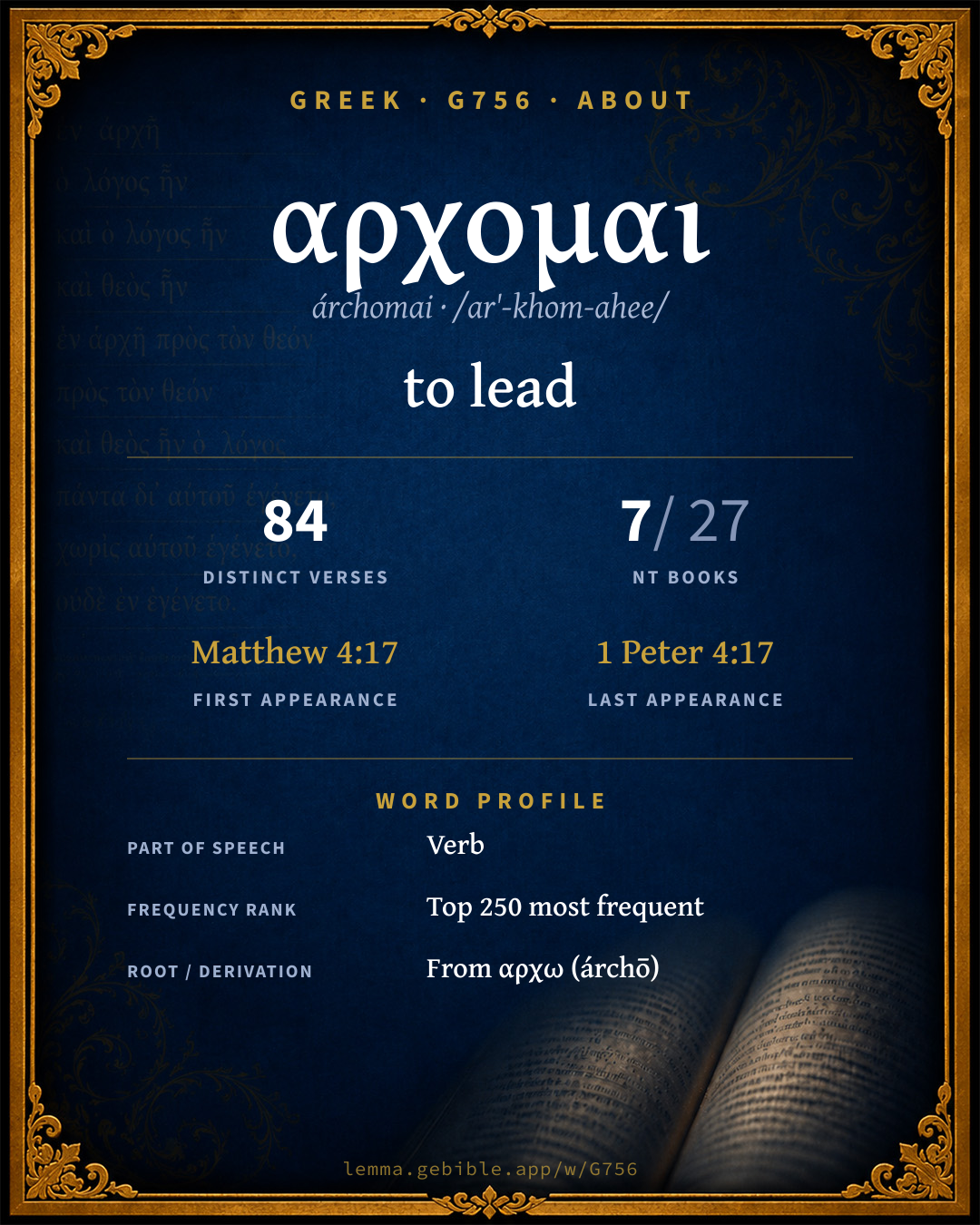
ἄρχομαι
to lead
‘to lead’ is one of 3 main senses fuller range ↓
Full lexicon entry — Thayer's Greek Lexicon
From Thayer's Greek Lexicon
Where this word appears
Grammar key — what these labels mean
Part of speech
- Verb
- An action or state-of-being word.
Tense
- Aorist
- Action viewed as a simple whole, without regard to duration — often past (perfective aspect).
- Future
- Action expected in future time.
- Present
- Ongoing or general action in present time (imperfective aspect).
Voice
- Middle deponent
- Middle in form but active in meaning.
- Middle
- The subject acts on or for itself, or with special interest in the action.
Mood
- Indicative
- States a fact or asks a factual question (the mood of reality).
- Participle
- A verbal adjective (“writing,” “having written”).
- Infinitive
- A verbal noun (“to write”), unmarked for person or number.
- Subjunctive
- Expresses probability, purpose, or possibility (the mood of contingency).
Case
- Nominative
- The case of the subject (and the predicate nominative).
- Genitive
- The case of source, possession, or “of” — answers “whose / from what.”
Person
- 3rd person
- The one spoken about (“he / she / it / they”).
- 2nd person
- The one addressed (“you”).
- 1st person
- The speaker (“I / we”).
Gender
- Masculine
- Grammatically masculine.
Number
- Singular
- One.
- Plural
- More than one.
Every verse where G756 appears in the Book of Mark — 26 distinct verses. Click any verse to open its interlinear word-by-word view. Verse text shown in the World English Bible for context — . Each verse’s Greek form is shown with its reference; the English is not keyword-highlighted, since the data carries no word-level English alignment. Use “Compare translations” on any verse to read it across multiple English versions. This concordance covers the Greek New Testament; Septuagint (Greek Old Testament) occurrences of this word are not indexed here.
Mark
- Mark 1:45 ἤρξατο aor mid.dep ind 3sg But he went out, and began to proclaim it much, and to spread about the matter, so that Jesus could no more openly enter into a city, but was outside in desert places: and they came to him from everywhere.
- Mark 2:23 ἤρξαντο aor mid.dep ind 3pl It happened that he was going on the Sabbath day through the grain fields, and his disciples began, as they went, to pluck the ears of grain.
- Mark 4:1 ἤρξατο aor mid.dep ind 3sg Again he began to teach by the seaside. A great multitude was gathered to him, so that he entered into a boat in the sea, and sat down. All the multitude were on the land by the sea.
- Mark 5:17 ἤρξαντο aor mid.dep ind 3pl They began to beg him to depart from their region.
- Mark 5:20 ἤρξατο aor mid.dep ind 3sg He went his way, and began to proclaim in Decapolis how Jesus had done great things for him, and everyone marveled.
- Mark 6:2 ἤρξατο aor mid.dep ind 3sg When the Sabbath had come, he began to teach in the synagogue, and many hearing him were astonished, saying, "Where did this man get these things?" and, "What is the wisdom that is given to this man, that such mighty works come about by his hands?
- Mark 6:7 ἤρξατο aor mid.dep ind 3sg He called to himself the twelve, and began to send them out two by two; and he gave them authority over the unclean spirits.
- Mark 6:34 ἤρξατο aor mid.dep ind 3sg Jesus came out, saw a great multitude, and he had compassion on them, because they were like sheep without a shepherd, and he began to teach them many things.
- Mark 6:55 ἤρξαντο aor mid.dep ind 3pl and ran around that whole region, and began to bring those who were sick, on their mats, to where they heard he was.
- Mark 8:11 ἤρξαντο aor mid.dep ind 3pl The Pharisees came out and began to question him, seeking from him a sign from heaven, and testing him.
- Mark 8:31 ἤρξατο aor mid.dep ind 3sg He began to teach them that the Son of Man must suffer many things, and be rejected by the elders, the chief priests, and the scribes, and be killed, and after three days rise again.
- Mark 8:32 ἤρξατο aor mid.dep ind 3sg He spoke to them openly. Peter took him, and began to rebuke him.
- Mark 10:28 Ἤρξατο aor mid.dep ind 3sg Peter began to tell him, "Behold, we have left all, and have followed you."
- Mark 10:32 ἤρξατο aor mid.dep ind 3sg They were on the way, going up to Jerusalem; and Jesus was going in front of them, and they were amazed; and those who followed were afraid. He again took the twelve, and began to tell them the things that were going to happen to him.
- Mark 10:41 ἤρξαντο aor mid.dep ind 3pl When the ten heard it, they began to be indignant towards James and John.
- Mark 10:47 ἤρξατο aor mid.dep ind 3sg When he heard that it was Jesus the Nazarene, he began to cry out, and say, "Jesus, you son of David, have mercy on me!"
- Mark 11:15 ἤρξατο aor mid.dep ind 3sg They came to Jerusalem, and Jesus entered into the temple, and began to throw out those who sold and those who bought in the temple, and overthrew the tables of the money-changers, and the seats of those who sold the doves.
- Mark 12:1 ἤρξατο aor mid.dep ind 3sg He began to speak to them in parables. "A man planted a vineyard, put a hedge around it, dug a pit for the winepress, built a tower, rented it out to a farmer, and went into another country.
- Mark 13:5 ἤρξατο aor mid.dep ind 3sg Jesus, answering, began to tell them, "Be careful that no one leads you astray.
- Mark 14:19 ἤρξαντο aor mid.dep ind 3pl They began to be sorrowful, and to ask him one by one, "Surely not I?" And another said, "Surely not I?"
- Mark 14:33 ἤρξατο aor mid.dep ind 3sg He took with him Peter, James, and John, and began to be greatly troubled and distressed.
- Mark 14:65 ἤρξαντό aor mid.dep ind 3pl Some began to spit on him, and to cover his face, and to beat him with fists, and to tell him, "Prophesy!" The officers struck him with the palms of their hands.
- Mark 14:69 ἤρξατο aor mid.dep ind 3sg The maid saw him, and began again to tell those who stood by, "This is one of them."
- Mark 14:71 ἤρξατο aor mid.dep ind 3sg But he began to curse, and to swear, "I don't know this man of whom you speak!"
- Mark 15:8 ἤρξατο aor mid.dep ind 3sg The multitude, crying aloud, began to ask him to do as he always did for them.
- Mark 15:18 ἤρξαντο aor mid.dep ind 3pl They began to salute him, "Hail, King of the Jews!"
About this entry
At a glance — auto-summarized from this page’s data, not written by a person. Every figure links to its source below. This summary describes the numbers; it doesn’t interpret them.
αρχομαι — transliterated árchomai — is a Greek verb carrying the sense “to lead.” It first appears in Matthew 4:17. With 84 verses in 7 books, it is a moderately common word in the Greek New Testament. Its uses concentrate in Luke (37% of all occurrences). Its lexical range runs to 3 senses. Each statement above links to its evidence; the full detail follows below.
Gloss history
Strong's 1890 vs modern scholarship

About this word
Strong's G756 catalogs a Greek word from the Greek New Testament.
These counts are not copied from any lexicon or concordance. They are computed here, from the morphology-tagged Greek New Testament. What Lemma adds →
- 84
- distinct verses
- The word appears in 84 distinct verses.
- 7 / 27
- NT books
- The word appears in 7 of 27 New Testament books.
- #204
- by frequency
- Top 250 most frequent Greek words (rank 204 of 5,347 Greek words by occurrence).
View all 84 occurrences in the concordance →
By section of the New Testament
By traditional corpus
Conventional, traditional groupings — biblical authorship is debated, so this is a traditional corpus grouping, not an authorship claim. Some books belong to more than one corpus (Luke is in both the Gospels and the Lukan corpus, and so on), so these shares overlap and need not total 100%. Each figure is a share of the word’s 84 distinct verses.
- Gospels 72 verses · 86%
- Lukan (Luke–Acts) 41 verses · 49%
- Johannine 2 verses · 2%
- Pauline corpus 1 verse · 1%
- General (Catholic) Epistles 1 verse · 1%
How translations render this word
Counts come from each version’s own published word-to-Strong’s tagging or interlinear alignment — an approximate guide to how each version renders this word, not a word-level alignment the data otherwise carries. Because each total is that version’s own tagged count, the per-version totals vary from one another and need not match the appearance or distinct-verse counts above. These counts may also differ from a printed concordance because Lemma counts each distinctly tagged rendering and does not collapse phrase taggings into a single head-word total. This is a fixed set of word-tagged versions (KJV, ASV, BSB, ULT) and does not change with the reading translation you choose elsewhere. Each version’s license is shown beside its name below (and on Sources).
- King James Version: Began 43×, He began 12×, Beginning 7×
- American Standard Version: Began 38×, He began 11×, Beginning 9×
- Berean Standard Bible: Began 44×, He began 9×, Beginning 6×
King James Version Public Domain
Renders G756 across 84 tagged occurrences — most commonly:
Plus 9 renderings that appear only once — usually multi-word phrases or single function words the recovered tagging swept in, not distinct renderings.
American Standard Version Public Domain
Renders G756 across 88 tagged occurrences — most commonly:
Plus 17 renderings that appear only once — usually multi-word phrases or single function words the recovered tagging swept in, not distinct renderings.
Berean Standard Bible Public Domain
Renders G756 across 78 tagged occurrences — most commonly:
Plus 8 renderings that appear only once — usually multi-word phrases or single function words the recovered tagging swept in, not distinct renderings. Not rendered by a distinct English word in 1 further occurrence.
Senses in Thayer's
The 3 senses Thayer's distinguishes for this word, in lexicon order (not ranked by frequency or importance). The full entry — with sub-senses — is in the Lexicon Entry tab.
- to be the first to do (anything), to begin
- to be chief, leader, ruler
- to begin, make a beginning
Word origin
Derived from αρχω (árchō) (G757) — to rule.
Middle voice of G757 (through the implication of precedence ); to commence (in order of time): - rehearse from the) begin (-ning).
— Strong’s Exhaustive Concordance (1890), public domain.
Forms in the corpus
The 18 distinct written forms G756 takes in the Greek New Testament, most frequent first — each parse links to that tense’s occurrences in the concordance.
Same root — word family
Other Thayer's entries built from the same root as G756, grouped by Strong’s listed origin. These share a root / origin per the lexicon — not necessarily a shared meaning. Each links to that word’s own entry.
Derives from
Shares the same root
Derived from this word
Proper names from this root
People and places named from this root — a name, not an additional meaning of the word.
Compare all same-root words → Showing 4 of 6 — not the complete family. 1 of the same-root words is a proper name (a person or place). They share a root, not necessarily a meaning.