Mark 14:19

Greek (Tischendorf 8th ed.) Mark 14:19 appears in the Greek New Testament. The text above is from the Tischendorf 8th edition. Each word links to its Strong’s number and a concise gloss. Click any word for its full Thayer’s Greek Lexicon entry.
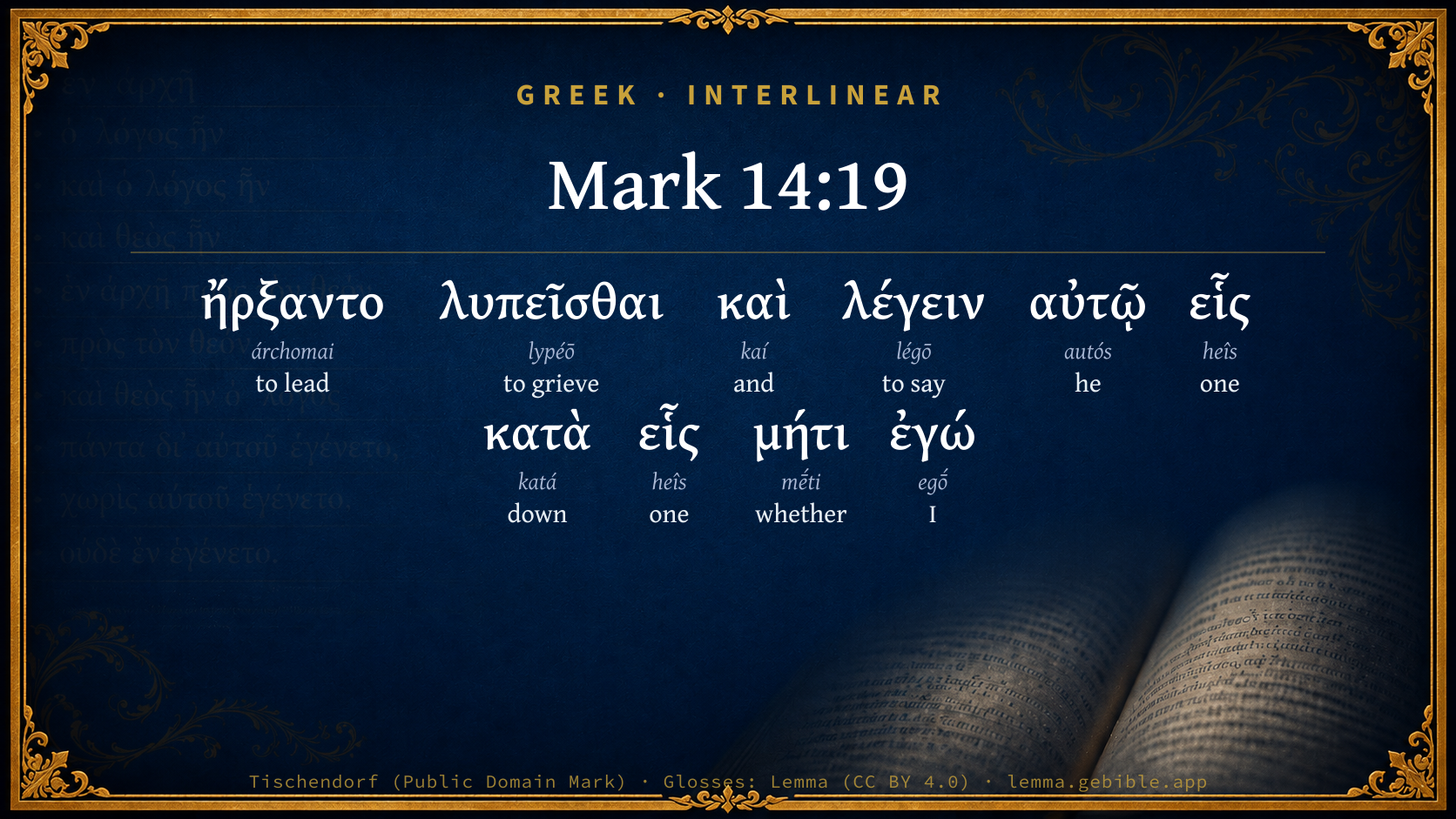
Download image
Cite this verse

Mark 14:19 (World English Bible). Public Domain. Lemma interlinear Bible study tool, https://lemma.gebible.app/v/mark/14/19.

Show BibTeX & RIS
BibTeX
RIS
English Translation
They began to be sorrowful, and to ask him one by one, "Surely not I?" And another said, "Surely not I?"
World English Bible · Public Domain
Download a study sheet

One document with this verse’s original text, its word-by-word gloss line, the meaning frame, cross-references with their text, attributed commentary, and full source and license credits — printable, and it pastes into notes with its structure intact.

This verse Autodidact and up

Study sheet (.html) Plain text (.txt)

A passage Seminary Student

Up to 50 verses in one chapter. A passage sheet keeps up to 6 commentary sources and 12 cross-references per verse, in the order this page ranks them, and says so on the sheet whenever that leaves anything out. Ask for a single verse and you get the Autodidact verse sheet above.

Everything on this page stays free to read, with no account — the sheet is a download of what is already on screen, not access to it.

Want to remove ads? Support Godless Engineer
Compare translations 3

The same verse in 3 English versions, stacked beneath the original-language interlinear above. Click any original word for its lexicon entry.

Each is an independent rendering of the whole verse — the interlinear is not word-aligned to these translations.

Highlighted words mark where these versions differ — a whole-verse word diff, not a word-by-word alignment.

  • World English Bible Public Domain
    They began to be sorrowful, and to ask him one by one, "Surely not I?" And another said, "Surely not I?"
  • King James Version Public Domain
    And they began to be sorrowful, and to say unto him one by one, Is it I? and another said, Is it I?
  • unfoldingWord Literal Text CC BY-SA 4.0
    They began to be grieved and to say to him one by one, “Surely not I?”

unfoldingWord Literal Text — © unfoldingWord, licensed CC BY-SA 4.0. Word-aligned USFM3 via Door43 (git.door43.org/unfoldingWord/en_ult).

Versions to compare (up to 4)

3 of 4 selected

Show all 19 translations

Every available English version of this verse, each an independent rendering of the whole verse.

  • World English Bible Public Domain
    They began to be sorrowful, and to ask him one by one, "Surely not I?" And another said, "Surely not I?"
  • Berean Standard Bible Public Domain
    They began to be grieved and to ask Him one after another, “Surely not I?”
  • Majority Standard Bible Public Domain
    They began to be grieved and to ask Him one after another, “Surely not I?” And another said, “Is it I?”
  • King James Version Public Domain
    And they began to be sorrowful, and to say unto him one by one, Is it I? and another said, Is it I?
  • American Standard Version (1901) Public Domain
    They began to be sorrowful, and to say unto him one by one, Is it I?
  • Revised Version (1885) Public Domain
    They began to be sorrowful, and to say unto him one by one, Is it I?
  • Geneva Bible (1599) Public Domain
    Then they began to be sorowful and to say to him one by one, Is it I? And another, Is it I?
  • Douay-Rheims (1899) Public Domain
    But they began to be sorrowful, and to say to him one by one: Is it I?
  • Young's Literal Translation Public Domain
    And they began to be sorrowful, and to say to him, one by one, `Is it I?' and another, `Is it I?'
  • Literal Standard Version CC BY-SA 4.0
    And they began to be sorrowful, and to say to Him one by one, “Is it I?” And another, “Is it I?”
  • Unlocked Literal Bible CC BY-SA 4.0
    They were all very sorrowful, and one by one they said to him, “Surely not I?”
  • unfoldingWord Literal Text CC BY-SA 4.0
    They began to be grieved and to say to him one by one, “Surely not I?”
  • Darby Bible Public Domain
    And they began to be grieved, and to say to him, one by one, Is it *I*? [and another, Is it *I*?]
  • World Messianic Bible Public Domain
    They began to be sorrowful, and to ask him one by one, “Surely not I?” And another said, “Surely not I?”
  • Webster's Bible Public Domain
    And they began to be sorrowful, and to say to him one by one, Is it I? and another said, Is it I?
  • Free Bible Version CC BY-SA 4.0
    They were shocked, and they each asked, “It's not me, is it?”
  • Bible in Basic English Public Domain
    They were sad, and said to him one by one, Is it I?
  • Text-Critical English NT CC BY 4.0
    So they began to be sorrowful and to say one after another, “Surely not I?” and, “Surely not I?”
  • Tyndale New Testament (1534) Public Domain
    And they begane to morne and to saye to him one by one: ys it I? And a nother sayde: ys it I?

Literal Standard Version (2020), Covenant Press — licensed CC BY-SA 4.0. Text via the HelloAO Bible API (eBible.org). Unlocked Literal Bible (unfoldingWord) — licensed CC BY-SA 4.0. Text via the HelloAO Bible API (eBible.org). unfoldingWord Literal Text — © unfoldingWord, licensed CC BY-SA 4.0. Word-aligned USFM3 via Door43 (git.door43.org/unfoldingWord/en_ult). Free Bible Version, Dr. Jonathan Gallagher — licensed CC BY-SA 4.0. Text via the HelloAO Bible API (eBible.org).

Word by word

More ways to search: Search by grammar → Find every occurrence → Compare this word →

Practice this passage: Drill this verse → Learn its vocabulary →

About this verse

These counts appear in no published source. They are computed here, from the morphology-tagged text and Lemma’s own curated glosses. What Lemma adds →

10
words
9
distinct lemmas
Gospels
section

Notable vocabulary

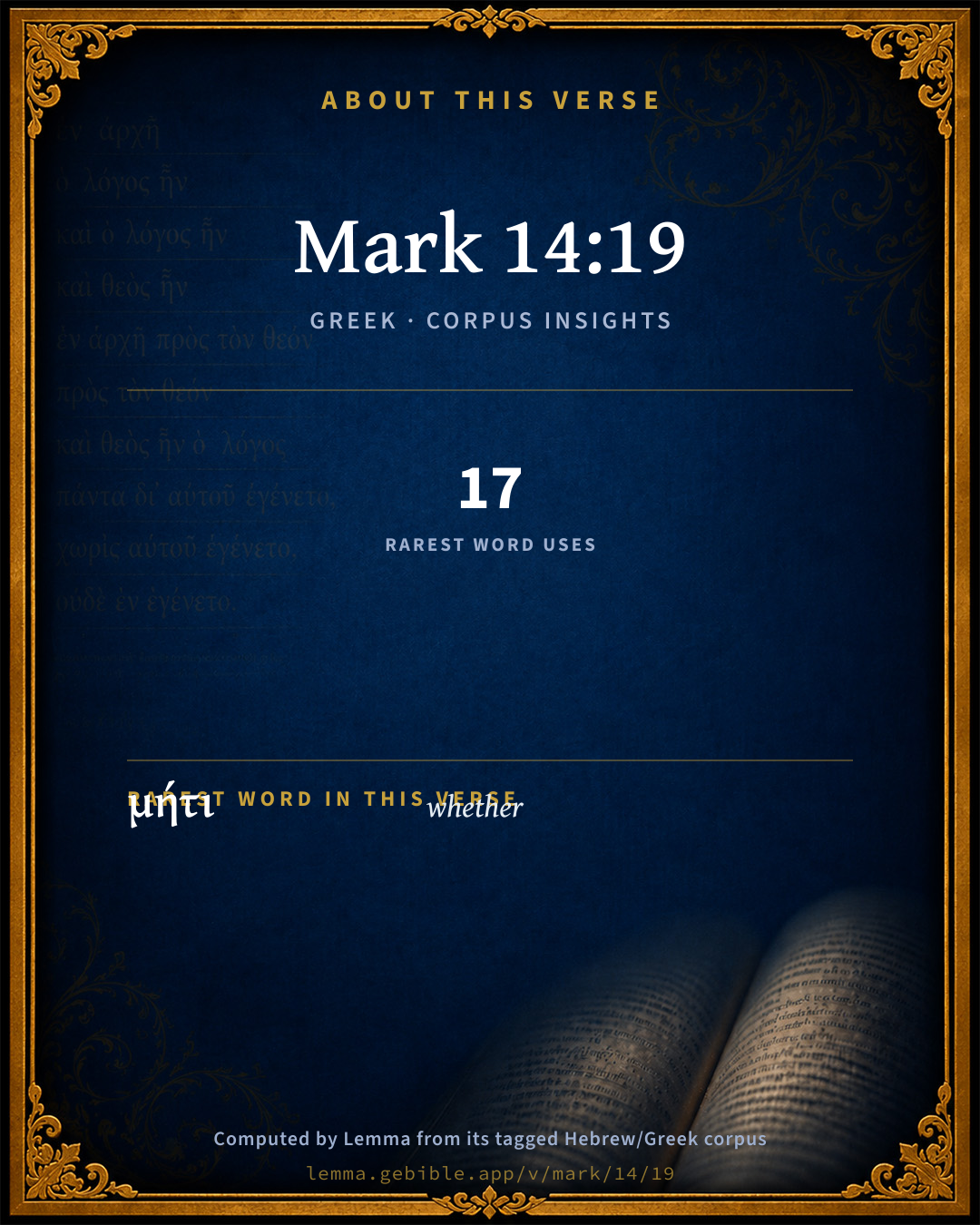
The rarest word here is μήτι whether G3385 — appearing just 17 times in the whole Greek New Testament.

Shared distinctive vocabulary

μήτι whether G3385 occurs in 17 verses of the Greek New Testament. Also found in:

Repetition

A word recurs within this verse:

Cross-references

3

Topical passages linked to Mark 14:19 in the Treasury of Scripture Knowledge — connected by theme and wording, ordered by reader-vote popularity; previews shown in the World English Bible.

  • Matthew 26:22 They were exceedingly sorrowful, and each began to ask him, "It isn't me, is it, Lord?"
  • Luke 22:21–23 But behold, the hand of him who betrays me is with me on the table.
  • John 13:22 The disciples looked at one another, perplexed about whom he spoke.

Cross-references courtesy of OpenBible.info (CC BY 4.0).

Where the printed editions differ

1 variant

Places in this verse where the major printed Greek editions disagree on the wording in a way that affects the translation — a comparison of editions, not a manuscript-by-manuscript collation. The editions are the modern critical texts (Nestlé-Aland 28/27, SBL, Westcott-Hort, Tregelles, Tyndale House) and the traditional texts behind the KJV (the Textus Receptus and the Byzantine/Majority text). It is not a claim about which reading is original.

  1. Extra text
    καὶ ἄλλος, μήτι ἐγώ;

    “and other surely not ever I myself?”

    In TRByz Not in NA28NA27TynSBLWHTreg

    καὶ ἄλλος, μήτι ἐγώ; (kai allos mēti egō) 'and other surely not ever I myself?' is only in traditional manuscripts (TR+Byz)

Textual data: Translators Amalgamated Greek New Testament (STEPBible TAGNT) · CC BY 4.0.

Commentary

Notes on Mark 14:19 from classic Christian and Jewish commentators (each source and its license shown beneath its notes). The classic Christian expositions comment on the surrounding passage and are grouped to its opening verse, so a note may address several verses; the Jewish commentaries on the Tanakh (Rashi and others) are per-verse, so they appear only where the commentator wrote on this verse.

Lemma curates 59 commentaries, every one of them public domain or Creative Commons licensed, each selected and text-cleaned for this edition rather than reprinted as found. About our sources →

MacLaren's Expositions of Holy Scripture

Alexander MacLaren

Mark

THE NEW PASSOVER

‘IS IT I?’

Mar 14:19.

The scene shows that Judas had not as yet drawn any suspicion on himself.

Here the Apostles seem to be higher than their ordinary stature; for they do not take to questioning one another, or even to protest, ‘No!’ but to questioning Christ.

I. The solemn prophecy.

It seems strange at first sight that our Lord should have introduced such thoughts then, disturbing the sweet repose of that hallowed hour. But the terrible fact of the betrayal was naturally suggested by the emblems of His death, and still more by the very confiding familiarity of that hour. His household were gathered around Him, and the more close and confidential the intercourse, the bitterer that thought to Him, that one of the little band was soon to play the traitor. It is the cry of His wounded love, the wail of His unrequited affection, and, so regarded, is infinitely touching. It is an instance of that sad insight into man’s heart which in His divinity He possessed. What a fountain of sorrow for His manhood was that knowledge! how it increases the pathos of His tenderness! Not only did He read hearts as they thought and felt in the present, but He read their future with more than a prophet’s insight. He saw how many buds of promise would shrivel, how many would go away and walk no more with Him.’

That solemn prophecy may well be pondered by all Christian assemblies, and specially when gathered for the observance of the Lord’s Supper. Perhaps never since that first institution has a community met to celebrate it without Him who ‘walks amid the candlesticks,’ with eyes as a flame of fire marking a Judas among the disciples. There is, I think, no doubt that Judas partook of the Lord’s Supper. But be that as it may, he was among the number, and our Lord knew him to be ‘the traitor.’

In its essence Judas’s sin can be repeated still, and the thought of that possibility may well mingle with the grateful and adoring contemplations suitable to the act of partaking of the Lord’s Supper. In the hour of holiest Christian emotion the thought that I may betray the Lord who has died for me will be especially hateful, and to remember the possibility then will do much to prevent its ever becoming a reality.

II. The self-distrustful question, ‘Is it I?’

It suggests that the possibilities of the darkest sin are in each of us, and especially, that the sin of treason towards Christ is in each of us.

Think generally of the awful possibilities of sin in every soul.

All sin has one root, so it is capable of passing from one form to another as light, heat, and motion do, or like certain diseases that are Protean in their forms. One sin is apt to draw others after it. ‘None shall want her mate.’ Wild beasts of ‘the desert’ meet with wild beasts of ‘the islands.’ Sins are gregarious, as it were; they ‘hunt in couples.’ ‘Then goeth he, and taketh with him seven other spirits more wicked than himself.’

The roots of all sin are in each. Men may think that they are protected from certain forms of sin by temperament, but identity of nature is deeper than varieties of temperament. The greatest sins are committed by yielding to very common motives. Love of money is not a rare feeling, but it led Judas to betray Jesus. Anger is thought to be scarcely a sin at all, but it often moves an arm to murder.

Temptations to each sin are round us all. We walk in a tainted atmosphere.

There is progress in evil. No man reaches the extreme of depravity at a bound. Judas’s treachery was of slow growth.

So still there is the constant operation and pressure of forces and tendencies drawing us away from Jesus Christ. We, every one of us, know that, if we allowed our nature to have its way, we should leave Him and ‘make shipwreck of faith and of a good conscience.’ The forms in which we might do it might vary, but do it we should. We are like a man desperately clutching some rocky projection on the face of a precipice, who knows that if once he lets go, he will be dashed to pieces. ‘There goes John Bradford, but for the grace of God!’ But for this same restraining grace, to what depths might we not sink? So, in all Christian hearts there should be profound consciousness of their own weakness. The man ‘who fears no fall’ is sure to have one. It is perilous to march through an enemy’s country in loose order, without scouts and rearguard. Rigorous control is ever necessary. Brotherly judgment, too, of others should result from our consciousness of weakness. Examples of others falling are not to make us say cynically, ‘We are all alike,’ but to set us to think humbly of ourselves, and to supplicate divine keeping,’ Lord, save me, or I perish!’

III. The safety of the self-distrustful.

When the consciousness of possible falling is brought home to us, we shall carry, if we are wise, all our doubts as to ourselves to Jesus. There is safety in asking Him, ‘Is it I?’ To bare our inmost selves before Him, and not to shrink, even if that piercing gaze lights on hidden meannesses and incipient treachery, may be painful, but is healing. He will keep us from yielding to the temptation of which we are aware, and which we tell frankly to Him. The lowly sense of our own liability to fall, if it drives us closer to Him, will make it certain that we shall not fall.

While the other disciples asked ‘Is it I?’ John asked ‘Who is it?’ The disciple who leaned on Christ’s bosom was bathed in such a consciousness of Christ’s love that treason against it was impossible. He, alone of the Evangelists, records his question, and he tells us that he put it, ‘leaning back as he was, on Jesus’s breast.’ For the purpose of whispering his interrogation, he changed his attitude for a moment so as to press still closer to Jesus. How could one who was thus nestling nearer to that heart be the betrayer? The consciousness of Christ’s love, accompanied with the effort to draw closer to Him, is our surest defence against every temptation to faithlessness or betrayal of Him.

Any other fancied ground of security is deceptive, and will sooner or later crumble beneath our deceived feet. On this very occasion, Peter built a towering fabric of profession of unalterable fidelity on such shifting ground, and saw it collapse into ruin in a few hours. Let us profit by the lesson! That wholesome consciousness of our weakness need not shade with sadness the hours of communion, but it may well help us to turn them to their highest use in making them occasions for lowlier self-distrust and closer cleaving to Him. If we thus use our sense of weakness, the sweet security will enter our souls that belongs to those who have trusted in the great promise: ‘He shall not fall, for God Is able to make him stand.’ The blessed ones who are kept from falling and ‘presented faultless before the presence of His glory,’ will hear with wonder the voice of the Judge ascribing to them deeds of service to Him of which they had not been conscious, and will have to ask once more the old question, but with a new meaning: ‘Lord, is it I? when saw we Thee an hungered, and fed Thee?’

Alexander MacLaren, Expositions of Holy Scripture (1904–1910) — public domain. Text from a community e-Sword module.

Tyndale Open Study Notes

Tyndale Open Resources

14:19 The disciples were shocked and saddened, asking, Am I the one? This is the first they had heard that Jesus would be betrayed (though the reader has known it since 3:19). Jesus maintained his betrayer’s anonymity.

Tyndale Open Study Notes — © Tyndale Open Resources, licensed CC BY-SA 4.0. Text via the HelloAO Bible API.

Bengel's Gnomon

Johann Albrecht Bengel

Mar 14:19. Εἷς καθεῖς) So Joh 8:9, and ὁ δὲ καθεῖς; Rom 12:5.—ὁ καθεὶς δὲ τὼν φίλων; 3Ma 5:31. From κατὰ (not καὶ εἶτα) and εἷς comes καθεὶς, of similar formation to ὀυδεὶς, μηδεὶς, unless you prefer accenting it καθεῖς, in order to distinguish it from the participle καθεὶς; κατὰ is used adverbially, as ἀνὰ μετά.

Bengel's Gnomon of the New Testament — English translation (T&T Clark, Edinburgh, 1860) — public domain. Text from a community e-Sword module.

Expositor's Greek Testament

ed. W. Robertson Nicoll

Mar 14:19 . εἶς κατὰ εἶς , one by one = εἶς ἕκαστος in Mt.; κατὰ is used adverbially, and hence is followed by εἶς instead of ἕνα . For other instances of this usage of late Greek vide Joh 8:9 , Rom 12:5 , and cf. Winer, § xxxvii. 3.

The Expositor's Greek Testament, edited by W. Robertson Nicoll (1897–1910) — public domain. Text from a community e-Sword module.

Adam Clarke's Commentary

Verse 19. And another said, Is it I?] This clause is wanting in BCLP, seventeen others, Syriac, Persic, Arabic, Coptic, AEthiopic, Vulgate, and four of the Itala. Griesbach leaves it doubtful: others leave it out.

Adam Clarke's Commentary on the Bible (1810–1826) — public domain. Text from a community e-Sword/MySword module.

The Cambridge Bible for Schools and Colleges

gen. ed. J. J. S. Perowne

19. they began to be sorrowful] The very thought of treason was to their honest and faithful hearts insupportable, and excited great surprise and deepest sorrow.

one by one] Observe the pictorial and minute details of St Mark.

Is it I?] None of them said “Is it he?” So utterly unconscious were they of the treachery that lurked in their midst.

The Cambridge Bible for Schools and Colleges (gen. ed. J. J. S. Perowne; Cambridge University Press, 1878–1918) — public domain. Text from a community e-Sword module.

John Gill's Exposition

And he answered and said unto them,.... In order to relieve their minds, and point out the particular person:

it is one of the twelve, that dippeth with me in the dish; just at that very instant; See Gill on Mat 26:23.

John Gill's Exposition of the Whole Bible (1746–1763) — public domain (CC PDM 1.0). Text via the HelloAO Bible API.

Trapp's Complete Commentary

John Trapp

19 And they began to be sorrowful, and to say unto him one by one, Is it I? and another said, Is it I?

Ver. 19. {See Trapp on "Mat 26:22"}

John Trapp, A Commentary or Exposition upon All the Books of the Old and New Testament (1647–1656) — public domain. Text from a community e-Sword module.

The Pulpit Commentary

They began to be sorrowful, and to say unto him one by one, Is it I? The disciples were naturally disposed to be joyful at this great festival. But their Master"s sorrow and his words, and the solemnity with which they were uttered, cast a shadow over the whole company; and the disciples began to be sorrowful. The words, "And another said, Is it I?" are omitted by the best authorities.

The Pulpit Commentary (1880–1919), ed. H.D.M. Spence-Jones & Joseph S. Exell — public domain. Text from a community e-Sword module.

Cambridge Greek Testament for Schools and Colleges

19. ἤρξαντο ([3095][3096][3097][3098]) rather than οἱ δὲ ἤρξαντο ([3099][3100][3101][3102][3103][3104]). εἷς κατὰ εἶς ([3105][3106][3107][3108]) rather than εἶς καθʼ εἶς ([3109][3110][3111][3112][3113]); cf. [Jn] Mar 8:9.

[3095] Codex Sinaiticus. 4th cent. Discovered by Tischendorf in 1859 at the Monastery of St Katharine on Mount Sinai. Now at St Petersburg. The whole Gospel, ending at Mar 16:8. Photographic facsimile, 1911.

[3096] Codex Vaticanus. 4th cent., but perhaps a little later than א. In the Vatican Library almost since its foundation by Pope Nicolas V., and one of its greatest treasures. The whole Gospel, ending at Mar 16:8. Photographic facsimile, 1889.

[3097] Codex Regius. 8th cent. An important witness. At Paris. Contains Mar 1:1 to Mar 10:15; Mar 10:30 to Mar 15:1; Mar 15:20 to Mar 16:20, but the shorter ending is inserted between Mar 16:8 and Mar 16:9, showing that the scribe preferred it to the longer one.

[3098] Codex Athous Laurae. 8th cent. Like N and Σ, it is written in silver letters on purple vellum. Contains Mar 9:5 to Mar 16:20, and, as in L, the shorter ending is inserted between Mar 16:8 and Mar 16:9. As in Δ, the text of Mark is specially good.

[3099] Codex Alexandrinus. 5th cent. Brought by Cyril Lucar, Patriarch of Constantinople, from Alexandria, and afterwards presented by him to King Charles I. in 1628. In the British Museum. The whole Gospel. Photographic facsimile, 1879.

[3100] Codex Bezae. 6th cent. Has a Latin translation (d) side by side with the Greek text, and the two do not quite always agree. Presented by Beza to the University Library of Cambridge in 1581. Remarkable for its frequent divergences from other texts. Contains Mark, except Mar 16:15-20, which has been added by a later hand. Photographic facsimile, 1899.

[3101] Codex Monacensis. 10th cent. Contains Mar 6:47 to Mar 16:20. Many verses in 14, 15, 16 are defective.

[3102] Codex Oxoniensis. 9th cent. Contains Mark, except Mar 3:35 to Mar 6:20.

[3103] Codex Sangallensis. 9th or 10th cent. Contains the Gospels nearly complete, with an interlinear Latin translation. The text of Mark is specially good, agreeing often with CL. At St Gall.

[3104] Codex Petropolitanus. 9th cent. Gospels almost complete. Mar 16:18-20 is in a later hand.

[3105] Codex Sinaiticus. 4th cent. Discovered by Tischendorf in 1859 at the Monastery of St Katharine on Mount Sinai. Now at St Petersburg. The whole Gospel, ending at Mar 16:8. Photographic facsimile, 1911.

[3106] Codex Vaticanus. 4th cent., but perhaps a little later than א. In the Vatican Library almost since its foundation by Pope Nicolas V., and one of its greatest treasures. The whole Gospel, ending at Mar 16:8. Photographic facsimile, 1889.

[3107] Codex Regius. 8th cent. An important witness. At Paris. Contains Mar 1:1 to Mar 10:15; Mar 10:30 to Mar 15:1; Mar 15:20 to Mar 16:20, but the shorter ending is inserted between Mar 16:8 and Mar 16:9, showing that the scribe preferred it to the longer one.

[3108] Codex Sangallensis. 9th or 10th cent. Contains the Gospels nearly complete, with an interlinear Latin translation. The text of Mark is specially good, agreeing often with CL. At St Gall.

[3109] Codex Alexandrinus. 5th cent. Brought by Cyril Lucar, Patriarch of Constantinople, from Alexandria, and afterwards presented by him to King Charles I. in 1628. In the British Museum. The whole Gospel. Photographic facsimile, 1879.

[3110] Codex Bezae. 6th cent. Has a Latin translation (d) side by side with the Greek text, and the two do not quite always agree. Presented by Beza to the University Library of Cambridge in 1581. Remarkable for its frequent divergences from other texts. Contains Mark, except Mar 16:15-20, which has been added by a later hand. Photographic facsimile, 1899.

[3111] Codex Monacensis. 10th cent. Contains Mar 6:47 to Mar 16:20. Many verses in 14, 15, 16 are defective.

[3112] Codex Oxoniensis. 9th cent. Contains Mark, except Mar 3:35 to Mar 6:20.

[3113] Codex Petropolitanus. 9th cent. Gospels almost complete. Mar 16:18-20 is in a later hand.

19. ἤρξαντο λυπεῖσθαι. See crit. note. The asyndeton is impressive; the festal meal was at once turned to mourning. But no disciple doubts the truth of the Master’s words; sooner than that each suspects himself, πιστεύοντες τῷ τὰς καρδίας εἰδότι πλέον ἢ ἑαυτοῖς (Theoph.). Leonardo’s fresco depicts this crisis.

εἷς κατὰ εἷς. This ungrammatical idiom is not found in classical writers, but it and similar expressions are not rare in late Greek; τὸ δὲ καθʼ εἷς (Rom 12:5); ἀνὰ εἷς ἕκαστος (Rev 21:21); ὁ καθʼ εἷς δὲ τῶν φίλων (3Ma 5:34); εἷς καθʼ ἕκαστος (Lev 25:10, A text, which Deissmann, Bib. St. p. 138, is inclined to support). Perhaps the prep. was treated as an adv.

Μήτι ἐγώ; Surely it cannot be I? Cf. Mar 2:19, Mar 4:21. If Mt. is drawing an inference, it is a safe inference, when he tells us that Judas also asked this question. Not to have asked with the rest would have attracted attention.

Cambridge Greek Testament for Schools and Colleges (Cambridge University Press, 1896; 21 vols, various authors incl. Carr, Maclear, Plummer, Farrar, Lumby, Moule, M. R. James, Simcox) — public domain. Text from a community e-Sword module.

Alford’s Greek Testament

Henry Alford

19.] εἷς κατά (or καθʼ) εἷς, a later Greek phrase in which the preposition serves merely as an adverb of distribution, is treated by Winer, § 37. 3. The ἄλλος following is used as if not εἷς κατὰ εἷς but only εἷς had been used. Meyer remarks that such broken construction is suitable to the graphic tendency of our Evangelist.

Henry Alford, The Greek Testament (1849–1861) — public domain. Text from a community e-Sword module.

International Critical Commentary

19. Ἤρξαντο λυπεῖσθαι, καὶ λέγειν αὐτῷ εἷς κατὰ εἷς,2 Μήτι ἐγώ;3—And they began to grieve, and to say to him, one by one, Is it I?

Omit Οἱ δὲ at beginning of verse, Tisch. Treg. WH. אBL Memph. κατὰ, instead of καθʼ, before εἷς, Tisch. Treg. WH. א BL Δ. Omit καὶ ἄλλος, Μήτι ἐγώ; and another, Is it I? Tisch. Treg. (Treg. marg.) WH. RV. אBCLP Δ, two mss. Lat. Vet. Vulg. Egyptt. Syrr.

International Critical Commentary — older volumes (1896–1929), various authors — public domain. Text from a community e-Sword module.

Lesson kit

Teaching starters — assembled from the data on this page, not authored interpretation. Every prompt links to the verse data it draws on. Edit before teaching.

Mark, in the Gospels, opens this verse with 10 words (9 distinct Greek lemmas). Its most distinctive word is mḗti (“whether”). A historical commentator’s framing appears above. Read the whole chapter for the surrounding context.

Discussion questions

  1. How does “whether” (mḗti) shape what this verse is saying?
  2. Matthew 7:16 shares the word «whether» with this verse. How do the two illuminate each other?
  3. “one” occurs 2× in this one verse. What is the effect of the repetition?
  4. These translations render this verse differently. What is at stake in choosing one wording over another?
  5. Reading how MacLaren's Expositions of Holy Scripture and Tyndale Open Study Notes read this verse, where do the two commentators agree and where do they part?

Things to notice

  • These translations choose different wording for 7 words in this verse.
  • “one” occurs 2× in this single verse.
  • 9 distinct Greek lemmas span 10 words in this verse.

Reading settings

Reading text

Shown beneath each verse's original-language words.

Old Testament
Old Testament edition

Read the OT as the Masoretic Hebrew (MT) or the Greek Septuagint (LXX).

English shown for the Greek Septuagint (in the Hebrew ↔ Greek comparison).

Comparing translations? Open the Compare panel on any verse page to stack up to four side by side.