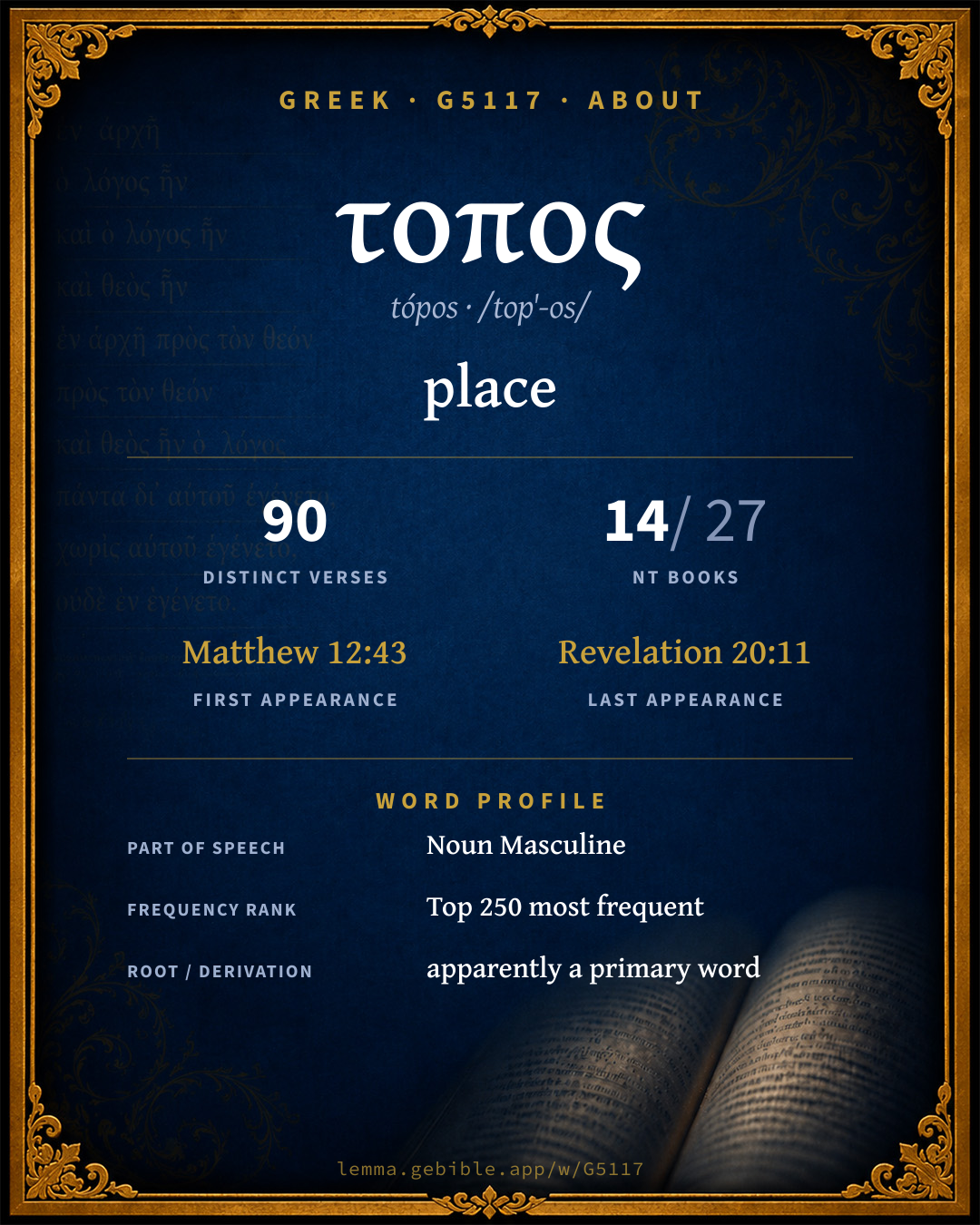
τόπος
place
‘place’ is one of 2 main senses fuller range ↓
Full lexicon entry — Thayer's Greek Lexicon
From Thayer's Greek Lexicon
Where this word appears
See every Accusative-case word in the Greek New Testament →
Grammar key — what these labels mean
Part of speech
- Noun
- A naming word — a person, place, thing, or idea.
Case
- Accusative
- The case of the direct object and of extent.
- Nominative
- The case of the subject (and the predicate nominative).
- Dative
- The case of the indirect object, means, or location — “to / for / with / in.”
- Genitive
- The case of source, possession, or “of” — answers “whose / from what.”
Gender
- Masculine
- Grammatically masculine.
Number
- Singular
- One.
- Plural
- More than one.
2 verses where G5117 appears in the Dative case in the Book of Acts. Filtered view — show all forms. Click any verse to open its interlinear word-by-word view. Verse text shown in the World English Bible for context — . Each verse’s Greek form is shown with its reference; the English is not keyword-highlighted, since the data carries no word-level English alignment. Use “Compare translations” on any verse to read it across multiple English versions. This concordance covers the Greek New Testament; Septuagint (Greek Old Testament) occurrences of this word are not indexed here.
Acts
- Acts 7:7 τόπῳ n dat sg masc 'I will judge the nation to which they will be in bondage,' said God, 'and after that will they come out, and serve me in this place.'
- Acts 16:3 τόποις n dat pl masc Paul wanted to have him go out with him, and he took and circumcised him because of the Jews who were in those parts; for they all knew that his father was a Greek.
About this entry
At a glance — auto-summarized from this page’s data, not written by a person. Every figure links to its source below. This summary describes the numbers; it doesn’t interpret them.
At its core, τοπος (tópos) means “place.” First canonically at Matthew 12:43, it enters the text early. It appears 90 verses across 14 books of the Greek New Testament, among its moderately common vocabulary. Catalogued under 2 senses, its meaning is not single-sense. Each statement above links to its evidence; the full detail follows below.
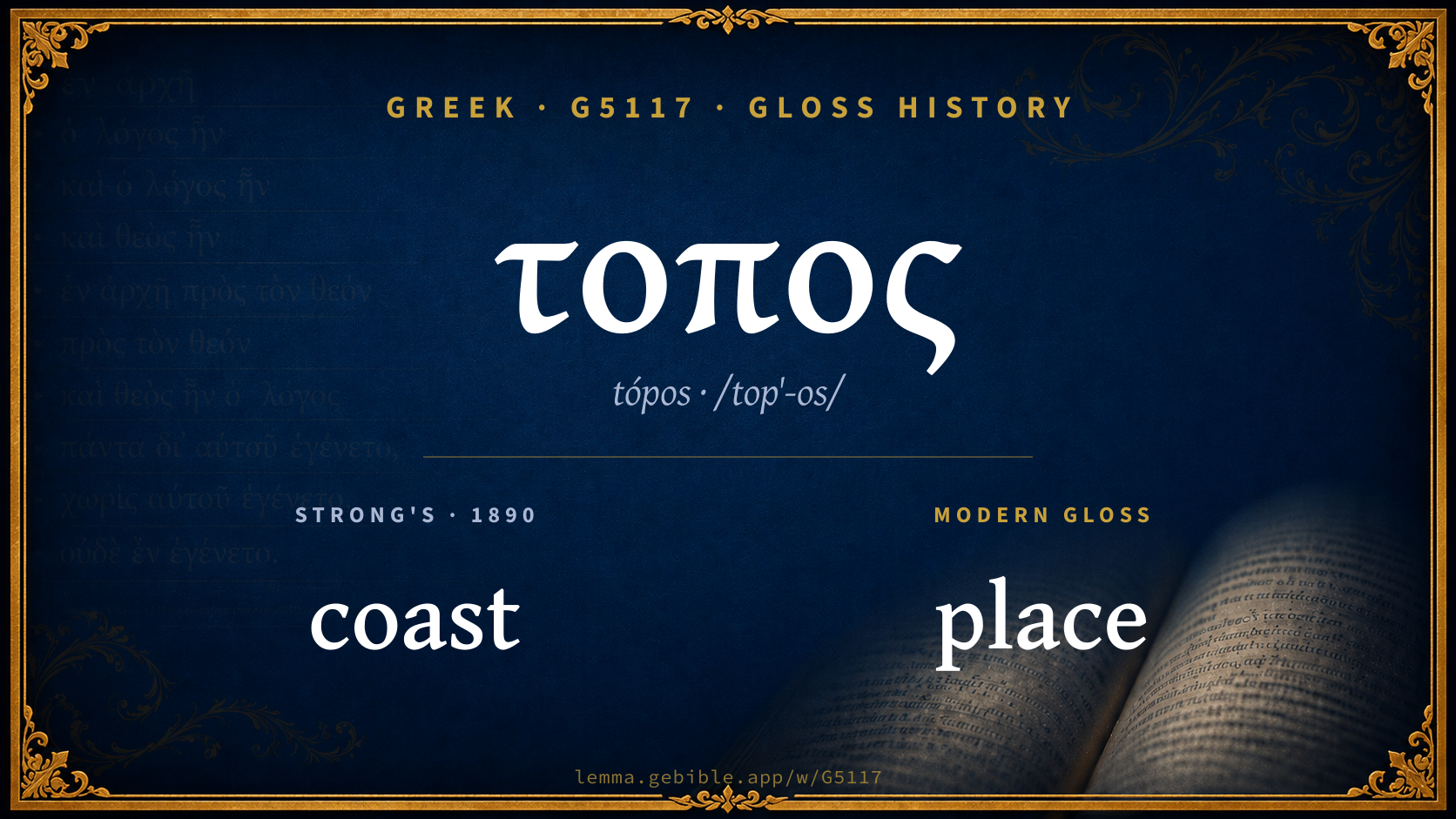
Gloss history
Strong's 1890 vs modern scholarship
About this word
Strong's G5117 catalogs a Greek word from the Greek New Testament.
These counts are not copied from any lexicon or concordance. They are computed here, from the morphology-tagged Greek New Testament. What Lemma adds →
- 90
- distinct verses
- The word appears in 90 distinct verses.
- 14 / 27
- NT books
- The word appears in 14 of 27 New Testament books.
- #179
- by frequency
- Top 250 most frequent Greek words (rank 179 of 5,347 Greek words by occurrence).
View all 90 occurrences in the concordance →
By section of the New Testament
By traditional corpus
Conventional, traditional groupings — biblical authorship is debated, so this is a traditional corpus grouping, not an authorship claim. Some books belong to more than one corpus (Luke is in both the Gospels and the Lukan corpus, and so on), so these shares overlap and need not total 100%. Each figure is a share of the word’s 90 distinct verses.
- Gospels 53 verses · 59%
- Lukan (Luke–Acts) 34 verses · 38%
- Johannine 25 verses · 28%
- Pauline corpus 9 verses · 10%
- Revelation 8 verses · 9%
- Hebrews 3 verses · 3%
- General (Catholic) Epistles 1 verse · 1%
How translations render this word
Counts come from each version’s own published word-to-Strong’s tagging or interlinear alignment — an approximate guide to how each version renders this word, not a word-level alignment the data otherwise carries. Because each total is that version’s own tagged count, the per-version totals vary from one another and need not match the appearance or distinct-verse counts above. These counts may also differ from a printed concordance because Lemma counts each distinctly tagged rendering and does not collapse phrase taggings into a single head-word total. This is a fixed set of word-tagged versions (KJV, ASV, BSB, ULT) and does not change with the reading translation you choose elsewhere. Each version’s license is shown beside its name below (and on Sources).
- King James Version: Place 71×, Places 6×, Room 5×
- American Standard Version: Place 71×, Places 6×, A 3×
- Berean Standard Bible: Place 62×, Places 6×, Everywhere 3×
- unfoldingWord Literal Text: Place 80×, A 11×, Places 8×
King James Version Public Domain
Renders G5117 across 91 tagged occurrences — most commonly:
Plus 7 renderings that appear only once — usually multi-word phrases or single function words the recovered tagging swept in, not distinct renderings. Not rendered by a distinct English word in 1 further occurrence.
American Standard Version Public Domain
Renders G5117 across 93 tagged occurrences — most commonly:
Plus 9 renderings that appear only once — usually multi-word phrases or single function words the recovered tagging swept in, not distinct renderings.
Berean Standard Bible Public Domain
Renders G5117 across 87 tagged occurrences — most commonly:
Plus 13 renderings that appear only once — usually multi-word phrases or single function words the recovered tagging swept in, not distinct renderings. Not rendered by a distinct English word in 5 further occurrences.
unfoldingWord Literal Text CC BY-SA 4.0
Renders G5117 across 107 tagged occurrences — most commonly:
Plus 4 renderings that appear only once — usually multi-word phrases or single function words the recovered tagging swept in, not distinct renderings.
Senses in Thayer's
The 2 senses Thayer's distinguishes for this word, in lexicon order (not ranked by frequency or importance). The full entry — with sub-senses — is in the Lexicon Entry tab.
- place, any portion or space marked off, as it were from surrounding space
- metaph.
Word origin
Origin: apparently a primary word
Apparently a primary word; a spot (generally in space but limited by occupancy; whereas G5561 is a larger but particular locality ) that is location (as a position home tract etc.); figuratively condition opportunity ; specifically a scabbard : - coast licence place X plain quarter + rock room where.
— Strong’s Exhaustive Concordance (1890), public domain.
Forms in the corpus
The 7 distinct written forms G5117 takes in the Greek New Testament, most frequent first — each parse links to that case’s occurrences in the concordance.
| Form | Parsing | Example | Uses |
|---|---|---|---|
| τόπον tópon | Noun, Accusative, Singular, Masculine | Matthew 14:13 | 47 |
| τόπος tópos | Noun, Nominative, Singular, Masculine | Matthew 14:15 | 16 |
| τόπῳ tópō | Noun, Dative, Singular, Masculine | Matthew 24:15 | 15 |
| τόπου tópou | Noun, Genitive, Singular, Masculine | Matthew 14:35 | 7 |
| τόπους tópous | Noun, Accusative, Plural, Masculine | Matthew 24:7 | 5 |
| τόπων tópōn | Noun, Genitive, Plural, Masculine | Matthew 12:43 | 3 |
| τόποις tópois | Noun, Dative, Plural, Masculine | Mark 1:45 | 2 |
Septuagint usage
The same Greek word τοπος appears 451 times in the Greek Old Testament (Septuagint), across 425 verses in 32 books.
- 451
- LXX occurrences
- Tagged occurrences of this Greek word in the Septuagint.
- 425
- verses
- Distinct Septuagint verses containing this word.
- 32 / 39
- OT books
- The word appears in 32 of the 39 Old Testament books.
Sample Septuagint occurrences
- Genesis 12:6 τόπος
- Exodus 3:5 τόπος
- Leviticus 1:16 τόπος
- Numbers 9:17 τόπος
- Deuteronomy 1:31 τόπος
- Joshua 1:3 τόπος
- Judges 2:5 τόπος
- Ruth 1:7 τόπος
- 1 Samuel 2:20 τόπος
- 2 Samuel 2:16 τόπος
- 1 Kings 5:1 τόπος
- 2 Kings 4:10 τόπος
Septuagint occurrences (same lexeme)
Every verse where the same Strong’s number (G5117) appears in the Greek Septuagint — showing the first 50 of 425. Verse text shown in the World English Bible for context; the Greek form is the matched word — the English is not keyword-highlighted.
- Genesis 12:6 τόπος Abram passed through the land to the place of Shechem, to the oak of Moreh. The Canaanite was then in the land.
- Genesis 13:3 τόπος He went on his journeys from the South even to Bethel, to the place where his tent had been at the beginning, between Bethel and Ai,
- Genesis 13:4 τόπος to the place of the altar, which he had made there at the first. There Abram called on the name of Yahweh.
- Genesis 13:14 τόπος Yahweh said to Abram, after Lot was separated from him, "Now, lift up your eyes, and look from the place where you are, northward and southward and eastward and westward,
- Genesis 18:24 τόπος What if there are fifty righteous within the city? Will you consume and not spare the place for the fifty righteous who are therein?
- Genesis 18:26 τόπος Yahweh said, "If I find in Sodom fifty righteous within the city, then I will spare all the place for their sake."
- Genesis 18:33 τόπος Yahweh went his way, as soon as he had finished communing with Abraham, and Abraham returned to his place.
- Genesis 19:12 τόπος The men said to Lot, "Do you have anybody else here? Sons-in-law, your sons, your daughters, and whoever you have in the city, bring them out of the place:
- Genesis 19:13 τόπος for we will destroy this place, because the cry of them is grown great before Yahweh. Yahweh has sent us to destroy it."
- Genesis 19:14 τόπος Lot went out, and spoke to his sons-in-law, who were pledged to marry his daughters, and said, "Get up! Get out of this place, for Yahweh will destroy the city." But he seemed to his sons-in-law to be joking.
- Genesis 19:27 τόπος Abraham got up early in the morning to the place where he had stood before Yahweh.
- Genesis 20:11 τόπος Abraham said, "Because I thought, 'Surely the fear of God is not in this place. They will kill me for my wife's sake.'
- Genesis 20:13 τόπος It happened, when God caused me to wander from my father's house, that I said to her, 'This is your kindness which you shall show to me. Everywhere that we go, say of me, "He is my brother."'"
- Genesis 21:17 τόπος God heard the voice of the boy. The angel of God called to Hagar out of the sky, and said to her, "What ails you, Hagar? Don't be afraid. For God has heard the voice of the boy where he is.
- Genesis 21:31 τόπος Therefore he called that place Beersheba, because they both swore there.
- Genesis 22:3 τόπος Abraham rose early in the morning, and saddled his donkey, and took two of his young men with him, and Isaac his son. He split the wood for the burnt offering, and rose up, and went to the place of which God had told him.
- Genesis 22:4 τόπος On the third day Abraham lifted up his eyes, and saw the place far off.
- Genesis 22:9 τόπος They came to the place which God had told him of. Abraham built the altar there, and laid the wood in order, bound Isaac his son, and laid him on the altar, on the wood.
- Genesis 22:14 τόπος Abraham called the name of that place Yahweh-Jireh. As it is said to this day, "In Yahweh's mountain it will be provided.
- Genesis 24:23 τόπος and said, "Whose daughter are you? Please tell me. Is there room in your father's house for us to lodge in?"
- Genesis 24:25 τόπος She said moreover to him, "We have both straw and provender enough, and room to lodge in."
- Genesis 24:31 τόπος He said, "Come in, you blessed of Yahweh. Why do you stand outside? For I have prepared the house, and room for the camels."
- Genesis 26:7 τόπος The men of the place asked him about his wife. He said, "She is my sister," for he was afraid to say, "My wife," lest, he thought, the men of the place might kill me for Rebekah, because she was beautiful to look on.
- Genesis 28:11 τόπος He came to a certain place, and stayed there all night, because the sun had set. He took one of the stones of the place, and put it under his head, and lay down in that place to sleep.
- Genesis 28:16 τόπος Jacob awakened out of his sleep, and he said, "Surely Yahweh is in this place, and I didn't know it."
- Genesis 28:17 τόπος He was afraid, and said, "How dreadful is this place! This is none other than God's house, and this is the gate of heaven."
- Genesis 28:19 τόπος He called the name of that place Bethel, but the name of the city was Luz at the first.
- Genesis 29:3 τόπος There all the flocks were gathered. They rolled the stone from the well's mouth, and watered the sheep, and put the stone again on the well's mouth in its place.
- Genesis 29:22 τόπος Laban gathered together all the men of the place, and made a feast.
- Genesis 29:26 τόπος Laban said, "It is not done so in our place, to give the younger before the first born.
- Genesis 30:25 τόπος It happened, when Rachel had borne Joseph, that Jacob said to Laban, "Send me away, that I may go to my own place, and to my country.
- Genesis 31:13 τόπος I am the God of Bethel, where you anointed a pillar, where you vowed a vow to me. Now arise, get out from this land, and return to the land of your birth."
- Genesis 32:1 τόπος Jacob went on his way, and the angels of God met him.
- Genesis 32:3 τόπος Jacob sent messengers in front of him to Esau, his brother, to the land of Seir, the field of Edom.
- Genesis 32:31 τόπος The sun rose on him as he passed over Peniel, and he limped because of his thigh.
- Genesis 33:17 τόπος Jacob traveled to Succoth, built himself a house, and made shelters for his cattle. Therefore the name of the place is called Succoth.
- Genesis 35:1 τόπος God said to Jacob, "Arise, go up to Bethel, and live there. Make there an altar to God, who appeared to you when you fled from the face of Esau your brother."
- Genesis 35:7 τόπος He built an altar there, and called the place El Beth El; because there God was revealed to him, when he fled from the face of his brother.
- Genesis 35:13 τόπος God went up from him in the place where he spoke with him.
- Genesis 35:14 τόπος Jacob set up a pillar in the place where he spoke with him, a pillar of stone. He poured out a drink-offering on it, and poured oil on it.
- Genesis 35:15 τόπος Jacob called the name of the place where God spoke with him "Bethel."
- Genesis 36:40 τόπος These are the names of the chiefs who came from Esau, according to their families, after their places, and by their names: chief Timna, chief Alvah, chief Jetheth,
- Genesis 38:21 τόπος Then he asked the men of her place, saying, "Where is the prostitute, that was at Enaim by the road?" They said, "There has been no prostitute here."
- Genesis 38:22 τόπος He returned to Judah, and said, "I haven't found her; and also the men of the place said, 'There has been no prostitute here.'"
- Genesis 39:20 τόπος Joseph's master took him, and put him into the prison, the place where the king's prisoners were bound, and he was there in custody.
- Genesis 40:3 τόπος He put them in custody in the house of the captain of the guard, into the prison, the place where Joseph was bound.
- Exodus 3:5 τόπος He said, "Don't come close. Take off your sandals from off your feet, for the place you are standing on is holy ground."
- Exodus 3:8 τόπος I have come down to deliver them out of the hand of the Egyptians, and to bring them up out of that land to a good and large land, to a land flowing with milk and honey; to the place of the Canaanite, the Hittite, the Amorite, the Perizzite, the Hivite, and the Jebusite.
- Exodus 15:23 τόπος When they came to Marah, they couldn't drink from the waters of Marah, for they were bitter. Therefore the name of it was called Marah.
- Exodus 16:29 τόπος Behold, because Yahweh has given you the Sabbath, therefore he gives you on the sixth day the bread of two days. Everyone stay in his place. Let no one go out of his place on the seventh day."
These are occurrences of the same Greek lexeme (G5117) in the Septuagint — not a translation of any one Hebrew word. The store carries no word-level Hebrew↔Greek alignment, so no Hebrew original is asserted here. Counts come from the recovered LXX Strong's tagging — high-frequency vocabulary is well covered, while rare or late forms may be untagged — so they reflect tagged occurrences and may slightly undercount.