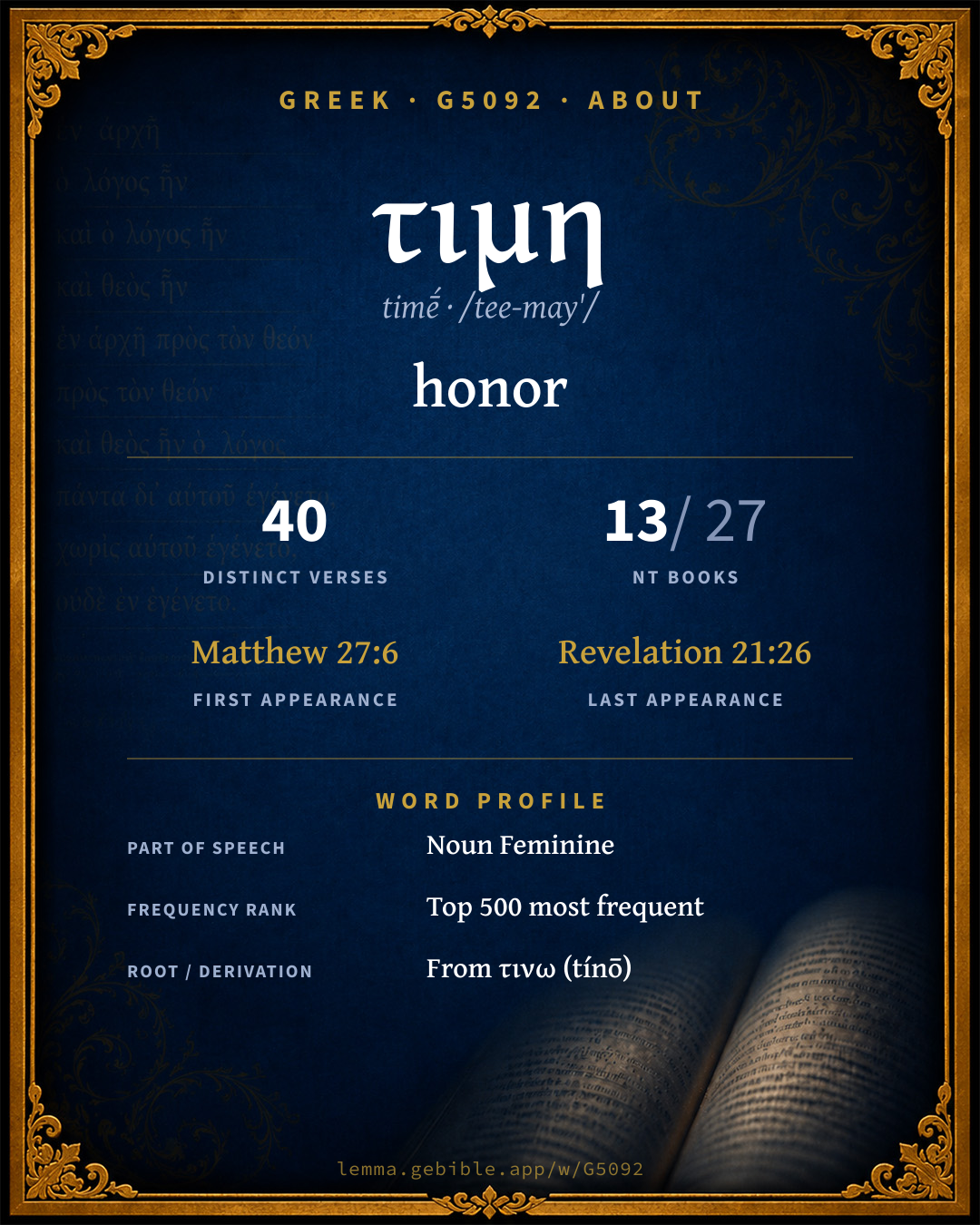
τιμή
honor
‘honor’ is one of 2 main senses fuller range ↓
Full lexicon entry — Thayer's Greek Lexicon
From Thayer's Greek Lexicon
Where this word appears
See every Accusative-case word in the Greek New Testament →
Grammar key — what these labels mean
Part of speech
- Noun
- A naming word — a person, place, thing, or idea.
Case
- Accusative
- The case of the direct object and of extent.
- Genitive
- The case of source, possession, or “of” — answers “whose / from what.”
- Nominative
- The case of the subject (and the predicate nominative).
- Dative
- The case of the indirect object, means, or location — “to / for / with / in.”
Gender
- Feminine
- Grammatically feminine.
Number
- Singular
- One.
- Plural
- More than one.
Grammatical forms
- Noun, Accusative, Singular, Feminine 19 times (46%)
- Noun, Genitive, Singular, Feminine 7 times (17%)
- Noun, Nominative, Singular, Feminine 7 times (17%)
- Noun, Dative, Singular, Feminine 5 times (12%)
- Noun, Accusative, Plural, Feminine 2 times (5%)
- Noun, Dative, Plural, Feminine 1 time (2%)
Parsed forms decoded from the imported morphology (Robinson–Tischendorf, public domain), counted across 41 parsed occurrences — not distinct verses.
Every verse where G5092 appears — 40 distinct verses across 13 books. Click any verse to open its interlinear word-by-word view. Verse text shown in the World English Bible for context — . Each verse’s Greek form is shown with its reference; the English is not keyword-highlighted, since the data carries no word-level English alignment. Use “Compare translations” on any verse to read it across multiple English versions. This concordance covers the Greek New Testament; Septuagint (Greek Old Testament) occurrences of this word are not indexed here.
Matthew 2 verses
- Matthew 27:6 τιμὴ n nom sg fem The chief priests took the pieces of silver, and said, "It's not lawful to put them into the treasury, since it is the price of blood."
- Matthew 27:9 τιμὴν n acc sg fem Then that which was spoken through Jeremiah the prophet was fulfilled, saying, "They took the thirty pieces of silver, The price of him upon whom a price had been set, Whom some of the children of Israel priced,
John 1 verse
Acts 6 verses
- Acts 4:34 τιμὰς n acc pl fem For neither was there among them any who lacked, for as many as were owners of lands or houses sold them, and brought the proceeds of the things that were sold,
- Acts 5:2 τιμῆς n gen sg fem and kept back part of the price, his wife also being aware of it, and brought a certain part, and laid it at the apostles' feet.
- Acts 5:3 τιμῆς n gen sg fem But Peter said, "Ananias, why has Satan filled your heart to lie to the Holy Spirit, and to keep back part of the price of the land?
- Acts 7:16 τιμῆς n gen sg fem and they were brought back to Shechem, and laid in the tomb that Abraham bought for a price in silver from the children of Hamor of Shechem.
- Acts 19:19 τιμὰς n acc pl fem Many of those who practiced magical arts brought their books together and burned them in the sight of all. They counted the price of them, and found it to be fifty thousand pieces of silver.
- Acts 28:10 τιμαῖς n dat pl fem They also honored us with many honors, and when we sailed, they put on board the things that we needed.
Romans 5 verses
- Romans 2:7 τιμὴν n acc sg fem to those who by patience in well-doing seek for glory and honor and incorruptibility, eternal life;
- Romans 2:10 τιμὴ n nom sg fem But glory and honor and peace to every man who works good, to the Jew first, and also to the Greek.
- Romans 9:21 τιμὴν n acc sg fem Or hasn't the potter a right over the clay, from the same lump to make one part a vessel for honor, and another for dishonor?
- Romans 12:10 τιμῇ n dat sg fem In love of the brothers be tenderly affectionate one to another; in honor preferring one another;
- Romans 13:7 τιμὴν τιμήν n acc sg fem n acc sg fem Give therefore to everyone what you owe: taxes to whom taxes are due; customs to whom customs; respect to whom respect; honor to whom honor.
1 Corinthians 4 verses
- 1 Corinthians 6:20 τιμῆς n gen sg fem for you were bought with a price. Therefore glorify God in your body and in your spirit, which are God's.
- 1 Corinthians 7:23 τιμῆς n gen sg fem You were bought with a price. Don't become bondservants of men.
- 1 Corinthians 12:23 τιμὴν n acc sg fem Those parts of the body which we think to be less honorable, on those we bestow more abundant honor; and our unpresentable parts have more abundant propriety;
- 1 Corinthians 12:24 τιμήν n acc sg fem whereas our presentable parts have no such need. But God composed the body together, giving more abundant honor to the inferior part,
Colossians 1 verse
1 Thessalonians 1 verse
1 Timothy 4 verses
- 1 Timothy 1:17 τιμὴ n nom sg fem Now to the King eternal, immortal, invisible, to God who alone is wise, be honor and glory forever and ever. Amen.
- 1 Timothy 5:17 τιμῆς n gen sg fem Let the elders who rule well be counted worthy of double honor, especially those who labor in the word and in teaching.
- 1 Timothy 6:1 τιμῆς n gen sg fem Let as many as are bondservants under the yoke count their own masters worthy of all honor, that the name of God and the doctrine not be blasphemed.
- 1 Timothy 6:16 τιμὴ n nom sg fem who alone has immortality, dwelling in unapproachable light; whom no man has seen, nor can see: to whom be honor and eternal power. Amen.
2 Timothy 2 verses
- 2 Timothy 2:20 τιμὴν n acc sg fem Now in a great house there are not only vessels of gold and of silver, but also of wood and of clay. Some are for honor, and some for dishonor.
- 2 Timothy 2:21 τιμήν n acc sg fem If anyone therefore purges himself from these, he will be a vessel for honor, sanctified, and suitable for the master's use, prepared for every good work.
Hebrews 4 verses
- Hebrews 2:7 τιμῇ n dat sg fem You made him a little lower than the angels; You crowned him with glory and honor.
- Hebrews 2:9 τιμῇ n dat sg fem But we see him who has been made a little lower than the angels, Jesus, because of the suffering of death crowned with glory and honor, that by the grace of God he should taste of death for everyone.
- Hebrews 3:3 τιμὴν n acc sg fem For he has been counted worthy of more glory than Moses, inasmuch as he who built the house has more honor than the house.
- Hebrews 5:4 τιμήν n acc sg fem Nobody takes this honor on himself, but he is called by God, just like Aaron was.
1 Peter 3 verses
- 1 Peter 1:7 τιμὴν n acc sg fem that the proof of your faith, which is more precious than gold that perishes even though it is tested by fire, may be found to result in praise, glory, and honor at the revelation of Jesus Christ--
- 1 Peter 2:7 τιμὴ n nom sg fem For you therefore who believe is the honor, but for such as are disobedient, "The stone which the builders rejected, Has become the chief cornerstone,"
- 1 Peter 3:7 τιμήν n acc sg fem You husbands, in like manner, live with your wives according to knowledge, giving honor to the woman, as to the weaker vessel, as being also joint heirs of the grace of life; that your prayers may not be hindered.
2 Peter 1 verse
Revelation 6 verses
- Revelation 4:9 τιμὴν n acc sg fem When the living creatures give glory, honor, and thanks to him who sits on the throne, to him who lives forever and ever,
- Revelation 4:11 τιμὴν n acc sg fem "Worthy are you, our Lord and God, the Holy One, to receive the glory, the honor, and the power, for you created all things, and because of your desire they existed, and were created!"
- Revelation 5:12 τιμὴν n acc sg fem saying with a loud voice, "Worthy is the Lamb who has been killed to receive the power, wealth, wisdom, strength, honor, glory, and blessing!"
- Revelation 5:13 τιμὴ n nom sg fem I heard every created thing which is in heaven, on the earth, under the earth, on the sea, and everything in them, saying, "To him who sits on the throne, and to the Lamb be the blessing, the honor, the glory, and the dominion, forever and ever! Amen!"
- Revelation 7:12 τιμὴ n nom sg fem saying, "Amen! Blessing, glory, wisdom, thanksgiving, honor, power, and might, be to our God forever and ever! Amen."
- Revelation 21:26 τιμὴν n acc sg fem and they shall bring the glory and the honor of the nations into it so that they may enter.
About this entry
At a glance — auto-summarized from this page’s data, not written by a person. Every figure links to its source below. This summary describes the numbers; it doesn’t interpret them.
The Greek noun τιμη centers on the idea of “honor.” The King James Version usually renders it “honour,” while modern versions prefer “honor” (Berean Standard Bible) — see the renderings breakdown. Spanning 40 verses in 13 books, it ranks among the moderately common words of the Greek New Testament. Debuting at Matthew 27:6, it then recurs through the corpus. Thayer's distinguishes 2 senses for it. For the data behind this summary, explore the sense tree and the renderings breakdown below.
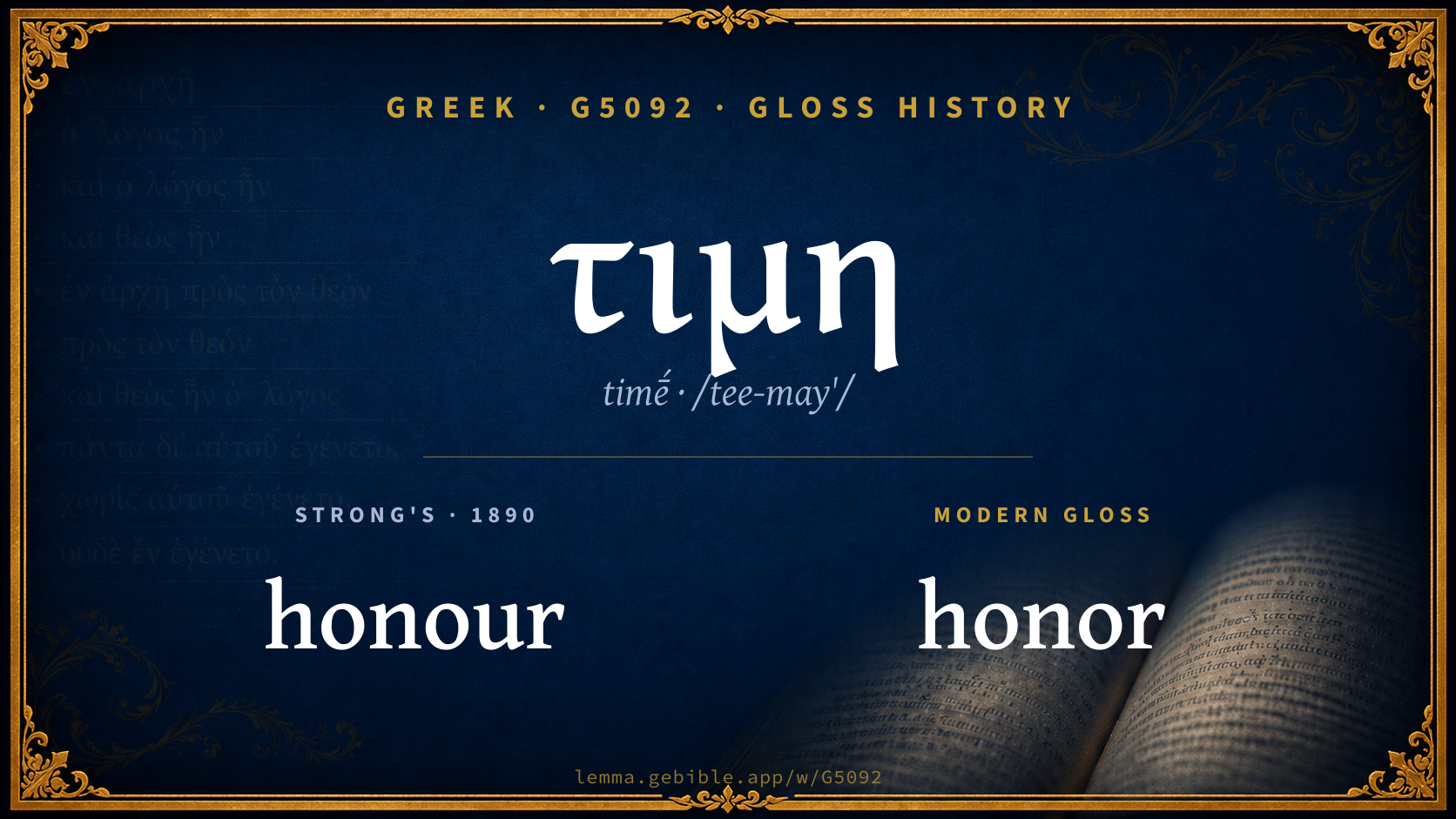
Gloss history
Strong's 1890 vs modern scholarship
About this word
Strong's G5092 catalogs a Greek word from the Greek New Testament.
These counts are not copied from any lexicon or concordance. They are computed here, from the morphology-tagged Greek New Testament. What Lemma adds →
- 40
- distinct verses
- The word appears in 40 distinct verses.
- 13 / 27
- NT books
- The word appears in 13 of 27 New Testament books.
- #364
- by frequency
- Top 500 most frequent Greek words (rank 364 of 5,347 Greek words by occurrence).
View all 40 occurrences in the concordance →
Most concentrated in
- Acts 6 verses 15%
- Revelation 6 verses 15%
- Romans 5 verses 13%
By section of the New Testament
By traditional corpus
Conventional, traditional groupings — biblical authorship is debated, so this is a traditional corpus grouping, not an authorship claim. Some books belong to more than one corpus (Luke is in both the Gospels and the Lukan corpus, and so on), so these shares overlap and need not total 100%. Each figure is a share of the word’s 40 distinct verses.
- Pauline corpus 17 verses · 43%
- Johannine 7 verses · 18%
- Lukan (Luke–Acts) 6 verses · 15%
- Revelation 6 verses · 15%
- Hebrews 4 verses · 10%
- General (Catholic) Epistles 4 verses · 10%
- Gospels 3 verses · 8%
How translations render this word
Counts come from each version’s own published word-to-Strong’s tagging or interlinear alignment — an approximate guide to how each version renders this word, not a word-level alignment the data otherwise carries. Because each total is that version’s own tagged count, the per-version totals vary from one another and need not match the appearance or distinct-verse counts above. These counts may also differ from a printed concordance because Lemma counts each distinctly tagged rendering and does not collapse phrase taggings into a single head-word total. This is a fixed set of word-tagged versions (KJV, ASV, BSB, ULT) and does not change with the reading translation you choose elsewhere. Each version’s license is shown beside its name below (and on Sources).
- King James Version: Honour 30×, Price 7×, Be honour 2×
- American Standard Version: Honor 27×, Price 8×, Be honor 2×
- Berean Standard Bible: Honor 26×, Price 3×, Proceeds 3×
- unfoldingWord Literal Text: Honor 28×, Price 8×, Be honor 2×
King James Version Public Domain
Renders G5092 across 43 tagged occurrences — most commonly:
Plus 4 renderings that appear only once — usually multi-word phrases or single function words the recovered tagging swept in, not distinct renderings.
American Standard Version Public Domain
Renders G5092 across 41 tagged occurrences — most commonly:
Plus 4 renderings that appear only once — usually multi-word phrases or single function words the recovered tagging swept in, not distinct renderings.
Berean Standard Bible Public Domain
Renders G5092 across 41 tagged occurrences — most commonly:
Plus 7 renderings that appear only once — usually multi-word phrases or single function words the recovered tagging swept in, not distinct renderings.
unfoldingWord Literal Text CC BY-SA 4.0
Renders G5092 across 45 tagged occurrences — most commonly:
Plus 3 renderings that appear only once — usually multi-word phrases or single function words the recovered tagging swept in, not distinct renderings.
Senses in Thayer's
The 2 senses Thayer's distinguishes for this word, in lexicon order (not ranked by frequency or importance). The full entry — with sub-senses — is in the Lexicon Entry tab.
- a valuing by which the price is fixed
- honour which belongs or is shown to one
Word origin
Derived from τινω (tínō) (G5099) — to pay penalty.
From G5099 ; a value that is money paid or (concretely and collectively) valuables ; by analogy esteem (especially of the highest degree) or the dignity itself : - honour precious price some.
— Strong’s Exhaustive Concordance (1890), public domain.
Forms in the corpus
The 7 distinct written forms G5092 takes in the Greek New Testament, most frequent first — each parse links to that case’s occurrences in the concordance.
| Form | Parsing | Example | Uses |
|---|---|---|---|
| τιμὴν timḕn | Noun, Accusative, Singular, Feminine | Matthew 27:9 | 14 |
| τιμὴ timḕ | Noun, Nominative, Singular, Feminine | Matthew 27:6 | 7 |
| τιμῆς timē̂s | Noun, Genitive, Singular, Feminine | Acts 5:2 | 7 |
| τιμήν timḗn | Noun, Accusative, Singular, Feminine | Romans 13:7 | 5 |
| τιμῇ timē̂ | Noun, Dative, Singular, Feminine | Romans 12:10 | 5 |
| τιμὰς timàs | Noun, Accusative, Plural, Feminine | Acts 4:34 | 2 |
| τιμαῖς timaîs | Noun, Dative, Plural, Feminine | Acts 28:10 | 1 |
Same root — word family
Other Thayer's entries built from the same root as G5092, grouped by Strong’s listed origin. These share a root / origin per the lexicon — not necessarily a shared meaning. Each links to that word’s own entry.
Derives from
Derived from this word
Proper names from this root
People and places named from this root — a name, not an additional meaning of the word.
Compare all same-root words → Showing 4 of 6 — not the complete family. 2 of the same-root words are proper names (people or places). They share a root, not necessarily a meaning.
Septuagint usage
The same Greek word τιμη appears 55 times in the Greek Old Testament (Septuagint), across 53 verses in 12 books.
- 55
- LXX occurrences
- Tagged occurrences of this Greek word in the Septuagint.
- 53
- verses
- Distinct Septuagint verses containing this word.
- 12 / 39
- OT books
- The word appears in 12 of the 39 Old Testament books.
Sample Septuagint occurrences
- Genesis 20:16 τιμή
- Exodus 28:2 τιμή
- Leviticus 5:15 τιμή
- Numbers 20:19 τιμή
- 2 Chronicles 1:16 τιμή
- Esther 1:20 τιμή
- Job 31:39 τιμή
- Psalms 8:6 τιμή
- Proverbs 6:26 τιμή
- Isaiah 10:16 τιμή
- Ezekiel 22:25 τιμή
- Daniel 1:9 τιμή
Septuagint occurrences (same lexeme)
Every verse where the same Strong’s number (G5092) appears in the Greek Septuagint — showing the first 50 of 53. Verse text shown in the World English Bible for context; the Greek form is the matched word — the English is not keyword-highlighted.
- Genesis 20:16 τιμή To Sarah he said, "Behold, I have given your brother a thousand pieces of silver. Behold, it is for you a covering of the eyes to all that are with you. In front of all you are vindicated."
- Genesis 44:2 τιμή Put my cup, the silver cup, in the sack's mouth of the youngest, with his grain money." He did according to the word that Joseph had spoken.
- Exodus 28:2 τιμή You shall make holy garments for Aaron your brother, for glory and for beauty.
- Exodus 28:40 τιμή "You shall make coats for Aaron's sons, and you shall make sashes for them and headbands shall you make for them, for glory and for beauty.
- Exodus 34:20 τιμή The firstborn of a donkey you shall redeem with a lamb: and if you will not redeem it, then you shall break its neck. All the firstborn of your sons you shall redeem. No one shall appear before me empty.
- Leviticus 5:15 τιμή "If anyone commits a trespass, and sins unwittingly, in the holy things of Yahweh; then he shall bring his trespass offering to Yahweh, a ram without blemish from the flock, according to your estimation in silver by shekels, after the shekel of the sanctuary, for a trespass offering.
- Leviticus 5:18 τιμή He shall bring a ram without blemish from of the flock, according to your estimation, for a trespass offering, to the priest; and the priest shall make atonement for him concerning the thing in which he sinned and didn't know it, and he will be forgiven.
- Leviticus 5:25 τιμή
- Leviticus 27:2 τιμή "Speak to the children of Israel, and say to them, 'When a man makes a vow, the persons shall be for Yahweh by your valuation.
- Leviticus 27:3 τιμή Your valuation shall be of a male from twenty years old even to sixty years old, even your valuation shall be fifty shekels of silver, after the shekel of the sanctuary.
- Leviticus 27:5 τιμή If the person is from five years old even to twenty years old, then your valuation shall be for a male twenty shekels, and for a female ten shekels.
- Leviticus 27:6 τιμή If the person is from a month old even to five years old, then your valuation shall be for a male five shekels of silver, and for a female your valuation shall be three shekels of silver.
- Leviticus 27:7 τιμή If the person is from sixty years old and upward; if it is a male, then your valuation shall be fifteen shekels, and for a female ten shekels.
- Leviticus 27:8 τιμή But if he is poorer than your valuation, then he shall be set before the priest, and the priest shall value him; according to the ability of him who vowed shall the priest value him.
- Leviticus 27:13 τιμή But if he will indeed redeem it, then he shall add the fifth part of it to its valuation.
- Leviticus 27:15 τιμή If he who dedicates it will redeem his house, then he shall add the fifth part of the money of your valuation to it, and it shall be his.
- Leviticus 27:16 τιμή "'If a man dedicates to Yahweh part of the field of his possession, then your valuation shall be according to the seed for it: the sowing of a homer of barley shall be valued at fifty shekels of silver.
- Leviticus 27:17 τιμή If he dedicates his field from the Year of Jubilee, according to your valuation it shall stand.
- Leviticus 27:19 τιμή If he who dedicated the field will indeed redeem it, then he shall add the fifth part of the money of your valuation to it, and it shall remain his.
- Leviticus 27:23 τιμή then the priest shall reckon to him the worth of your valuation up to the Year of Jubilee; and he shall give your valuation on that day, as a holy thing to Yahweh.
- Leviticus 27:25 τιμή All your valuations shall be according to the shekel of the sanctuary: twenty gerahs to the shekel.
- Leviticus 27:27 τιμή If it is an unclean animal, then he shall buy it back according to your valuation, and shall add to it the fifth part of it: or if it isn't redeemed, then it shall be sold according to your valuation.
- Numbers 20:19 τιμή The children of Israel said to him, We will go up by the highway; and if we drink of your water, I and my cattle, then will I give the price of it: let me only, without [doing] anything [else], pass through on my feet.
- 2 Chronicles 1:16 τιμή The horses which Solomon had were brought out of Egypt and from Kue; the king's merchants purchased them from Kue.
- 2 Chronicles 32:33 τιμή Hezekiah slept with his fathers, and they buried him in the ascent of the tombs of the sons of David: and all Judah and the inhabitants of Jerusalem did him honor at his death. Manasseh his son reigned in his place.
- Esther 1:20 τιμή When the king's decree which he shall make shall be published throughout all his kingdom (for it is great), all the wives will give to their husbands honor, both to great and small.
- Job 31:39 τιμή If I have eaten the fruits of it without money, Or have caused the owners of it to lose their life:
- Job 34:19 τιμή Who doesn't respect the persons of princes, Nor regards the rich more than the poor; For they all are the work of his hands.
- Job 37:22 τιμή Out of the north comes golden splendor; With God is awesome majesty.
- Job 40:10 τιμή "Now deck yourself with excellency and dignity. Array yourself with honor and majesty.
- Psalms 8:6 τιμή You make him ruler over the works of your hands. You have put all things under his feet:
- Psalms 28:1 τιμή To you, Yahweh, I call. My rock, don't be deaf to me; Lest, if you are silent to me, I would become like those who go down into the pit.
- Psalms 43:13 τιμή
- Psalms 44:10 τιμή You make us turn back from the adversary. Those who hate us take spoil for themselves.
- Psalms 48:9 τιμή We have thought about your loving kindness, God, In the midst of your temple.
- Psalms 48:13 τιμή Mark well her bulwarks. Consider her palaces, That you may tell it to the next generation.
- Psalms 48:21 τιμή
- Psalms 61:5 τιμή For you, God, have heard my vows. You have given me the heritage of those who fear your name.
- Psalms 95:7 τιμή For he is our God. We are the people of his pasture, And the sheep in his care. Today, oh that you would hear his voice!
- Psalms 98:4 τιμή Make a joyful noise to Yahweh, all the earth! Burst out and sing for joy, yes, sing praises!
- Proverbs 6:26 τιμή For a prostitute reduces you to a piece of bread. The adulteress hunts for your precious life.
- Proverbs 12:9 τιμή Better is he who is lightly esteemed, and has a servant, Than he who honors himself, and lacks bread.
- Proverbs 22:9 τιμή He who has a generous eye will be blessed; For he shares his food with the poor.
- Proverbs 26:1 τιμή Like snow in summer, and as rain in harvest, So honor is not fitting for a fool.
- Isaiah 10:16 τιμή Therefore will the Lord, Yahweh of Hosts, send among his fat ones leanness; and under his glory there shall be kindled a burning like the burning of fire.
- Isaiah 11:10 τιμή It shall happen in that day, that the root of Jesse, who stands for an ensign of the peoples, to him shall the nations seek; and his resting-place shall be glorious.
- Isaiah 14:18 τιμή All the kings of the nations, all of them, sleep in glory, everyone in his own house.
- Isaiah 35:2 τιμή It shall blossom abundantly, and rejoice even with joy and singing; the glory of Lebanon shall be given to it, the excellency of Carmel and Sharon: they shall see the glory of Yahweh, the excellency of our God.
- Isaiah 55:1 τιμή Ho, everyone who thirsts, come you to the waters, and he who has no money; come you, buy, and eat; yes, come, buy wine and milk without money and without price.
- Ezekiel 22:25 τιμή There is a conspiracy of her prophets in the midst of it, like a roaring lion ravening the prey: they have devoured souls; they take treasure and precious things; they have made her widows many in the midst of it.
These are occurrences of the same Greek lexeme (G5092) in the Septuagint — not a translation of any one Hebrew word. The store carries no word-level Hebrew↔Greek alignment, so no Hebrew original is asserted here. Counts come from the recovered LXX Strong's tagging — high-frequency vocabulary is well covered, while rare or late forms may be untagged — so they reflect tagged occurrences and may slightly undercount.