
Psalms 98:4

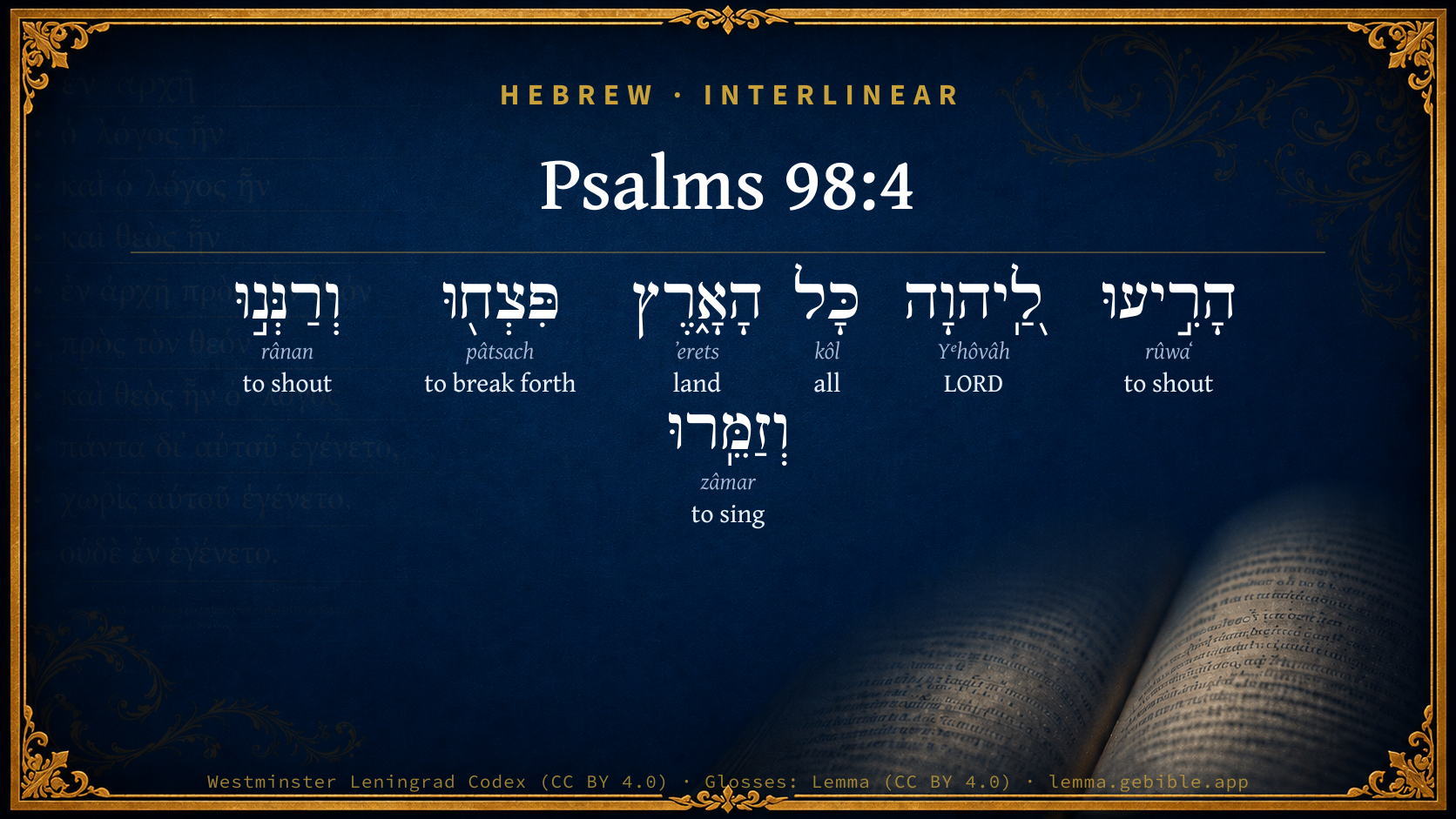
Hebrew (Westminster Leningrad Codex) Psalms 98:4 appears in the Hebrew Old Testament. The text above is from the Westminster Leningrad Codex. Each word links to its Strong’s number, a concise gloss, and parsing drawn from the Open Scriptures Hebrew Bible morphology. Click any word for its full Brown-Driver-Briggs (BDB) entry.
Download image
Cite this verse

Psalms 98:4 (World English Bible). Public Domain. Lemma interlinear Bible study tool, https://lemma.gebible.app/v/psalms/98/4.

Show BibTeX & RIS
BibTeX
RIS
English Translation
Make a joyful noise to Yahweh, all the earth! Burst out and sing for joy, yes, sing praises!
World English Bible · Public Domain
Highlights
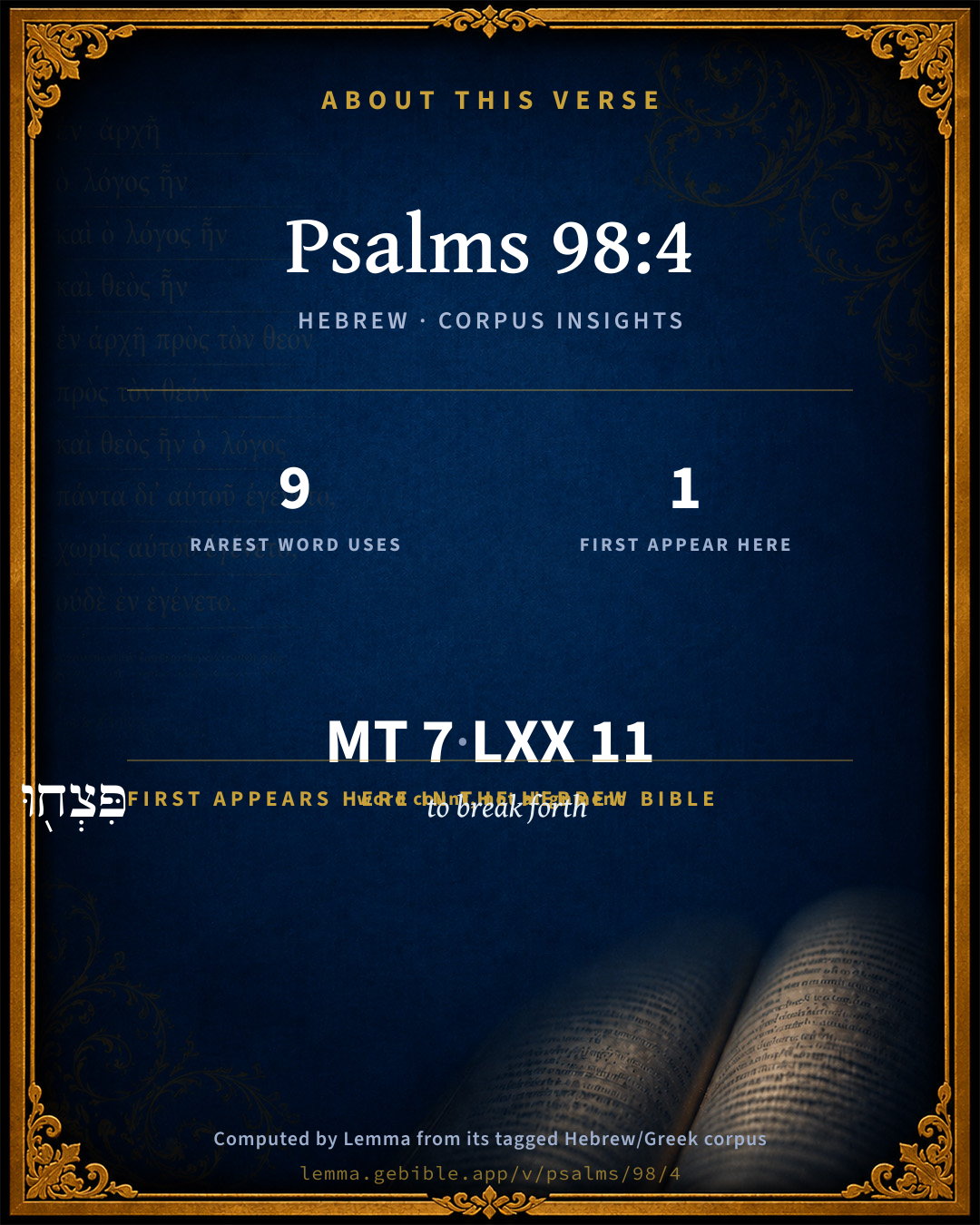
  • 1 first appearance in the Hebrew Bible
Full analysis ↓
Download a study sheet

One document with this verse’s original text, its word-by-word gloss line, the meaning frame, cross-references with their text, attributed commentary, and full source and license credits — printable, and it pastes into notes with its structure intact.

This verse Autodidact and up

Study sheet (.html) Plain text (.txt)

A passage Seminary Student

Up to 50 verses in one chapter. A passage sheet keeps up to 6 commentary sources and 12 cross-references per verse, in the order this page ranks them, and says so on the sheet whenever that leaves anything out. Ask for a single verse and you get the Autodidact verse sheet above.

Everything on this page stays free to read, with no account — the sheet is a download of what is already on screen, not access to it.

Want to remove ads? Support Godless Engineer
Compare translations 3

The same verse in 3 English versions, stacked beneath the original-language interlinear above. Click any original word for its lexicon entry.

Each is an independent rendering of the whole verse — the interlinear is not word-aligned to these translations.

Highlighted words mark where these versions differ — a whole-verse word diff, not a word-by-word alignment.

  • World English Bible Public Domain
    Make a joyful noise to Yahweh, all the earth! Burst out and sing for joy, yes, sing praises!
  • King James Version Public Domain
    Make a joyful noise unto the LORD, all the earth: make a loud noise, and rejoice, and sing praise.
  • unfoldingWord Literal Text CC BY-SA 4.0
    Shout to Yahweh, all the earth; burst into song, sing for joy, and make music!

unfoldingWord Literal Text — © unfoldingWord, licensed CC BY-SA 4.0. Word-aligned USFM3 via Door43 (git.door43.org/unfoldingWord/en_ult).

Versions to compare (up to 4)

3 of 4 selected

Show all 18 translations

Every available English version of this verse, each an independent rendering of the whole verse.

  • World English Bible Public Domain
    Make a joyful noise to Yahweh, all the earth! Burst out and sing for joy, yes, sing praises!
  • Berean Standard Bible Public Domain
    Make a joyful noise to the LORD, all the earth; break forth—let your cry ring out, and sing praises!
  • Majority Standard Bible Public Domain
    Make a joyful noise to the LORD, all the earth; break forth—let your cry ring out, and sing praises!
  • King James Version Public Domain
    Make a joyful noise unto the LORD, all the earth: make a loud noise, and rejoice, and sing praise.
  • American Standard Version (1901) Public Domain
    Make a joyful noise unto Jehovah, all the earth: Break forth and sing for joy, yea, sing praises.
  • Revised Version (1885) Public Domain
    Make a joyful noise unto the LORD, all the earth: break forth and sing for joy, yea, sing praises.
  • Geneva Bible (1599) Public Domain
    All the earth, sing ye loude vnto the Lord: crie out and reioyce, and sing prayses.
  • Douay-Rheims (1899) Public Domain
    Sing joyfully to God, all the earth; make melody, rejoice and sing.
  • Young's Literal Translation Public Domain
    Shout to Jehovah, all the earth, Break forth, and cry aloud, and sing.
  • Literal Standard Version CC BY-SA 4.0
    Shout to YHWH, all the earth, || Break forth, and cry aloud, and sing.
  • Unlocked Literal Bible CC BY-SA 4.0
    Shout for joy to Yahweh, all the earth; burst into song, sing for joy, and sing praises.
  • unfoldingWord Literal Text CC BY-SA 4.0
    Shout to Yahweh, all the earth; burst into song, sing for joy, and make music!
  • Darby Bible Public Domain
    Shout aloud unto Jehovah, all the earth; break forth and shout for joy, and sing psalms.
  • World Messianic Bible Public Domain
    Make a joyful noise to the LORD, all the earth! Burst out and sing for joy, yes, sing praises!
  • Webster's Bible Public Domain
    Make a joyful noise to the LORD, all the earth: make a loud noise, and rejoice, and sing praise.
  • Free Bible Version CC BY-SA 4.0
    Everyone on earth, shout in triumph to the Lord; break out in joyful songs of praise!
  • Bible in Basic English Public Domain
    Let all the earth send out a glad cry to the Lord; sounding with a loud voice, and praising him with songs of joy.
  • JPS Tanakh (1917) Public Domain
    Shout unto the LORD, all the earth; break forth and sing for joy, yea, sing praises.

Literal Standard Version (2020), Covenant Press — licensed CC BY-SA 4.0. Text via the HelloAO Bible API (eBible.org). Unlocked Literal Bible (unfoldingWord) — licensed CC BY-SA 4.0. Text via the HelloAO Bible API (eBible.org). unfoldingWord Literal Text — © unfoldingWord, licensed CC BY-SA 4.0. Word-aligned USFM3 via Door43 (git.door43.org/unfoldingWord/en_ult). Free Bible Version, Dr. Jonathan Gallagher — licensed CC BY-SA 4.0. Text via the HelloAO Bible API (eBible.org).

Word by word

More ways to search: Search by grammar → Find every occurrence → Compare this word →

Practice this passage: Drill this verse → Learn its vocabulary →

About this verse

These counts appear in no published source. They are computed here, from the morphology-tagged text and Lemma’s own curated glosses. What Lemma adds →

7
words
7
distinct lemmas
Wisdom
section

Notable vocabulary

The rarest word here is פִּצְח֖וּ to break forth H6476 — appearing just 9 times in the whole Hebrew Bible.

First appearance in Scripture

This word makes its first canonical appearance in the Hebrew Bible here:

  • פִּצְח֖וּ to break forth H6476

Shared distinctive vocabulary

פִּצְח֖וּ to break forth H6476 occurs in 8 verses of the Hebrew Bible. Also found in:

Grammatical profile

  • 4 verbs
  • 3 nouns

Verb forms

  • הָרִ֣יעוּ Hiphil · Imperative
  • פִּצְח֖וּ Qal · Imperative
  • וְרַנְּנ֣וּ Piel · Imperative
  • וְזַמֵּֽרוּ Piel · Imperative

Hebrew & Septuagint length

In English translation the verse runs 18 words from the Hebrew and 12 from the Septuagint (LXX English) — closely comparable.

A rough comparison of the two English renderings, which tokenize alike — not a word-level alignment.

Word counts can differ between the Hebrew and the Greek without any difference in meaning — e.g. the Hebrew direct-object marker אֵת has no separate Greek word, and Greek often adds the article ὁ.

In the original languages it is 7 Hebrew tokens and 11 Greek tokens — but the two are counted differently (Hebrew bundles its prefixes and suffixes into one token; the Greek is in lemma form), so that isn’t a like-for-like length.

Cross-references

14

Topical passages linked to Psalms 98:4 in the Treasury of Scripture Knowledge — connected by theme and wording, ordered by reader-vote popularity; previews shown in the World English Bible.

  • Isaiah 44:23 Sing, you heavens, for Yahweh has done it; shout, you lower parts of the earth; break forth into singing, you mountains, O forest, and every tree therein: for Yahweh has redeemed Jacob, and will glorify himself in Israel.
  • Revelation 19:6 I heard something like the voice of a great multitude, and like the voice of many waters, and like the voice of mighty thunders, saying, "Hallelujah! For the Lord our God, the Almighty, reigns!
  • Psalms 66:1 Make a joyful shout to God, all the earth!
  • Psalms 95:1 Oh come, let's sing to Yahweh. Let's shout aloud to the rock of our salvation!
  • Psalms 100:1 Shout for joy to Yahweh, all you lands!
  • Isaiah 12:6 Cry aloud and shout, you inhabitant of Zion; for great in the midst of you is the Holy One of Israel!"
  • Jeremiah 33:11 the voice of joy and the voice of gladness, the voice of the bridegroom and the voice of the bride, the voice of those who say, Give thanks to Yahweh of Hosts, for Yahweh is good, for his loving kindness endures forever; [and of them] who bring [sacrifices of] thanksgiving into the house of Yahweh. For I will cause the captivity of the land to return as at the first, says Yahweh.
  • Psalms 47:1–5 Oh clap your hands, all you nations. Shout to God with the voice of triumph!
  • Matthew 21:9 The multitudes who went before him, and who followed kept shouting, "Hosanna to the son of David! Blessed is he who comes in the name of the Lord! Hosanna in the highest!"
  • Zephaniah 3:14 Sing, daughter of Zion! Shout, Israel! Be glad and rejoice with all your heart, daughter of Jerusalem.
  • Psalms 67:4 Oh let the nations be glad and sing for joy, For you will judge the peoples with equity, And govern the nations on earth. Selah.
  • Revelation 19:1 After these things I heard something like a loud voice of a great multitude in heaven, saying, "Hallelujah! Salvation, power, and glory belong to our God:
  • Isaiah 42:11 Let the wilderness and the cities of it lift up [their voice], the villages that Kedar does inhabit; let the inhabitants of Sela sing, let them shout from the top of the mountains.
  • Psalms 66:4 All the earth will worship you, And will sing to you; They will sing to your name." Selah.

Cross-references courtesy of OpenBible.info (CC BY 4.0).

Hebrew and Greek witnesses Masoretic Hebrew ↔ Greek Septuagint

The same verse in the two great witnesses to the Old Testament, shown verse-for-verse.

You’re reading Greek Psalm 97 (Hebrew Psalm 98). The Septuagint counts the superscription, so verse numbers can differ from the Hebrew — chapter-level alignment, not verse-by-verse. Numbering follows Rahlfs.

These are two independent witnesses, not word-aligned to each other, and the Septuagint is shown in lemma (dictionary) form.

Hebrew Psalms 98:4 Masoretic · Westminster Leningrad Codex

הָרִ֣יעוּ לַֽ֭יהוָה כָּל הָאָ֑רֶץ פִּצְח֖וּ וְרַנְּנ֣וּ וְזַמֵּֽרוּ

Make a joyful noise to Yahweh, all the earth! Burst out and sing for joy, yes, sing praises!

World English Bible · Public Domain

Greek LXX Greek Psalm 97:4 Septuagint · lemma form

ἀλαλάζω ὁ θεός πᾶς ὁ γῆ ᾄδω καί ἀγαλλιάομαι καί ψάλλω

Shout to God, all the earth; sing, and exult, and sing psalms.

LXX2012 (modern English Septuagint) · Public Domain

Hebrew: Westminster Leningrad Codex (CC BY 4.0). Greek: Septuagint (public domain); English from LXX2012 (modern English Septuagint) (Public Domain). How the Septuagint differs from the Hebrew →

Commentary

Notes on Psalms 98:4 from classic Christian and Jewish commentators (each source and its license shown beneath its notes). The classic Christian expositions comment on the surrounding passage and are grouped to its opening verse, so a note may address several verses; the Jewish commentaries on the Tanakh (Rashi and others) are per-verse, so they appear only where the commentator wrote on this verse.

Lemma curates 59 commentaries, every one of them public domain or Creative Commons licensed, each selected and text-cleaned for this edition rather than reprinted as found. About our sources →

Matthew Henry's Commentary

The setting up of the kingdom of Christ is here represented as a matter of joy and praise.

I. Let all the children of men rejoice in it, for they all have, or may have, benefit by it. Again and again we are here called upon by all ways and means possible to express our joy in it and give God praise for it: Make a joyful noise, as before, Psa 95:1, Psa 95:2. Make a loud noise, as those that are affected with those glad tidings and are desirous to affect others with them. Rejoice and sing praise, sing Hosannas (Mat 21:9), sing Hallelujahs, Rev 19:6. Let him be welcomed to the throne, as new kings are, with acclamations of joy and loud shouts, till the earth ring again, as when Solomon was proclaimed, Kg1 1:40. And let the shouts of the crowd be accompanied with the singers and players on instruments (Psa 87:7; Psa 68:25), as is usual in such solemnities. 1. Let sacred songs attend the new King: "Sing praise, sing with the voice of a psalm. Express your joy; thus proclaim it, thus excite it yet more, and thus propagate it among others." 2. Let these be assisted with sacred music, not only with the soft and gentle melody of the harp, but since it is a victorious King whose glory is to be celebrated, who goes forth conquering and to conquer, let him be proclaimed with the martial sound of the trumpet and cornet, Psa 98:6. Let all this joy be directed to God, and expressed in a solemn religious manner: Make a joyful noise to the Lord, Psa 98:4. Sing to the Lord, (Psa 98:5); do it before the Lord, the King, Psa 98:6. Carnal mirth is an enemy to this holy joy. When David danced before the ark he pleaded that it was before the Lord; and the piety and devotion of the intention not only vindicated what he did, but commended it. We must rejoice before the Lord whenever we draw near to him (Deu 12:12), before the Lord Jesus, and before him, not only as the Saviour, but as the King, the King of kings, the church's King, and our King.

II. Let the inferior creatures rejoice in it, Psa 98:7-9. This is to the same purport with what we had before (Psa 96:11-13): Let the sea roar, and let that be called, not as it used to be, a dreadful noise, but a joyful noise; for the coming of Christ, and the salvation wrought out by him, have quite altered the property of the troubles and terrors of this world, so that when the floods lift up their voice, lift up their waves, we must not construe that to be the sea roaring against us, but rather rejoicing with us. Let the floods express their joy, as men do when they clap their hands; and let the hills, that trembled for fear before God when he came down to give the law at Mount Sinai, dance for joy before him when his gospel is preached and that word of the Lord goes forth from Zion in a still small voice: Let the hills be joyful together before the Lord. This intimates that the kingdom of Christ would be a blessing to the whole creation; but that, as the inferior creatures declare the glory of the Creator (Psa 19:1), so they declare the glory of the Redeemer, for by him all things not only subsist in their being, but consist in their order. It intimates likewise that the children of men would be wanting in paying their due respects to the Redeemer, and therefore that he must look for his honour from the sea and the floods, which would shame the stupidity and ingratitude of mankind. And perhaps respect is here had to the new heavens and the new earth, which we yet, according to his promise, look for (Pe2 3:13), and this second mention of his coming (after the like, Psa 96:1-13) may principally refer to his second coming, when all these things shall be so dissolved as to be refined; then shall he come to judge the world with righteousness. In the prospect of that day all that are sanctified do rejoice, and even the sea, and the floods, and the hills, would rejoice if they could. One would think that Virgil had these psalms in his eye, as well as the oracles of the Cumean Sibyl, in his fourth eclogue, where he either ignorantly or basely applies to Asinius Pollio the ancient prophecies, which at that time were expected to be fulfilled; for he lived in the reign of Augustus Caesar, a little before our Saviour's birth. He owns they looked for the birth of a child from heaven that should be a great blessing to the world, and restore the golden age: -

Jam nova progenies coelo demittitur alto -

A new race descends from the lofty sky;

and that should take away sin: -

Te duce, si qua manent sceleris vestigia nostri,

Irrita perpetua solvent formidine terras -

Thy influence shall efface every stain of corruption,

And free the world from alarm.

Many other things he says of this long-looked-for child, which Ludovicus Vives, in his notes on that eclogue, thinks applicable to Christ; and he concludes, as the psalmist here, with a prospect of the rejoicing of the whole creation herein: -

Aspice, venturo laetentur ut omnia saeclo -

See how this promis'd age makes all rejoice.

And, if all rejoice, why should not we?

Matthew Henry's Commentary on the Whole Bible (1708–1710) — public domain (CC PDM 1.0). Text via the HelloAO Bible API.

Trapp's Complete Commentary

John Trapp

Psa 98:4 Make a joyful noise unto the LORD, all the earth: make a loud noise, and rejoice, and sing praise.

Ver. 4. Make a joyful noise] Bless God for a Christ. The Argives, when delivered by the Romans from the tyranny of the Macedonians and Spartans, Quae gaudia, quae vociferationes fuerunt! quid fiorum in Consulem profuderunt! what great joys expressed they! what loud outcries made they! the very birds that flew over them fell on the ground, astonied with their noises (Plut. in Flamin.). The crier at the Nemean games was forced to pronounce the word liberty iterumque iterumque, again and again.

John Trapp, A Commentary or Exposition upon All the Books of the Old and New Testament (1647–1656) — public domain. Text from a community e-Sword module.

Joseph Benson's Commentary

Psa 98:4-9. Make a joyful noise, &c. — Because you all now partake of the same privileges with the Jews, join with them in worshipping and praising God. Sing unto the Lord with a harp — Here again, as in Psa 92:3, the worship of the New Testament is described in phrases taken from the rites of the Old. “The psalmist, beholding in spirit the accomplishment of the promises, the advent of Christ, and the glory of his kingdom, thinks it criminal in any creature to be silent: he bids the whole earth break forth into joy, and exult in God her Saviour, with every token of gratitude and thankfulness.” He even calls upon “the inanimate parts of creation to bear their parts in the new song, and to fill up the universal chorus of praise.” He bids the sea roar, as men in triumph make a loud and vehement noise, and the floods to clap their hands, as men do in token of delight and approbation, while the hills, in like manner, resound their joy. Before the Lord, for he cometh, &c. — Here we have “the subject of this general joy, as before in Psa 96:13, namely, the coming of the Messiah to reform the world, to execute judgment upon the wicked, and to establish a kingdom of righteousness upon the earth. We expect his second advent to restore all things, to judge the world, to condemn his enemies, and to begin his glorious reign. Then shall heaven and earth rejoice, and the joy of the redeemed shall be full.” — Horne.

Joseph Benson's Commentary on the Old and New Testaments (1811–1818) — public domain. Text from a community e-Sword module.

Whedon's Commentary on the Bible

Daniel D. Whedon

4. Make a joyful noise unto the Lord—Shout to Jehovah. This call is made to all the earth, inasmuch as “the ends of the earth” had seen (Psa_98:3) the salvation of God to his people. The descriptions of joy and praise, given in Psa_98:4-6, may be accepted as comprehending all that was known in Hebrew worship of vocal and instrumental demonstrations of rejoicing.

Daniel D. Whedon (gen. ed.), Commentary on the Old and New Testaments (1874–1909) — public domain. Text from a community e-Sword module.

Keil & Delitzsch

C. F. Keil & F. Delitzsch

The call in Psa 98:4 demands some joyful manifestation of the mouth, which can be done in many ways; in Psa 98:5 the union of song and the music of stringed instruments, as of the Levites; and in Psa 98:6 the sound of wind instruments, as of the priests. On Psa 98:4 cf. Isa 44:23; Isa 49:13; Isa 52:9, together with Isa 14:7 (inasmuch as פּצחוּ ורננוּ is equivalent to פּצחוּ רנּה). קול זמרה is found also in Isa 51:3.

Keil & Delitzsch — Biblical Commentary on the Old Testament (1861–1891) — public domain (CC PDM 1.0). Text via the HelloAO Bible API. (Old Testament only.)

J. A. Alexander on Psalms

Joseph Addison Alexander

4. (Psa 98:4) Shout to Jehovah, all the earth! Burst forth, and sing, and play! The second stanza prescribes the form or manner of the praise. This verse accumulates the verbs denoting joyful noise, whether inarticulate, or instrumental. The first clause differs from Ps. xcvi. 1, only by substituting one divine name for another. See also Psa 47:1. The verb to burst forth (into praise or singing) is almost peculiar to Isaiah (Isa 14:7; Isa 44:23; Isa 49:12; Isa 54:1). This very combination with the verb to sing occurs in Isa 52:9.

Joseph Addison Alexander, The Psalms Translated and Explained (1850) — public domain. Text from a community e-Sword module.

Tyndale Open Study Notes

Tyndale Open Resources

98:4-6 The psalmist invites the whole earth to worship the King (see 96:1).

Tyndale Open Study Notes — © Tyndale Open Resources, licensed CC BY-SA 4.0. Text via the HelloAO Bible API.

John Calvin's Commentaries

4 Exult before Jehovah all the earth Here he repeats the exhortation with which he had begun, and by addressing it to the nations at large, he indicates that when God should break down the middle wall of partition all would be gathered to the common faith, and one Church formed throughout the whole world. When he speaks of musical instruments the allusion is evidently to the practice of the Church at that time, without any intention of binding down the Gentiles to the observance of the ceremonies of the law. The repetition made use of is emphatical, and implies that the most ardent attempts men might make to celebrate the great work of the world’s redemption would fall short of the riches of the grace of God. This is brought out still more forcibly in what follows, where feeling is ascribed to things inanimate. The whole passage has been elsewhere expounded, and it is unnecessary to insist further upon it.

John Calvin's Commentaries (1540-1563) — public domain. Text from the Calvin Translation Society English edition (1840s-50s) via the Christian Classics Ethereal Library (ccel.org). Calvin's coverage is partial (roughly two-thirds of the Bible); uncommented books and verses are honest gaps, never fabricated. The 19th-century editor's footnotes and remarks are omitted so the notes are faithfully Calvin's own voice.

Ellicott's Commentary for English Readers

(4) Make a joyful noise.—Better, Break out into songs and music.

A Bible Commentary for English Readers, edited by Charles John Ellicott (1878–1897) — public domain. Text from a community e-Sword module.

The Cambridge Bible for Schools and Colleges

gen. ed. J. J. S. Perowne

4. Shout unto Jehovah, all the earth;

Break forth and sing for joy, yea, make melody.

Salute Jehovah with the gladsome shouts and music and blare of trumpets (Psa_98:6) and clapping of hands (Psa_98:8) which are the proper greeting for a king upon his accession. See on Psa_47:1; Psa_47:5-8; Psa_95:1-2; and cp. 1Sa_10:24; 1Ki_1:39; 2Ki_11:12; 2Ki_11:14.

Break forth and sing for joy is from Isa_52:9 : cp. Psa_44:23; Psa_49:13; Psa_54:1.

4–6. Let all the earth salute its King.

The Cambridge Bible for Schools and Colleges (gen. ed. J. J. S. Perowne; Cambridge University Press, 1878–1918) — public domain. Text from a community e-Sword module.

John Gill's Exposition

Make a joyful noise unto the Lord, all the earth,.... That is, all the inhabitants of the earth, as the Targum, to whom the joyful sound of the Gospel comes; See Gill on Psa 95:1,

make a loud noise, rejoice, and sing praise; exalt and extend the voice to the highest pitch, in the most musical and melodious strains; this heap of words is used to express the intenseness of mind, vehemency of affection, and strength of spirit and exceeding greatness of joy, with which the Lord should be praised for his great and marvellous works.

John Gill's Exposition of the Whole Bible (1746–1763) — public domain (CC PDM 1.0). Text via the HelloAO Bible API.

Albert Barnes' Notes on the Bible

Make a joyful noise unto the Lord - By singing; by instruments of music. See the notes at Psa 95:1.

All the earth - All lands. The event is of sufficient importance to be celebrated by all nations. It is a matter of universal exultation and joy.

Make a loud noise - The word used here - פצח pâtsach - means properly to break in pieces; then, to break forth, as a shout of triumph or joy, as if the joy could be no longer confined or repressed. See the notes at Isa 14:7. The word occurs only in the following places (besides that which is before us), in all of which it is rendered “break forth.” Isa 14:7; Isa 44:23; Isa 49:13; Isa 52:9; Isa 54:1; Isa 55:12 - (except in Mic 3:3, where it it is rendered “break”). It is expressive of irrepressible joy.

Rejoice and sing praise - This very combination of the words, “Break forth into joy, sing together” - the same words in Hebrew as here - occurs in Isa 52:9, showing, as above remarked, that the psalm was composed after the times of Isaiah, and probably had reference to the same event.

Albert Barnes' Notes on the Bible (1834–1885) — public domain. Text from a community e-Sword/MySword module.

Matthew Poole's English Annotations

Because you all do now partake of the same privileges with the Jews, join with them in worshipping and praising of God.

Matthew Poole's English Annotations on the Holy Bible (1683–1685) — public domain. Text from a community e-Sword/MySword module.

The Treasury of David

Charles H. Spurgeon

Ver. 4. Make a joyful noise unto the LORD, all the earth. Every tongue must applaud, and that with the rigour which joy of heart alone can arouse to action. As men shout when they welcome a king, so must we. Loud hosannas, full of happiness, must be lifted up. If ever men shout for joy it should be when the Lord comes among them in the proclamation of his gospel reign. John Wesley said to his people, "Sing lustily, and with a good courage. Beware of singing as if you were half dead or half asleep; but lift up your voice with strength. Be no more afraid of your voice now, nor more ashamed of its being heard, than when you sung the songs of Satan."

Make a loud noise, and rejoice, and sing praise; or Burst forth, and sing, and play. Let every form of exultation be used, every kind of music pressed into the service till the accumulated praise causes the skies to echo the joyful tumult. There is no fear of our being too hearty in magnifying the God of our salvation, only we must take care the song comes from the heart, otherwise the music is nothing but a noise in his ears, whether it be caused by human throats, or organ pipes, or far resounding trumpets. Loud let our hearts ring out the honours of our conquering Saviour; with all our might let us extol the Lord who has vanquished all our enemies, and led our captivity captive: He will do this best who is most in love with Jesus:

"I have found the pearl of greatest price,

My heart doth sing for joy;

And sing I must, a Christ I have.

Oh, what a Christ have I!"

Ver. 4. Make a joyful noise. Bless God for a Christ. The Argives when delivered by the Romans from the tyranny of the Macedonians and Spartans, Quae guadia, quae vociferationes fuerunt! quid florum in Consulem profuderunt! what great joys expressed they! what loud outcries made they! The very birds that flew over them fell to the ground, astonied at their noises. The crier at the Nemean games was forced to pronounce the word Liberty, iterumque, iterumque, again, and again. John Trapp.

Ver. 4-6. Wherewith is God to be praised? In a literal sense with all kind of music: vocal, sing unto the Lord: chordal, Praise him upon the harp: pneumatical, with trumpets, etc. In an allegorical exposition (as Euthymius interprets it) we must praise God in our actions, and praise him in our contemplation; praise him in our words, praise him in our works; praise him in our life, praise him at our death; being not only temples (as Paul), but (as Clemens Alexaudrinus calls us) timbrels also of the Holy Ghost. John Boys.

Ver. 4. The right use of noise.

1. "Make a noise." Awake, O sleeper. Speak, O dumb.

2. "Make a joyful noise." The shout of deliverance, of gratitude, of gladness.

3. "Make a loud noise, all the earth." Nature with her ten thousand voices. The church with myriad saints.

4. "Make a joyful noise unto God." Praise him alone. Praise him for ever. E.G.G.

Psalms 98:5*

Charles H. Spurgeon's The Treasury of David (1869–1885) — public domain. Psalms only. Text from a community e-Sword/MySword module.

The Pulpit Commentary

Make a joyful noise unto the Lord, all the earth. God is to be praised heartily with a loud and ringing voice. The body is to unite with the soul in giving him thanks, and to perform its part vigorously and with zeal. (comp. Psa_5:3 Psa_66:1 Psa_81:1 Psa_95:1, 2 100:1, etc.) And in the praise of God the whole earth is to join. Make a loud noise, and rejoice, and sing praise; rather, break forth, and sing for joy, and sing praise (see the Revised Version).

The Pulpit Commentary (1880–1919), ed. H.D.M. Spence-Jones & Joseph S. Exell — public domain. Text from a community e-Sword module.

Lesson kit

Teaching starters — assembled from the data on this page, not authored interpretation. Every prompt links to the verse data it draws on. Edit before teaching.

Psalms, in the Wisdom, opens this verse with 7 words (7 distinct Hebrew lemmas). Its most distinctive word is pâtsach (“to break forth”). A historical commentator’s framing appears above. Read the whole chapter for the surrounding context.

Discussion questions

  1. The word pâtsach carries the sense “to break forth.” How does it shape the verse?
  2. This is the first place “to break forth” appears in Scripture (first appears here). What does its debut here establish?
  3. How does Isaiah 14:7, which shares the word «to break forth», read alongside this verse?
  4. The translations on this page render this verse differently — a whole-verse word diff, not a word-by-word alignment. What might account for the different wordings?
  5. «הָרִ֣יעוּ» is a Hiphil Imperative verb. How does that grammatical form shape the action described?
  6. Compare how Matthew Henry's Commentary and Trapp's Complete Commentary read this verse. Where do they agree or differ?

Things to notice

Reading settings

Reading text

Shown beneath each verse's original-language words.

Old Testament
Old Testament edition

Read the OT as the Masoretic Hebrew (MT) or the Greek Septuagint (LXX).

English shown for the Greek Septuagint (in the Hebrew ↔ Greek comparison).

Comparing translations? Open the Compare panel on any verse page to stack up to four side by side.