
1 Corinthians 7:23

Greek (Tischendorf 8th ed.) 1 Corinthians 7:23 appears in the Greek New Testament. The text above is from the Tischendorf 8th edition. Each word links to its Strong’s number and a concise gloss. Click any word for its full Thayer’s Greek Lexicon entry.
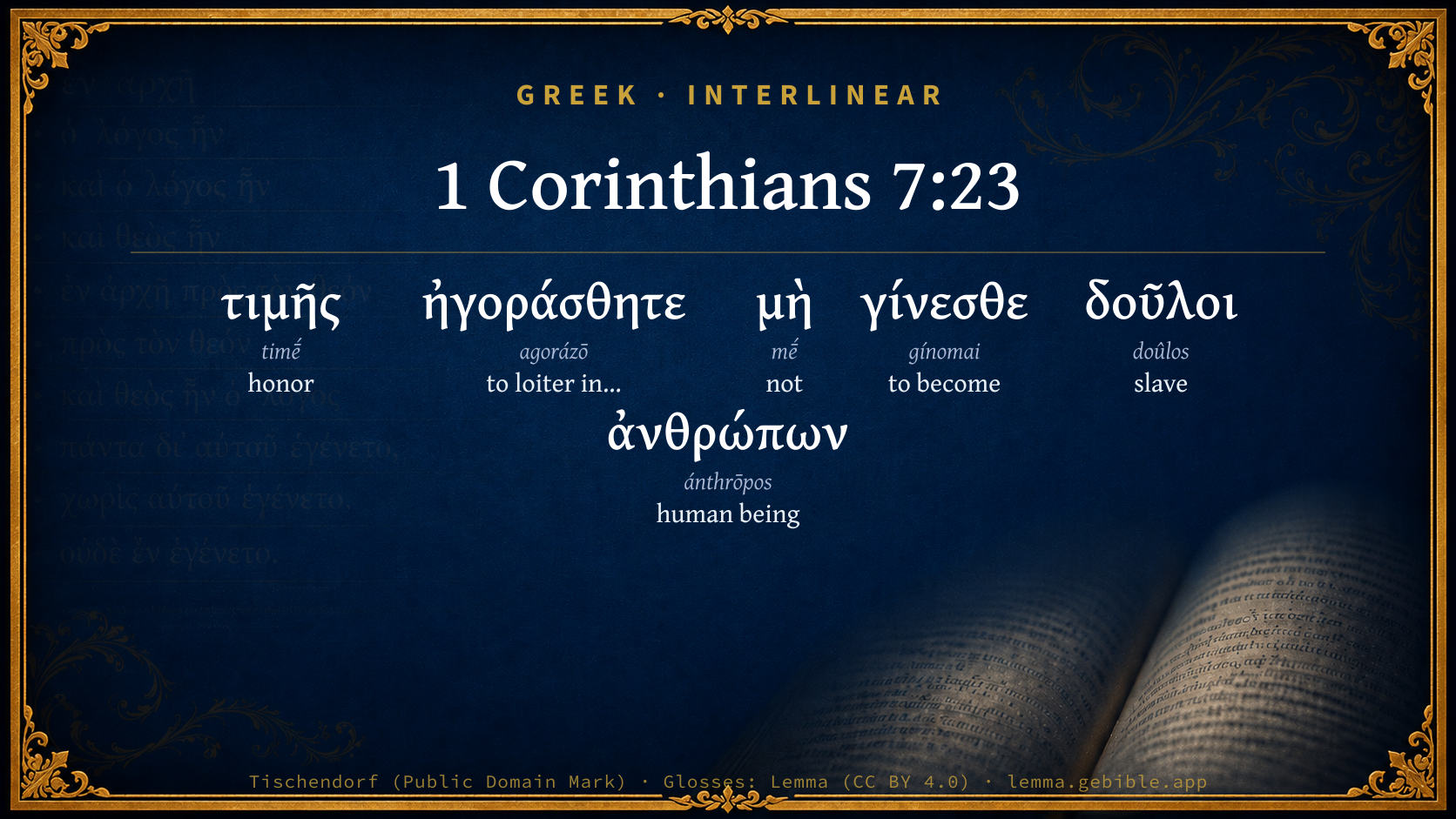
Download image
Cite this verse

1 Corinthians 7:23 (World English Bible). Public Domain. Lemma interlinear Bible study tool, https://lemma.gebible.app/v/1-corinthians/7/23.

Show BibTeX & RIS
BibTeX
RIS
English Translation
You were bought with a price. Don't become bondservants of men.
World English Bible · Public Domain
Download a study sheet

One document with this verse’s original text, its word-by-word gloss line, the meaning frame, cross-references with their text, attributed commentary, and full source and license credits — printable, and it pastes into notes with its structure intact.

This verse Autodidact and up

Study sheet (.html) Plain text (.txt)

A passage Seminary Student

Up to 50 verses in one chapter. A passage sheet keeps up to 6 commentary sources and 12 cross-references per verse, in the order this page ranks them, and says so on the sheet whenever that leaves anything out. Ask for a single verse and you get the Autodidact verse sheet above.

Everything on this page stays free to read, with no account — the sheet is a download of what is already on screen, not access to it.

Want to remove ads? Support Godless Engineer
Compare translations 3

The same verse in 3 English versions, stacked beneath the original-language interlinear above. Click any original word for its lexicon entry.

Each is an independent rendering of the whole verse — the interlinear is not word-aligned to these translations.

Highlighted words mark where these versions differ — a whole-verse word diff, not a word-by-word alignment.

  • World English Bible Public Domain
    You were bought with a price. Don't become bondservants of men.
  • King James Version Public Domain
    Ye are bought with a price; be not ye the servants of men.
  • unfoldingWord Literal Text CC BY-SA 4.0
    You were bought with a price; do not become slaves of men.

unfoldingWord Literal Text — © unfoldingWord, licensed CC BY-SA 4.0. Word-aligned USFM3 via Door43 (git.door43.org/unfoldingWord/en_ult).

Versions to compare (up to 4)

3 of 4 selected

Show all 19 translations

Every available English version of this verse, each an independent rendering of the whole verse.

  • World English Bible Public Domain
    You were bought with a price. Don't become bondservants of men.
  • Berean Standard Bible Public Domain
    You were bought at a price; do not become slaves of men.
  • Majority Standard Bible Public Domain
    You were bought at a price; do not become slaves of men.
  • King James Version Public Domain
    Ye are bought with a price; be not ye the servants of men.
  • American Standard Version (1901) Public Domain
    Ye were bought with a price; become not bondservants of men.
  • Revised Version (1885) Public Domain
    Ye were bought with a price; become not bondservants of men.
  • Geneva Bible (1599) Public Domain
    Yee are bought with a price: be not the seruants of men.
  • Douay-Rheims (1899) Public Domain
    You are bought with a price; be not made the bondslaves of men.
  • Young's Literal Translation Public Domain
    with a price ye were bought, become not servants of men;
  • Literal Standard Version CC BY-SA 4.0
    you were bought with a price, do not become servants of men;
  • Unlocked Literal Bible CC BY-SA 4.0
    You have been bought with a price, so do not become slaves of men.
  • unfoldingWord Literal Text CC BY-SA 4.0
    You were bought with a price; do not become slaves of men.
  • Darby Bible Public Domain
    Ye have been bought with a price; do not be the bondmen of men.
  • World Messianic Bible Public Domain
    You were bought with a price. Don’t become bondservants of men.
  • Webster's Bible Public Domain
    Ye are bought with a price; be not ye the servants of men.
  • Free Bible Version CC BY-SA 4.0
    A price has been paid for you, so don't become a slave to anyone.
  • Bible in Basic English Public Domain
    It is the Lord who has made payment for you: be not servants of men.
  • Text-Critical English NT CC BY 4.0
    You were bought with a price; do not become slaves of men.
  • Tyndale New Testament (1534) Public Domain
    Ye are dearly bought be not mennes seruauntes.

Literal Standard Version (2020), Covenant Press — licensed CC BY-SA 4.0. Text via the HelloAO Bible API (eBible.org). Unlocked Literal Bible (unfoldingWord) — licensed CC BY-SA 4.0. Text via the HelloAO Bible API (eBible.org). unfoldingWord Literal Text — © unfoldingWord, licensed CC BY-SA 4.0. Word-aligned USFM3 via Door43 (git.door43.org/unfoldingWord/en_ult). Free Bible Version, Dr. Jonathan Gallagher — licensed CC BY-SA 4.0. Text via the HelloAO Bible API (eBible.org).

Word by word

More ways to search: Search by grammar → Find every occurrence → Compare this word →

Practice this passage: Drill this verse → Learn its vocabulary →

About this verse

These counts appear in no published source. They are computed here, from the morphology-tagged text and Lemma’s own curated glosses. What Lemma adds →

6
words
6
distinct lemmas
Pauline Epistles
section

Shared distinctive vocabulary

ἠγοράσθητε to loiter in marketplace G59 occurs in 30 verses of the Greek New Testament. Also found in:
Cross-references

9

Topical passages linked to 1 Corinthians 7:23 in the Treasury of Scripture Knowledge — connected by theme and wording, ordered by reader-vote popularity; previews shown in the World English Bible.

  • 1 Corinthians 6:20 for you were bought with a price. Therefore glorify God in your body and in your spirit, which are God's.
  • 1 Peter 1:18–19 knowing that you were redeemed, not with corruptible things, with silver or gold, from the useless way of life handed down from your fathers,
  • Titus 2:14 who gave himself for us, that he might redeem us from all iniquity, and purify for himself a people for his own possession, zealous for good works.
  • Leviticus 25:42 For they are my servants, whom I brought forth out of the land of Egypt. They shall not be sold as slaves.
  • Revelation 5:9 They sang a new song, saying, "You are worthy to take the book, And to open its seals: For you were killed, And bought us for God with your blood, Out of every tribe, language, people, and nation,
  • Acts 20:28 Take heed, therefore, to yourselves, and to all the flock, in which the Holy Spirit has made you overseers, to shepherd the assembly of the Lord and God which he purchased with his own blood.
  • 1 Peter 3:18 Because Christ also suffered for sins once, the righteous for the unrighteous, that he might bring you to God; being put to death in the flesh, but made alive in the spirit;
  • Galatians 2:4 This was because of the false brothers secretly brought in, who stole in to spy out our liberty which we have in Christ Jesus, that they might bring us into bondage;
  • Matthew 23:8–11 But don't you be called 'Rabbi,' for one is your teacher, the Christ, and all of you are brothers.

Cross-references courtesy of OpenBible.info (CC BY 4.0).

Commentary

Notes on 1 Corinthians 7:23 from classic Christian and Jewish commentators (each source and its license shown beneath its notes). The classic Christian expositions comment on the surrounding passage and are grouped to its opening verse, so a note may address several verses; the Jewish commentaries on the Tanakh (Rashi and others) are per-verse, so they appear only where the commentator wrote on this verse.

Lemma curates 59 commentaries, every one of them public domain or Creative Commons licensed, each selected and text-cleaned for this edition rather than reprinted as found. About our sources →

Bengel's Gnomon

Johann Albrecht Bengel

1Co 7:23. Ἠγοράσθητε, you have been bought) by God [as the servants of Christ.—V. g.]—μὴ γίνεσθε, [not as Engl. Vers. “be not ye”] do not become) The internal and external state should, so far as it is attainable, agree together, and the latter should be subservient to the former. To become here, is properly applied to those, who are not slaves. [Let not him who is free, cast away his liberty. Not. crit.]

Bengel's Gnomon of the New Testament — English translation (T&T Clark, Edinburgh, 1860) — public domain. Text from a community e-Sword module.

Meyer's Critical & Exegetical Commentary

Heinrich August Wilhelm Meyer

1Co_7:23. For a price (see on 1Co_6:20) were ye (my readers in general) bought (namely, by Christ to be His slaves); become not (therefore) servants of men; i.e. do not make yourselves dependent upon what men wish and demand of you, instead of allowing your conduct to be moulded by Christs will and service. Paul designs that this should be applied to the mistaken submission shown on the part of the church to such as wished that men should break up or alter their civil relationships and other existing situations to please them, and in compliance with their solicitations and deceptive suggestions. This more specific reference of the warning, in itself conveyed in general terms, we may naturally gather from 1Co_7:24. Instigations and seductions of this kind, arising partly, perhaps, from fanatical excitement, must plainly have occurred at Corinth in connection with circumstances of the details of which we are ignorant; for otherwise the whole of the minute instructions from 1Co_7:17 to 1Co_7:24 would lack any concrete basis. The interpretation with which Chrysostom and Theophylact content themselves is therefore much too vague: that Paul is forbidding men-pleasing generally, and compliance with immoral demands. So also Theodorets view, that he enjoins μὴ δουλοπρεπὲς ἔχειν φρόνημα. Osiander and Neanders rendering is too general also (every kind of wrong dependence). It is altogether alien to the context, 1Co_7:17-24, to suppose that ἀνθρώπων refers to Paul, Cephas, Apollos, etc. (Rückert), and that the meaning is substantially the same as had been expressed in 1Co_3:21 by μηδεὶς καυχάσθω ἐν ἀνθρώποις (Hofmann). Equally out of accordance with the subject in hand is Billroths exposition (given before by Vatablus), that the apostle exhorts the slaves not to do their service for the sake of men, but for the Lords sake (Col_3:22). Heydenreich, on the other hand, holds (with Menochius, Hammond, Knatchbull, Mosheim, Michaelis, Zachariae) that he is admonishing the freemen not to sell themselves into slavery. But, even putting out of account the second person plural, which directs the words to the readers generally, were that the meaning, Paul would undoubtedly have called attention to a new illustration of his rule, as he does in 1Co_7:18; 1Co_7:21. And how unlikely a thing that men went into slavery in those days for the sake of Christianity (for according to the connection it is this motive which must be presupposed, not: for gains sake)!

Meyer — Critical and Exegetical Commentary on the New Testament — English translation by Peter Christie, edited by Frederick Crombie (T&T Clark, 1880) — public domain. Text from a community e-Sword module.

Expositor's Greek Testament

ed. W. Robertson Nicoll

1Co 7:23 . τιμῆς ἠγοράσθητε (see note on 1Co 6:20 ) explains the position both of the δοῦλος ἀπελεύθερος and the ἐλεύθ . δοῦλος by the same act of purchase: the slave has been liberated from sin, and the freeman bound to a new Lord. The point of the appended exhortation, μὴ γίνεσθε δοῦλ . ἀνθρ ., is not obvious: we can scarcely imagine free Christians selling themselves into slavery ; and subservience to party leaders (so Mr [1105] , Hf [1106] , Lt [1107] , El [1108] ; cf. 1Co 1:12 , 1Co 2:4 , etc.) appears foreign to this context. It is better to take the warning quite generally: as much as to say, “Let no human influence divert you from service to God, or infringe on the devotion due to your Redeemer”; cf. Gal 5:1 ; Gal 6:14 . Public opinion and the social pressure of heathenism were too likely to enslave the Corinthians.

[1105] Meyer’s Critical and Exegetical Commentary (Eng. Trans.).

[1106] J. C. K. von Hofmann’s Die heilige Schrift N.T. untersucht , ii. 2 (2te Auflage, 1874).

[1107] J. B. Lightfoot’s (posthumous) Notes on Epp. of St. Paul (1895).

[1108] C. J. Ellicott’s St. Paul’s First Epistle to the Corinthians .

The Expositor's Greek Testament, edited by W. Robertson Nicoll (1897–1910) — public domain. Text from a community e-Sword module.

Hodge's Commentary on Romans, Ephesians & First Corinthians

Charles Hodge

1Co_7:23

Ye are bought with a price; be not ye the servants of men.

Ye (i.e. all Christians, bond and free,) were bought with a price. That is, purchased by Christ with his most precious blood, 1Pe_1:18, 1Pe_1:19. Ye belong to him; ye are his slaves, and should therefore act accordingly; and not be the slaves of men. The slave of one master cannot be the slave of another. One who is redeemed by Christ, who feels that he belongs to him, that his will is the supreme rule of action, and who performs all his duties, not as a man-pleaser, but as doing service as to the Lord, and not to men, Eph_6:6, Eph_6:7, is inwardly free, whatever his external relations may be. This verse is a proper sequel to the preceding one. The apostle had exhorted all believers, even slaves, to be contented with their external condition. As a motive to such contentment, he had said they were all equally the subjects of redemption. They all belonged to Christ. To him their allegiance was due. They, therefore, whether bond or free, should act in obedience to him, and not in obedience to men. There is a very important sense in which even slaves are forbidden to be the servants of men that is, they are not to be men-pleasers, but in all things should act from a sense of duty to God.

Charles Hodge — Commentary on Romans (1835), First Corinthians (1857), and Ephesians (1856) — public domain. Text from a community e-Sword module.

Geneva Bible (1599)

Geneva Bible translators

1 Cor. 6:20; 1 Pet. 18:19

He showeth the reason of the unlikeness, because that he that desireth to be circumcised, maketh himself subject to man’s tradition, and not to God. And this may be much more understood of superstitions, which some do foolishly accompt for things indifferent.

Geneva Bible (1599) marginal notes — public domain. Text via Bolls.life.

Jamieson, Fausset & Brown

Robert Jamieson, A. R. Fausset & David Brown

be not ye--Greek, "become not ye." Paul here changes from "thou" (Co1 7:21) to "ye." YE ALL are "bought" with the blood of Christ, whatever be your earthly state (Co1 6:20). "Become not servants to men," either externally, or spiritually; the former sense applying to the free alone: the latter to Christian freemen and slaves alike, that they should not be servile adherents to their party leaders at Corinth (Co1 3:21-22; Mat 23:8-10; Co2 11:20); nor indeed slaves to men generally, so far as their condition admits. The external and internal conditions, so far as is attainable, should correspond, and the former be subservient to the latter (compare Co1 7:21, Co1 7:32-35).

Jamieson, Fausset & Brown — Commentary Critical and Explanatory on the Whole Bible (1871) — public domain (CC PDM 1.0). Text via the HelloAO Bible API.

Adam Clarke's Commentary

Verse 23. Ye are bought with a price] As truly as your bodies have become the property of your masters, in consequence of his paying down a price for you; so sure you are now the Lord's property, in consequence of your being purchased by the blood of Christ.

Some render this verse interrogatively: Are ye bought with a price from your slavery? Do not again become slaves of men. Never sell yourselves; prefer and retain your liberty now that ye have acquired it.

In these verses the apostle shows that the Christian religion does not abolish our civil connections; in reference to them, where it finds us, there it leaves us. In whatever relation we stood before our embracing Christianity, there we stand still; our secular condition being no farther changed than as it may be affected by the amelioration of our moral character. But slavery, and all buying and selling of the bodies and souls of men, no matter what colour or complexion, is a high offence against the holy and just God, and a gross and unprincipled attack on the liberty and rights of our fellow creatures.

Adam Clarke's Commentary on the Bible (1810–1826) — public domain. Text from a community e-Sword/MySword module.

John Calvin's Commentaries

23. Yea are bought with a price We had these words in the preceding chapter, (1 Corinthians 6:20,) but for a different purpose. As to the word price, I have stated there, what is my view of it. The sum is this, that he exhorts servants, indeed, not to be anxious as to their condition, but wishes them rather to take heed not to subject themselves to the wicked or depraved inclinations of their masters. “We are holy to the Lord, because he has redeemed us: let us, therefore, not defile ourselves for the sake of men, as we do when we are subject to their corrupt desires.” This admonition was very necessary at that time, when servants were driven by threats and stripes, and even fear of death, to obey every kind of command without selection or exception, so that they reckoned the procuring of prostitutes, and other crimes of that nature, to be duties belonging to servants, equally with honorable employment’s. It is, therefore, not without reason that Paul makes this exception — that they are not to yield obedience in things base and wicked. Would that this were thoroughly and entirely impressed upon the minds of all! There would not, in that case, be so many that prostitute themselves to the lusts of men, as if exposed for sale. As for us, let us bear in mind, that we belong to him who has redeemed us.

John Calvin's Commentaries (1540-1563) — public domain. Text from the Calvin Translation Society English edition (1840s-50s) via the Christian Classics Ethereal Library (ccel.org). Calvin's coverage is partial (roughly two-thirds of the Bible); uncommented books and verses are honest gaps, never fabricated. The 19th-century editor's footnotes and remarks are omitted so the notes are faithfully Calvin's own voice.

Ellicott's Commentary for English Readers

(23) Ye are bought with a price . . .—Better, You were bought with a price therefore become not slaves of men. This carries on the idea of freedmen of the previous verse. With a great price—even the blood of Christ—they have been purchased by Him as freedmen: therefore, do not become slaves of men—do not yield to their views by seeking to change the condition of your calling.

A Bible Commentary for English Readers, edited by Charles John Ellicott (1878–1897) — public domain. Text from a community e-Sword module.

The Cambridge Bible for Schools and Colleges

gen. ed. J. J. S. Perowne

23. be not ye the servants of men] Literally, slaves of men. Let your minds and spirits be free, whatever may be your outward condition, i.e. be indifferent to mere external relations altogether, for though man may enslave the body he cannot enslave the soul.

The Cambridge Bible for Schools and Colleges (gen. ed. J. J. S. Perowne; Cambridge University Press, 1878–1918) — public domain. Text from a community e-Sword module.

John Gill's Exposition

Ye are bought with a price,.... Some read these words interrogatively, as Co1 7:18, "are ye bought with a price?" and suppose them directed to such who had bought out their time of servitude with a sum of money, and ought not to return to their former condition; but they are rather to be read affirmatively, and to be understood of all, whether freemen or servants, that are bought with the inestimable price of Christ's blood, as in Co1 6:20 and contain in them a reason why such as are called by the grace of God, whilst in a state of civil servitude, are Christ's freemen, because they are redeemed by him from sin, Satan, the law, and from among men; and also why such as are called by the grace of God, being in a state of civil liberty, are Christ's servants, because he has purchased them with his blood, and therefore has a right unto them, both to their persons and service:

be not ye the servants of men: not that the apostle dissuades such as are redeemed by Christ, and are believers in him, from being the servants of men in a civil sense; for this would be to contradict himself, who here and elsewhere exhorts servants to continue in the service of their masters, and to perform it heartily and cheerfully, and with great sincerity and integrity; but his meaning is, that since they were redeemed from a vain conversation by the blood of Christ, they should not be servants to the lusts of men, nor obey them in things sinful and wicked, which were contrary to law and Gospel, and which were made unlawful by the word of God, and were a breach of the command of their Lord and master Christ; nor should they in matters of religion and the worship of God submit to the authority of any set of men whatever, or be subject to the doctrines and commandments of men; whether these relate to Jewish ceremonies, or Gentile superstitions, or be a mixture of both: they were to call no man master upon earth; nor suffer any to lord it over them, as the false teachers very much did in this church; but to acknowledge Christ, who had bought them to be their only Lord and master. The allusion seems to he to a tradition of the Jews, that the Israelites being redeemed out of Egypt were the servants of God, and not of men (p);

"R. Jochanan ben Zaccai was explaining this Scripture, Exo 21:6 how different the ear is from all the members of the body; says the holy blessed God, the ear that heard my voice on Mount Sinai, at the time I said, the children of Israel are my servants, , and "not servants to servants"; and this goes and gets itself a master, let it be bored: R. Simeon ben Ribbi was explaining the same Scripture, how different the door and the door post were from all the parts of the house; says the holy blessed God, the door and the door post, which were witnesses in Egypt, at the time that I passed by the threshold, and by the two door posts, and I said, the children of Israel are my servants, and not servants to servants, and I brought them out of bondage to liberty; and this goes and gets itself a master, let it be bored before them.''

(p) T. Bab. Kiddushin, fol. 22. 2.

John Gill's Exposition of the Whole Bible (1746–1763) — public domain (CC PDM 1.0). Text via the HelloAO Bible API.

Trapp's Complete Commentary

John Trapp

23 Ye are bought with a price; be not ye the servants of men.

Ver. 23. Ye are bought with a price] The redeemed among the Romans were to addict themselves to the service of their redeemers, and to observe them as their parents all days of their lives.

Be not ye the servants of men] When they command you things forbidden by Christ, or when they would tyrannize over your consciences, as the Jesuits, that require blind obedience. Cardinal Tolet saith, The people may merit at God’s hand in believing a heresy, if their teacher propound it; for their obedience is meritorious. (Cases of Conscience.) If a priest teach it (saith Stapleton), be it true, be it false, take it as God’s oracle. If the Church should approve and authorize Arianism or Pelagianism, saith Erasmus (Epist. ad Firkeimer), I would do so too. But so would no wise man.

John Trapp, A Commentary or Exposition upon All the Books of the Old and New Testament (1647–1656) — public domain. Text from a community e-Sword module.

Albert Barnes' Notes on the Bible

Ye are bought with a price - Though you are slaves to people, yet you have been purchased for God by the blood of His Son; see the note at 1Co 6:20. You are, therefore, in his sight of inestimable worth, and are bound to be His.

Be not ye the servants of men - That is, “Do not regard yourselves as the slaves of men. Even in your humble relation of life, even as servants under the laws of the land, regard yourselves as the servants of God, as obeying and serving him “even in this relation,” since all those who are bought with a price - all Christians, whether bond or free - are in fact the servant (slaves, δοῦλοι douloi) of God, 1Co 7:22. in this relation, therefore, esteem yourselves as the servants of God, as bound by his laws, as subject to him, and as really serving him, while you yield all proper obedience to your master.” Rosenmuller, Grotius, and some others, however, think that this refers to Christians in general; and that the apostle means to caution them against subjecting themselves to needless rites and customs which the false teachers would impose on them. Others have supposed (as Doddridge) that it means that they should not sell themselves into slavery; but assuredly a caution of this kind was not needful. The view given above I regard as the interpretation demanded by the connection. And in this view it would promote contentment, and would even prevent their taking any improper measures to disturb the relations of social life, by the high and solemn consideration that even in that relation they were in common with all Christians, the true and real servants of God. They belonged to God, and they should serve Him. In all things which their masters commanded, that were in accordance with the will of God, and that could be done with a quiet conscience, they were to regard themselves as serving God; if at any time they were commanded to do that which God had forbidden, they were to remember that they were the servants of God, and that he was to be obeyed rather than man.

Albert Barnes' Notes on the Bible (1834–1885) — public domain. Text from a community e-Sword/MySword module.

Haydock's Catholic Bible Commentary

With a price. Viz. with the price of the precious blood of Christ. (Estius) --- Him only should we serve, for whatever draws us from this allegiance, is perfect servitude, such as the love of any person or thing out of God.

George Leo Haydock (1774–1849), Haydock's Catholic Family Bible and Commentary, 1859 edition — public domain. Excludes Psalms (Douay-Rheims chapter numbering differs from Protestant) and Deuterocanonical books (Catholic canon only).

Matthew Poole's English Annotations

What price we are bought with, we heard, 1Co 6:20; the apostle there pressed it upon us as our duty to glorify God with our bodies and our spirits; here he presseth upon us another duty, viz. upon that consideration not to be

the servants of men; by which some think he forbiddeth the selling themselves as slaves to infidels; others think that he only forbiddeth eye-service, as the apostle calls it, Eph 6:6; while in the mean time they might be the servants of men, if they served them as the servants of Christ, doing the will of God from the heart; with good will doing service, as to the Lord, and not to men. But the most probable interpretation is: Be not servants to the lusts of men: wherein you can serve men, and in the same actions also serve God, and be obedient to his will, you may be the servants of men; but be not servants of men in such actions wherein, to serve them, you must disobey God.

Matthew Poole's English Annotations on the Holy Bible (1683–1685) — public domain. Text from a community e-Sword/MySword module.

Whedon's Commentary on the Bible

Daniel D. Whedon

23. Bought—Carrying out the metaphor of the slave; but it is still used to show that, as purchased by Christ, they are wrongfully bought and sold and owned by men.

Be not ye—By any consent of your own. If slaves you are by compulsion of men, the crime is that of men, not yours. But whether you are compulsory bonds-men or not, be in soul so completely the liege of Christ that you are freemen as to men. There is every reason to believe that slaves formed a large part of the first Christian Churches. Says Mr. Withrow, in his Catacombs of Rome, p. 487.

“The condition of the slave population of Rome was one of inconceivable wretchedness. Colossal piles built by their blood and sweat attest the bitterness of their bondage. The lash of the taskmaster was heard in the fields, and crosses bearing aloft their quivering victims polluted the public highways. Vidius Pollio fed his lampreys with the bodies of his slaves. Four hundred of these wretched beings deluged with their blood the funeral pyre of Pedanius Secundus. A single freedman possessed over four thousand of these human chattels. They had no rights of marriage nor any claim to their children. This dumb, weltering mass of humanity, crushed by power, led by their lusts, and fed by public dole, became a hotbed of vice in which every evil passion grew.”

Yet how Christianity ignored degrading distinctions is thus shown by the records on their tombs. “Out of eleven thousand Christian inscriptions of the first six centuries, scarce half a dozen make any reference to a condition of servitude, and of these, as Dr. Northcote remarks, two or three are doubtful. Yet of pagan epitaphs at least three fourths are those of slaves or freedmen. The conspicuous absence of recognition of this unhappy distinction is no mere accident. We know that the Christians were largely drawn from the servile classes, but in the Church of God there was no respect of persons.”—Catacombs, p. 485.

Daniel D. Whedon (gen. ed.), Commentary on the Old and New Testaments (1874–1909) — public domain. Text from a community e-Sword module.

The Pulpit Commentary

Ye are bought with a price; rather, ye were bought, namely, by Christ; and the price paid for you was his blood (see 1 Corinthians. (1Pe_1:18, 1Pe_1:19) Be not ye; rather, become not. The servants of men. There is a grand play of words in the advice to them not to become slaves, at the very moment when he is advising them to continue in slavery. In that which the world called "slavery" the Christian slave might enjoy absolute liberty. The price which a master paid for them was but an unmeaning shadow; they had been bought once and eternally by an infinitely nobler price, and that purchase was the pledge of absolute emancipation.

The Pulpit Commentary (1880–1919), ed. H.D.M. Spence-Jones & Joseph S. Exell — public domain. Text from a community e-Sword module.

John Wesley's Explanatory Notes

Ye are bought with a price - Ye belong to God; therefore, where it can be avoided, do not become the bondslaves of men - Which may expose you to many temptations.

John Wesley, Explanatory Notes Upon the Whole Bible (1754–1765) — public domain. Text via the GEBible commentary corpus.

McGarvey & Pendleton's Commentaries

J. W. McGarvey

Ye were bought with a price; become not bondservants of men .

J. W. McGarvey (with Philip Y. Pendleton), Commentaries on the New Testament (The Fourfold Gospel, 1914; Acts; and the epistles) — public domain. Text from a community e-Sword/MySword module.

The People's New Testament

B. W. Johnson

23. Ye are bought with a price. Christ has bought each alike, ransomed them from the bondage of sin with his blood, and bound them to his service as his own. Be not ye the servants of men. As Christ's servants, do not become the followers of any other religious master.

B. W. Johnson's The People's New Testament with Notes (1889–1891) — public domain. Electronic text from the Christian Classics Ethereal Library (CCEL) ThML edition.

Cambridge Greek Testament for Schools and Colleges

23. τιμῆς ἠγοράσθητε. See ch. 1Co 6:20.

δοῦλοι ἀνθρώπων. Slaves of men. Let your minds and spirits be free, whatever may be your outward condition, i.e. be indifferent to mere external relations altogether, for though man may enslave the body he cannot enslave the soul. We may profitably compare the tone of this passage with that of Epict. Enchir. 19 σὺ δὲ αὐτὸς οὐ στρατηγός, οὐ πρύτανις ἢ ὕπατος εἶναι θελήσῃς, ἀλλ’ ἐλεύθερος· μία δὲ ὁδὸς πρὸς τοῦτο, καταφρόνησις τῶν οὐκ ἐφ’ ἡμῶν. καταφρόνησις, save of the αἰσχύνη τοῦ σταυροῦ, is nowhere represented as a Christian virtue. Even ‘contempt of the world’ is an expression which savours more of the heathen philosopher than of Christ.

Cambridge Greek Testament for Schools and Colleges (Cambridge University Press, 1896; 21 vols, various authors incl. Carr, Maclear, Plummer, Farrar, Lumby, Moule, M. R. James, Simcox) — public domain. Text from a community e-Sword module.

Alford’s Greek Testament

Henry Alford

23.] Following out of δοῦλός ἐστιν χριστοῦ, by reminding them of the price paid whereby Christ purchased them for His (ch. 6:20): and precept thereupon, become not slaves of men: i.e. ‘do not allow your relations to human society, whether of freedom or slavery, to bring you into bondage so as to cause you anxiety to change the one or increase the other.’ Chrys., al., think the precept directed against ὀφθαλμοδουλεία, and general regard to men’s opinion. But it is better to restrict it (however it may legitimately be applied generally) to the case in hand. Hammond, Knatchbull, Michaelis, al., understand it as addressed to the free, and meaning that they are not to sell themselves into slavery: but this is evidently wrong: as may be seen by the change to the second person plur. as addressing all his readers: besides that a new example would have been marked as in vv. 18, 21. See Stanley’s note.

Henry Alford, The Greek Testament (1849–1861) — public domain. Text from a community e-Sword module.

International Critical Commentary

23. τιμῆς ἠγοράσθητε. This recalls 6:20 and applies it to both classes. The social slave, who has been set free by Christ, and the social freeman, who has become enslaved to Christ, have alike been bought by God, and are now His property. In one sense Christ’s death was an act of emanicipation, it set free from the thraldom of sin; in another sense it was a change of ownership.* It is a mistake to suppose that the words are addressed only to those who are socially free, charging them not to lose their freedom. Such a charge would be superfluous. Moreover, the change from the singular to the plural intimates that both classes are now exhorted. See below.

In commenting on this verse, Origen lets us know that he was not the first to comment on this Epistle. He speaks of what οἱ λοιποὶ ἑρμηνευταί say on the subject. See on 9:20.

μὴ γίνεσθε δοῦλοι ἀνθρώπων. ‘Do not become, do not show yourselves to be, bondservants of men.’ The words are obscure. It is very improbable that the prohibition is addressed to those who are free, and that it forbids them to sell themselves into slavery. Such a prohibition could not be needed. Moreover, the change from the and pers. sing. to the and pers. plur. shows that he is now addressing all his converts. Origen strangely interprets the slavery as meaning marriage, in which neither partner τοῦ ἰδίου ώματος ἐξουσιάζει, and from which both partners should seek freedom ἐκ συμφώνου. The bondage must mean ‘some condition of life which is likely to violate God’s rights of ownership’ (Lev 25:42, Lev 25:55). The interpretation, ‘Do not become enslaved to any party-leader,’ is remote from the context. More probably, ‘Do not let social relations or public opinion or evil advisers interfere with the absolute service which is due to Him who bought you with His Son’s blood.’

International Critical Commentary — older volumes (1896–1929), various authors — public domain. Text from a community e-Sword module.

Vincent's Word Studies in the New Testament

Marvin R. Vincent

The servants of men. Not referring to the outward condition of bondage, but to spiritual subjection to the will and guidance of men as contrasted with Christ.

Marvin R. Vincent, Word Studies in the New Testament (1887–1900) — public domain. Text from a community e-Sword/MySword module.

Godet's Commentaries

Frédéric Louis Godet

Vv. 23. The second person plural which comes in here shows that the apostle is addressing the entire Church without distinction. If some from being slaves have become free, and the others from being free have become slaves, it is because a purchase has been made; this purchase, so far as it is a ransom, has freed the slaves, and, as a purchase price, it has brought the free into servitude.

But how is the warning which follows connected with the mention of the great fact of redemption? Some have thought that Paul meant thereby to prevent the free men of Corinth from selling themselves as slaves for the service of Christ (Michaëlis, Heydenreich). But no trace is found of such conduct, and in any case the transition to so new an idea would be denoted by some particle or other.

Monod compares this saying with a passage of the letter of Ignatius to Polycarp (c. 4), where the former writes of male and female servants: “Let them not desire to be set free at the charge of the common treasury, lest they should be found the slaves of their lust.” Paul, he thinks, is reminding Christians thus redeemed that they ought to take care to maintain their independence over-against the Church, or those who have rendered them this service. But how can we bring ourselves to apply to such a purchase the solemn expression, bought with a price? comp. 1Co 6:20. Besides, Paul addresses this recommendation, as we have seen, to the whole Church. This last reason equally forbids us to accept the opinion of Chrysostom (De Virgin., c. 41), quoted by Edwards, according to which Paul recommends slaves not to serve servilely, but as exercising their spiritual liberty; comp. Col 3:23. — Rückert, Hofmann, compare this warning with 1Co 3:21 : “Let no man glory in men;” they think that Paul is inviting the Church to shake off the yoke of the party leaders spoken of in the first chapters. Nothing appears in the context which could call forth such a warning here, and how should Paul immediately return from this strange thought to the general rule, 1Co 7:24? Meyer’s solution seems to me the most natural. Paul, he thinks, wishes to combat the docility of the Church towards certain agitators who were urging believers, in consequence of their conversion, to change their external situation. Indeed, Meyer rightly observes that unless we assume such a tendency, this whole digression (1Co 7:17-24) lacks a basis. Perhaps it was above all in regard to questions about slavery and liberty that those men sought to impose their opinions on the other members of the Church. Let the severe saying, 1Co 4:15, be remembered: “Though ye should have ten thousand tutors in Christ...!”

The apostle concludes by reproducing in a summary form the general principle already twice stated, 1Co 7:17; 1Co 7:20.

Frédéric Louis Godet — Commentaries on Luke, John, Romans, and 1 Corinthians — English translation (T&T Clark, Edinburgh, 1870s–1890s) — public domain. Text from a community e-Sword module.

Lesson kit

Teaching starters — assembled from the data on this page, not authored interpretation. Every prompt links to the verse data it draws on. Edit before teaching.

1 Corinthians, in the Pauline Epistles, opens this verse with 6 words (6 distinct Greek lemmas). Its most distinctive word is agorázō (“to loiter in marketplace”). A historical commentator’s framing appears above. Read the whole chapter for the surrounding context.

Discussion questions

  1. What does “to loiter in marketplace” (agorázō) contribute to the verse as a whole?
  2. How does Matthew 13:44, which shares the word «to loiter in marketplace», read alongside this verse?
  3. The translations on this page render this verse differently — a whole-verse word diff, not a word-by-word alignment. What might account for the different wordings?
  4. Compare how Bengel's Gnomon and Meyer's Critical & Exegetical Commentary read this verse. Where do they agree or differ?

Things to notice

Reading settings

Reading text

Shown beneath each verse's original-language words.

Old Testament
Old Testament edition

Read the OT as the Masoretic Hebrew (MT) or the Greek Septuagint (LXX).

English shown for the Greek Septuagint (in the Hebrew ↔ Greek comparison).

Comparing translations? Open the Compare panel on any verse page to stack up to four side by side.