
Proverbs 3:21

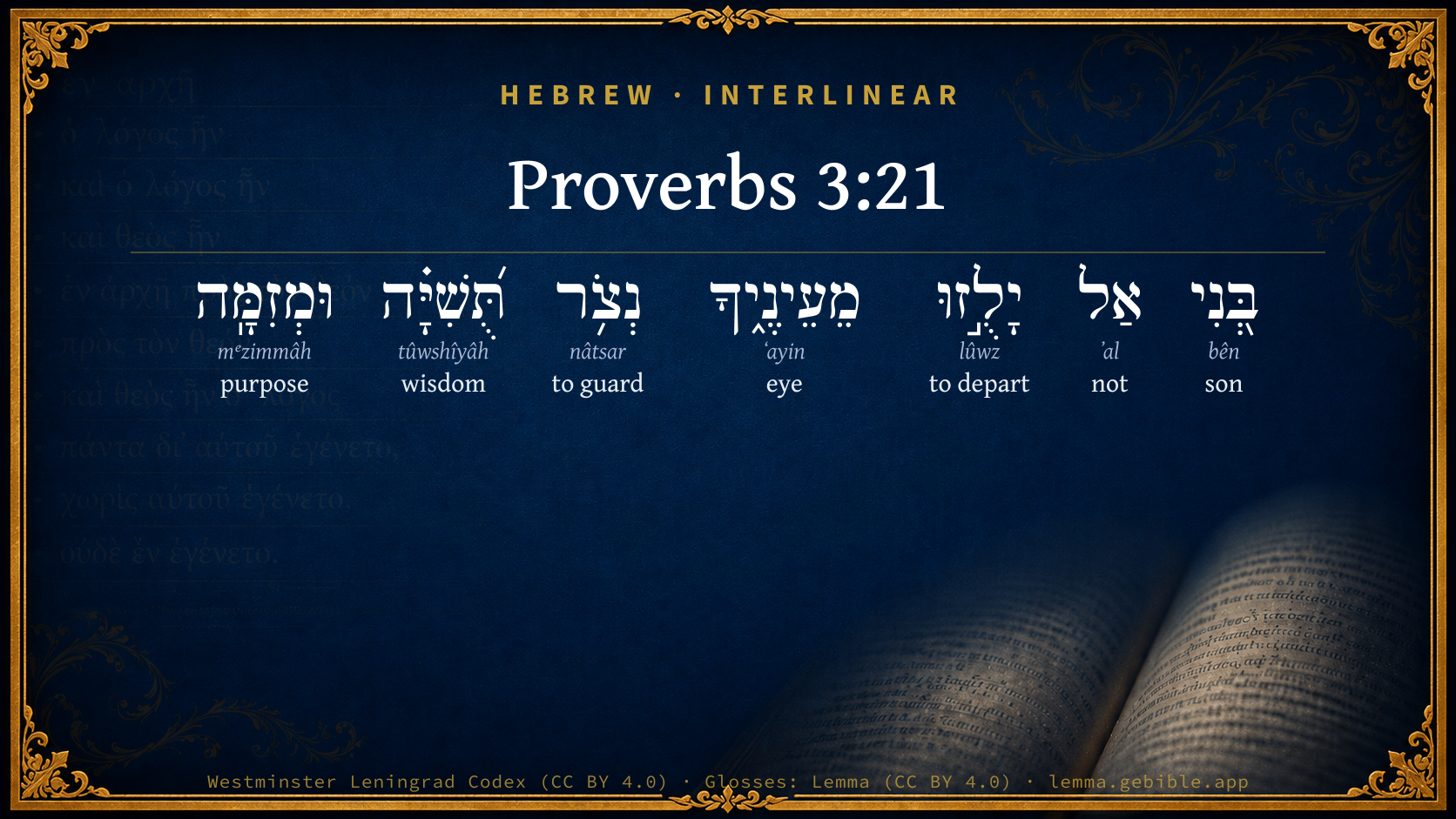
Hebrew (Westminster Leningrad Codex) Proverbs 3:21 appears in the Hebrew Old Testament. The text above is from the Westminster Leningrad Codex. Each word links to its Strong’s number, a concise gloss, and parsing drawn from the Open Scriptures Hebrew Bible morphology. Click any word for its full Brown-Driver-Briggs (BDB) entry.
Download image
Cite this verse

Proverbs 3:21 (World English Bible). Public Domain. Lemma interlinear Bible study tool, https://lemma.gebible.app/v/proverbs/3/21.

Show BibTeX & RIS
BibTeX
RIS
English Translation
My son, let them not depart from your eyes. Keep sound wisdom and discretion:
World English Bible · Public Domain
Download a study sheet

One document with this verse’s original text, its word-by-word gloss line, the meaning frame, cross-references with their text, attributed commentary, and full source and license credits — printable, and it pastes into notes with its structure intact.

This verse Autodidact and up

Study sheet (.html) Plain text (.txt)

A passage Seminary Student

Up to 50 verses in one chapter. A passage sheet keeps up to 6 commentary sources and 12 cross-references per verse, in the order this page ranks them, and says so on the sheet whenever that leaves anything out. Ask for a single verse and you get the Autodidact verse sheet above.

Everything on this page stays free to read, with no account — the sheet is a download of what is already on screen, not access to it.

Want to remove ads? Support Godless Engineer
Compare translations 3

The same verse in 3 English versions, stacked beneath the original-language interlinear above. Click any original word for its lexicon entry.

Each is an independent rendering of the whole verse — the interlinear is not word-aligned to these translations.

Highlighted words mark where these versions differ — a whole-verse word diff, not a word-by-word alignment.

  • World English Bible Public Domain
    My son, let them not depart from your eyes. Keep sound wisdom and discretion:
  • King James Version Public Domain
    My son, let not them depart from thine eyes: keep sound wisdom and discretion:
  • unfoldingWord Literal Text CC BY-SA 4.0
    My son, do not let them depart from your eyes; guard prudence and discretion,

unfoldingWord Literal Text — © unfoldingWord, licensed CC BY-SA 4.0. Word-aligned USFM3 via Door43 (git.door43.org/unfoldingWord/en_ult).

Versions to compare (up to 4)

3 of 4 selected

Show all 18 translations

Every available English version of this verse, each an independent rendering of the whole verse.

  • World English Bible Public Domain
    My son, let them not depart from your eyes. Keep sound wisdom and discretion:
  • Berean Standard Bible Public Domain
    My son, do not lose sight of this: Preserve sound judgment and discernment.
  • Majority Standard Bible Public Domain
    My son, do not lose sight of this: Preserve sound judgment and discernment.
  • King James Version Public Domain
    My son, let not them depart from thine eyes: keep sound wisdom and discretion:
  • American Standard Version (1901) Public Domain
    My son, let them not depart from thine eyes; Keep sound wisdom and discretion:
  • Revised Version (1885) Public Domain
    My son, let not them depart from thine eyes; keep sound wisdom and discretion;
  • Geneva Bible (1599) Public Domain
    My sonne, let not these things depart from thine eyes, but obserue wisdome, and counsell.
  • Douay-Rheims (1899) Public Domain
    My son, let not these things depart from thy eyes: keep the law and counsel:
  • Young's Literal Translation Public Domain
    My son! let them not turn from thine eyes, Keep thou wisdom and thoughtfulness,
  • Literal Standard Version CC BY-SA 4.0
    My son! Do not let them turn from your eyes, || Keep wisdom and thoughtfulness,
  • Unlocked Literal Bible CC BY-SA 4.0
    My son, keep sound judgment and discernment, and do not lose sight of them.
  • unfoldingWord Literal Text CC BY-SA 4.0
    My son, do not let them depart from your eyes; guard prudence and discretion,
  • Darby Bible Public Domain
    My son, let them not depart from thine eyes; keep sound wisdom and discretion:
  • World Messianic Bible Public Domain
    My son, let them not depart from your eyes. Keep sound wisdom and discretion,
  • Webster's Bible Public Domain
    My son, let not them depart from thy eyes: keep sound wisdom and discretion:
  • Free Bible Version CC BY-SA 4.0
    My son, hold on to good judgment and wise decisions—don't let them out of your sight,
  • Bible in Basic English Public Domain
    My son, keep good sense, and do not let wise purpose go from your eyes.
  • JPS Tanakh (1917) Public Domain
    My son, let not them depart from thine eyes; keep sound wisdom and discretion;

Literal Standard Version (2020), Covenant Press — licensed CC BY-SA 4.0. Text via the HelloAO Bible API (eBible.org). Unlocked Literal Bible (unfoldingWord) — licensed CC BY-SA 4.0. Text via the HelloAO Bible API (eBible.org). unfoldingWord Literal Text — © unfoldingWord, licensed CC BY-SA 4.0. Word-aligned USFM3 via Door43 (git.door43.org/unfoldingWord/en_ult). Free Bible Version, Dr. Jonathan Gallagher — licensed CC BY-SA 4.0. Text via the HelloAO Bible API (eBible.org).

Word by word

More ways to search: Search by grammar → Find every occurrence → Compare this word →

Practice this passage: Drill this verse → Learn its vocabulary →

About this verse

These counts appear in no published source. They are computed here, from the morphology-tagged text and Lemma’s own curated glosses. What Lemma adds →

7
words
7
distinct lemmas
Wisdom
section

Notable vocabulary

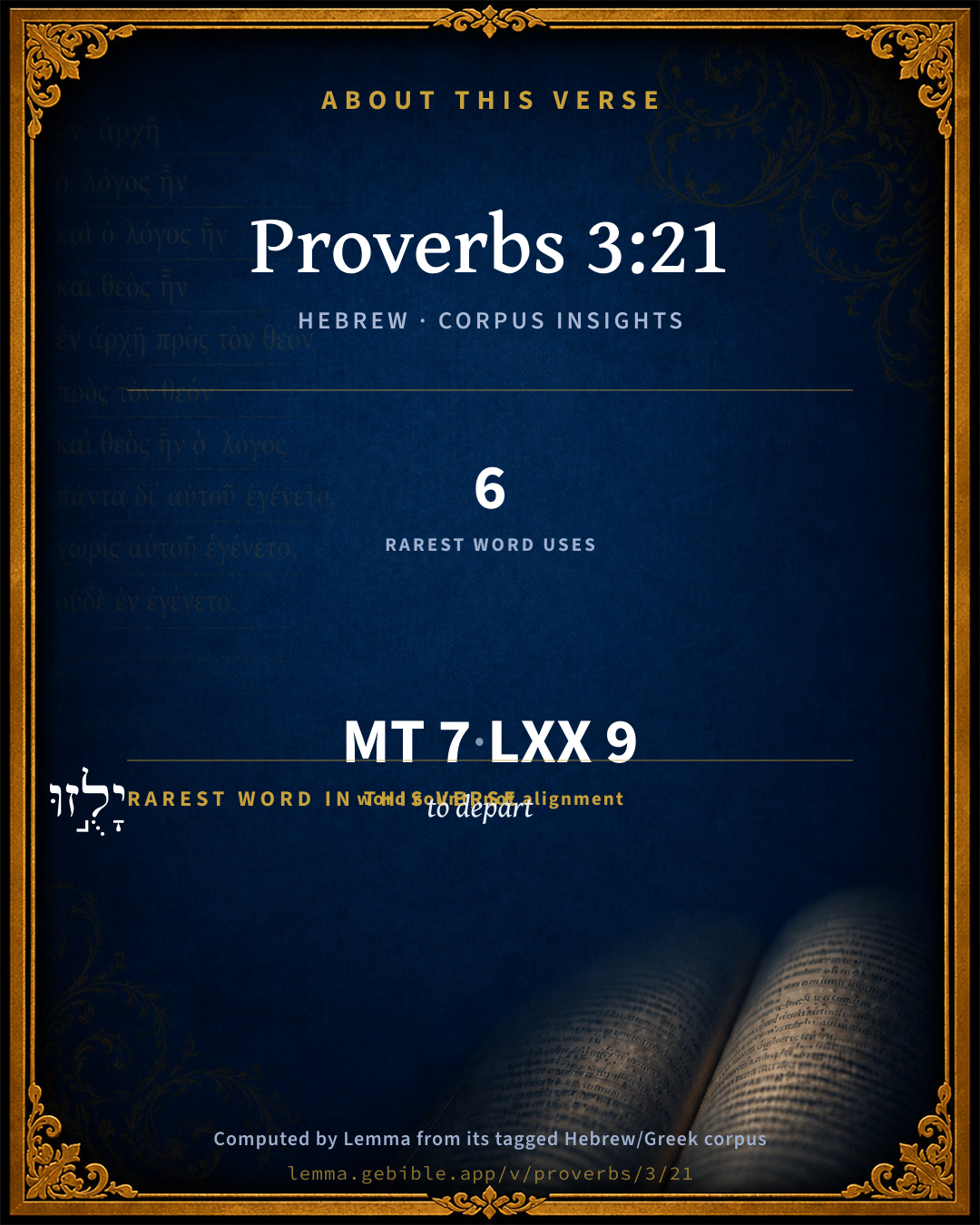
The rarest word here is יָלֻ֣זוּ to depart H3868 — appearing just 6 times in the whole Hebrew Bible.

Shared distinctive vocabulary

יָלֻ֣זוּ to depart H3868 occurs in 6 verses of the Hebrew Bible. Also found in:

Grammatical profile

  • 2 verbs
  • 4 nouns
  • 1 particle

Verb forms

  • יָלֻ֣זוּ Qal · Jussive
  • נְצֹ֥ר Qal · Imperative

Hebrew & Septuagint length

In English translation the verse runs 14 words from the Hebrew and 14 from the Septuagint (LXX English) — the same length.

A rough comparison of the two English renderings, which tokenize alike — not a word-level alignment.

Word counts can differ between the Hebrew and the Greek without any difference in meaning — e.g. the Hebrew direct-object marker אֵת has no separate Greek word, and Greek often adds the article ὁ.

In the original languages it is 7 Hebrew tokens and 9 Greek tokens — but the two are counted differently (Hebrew bundles its prefixes and suffixes into one token; the Greek is in lemma form), so that isn’t a like-for-like length.

Cross-references

12

Topical passages linked to Proverbs 3:21 in the Treasury of Scripture Knowledge — connected by theme and wording, ordered by reader-vote popularity; previews shown in the World English Bible.

  • Joshua 1:8 This book of the law shall not depart out of your mouth, but you shall meditate thereon day and night, that you may observe to do according to all that is written therein: for then you shall make your way prosperous, and then you shall have good success.
  • Deuteronomy 6:6–9 These words, which I command you this day, shall be on your heart;
  • Deuteronomy 32:46–47 He said to them, Set your heart to all the words which I testify to you this day, which you shall command your children to observe to do, [even] all the words of this law.
  • Proverbs 4:21 Let them not depart from your eyes. Keep them in the midst of your heart.
  • Hebrews 2:1–3 Therefore we ought to pay greater attention to the things that were heard, lest perhaps we drift away.
  • Deuteronomy 4:9 Only take heed to yourself, and keep your soul diligently, lest you forget the things which your eyes saw, and lest they depart from your heart all the days of your life; but make them known to your children and your children's children;
  • John 8:31 Jesus therefore said to those Jews who had believed him, "If you remain in my word, then you are truly my disciples.
  • 1 John 2:27 As for you, the anointing which you received from him remains in you, and you don't need for anyone to teach you. But as his anointing teaches you concerning all things, and is true, and is no lie, and even as it taught you, you will remain in him.
  • Proverbs 3:1–3 My son, don't forget my teaching; But let your heart keep my commandments:
  • John 15:6–7 If a man doesn't remain in me, he is thrown out as a branch, and is withered; and they gather them, throw them into the fire, and they are burned.
  • 1 John 2:24 Therefore, as for you, let that remain in you which you heard from the beginning. If that which you heard from the beginning remains in you, you also will remain in the Son, and in the Father.
  • Proverbs 2:7 He lays up sound wisdom for the upright. He is a shield to those who walk in integrity;

Cross-references courtesy of OpenBible.info (CC BY 4.0).

Hebrew and Greek witnesses Masoretic Hebrew ↔ Greek Septuagint

The same verse in the two great witnesses to the Old Testament, shown verse-for-verse.

These are two independent witnesses, not word-aligned to each other, and the Septuagint is shown in lemma (dictionary) form.

Hebrew Proverbs 3:21 Masoretic · Westminster Leningrad Codex

בְּ֭נִי אַל יָלֻ֣זוּ מֵעֵינֶ֑יךָ נְצֹ֥ר תֻּ֝שִׁיָּ֗ה וּמְזִמָּֽה

My son, let them not depart from your eyes. Keep sound wisdom and discretion:

World English Bible · Public Domain

Greek LXX Proverbs 3:21 Septuagint · lemma form

υἱός μή παραῥέω τηρέω δέ ἐμός βουλή καί ἔννοια

My son, let them not pass from you, but keep my counsel and understanding:

LXX2012 (modern English Septuagint) · Public Domain

On this verse, The Cambridge Bible for Schools and Colleges discusses the Septuagint’s reading. Read the note in Commentary ↓

Hebrew: Westminster Leningrad Codex (CC BY 4.0). Greek: Septuagint (public domain); English from LXX2012 (modern English Septuagint) (Public Domain). How the Septuagint differs from the Hebrew →

Commentary

Notes on Proverbs 3:21 from classic Christian and Jewish commentators (each source and its license shown beneath its notes). The classic Christian expositions comment on the surrounding passage and are grouped to its opening verse, so a note may address several verses; the Jewish commentaries on the Tanakh (Rashi and others) are per-verse, so they appear only where the commentator wrote on this verse.

Lemma curates 59 commentaries, every one of them public domain or Creative Commons licensed, each selected and text-cleaned for this edition rather than reprinted as found. About our sources →

Matthew Henry's Commentary

Solomon, having pronounced those happy who not only lay hold on wisdom, but retain her, here exhorts us therefore to retain her, assuring us that we ourselves shall have the comfort of doing so.

I. The exhortation is, to have religion's rules always in view and always at heart, Pro 3:21. 1. To have them always in view: "My son, let them not depart from thy eyes; let not thy eyes ever depart from them to wander after vanity. Have them always in mind, and do not forget them; be ever and anon thinking of them, and conversing with them, and never imagine that thou hast looked upon them long enough and that it is time now to lay them by; but, as long as thou livest, keep up and cultivate thy acquaintance with them." He who learns to write must always have his eye upon his copy, and not let that be out of his sight; and to the words of wisdom must those, in like manner, have a constant respect, who will walk circumspectly. 2. To have them always at heart; for it is in that treasury, the hidden man of the heart, that we must keep sound wisdom and discretion, keep to the principles of it and keep in the ways of it. It is wealth that is worth keeping.

II. The argument to enforce this exhortation is taken from the unspeakable advantage which wisdom, thus kept, will be of to us. 1. In respect of strength and satisfaction: "It will be life to thy soul (Pro 3:22); it will quicken thee to thy duty when thou beginnest to be slothful and remiss; it will revive thee under thy troubles when thou beginnest to droop and despond. It will be thy spiritual life, an earnest of life eternal." Life to the soul is life indeed. 2. In respect of honour and reputation: It shall be grace to thy neck, as a chain of gold, or a jewel. Grace to thy jaws (so the word is), grateful to thy taste and relish (so some); it shall infuse grace into all thou sayest (so others), shall furnish thee with acceptable words, which shall gain thee credit. 3. In respect of safety and security. This he insists upon in four verses, the scope of which is to show that the effect of righteousness (which is the same with wisdom here) is quietness and assurance for ever, Isa 32:17. Good people are taken under God's special protection, and therein they may have an entire satisfaction. They are safe and may be easy, (1.) In their motions by day, Pro 3:23. If our religion be our companion, it will be our convoy: "Then shalt thou walk in thy way safely. The natural life, and all that belongs to it, shall be under the protection of God's providence; the spiritual life, and all its interests, are under the protection of his grace; so that thou shalt be kept from falling into sin or trouble." Wisdom will direct us into, and keep us in, the safe way, as far as may be, from temptation, and will enable us to walk in it with holy security. The way of duty is the way of safety. "We are in danger of falling, but wisdom will keep thee, that thy foot shall not stumble at those things which are an offence and overthrow to many, but which thou shalt know how to get over." (2.) In their rest by night, Pro 3:24. In our retirements we lie exposed and are most subject to frights. "But keep up communion with God, and keep a good conscience, and then when thou liest down thou shalt not be afraid of fire, or thieves, or specters, or any of the terrors of darkness, knowing that when we, and all our friends, are asleep, yet he that keeps Israel and every true-born Israelite neither slumbers nor sleeps, and to him thou hast committed thyself and taken shelter under the shadow of his wings. Thou shalt lie down, and not need to sit up to keep guard; having lain down, thou shalt sleep, and not have thy eyes held waking by care and fear; and thy sleep shall be sweet and refreshing to thee, being not disturbed by any alarms from without or from within," Psa 4:8; Psa 116:7. The way to have a good night is to keep a good conscience; and the sleep, as of the labouring man, so of the wise and godly man, is sweet. (3.) In their greatest straits and dangers. Integrity and uprightness will preserve us, so that we need not be afraid of sudden fear, Pro 3:25. The harms that surprise us, unthought of, giving us no time to arm ourselves by consideration, are most likely to put us into confusion. But let not the wise and good man forget himself, and then he will not give way to any fear that has torment, be the alarm ever so sudden. Let him not fear the desolation of the wicked, when it comes, that is, [1.] The desolation which the wicked ones make of religion and the religious; though it comes, and seems to be just at the door, yet be not afraid of it; for, though God may make use of the wicked as instruments of his people's correction, yet he will never suffer them to be the authors of their desolation. Or rather, [2.] The desolation which wicked men will be brought into in a moment. It will come, and timorous saints may be apprehensive that they shall be involved in it; but let this be their comfort, that though judgments lay waste generally, at least promiscuously, yet God knows who are his and how to separate between the precious and the vile. Therefore be not afraid of that which appears most formidable, for (Pro 3:26) "the Lord shall be not only thy protector to keep thee safe, but thy confidence to keep thee secure, so that thy foot shall not be taken by thy enemies nor ensnared by thy own fears." God has engaged to keep the feet of his saints.

Matthew Henry's Commentary on the Whole Bible (1708–1710) — public domain (CC PDM 1.0). Text via the HelloAO Bible API.

The Cambridge Bible for Schools and Colleges

gen. ed. J. J. S. Perowne

Sixth Address. Chap. 3. Pro_3:21-35

21. let not them] The reference may be to the “sound wisdom and discretion” of the following clause; but it is better perhaps to understand by “them” the precepts already given. The reading of the LXX., μὴ παραρυῇς, is interesting in connection with παραρυῶμεν, Heb_2:1, where see notes in this Series and in Dean Vaughan’s Commentary.

The Cambridge Bible for Schools and Colleges (gen. ed. J. J. S. Perowne; Cambridge University Press, 1878–1918) — public domain. Text from a community e-Sword module.

Trapp's Complete Commentary

John Trapp

Pro 3:21 My son, let not them depart from thine eyes: keep sound wisdom and discretion:

Ver. 21. Let not them depart.] Ne effluant haec ab oculis tuis, saith the Vulgate. Ne haec a tuis oculis deflectant in obliquum huc et illuc; so Mercer. Let the eyes look right on, σκοπουντων, {Pro 4:25} look wistfully and intently on these great works of God, and his wisdom therein set forth and conspicuous, as on a theatre. Eye these things, as the steersman doth the compass, as the archer doth the mark he shoots at, {2Co 4:18} or as the passenger doth his way, which he finds hard to hit, and dangerous to miss. Yea, let them be the delight of thine eyes, with the sight whereof thou canst not be sated or surfeited.

John Trapp, A Commentary or Exposition upon All the Books of the Old and New Testament (1647–1656) — public domain. Text from a community e-Sword module.

The Biblical Illustrator

Joseph S. Exell

Pro_3:21-23

My son, let not them depart from thine eyes: keep sound wisdom and discretion.

Fidelity to principle

The advantages connected with fidelity to the ethics of godliness are here sketched.

I. Life. The principles of heavenly wisdom--

1. Originate spiritual life.

2. Nurture spiritual life.

II. Ornament. Grace to thy neck.

1. This gracefulness of soul is an ornamental. Becoming to all.

2. Within the reach of every man.

3. Admired by the highest intelligences.

4. Imperishable in its nature.

III. Safety. God is the guide and guardian of the faithful.

IV. Courage. It is one thing to be safe and another thing to feel safe. A feeling of safety may well make us courageous. (D. Thomas, D.D.)

Securing wisdom when we have it

We are not called to be mere idolaters of wisdom, but to keep it in the heart, with the distinct idea of reproducing it in an obedient and pure life. Wisdom rightly used is increased in amount and energy. It is not a mere decoration, a medal to be worn on the breast, or a badge to proclaim superiority of class; it is a life-generating force, living ever in the soul for its enlargement and establishment in goodness. (Joseph Parker, D.D.)

The Biblical Illustrator, edited by Joseph S. Exell (c. 1880s–1900s) — public domain. Text from a community e-Sword module.

Joseph Benson's Commentary

Pro 3:21-22. My son, let them not depart, &c. — Let me prevail with thee to keep these good instructions before the eyes of thy mind continually. Constantly and seriously meditate upon them, and thereby thou wilt attain and retain sound wisdom and discretion. So shall they be life unto thy soul — To thee, or thy person. They shall prolong thy life, and make it life indeed, namely, wise, holy, and happy: whereas a foolish, sinful, and miserable life is reputed a kind of death, and is often so called. Thus Moses says to Israel, He (namely, God) is thy life, and the length of thy days, Deu 30:20. Or Solomon here means, They shall be life to thy soul, properly so called. They shall quicken, delight, and save thy soul. And grace to thy neck — They shall be like a beautiful chain or ornament about thy neck, as above, Pro 3:3, and Pro 1:9.

Joseph Benson's Commentary on the Old and New Testaments (1811–1818) — public domain. Text from a community e-Sword module.

The Preacher's Complete Homiletical Commentary

Joseph S. Exell (gen. ed.)

CRITICAL NOTES.—

Pro_3:21. Them, i.e. “sound wisdom and discretion;” Sound wisdom, the same word as in chap. Pro_2:7 (see notes there). Miller translates here, as there, “something stable”

Pro_3:25. Desolation of the wicked. This is interpreted in two ways.

1. The desolation in which the wicked strive to overwhelm the good; or,

2. The destruction which will sweep away the wicked, leaving the godly unharmed. “A positive decision is probably not possible” (Lange’s Commentary). Stuart, and most modern commentators, adopt the latter view.

Pro_3:26. Confidence. “Jehovah shall be as loins to thee” (Miller).

MAIN HOMILETICS OF THE PARAGRAPH.—Pro_3:21-26

GOD’S KEEPING, THE REWARD OF MAN’S KEEPING

Here we have the keeping of the Divine commands resulting in a being kept by Divine power and love.

I. There is a possibility of losing what has been attained. The injunction here given is not, as in chap. Pro_2:10, to seek wisdom, but as in Pro_3:18 of this chapter, to keep a hold upon what has been already gotten. The Scriptures abound in such exhortations. Barnabas exhorted the Church at Antioch to “cleave unto the Lord,” and he and Paul, when in Pisidian Antioch, persuaded the disciples “to continue in the grace of God” (Act_11:23; Act_13:43). The word of Our Lord to the Church at Thyatira was “That which ye have hold fast till I come” (Rev_2:25). There is no safety but in continual watchfulness and in constant study of Divine precepts. “My son, let them not depart from thine eyes.” A mariner may set out on his voyage with his vessel’s head pointing in the right direction, but if he does not hourly keep consulting the compass, it will not avail him much that he started right. The Apostle speaks of men having “made shipwreck of faith and a good conscience” (1Ti_1:19). The world, the flesh, and the devil are cross currents and contrary winds which can only be met and overcome by constant, watchful reference to chart and compass.

II. The blessing which will result from “keeping wisdom,” viz., Soul-life. As food and an observance of physical laws are the means by which the body is enabled to perform the functions which are natural to it, so a constant receiving of God’s thoughts and an observance of God’s laws will enable the soul—the spiritual man—to fulfil the end for which it was created—to glorify and enjoy God. Such a man has the assurance that he is under the special guardianship of God. All the subjects of this realm are under the protection of the monarch, but she has a special and personal care for her own children. So God is the “Saviour of all men, specially of those that believe” (1Ti_4:10). This particular regard of God for those who have become His children, by falling in with His method of making them right with themselves and with Him, is guaranteed.—

1. In the ordinary events of life. As the heirs of the monarch are always accompanied by those who count it an honour to serve them and, if needful, to protect them, so the heirs of salvation are ever attended by their body-guard, the angels who are “ministering spirits to the heirs of salvation” (Heb_1:14). In the night not only do they encamp round about them that fear God (Psa_34:7), but the Lord Himself is said to be their keeper (Psa_121:5). His peace “keeps (lit. garrisons) the heart” (Php_4:7) and gives the sweet sleep promised in Pro_3:24, even although outward circumstances may be apparently adverse (see illustration). This was the experience of David in the night of his adversity, even although he had brought it upon himself (Psalms 3, 4). And the certain guidance which is promised in Pro_3:6 insures an avoidance of all real danger (Pro_3:23).

2. In times of special visitation (Pro_3:25). There was a “desolation of the wicked” in the days of Noah, but he and his house were “shut in” the ark by God Himself (Gen_7:16). In the day when the Lord “rained upon Sodom and Gomorrah He delivered just Lot.” (2Pe_2:6). When the “abomination of desolation stood in the holy place” at Jerusalem as foretold by our Lord (Mat_24:15), those who obeyed His command and fled to the mountains escaped the terrible fate of those who remained in the city. (This is recorded by Eusebius). This assurance of constant guardianship and guidance is “life” to the soul (Psa_30:5). Fear of the future paralyses a man’s energies, but confidence in an over-ruling personal God gives him strength for action.

ILLUSTRATION OF Pro_3:24

THE LAST HOURS OF THE NINTH EARL OF ARGYLE, EXECUTED BY JAMES II

So effectually had religious faith and hope, co-operating with natural courage and equanimity, composed his spirits that, on the very day on which he was to die, he dined with appetite, conversed with gaiety at table, and, after his last meal, lay down, as he was wont, to take a short slumber, in order that his body and mind might be in full vigour when he should mount the scaffold. At this time one of the Lords of the Council, who had probably been bred a Presbyterian, and had been seduced by interest to join in oppressing the Church of which he had once been a member, came to the castle with a message from his brethren, and demanded admittance to the Earl. It was answered that the Earl was asleep. The Privy Councillor thought that this was a subterfuge, and insisted on entering. The door of the cell was softly opened, and there lay Argyle on the bed, sleeping, in his irons, the placid sleep of infancy. The conscience of the renegade smote him. He turned away, sick at heart, ran out of the castle, and took refuge in the dwelling of a lady of his family, who lived hard by. There he flung himself upon a couch, and gave himself up to an agony of remorse and shame. His kinswoman, alarmed by his looks and groans, thought that he had been taken with sudden illness, and begged him to drink a cup of sack. “No, no,” he said, “that will do me no good.” She prayed him to tell her what had disturbed him. “I have been,” he said, “to Argyle’s prison. I have seen him within an hour of eternity sleeping as sweetly as ever man did. But as for me——.”—Macaulay.

OUTLINES AND SUGGESTIVE COMMENTS

Pro_3:21. Simply attend to them. “Watch” like a sentinel, intently eyeing. Solomon enjoins the voluntary, and promises the involuntary. The voluntary we can do, save only for that grand helplessness, an aversion of the will itself. The involuntary we cannot do, save only mediately through obedient acts. Attention is within our power if God gives grace to the will. This is the drift of the promise: You do your part and God will do His.—Miller.

Eye these things as the steersman doth the load-star, as the archer doth the mark he shoots at, or as the passenger doth his way, which he finds hard to hit and dangerous to miss.—Trapp.

Pro_3:22.—Wisdom reveals the righteousness of God, whereby a believer lives before God. Without this the man is dead in sins (Heb_2:4, Eph_2:1).—Fausset.

There is no life in the soul till knowledge come into it. There was no living creature in the world till light was made. God clears the understanding before He rectifies the will and affections; He keeps the same method in the little world that He did in the great world.—Francis Taylor.

Pro_3:23. This promise has a direction embodied with it, “Thou shalt walk in thy way.” We are required to keep the way of the Lord, and in the affairs of life to attend to our own concerns, shunning the character of busybodies by not meddling in the affairs of others.—Lawson.

Good success in the way may be crossed again; what is crowned with good success in the end can never be crossed.—Francis Taylor.

There shall be no cause to make thee stumble. For he that is blind or weak may stumble, though he be never so careful; and he may stumble that is careless, though he be never so well able to walk safely. But wisdom shall take away thy blindness, thy weakness, thy carelessness.—Jermin.

Thou shalt ever go under a double guard, the peace of God within thee and the power of God about thee.—Trapp.

Pro_3:24.—Peter in prison, in chains, between two soldiers, on the eve of his probable execution, when there seemed but a “step between him and death.” Yet in such a place, in such company, at such a moment, did he lie down so fearlessly and sleep so sweetly, that even the shining light failed to disturb him, and an angel’s stroke was needed to awaken him.—Bridges.

Surely the way to sleep quietly in this world is to be asleep to the world; his sleep is sweetest, when he is asleep, who, when he is awake, doth sweetly sleep in a neglect of worldly crosses or contentments.—Jermin.

Pro_3:25. So safe will all thy ways be that to fear will be a sin.—Plumptre.

From the terms before used, respecting the final destruction of the wicked, it is most likely that to it the reference is in this verse.—Wardlaw.

“Be not afraid” is at once a precept and a promise to the godly. They shall have no cause to fear evil tidings, therefore it is their privilege that they are not to fear them (Psa_112:7; Psa_91:5).—Fausset.

The Christian is threatened by the sinners in all their ills, whether for them or by them. Sin breeds the whole of them; and the wise man would magnify the grace by saying that they are all equally indifferent. “Let cares, like a wild deluge come.”—Miller.

Let a David “walk through the vale of the shadow of death” he will not fear, no, though he should go back the same way; “for Thou art with me,” saith he. He had God by the hand, and so long he feared no colours.—Trapp.

Pro_3:26. Beware of mistakes here. Do not say God is your confidence, if He be only your dread. An appalling amount of hypocrisy exists in Christendom, and passes current for devotion. He who is himself most worthy is often more disliked than any other being, and, as if this ingratitude were not enough, men double the sin by professing that they have confidence in Him. I have observed that sea-going ships do not trust to themselves in the windings of a river. Where they are hemmed in between rock and quicksand, grazing now the one and now the other, they take care to have a steamtug, both to bear them forward and to guide them aright. They hang implicitly upon its power. They make no attempt at independent action. But as soon as they get clear of the narrows—as soon as they have attained a good offing and an open sea—they heave off and hoist their own sails. They never want a steamer till they come into narrow waters again. Such is the trust in God which the unreconciled experience. In distress they are fain to lean upon the Almighty. While they are in the narrows they would hang on the help of a Deliverer.… The line of their dependence seems ever tight by their constant leaning. But when they begin to creep out of these shoals of life they heave off and throw themselves upon their own resources.… This is not to have confidence in God.—Arnot.

The Preacher's Complete Homiletical Commentary (gen. ed. Joseph S. Exell; Funk & Wagnalls, c. 1892) — public domain (pre-1929). A full-Bible homiletical/sermon-outline anthology covering 65 of 66 books (2 John is absent from the source module). Text from a community e-Sword module.

Keil & Delitzsch

C. F. Keil & F. Delitzsch

From this eminence, in which the work of creation presents wisdom, exhortations are now deduced, since the writer always expresses himself only with an ethical intention regarding the nature of wisdom:

21 My son, may they not depart from thine eyes -

Preserve thoughtfulness and consideration,

22 And they will be life to thy soul

And grace to thy neck.

If we make the synonyms of wisdom which are in 21b the subject per prolepsin to אל־ילזוּ (Hitzig and Zckler), then Pro 3:19-20 and Pro 3:21-22 clash. The subjects are wisdom, understanding, knowledge, which belong to God, and shall from His become the possession of those who make them their aim. Regarding לוּז, obliquari, deflectere, see under Pro 2:15, cf. Pro 4:21; regarding תּשׁיּה (here defective after the Masora, as rightly in Vened. 1515, 1521, and Nissel, 1662), see at Pro 2:7; ילזוּ for תּלזנה, see at Pro 3:2. The lxx (cf. Heb 2:1) translate without distinctness of reference: υἱὲ μὴ παραῤῥυῂς (παραρυῇς), let it now flow past, i.e., let it not be unobserved, hold it always before thee; the Targ. with the Syr. render לא נזּל, ne vilescat, as if the words were אל־יזוּלוּ. In 22a the synallage generis is continued: ויהיוּ for ותהיינה. Regarding גּרגּרת, see at Pro 1:9. By wisdom the soul gains life, divinely true and blessed, and the external appearance of the man grace, which makes him pleasing and gains for him affection.

Keil & Delitzsch — Biblical Commentary on the Old Testament (1861–1891) — public domain (CC PDM 1.0). Text via the HelloAO Bible API. (Old Testament only.)

Tyndale Open Study Notes

Tyndale Open Resources

3:21-26 This passage enumerates the benefits of common sense and discernment, which are fruits of wisdom.

Tyndale Open Study Notes — © Tyndale Open Resources, licensed CC BY-SA 4.0. Text via the HelloAO Bible API.

Jamieson, Fausset & Brown

Robert Jamieson, A. R. Fausset & David Brown

sound wisdom--(compare Pro 2:7).

let . . . eyes--that is, these words of instruction.

Jamieson, Fausset & Brown — Commentary Critical and Explanatory on the Whole Bible (1871) — public domain (CC PDM 1.0). Text via the HelloAO Bible API.

Adam Clarke's Commentary

Verse 21. Let not them depart from thine eyes] Never forget that God, who is the author of nature, directs and governs it in all things; for it is no self-determining agent.

Keep sound wisdom and discretion] תושיה ומזמה tushiyah umezimmah. We have met with both these words before. Tushiyah is the essence or substance of a thing; mezimmah is the resolution or purpose formed in reference to something good or excellent. To acknowledge God as the author of all good, is the tushiyah, the essence, of a godly man's creed; to resolve to act according to the directions of his wisdom, is the mezimmah, the religious purpose, that will bring good to ourselves and glory to God. These bring life to the soul, and are ornamental to the man who acts in this way, Pr 3:22.

Adam Clarke's Commentary on the Bible (1810–1826) — public domain. Text from a community e-Sword/MySword module.

John Gill's Exposition

My son, let not them depart from thine eyes,.... Meaning not the things done by Wisdom; though it is good to contemplate his works of creation and providence, which serve to set forth the glory of Christ, and lead into adoring and admiring views of him, and to thankfulness to him; but wisdom, understanding, and knowledge, whereby these things are done, which are but so many names of Christ: we should always set him before us, keep him always in view, be ever looking to him by faith, and never suffer him to depart from our eyes; we should always have in sight his divine Person for our acceptance with God, the greatness and glory of it to encourage our faith and hope in him; we should keep in view his righteousness for our justification, and which we should ever make mention of at the throne of grace, and hold it forth in the hand of faith against all charges and accusations of law and justice, Satan, or our own hearts; we should be continually looking to his blood for peace and pardon, healing and cleansing; and our eyes should be at all times on his fulness, for fresh supplies of grace, for spiritual food, or the daily bread of our souls, and for spiritual strength and comfort; we should always consider him as the Saviour, and be exercising faith on him as such, for there is no other; and should always look upon him as the Mediator between God and man, and make use of him; and he should be ever before us as our example, both in the exercise of grace and performance of duty, to copy after; and we should always keep sight of him while running our Christian race, as the forerunner for us entered, and as the mark for the prize of the high calling of God. And not only Wisdom, or Christ, but all the things that are said of him in the context, we should never lose sight of; the exceeding great gain got by him, the superlative preciousness of him, the fulness of blessings in both his hands, the pleasantness and peaceableness of his ways, the usefulness of him as a tree of life to those that lay hold upon him and retain him, and the works of nature and providence done by him, Pro 3:14. Moreover, this may include all the truths and doctrines of Wisdom, or Christ; for, if the law and its precepts were to be upon the hands and as frontlets between the eyes of the Israelites, and so be ever in sight, then much more the doctrines of the Gospel, Deu 6:8. It is observable that the Septuagint here makes use of the same word the apostle does in Heb 2:1; speaking of Gospel truths; See Gill on Heb 2:1; these are meant in the next clause; and some by a transposition place them thus, "let not sound wisdom and discretion depart from thine eyes, keep" them; for by

sound wisdom is meant sound doctrine, the wholesome words of Christ, the solid and substantial truths of the Gospel. The Vulgate Latin version renders it, "keep the law"; but the Syriac version, much better, "keep my doctrine", the doctrine of the Gospel; which also is meant by

discretion, or "counsel" (d), as some render the word, and as the Gospel is called, Act 20:27; this should be kept; the doctrines of it should be held fast and not let go, or be departed from; and the ordinances of it should be observed and kept, as they were delivered, from a principle of love, and a view to the glory of Christ; the advantages arising from them follow.

(d) Sept. "consilium", Arabic version.

John Gill's Exposition of the Whole Bible (1746–1763) — public domain (CC PDM 1.0). Text via the HelloAO Bible API.

Albert Barnes' Notes on the Bible

Let not them depart - i. e., The wisdom and discretion of the following clause. Keep thine eye on them, as one who watches over priceless treasures.

Albert Barnes' Notes on the Bible (1834–1885) — public domain. Text from a community e-Sword/MySword module.

Haydock's Catholic Bible Commentary

CHAPTER III.

George Leo Haydock (1774–1849), Haydock's Catholic Family Bible and Commentary, 1859 edition — public domain. Excludes Psalms (Douay-Rheims chapter numbering differs from Protestant) and Deuterocanonical books (Catholic canon only).

Matthew Poole's English Annotations

Them, to wit,

wisdom and discretion; of which he hath hitherto discoursed, and which are expressed in the end of this verse, and may be referred hither by a figure called trajection; and the words may be put into this order, let not sound wisdom and discretion depart from thine eyes, but keep them diligently. The like trajections are found in other texts of Scripture.

From thine eyes, i.e. from the eyes of thy mind. Constantly and seriously meditate upon them, and upon those excellent precepts and rules which proceed from them.

Matthew Poole's English Annotations on the Holy Bible (1683–1685) — public domain. Text from a community e-Sword/MySword module.

Whedon's Commentary on the Bible

Daniel D. Whedon

21. The direct address is resumed. The pupil is exhorted by various most desirable considerations to follow after and adhere to wisdom.

Let not them — Either the various precepts before given, or that sound wisdom and discretion which are real and essential. Zockler renders last clause, “Thoughtfulness and circumspection.” Miller, “Stable and well considered.”

Daniel D. Whedon (gen. ed.), Commentary on the Old and New Testaments (1874–1909) — public domain. Text from a community e-Sword module.

The Pulpit Commentary

My son, let not them depart from thine eyes. After the description of the power of Wisdom exhibited in creating and sustaining the earth, the exhortation to keep Wisdom steadily before the eyes, and the promises of Divine protection, appropriately follow. Since Wisdom is so powerful, then, the teacher argues, she is worthy of being retained and guarded, and able to protect. Let them not depart (al-yaluzu); i.e. "let them not escape or slip aside from your mind (cf. Vulgate, ne effluant haec ab oculis ruts). They are to be as frontiers between your eyes, as a ring upon your finger. Yaluzu, from luz, "to bend aside," defiectere, a via declinare, which see in Pro_2:15, ought probably to be written yellezu, on the analogy of the corresponding passage in Pro_4:21. The LXX renders absolutely mh pararruhv , "do not thou pass by," from pararruw , "to flow by," "to pass by, recede"," (cf. Heb_2:1, "Therefore we ought to give the more earnest heed to these things, lest at any time we should let them slip (mh pote pararruwmen) quoted probably from the LXX of this passage). The Targum Jonathan reads ne vilescat, "let it," i.e. wisdom, "not become worthless." Them, included in the verb yaluzu of which it is subject in the original, is to be referred either to "sound wisdom and discretion" of ver. 21b so Gejerus, Cartwright, Geier, Umbreit, Hitzig, Zockter, Plumptre (a similar trajection occurs in Deu_32:5, and is used, as here, to give vividness to the description): or to "wisdom, understanding, knowledge," of the preceding verses so Delitzsch and Holden. The first view in every way seems preferable, and it is no objection to it that "sound wisdom" (tushiyyah) and "discretion" (m"yimmah) are feminine, while the verb "depart" (yaluzu) is masculine (see Gesenius, *Gram.," The Syriac reads, "Let it not become worthless (ne vile fit) in thine eyes to keep my doctrine and my counsels." Keep sound wisdom and discretion. Keep; n"zor, kal imperative of natsar, "to watch, guard." For "sound wisdom" (tushiyyah), Pro_2:7. Here used for "wisdom" (kokhmah), as "discretion" (m"zimmah) for "understanding" (t"vunah), to contrast the absolute wisdom and insight of God with the corresponding attributes in man (see Zockler, in loc. ). They belong to God, but are conferred on those who seek after Wisdom, and are then to be guarded as priceless treasures. The Vulgate reads, custodi legem et consilium; and the LXX, thrhson de emh ennoian , "guard my counsel and thought.

Vers. 21-26. Confidence and the sense of security in the ways of God.

In rich variation the religious habit of mind is presented. What has been spoken of as worthy to be hung about the neck as precious is now referred to as to be kept continually before the eyes of the mind. The designation of wisdom or its attributes is also varied, viz. "thoughtfulness and circumspection" (ver. 21). In the next, former modes of statement recur (comp. ver. 3, sqq.).

I RELIGION STRENGTHENS AND STEADIES THE PERCEPTION. (Ver. 23) Perfect unconsciousness of danger, as in the child, the somnambulist, etc., is often seen to be a condition of security in walking in dangerous places. And so may the mind be unconscious of danger through the full enfolding in God. But better is the safe step which is given by the perfect knowledge both of danger and the resources against it. This is found in religion. We know what is against us, still more who is for us, and so pass on with head erect and footstep firm.

II RELIGION CONTROLS THE IMAGINATION. (Vers. 24, 25) The indefinable in space and time continually besets the fancy, and, especially in certain temperaments, fills it with images of gloom and terror. The timid heart forebodes some sudden "tempest of the wicked," some onrush of malice and violence out of the dark. What a chapter of "imaginary terrors" could be filled from the experience of many such a one! But faith re, titles the imagination, preoccupying it with the thought of the almighty Defender. (compare the beautiful Ps 91) J.

The Pulpit Commentary (1880–1919), ed. H.D.M. Spence-Jones & Joseph S. Exell — public domain. Text from a community e-Sword module.

John Wesley's Explanatory Notes

Eyes - The eyes of thy mind. Constantly and seriously meditate upon them.

John Wesley, Explanatory Notes Upon the Whole Bible (1754–1765) — public domain. Text via the GEBible commentary corpus.

Bridges on Proverbs

Charles Bridges

Again we listen to Wisdom’s voice. Her repetitions are not "vain repetitions;" but well fitted to impress upon youth (Isa 28:9-10 ) the weight of her instructions. (Php 3:1 . 2Pe 1:12 .) As thy much-loved treasure, as thy daily guide — let them not depart from thine eyes. (Pro 7:1-3 .) Worse than valueless are they, if received as notions; of inestimable price, if kept as principles. God’s teaching is sound wisdom (Deu 4:9 ; Deu 6:8 . Jos 1:7-8 ); full of light and substance; transfiguring Divine truth with heavenly glory. Therefore keep it close to thine heart. Exercise it in that practical discretion, which disciplines all our tempers and duties. Man’s wisdom is utterly devoid of all energy. The soul, "alienated from the life of God" (Eph 4:18 ), is in a state of death, until "the entrance of God’s word giveth light and understanding" (Psa 119:130 ) — "the light of life." (Joh 8:12 .) "The excellency of this knowledge is, that," "with this light and understanding," it giveth life to them that have it. (Ecc 7:12 . Compare Pro 4:22 ; Pro 6:23 .) Every truth under its influence springs up into the new creature with heavenly glow, and with all the grace of "the beauty of the LORD;"†1 outshining, even in the most despised garb, the richest glory of an earthly crown.

Footnotes

†1 Psalm 90:17; Psa 149:4 . Compare Pro 1:9 . ’Grace to thy jaws’ — is the Douay Version, with the Marg. Explanation — ’Merit for the words of thy mouth.’

Charles Bridges, An Exposition of the Book of Proverbs (1846) — public domain. Text from a community e-Sword module.

unfoldingWord translationNotes

Door43 World Missions Community

do not lose sight of them

The writer speaks of not forgetting something as if it were always being able to see it. AT: "do not forget them" (See: Metaphor)

They will be life to your soul

Here the word "soul" represents the person. AT: "They will be life for you" (See: Synecdoche)

an adornment of favor to wear around your neck

The writer speaks of "sound judgment" and "discernment" as if they were objects that a person could tie around the neck like a necklace. The image suggests that these are valuable things that the person displays outwardly. AT: "a display of favor like one would adorn themselves with a necklace" (See: Metaphor)

adornment of favor

Possible meanings are 1) "a favorable adornment" or 2) "an adornment that displays Yahweh's favor."

translationWords

judge

discern

life

soul

favor

unfoldingWord translationNotes — © Distant Shores Media and the Door43 World Missions Community, licensed CC BY-SA 4.0. Source: git.door43.org/Door43/en_tn.

Rashi

Rabbi Shlomo Yitzchaki (Rashi)

let them not depart from your eyes Let them not be curved away from before your eyes, to remove them from before you.

Rashi on the Tanakh — English translations: “The Judaica Press complete Tanach with Rashi, translated by A. J. Rosenberg” (CC BY 4.0); “Pentateuch with Rashi's commentary by M. Rosenbaum and A.M. Silbermann, 1929-1934” (public domain); “The Metsudah Tanach series, Lakewood, N.J” (CC BY 4.0); and “The Book of Joshua, Metsudah Publications, 1997” (CC BY 4.0). Text via Sefaria.

Lesson kit

Teaching starters — assembled from the data on this page, not authored interpretation. Every prompt links to the verse data it draws on. Edit before teaching.

Proverbs, in the Wisdom, opens this verse with 7 words (7 distinct Hebrew lemmas). Its most distinctive word is lûwz (“to depart”). A historical commentator’s framing appears above. Read the whole chapter for the surrounding context.

Discussion questions

  1. The word lûwz carries the sense “to depart.” How does it shape the verse?
  2. How does Proverbs 2:15, which shares the word «to depart», read alongside this verse?
  3. The translations on this page render this verse differently — a whole-verse word diff, not a word-by-word alignment. What might account for the different wordings?
  4. «יָלֻ֣זוּ» is a Qal Jussive verb. How does that grammatical form shape the action described?
  5. Compare how Matthew Henry's Commentary and The Cambridge Bible for Schools and Colleges read this verse. Where do they agree or differ?

Things to notice

Reading settings

Reading text

Shown beneath each verse's original-language words.

Old Testament
Old Testament edition

Read the OT as the Masoretic Hebrew (MT) or the Greek Septuagint (LXX).

English shown for the Greek Septuagint (in the Hebrew ↔ Greek comparison).

Comparing translations? Open the Compare panel on any verse page to stack up to four side by side.