Ephesians 4:3

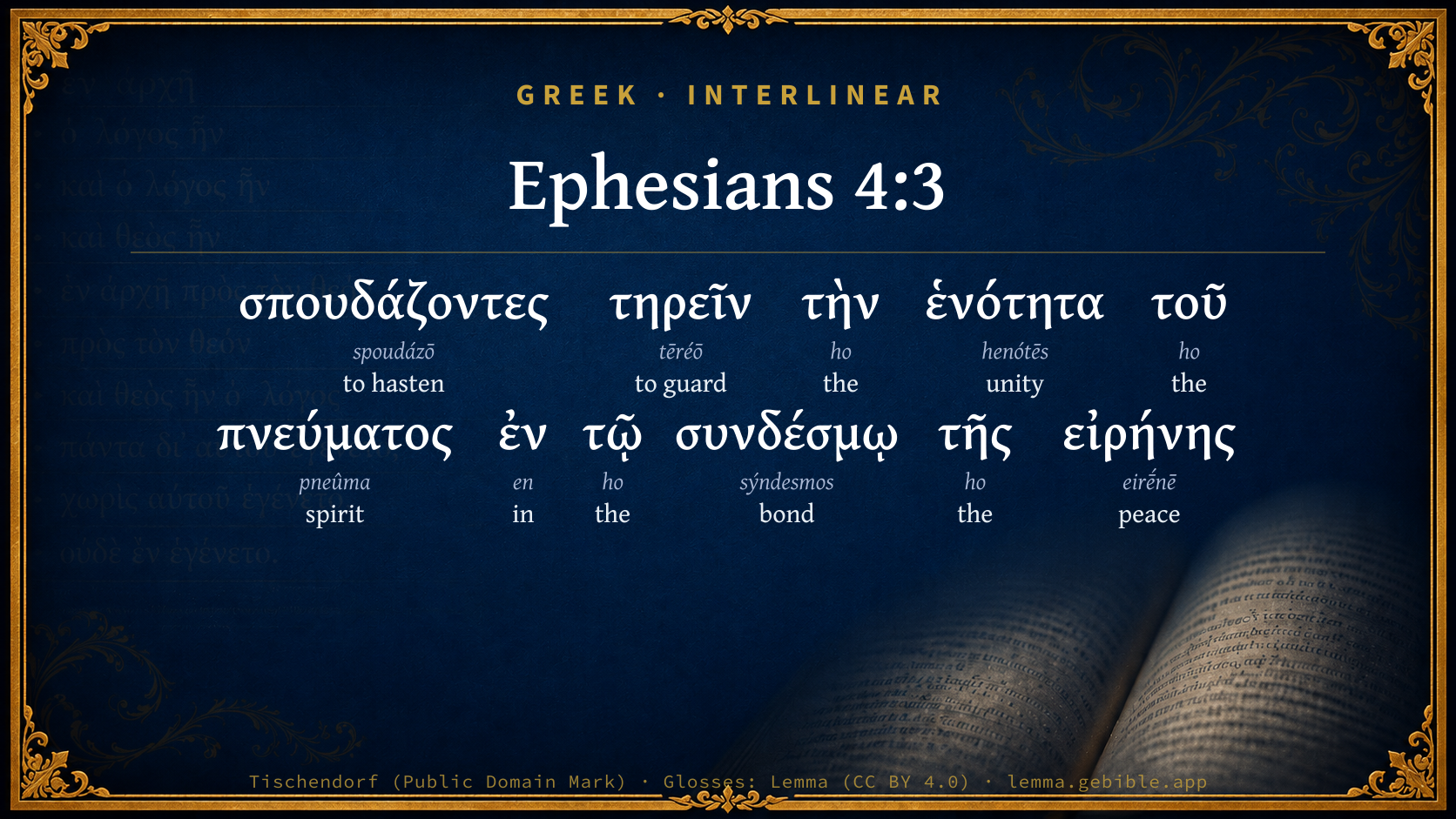
Greek (Tischendorf 8th ed.) Ephesians 4:3 appears in the Greek New Testament. The text above is from the Tischendorf 8th edition. Each word links to its Strong’s number and a concise gloss. Click any word for its full Thayer’s Greek Lexicon entry.
Download image
Cite this verse

Ephesians 4:3 (World English Bible). Public Domain. Lemma interlinear Bible study tool, https://lemma.gebible.app/v/ephesians/4/3.

Show BibTeX & RIS
BibTeX
RIS
English Translation
being eager to keep the unity of the Spirit in the bond of peace.
World English Bible · Public Domain
Highlights
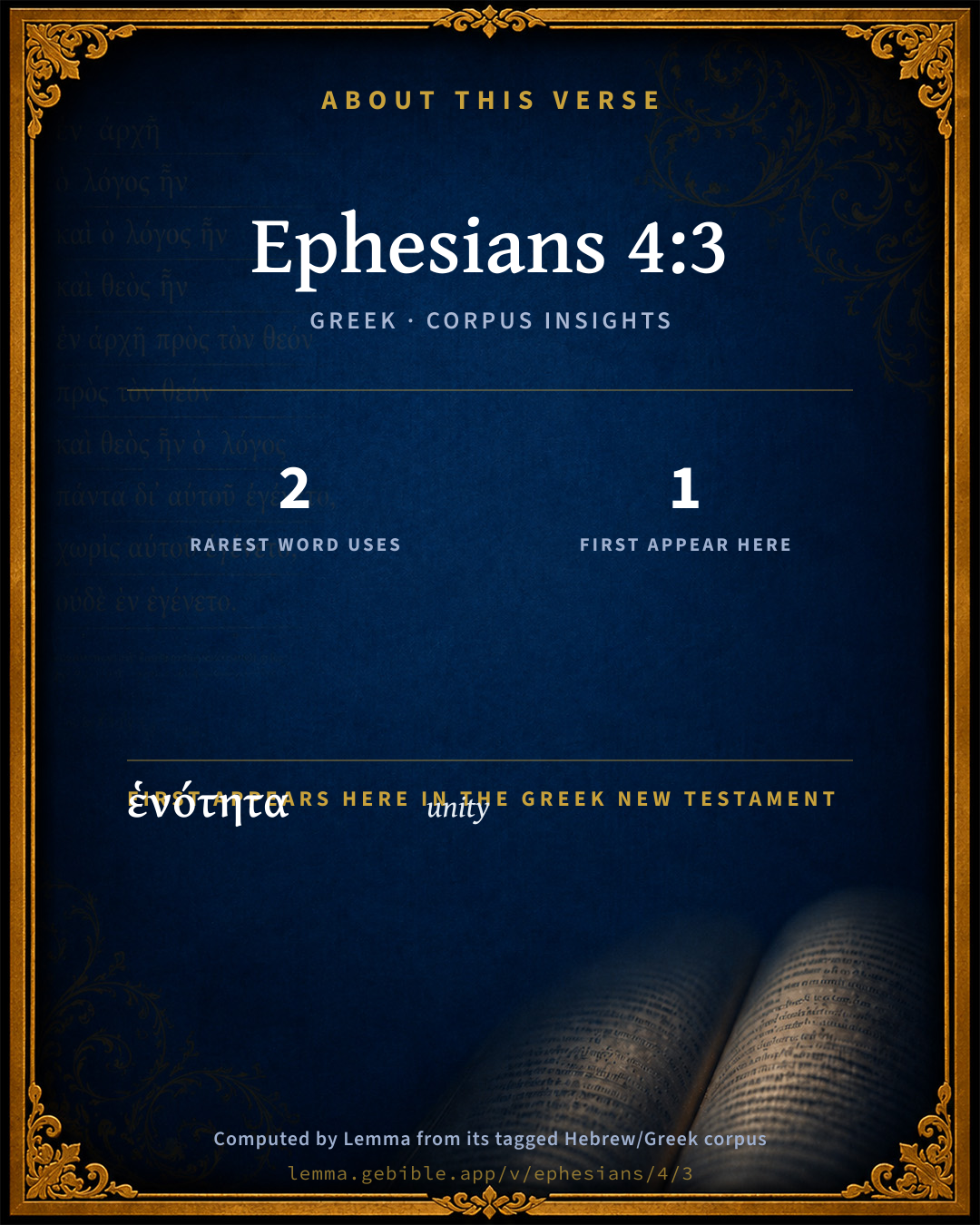
  • 1 first appearance in the Greek New Testament
Full analysis ↓
Download a study sheet

One document with this verse’s original text, its word-by-word gloss line, the meaning frame, cross-references with their text, attributed commentary, and full source and license credits — printable, and it pastes into notes with its structure intact.

This verse Autodidact and up

Study sheet (.html) Plain text (.txt)

A passage Seminary Student

Up to 50 verses in one chapter. A passage sheet keeps up to 6 commentary sources and 12 cross-references per verse, in the order this page ranks them, and says so on the sheet whenever that leaves anything out. Ask for a single verse and you get the Autodidact verse sheet above.

Everything on this page stays free to read, with no account — the sheet is a download of what is already on screen, not access to it.

Want to remove ads? Support Godless Engineer
Compare translations 3

The same verse in 3 English versions, stacked beneath the original-language interlinear above. Click any original word for its lexicon entry.

Each is an independent rendering of the whole verse — the interlinear is not word-aligned to these translations.

Highlighted words mark where these versions differ — a whole-verse word diff, not a word-by-word alignment.

  • World English Bible Public Domain
    being eager to keep the unity of the Spirit in the bond of peace.
  • King James Version Public Domain
    Endeavouring to keep the unity of the Spirit in the bond of peace.
  • unfoldingWord Literal Text CC BY-SA 4.0
    doing your best to keep the unity of the Spirit in the bond of peace.

unfoldingWord Literal Text — © unfoldingWord, licensed CC BY-SA 4.0. Word-aligned USFM3 via Door43 (git.door43.org/unfoldingWord/en_ult).

Versions to compare (up to 4)

3 of 4 selected

Show all 19 translations

Every available English version of this verse, each an independent rendering of the whole verse.

  • World English Bible Public Domain
    being eager to keep the unity of the Spirit in the bond of peace.
  • Berean Standard Bible Public Domain
    and with diligence to preserve the unity of the Spirit through the bond of peace.
  • Majority Standard Bible Public Domain
    and with diligence to preserve the unity of the Spirit through the bond of peace.
  • King James Version Public Domain
    Endeavouring to keep the unity of the Spirit in the bond of peace.
  • American Standard Version (1901) Public Domain
    giving diligence to keep the unity of the Spirit in the bond of peace.
  • Revised Version (1885) Public Domain
    giving diligence to keep the unity of the Spirit in the bond of peace.
  • Geneva Bible (1599) Public Domain
    Endeuouring to keepe the vnitie of the Spirit in the bond of peace.
  • Douay-Rheims (1899) Public Domain
    Careful to keep the unity of the Spirit in the bond of peace.
  • Young's Literal Translation Public Domain
    being diligent to keep the unity of the Spirit in the bond of the peace;
  • Literal Standard Version CC BY-SA 4.0
    being diligent to keep the unity of the Spirit in the bond of peace;
  • Unlocked Literal Bible CC BY-SA 4.0
    Do your best to keep the unity of the Spirit in the bond of peace.
  • unfoldingWord Literal Text CC BY-SA 4.0
    doing your best to keep the unity of the Spirit in the bond of peace.
  • Darby Bible Public Domain
    using diligence to keep the unity of the Spirit in the uniting bond of peace.
  • World Messianic Bible Public Domain
    being eager to keep the unity of the Spirit in the bond of peace.
  • Webster's Bible Public Domain
    Endeavoring to keep the unity of the Spirit in the bond of peace.
  • Free Bible Version CC BY-SA 4.0
    Make every effort to remain one in the Spirit through the peace that binds you together.
  • Bible in Basic English Public Domain
    Taking care to keep the harmony of the Spirit in the yoke of peace.
  • Text-Critical English NT CC BY 4.0
    and being diligent to keep the unity of the Spirit in the bond of peace.
  • Tyndale New Testament (1534) Public Domain
    and that ye be dyliget to kepe the vnitie of the sprete in the bonde of peace

Literal Standard Version (2020), Covenant Press — licensed CC BY-SA 4.0. Text via the HelloAO Bible API (eBible.org). Unlocked Literal Bible (unfoldingWord) — licensed CC BY-SA 4.0. Text via the HelloAO Bible API (eBible.org). unfoldingWord Literal Text — © unfoldingWord, licensed CC BY-SA 4.0. Word-aligned USFM3 via Door43 (git.door43.org/unfoldingWord/en_ult). Free Bible Version, Dr. Jonathan Gallagher — licensed CC BY-SA 4.0. Text via the HelloAO Bible API (eBible.org).

Word by word

More ways to search: Search by grammar → Find every occurrence → Compare this word →

Practice this passage: Drill this verse → Learn its vocabulary →

About this verse

These counts appear in no published source. They are computed here, from the morphology-tagged text and Lemma’s own curated glosses. What Lemma adds →

11
words
8
distinct lemmas
Pauline Epistles
section

Notable vocabulary

The rarest word here is ἑνότητα unity G1775 — appearing just 2 times in the whole Greek New Testament.

First appearance in Scripture

This word makes its first canonical appearance in the Greek New Testament here:

  • ἑνότητα unity G1775

Shared distinctive vocabulary

ἑνότητα unity G1775 occurs in 2 verses of the Greek New Testament. Also found in:

Repetition

A word recurs within this verse:

Cross-references

11

Topical passages linked to Ephesians 4:3 in the Treasury of Scripture Knowledge — connected by theme and wording, ordered by reader-vote popularity; previews shown in the World English Bible.

  • 1 Corinthians 1:10 Now I beg you, brothers, through the name of our Lord, Jesus Christ, that you all speak the same thing and that there be no divisions among you, but that you be perfected together in the same mind and in the same judgment.
  • Colossians 3:13–15 bearing with one another, and forgiving each other, if any man has a complaint against any; even as Christ forgave you, so you also do.
  • 1 Corinthians 12:12–13 For as the body is one, and has many members, and all the members of the body, being many, are one body; so also is Christ.
  • John 13:34 A new commandment I give to you, that you love one another, just like I have loved you; that you also love one another.
  • Romans 14:17–19 for the Kingdom of God is not eating and drinking, but righteousness, peace, and joy in the Holy Spirit.
  • Hebrews 12:14 Follow after peace with all men, and the sanctification without which no man will see the Lord,
  • 2 Corinthians 13:11 Finally, brothers, rejoice. Be perfected, be comforted, be of the same mind, live in peace, and the God of love and peace will be with you.
  • John 17:21–23 that they may all be one; even as you, Father, are in me, and I in you, that they also may be one in us; that the world may believe that you sent me.
  • James 3:17–18 But the wisdom that is from above is first pure, then peaceful, gentle, reasonable, full of mercy and good fruits, without partiality, and without hypocrisy.
  • 1 Thessalonians 5:13 and to respect and honor them in love for their work's sake. Be at peace among yourselves.
  • Ephesians 4:4 There is one body, and one Spirit, even as you also were called in one hope of your calling;

Cross-references courtesy of OpenBible.info (CC BY 4.0).

Commentary

Notes on Ephesians 4:3 from classic Christian and Jewish commentators (each source and its license shown beneath its notes). The classic Christian expositions comment on the surrounding passage and are grouped to its opening verse, so a note may address several verses; the Jewish commentaries on the Tanakh (Rashi and others) are per-verse, so they appear only where the commentator wrote on this verse.

Lemma curates 59 commentaries, every one of them public domain or Creative Commons licensed, each selected and text-cleaned for this edition rather than reprinted as found. About our sources →

The Biblical Illustrator

Joseph S. Exell

Eph_4:3

Endeavouring to keep the unity of the Spirit in the bond of peace.

The unity of the Spirit

By virtue of his having the Spirit, the believer is in union with every other spiritual man, and this is the unity which he is to endeavour to keep.

1. This unity of the Spirit is manifested in love. A husband and wife may be, through providence, cast hundreds of miles from one another, but there is a unity of spirit in them because their hearts are one. We, brethren, are divided many thousands of miles from the saints in Australia, America, and the South Sea, but, loving as brethren, we feel the unity of the Spirit.

2. This unity of the Spirit is caused by a similarity of nature. Find a drop of water glittering in the rainbow, leaping in the cataract, rippling in the rivulet, lying silent in the stagnant pool, or dashing in spray against the vessels side, that water claims kinship with every drop of water the wide world over, because it is the same in its elements; and even so there is a unity of the Spirit which we cannot imitate, which consists in our being begotten again unto a lively hope by the resurrection of Jesus Christ from the dead, bearing in us the Holy Ghost as our daily quickener, and walking in the path of faith in the living God. Here is the unity of the Spirit, a unity of life, nature working itself out in love. This is sustained daily by the Spirit of God. He who makes us one, keeps us one. Every member of my body must have a communion with every other member of my body.

3. The unity of the Spirit will discover itself in prayer.

4. There is also a unity of praise.

5. This unity will soon discover itself in co-working. It was a motto with Bucer, To love all in whom he could see anything of the Lord Jesus. It is said of some men that they appear to have been born upon the mountains of Berber, for they do nothing but cause division; and baptized in the waters of Meribah, for they delight in causing strife. This is not the case with the genuine Christian; he cares only for the truth, for his Master, for the love of souls; and when these things are not imperilled, his own private likes or dislikes never affect him. (C. H. Spurgeon.)

Exhortation to unity

Let us here inquire--

I. Into the state and character of those to whom the advice of the text is given. The persons to whom the advice is given are all members of one body; they are members of Christ and of one another. All inhabited by one Spirit. Called in one hope of their calling. The property, the subjects, the servants of one Lord. Professing and possessing one faith. This God is above them all, superintending and governing them, although infinitely exalted: through them all, and they live and move and exist in Him; and in them all, for they are an habitation of God through the Spirit.

II. What this advice implies.

1. The unity of the Spirit, of which the apostle speaks, it should be observed, is an internal unity, an unity between the spirits of men. It may subsist, therefore, between persons of different nations, educations, conditions, etc.

2. It is an unity of affection--mutual love, viz., desire of, and delight in, each other--mutual sympathy.

3. It is an unity of intention; one and all must have the same end in view, the glory of God in our own salvation, and the salvation of others.

4. It is an unity of resolution to prosecute that end.

5. It is an unity of operation (1Co_3:9), their work in the field.

III. The reasonableness of this advice. Inhabited as they are by one Spirit, which can no more set them at variance with each other, than the soul which resides in the human body can set the members of it against each other. Called from similar misery to a similar state of safety and happiness, in the same way and manner: having one object of hope, and one hope, is it not reasonable they should be united? (Anon.)

The unity of the Spirit

1. Christians should strive for unity in faith and opinion. Lowliness of mind and patience will conduce to this; as pride, self-love, and impatience make men easily dissent in affection and opinion. Satan is constantly trying to stir up strife in the Church.

2. Means to be taken for the attainment of unity.

(1) Abandon a striving spirit.

(2) Renounce vainglory.

(3) Esteem others better than self.

3. It is not enough for us to entertain peace; we must give diligent endeavour to compass and maintain it.

(1) Because the wisdom from above is peaceable.

(2) A contentious nature is bred within us, and must be rooted out.

(3) The devil is always ready to sow discord.

(4) Unity is a comely thing, and a credit to religion.

(5) God takes to Himself the title of the God of peace (Rom_15:33; 1Co_13:11).

4. A peaceable disposition is an excellent means of concord. (Paul Bayne.)

How to get and maintain peace

1 Take heed of giving offence.

2. Avoid taking offence.

3. Guard against beginning any contention.

4. To keep peace, get pure hearts. (Paul Bayne.)

The unity of the Spirit: the bond of peace

I. What is to be kept. The unity of the Spirit--the unity of which the Holy Spirit is the Author: that oneness of believing men in Christ which is the Spirits new creation. It must be an unity corresponding in its nature and character to the nature and character of Him who is its Author and Creator.

1. Look at its outward manifestation.

2. The real seat of this unity is within, in the heart.

II. The unity of the spirit is to be kept.

1. There must be an endeavour to keep it. And the endeavour must be most earnest and most strenuous.

2. There is a bond provided for keeping this unity. The bond of peace. The endeavour, strenuous and sustained as it must be, is not to be the endeavour of violence or excitement. It is no desperate groping and struggling in the dark that is required. The unity of the Spirit is to be sedulously kept. But the keeping of it is to be quiet, calm, peaceful. The bond, the girdle, which is to be the means of keeping it, is peace. (R. S. Candlish, D. D.)

The unity of the Church

I. Observe, in the first place, there is much said in the Word of God on this very subject of the true unity of the children of God (Joh_17:20-23; Rom_14:19; Rom_15:5; 1Co_1:10; 2Co_13:11; Php_3:1-3; Col_3:12-15). But there is an expression in the text, that I would not pass over: the apostle speaks of it us the unity of the Spirit, because He secretly inclines heart to heart in the children of God.

II. But, observe, secondly, some of those high motives that we have. The world thinks that we are full of discrepancies; that our differences are unutterable, and that we have no real unity. But we say that in the midst of it all there is a solid, real, substantial, veritable unity.

1. It is the unity of a flock. Many folds; but one flock.

2. It is the unity of one body. There are many members in that body.

3. It is the unity of a temple.

4. The unity of a family.

III. Observe we now, beloved, the precept given to us in the words of the text--Endeavouring to keep the unity of the Spirit in the bond of peace. And here I would desire to give tender counsel, that in order to bear with infirmities and to avoid all needless separations, all causeless divisions, I must be effectually called and renewed by the Holy Ghost. Observe, further, that the words imply difficulty. Endeavouring. It is a hard thing; it is easy when the love of Christ constrains, but in itself we find abundance of difficulty. How little can I understand my brothers position! How little can I see a secret principle of his spirit! How little can I comprehend the prejudice that works through him; that he has been brought up in from his infancy. Labour for it in all things possible. It is not the surrender of principle; it is not the sacrifice of truth; it is not the giving up of conscience. No, beloved; that is a sort of union the Spirit of God never would sanction. Do not attempt that which is actually impossible. We may endeavour to keep the unity of the Spirit in a way that never can be attained. It is the unity of a flock; various are the grades in that flock. It is the unity of a temple; various are the stones in that temple. It is the unity of a body; various are the members of that body. It is the unity of a family; but all the family do not speak alike, all the family do not think alike. To attempt it, is to attempt that which is unattainable; and we forget that, although these things have their source in our sin and ignorance, yet the eternal God overrules them for good, and brings good, and educes good out of evil. (J. H. Evans, M. A.)

The unity of the Church of Christ

So long as imperfect men are gathered together in a Christian society--men of different types of character sad different powers, and with a special fondness for their own way; men liable to mistake excited feeling for intensity of conviction, and to treat their own opinions with the reverence due to absolute truth--they will require to be admonished to endeavour, etc.

I. The unity of the church. Spiritual--not formal.

1. Unity of life. Bringing forth the fruits of the Spirit; their affections set on things above, etc.

2. Unity of service. Christians have one Lord, towards whom they cherish one faith. He inspires the same loyalty; it is into His service they have been all baptized.

3. Unity of worship. We have not an unknown God; he that hath seen Christ hath seen the Father. We know Him to be righteous in all His works, and holy in all His ways. To worship is to perceive His excellence, and to love Him for it; to be strengthened by communion with Him, calmed by submission to Him.

II. How to preserve the unity of the Spirit.

1. By recognizing it.

2. By cherishing a peaceful mind. (A. Mackennal, D. D.)

The promotion of unity among members of thy same Church

If we are to endeavour to keep the unity of the Spirit in the bond of peace in the same Church, then we must avoid everything that would mar it. Gossip--gossip is a very ready means of separating friends from one another. Let us endeavour to talk of something better than each others characters. Dionysius went down to the Academy to Plato. Plato asked what he came for. Why, said Dionysius, I thought that you, Plato, would be talking against me to your students. Plato made this answer: Dost thou think, Dionysius, we are so destitute of matter to converse upon that we talk of thee? Truly we must be very short of subjects when we begin to talk of one another. It is better far that we magnify Christ than detract from the honour of His members. We must lay aside all envy. Multitudes of good people liked the Reformation, but they said they did not like the idea of its being done by a poor miserable monk, like Martin Luther; and so there are many who like to see good things done, and good works carried on, but do not care to see it done by that upstart young brother, or that poor man, or that woman who has no particular rank or state. As a Church let us shake off envyings; let us all rejoice in Gods light; and as for pride--if any of you have grown vainglorious of late, shake it off. (C. H. Spurgeon.)

Wherein the unity of the Church consists

This unity, whereof the apostle speaks, consists in submission to one single influence or spirit. Wherein consists the unity of the body? Consists it not in this, that there is one life uniting, making all the separate members one? Take away the life, and the members fall to pieces; they are no longer one; decomposition begins, and every element separates, no longer having any principle of cohesion or union with the rest. There is not one of us who, at some time or other, has not been struck with the power there is in a single living influence. Have we never, for instance, felt the power wherewith the orator unites and holds together a thousand men as if they were but one; with flashing eyes and throbbing hearts all attentive to his words, and by the difference of their attitudes, by the variety of expressions of their countenances, testifying to the unity of that single living feeling with which he had inspired them? Whether it be indignation, whether it be compassion, or whether it be enthusiasm, that one living influence made the thousand for the time one. Have we not heard how, even in this century in which we live, the various and conflicting feelings of the people of this country were concentrated into one, when the threat of foreign invasion had fused down and broken the edges of conflict and variance, and from shore to shore was heard one cry of terrible defiance, and the different classes and orders of this manifold and mighty England were as one? Have we not heard how the mighty winds hold together as if one the various atoms of the desert, so that they rush like a living thing across the wilderness? And this, brethren, is the unity of the Church of Christ, the subjection to the one uniting Spirit of its God. (F. W. Robertson, M. A.)

Unity among dissimilarities

Unity, is that which subsists between things not similar and alike, but things dissimilar and unlike. There is no unity in the separate atoms of a sand pit; they are things similar; there is an aggregate or collection of them. Even if they be hardened in a mass they are not one, they do not form a unity; they are simply a mass. There is no unity in a flock of sheep; it is simply a repetition of a number of things similar to each other. If you strike off from a thousand five hundred, or if you strike off nine hundred, there is nothing lest of unity, because there never was unity. A flock of one thousand or a flock of five is just as much a flock as any other number. On the other hand, let us turn to the unity of peace which the apostle speaks of, and we find it is something different; it is made up of dissimilar members, without which dissimilarity there could be no unity. Each is imperfect in itself, each supplying what it has in itself to the deficiencies and wants of the other members. So, if you strike off from this body any one member, if you cut off an arm, or tear out an eye, instantly the unity is destroyed; you have no longer an entire and perfect body, there is nothing but a remnant of the whole, a part, a portion; no unity whatever. This will help us to understand the unity of the Church of Christ. If the ages and the centuries of the Church of Christ, if the different churches whereof it was composed, if the different members of each Church were similar, one in this, that they all held the same views, all spoke the same words, all viewed truth from the same side, they would have no unity; but would simply be an aggregate of atoms, the sand-pit over again. (F. W. Robertson, M. A.)

Advantages of unity

Great is the force of unity, peace, and concord. One man serves to strengthen and stablish another, like many staves bound together in one. Many sticks or staves bound together in one bundle are not easily broken; but sever them and pull them asunder, they are soon broken with little strength. Thus the case in all societies, whether it be in the Church, or commonwealth, or in the private family. (W. Attersol.)

How unity is to be attained

An apparent union may be produced by none thinking at all, as well as by all thinking alike; but such a union, as Leighton observes, is not produced by the active heat of the spirit, but is a confusion rather arising from the want of it; not a fusing together, but a freezing together, as cold congregates all bodies how heterogeneous soever, sticks, stones, and water: but heat makes first a separation of different things, and then unites those that are of the same nature. (H. G. Salter.)

Real unity

1. ll real unity is manifold. Feelings in themselves identical find countless forms of expression; for instance, sorrow is the same feeling throughout the human race; but the Oriental prostrates himself upon the ground, throws dust upon his head, tears his garments, is not ashamed to break out into the most violent lamentations. In the north we rule our grief; suffer not even a quiver to be seen upon the lip or brow, and consider calmness as the appropriate expression of manly grief. Nay, two sisters of different temperament will show their grief diversely; one will love to dwell upon the theme of the qualities of the departed; the other feels it a sacred sorrow, on which the lips are sealed forever. Yet would it not be idle to ask which of them has the truest affection? Are they not both in their own way true? In the East, men take off their sandals in devotion; we exactly reverse the procedure, and uncover the head. The Oriental prostrates himself in the dust before his sovereign; even before his God the Briton only kneels: yet would it not again be idle to ask which is the essential and proper form of reverence? Is not true reverence in all cases modified by the individualities of temperament and education? Should we not say in all these forms worketh one and the same spirit of reverence?

2. All living unity is spiritual, not formal; not sameness but manifoldness. You may have a unity shown in identity of form; but it is a lifeless unity. There is a sameness on the sea beach--that unity which the ocean waves have produced by curling and forcibly destroying the angularities of individual form, so that every stone presents the same monotony of aspect, and you must fracture each again in order to, distinguish whether you hold in your hand a mass of flint or a fragment of basalt. There is no life in unity such as this. But as soon as you arrive at a unity that is living, the form becomes more complex, and you search in vain for uniformity. In the parts it must be found, if found at all, in the sameness of pervading life. The illustration given by the apostle is that of the human body--a higher unity, he says, by being composed of many members, than if every member were but a repetition of a single type. (F. W. Robertson, M. A.)

Spiritual unity

The union for which the Lord Jesus prayed was a union of spiritual men--a union not of mere professors but of His true disciples--a union in the Lord. Any other union is little worth. A union of professors with professors of one dead Church with another dead Church is but a filling of the charnel house, a heaping of the compost pile. A union of dead professors with living saints, this union of life and death is but to pour the green and putrid water of the stagnant pool into the living spring. It is not to graft new branches into the goodly vine, but to bandage on dead boughs that will but deform it. It is not to gather new wheat into the garner, but to blend the wheat and chaff again together. It is not to gather new sheep into the fold, but it is to borrow the shepherds brand and imprint it on the dogs and wolves and call them sheep. The identifying of christened pagans with the peculiar people has done much dishonour to the Redeemer, has deluded many souls, and made it much more difficult for the Church to convince the world. It was not this amalgamation of the Church and the world which the Saviour contemplated when He prayed for His peoples unity. It was a union of spiritual men--a holy unity springing from oneness with Himself. Union with Christ is an indispensable preliminary to union with the Church of Christ. An individual must be joined to Christ before he can be a true member of the Church of Christ. And those individuals and those Churches which are the most closely joined to Christ are the nearest to one another, and will be the first to coalesce in the fulfilment of Christs prayer--May they all be one! (Hamilton.)

Need of unity

Ane stickll never burn! Put more wood on the fire, laddie; ane stickll never burn! my old Scotch grandfather used to say to his boys. Sometimes, when the fire in the heart burns low, and love to the Saviour grows faint, it would grow warm and bright again if it could only touch another stick. Where two or three are gathered together the heart burns; love kindles to a fervent heat. Ane stickll never burn as a great, generous fire will be sure to.

Si collidimur, frangimur

If we clash, we are broken, according to the old fable of the two earthen pots swimming in the sea. The daughter of dissension is dissolution, said Nazianzen; and every subdivision in point of religion is a strong weapon in the hand of the contrary party, as he (the historian), upon the Council of Trent, wisely observed. Castor and Pollux, if they appear not together it presageth a storm. (J. Trapp.)

Unity aids work

By union the pyramids of Egypt, the gates of Thebes, and the columns of the Parthenon were reared, and oceans crossed, and valleys filled up. (Dr. Cumming.)

Strength of union

There was a small band of three hundred cavalry in the Theban army, who proved a great terror to any enemy with whom they were called to fight. They were companions, who had bound themselves together by a vow of perpetual friendship, determined to stand together until the last drop of their blood was spilled upon the ground. They were called The Sacred Battalion, or the Band of Lovers, and they were bound alike by affection for the State and fidelity for each other, and thus achieved marvels, some of which seem almost fabulous. What a name for a militant Church, The Sacred Battalion! It is when she is thus animated by one spirit that she is victorious.

Love of Christian unity

The attachment of the Rev. John Elliot, usually called The Apostle to the Indians, to peace and union among Christians was exceedingly great. When he heard ministers complain that some in their congregations were too difficult for them, the substance of his advice would be, Brother, compass them. Brother, learn the meaning of those three little words--bear, forbear, forgive. His love of peace, indeed, almost led him to sacrifice right itself.

Unity is strength

Separate the atoms which make the hammer and each would fall on the stone as a snow flake; but welded into one, and wielded by the firm arm of the quarryman, it will break the massive rocks asunder. Divide the waters of Niagara into distinct and individual drops, and they would be no mere than the falling rain, but in their united body they would quench the fires of Vesuvius, and have some to spare for the volcanoes of other mountains. (T. Guthrie, D. D.)

False unity

Divisions are bad things. Do not fancy that I have any sympathy with those who, confounding charity with indifference, regard matters of religion as not worth disputing about. Such a state of death is still worse than war. Give me the roaring storm rather than the peace of the grave. Division is better than such union as the frost produces, when with its cold and icy fingers it binds up into one dead, congealed, heterogeneous mass, stones and straws, pearls and pebbles, gold and silver, iron and clay, substances that have nothing in common. Yet divisions are bad things. They give birth to bad passions. They cause Ephraim to envy Judah, and Judah to vex Ephraim. Therefore, what we ought to aim at is to heal them, and when we cannot heal them, to soften their asperities. (T. Guthrie, D. D.)

Unity in the bond of peace

Bind not thine hands, but bind thy heart and mind. Bind thyself to thy brother. They bear all things lightly who are bound together by love. Bind thyself to him, and him to thee. For to this end was the Spirit given, that He might unite those who are separated by race and diversity of habits: old and young, rich and poor, child, youth, and man, male and female, and every soul become in a manner one, and more entirely so than if they were of one body. For this spiritual relation is far higher than natural relation, and the perfectness of the union more entire; because the conjunction of the soul, being simple and accordant, is more perfect. And how is this unity preserved? In the bond of peace. It is not possible that unity should exist in enmity and discord. St. Paul would have us linked and tied one to another; not simply that we be at peace, not simply that we love one another, but that in all there should be but one soul. A glorious bond is this: with this bond let us bind ourselves together, alike to one another and to God. (Chrysostom.)

Need of harmony

The following incident in the life of Lord Nelson contains a lesson for Christians. On the day before the battle of Trafalgar, Nelson took Collingwood and Rotherham, who were at variance, to a spot where they could see the fleet opposed to them. Yonder, said the Admiral, are your enemies; shake hands and be friends like good Englishmen.

The fulness of the unity

Were all Churches and church members concerned to keep the unity of His Spirit, a bond of peace, strong as the everlasting firmament, would encircle them. But how is it possible that we should worthily conceive of the riches comprehended in the unity of the Spirit? We have seen a company of a thousand musicians and singers playing and singing one tune in harmony. The persons were distinct, the instruments distinct, and the voices very distinct, and yet all were a composed unity. An army of a hundred thousand men, in movement and operation, may be a perfect unity. But in order to form an idea of the unity of the Spirit, we must imagine that the whole universe, visible and invisible, with all its distinctions, elements, powers, and virtues were dissolved in one sea of being. For all have sprung from such a sea, and, in the Spirit, are such a sea of living, blissful unity. Even in the sphere of striving, corrupt nature, we see enough to make us wonder at the variety which the Spirit carries in the bosom of His unity. For all the variety, in earth and heaven, is wrought by One and the self-same Spirit. The new growths, the joy and the glory, which constitute our summer, are so much of the fulness of the Spirit opened to our view. The creatures in different elements and latitudes are so distinct that they have no communion with each other; but they are all One in the Spirit which animates them. The sea and its contents, the innumerable tribes of the air, and all the species found on our hills and in our plains and valleys, are but very partial manifestations of the wealth and variety of the Spirit. The all things of the Father, and all things of Creation, and the all things in Christs finished work are included in the Spirits unity. Pause and contemplate the river of Gods pleasures, the fulness of joy which the perfect know above. Whatever our understandings may hold as truth, is but a mere division of this unity. The unity of the Spirit is the law of the Spirit of Life in Christ Jesus, and can only be apprehended by the affections. (J. Pulsford.)

The Biblical Illustrator, edited by Joseph S. Exell (c. 1880s–1900s) — public domain. Text from a community e-Sword module.

Tyndale Open Study Notes

Tyndale Open Resources

4:3 binding yourselves together with peace: Paul’s emphasis on God’s acceptance of Gentiles as well as Jews (2:11–3:6) is now applied ethically: Jews and Gentiles are to accept one another in the church (see Col 3:14-15).

Tyndale Open Study Notes — © Tyndale Open Resources, licensed CC BY-SA 4.0. Text via the HelloAO Bible API.

Bengel's Gnomon

Johann Albrecht Bengel

Eph 4:3. Τηρεῖν, to keep) Even where there is no division, there is need of admonitions.—τὴν ἑνότητα, the unity) So far as we are concerned, for the Holy Spirit in Himself remains one, Eph 4:4.—ἐν τῷ συνδέσμῳ, in the bond) The bond, by which peace is maintained, is love itself; Col 3:14-15.

Bengel's Gnomon of the New Testament — English translation (T&T Clark, Edinburgh, 1860) — public domain. Text from a community e-Sword module.

Meyer's Critical & Exegetical Commentary

Heinrich August Wilhelm Meyer

Eph_4:3. Parallel of ἀνεχόμενοι κ.τ.λ., which is characterized as respects the effort by which it must be upheld.

τὴν ἑνότητα τοῦ πνεύματος] The πνεῦμα is not the human spirit, so that in general animi studiorumque consensus is meant (Ambrosiaster, Anselm, Erasmus, Calvin, Piscator, Estius, Wolf, Koppe, and many, including Meier, Baumgarten-Crusius, and Rückert, according to whom Paul did not write τοῦ νοός, because he derives the unity of the spirit from the Divine Spirit), but, as is shown from Eph_4:4, and is in itself clear from the exhortation to the Christian life (Eph_4:1), the Holy Spirit, instead of which we have not, with de Wette and Schenkel, to understand the Christian spirit of the community; the N.T. knows not this modern notion, but knows only the Holy Spirit of God, as that which rules in the church (Eph_2:22), and upholds and developes its specific life, so that the latter has precisely in the κοινωνία τοῦ πνεύματος (Php_2:1; 2Co_13:13) its common source and support. Rightly already Chrysostom (τὸ πνεῦμα τοὺς γένει καὶ τρόποις διαφόροις διεστηκότας ἑνοῖ) and his successors, Beza, Calovius, Bengel, and others, including Harless, Winzer, Bleek, and Ch. F. Fritzsche, Nova opp. acad. p. 244: the unity, which the Spirit produces. Comp. Php_1:27; 1Co_12:13; Joh_17:21. And this unity is the identity of faith, of love, of sentiment, of hope, etc., in the different subjects who are moved by the Spirit.

ἐν τῷ συνδέσμῳ τῆς εἰρήνης] is attached by Lachmann to what follows, whereby the parallelism with the preceding participial clause is destroyed. And after the definition by ἐν τῷ συνδέσμῳ τῆς εἰρ. being prefixed, several of the following elements of unity would not be appropriate, since even without the bond of peace there is one Lord, one baptism, one God and Father.

ἐν is ordinarily taken as instrumental: through the bond of peace. In opposition to the parallelism with ἐν ἀγάπῃ; and through the unity of the Spirit the bond of peace is preserved, not the converse.[199] Hence: in the bond of peace, by which is denoted the ethical relation, in which they are to preserve the unity of the Spirit, namely, while peace one towards another must be the bond, which is to envelope them. τῆς εἰρήνης, accordingly, is genitive of apposition. Comp. σύνδεσμος εὐνοίας καὶ φιλίας, Plut. Numbers 6; Act_8:23; Isa_58:6. Others: vinculum, quo pax retinetur (Bengel; so Theophylact, Calovius, and others, including Rückert, Meier, Harless, Winzer), and this is held to be love. Appeal is made to Col_3:14, and to the parallel with ἐν ἀγάπῃ. But, in Col. l.c., love in fact is expressly named, and designated as σύνδεσμος τῆς τελείοτητος; while justice is done to the parallel with ἐν ἀγάπῃ by our interpretation also, and it was at any rate most natural for the reader to understand under the bond of peace peace itself, conceived of as a bond. Expositors would not have sought for another explanation, had they not taken ἐν as instrumental, in which case the difficulty obtruded itself, that the unity of the Spirit is not preserved by means of peace, but peace by means of the unity of the Spirit.

That, moreover, no inference may be drawn from Eph_4:3 as to divisions prevailing in the church, Bengel has already rightly observed: etiam ubi nulla fissura est, monitis opus est. And particularly was such exhortation natural for the apostle, even in the absence of special occasion, considering the many saddening experiences which he had met with elsewhere on this point!

[199] What de Wette observes in opposition to this viewthat the peacefulness, to which the readers are exhorted, is to preserve the unity of the Spirit by the fact that it holds all enveloped with the bond of peaceis not sufficient; since this peacefulness, which encircles all with the bond of peace, at any rate presupposes the unity of the Spirit. Where there is dispeace, this unity is already wanting.

Meyer — Critical and Exegetical Commentary on the New Testament — English translation by Peter Christie, edited by Frederick Crombie (T&T Clark, 1880) — public domain. Text from a community e-Sword module.

Expositor's Greek Testament

ed. W. Robertson Nicoll

Eph 4:3 . σπουδάζοντες τηρεῖν τὴν ἑνότητα τοῦ πνεύματος : giving diligence to keep the unity of the Spirit . Further description of the mutual forbearance in respect of the inward effort required, but introducing also the larger, fundamental idea of unity . σπουδάζω , which conveys the idea of exertion , is better rendered “giving diligence” (RV) or “earnestly striving” (Alf.), than “endeavouring” (AV). τηρεῖν = keep , in the sense of maintaining with watchful care; suggesting also that what is to be kept is something already in our possession. τοῦ Πνεύματος is the gen. of originating cause , = the unity which the Spirit produces or works, and here the oneness in feeling, interest and purpose which is appropriate to the oneness in doctrine and privilege whereof the readers are immediately reminded. Commentators, even of the rank of Calvin, have interpreted the πνεύματος here as the human spirit , the Christian spirit of concord; while others (De Wette, etc.) have taken it to denote the spirit of the Christian community. But the ἓν Πνεῦμα of the following verse, the general NT doctrine of the Spirit of God as operating in the believer and in the Church ( cf. Eph 2:22 ), and the analogy of such passages as 1Co 12:13 , point clearly to the Holy Spirit. ἐν τῷ συνδέσμῳ τῆς εἰρήνης : in the bond of peace . This is not to be attached to the next verse (Lach.), a connection which would again disturb the symmetry of the participial sentences and rob some of the statements which follow of their appropriateness. It defines the way in which the unity is to be kept. The ἐν is not the instrumental ἐν , = “by means of the bond of peace”; but, as in ἐν ἀγάπῃ , the local ἐν or that of relation specifying the sphere (Ell.), or the ethical relation (Mey.) in which the unity is to be maintained. The εἰρήνης might be the gen. obj. , = “the bond by which peace is kept,” to wit, love (Beng., etc.). But it is best understood as the gen. of apposition (Mey.), or identity (Ell.), = “the bond which is peace”. The unity, therefore, which is wrought among these Ephesians by the Spirit of God will be theirs in so far as they make peace the relation which they maintain one to another, or the bond in which they walk together. In Col 3:14 love is the “bond of perfectness”; but the construction and the idea are different here.

The Expositor's Greek Testament, edited by W. Robertson Nicoll (1897–1910) — public domain. Text from a community e-Sword module.

Geneva Bible (1599)

Geneva Bible translators

Thirdly, he requireth perfect agreement, but yet such as is knit with the band of the holy Ghost.

Geneva Bible (1599) marginal notes — public domain. Text via Bolls.life.

Adam Clarke's Commentary

Verse 3. Endeavouring to keep the unity of the Spirit in the bond of peace.] There can be no doubt that the Church at Ephesus was composed partly of converted Jews, as well as Gentiles. Now, from the different manner in which they had been brought up, there might be frequent causes of altercation. Indeed, the Jews, though converted, might be envious that the Gentiles were admitted to the same glorious privileges with themselves, without being initiated into them by bearing the yoke and burden of the Mosaic law. The apostle guards them against this, and shows them that they should intensely labour (for so the word σπουδαζειν implies) to promote and preserve peace and unity. By the unity of the Spirit we are to understand, not only a spiritual unity, but also a unity of sentiments, desires, and affections, such as is worthy of and springs from the Spirit of God. By the bond of peace we are to understand a peace or union, where the interests of all parties are concentrated, cemented, and sealed; the Spirit of God being the seal upon this knot.

Adam Clarke's Commentary on the Bible (1810–1826) — public domain. Text from a community e-Sword/MySword module.

John Calvin's Commentaries

3. Endeavoring to keep the unity of the Spirit. With good reason does he recommend forbearance, as tending to promote the unity of the Spirit. Innumerable offenses arise daily, which might produce quarrels, particularly when we consider the extreme bitterness of man’s natural temper. Some consider the unity of the Spirit to mean that spiritual unity which is produced in us by the Spirit of God. There can be no doubt that He alone makes us “of one accord, of one mind,” (Philippians 2:2,) and thus makes us one; but I think it more natural to understand the words as denoting harmony of views. This unity, he tells us, is maintained by the bond of peace; for disputes frequently give rise to hatred and resentment. We must live at peace, if we would wish that brotherly kindness should be permanent amongst us.

John Calvin's Commentaries (1540-1563) — public domain. Text from the Calvin Translation Society English edition (1840s-50s) via the Christian Classics Ethereal Library (ccel.org). Calvin's coverage is partial (roughly two-thirds of the Bible); uncommented books and verses are honest gaps, never fabricated. The 19th-century editor's footnotes and remarks are omitted so the notes are faithfully Calvin's own voice.

Ellicott's Commentary for English Readers

(3) Eph_4:12-16 return from diversity of functions to singleness of object—viz., the perfecting individual souls in the likeness of Christ, and so building up of the whole Church in unity with Him.

A Bible Commentary for English Readers, edited by Charles John Ellicott (1878–1897) — public domain. Text from a community e-Sword module.

The Cambridge Bible for Schools and Colleges

gen. ed. J. J. S. Perowne

3. endeavouring] R. V., better, giving diligence. The A. V., to a modern reader, suggests (as the Gr. does not) a certain imperfection and precariousness of result.

the unity of the Spirit] The sacred Oneness effected and maintained by the One Holy Spirit who had, by uniting them to Christ, united them to each other. This Oneness has many aspects. The aspect here is that of realized community of feeling and purpose, based on the fact of community of regenerated position and nature in Christ.

in the bond of peace] Grammatically, this may mean either “in peace, as the bond”; or “in that which secures peace.” Bengel prefers the latter; “the bond, with which peace is bound, is even love.” But we have recently (ch. 2) had Christ Himself presented as the “peace” of His people one with another; and is not the same thought present here? To realize their connexion with Him as such was the way to maintain the sense and exercise of spiritual solidarity.

The Cambridge Bible for Schools and Colleges (gen. ed. J. J. S. Perowne; Cambridge University Press, 1878–1918) — public domain. Text from a community e-Sword module.

John Gill's Exposition

Endeavouring to keep the unity of the Spirit,.... That is, a spiritual union: there is an union between God and his people, and between Christ and his members, and between saints and saints, and the bond of each union is love; and that it is which knits and cements them together; and it is the last of these which is here intended: the saints are united under one head, and are members of one and the same body, and should be of the same mind and judgment, and of one accord, heart, and affection: and this may be called "the unity of the Spirit"; because it is an union of spirits, of the spirits or souls of men; and that in spiritual affairs, in the spiritual exercises of religion; and it is effected by the Spirit of God, by whom they are baptized into one body. Now to endeavour or study to keep and preserve this, supposes that this union does already exist; that it is very valuable, as making much for the glory of God, the mutual comfort and delight of saints, and is worth taking some pains about; and that it is very difficult to secure, there being so many things which frequently arise, and break in upon it, through the devices of Satan, and the corruptions of men's hearts: but though it is difficult, and may sometimes seem to be impossible, yet it becomes the saints to be diligent in the use of means to keep it up, and continue it; and which they may be said to endeavour after, when they abide with one another, and do not forsake each other upon every occasion; when they perform all offices of love to one another, and stir up each other to the like: and the way and manner in which this is to be kept, is

in the bond of peace: the Arabic version reads, "by the bond of love and peace": by maintaining peace among themselves, and seeking those things which tend to, and make for peace, and spiritual edification; and which is called a bond, in allusion to the Greek word used, which comes from one that signifies to knit, join, and bind together, and because it is of a knitting and uniting nature. Now so to act is to walk worthy of calling grace, or agreeably to it: peace is what the saints are called unto in the effectual calling: and what is suitable to God, who is the God of peace; and to Christ, who is the Prince of peace; and to the Holy Spirit, whose fruit is peace; and to the Gospel, which is the Gospel of peace; and to the character which the saints bear, which is that of sons of peace.

John Gill's Exposition of the Whole Bible (1746–1763) — public domain (CC PDM 1.0). Text via the HelloAO Bible API.

Trapp's Complete Commentary

John Trapp

3 Endeavouring to keep the unity of the Spirit in the bond of peace.

Ver. 3. The unity of the Spirit] That is, unanimity; this keeps all together which else will shatter and fall asunder. The daughter of dissension is dissolution, saith Nazianzen.

Endeavouring] σπουδαζοντες, Or using all possible carefulness: this imports, 1. The necessity; 2. Difficulty of the duty. Satan will endeavour, by making division, to get dominion.

John Trapp, A Commentary or Exposition upon All the Books of the Old and New Testament (1647–1656) — public domain. Text from a community e-Sword module.

Albert Barnes' Notes on the Bible

The unity of the Spirit - A united spirit, or oneness of spirit. This does not refer to the fact that there is one Holy Spirit; but it refers to unity of affection, of confidence, of love. It means that Christians should be united in temper and affection, and not be split up into factions and parties. It may be implied here, as is undoubtedly true, that such a unity would be produced only by the Holy Spirit; and that, as there was but one Spirit which had acted on their hearts to renew them, they ought to evince the same feelings and views. There was occasion among the Ephesians for this exhortation; for they were composed of Jews and Gentiles, and there might be danger of divisions and strifes, as there had been in other churches. There is “always” occasion for such an exhortation; for:

(1) “unity” of feeling is eminently desirable to honor the gospel (see the notes on Joh 17:21); and,

(2) There is always danger of discord where people are brought together in one society. There are so many different tastes and habits; there is such a variety of intellect and feeling; the modes of education have been so various, and the temperament may be so different, that there is constant danger of division. Hence, the subject is so often dwelt on in the Scriptures (see the notes on 1 Cor. 2ff), and hence, there is so much need of caution and of care in the churches.

In the bond of peace - This was to be by the cultivation of that peaceful temper which binds all together. The American Indians usually spoke of peace as a “chain of friendship” which was to be kept bright, The meaning here is, that they should be bound or united together in the sentiments and affections of peace. It is not mere “external” unity; it is not a mere unity of creed; it is not a mere unity in the forms of public worship; it is such as the Holy Spirit produces in the hearts of Christians, when it fills them all with the same love, and joy, and peace in believing. The following verses contain the reasons for this.

Albert Barnes' Notes on the Bible (1834–1885) — public domain. Text from a community e-Sword/MySword module.

Matthew Poole's English Annotations

The unity of the Spirit; either unity of mind, or spiritual unity, as being wrought by the Spirit, and then he means that unity he spoke of, Eph 2:14-16, and Eph 3:6, whereby is intended the mystical body of Christ.

In the bond of peace; i.e. in peace as the bond which keeps the members or parts of the church together, which by dissensions are dissipated and scattered. The first step to this unity is humility, for where that is not, there will be no meekness nor forbearance, without which unity cannot be maintained.

Matthew Poole's English Annotations on the Holy Bible (1683–1685) — public domain. Text from a community e-Sword/MySword module.

Whedon's Commentary on the Bible

Daniel D. Whedon

3. Endeavouring—Zealously aiming.

Unity of the Spirit—That unity of love which the Spirit inspires and creates. Bond, consisting of peace. Peace is the very girdle and tie which binds the bundle.

Daniel D. Whedon (gen. ed.), Commentary on the Old and New Testaments (1874–1909) — public domain. Text from a community e-Sword module.

The Pulpit Commentary

Striving to keep the unity of the Spirit. Spoudazontev is stronger than the A.V "endeavoring," and denotes an object to be carefully and earnestly watched for and promoted. "The unity of the Spirit" is equivalent to the unity of which the Spirit is the Author. In all in whom he works savingly, the Spirit produces a certain oneness in faith, in repentance, in knowledge, in their views of sin, grace, Christ, the world, etc. This oneness exists, and cannot but exist, even when Christians are not careful of it, but the manifestation of it is lost; it seems to the world as if there were no such oneness. "Many men, many minds," says the world, when believers differ much and contend much, and are at no pains to preserve and manifest the unity wrought by the Spirit. It is due to the Spirit, as well as to the interests of the kingdom of God, that the unity of the Spirit be maintained in the bond of peace. The genitive, eijrhuhv, is commonly held to be that of apposition, the bond which consists of peace a peace-loving spirit, a spirit laying more stress on the points in whichChristians agree than those in which they differ. Those who are combative, censorious, careless of peace, do not walk worthy of their vocation.

The unity of the Spirit and the mode of its keeping.

to keep the unity of the Spirit in the bond of peace.

I CONSIDER THE NATURE OF THIS UNITY.

1. It is not the unity of the body, the Church. That is an immutable unity which man cannot keep. God alone keeps it. Neither are we commanded to make the unity of the Spirit, but simply to keep it for it exists, in a sense, independently of man"s fidelity; but in the degree in which it is kept in the bond of peace, it will eventually lead to visible oneness.

2. Much less is it a unity of external organization. That unity existed already at Ephesus. It is rather a unity in view of internal differences, which must have existed at Ephesus, as in other Churches which had a mixed membership of Jews and Gentiles. Christ did undoubtedly make both one on the cross, but the apostles allowed a considerable diversity of order and usage to exist in the Churches, according to the dominance of the Jewish or the Gentile element in them. There were Churches that followed the rule of Moses the apostles themselves holding by the ceremonial law till the end of their lives. (Act_21:20-26) And there were Churches that did not observe days nor follow Jewish usage, but took a course authorized by apostolic command itself. If the differences that existed in the days of the apostles did not destroy the unity of the body, it is difficult to see how similar differences in order and worship can destroy it now.

3. The unity of the Spirit is that unity of which the Spirit is the Author. Its indwelling is the principle of unity in the body of Christ. Man, therefore, cannot make it, nor can he destroy it, though he can thwart or disturb its manifestations. The use of the word "endeavoring" implies that it may be kept with a greater or lesser degree of fidelity.

II CONSIDER HOW THIS UNITY IS TO BE PRESERVED, "In the bond of peace." That is, the bond which is peace, springing out of humility, meekness, and forbearance. Just as pride, arrogance, and contention are separating elements, the opposite dispositions are conducive to unity. The peace which is the element of Christian society is that to which we are called in one body; for we are called by the God of peace, redeemed by Christ who is our Peace, sanctified by the Spirit whose fruit is peace, and edified by the gospel of peace, that we may walk as sons of peace. Thus the unity is preserved and manifested by peace, as it is marred or lost sight of amidst conflicts and jars. The apostolic injunction is very inconsistent with the Darbyite principle that the unity of the Spirit is to be preserved by separation from evil, theological, ecclesiastical, or moral. It is strange that the apostle never hints at such a thing as separation, but speaks only of such graces as "lowliness, meekness, with long-suffering," which are but little exemplified in many of the separations brought about by such a principle. The Darbyite principle is not a bond of peace. It multiplies separations and divides the saints of God. There is uniting power in a common belief or in a common affection, but there is none in mere separation from evil. The common rejection of Arianism can never become a center of union for Protestants and Roman Catholics, because they are still so fundamentally apart in the whole spirit of their theology. The unity of the Spirit which we are enjoined to keep is, therefore, a unity compatible with minor differences, and ought to be the grand means of throwing the unity of the body into more glorious distinctness before the world. T.C.

Vers. 3-6.

The unities of Christianity a reason for union amongst Christians.

to keep the unity of the Spirit in the bond of peace. There is one body, and one Spirit, even as ye are called in one hope of your calling; one Lord, one faith, one baptism, one God and Father of all, who is above all, and through all, and in you all." These various unities in Christianity are here specified by the apostle in order to enforce the importance and obligation of a loving concord amongst all true Christians. By noticing these unities with a little closer attention we shall see how they formed in the apostle"s mind an argument for a loving union amongst all the disciples of Christ.

I All Christians are members of ONE SPIRITUAL ORGANIZATION. "One body." Though they are very numerous and ever increasing, though they differ widely in many morally unfundamental points, and live in different lands and different worlds, still they are parts of one great whole. The tree, though it has a thousand branches all varying in size and shape and hue, is an organic whole. This unity, though not visible, really exists. To be a Christian is to be a branch of the one tree, a stone in the one building, a member of the one body. Now, this fact is certainly a strong reason for the cherishing amongst all of brotherly love and hearty fellowship. "That there should be no schism in the body; but that the members should have the same care one for another. And whether one member suffer, all the members suffer with it; or one member be honored, all the members rejoice with it.

II All Christians are animated by ONE GREAT SPIRIT. "One Spirit." What the body is to the human soul, this great organization, this universal Church, is to the Spirit of the living God.

1. Servant. As every member of the body is the servant of the soul, every genuine Christian is the servant of the Spirit, obeys his dictates in everything.

2. Symbol. As the body reveals and expresses the soul by its looks, words, and operations, so the true Church reveals the Divine Spirit; reveals its quickening, redeeming, elevating, sanctifying influence.

3. Residence. As the body is the residence of the soul, even so the Church is the temple for the Holy Ghost to dwell in. If there is this one Spirit running through all, guiding, animating, overruling all, should there not be through all a mutual, loving sympathy and interest?

III All Christians have ONE GLORIOUS HEAVEN. "One hope." What is the object of a true Christian"s hope? Not happiness. He whose grand object in life is his own happiness is under the influence of that selfishness which is the essence of sin and the devil of the soul. That spirit in Churches which cries, "Oh that I had the wings of a dove! then would I fly away and be at rest," is discontented selfishness, nothing more. Alas! that there should be churches, chapels, and pulpits in England ministering to an insatiable avarice that considers this beautiful world not good enough for its home! But if the object of a true Christian"s hope is not happiness, what then? Moral goodness. Goodness as exemplified in the life of Jesus. To become like Christ, to be partakers of the Divine nature, to be holy even as God is holy, this is the great object of a true Christian"s hope. And herein is heaven and nowhere else. To be happy is to be good, to be good is to be like God, and this is the grand object of genuine Christian hope. "Then shall I be satisfied when I awake up in thine own image." Mural goodness is the only true Paradise of souls.

IV All Christians have ONE SOVEREIGN MASTER. "One Lord." Who is this one Lord? By the general consent of acknowledged expositors, the one Lord Jesus Christ. "One is your Master, even Christ." There are men in Christendom who assume titles indicating authority over human souls. We have the Pope of Rome, the lord bishop, and the "Primate of all England." Terribly sad it is that in the name of him who had nowhere to lay his head, and who taught that the least should be greatest in his kingdom, there should be found men either so dull or daring as to assume such titles as these. Call no man "master," said this "one Lord." He is the Head of the Church which is his body, the only Head. Is not this also a potent reason for loving concord among Christians? They have to draw their doctrines from one Teacher, they have to learn their duty from one Master, they have to fashion their character after one Model, to depend for reconciliation to God upon one Mediator.

V All Christians have ONE SUPREME CREED. "One faith." This means, as we have seen, one Object of faith. What is the one creed? Theological propositions put forth as articles of belief? If so, there are many faiths faiths almost as numerous as there are Christian professors. No two men can perhaps believe the same thing in exactly the same way; the same proposition shapes itself differently to different souls. The New Testament teaches with unmistakable explicitness that the true creed of a Christian is not a propositional manifesto, but a personal life the life of Christ. In more than thirty passages of one Gospel, the Gospel of St. John, we find with reference to Christ the expressions, "trusting to me," "trusting to him," or "trusting to the Son." Take two or three as specimens. "This is the work of God, that ye believe on him whom he hath sent." Again, "He that believeth on me hath everlasting life." Again, "He that believeth on him shall not be damned." Again, "He that believeth on me, the works that I do," etc. "Do this in remembrance of me." Christ is the one Creed. He is, in truth, the Bible. See how this one creed argues the importance of loving union amongst Christians. If our creed is a series of propositions we shall be divided, but if our creed is the personal life of One all-holy, all-loving, all-good, we shall be united. If all the members of all the Churches believed with a living faith in the one personal Christ, there would be a loving concord of souls.

VI All Christians have ONE SPIRITUAL CLEANSING. "One baptism." The primary meaning of "baptism" is cleansing. "Baptismov is rendered" washing in several places (Mar_7:4, 8; Heb_9:10) There are two kinds of baptisms or cleansings mentioned in the New Testament the material and the spiritual, that of water and that of fire. The latter, namely, the fiery baptism of the Spirit, is the great thing. This undoubtedly is the one baptism, the one cleansing.

1. This is the one essential cleansing. Without this, though we were baptized in all the rivers of the world, we are not members of that one body of which Christ is the Head. Millions have entered heaven without water baptism, but not one without the spiritual.

2. This is the one Divine cleansing. It is the Spirit"s work. This is the "washing of regeneration" and the renewing of the Holy Ghost. Is not this one essential, Divine cleansing another good argument for unity of love in all Christians?

VII All Christians have ONE ADORABLE GOD. "One God and Father of all, who is above all, and through all, and in you all.

1. There is but one God. This fact is supported by the structure and order of nature; stands in direct antagonism to atheism, fetichism, polytheism, and pantheism; and is accepted as a fundamental truth in all evangelical Churches throughout the world. The glorious fact reveals the greatness of the Creator, the definiteness of moral obligations, the fitness of religion for the constitution of man, and the universal brotherhood of souls.

2. This one God is universal Father. "Father of all." "Of all and through all." All is not neuter: pantwn." It is true that God is the Author of all nature, is over all nature, and lives through all nature; but the apostle"s reference here is undoubtedly to intelligent existences, and it may be that he intends only the members of the true Church. All the members of the true Church recognize him as the Father of all, over all, through all, and in all.

CONCLUSION. Here, then, in the unities of Christianity are the bonds of true union amongst men. Notwithstanding all the discords and conflicts that rage and revel through the world, there lies deep down in the heart of humanity an ineradicable desire for unity. The greatest events that have marked and helped the progress of the human race are the outcomes of this desire. Mankind have tried for this unity in many different ways. They have tried by:

1. Political means. In ancient times kings and warriors endeavored to bring men together under one iron scepter. The Assyrian, the Persian, the Greek,

2. the Roman, each in his turn made the desperate endeavor. In modern times Spain and France and Russia have tried and failed. Far enough are we from denouncing or even depreciating such a grand political purpose. For our own part, we should like to see what we think will one day appear on this earth one great cosmopolitan government a government embracing within its majestic arms of righteous and sanitary law all the children of men the world over. The fact that England now sways her scepter over India and Australia shows that neither diversities of race, language, color, religion, habit, nor remoteness of position from the central power are necessary obstructions to the establishment of such a rule. With such a government immense and manifold would be the advantages. The liberties of all would be secured. The spirit of nationality, the prolific parent of desolating wars, would find no place. All would be fellow-citizens of one state. All the tyrannies and rivalries of little despots would be played out. The age of standing armies would be over. The markets of the world be open alike to all. Such a government, I believe, will come. The gradual absorption of the smaller into the larger states, the ever-multiplying facilities of intercourse between the remotest parts of the globe and diversified races of mankind, and the ever-advancing intellectual, moral, numerical, and colonizing superiority of the Anglo-Saxon race charm my poor soul at times with the belief that such an empire is in the tenor of things inevitable. But let it come. The real unity for which the human soul craves will not be met. Law cannot create love.

3. Ecclesiastical means. Religion has made one great attempt to bind the human race into one grand confederation. The Church of Rome sets up one head to which all souls must bow, prescribes one ritual through which all souls must move, propounds one creed to which all souls must adhere. The object is a noble one; our hearts go with it. But the means, involving priestly assumptions and the infringement of the rights of conscience, are amongst the worst damnabilities of history. Hence it has failed in its object. Aiming at unity, it has led to endless divisions. Many a peace-loving soul, pained with the controversies of the sects, has sought refuge in Rome, but has found it a stormy as well as perilous port.

4. Commercial means. Merchandise in this age is preached as the uniting power. Self-interest is to be the golden chain to bind all men together. Nothing is more unphilosophic than this. Self-interest is not a uniting but an insulating power. The battles of the market, if not as bloody, are as base and as heartless as those of the field and the ocean. The true principles of union are in the text. For universal union there must be universal love, for universal love there must be universal excellence, and for universal excellence there must be the universal recognition of the one body, the one Spirit, the one heaven, the one Master, the one creed, the one cleansing, the one God and Father of all. D.T.

The Pulpit Commentary (1880–1919), ed. H.D.M. Spence-Jones & Joseph S. Exell — public domain. Text from a community e-Sword module.

John Wesley's Explanatory Notes

endeavouring to keep the unity of the Spirit - That mutual union and harmony, which is a fruit of the Spirit. The bond of peace is love.

John Wesley, Explanatory Notes Upon the Whole Bible (1754–1765) — public domain. Text via the GEBible commentary corpus.

The People's New Testament

B. W. Johnson

3. Endeavoring to keep the unity of the Spirit. Forbearance and long suffering are essential to unity and peace. The unity of the Spirit. The unity of those who have the same Spirit, not merely an outward unity. In the bond of peace. An outward unity, which does not secure peace, cannot be the unity of the Spirit.

B. W. Johnson's The People's New Testament with Notes (1889–1891) — public domain. Electronic text from the Christian Classics Ethereal Library (CCEL) ThML edition.

Cambridge Greek Testament for Schools and Colleges

3. σπουδάζοντες τηρεῖν τὴν ἑνότητα τοῦ πνεύματος ἐν τῷ συνδέσμῳ τῆς εἰρήνης. The reference here to the unity described in Eph 2:14 ff. is unmistakeable. It is the condition of the growth and ultimate perfecting of the Church, and therefore needs to be guarded with zealous care, whether in the Church as a whole (as in Eph 2:18) or in any local congregation, as in 1Co 12:12 f.; Php 2:2. This implicit reference to chap. 2 makes it probable that ‘the unity of the Spirit’ is the unity in mind and heart and will which is characteristic of men who recognize each other as members of the same body, and is directly the gift of the Holy Spirit. The reference to peace in the same chapter makes it clear that ‘the bond of the peace’ is also specific. St Paul is not merely telling men to be at peace as a means of preserving unity, a form of expression not easy to defend from the charge of tautology. He is reminding them of the power (Eph 2:14 ff.) which, as it had in the first instance made them one, was able, if they would surrender themselves to its influence, to keep them one, cf. Col 3:15 ἡ εἰρήνη τοῦ χριστοῦ βραβευέτω, and Php 4:7 ἡ εἰρήνη τοῦ θεοῦ … φρουρήσει. ‘The unity’ it should be noticed is regarded as an already existent fact, something not needing to be created but simply to be ‘kept.’ From another point of view (as in Eph 4:13; cf. Joh 17:23) it is regarded as the ultimate goal which we must strive to attain.

Cambridge Greek Testament for Schools and Colleges (Cambridge University Press, 1896; 21 vols, various authors incl. Carr, Maclear, Plummer, Farrar, Lumby, Moule, M. R. James, Simcox) — public domain. Text from a community e-Sword module.

International Critical Commentary

3. σπουδάζοντες τηρεῖν τὴν ἑνότητα τοῦ πνεύματος ἐν τῷ συνδέσμῳ τῆς εἰρήνης, “giving diligence to keep the unity of the Spirit in the bond of peace.” “Endeavouring,” as in the AV., would imply the possibility, if not likelihood, of the endeavour failing. Trench (On the Authorised Version, p. 44) says that in the time of the translators “endeavouring” meant “giving all diligence.” But in Act 16:10 the word is used to render ἐζητήσαμεν, and except in this and two other passages it is not used for σπουδάζειν, which, in Tit 3:12 and 2Pe 3:14, is rendered “be diligent”; in 2Ti 4:9, 2Ti 4:21, “do thy diligence”; 2Ti 2:15, “study.” The other passages where the rendering is “endeavour” are 1Th 2:17, where the endeavour did fail, and 2Pe 1:15, where failure might have appeared possible. Theophylact well expresses the force of the word here: οὐκ ἀπόνως ἰσχύσομεν εἰρηνεύειν. The clause expresses the end to be attained by the exercise of the virtues mentioned in ver. 2.

τηρεῖν, “to preserve,” for it is supposed already to exist. “Etiam ubi nulla fissura est, monitis opus est,” Bengel. The existence of divisions, therefore, is not suggested. “The unity of the Spirit,” i.e. the unity which the Spirit has given us. “The Spirit unites those who are separated by race and customs,” Chrys., and so most recent commentators; and this seems to be proved by ἕν Πνεῦμα in the following verse. But Calvin, Estius, and others, following Anselm and ps-Ambrose, understand πν. here of the human spirit, “animorum concordia.” De Wette, again, thinks that the analogy of ἑνότης τῆς πίστεως, in ver. 13, is against the received interpretation, and accordingly interprets “the unity of the spirit of the Christian community,” taking πν. in ver. 4 similarly. Comp. Grotius, “unitatem ecclesiae quae est corpus spirituale.” (Theodore Mops. agrees with Chrys. The quotation in Ellicott belongs to the next verse.)

ἐν τῷ συνδέσμῳ τῆς εἰρήνης. Genitive of apposition; peace is the bond in which the unity is kept; cf. σύνδεσμον ἀδικίας, Act 8:23, and σύνδεσμος εὐνοίας, Plut. Num_6. The fact that love is called the bond of peace in Col 3:14 does not justify us in taking the words here as meaning “love,” an interpretation adopted, probably, in consequence of ἐν being taken instrumentally; in which case, as peace could not be the instrument by which the unity of the Spirit is maintained, but is itself maintained thereby, the genitive could not be one of apposition. But the ἐν is parallel to the ἐν before ἀγάπῃ, and in any case it is not by the bond of peace that the unity of the Spirit is kept.

International Critical Commentary — older volumes (1896–1929), various authors — public domain. Text from a community e-Sword module.

Vincent's Word Studies in the New Testament

Marvin R. Vincent

Endeavoring [σπουδαζοντες] . Not strong enough. Originally the verb means to make haste. So the kindred noun spoudh haste, Mr 6:25; Luk 1:39. Hence diligence. Rev., here, giving diligence.

To keep [τηρειν] . See on reserved, 1Pe 1:4.

Unity of the Spirit. Wrought by the Holy Spirit.

Bond of peace. The bond which is peace. Compare ch. 2 14, our peace - made both one. Christ, our peace, is thus a bond of peace. Others, however, treat in the bond as parallel with in love of ver. 2, and cite Col 3:14, "love the bond of perfectness."

Marvin R. Vincent, Word Studies in the New Testament (1887–1900) — public domain. Text from a community e-Sword/MySword module.

Hodge's Commentary on Romans, Ephesians & First Corinthians

Charles Hodge

Chapter IV

An exhortation to unity, vs. 1-16 an exhortation to holiness and to specific virtues, vs. 17-32.

Ephesians 4:1-16

Analysis

The apostle exhorts his readers to walk worthy of their vocation. Such a walk should be characterized by humility, meekness, long-suffering, and zeal to promote spiritual unity and peace, Eph_4:1-3. The church is one because it is one body, has one Spirit, one hope, one Lord, one faith, one baptism, and one God and Father who is over, through, and in all its members, Eph_4:4-6.

This unity, however, is consistent with great diversity of gifts, which Christ distributes according to his own will, Eph_4:7. This is confirmed by a passage from the Psalms which speaks of the Messiah as giving gifts to men; which passage it is shown must refer to Christ, since it speaks of a divine person ascending to heaven, which necessarily implies a preceding descent to the earth, Eph_4:9-10. The gifts which Christ bestows on his church are the various classes of ministers, apostles, prophets, evangelists, and pastors who are teachers, Eph_4:11. The design of the ministry is the edification of the church, and to bring all its members to unity of faith and knowledge, and to the full stature of Christ; that they should no longer have the instability of children, but be a firm, compact, and growing body in living union with Christ its head, Eph_4:12-16.

Commentary

Eph_4:1-3

Παρακαλῶ οὖν ὑμᾶς ἐγὼ ὁ δέσμιος ἐν Κυρίῳ. The exhortation is a general one; it flows from the preceding doctrines, and is enforced by the authority, and the sufferings of him who gave it. As you are partakers of the redemption purchased by Christ, I therefore beseech you. I the prisoner, not of, but in the Lord, ἐν Κυρίῳ He was a prisoner because he was in the Lord and for his sake. It was as a Christian and in the cause of Christ he suffered bonds. Compare the frequently occurring expressions, συνεργὸς ἐν Χριστῷ, ἀγαπητὸς ἐν Κυρίῳ, δόκιμος ἐν Χριστῷ, ἐκλεκτὸς ἐν Κυρίῳ. He speaks as a prisoner not to excite sympathy, not merely to add weight to his exhortation, but rather as exulting that he was counted worthy to suffer for Christs sake. This is in accordance with the beautiful remark of Theodoret: τοῖς διὰ τὸν Κριστὸν δεσμοῖς ἐναβρύνεται μᾶλλον ἤ βασιλεὺς διαδήματι, he glories in his chains more than a king in his diadem. I, the martyr Paul, the crowned apostle, exhort you, etc. All is thus in keeping with the elevated tone of feeling which marks the preceding passage.

The exhortation is, ἀξίως περιπατῆσαι τῆς κλήσεως ἧς ἐκλήθητε, to walk worthy of the vocation wherewith they were called. That vocation was to sonship; Eph_1:5. This includes three things holiness, exaltation, and unity. They were called to be conformed to the image of Christ, to share in his exaltation and glory, and to constitute one family as all are the children of God. A conversation becoming such a vocation, therefore, should be characterized by holiness, humility, and mutual forbearance, and brotherly love. The apostle, therefore, immediately adds, with all lowliness and meekness. Undeserved honor always produces these effects upon the ingenuous. To be raised from the depths of degradation and misery and made the sons of God, and thus exalted to an inconceivable elevation and dignity, does and must produce humility and meekness. Where these effects are not found, we may conclude the exaltation has not taken place. Lowliness of mind, ταπεινοφροσύνης, includes a low estimate of ones self, founded on the consciousness of guilt and weakness, and a consequent disposition to be low, unnoticed, and unpraised. It stands opposed not only to self-complacency and self-conceit, but also to self-exaltation, and setting ones self up to attract the honor which comes from men. This is taught in Rom_12:16, where τὰ ὑψηλὰ, seeking high things, is opposed to the lowliness of mind here inculcated. There. is a natural connection between humility and meekness, and therefore they are here joined together as in so many other places. Πραότης is softness, mildness, gentleness, which when united with strength, is one of the loveliest attributes of our nature. The blessed Savior says of himself, I am meek (πρᾶος) and lowly in heart, Mat_11:29; and the apostle speaks of the gentleness of Christ, 2Co_10:1. Meekness is that unresisting, uncomplaining disposition of mind, which enables us to bear without irritation or resentment the faults or injuries of others. It is the disposition of which the lamb, dumb before the shearers, is the symbol, and which was one of the most wonderful of all the virtues of the Son of God. The most exalted of all beings was the gentlest.

The third associated virtue which becomes the vocation where with we are called, is long-suffering; μακροθυμία, a disposition which leads to the suppression of anger, 2Co_6:6; Gal_3:22; Col_3:12; to deferring the infliction of punishment, and is therefore often attributed to God, Rom_2:4; Rom_9:22; 1Pe_3:10; and to patient forbearance towards our fellow men, 2Ti_4:2; 1Ti_1:16. It is explained by what follows, forbearing one another in love. Or, rather, the three virtues, humility, meekness, and long-suffering, are all illustrated and manifested in this mutual forbearance. Ἀνέχρς, is to restrain, ἀνέχομαι, to restrain oneself, ἀνεχόμενοι ἀλλήλων ἐν ἀγάπῃ, therefore, means restraining yourselves in reference to each other in love. Let love induce you to be forbearing towards each other.

The construction of the passage adopted by our translators is preferable to either connecting μετὰ μακροθυμίας with ἀνεχόμενοι with long-suffering forbearing, or detaching ἐν ἀγάπῃ from this clause and connecting it with the following one, so as to read ἐν ἀγάπῃ σπουδάζοντες. The participle σπουδάζοντες is of course connected with what precedes. They were to walk worthy of their vocation, forbearing one another, endeavoring to keep the unity of the Spirit. Of the phrase unity of the spirit, there are three interpretations:

1. Ecclesiastical unity, so Grotius: unitatem ecclesiae, quod est corpus spirituale. Instead of that discordance manifested in the church of Corinth, for example, not only in their division into parties, but in the conflict of spirits, or contentions among those endowed with spiritual gifts, the apostle would have the Ephesians manifest in the church that they were animated by one spirit. But this is foreign not only to the simple meaning of the terms, but also to the context.

2. The word spirit is assumed to refer to the human spirit, and the unity of the spirit to mean, concordia animorum, or harmony.

3. The only interpretation in accordance with the ordinary usage of the words and with the context, is that which makes the phrase in question mean that unity of which the Spirit is the author.

Everywhere the indwelling of the Holy Ghost is said to be the principle of unity in the body of Christ. This unity may be promoted or disturbed. The exhortation is that the greatest zeal should be exercised in its preservation; and the means by which it is to be preserved is the bond of peace. That is, that bond which is peace. The peace which results from love, humility, meekness, and mutual forbearance, is essential to the union and communion of the members of Christs body, which is the fruit and evidence of the Spirits presence. As hatred, pride and contention among Christians cause the Spirit to withdraw from them, so love and peace secure his presence. And as his presence is the condition and source of all good, and his absence the source of all evil, the importance of the duty enjoined cannot be overestimated. Our Lord said: Blessed are the peacemakers. Blessed are those who endeavor to preserve among the discordant elements of the church, including as it does men of different nations, manners, names and denominations, that peace which is the condition of the Spirits presence. The apostle labors in this, as in his other epistles, to bring the Jewish and Gentile Christians to this spirit of mutual forbearance, and to convince them that we are all one in Christ Jesus.‹12›

As in Col_3:14, love is said to be the bond of perfectness, many commentators understand the bond of peace in this passage to be love. So Bengel: Vinculum quo pax retinetur est ipse amor. But as the passages are not really parallel, and as in Colossians love is mentioned and here it is not; and as the sense is simple and good without any deviation from the plain meaning of the words, the great majority of interpreters adopt the view given above.

Charles Hodge — Commentary on Romans (1835), First Corinthians (1857), and Ephesians (1856) — public domain. Text from a community e-Sword module.

Lesson kit

Teaching starters — assembled from the data on this page, not authored interpretation. Every prompt links to the verse data it draws on. Edit before teaching.

Ephesians, in the Pauline Epistles, opens this verse with 11 words (8 distinct Greek lemmas). Its most distinctive word is henótēs (“unity”). A historical commentator’s framing appears above. Read the whole chapter for the surrounding context.

Discussion questions

  1. The word henótēs carries the sense “unity.” How does it shape the verse?
  2. This is the first place “unity” appears in Scripture (first appears here). What does its debut here establish?
  3. How does Ephesians 4:13, which shares the word «unity», read alongside this verse?
  4. What does the repetition of “the” (4× in this one verse) do in this verse?
  5. These translations render this verse differently. What is at stake in choosing one wording over another?
  6. Compare how The Biblical Illustrator and Tyndale Open Study Notes read this verse. Where do they agree or differ?

Things to notice

  • 1 word makes its first canonical appearance in Scripture here.
  • These translations choose different wording for 5 words in this verse.
  • “the” occurs 4× in this single verse.
  • 8 distinct Greek lemmas span 11 words in this verse.

Reading settings

Reading text

Shown beneath each verse's original-language words.

Old Testament
Old Testament edition

Read the OT as the Masoretic Hebrew (MT) or the Greek Septuagint (LXX).

English shown for the Greek Septuagint (in the Hebrew ↔ Greek comparison).

Comparing translations? Open the Compare panel on any verse page to stack up to four side by side.