
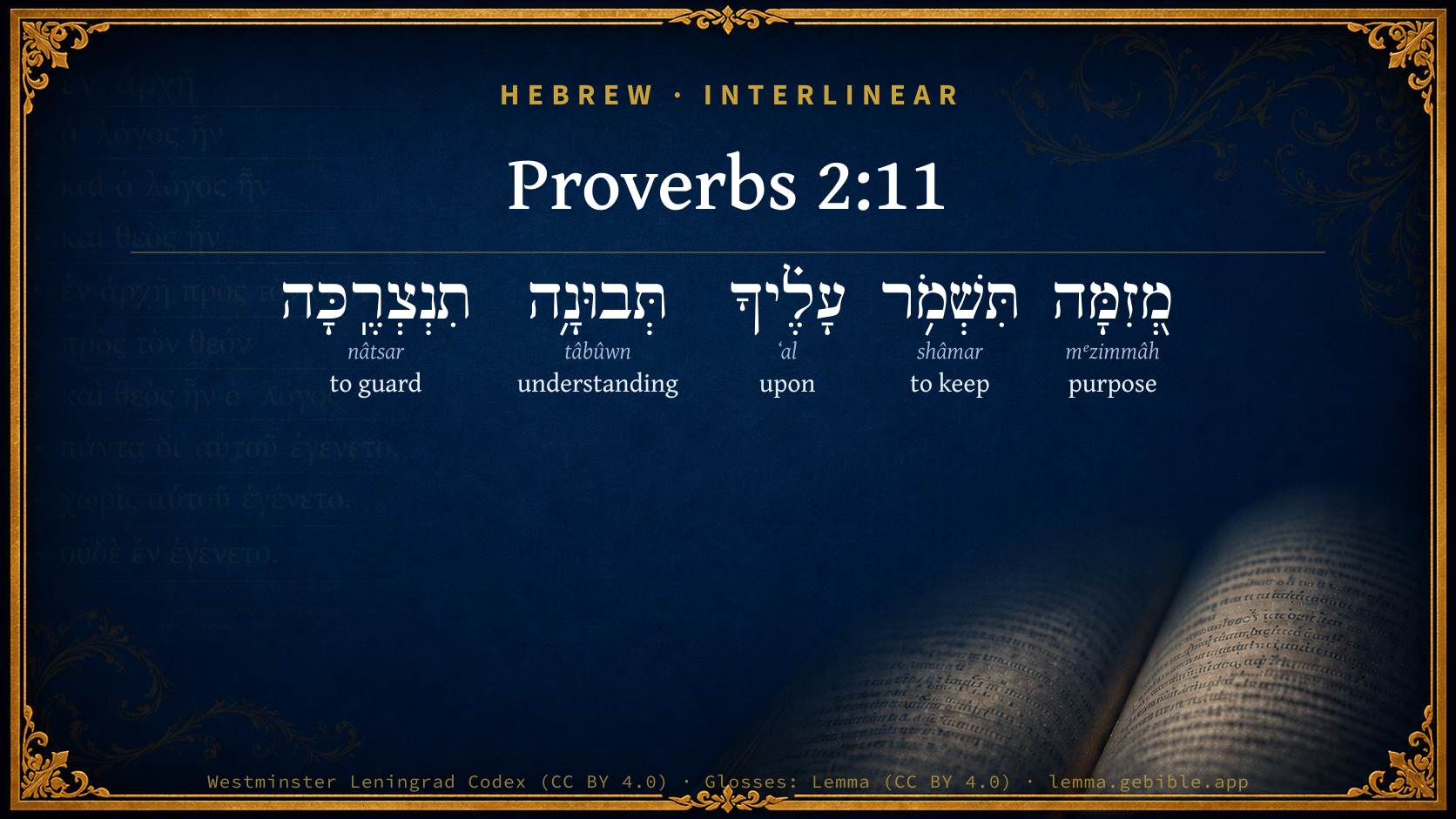
Proverbs 2:11

Hebrew (Westminster Leningrad Codex) Proverbs 2:11 appears in the Hebrew Old Testament. The text above is from the Westminster Leningrad Codex. Each word links to its Strong’s number, a concise gloss, and parsing drawn from the Open Scriptures Hebrew Bible morphology. Click any word for its full Brown-Driver-Briggs (BDB) entry.
Download image
Cite this verse

Proverbs 2:11 (World English Bible). Public Domain. Lemma interlinear Bible study tool, https://lemma.gebible.app/v/proverbs/2/11.

Show BibTeX & RIS
BibTeX
RIS
English Translation
Discretion will watch over you. Understanding will keep you,
World English Bible · Public Domain
Download a study sheet

One document with this verse’s original text, its word-by-word gloss line, the meaning frame, cross-references with their text, attributed commentary, and full source and license credits — printable, and it pastes into notes with its structure intact.

This verse Autodidact and up

Study sheet (.html) Plain text (.txt)

A passage Seminary Student

Up to 50 verses in one chapter. A passage sheet keeps up to 6 commentary sources and 12 cross-references per verse, in the order this page ranks them, and says so on the sheet whenever that leaves anything out. Ask for a single verse and you get the Autodidact verse sheet above.

Everything on this page stays free to read, with no account — the sheet is a download of what is already on screen, not access to it.

Want to remove ads? Support Godless Engineer
Compare translations 3

The same verse in 3 English versions, stacked beneath the original-language interlinear above. Click any original word for its lexicon entry.

Each is an independent rendering of the whole verse — the interlinear is not word-aligned to these translations.

Highlighted words mark where these versions differ — a whole-verse word diff, not a word-by-word alignment.

  • World English Bible Public Domain
    Discretion will watch over you. Understanding will keep you,
  • King James Version Public Domain
    Discretion shall preserve thee, understanding shall keep thee:
  • unfoldingWord Literal Text CC BY-SA 4.0
    Discretion will watch over you; understanding will guard you,

unfoldingWord Literal Text — © unfoldingWord, licensed CC BY-SA 4.0. Word-aligned USFM3 via Door43 (git.door43.org/unfoldingWord/en_ult).

Versions to compare (up to 4)

3 of 4 selected

Show all 18 translations

Every available English version of this verse, each an independent rendering of the whole verse.

  • World English Bible Public Domain
    Discretion will watch over you. Understanding will keep you,
  • Berean Standard Bible Public Domain
    Discretion will watch over you, and understanding will guard you,
  • Majority Standard Bible Public Domain
    Discretion will watch over you, and understanding will guard you,
  • King James Version Public Domain
    Discretion shall preserve thee, understanding shall keep thee:
  • American Standard Version (1901) Public Domain
    Discretion shall watch over thee; Understanding shall keep thee:
  • Revised Version (1885) Public Domain
    Discretion shall watch over thee, understanding shall keep thee:
  • Geneva Bible (1599) Public Domain
    Then shall counsell preserue thee, and vnderstanding shall keepe thee,
  • Douay-Rheims (1899) Public Domain
    Counsel shall keep thee, and prudence shall preserve thee,
  • Young's Literal Translation Public Domain
    Thoughtfulness doth watch over thee, Understanding doth keep thee,
  • Literal Standard Version CC BY-SA 4.0
    Thoughtfulness watches over you, || Understanding keeps you,
  • Unlocked Literal Bible CC BY-SA 4.0
    Discretion will watch over you, understanding will guard you.
  • unfoldingWord Literal Text CC BY-SA 4.0
    Discretion will watch over you; understanding will guard you,
  • Darby Bible Public Domain
    discretion shall keep thee, understanding shall preserve thee:
  • World Messianic Bible Public Domain
    Discretion will watch over you. Understanding will keep you,
  • Webster's Bible Public Domain
    Discretion shall preserve thee, understanding shall keep thee:
  • Free Bible Version CC BY-SA 4.0
    Good decisions will keep you on track; thinking logically will keep you safe.
  • Bible in Basic English Public Domain
    Wise purposes will be watching over you, and knowledge will keep you;
  • JPS Tanakh (1917) Public Domain
    Discretion shall watch over thee, discernment shall guard thee;

Literal Standard Version (2020), Covenant Press — licensed CC BY-SA 4.0. Text via the HelloAO Bible API (eBible.org). Unlocked Literal Bible (unfoldingWord) — licensed CC BY-SA 4.0. Text via the HelloAO Bible API (eBible.org). unfoldingWord Literal Text — © unfoldingWord, licensed CC BY-SA 4.0. Word-aligned USFM3 via Door43 (git.door43.org/unfoldingWord/en_ult). Free Bible Version, Dr. Jonathan Gallagher — licensed CC BY-SA 4.0. Text via the HelloAO Bible API (eBible.org).

Word by word

More ways to search: Search by grammar → Find every occurrence → Compare this word →

Practice this passage: Drill this verse → Learn its vocabulary →

About this verse

These counts appear in no published source. They are computed here, from the morphology-tagged text and Lemma’s own curated glosses. What Lemma adds →

5
words
5
distinct lemmas
Wisdom
section

Notable vocabulary

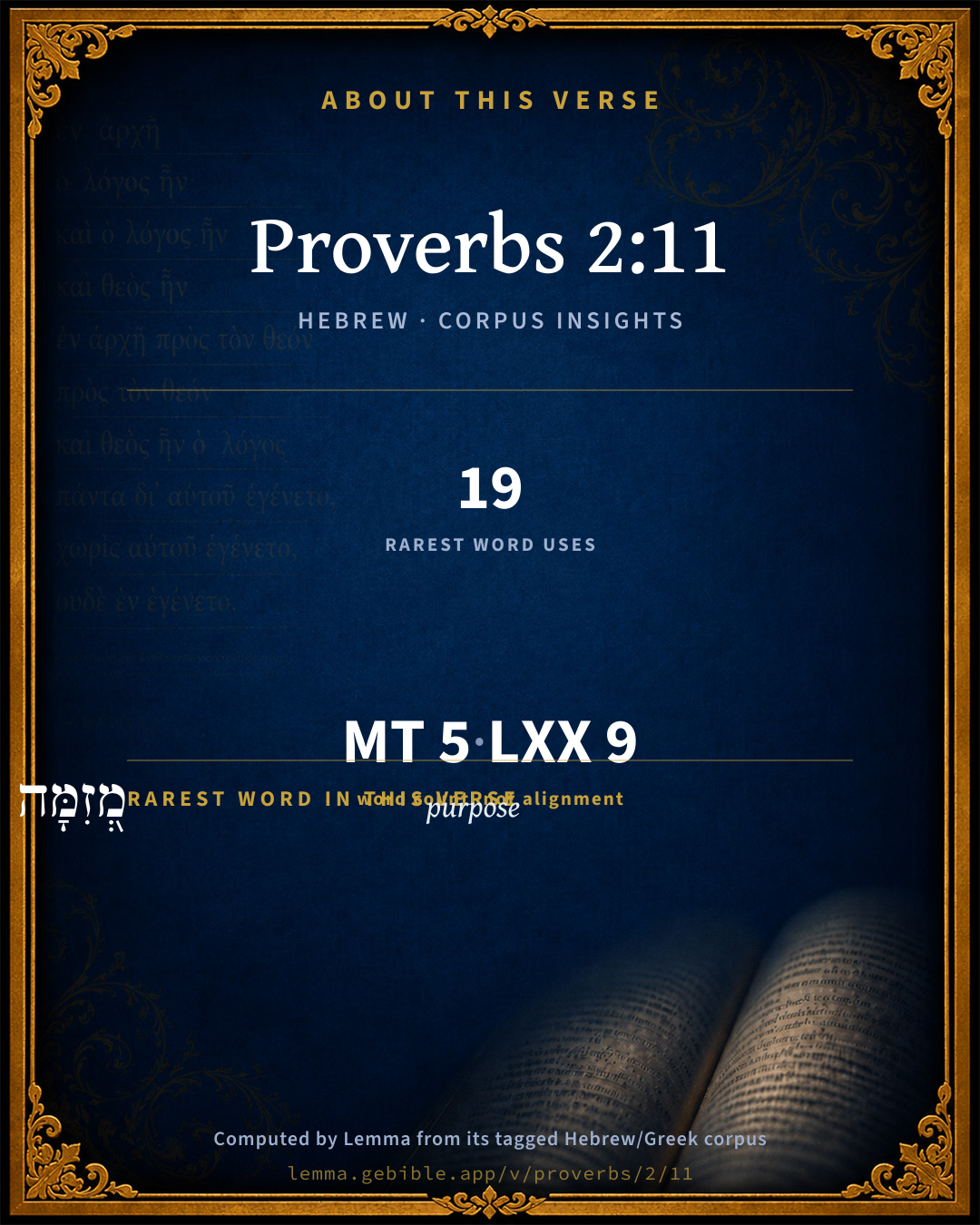
The rarest word here is מְ֭זִמָּה purpose H4209 — appearing just 19 times in the whole Hebrew Bible.

Shared distinctive vocabulary

מְ֭זִמָּה purpose H4209 occurs in 19 verses of the Hebrew Bible. Also found in:

Grammatical profile

  • 2 verbs
  • 2 nouns
  • 1 preposition

Verb forms

  • תִּשְׁמֹ֥ר Qal · Imperfect
  • תִנְצְרֶֽכָּה Qal · Imperfect

Hebrew & Septuagint length

In English translation the verse runs 9 words from the Hebrew and 11 from the Septuagint (LXX English) — closely comparable.

A rough comparison of the two English renderings, which tokenize alike — not a word-level alignment.

Word counts can differ between the Hebrew and the Greek without any difference in meaning — e.g. the Hebrew direct-object marker אֵת has no separate Greek word, and Greek often adds the article ὁ.

In the original languages it is 5 Hebrew tokens and 9 Greek tokens — but the two are counted differently (Hebrew bundles its prefixes and suffixes into one token; the Greek is in lemma form), so that isn’t a like-for-like length.

Cross-references

7

Topical passages linked to Proverbs 2:11 in the Treasury of Scripture Knowledge — connected by theme and wording, ordered by reader-vote popularity; previews shown in the World English Bible.

  • Proverbs 4:6 Don't forsake her, and she will preserve you. Love her, and she will keep you.
  • Ephesians 5:15 Therefore watch carefully how you walk, not as unwise, but as wise;
  • Psalms 25:21 Let integrity and uprightness preserve me, For I wait for you.
  • Ecclesiastes 10:10 If the axe is blunt, and one doesn't sharpen the edge, then he must use more strength; but skill brings success.
  • Psalms 119:9–11 How can a young man keep his way pure? By living according to your word.
  • Proverbs 6:22–24 When you walk, it will lead you. When you sleep, it will watch over you. When you awake, it will talk with you.
  • Ecclesiastes 9:15–18 Now a poor wise man was found in it, and he by his wisdom delivered the city; yet no man remembered that same poor man.

Cross-references courtesy of OpenBible.info (CC BY 4.0).

Hebrew and Greek witnesses Masoretic Hebrew ↔ Greek Septuagint

The same verse in the two great witnesses to the Old Testament, shown verse-for-verse.

These are two independent witnesses, not word-aligned to each other, and the Septuagint is shown in lemma (dictionary) form.

Hebrew Proverbs 2:11 Masoretic · Westminster Leningrad Codex

מְ֭זִמָּה תִּשְׁמֹ֥ר עָלֶ֗יךָ תְּבוּנָ֥ה תִנְצְרֶֽכָּה

Discretion will watch over you. Understanding will keep you,

World English Bible · Public Domain

Greek LXX Proverbs 2:11 Septuagint · lemma form

βουλή καλός φυλάσσω σύ ἔννοια δέ ὅσιος τηρέω σύ

good counsel shall guard you, and holy understanding shall keep you;

LXX2012 (modern English Septuagint) · Public Domain

On this verse, The Pulpit Commentary discusses the Septuagint’s reading. Read the note in Commentary ↓

Hebrew: Westminster Leningrad Codex (CC BY 4.0). Greek: Septuagint (public domain); English from LXX2012 (modern English Septuagint) (Public Domain). How the Septuagint differs from the Hebrew →

Commentary

Notes on Proverbs 2:11 from classic Christian and Jewish commentators (each source and its license shown beneath its notes). The classic Christian expositions comment on the surrounding passage and are grouped to its opening verse, so a note may address several verses; the Jewish commentaries on the Tanakh (Rashi and others) are per-verse, so they appear only where the commentator wrote on this verse.

Lemma curates 59 commentaries, every one of them public domain or Creative Commons licensed, each selected and text-cleaned for this edition rather than reprinted as found. About our sources →

Trapp's Complete Commentary

John Trapp

Pro 2:11 Discretion shall preserve thee, understanding shall keep thee:

Ver. 11. Discretion.] Heb., Thoughtfulness, or good advisement. Cogito quasi coagito. {a} Notat sereitatem, such as is that of the wife "to please her husband," {1Co 7:34} casting this way and that way how to give best content: or that of the good housewife to "build her house," {Pro 14:1} studying in every business how to set everything in order, as the carpenter studies how to set every part of the frame in joint.

{a} Becman, μεριμνα.

John Trapp, A Commentary or Exposition upon All the Books of the Old and New Testament (1647–1656) — public domain. Text from a community e-Sword module.

The Biblical Illustrator

Joseph S. Exell

Pro_2:11

Discretion shall preserve thee.

Humility

This is the first sought and last won of the Christian graces. Such are the difficulties in the acquisition of humility that it is but seldom really found. It is a common want of the present day. See the ordinary courtesy of modern society. See the special snare in intellectual careers. In both of these provinces of life especial discouragement has been given during the recent period to the growth in us of true humility.

I. Abjectness is not humility. Depression, abasement, humiliation, by no means exhaust all the commutation of this well-known Christian term. Abjectness and humility may have some features in common. But humility presupposes a soaring spirit. The calm dignity of Christian holiness must rest behind. This lovely grace assists and furthers genuine aspirations. Our Lord made three contributions to the science of ethics, and each of them bore the impress of the Cross--humility, faith, love. These, at least, He lifted into places of high importance. Our Lord places humility in the very front of His teaching. See sermons on the mount and on the plain. There is nothing vain or false in humility. Humility is the hall-mark of wisdom.

II. The beginnings of humility must be made in careful self-repression. We are so much bound up with ourselves that we cannot come to a just and fair estimate of our own affairs without rejecting a vast amount of the suggestions and insinuations that we make to ourselves. Self-abnegation may, in becoming habitual, cast off all consciousness. Repentance must begin with humiliation. There can be no contrition without humility. The difficulty is to get this feeling the permanent posture of the soul. Here we must depend upon the action of conscience. The following are some of the provinces in which we have to exercise self-repression.

1. Good-fortune, successes, advancement, commendation, praise, bring a too satisfied sense of our own exaltation.

2. Success is said to try humility, misfortune to produce it. We can hardly learn humility and tenderness enough except by suffering.

3. Think of the wrath, quarrels, and resentments which arise from nervous anxiety about ourselves and our position. Bishop Wilson says, He that is truly humble never thinks himself wronged.

4. Humility often seems persistently to fly away from the intellectual life.

III. Humility requires us to fix our attentions upon people and things outside of ourselves. This includes a steady posture of reverence. The reverent life confers grace and refinement upon our characters. It constitutes the inextinguishable charm of religion. In the practice of the reverent life we have the conscious cultivation of humility. We move out of self-contemplation and self-pleasing into the higher region of sacrifice, and into the dignity of giving, in offering homage to the Almighty God, and in according attention to other people.

IV. Humility is regulated by our deportment towards truth. True humility is marked by a simplicity of mind from which self is banished. Disorderly introspection is morbid and unwholesome. But humility is difficult to attain. It is scarcely possible until the character is thoroughly settled to avoid an amount of self-consciousness which is inconsistent with real humility. There is indeed much intellectual as well as moral weakness that stands in the way of acquiring humility. Besides the want of the power of concentration, there is generally a lack of imagination. See illustration in our Lords life of humility with aspiration in it.

1. The lofty aspirations and the soaring aims of our Lord were never laid aside by Him, but they were kept in the background.

2. With what consistency did He repress Himself, and how thoroughly His teaching coincided with His example!

3. He showed reverence towards all. His respect for men is most touching.

4. What self-sacrifice and neglect of self are visible throughout His career! No labour is ever too much for Him. He was always ready at the call of duty. Does the way of humility still seem hard? There, on that hill outside Jerusalem, at the foot of that Cross which is set up towards heaven, drawing all men unto it, we may come to learn what we can learn nowhere else--how to lower our pride, and to foster humility in our souls. (Edward Miller, M.A.)

The negative beneficial influence of religion

There is an important distinction between the understanding of the meaning of Divine discoveries and the perception of their excellence and truth. Knowledge in Scripture, with which salvation is connected, includes the latter. The knowledge of anything means the knowledge of its real and distinctive properties. The apostle speaks of spiritual discernment. Discretion and, understanding in this connection mean self-jealousy arising from self-knowledge. The knowledge of ourselves includes the knowledge, theoretical and experimental, of the unlimited deceitfulness of our own hearts. And this, connected with a right knowledge of the sources of temptation as they exist in such abundance and variety around us, will inspire and maintain discretion. He will watch unto prayer, and not merely trust to his own discretion. Diffidence of self and confidence in God constitute the discretion of the spiritual man. The two sources of temptation for youth are wicked men and wicked women. The evil man speaketh froward things, i.e., words of perverse rebellion, of a spirit stubborn, refractory, scornful, self-willed. These work seductively on youthful minds of a particular temperament; especially on those who have a craze for independence. The evil mans ways are crooked ways, changing from purpose at wayward inclination. The strange woman represents all seducers to immorality and sensual indulgences, and such have a special influence on youth. (R. Wardlaw,D. D.)

The youth assisted in forming his religious sentiments

I. Let your mind be impressed with this sentiment, that there is such a thing as religion; and that it is of serious importance.

II. Always remember that religion is agreeable to the nature of God. As it is a service which you owe to Him, your ideas of it must correspond with His moral character.

III. To judge what religion is, you must always consider that it is a rational thing.

IV. Religion must be a work suited to the nature and condition of man.

V. You must always remember that religion is a benevolent and useful thing; and that, wherever it takes place, it makes men better than they were before.

VI. Judge of things doubtful by things which are plain. VII. If a matter proposed to you, in a way of instruction or advice, appears doubtful, suspend your resolution, until you have made further inquiry. (J. Lathrop, D. D.)

The Biblical Illustrator, edited by Joseph S. Exell (c. 1880s–1900s) — public domain. Text from a community e-Sword module.

The Pulpit Commentary

Discretion shall preserve thee. Discretion (tMzm, mzimoth), as in Pro_1:4, is the outward manifestation of wisdom; it tests what is uncertain, and avoids danger (Hitzig). The word carries with it the idea of reflection or consideration (see Pro_3:21 Pro_5:2 Pro_8:12) The LXX reads, boulh kalh , "good counsel;" and the Vulgate, concilium. Shall preserve thee. The idea of protection and guarding, which is predicated of Jehovah in ver. 8, is here transferred to discretion and understanding, which to some extent are put forward as personifications. Understanding (hnWbt, t"vunah), as in Pro_2:11; the power of distinguishing and separating, and, in the case of conflicting interests, to decide on the best. Shall keep; i.e. keep safe, or in the sense of watching over or guarding. The two verbs "to preserve" (rmv, shamar) and "to keep" (rxn, natsar), LXX threin , occur together again in Pro_4:6.

The Pulpit Commentary (1880–1919), ed. H.D.M. Spence-Jones & Joseph S. Exell — public domain. Text from a community e-Sword module.

Geneva Bible (1599)

Geneva Bible translators

The word of God shall teach thee, and counsel thee how to govern thyself.

Geneva Bible (1599) marginal notes — public domain. Text via Bolls.life.

Adam Clarke's Commentary

Verse 11. Discretion shall preserve thee] מזמה mezimmah. See on Pr 1:4. Here the word is taken in a good sense, a good device. The man invents purposes of good; and all his schemes, plans, and devices, have for their object God's glory and the good of man: he deviseth liberal things, and by liberal things he shall stand. Coverdale translates, "Then shall COUNSEL preserve thee." A very good translation, much better than the present.

Adam Clarke's Commentary on the Bible (1810–1826) — public domain. Text from a community e-Sword/MySword module.

The Cambridge Bible for Schools and Colleges

gen. ed. J. J. S. Perowne

11. preserve] Rather: watch over, R.V.; φυλάξει, LXX.; custodiet, Vulg.

The Cambridge Bible for Schools and Colleges (gen. ed. J. J. S. Perowne; Cambridge University Press, 1878–1918) — public domain. Text from a community e-Sword module.

John Gill's Exposition

Discretion shall preserve thee,.... Which wisdom or the Gospel gives, or the Lord by the means of it; for the Gospel makes a man wise and discreet in the business of salvation, and in his conduct and deportment; and the discretion it gives him will put him upon his guard, and direct him to watch against every error, and every false way. And so the words may be rendered, "discretion will watch over thee"; to keep thee from everything pernicious in doctrine and practice. The Septuagint version renders it, "good counsel"; which wisdom gives, and the Gospel is full of; and which, if attended to, is a means of the preservation of the saints;

understanding shall keep thee; which is only the same thing expressed in other words. The Septuagint version renders it, "an holy thought"; and the Arabic version, "a just thought shall preserve thee in thy last times". What these are a means of keeping and preserving from is explained in the following verses.

John Gill's Exposition of the Whole Bible (1746–1763) — public domain (CC PDM 1.0). Text via the HelloAO Bible API.

Matthew Poole's English Annotations

From wicked courses, and the mischiefs which attend upon them; as is particularly expressed in the following verses.

Matthew Poole's English Annotations on the Holy Bible (1683–1685) — public domain. Text from a community e-Sword/MySword module.

unfoldingWord translationNotes

Door43 World Missions Community

Discretion will watch over you, understanding will guard you

This speaks of "discretion" and "understanding" as if they were persons who could watch over someone else. Both statements mean basically the same thing. AT: "Because you think carefully and understand what is right and wrong you will be safe" (See: Personification and Parallelism)

Discretion

the quality of being careful in actions and speech

watch over

to guard, protect or take care of someone or something

They will rescue you from the way of evil

"They" refers to discretion and understanding, which are spoken of as if they were persons who could rescue someone else. AT: "You will know to stay away from what is evil" (See: Personification)

from the way of evil

Evil behaviors are spoken of as if evil were a way or path on which a person walks. (See: Metaphor)

who abandon the right paths and walk in the ways of darkness

A person no longer doing what is right but deciding to do what is evil is spoken of as if the person stops walking on the correct path and chooses to walk down a dark path. (See: Metaphor)

who abandon

The word "who" refers to the people who speak perverse things.

abandon

to leave and never return to someone or something

translationWords

watch

evil

walk

darkness

unfoldingWord translationNotes — © Distant Shores Media and the Door43 World Missions Community, licensed CC BY-SA 4.0. Source: git.door43.org/Door43/en_tn.

Rashi

Rabbi Shlomo Yitzchaki (Rashi)

thought Heb. מזמה. The Torah shall watch over you.

Rashi on the Tanakh — English translations: “The Judaica Press complete Tanach with Rashi, translated by A. J. Rosenberg” (CC BY 4.0); “Pentateuch with Rashi's commentary by M. Rosenbaum and A.M. Silbermann, 1929-1934” (public domain); “The Metsudah Tanach series, Lakewood, N.J” (CC BY 4.0); and “The Book of Joshua, Metsudah Publications, 1997” (CC BY 4.0). Text via Sefaria.

Lesson kit

Teaching starters — assembled from the data on this page, not authored interpretation. Every prompt links to the verse data it draws on. Edit before teaching.

Proverbs, in the Wisdom, opens this verse with 5 words (5 distinct Hebrew lemmas). Its most distinctive word is mᵉzimmâh (“purpose”). A historical commentator’s framing appears above. Read the whole chapter for the surrounding context.

Discussion questions

  1. The word mᵉzimmâh carries the sense “purpose.” How does it shape the verse?
  2. How does Job 21:27, which shares the word «purpose», read alongside this verse?
  3. These translations render this verse differently. What is at stake in choosing one wording over another?
  4. «תִּשְׁמֹ֥ר» is a Qal Imperfect verb. How does that grammatical form shape the action described?
  5. Compare how Trapp's Complete Commentary and The Biblical Illustrator read this verse. Where do they agree or differ?

Things to notice

Reading settings

Reading text

Shown beneath each verse's original-language words.

Old Testament
Old Testament edition

Read the OT as the Masoretic Hebrew (MT) or the Greek Septuagint (LXX).

English shown for the Greek Septuagint (in the Hebrew ↔ Greek comparison).

Comparing translations? Open the Compare panel on any verse page to stack up to four side by side.