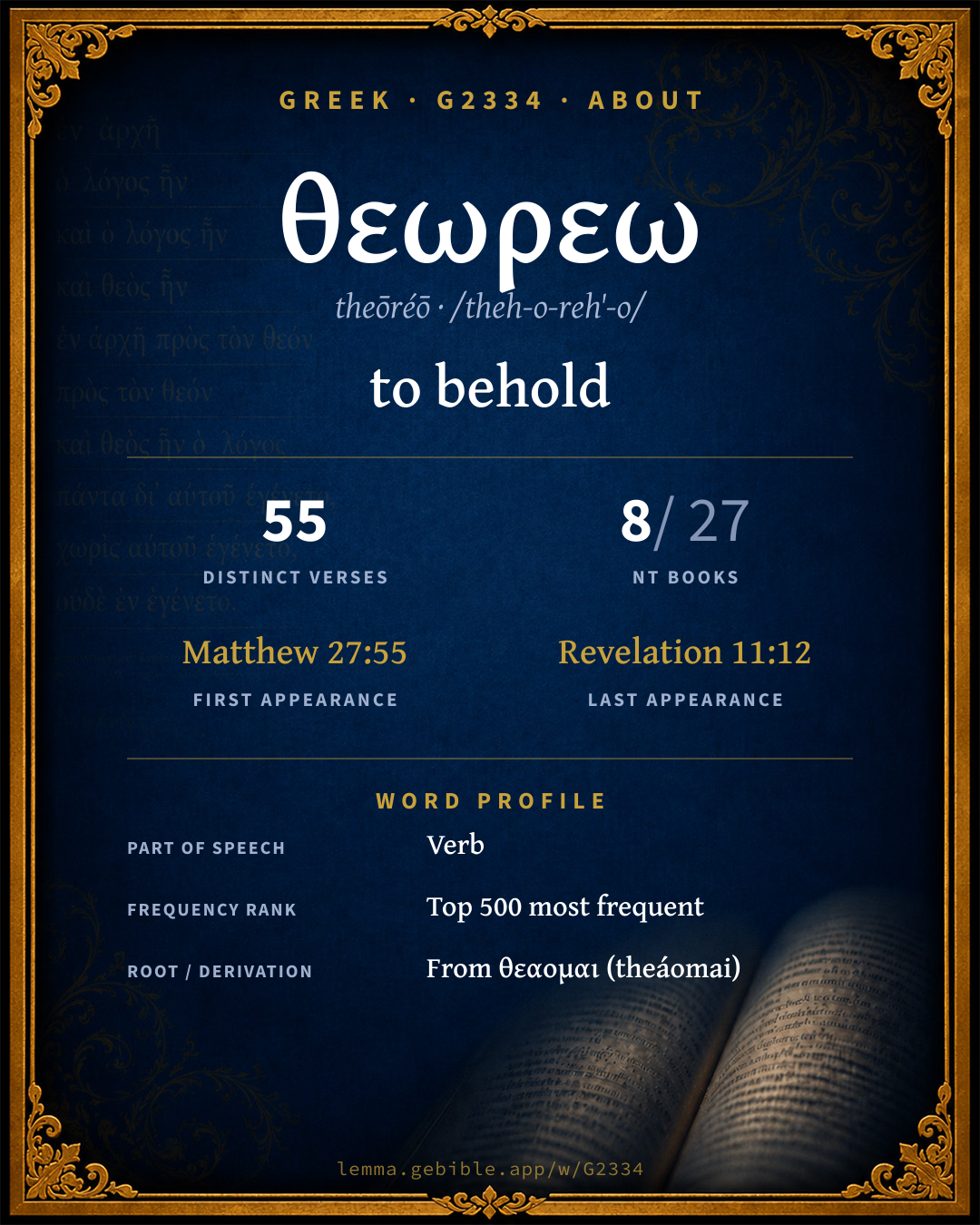
θεωρέω
to behold
‘to behold’ is one of 4 main senses fuller range ↓
Full lexicon entry — Thayer's Greek Lexicon
From Thayer's Greek Lexicon
Where this word appears
See every Present-tense verb in the Greek New Testament →
Grammar key — what these labels mean
Part of speech
- Verb
- An action or state-of-being word.
Tense
- Present
- Ongoing or general action in present time (imperfective aspect).
- Imperfect
- Continuous or repeated action in past time (“was writing”).
- Aorist
- Action viewed as a simple whole, without regard to duration — often past (perfective aspect).
- Future
- Action expected in future time.
Voice
- Active
- The subject performs the action.
Mood
- Indicative
- States a fact or asks a factual question (the mood of reality).
- Participle
- A verbal adjective (“writing,” “having written”).
- Infinitive
- A verbal noun (“to write”), unmarked for person or number.
- Subjunctive
- Expresses probability, purpose, or possibility (the mood of contingency).
Case
- Nominative
- The case of the subject (and the predicate nominative).
- Accusative
- The case of the direct object and of extent.
- Genitive
- The case of source, possession, or “of” — answers “whose / from what.”
Person
- 2nd person
- The one addressed (“you”).
- 3rd person
- The one spoken about (“he / she / it / they”).
- 1st person
- The speaker (“I / we”).
Gender
- Masculine
- Grammatically masculine.
- Feminine
- Grammatically feminine.
Number
- Plural
- More than one.
- Singular
- One.
Grammatical forms 23 distinct
- Verb, Present, Active, Indicative, 2nd person, Plural 12 times (21%)
- Verb, Present, Active, Indicative, 3rd person, Singular 9 times (16%)
- Verb, Present, Active, Participle, Nominative, Plural, Masculine 5 times (9%)
- Verb, Present, Active, Indicative, 1st person, Singular 4 times (7%)
- Verb, Present, Active, Participle, Nominative, Singular, Masculine 4 times (7%)
- Verb, Present, Active, Indicative, 3rd person, Plural 3 times (5%)
- Verb, Imperfect, Active, Indicative, 3rd person, Plural 2 times (4%)
- Verb, Present, Active, Infinitive 2 times (4%)
+15 more forms (16 occurrences)
Parsed forms decoded from the imported morphology (Robinson–Tischendorf, public domain), counted across 57 parsed occurrences — not distinct verses.
Every verse where G2334 appears — 55 distinct verses across 8 books. Click any verse to open its interlinear word-by-word view. Verse text shown in the World English Bible for context — . Each verse’s Greek form is shown with its reference; the English is not keyword-highlighted, since the data carries no word-level English alignment. Use “Compare translations” on any verse to read it across multiple English versions. This concordance covers the Greek New Testament; Septuagint (Greek Old Testament) occurrences of this word are not indexed here.
Matthew 2 verses
- Matthew 27:55 θεωροῦσαι pres act ptcp nom pl fem Many women were there watching from afar, who had followed Jesus from Galilee, serving him.
- Matthew 28:1 θεωρῆσαι aor act inf Now after the Sabbath, as it began to dawn on the first day of the week, Mary Magdalene and the other Mary came to see the tomb.
Mark 7 verses
- Mark 3:11 ἐθεώρουν impf act ind 3pl The unclean spirits, whenever they saw him, fell down before him, and cried, "You are the Son of God!"
- Mark 5:15 θεωροῦσιν pres act ind 3pl They came to Jesus, and saw him who had been possessed by demons sitting, clothed, and in his right mind, even him who had the legion; and they were afraid.
- Mark 5:38 θεωρεῖ pres act ind 3sg He came to the synagogue ruler's house, and he saw an uproar, weeping, and great wailing.
- Mark 12:41 ἐθεώρει impf act ind 3sg Jesus sat down opposite the treasury, and saw how the multitude cast money into the treasury. Many who were rich cast in much.
- Mark 15:40 θεωροῦσαι pres act ptcp nom pl fem There were also women watching from afar, among whom were both Mary Magdalene, and Mary the mother of James the less and of Joses, and Salome;
- Mark 15:47 ἐθεώρουν impf act ind 3pl Mary Magdalene and Mary, the mother of Joses, saw where he was laid.
- Mark 16:4 θεωροῦσιν pres act ind 3pl for it was very big. Looking up, they saw that the stone was rolled back.
Luke 7 verses
- Luke 10:18 ἐθεώρουν impf act ind 1sg He said to them, "I saw Satan having fallen like lightning from heaven.
- Luke 14:29 θεωροῦντες pres act ptcp nom pl masc Or perhaps, when he has laid a foundation, and is not able to finish, everyone who sees begins to mock him,
- Luke 21:6 θεωρεῖτε pres act ind 2pl "As for these things which you see, the days will come, in which there will not be left here one stone on another that will not be thrown down."
- Luke 23:35 θεωρῶν pres act ptcp nom sg masc The people stood watching. The rulers with them also scoffed at him, saying, "He saved others. Let him save himself, if this is the Christ of God, his chosen one!"
- Luke 23:48 θεωρήσαντες aor act ptcp nom pl masc All the multitudes that came together to see this, when they saw the things that were done, returned home beating their breasts.
- Luke 24:37 θεωρεῖν pres act inf But they were terrified and filled with fear, and supposed that they had seen a spirit.
- Luke 24:39 θεωρεῖτε pres act ind 2pl See my hands and my feet, that it is truly me. Touch me and see, for a spirit doesn't have flesh and bones, as you see that I have."
John 21 verses
- John 2:23 θεωροῦντες pres act ptcp nom pl masc Now when he was in Jerusalem at the Passover, during the feast, many believed in his name, observing his signs which he did.
- John 4:19 θεωρῶ pres act ind 1sg The woman said to him, "Sir, I perceive that you are a prophet.
- John 6:19 θεωροῦσιν pres act ind 3pl When therefore they had rowed about twenty-five or thirty stadia, they saw Jesus walking on the sea, and drawing near to the boat; and they were afraid.
- John 6:40 θεωρῶν pres act ptcp nom sg masc This is the will of the one who sent me, that everyone who sees the Son, and believes in him, should have eternal life; and I will raise him up at the last day."
- John 6:62 θεωρῆτε pres act subj 2pl Then what if you would see the Son of Man ascending to where he was before?
- John 7:3 θεωρήσουσιν fut act ind 3pl His brothers therefore said to him, "Depart from here, and go into Judea, that your disciples also may see your works which you do.
- John 8:51 θεωρήσῃ aor act subj 3sg Most assuredly, I tell you, if a person keeps my word, he will never see death."
- John 9:8 θεωροῦντες pres act ptcp nom pl masc The neighbors therefore, and those who saw that he was blind before, said, "Isn't this he who sat and begged?"
- John 10:12 θεωρεῖ pres act ind 3sg He who is a hired hand, and not a shepherd, who doesn't own the sheep, sees the wolf coming, leaves the sheep, and flees. The wolf snatches the sheep, and scatters them.
- John 12:19 θεωρεῖτε pres act ind 2pl The Pharisees therefore said among themselves, "See how you accomplish nothing. Behold, the world has gone after him."
- John 12:45 θεωρῶν θεωρεῖ pres act ptcp nom sg masc pres act ind 3sg He who sees me sees him who sent me.
- John 14:17 θεωρεῖ pres act ind 3sg the Spirit of truth, whom the world can't receive; for it doesn't see him, neither knows him. You know him, for he lives with you, and will be in you.
- John 14:19 θεωρεῖ θεωρεῖτέ pres act ind 3sg pres act ind 2pl Yet a little while, and the world will see me no more; but you will see me. Because I live, you will live also.
- John 16:10 θεωρεῖτέ pres act ind 2pl about righteousness, because I am going to my Father, and you won't see me any more;
- John 16:16 θεωρεῖτέ pres act ind 2pl A little while, and you will not see me. Again a little while, and you will see me."
- John 16:17 θεωρεῖτέ pres act ind 2pl Some of his disciples therefore said to one another, "What is this that he says to us, 'A little while, and you won't see me, and again a little while, and you will see me;' and, 'Because I go to the Father?'"
- John 16:19 θεωρεῖτέ pres act ind 2pl Therefore Jesus perceived that they wanted to ask him, and he said to them, "Do you inquire among yourselves concerning this, that I said, 'A little while, and you won't see me, and again a little while, and you will see me?'
- John 17:24 θεωρῶσιν pres act subj 3pl Father, I desire that they also whom you have given me be with me where I am, that they may see my glory, which you have given me, for you loved me before the foundation of the world.
- John 20:6 θεωρεῖ pres act ind 3sg Then Simon Peter came, following him, and entered into the tomb. He saw the linen cloths lying,
- John 20:12 θεωρεῖ pres act ind 3sg and she saw two angels in white sitting, one at the head, and one at the feet, where the body of Jesus had lain.
- John 20:14 θεωρεῖ pres act ind 3sg When she had said this, she turned around and saw Jesus standing, and didn't know that it was Jesus.
Acts 14 verses
- Acts 3:16 θεωρεῖτε pres act ind 2pl By faith in his name has his name made this man strong, whom you see and know. Yes, the faith which is through him has given him this perfect soundness in the presence of you all.
- Acts 4:13 Θεωροῦντες pres act ptcp nom pl masc Now when they saw the boldness of Peter and John, and had perceived that they were unlearned and ignorant men, they marveled. They recognized that they had been with Jesus.
- Acts 7:56 θεωρῶ pres act ind 1sg and said, "Behold, I see the heavens opened, and the Son of Man standing at the right hand of God!"
- Acts 8:13 θεωρῶν pres act ptcp nom sg masc Simon himself also believed. Being baptized, he continued with Philip. Seeing signs and great miracles occuring, he was amazed.
- Acts 9:7 θεωροῦντες pres act ptcp nom pl masc The men who traveled with him stood speechless, hearing the sound, but seeing no one.
- Acts 10:11 θεωρεῖ pres act ind 3sg He saw heaven opened and a certain container descending to him, like a great sheet let down by four corners on the earth,
- Acts 17:16 θεωροῦντος pres act ptcp gen sg masc Now while Paul waited for them at Athens, his spirit was provoked within him as he saw the city full of idols.
- Acts 17:22 θεωρῶ pres act ind 1sg Paul stood in the middle of the Areopagus, and said, "You men of Athens, I perceive that you are very religious in all things.
- Acts 19:26 θεωρεῖτε pres act ind 2pl You see and hear, that not at Ephesus alone, but almost throughout all Asia, this Paul has persuaded and turned away many people, saying that they are no gods, that are made with hands.
- Acts 20:38 θεωρεῖν pres act inf sorrowing most of all because of the word which he had spoken, that they should see his face no more. And they accompanied him to the ship.
- Acts 21:20 θεωρεῖς pres act ind 2sg They, when they heard it, glorified God. They said to him, "You see, brother, how many thousands there are among the Jews of those who have believed, and they are all zealous for the law.
- Acts 25:24 θεωρεῖτε pres act ind 2pl Festus said, "King Agrippa, and all men who are here present with us, you see this man, about whom all the multitude of the Jews petitioned me, both at Jerusalem and here, crying that he ought not to live any longer.
- Acts 27:10 θεωρῶ pres act ind 1sg and said to them, "Sirs, I perceive that the voyage will be with injury and much loss, not only of the cargo and the ship, but also of our lives."
- Acts 28:6 θεωρούντων pres act ptcp gen pl masc But they expected that he would have swollen or fallen down dead suddenly, but when they watched for a long time and saw nothing bad happen to him, they changed their minds, and said that he was a god.
Hebrews 1 verse
1 John 1 verse
Revelation 2 verses
- Revelation 11:11 θεωροῦντας pres act ptcp acc pl masc After the three and a half days, the breath of life from God entered into them, and they stood on their feet. Great fear fell on those who saw them.
- Revelation 11:12 ἐθεώρησαν aor act ind 3pl I heard a loud voice from heaven saying to them, "Come up here!" They went up into heaven in the cloud, and their enemies saw them.
About this entry
At a glance — auto-summarized from this page’s data, not written by a person. Every figure links to its source below. This summary describes the numbers; it doesn’t interpret them.
The Greek verb θεωρεω centers on the idea of “to behold.” Where the King James Version says “seeth,” newer translations reach for “saw” (Berean Standard Bible); the renderings breakdown has the detail. It appears 55 verses across 8 books of the Greek New Testament, among its moderately common vocabulary. The word gravitates to John (38%), then Acts and Mark. Thayer's distinguishes 4 senses for it. For the data behind this summary, explore the sense tree and the renderings breakdown below.
Gloss history
Strong's 1890 vs modern scholarship
About this word
Strong's G2334 catalogs a Greek word from the Greek New Testament.
These counts are not copied from any lexicon or concordance. They are computed here, from the morphology-tagged Greek New Testament. What Lemma adds →
- 55
- distinct verses
- The word appears in 55 distinct verses.
- 8 / 27
- NT books
- The word appears in 8 of 27 New Testament books.
- #284
- by frequency
- Top 500 most frequent Greek words (rank 284 of 5,347 Greek words by occurrence).
View all 55 occurrences in the concordance →
By section of the New Testament
By traditional corpus
Conventional, traditional groupings — biblical authorship is debated, so this is a traditional corpus grouping, not an authorship claim. Some books belong to more than one corpus (Luke is in both the Gospels and the Lukan corpus, and so on), so these shares overlap and need not total 100%. Each figure is a share of the word’s 55 distinct verses.
- Gospels 37 verses · 67%
- Johannine 24 verses · 44%
- Lukan (Luke–Acts) 21 verses · 38%
- Revelation 2 verses · 4%
- Hebrews 1 verse · 2%
- General (Catholic) Epistles 1 verse · 2%
How translations render this word
Counts come from each version’s own published word-to-Strong’s tagging or interlinear alignment — an approximate guide to how each version renders this word, not a word-level alignment the data otherwise carries. Because each total is that version’s own tagged count, the per-version totals vary from one another and need not match the appearance or distinct-verse counts above. These counts may also differ from a printed concordance because Lemma counts each distinctly tagged rendering and does not collapse phrase taggings into a single head-word total. This is a fixed set of word-tagged versions (KJV, ASV, BSB, ULT) and does not change with the reading translation you choose elsewhere. Each version’s license is shown beside its name below (and on Sources).
- King James Version: Seeth 9×, See 8×, Ye see 5×
- American Standard Version: Beholdeth 7×, Ye behold 6×, Beheld 5×
- Berean Standard Bible: Saw 8×, Sees 5×, They saw 5×
- unfoldingWord Literal Text: See 10×, Seeing 8×, You see 6×
King James Version Public Domain
Renders G2334 across 61 tagged occurrences — most commonly:
Plus 18 renderings that appear only once — usually multi-word phrases or single function words the recovered tagging swept in, not distinct renderings.
American Standard Version Public Domain
Renders G2334 across 58 tagged occurrences — most commonly:
Plus 18 renderings that appear only once — usually multi-word phrases or single function words the recovered tagging swept in, not distinct renderings.
Berean Standard Bible Public Domain
Renders G2334 across 58 tagged occurrences — most commonly:
Plus 21 renderings that appear only once — usually multi-word phrases or single function words the recovered tagging swept in, not distinct renderings.
unfoldingWord Literal Text CC BY-SA 4.0
Renders G2334 across 64 tagged occurrences — most commonly:
Plus 17 renderings that appear only once — usually multi-word phrases or single function words the recovered tagging swept in, not distinct renderings.
Senses in Thayer's
The 4 senses Thayer's distinguishes for this word, in lexicon order (not ranked by frequency or importance). The full entry — with sub-senses — is in the Lexicon Entry tab.
- to be a spectator, look at, behold
- to perceive with the eyes, to enjoy the presence of one
- to discern, descry
- to ascertain, find out by seeing
Word origin
Derived from θεαομαι (theáomai) (G2300) — to behold.
Forms in the corpus
The 25 distinct written forms G2334 takes in the Greek New Testament, most frequent first — each parse links to that tense’s occurrences in the concordance.
Same root — word family
Other Thayer's entries built from the same root as G2334, grouped by Strong’s listed origin. These share a root / origin per the lexicon — not necessarily a shared meaning. Each links to that word’s own entry.
Derives from
Shares the same root
Derived from this word
Compare all same-root words → Showing 4 of 6 — not the complete family. They share a root, not necessarily a meaning.
Septuagint usage
The same Greek word θεωρεω appears 24 times in the Greek Old Testament (Septuagint), across 24 verses in 6 books.
- 24
- LXX occurrences
- Tagged occurrences of this Greek word in the Septuagint.
- 24
- verses
- Distinct Septuagint verses containing this word.
- 6 / 39
- OT books
- The word appears in 6 of the 39 Old Testament books.
Sample Septuagint occurrences
- Joshua 8:20 θεωρέω
- Judges 16:27 θεωρέω
- Psalms 21:8 θεωρέω
- Proverbs 15:30 θεωρέω
- Ecclesiastes 7:11 θεωρέω
- Daniel 3:91 θεωρέω
Septuagint occurrences (same lexeme)
Every verse where the same Strong’s number (G2334) appears in the Greek Septuagint. Verse text shown in the World English Bible for context; the Greek form is the matched word — the English is not keyword-highlighted.
- Joshua 8:20 θεωρέω When the men of Ai looked behind them, they saw, and, behold, the smoke of the city ascended up to heaven, and they had no power to flee this way or that way: and the people who fled to the wilderness turned back on the pursuers.
- Judges 16:27 θεωρέω Now the house was full of men and women; and all the lords of the Philistines were there; and there were on the roof about three thousand men and women, who saw while Samson made sport.
- Psalms 21:8 θεωρέω Your hand will find out all of your enemies. Your right hand will find out those who hate you.
- Psalms 26:4 θεωρέω I have not sat with deceitful men, Neither will I go in with hypocrites.
- Psalms 30:12 θεωρέω To the end that my heart may sing praise to you, and not be silent. Yahweh my God, I will give thanks to you forever!
- Psalms 49:18 θεωρέω Though while he lived he blessed his soul-- And men praise you when you do well for yourself--
- Psalms 63:9 θεωρέω But those who seek my soul, to destroy it, Shall go into the lower parts of the earth.
- Psalms 65:18 θεωρέω
- Psalms 67:25 θεωρέω
- Psalms 72:3 θεωρέω The mountains shall bring prosperity to the people. The hills bring the fruit of righteousness.
- Proverbs 15:30 θεωρέω The light of the eyes rejoices the heart. Good news gives health to the bones.
- Proverbs 31:16 θεωρέω She considers a field, and buys it. With the fruit of her hands, she plants a vineyard.
- Ecclesiastes 7:11 θεωρέω Wisdom is as good as an inheritance. Yes, it is more excellent for those who see the sun.
- Daniel 3:91 θεωρέω
- Daniel 3:94 θεωρέω
- Daniel 4:6 θεωρέω Therefore made I a decree to bring in all the wise men of Babylon before me, that they might make known to me the interpretation of the dream.
- Daniel 7:2 θεωρέω Daniel spoke and said, I saw in my vision by night, and, behold, the four winds of the sky broke forth on the great sea.
- Daniel 7:4 θεωρέω The first was like a lion, and had eagle's wings: I saw until the wings of it were plucked, and it was lifted up from the earth, and made to stand on two feet as a man; and a man's heart was given to it.
- Daniel 7:6 θεωρέω After this I saw, and, behold, another, like a leopard, which had on its back four wings of a bird; the animal had also four heads; and dominion was given to it.
- Daniel 7:7 θεωρέω After this I saw in the night-visions, and, behold, a fourth animal, awesome and powerful, and strong exceedingly; and it had great iron teeth; it devoured and broke in pieces, and stamped the residue with its feet: and it was diverse from all the animals that were before it; and it had ten horns.
- Daniel 7:9 θεωρέω I saw until thrones were placed, and one who was ancient of days sat: his clothing was white as snow, and the hair of his head like pure wool; his throne was fiery flames, [and] the wheels of it burning fire.
- Daniel 7:11 θεωρέω I saw at that time because of the voice of the great words which the horn spoke; I saw even until the animal was slain, and its body destroyed, and it was given to be burned with fire.
- Daniel 7:13 θεωρέω I saw in the night-visions, and, behold, there came with the clouds of the sky one like a son of man, and he came even to the ancient of days, and they brought him near before him.
- Daniel 8:15 θεωρέω It happened, when I, even I Daniel, had seen the vision, that I sought to understand it; and, behold, there stood before me as the appearance of a man.
These are occurrences of the same Greek lexeme (G2334) in the Septuagint — not a translation of any one Hebrew word. The store carries no word-level Hebrew↔Greek alignment, so no Hebrew original is asserted here. Counts come from the recovered LXX Strong's tagging — high-frequency vocabulary is well covered, while rare or late forms may be untagged — so they reflect tagged occurrences and may slightly undercount.