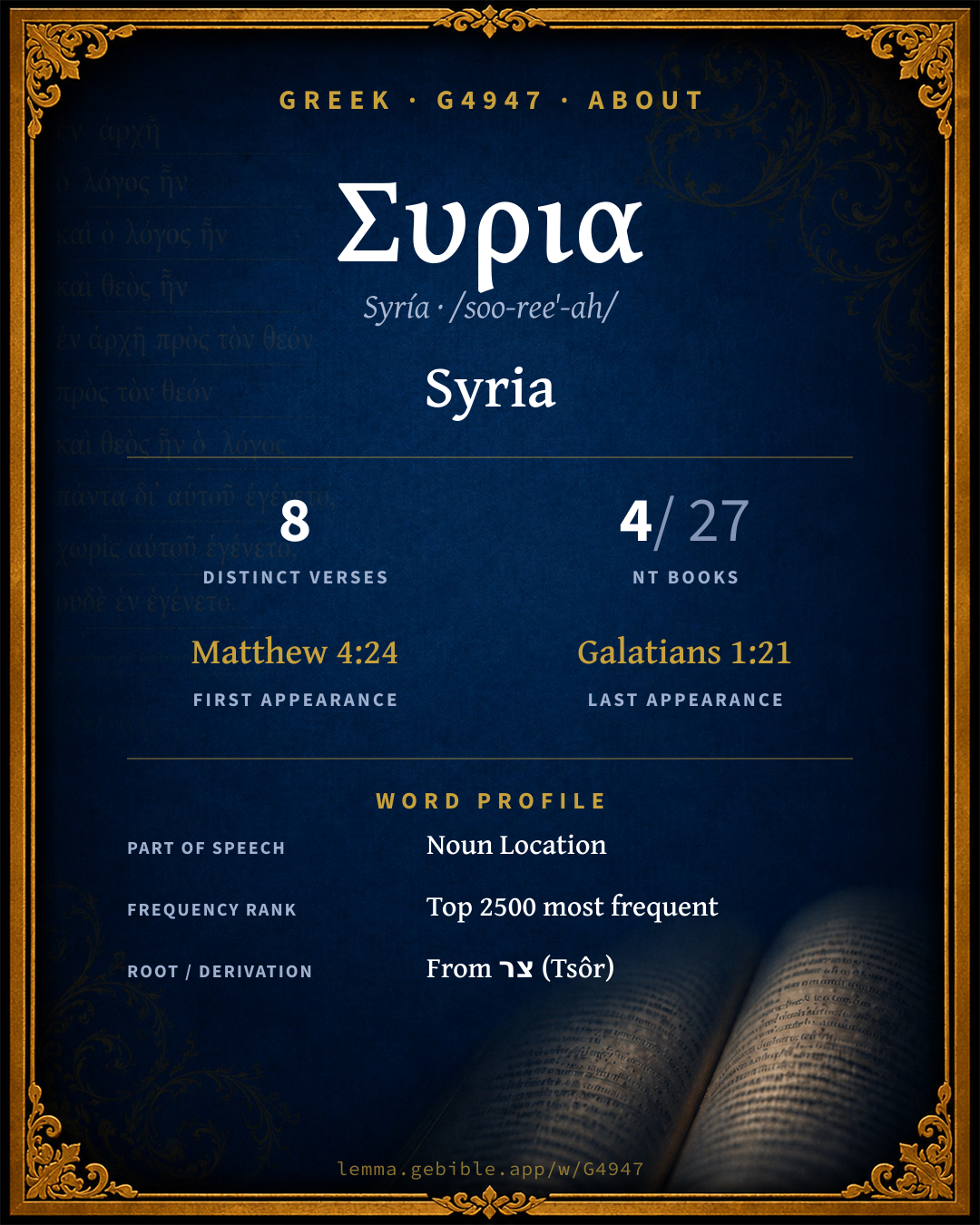
Συρία
Syria
Thayer's lists 2 entries for ‘Syria’ fuller range ↓
Full lexicon entry — Thayer's Greek Lexicon
From Thayer's Greek Lexicon
Where this word appears
See every Accusative-case word in the Greek New Testament →
Grammar key — what these labels mean
Part of speech
- Noun
- A naming word — a person, place, thing, or idea.
Case
- Accusative
- The case of the direct object and of extent.
- Genitive
- The case of source, possession, or “of” — answers “whose / from what.”
Gender
- Feminine
- Grammatically feminine.
Number
- Singular
- One.
6 distinct verses where G4947 appears in the Accusative case, across 2 books. Filtered view — show all forms. Click any verse to open its interlinear word-by-word view. Verse text shown in the World English Bible for context — . Each verse’s Greek form is shown with its reference; the English is not keyword-highlighted, since the data carries no word-level English alignment. Use “Compare translations” on any verse to read it across multiple English versions. This concordance covers the Greek New Testament; Septuagint (Greek Old Testament) occurrences of this word are not indexed here.
Matthew 1 verse
Acts 5 verses
- Acts 15:23 Συρίαν n acc sg fem They wrote these things by their hand: "The apostles, the elders, and the brothers, to the brothers who are of the Gentiles in Antioch, Syria, and Cilicia: greetings.
- Acts 15:41 Συρίαν n acc sg fem He went through Syria and Cilicia, strengthening the assemblies.
- Acts 18:18 Συρίαν n acc sg fem Paul, having stayed after this many more days, took his leave of the brothers, and sailed from there for Syria, together with Priscilla and Aquila. He shaved his head in Cenchreae, for he had a vow.
- Acts 20:3 Συρίαν n acc sg fem When he had spent three months there, and a plot was made against him by Jews as he was about to set sail for Syria, he determined to return through Macedonia.
- Acts 21:3 Συρίαν n acc sg fem When we had come in sight of Cyprus, leaving it on the left hand, we sailed to Syria, and landed at Tyre, for there the ship was to unload her cargo.
About this entry
At a glance — auto-summarized from this page’s data, not written by a person. Every figure links to its source below. This summary describes the numbers; it doesn’t interpret them.
Συρια (Syría) is a Greek name most often rendered “Syria.” It clusters heavily in Acts, which alone accounts for 63% of its uses. It turns up in 8 verses across 4 books, an uncommon footprint. Scripture first uses it in Matthew 4:24. For the data behind this summary, explore 8-verse concordance and the renderings breakdown below.
Gloss history
Strong's 1890 vs modern scholarship
About this word
Strong's G4947 catalogs a Greek word from the Greek New Testament.
These counts are not copied from any lexicon or concordance. They are computed here, from the morphology-tagged Greek New Testament. What Lemma adds →
- 8
- distinct verses
- The word appears in 8 distinct verses.
- 4 / 27
- NT books
- The word appears in 4 of 27 New Testament books.
- #1,240
- by frequency
- Top 2500 most frequent Greek words (rank 1,240 of 5,347 Greek words by occurrence).
View all 8 occurrences in the concordance →
By section of the New Testament
By traditional corpus
Conventional, traditional groupings — biblical authorship is debated, so this is a traditional corpus grouping, not an authorship claim. Some books belong to more than one corpus (Luke is in both the Gospels and the Lukan corpus, and so on), so these shares overlap and need not total 100%. Each figure is a share of the word’s 8 distinct verses.
- Lukan (Luke–Acts) 6 verses · 75%
- Gospels 2 verses · 25%
- Pauline corpus 1 verse · 13%
How translations render this word
Counts come from each version’s own published word-to-Strong’s tagging or interlinear alignment — an approximate guide to how each version renders this word, not a word-level alignment the data otherwise carries. Because each total is that version’s own tagged count, the per-version totals vary from one another and need not match the appearance or distinct-verse counts above. These counts may also differ from a printed concordance because Lemma counts each distinctly tagged rendering and does not collapse phrase taggings into a single head-word total. This is a fixed set of word-tagged versions (KJV, ASV, BSB, ULT) and does not change with the reading translation you choose elsewhere. Each version’s license is shown beside its name below (and on Sources).
- King James Version: Syria 8×
- American Standard Version: Syria 8×
- Berean Standard Bible: Syria 8×
- unfoldingWord Literal Text: Syria 8×
King James Version Public Domain
Renders G4947 across 8 tagged occurrences — most commonly:
American Standard Version Public Domain
Renders G4947 across 8 tagged occurrences — most commonly:
Berean Standard Bible Public Domain
Renders G4947 across 8 tagged occurrences — most commonly:
unfoldingWord Literal Text CC BY-SA 4.0
Renders G4947 across 8 tagged occurrences — most commonly:
Senses in Thayer's
The 2 senses Thayer's distinguishes for this word, in lexicon order (not ranked by frequency or importance). The full entry — with sub-senses — is in the Lexicon Entry tab.
- Syria = "exalted"
- a region of Asia bounded on the north by Taurus and Amanus ranges…
Word origin
Derived from צר (Tsôr) (H6865) — Tyre.
Probably of hebrew origin [ H6865 ]; Syria (that is Tsyria or Tyre ) a region of Asia : - Syria.
— Strong’s Exhaustive Concordance (1890), public domain.
Forms in the corpus
The 2 distinct written forms G4947 takes in the Greek New Testament, most frequent first — each parse links to that case’s occurrences in the concordance.
| Form | Parsing | Example | Uses |
|---|---|---|---|
| Συρίαν Syrían | Noun, Accusative, Singular, Feminine | Matthew 4:24 | 6 |
| Συρίας Syrías | Noun, Genitive, Singular, Feminine | Luke 2:2 | 2 |
Same root — word family
Other Thayer's entries built from the same root as G4947, grouped by Strong’s listed origin. These share a root / origin per the lexicon — not necessarily a shared meaning. Each links to that word’s own entry.
Derives from
Proper names from this root
People and places named from this root — a name, not an additional meaning of the word.
Compare all same-root words → Showing 4 of 5 — not the complete family. 4 of the same-root words are proper names (people or places). They share a root, not necessarily a meaning.
Bible dictionary
Public-domain dictionary articles matched to this entry by name (Syria). A biblical name can be shared by more than one person or place, so an article may treat several.
Easton's Bible Dictionary · M. G. Easton, 1897
(Heb. Aram), the name in the Old Testament given to the whole country which lay to the north-east of Phoenicia, extending to beyond the Euphrates and the Tigris. Mesopotamia is called (Gen. 24:10; Deut. 23:4) Aram-naharain (=Syria of the two rivers), also Padan-aram (Gen. 25:20). Other portions of Syria were also known by separate names, as Aram-maahah (1 Chr. 19:6), Aram-beth-rehob (2 Sam. 10:6), Aram-zobah (2 Sam. 10:6, 8). All these separate little kingdoms afterwards became subject to Damascus. In the time of the Romans, Syria included also a part of Palestine and Asia Minor.
"From the historic annals now accessible to us, the history of Syria may be divided into three periods: The first, the period when the power of the Pharaohs was dominant over the fertile fields or plains of Syria and the merchant cities of Tyre and Sidon, and when such mighty conquerors as Thothmes III. and Rameses II. could claim dominion and levy tribute from the nations from the banks of the Euphrates to the borders of the Libyan desert. Second, this was followed by a short period of independence, when the Jewish nation in the south was growing in power, until it reached its early zenith in the golden days of Solomon; and when Tyre and Sidon were rich cities, sending their traders far and wide, over land and sea, as missionaries of civilization, while in the north the confederate tribes of the Hittites held back the armies of the kings of Assyria. The third, and to us most interesting, period is that during which the kings of Assyria were dominant over the plains of Syria; when Tyre, Sidon, Ashdod, and Jerusalem bowed beneath the conquering armies of Shalmaneser, Sargon, and Sennacherib; and when at last Memphis and Thebes yielded to the power of the rulers of Nineveh and Babylon, and the kings of Assyria completed with terrible fulness the bruising of the reed of Egypt so clearly foretold by the Hebrew prophets.", Boscawen.
Smith's Bible Dictionary · William Smith, 1863
is the term used throughout our version for the Hebrew Aram, as well as for the Greek Zupia . Most probably Syria is for Tsyria, the country about Tsur or Tyre which was the first of the Syrian towns known to the Greeks. It is difficult to fix the limits of Syria. The limits of the Hebrew Aram and its subdivisions are spoken of under Aram. Syria proper was bounded by Amanus and Taurus on the north by the Euphrates and the Arabian desert on the east, by Palestine on the south, by the Mediterranean near the mouth of the Orontes, and then by Phoenicia on the west. This tract is about 300 miles long from north to south, and from 50 to 150 miles broad. It contains an area of about 30,000 square miles. General physical features .--The general character of the tract is mountainous, as the Hebrew name Aram (from a roof signifying "height") sufficiently implies. The most fertile and valuable tract of Syria is the long valley intervening between Libanus and Anti-Libanus. Of the various mountain ranges of Syria, Lebanon possesses the greatest interest. It extends from the mouth of the Litany to Arka, a distance of nearly 100 miles. Anti-Libanus, as the name implies, stands lover against Lebanon, running in the same direction, i.e. nearly north and south, and extending the same length. [Lebanon] The principal rivers of Syria are the Litany and the Orontes. The Litany springs from a small lake situated in the middle of the Coele-Syrian valley, about six miles to the southwest of Baalbek. It enters the sea about five miles north of Tyre. The source of the Orontes is but about 15 miles from that of the Litany. Its modern name is the Nahr-el-Asi, or "rebel stream," an appellation given to it on account of its violence and impetuosity in many parts of its course. The chief towns of Syria may be thus arranged, as nearly as possible in the order of their importance: 1, Antioch; 2, Damascus; 3, Apamea; 4, Seleucia; 5, Tadmor or Palmyra; 6, Laodicea; 7, Epiphania (Hamath); 8, Samosata; 9, Hierapolis (Mabug); 10, Chalybon; 11, Emesa; 12, Heliopolis; 13, Laodicea ad Libanum; 14, Cyrrhus; 15, Chalcis; 16, Poseideum; 17, Heraclea; 18, Gindarus; 19, Zeugma; 20, Thapsacus. Of these, Samosata, Zeugma and Thapsacus are on the Euphrates; Seleucia, Laodicea, Poseideum and Heraclea, on the seashore, Antioch, Apamea, Epiphania and Emesa (Hems), on the Orontes; Heliopolis and Laodicea ad Libanum, in Coele-Syria; Hierapolis, Chalybon, Cyrrhus, Chalcis and Gindarns, in the northern highlands; Damascus on the skirts, and Palmyra in the centre, of the eastern desert. History.--The first occupants of Syria appear to have been of Hamitic descent--Hittites, Jebusites, Amorites, etc. After a while the first comers, who were still to a great extent nomads, received a Semitic infusion, while most Probably came to them from the southeast. The only Syrian town whose existence we find distinctly marked at this time is Damascus, (Genesis 14:15; 15:2) which appears to have been already a place of some importance. Next to Damascus must be placed Hamath. (Numbers 13:21; 34:8) Syria at this time, and for many centuries afterward, seems to have been broken up among a number of petty kingdoms. The Jews first come into hostile contact with the Syrians, under that name, in the time of David. (Genesis 15:18; 2 Samuel 8:3,4,13) When, a few years later, the Ammonites determined on engaging in a war with David, and applied to the Syrians for aid, Zolah, together with Beth-rehob sent them 20,000 footmen, and two other Syrian kingdoms furnished 13,000. (2 Samuel 10:6) This army being completely defeated by Joab, Hadadezer obtained aid from Mesopotamia, ibid. ver. 16, and tried the chance of a third battle, which likewise went against him, and produced the general submission of Syria to the Jewish monarch. The submission thus begun continued under the reign of Solomon. (1 Kings 4:21) The only part of Syria which Solomon lost seems to have been Damascus, where an independent kingdom was set up by Rezon, a native of Zobah. (1 Kings 11:23-25) On the separation of the two kingdoms, soon after the accession of Rehoboam, the remainder of Syria no doubt shook off the yoke. Damascus now became decidedly the leading state, Hamath being second to it, and the northern Hittites, whose capital was Carchemish, near Bambuk, third. [Damascus] Syria became attached to the great Assyrian empire, from which it passed to the Babylonians, and from them to the Persians, In B.C. 333 it submitted to Alexander without a struggle. Upon the death of Alexander, Syria became, for the first time the head of a great kingdom. On the division of the provinces among his generals, B.C. 321, Seleucus Nicator received Mesopotamia and Syria. The city of Antioch was begun in B.C. 300, and, being finished in a few years, was made the capital of Seleucus' kingdom. The country grew rich with the wealth which now flowed into it on all sides. Syria was added to the Roman empire by Pompey, B.C. 64, and as it holds an important place, not only in the Old Testament but in the New, some account of its condition under the Romans must be given. While the country generally was formed into a Roman province, under governors who were at first proprietors or quaestors, then procounsuls, and finally legates, there were exempted from the direct rule of the governor in the first place, a number of "free cities" which retained the administration of their own affairs, subject to a tribute levied according to the Roman principles of taxation; secondly, a number of tracts, which were assigned to petty princes, commonly natives, to be ruled at their pleasure, subject to the same obligations with the free cities as to taxation. After the formal division of the provinces between Augustus and the senate, Syria, being from its exposed situation among the province principis, were ruled by legates, who were of consular rank (consulares) and bore severally the full title of "Legatus Augusti pro praetore." Judea occupied a peculiar position; a special procurator was therefore appointed to rule it, who was subordinate to the governor of Syria, but within his own province had the power of a legatus. Syria continued without serious disturbance from the expulsion of the Parthians, B.C. 38, to the breaking out of the Jewish war, A.D. 66. in A.D. 44-47 it was the scene of a severe famine. A little earlier, Christianity had begun to spread into it, partly by means of those who "were scattered" at the time of Stephen's persecution, (Acts 11:19) partly by the exertions of St. Paul. (Galatians 1:21) The Syrian Church soon grew to be one of the most flourishing (Acts 13:1; 15:23,35,41) etc. (Syria remained under Roman and Byzantine rule till A.D. 634, when it was overrun by the Mohammedans; after which it was for many years the scene of fierce contests, and was finally subjugated by the Turks, A.D. 1517, under whose rule it still remains.--ED.)
Classic public-domain reference works; full attribution on Sources.
Septuagint usage
The same Greek word Συρια appears 111 times in the Greek Old Testament (Septuagint), across 101 verses in 14 books.
- 111
- LXX occurrences
- Tagged occurrences of this Greek word in the Septuagint.
- 101
- verses
- Distinct Septuagint verses containing this word.
- 14 / 39
- OT books
- The word appears in 14 of the 39 Old Testament books.
Sample Septuagint occurrences
- Genesis 28:6 συρία
- Deuteronomy 26:5 συρία
- Judges 3:8 συρία
- 2 Samuel 8:5 συρία
- 1 Kings 10:29 συρία
- 2 Kings 5:1 συρία
- 1 Chronicles 18:6 συρία
- 2 Chronicles 1:17 συρία
- Psalms 59:2 συρία
- Isaiah 9:11 συρία
- Ezekiel 16:57 συρία
- Hosea 12:13 συρία
Septuagint occurrences (same lexeme)
Every verse where the same Strong’s number (G4947) appears in the Greek Septuagint — showing the first 50 of 101. Verse text shown in the World English Bible for context; the Greek form is the matched word — the English is not keyword-highlighted.
- Genesis 28:6 συρία Now Esau saw that Isaac had blessed Jacob and sent him away to Paddan Aram, to take him a wife from there, and that as he blessed him he gave him a charge, saying, "You shall not take a wife of the daughters of Canaan,"
- Genesis 28:7 συρία and that Jacob obeyed his father and his mother, and was gone to Paddan Aram.
- Genesis 33:18 συρία Jacob came in peace to the city of Shechem, which is in the land of Canaan, when he came from Paddan Aram; and encamped before the city.
- Genesis 35:9 συρία God appeared to Jacob again, when he came from Paddan Aram, and blessed him.
- Genesis 35:26 συρία The sons of Zilpah (Leah's handmaid): Gad and Asher. These are the sons of Jacob, who were born to him in Paddan Aram.
- Genesis 46:15 συρία These are the sons of Leah, whom she bore to Jacob in Paddan Aram, with his daughter Dinah. All the souls of his sons and his daughters were thirty-three.
- Genesis 48:7 συρία As for me, when I came from Paddan, Rachel died by me in the land of Canaan in the way, when there was still some distance to come to Ephrath, and I buried her there in the way to Ephrath (the same is Bethlehem)."
- Deuteronomy 26:5 συρία You shall answer and say before Yahweh your God, A Syrian ready to perish was my father; and he went down into Egypt, and sojourned there, few in number; and he became there a nation, great, mighty, and populous.
- Judges 3:8 συρία Therefore the anger of Yahweh was kindled against Israel, and he sold them into the hand of Cushan Rishathaim king of Mesopotamia: and the children of Israel served Cushan Rishathaim eight years.
- Judges 3:10 συρία The Spirit of Yahweh came on him, and he judged Israel; and he went out to war, and Yahweh delivered Cushan Rishathaim king of Mesopotamia into his hand: and his hand prevailed against Cushan Rishathaim.
- 2 Samuel 8:5 συρία When the Syrians of Damascus came to help Hadadezer king of Zobah, David struck of the Syrians two and twenty thousand men.
- 2 Samuel 8:6 συρία Then David put garrisons in Syria of Damascus; and the Syrians became servants to David, and brought tribute. Yahweh gave victory to David wherever he went.
- 2 Samuel 10:6 συρία When the children of Ammon saw that they were become odious to David, the children of Ammon sent and hired the Syrians of Beth Rehob, and the Syrians of Zobah, twenty thousand footmen, and the king of Maacah with one thousand men, and the men of Tob twelve thousand men.
- 2 Samuel 10:8 συρία The children of Ammon came out, and put the battle in array at the entrance of the gate: and the Syrians of Zobah and of Rehob, and the men of Tob and Maacah, were by themselves in the field.
- 2 Samuel 10:9 συρία Now when Joab saw that the battle was set against him before and behind, he chose of all the choice men of Israel, and put them in array against the Syrians:
- 2 Samuel 10:11 συρία He said, If the Syrians be too strong for me, then you shall help me; but if the children of Ammon be too strong for you, then I will come and help you.
- 2 Samuel 10:13 συρία So Joab and the people who were with him drew near to the battle against the Syrians: and they fled before him.
- 2 Samuel 10:14 συρία When the children of Ammon saw that the Syrians were fled, they likewise fled before Abishai, and entered into the city. Then Joab returned from the children of Ammon, and came to Jerusalem.
- 2 Samuel 10:15 συρία When the Syrians saw that they were put to the worse before Israel, they gathered themselves together.
- 2 Samuel 10:16 συρία Hadarezer sent, and brought out the Syrians who were beyond the River: and they came to Helam, with Shobach the captain of the host of Hadarezer at their head.
- 2 Samuel 10:17 συρία It was told David; and he gathered all Israel together, and passed over the Jordan, and came to Helam. The Syrians set themselves in array against David, and fought with him.
- 2 Samuel 10:18 συρία The Syrians fled before Israel; and David killed of the Syrians [the men of] seven hundred chariots, and forty thousand horsemen, and struck Shobach the captain of their host, so that he died there.
- 2 Samuel 10:19 συρία When all the kings who were servants to Hadarezer saw that they were put to the worse before Israel, they made peace with Israel, and served them. So the Syrians feared to help the children of Ammon any more.
- 2 Samuel 15:8 συρία For your servant vowed a vow while I abode at Geshur in Syria, saying, If Yahweh shall indeed bring me again to Jerusalem, then I will serve Yahweh.
- 1 Kings 10:29 συρία A chariot came up and went out of Egypt for six hundred [shekels] of silver, and a horse for one hundred fifty; and so for all the kings of the Hittites, and for the kings of Syria, did they bring them out by their means.
- 1 Kings 15:18 συρία Then Asa took all the silver and the gold that were left in the treasures of the house of Yahweh, and the treasures of the king's house, and delivered them into the hand of his servants; and king Asa sent them to Ben Hadad, the son of Tabrimmon, the son of Hezion, king of Syria, who lived at Damascus, saying,
- 1 Kings 16:28 συρία So Omri slept with his fathers, and was buried in Samaria; and Ahab his son reigned in his place.
- 1 Kings 19:15 συρία Yahweh said to him, Go, return on your way to the wilderness of Damascus: and when you come, you shall anoint Hazael to be king over Syria;
- 1 Kings 21:17 συρία The word of Yahweh came to Elijah the Tishbite, saying,
- 1 Kings 21:20 συρία Ahab said to Elijah, Have you found me, my enemy? He answered, I have found you, because you have sold yourself to do that which is evil in the sight of Yahweh.
- 1 Kings 21:21 συρία Behold, I will bring evil on you, and will utterly sweep you away and will cut off from Ahab every man-child, and him who is shut up and him who is left at large in Israel:
- 1 Kings 21:22 συρία and I will make your house like the house of Jeroboam the son of Nebat, and like the house of Baasha the son of Ahijah for the provocation with which you have provoked me to anger, and have made Israel to sin.
- 1 Kings 21:23 συρία Of Jezebel also spoke Yahweh, saying, The dogs shall eat Jezebel by the rampart of Jezreel.
- 1 Kings 21:26 συρία He did very abominably in following idols, according to all that the Amorites did, whom Yahweh cast out before the children of Israel.)
- 1 Kings 21:27 συρία It happened, when Ahab heard those words, that he tore his clothes, and put sackcloth on his flesh, and fasted, and lay in sackcloth, and went softly.
- 1 Kings 21:28 συρία The word of Yahweh came to Elijah the Tishbite, saying,
- 1 Kings 21:29 συρία See you how Ahab humbles himself before me? because he humbles himself before me, I will not bring the evil in his days; but in his son's days will I bring the evil on his house.
- 1 Kings 22:1 συρία They continued three years without war between Syria and Israel.
- 1 Kings 22:3 συρία The king of Israel said to his servants, "You know that Ramoth-gilead is ours, and we are still, and don't take it out of the hand of the king of Syria?"
- 1 Kings 22:11 συρία Zedekiah the son of Chenaanah made him horns of iron, and said, Thus says Yahweh, With these shall you push the Syrians, until they be consumed.
- 1 Kings 22:12 συρία All the prophets prophesied so, saying, Go up to Ramoth-gilead, and prosper; for Yahweh will deliver it into the hand of the king.
- 1 Kings 22:31 συρία Now the king of Syria had commanded the thirty-two captains of his chariots, saying, Fight neither with small nor great, save only with the king of Israel.
- 1 Kings 22:35 συρία The battle increased that day: and the king was stayed up in his chariot against the Syrians, and died at even; and the blood ran out of the wound into the bottom of the chariot.
- 2 Kings 5:1 συρία Now Naaman, captain of the host of the king of Syria, was a great man with his master, and honorable, because by him Yahweh had given victory to Syria: he was also a mighty man of valor, [but he was] a leper.
- 2 Kings 5:2 συρία The Syrians had gone out in bands, and had brought away captive out of the land of Israel a little maiden; and she waited on Naaman's wife.
- 2 Kings 5:5 συρία The king of Syria said, Go now, and I will send a letter to the king of Israel. He departed, and took with him ten talents of silver, and six thousand [pieces] of gold, and ten changes of clothing.
- 2 Kings 6:8 συρία Now the king of Syria was warring against Israel; and he took counsel with his servants, saying, In such and such a place shall be my camp.
- 2 Kings 6:9 συρία The man of God sent to the king of Israel, saying, Beware that you not pass such a place; for there the Syrians are coming down.
- 2 Kings 6:11 συρία The heart of the king of Syria was sore troubled for this thing; and he called his servants, and said to them, Won't you show me which of us is for the king of Israel?
- 2 Kings 6:23 συρία He prepared great provision for them; and when they had eaten and drunk, he sent them away, and they went to their master. The bands of Syria came no more into the land of Israel.
These are occurrences of the same Greek lexeme (G4947) in the Septuagint — not a translation of any one Hebrew word. The store carries no word-level Hebrew↔Greek alignment, so no Hebrew original is asserted here. Counts come from the recovered LXX Strong's tagging — high-frequency vocabulary is well covered, while rare or late forms may be untagged — so they reflect tagged occurrences and may slightly undercount.