Acts 15:41

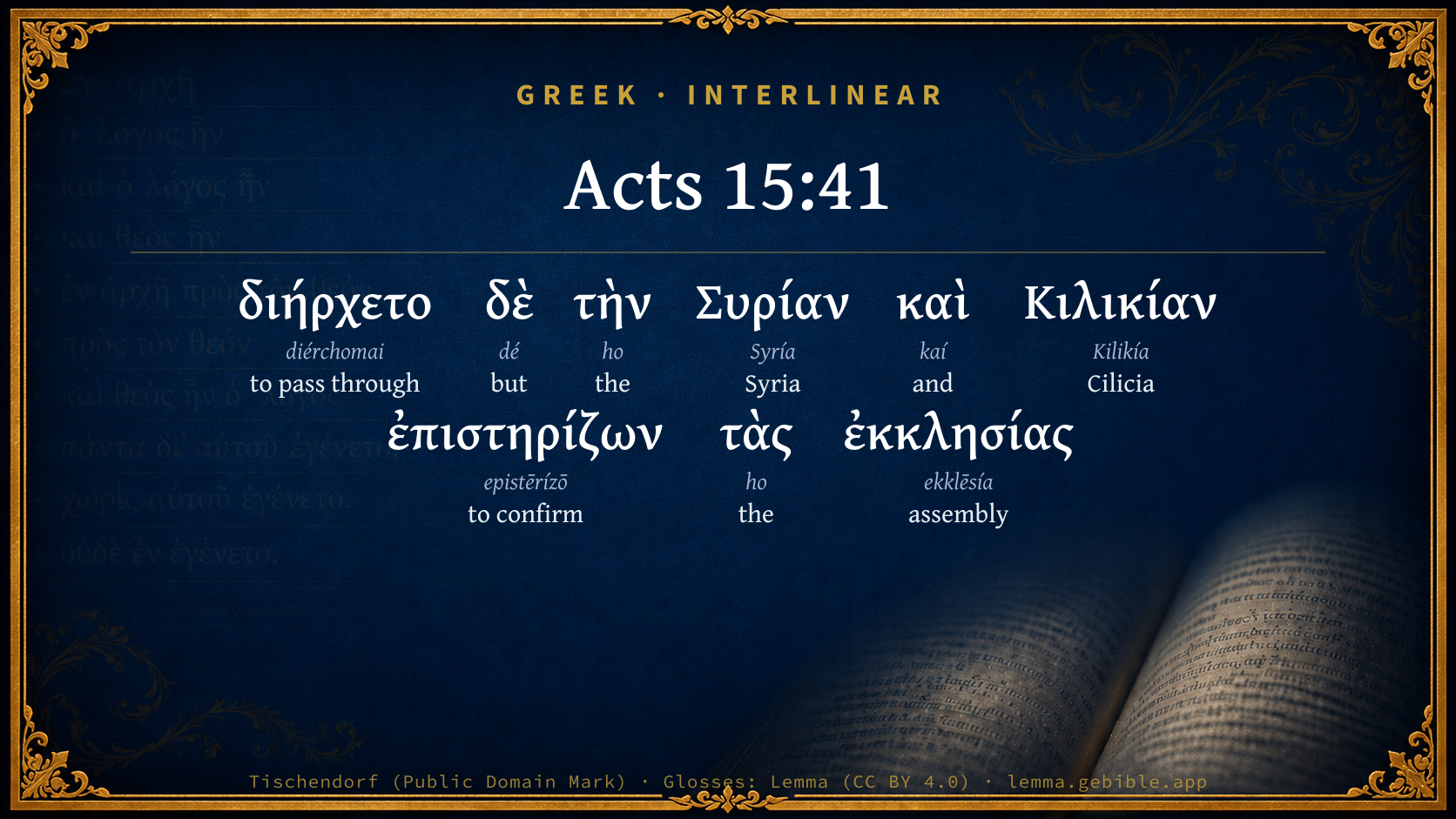
Greek (Tischendorf 8th ed.) Acts 15:41 appears in the Greek New Testament. The text above is from the Tischendorf 8th edition. Each word links to its Strong’s number and a concise gloss. Click any word for its full Thayer’s Greek Lexicon entry.
Download image
Cite this verse

Acts 15:41 (World English Bible). Public Domain. Lemma interlinear Bible study tool, https://lemma.gebible.app/v/acts/15/41.

Show BibTeX & RIS
BibTeX
RIS
English Translation
He went through Syria and Cilicia, strengthening the assemblies.
World English Bible · Public Domain
Download a study sheet

One document with this verse’s original text, its word-by-word gloss line, the meaning frame, cross-references with their text, attributed commentary, and full source and license credits — printable, and it pastes into notes with its structure intact.

This verse Autodidact and up

Study sheet (.html) Plain text (.txt)

A passage Seminary Student

Up to 50 verses in one chapter. A passage sheet keeps up to 6 commentary sources and 12 cross-references per verse, in the order this page ranks them, and says so on the sheet whenever that leaves anything out. Ask for a single verse and you get the Autodidact verse sheet above.

Everything on this page stays free to read, with no account — the sheet is a download of what is already on screen, not access to it.

Want to remove ads? Support Godless Engineer
Compare translations 3

The same verse in 3 English versions, stacked beneath the original-language interlinear above. Click any original word for its lexicon entry.

Each is an independent rendering of the whole verse — the interlinear is not word-aligned to these translations.

Highlighted words mark where these versions differ — a whole-verse word diff, not a word-by-word alignment.

  • World English Bible Public Domain
    He went through Syria and Cilicia, strengthening the assemblies.
  • King James Version Public Domain
    And he went through Syria and Cilicia, confirming the churches.
  • unfoldingWord Literal Text CC BY-SA 4.0
    And he was going through Syria and Cilicia, strengthening the churches.

unfoldingWord Literal Text — © unfoldingWord, licensed CC BY-SA 4.0. Word-aligned USFM3 via Door43 (git.door43.org/unfoldingWord/en_ult).

Versions to compare (up to 4)

3 of 4 selected

Show all 19 translations

Every available English version of this verse, each an independent rendering of the whole verse.

  • World English Bible Public Domain
    He went through Syria and Cilicia, strengthening the assemblies.
  • Berean Standard Bible Public Domain
    And he traveled through Syria and Cilicia, strengthening the churches.
  • Majority Standard Bible Public Domain
    And he traveled through Syria and Cilicia, strengthening the churches.
  • King James Version Public Domain
    And he went through Syria and Cilicia, confirming the churches.
  • American Standard Version (1901) Public Domain
    And he went through Syria and Cilicia, confirming the churches.
  • Revised Version (1885) Public Domain
    And he went through Syria and Cilicia, confirming the churches.
  • Geneva Bible (1599) Public Domain
    And he went through Syria and Cilicia, stablishing the Churches.
  • Douay-Rheims (1899) Public Domain
    And he went through Syria and Cilicia, confirming the churches, commanding them to keep the precepts of the apostles and the ancients.
  • Young's Literal Translation Public Domain
    and he went through Syria and Cilicia, confirming the assemblies.
  • Literal Standard Version CC BY-SA 4.0
    and he went through Syria and Cilicia, confirming the assemblies.
  • Unlocked Literal Bible CC BY-SA 4.0
    Then he went through Syria and Cilicia, strengthening the churches.
  • unfoldingWord Literal Text CC BY-SA 4.0
    And he was going through Syria and Cilicia, strengthening the churches.
  • Darby Bible Public Domain
    And he passed through Syria and Cilicia, confirming the assemblies.
  • World Messianic Bible Public Domain
    He went through Syria and Cilicia, strengthening the assemblies.
  • Webster's Bible Public Domain
    And he went through Syria and Cilicia, confirming the churches.
  • Free Bible Version CC BY-SA 4.0
    Paul traveled through Syria and Cilicia, encouraging the churches there.
  • Bible in Basic English Public Domain
    And he went through Syria and Cilicia, making the churches stronger in the faith.
  • Text-Critical English NT CC BY 4.0
    And he went through Syria and Cilicia, strengthening the churches.
  • Tyndale New Testament (1534) Public Domain
    And he went thorowe all Cyria and Cilicia stablisshynge the congregacions.

Literal Standard Version (2020), Covenant Press — licensed CC BY-SA 4.0. Text via the HelloAO Bible API (eBible.org). Unlocked Literal Bible (unfoldingWord) — licensed CC BY-SA 4.0. Text via the HelloAO Bible API (eBible.org). unfoldingWord Literal Text — © unfoldingWord, licensed CC BY-SA 4.0. Word-aligned USFM3 via Door43 (git.door43.org/unfoldingWord/en_ult). Free Bible Version, Dr. Jonathan Gallagher — licensed CC BY-SA 4.0. Text via the HelloAO Bible API (eBible.org).

Word by word

More ways to search: Search by grammar → Find every occurrence → Compare this word →

Practice this passage: Drill this verse → Learn its vocabulary →

About this verse

These counts appear in no published source. They are computed here, from the morphology-tagged text and Lemma’s own curated glosses. What Lemma adds →

9
words
8
distinct lemmas
Acts
section

Notable vocabulary

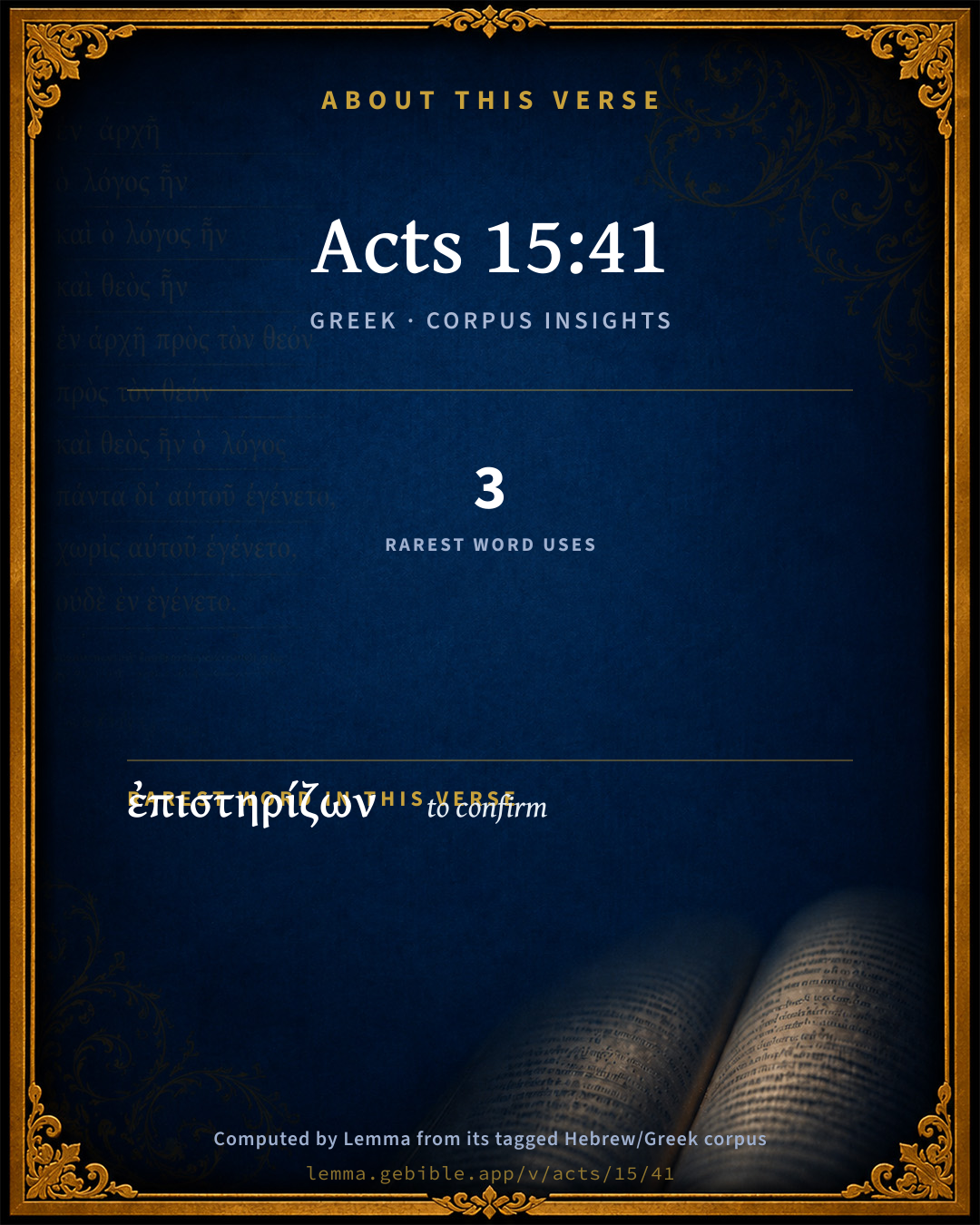
The rarest word here is ἐπιστηρίζων to confirm G1991 — appearing just 3 times in the whole Greek New Testament.

Shared distinctive vocabulary

ἐπιστηρίζων to confirm G1991 occurs in 3 verses of the Greek New Testament. Also found in:

Repetition

A word recurs within this verse:

Cross-references

7

Topical passages linked to Acts 15:41 in the Treasury of Scripture Knowledge — connected by theme and wording, ordered by reader-vote popularity; previews shown in the World English Bible.

  • Acts 15:23 They wrote these things by their hand: "The apostles, the elders, and the brothers, to the brothers who are of the Gentiles in Antioch, Syria, and Cilicia: greetings.
  • Acts 15:32 Judas and Silas, also being prophets themselves, encouraged the brothers with many words, and strengthened them.
  • Galatians 1:21 Then I came to the regions of Syria and Cilicia.
  • Acts 6:9 But some of those who were of the synagogue called "The Libertines," and of the Cyrenians, of the Alexandrians, and of those of Cilicia and Asia arose, disputing with Stephen.
  • Acts 16:4–5 As they went on their way through the cities, they delivered the decrees to them to keep which had been ordained by the apostles and elders who were at Jerusalem.
  • Acts 21:3 When we had come in sight of Cyprus, leaving it on the left hand, we sailed to Syria, and landed at Tyre, for there the ship was to unload her cargo.
  • Acts 18:18 Paul, having stayed after this many more days, took his leave of the brothers, and sailed from there for Syria, together with Priscilla and Aquila. He shaved his head in Cenchreae, for he had a vow.

Cross-references courtesy of OpenBible.info (CC BY 4.0).

Commentary

Notes on Acts 15:41 from classic Christian and Jewish commentators (each source and its license shown beneath its notes). The classic Christian expositions comment on the surrounding passage and are grouped to its opening verse, so a note may address several verses; the Jewish commentaries on the Tanakh (Rashi and others) are per-verse, so they appear only where the commentator wrote on this verse.

Lemma curates 59 commentaries, every one of them public domain or Creative Commons licensed, each selected and text-cleaned for this edition rather than reprinted as found. About our sources →

Jamieson, Fausset & Brown

Robert Jamieson, A. R. Fausset & David Brown

and he went through Syria and Cilicia, confirming the churches--"It is very likely that Paul and Barnabas made a deliberate and amicable arrangement to divide the region of their first mission between them; Paul taking the continental, and Barnabas the insular, part of the proposed visitation. If Barnabas visited Salamis and Paphos, and if Paul (travelling westward), after passing through Derbe, Lystra, and Iconium, went as far as Antioch in Pisidia, the whole circuit of the proposed visitation was actually accomplished, for it does not appear that any converts had been made at Perga and Attalia" [HOWSON]. "This second missionary tour appears to have proceeded at first solely from the desire of visiting the churches already planted. In the end, however, it took a much wider sweep, for it brought the apostle to Europe" [OLSHAUSEN].

PAUL'S SECOND MISSIONARY JOURNEY.

VISITATION OF THE CHURCHES FORMERLY ESTABLISHED, TIMOTHEUS HERE JOINING THE MISSIONARY PARTY. (Acts 15:41-16:5)

he went through Syria and Cilicia--(See on Act 15:23). Taking probably the same route as when despatched in haste from Jerusalem to Tarsus, he then went by land (see on Act 9:30).

Next: Acts Chapter 16

Jamieson, Fausset & Brown — Commentary Critical and Explanatory on the Whole Bible (1871) — public domain (CC PDM 1.0). Text via the HelloAO Bible API.

Bengel's Gnomon

Johann Albrecht Bengel

Act 15:41. Διήρχετο, he went through) Act 15:36.

Bengel's Gnomon of the New Testament — English translation (T&T Clark, Edinburgh, 1860) — public domain. Text from a community e-Sword module.

Expositor's Greek Testament

ed. W. Robertson Nicoll

Act 15:41 . διήρχετο , see above on Act 13:6 . Συρίαν καὶ Κιλικίαν : as Barnabas had turned to Cyprus, the scene of his early labours in the Gospel, and perhaps also his own home, so Paul turned to Syria and Cilicia, not only because his home was in Cilicia, but also because he had worked there in his early Christian life and labours, Gal 1:21 ; Gal 1:23 . It is a coincidence with the notice in Gal. that St. Luke here and in Act 15:23 presupposes the existence of Churches in Syria and Cilicia, although nothing had been previously said of their foundation, whilst the presence of Saul at Tarsus is twice intimated, Act 9:30 , Act 11:25 . Moreover the commencement of the letter, Act 15:22-23 , indicates that these regions had been the centre of the teaching of the Judaisers, and St. Paul’s presence, together with the fact that Silas, a prominent and leading member of the Jerusalem Church, was his colleague, would doubtless help to prevent further disquiet. On the addition to the verse in the Bezan text see critical note.

Additional note (1).

Amongst recent writers on the Acts , Mr. Rendall has stated that the evidence for the identification of Act 15 with Gal 2:1-10 is overwhelming, Appendix to Acts, pp. 357, 359. If we cannot fully endorse this, it is at all events noticeable that critics of widely different schools of thought have refused to regard the alleged differences between the two as irreconcilable; in this conservative writers like Lechler, Godet, Belser, Knabenbauer and Zahn, Einleitung , ii., 627, 628; scientific critics, as we may call them, like Reuss, B. Weiss; and still more advanced critics like Lipsius and H. Holtzmann are agreed. This general agreement is recognised and endorsed by Wendt, p. 255 (1899), see also K. Schmidt, “Apostelkonvent,” in Real-Encyclopädie für protest. Theol. (Hauck), p. 704 ff. Amongst English writers Lightfoot, Hort, Sanday, Salmon, Drummond, Turner may be quoted on the same side (so too McGiffert, Apostolic Age , p. 208), (see for the points of agreement, Lightfoot, Galatians , p. 123; Drummond, Galatians , p. 73 ff.; Salmon, “Galatians,” B.D. 2 ; Reuss, Geschichte des h. . des N. T. , p. 60, sixth edition, and very fully in Belser, Die Selbstvertheidigung der h. Paulus im Galaterbriefe , p. 83 ff., 1896; for the difficulty in identifying Gal 2 with any other visit of St. Paul to Jerusalem, cf. Salmon, Lightfoot, u. s. , and Zahn, u. s. , Felten, Introd. to Apostelgeschichte , p. 46). But the recent forcible attempt of Professor Ramsay to identify Gal 2:1-10 with St. Paul’s second visit to Jerusalem, Act 11:30 ; Act 12:25 , and not with the third visit, Act 15 , has opened up the whole question again (see on the same identification recently proposed from a very different point of view by Völter, Witness of the Epistles , p. 231, and also by Spitta, Apostelgeschichte , p. 184). At first sight it is no doubt in favour of this conclusion that according to Acts the journey, Act 11:30 , is the second made by St. Paul to Jerusalem, and the journey in 15 the third, whilst Gal 2:1 also describes a journey which the Apostle himself represents as his second to the mother-city. We cannot fairly solve this difficulty by cutting the knot with McGiffert, who regards Act 11:30 ; Act 11:15 as = Gal 2:1-10 , and thinks that Luke found two independent accounts of the same journey, and supposed them to refer to separate events ( Apostolic Age , p. 171); or by concluding with Drummond, Galatians , p. 78, that the writer of Acts made a mistake in bringing St. Paul to Jerusalem at the time of the famine, so that Gal 2 and Act 15 both refer to his second visit ( cf. to the same effect, Wendt, p. 218 (1899), who looks upon the visit described in Act 11:25 as a mistake of the author, at all events as regards Paul). But McGiffert and Drummond are both right in emphasising one most important and, as it seems to us, crucial difficulty in the way of the view advocated by Ramsay; if he is correct, it is difficult to see any object in the visit described in Act 15 . After the decision already arrived at in Gal 2:1-10 : Act 11:30 ; Act 12:25 , the question then ex hypothesi at issue could scarcely have been raised again in the manner described in Act 15 . Moreover, whilst Ramsay admits that another purpose was achieved by the journey to Jerusalem described in Gal 2:1-10 , although only as a mere private piece of business, St. Paul , p. 57, he maintains that the special and primary object of the visit was to relieve the poor. But if the pillars of the Church were already aware, as ex hypothesi they must have been aware, that St. Paul came to Jerusalem bringing food and money for the poor (Act 11:29-30 ), we may be pardoned for finding it difficult to believe that the “one charge alone” (Gal 2:10 ) which they gave him was to do the very thing which he actually came for the purpose of doing. If, too, Barnabas and Saul had just been associated in helping the poor, and if the expression ὃ καὶ ἐσπούδασα , Gal 2:10 , refers, as Professor Ramsay holds, to this service, we should hardly have expected Paul to use the first person singular, but rather to have associated Barnabas with himself in his reference to their work of love and danger. Professor Ramsay emphasises the fact ( Expositor , p. 183, March, 1896) that Luke pointedly records that the distribution was carried out to its completion by Barnabas and Saul in person (Act 12:25 ). Why then does Paul only refer to his own zeal in remembering the poor in Act 11:29 ; Act 12:25 = Gal 2:1-10 ? (On the force of the aorist as against Professor Ramsay’s view, see Expositor , March, 1899, p. 221, Mr. Vernon Bartlet’s note.) Gal 2:10 should rather be read in the light of 1Co 16:1-3 ; if the first-named Epistle was also the first in point of time, then we can understand how, whilst it contains no specific and definite mention of a collection for the Church at Jerusalem, which is so emphasised in 1Co 16:1 , 2Co 8:9 , etc., yet the eager desire of the pillars of the Church that the poor in Judæa should be remembered, and the thought of a fund for supplying their needs, may well have been working in St. Paul’s mind from the earlier time of the expression of that desire and need, Gal 2:10 , Expositor , November, 1893, “Pauline Collection for the Saints,’ and April, 1894, “The Galatians of St. Paul,” Rendall Hort, Judaistic Christianity , p. 67.

For reasons why St. Paul did not refer to his second visit to Jerusalem when writing to the Galatians see on Act 11:30 , and Salmon, “Galatians,” B.D. 2 , p. 1111; Sanday, Expositor , February, 1896, p. 92; Hort, Judaistic Christianity , p. 61; “Acts of the Apostles,” p. 30, Hastings’ B.D. and “Chron. of the N.T.,” ibid. , p. 423; Zahn, Einleitung , ii., 629. Further: Dr. Sanday has emphasised the fact that at the time of St. Paul’s second visit to Jerusalem the state of things which we find in Act 15 (the third visit) did not exist; that a stage in the controversy as to the terms of admission of Gentile converts had been reached by the date of Act 15 which had not been reached at the date of Act 11:30 ; that at this latter date, e.g. , there was no such clear demarcation of spheres between St. Peter and St. Paul, and that it is not until Act 13:46 that the turning-point is actually reached: henceforth St. Paul assumes his true “Apostleship of the Gentiles,” and preaches a real “Gospel of the uncircumcision”; see especially Expositor , July, 1896, p. 62. Of course Professor Ramsay’s theory obliges us to place Gal 2:1-10 before the Apostolic Conference, and to suppose that when the events narrated in Gal 2 took place, the journey of Act 13:14 was still in the future. But is not the whole tone and attitude of St. Paul in Gal 2:1-10 , placing himself, e.g. , before Barnabas in Act 15:9 and evidently regarding himself as the foremost representative of one sphere of missionary work, as St. Peter was of the other, Act 15:8 , more easily explained if his first missionary journey was already an accomplished fact and not still in the future?

In the two short references to Paul’s second visit to Jerusalem, Act 11:30 ; Act 12:25 , it is still “Barnabas and Saul,” so too in Act 13:1-2 ; Act 13:7 ; not till Act 13:9 does the change come: henceforth Paul takes the lead, Act 13:13 ; Act 13:16 ; Act 13:43 ; Act 13:45 ; Act 13:50 , etc., with two exceptions as Professor Ramsay pointedly describes them (see above on Act 13:9 ), and in the account of the Conference and all connected with it St. Luke and the Church at Antioch evidently regard Paul as the leader, Act 15:2 (2), 22 (although the Church at Jerusalem places Barnabas first, Act 15:12 ; Act 15:25 ). But in Act 11:30 , Act 12:25 the historian speaks of “Barnabas and Saul”. The whole position of St. Paul assigned to him by St. Luke in Act 15 is in harmony with the Apostle’s own claims and prominence in Gal 2:1-10 ; it is not in harmony with the subordinate place which the same St. Luke assigns to him in the second visit to Jerusalem. In other words, if Gal 2:1-10 = Act 15 , then St. Paul’s claim to be an Apostle of the Gentiles is ratified by the Gentile Luke; but if Gal 2:1-10 = Act 11:30 ; Act 12:25 , then there is no hint in Acts that Luke as yet regarded Paul in any other light than a subordinate to the Hebrew Barnabas; he is still Saul, not Paul. For the points of discrepancy between Gal 2:1-10 and Act 15 see same authorities as above; one point upon which Ramsay strongly insists, viz. , that a visit which is said to be “by revelation,” Gal 2:2 , cannot be identified with a visit which takes place by the appointment of the Church, Act 15:2 , is surely hypercritical; it would not be the first occasion on which the Spirit and the Church had spoken in harmony; in Act 13:3-4 the Church ἀπέλυσαν sent away Paul and Barnabas, and yet in the next verse we read οἱ ἐκπεμφθέντες ὑπὸ τοῦ ἁγίου πνεύματος , see Lightfoot, Galatians , . 125; Drummond, Galatians , . 75; Turner, “Chronology of the N.T.,” Hastings’ B.D., p. 424; cf. also Wendt, p. 258 (1899), and Zahn, Einleitung , ii., 632, who both point out that the statements referred to are by no means mutually exclusive. On the whole question see Wendt’s 1899 edition, p. 255 ff., and Expositor , 1896 (February, March, April, July) for its full discussion by Dr. Sanday and Professor Ramsay.

A further question arises as to the position to be assigned to the incident in Gal 2:11-14 . Professor Ramsay, St. Paul , p. 157 ff., supposes that it took place before the Apostolic Conference, and finds a description of the occasion of the incident in Act 15:1 , Act 15:24 , Gal 2:12 , i.e. , in the words of three authorities, St. Luke, the Apostles at Jerusalem, and St. Paul himself; the actual conflict between St. Peter and St. Paul took place after the latter’s second visit to Jerusalem, but before his third visit. The issue of the conflict is not described by Paul, but it is implied in the events of the Jerusalem Conference, Act 15:2 ; Act 15:7 . Barnabas had wavered, but had afterwards joined Paul; Peter had been rebuked, but had received the rebuke in such a way as to become a champion of freedom in the ensuing Conference, employing to others the argument which had convinced himself, cf. Act 15:10 , Gal 2:14 . Mr. Turner, “Chronology of the N.T.,” Hastings’ B.D., i., 424, is inclined to adopt this view, which identifies the two Judaising missions from Jerusalem to Antioch, Gal 2:12 and Act 15:1 , while he still maintains the ordinary view that Gal 2:1-10 = Act 15 . This, as he points out, we may easily do, whilst Gal 2:11-14 may be allowed to precede Gal 2:1-10 in order of time, and in the absence of the ἔπειτα in Gal 1:18 ; Gal 1:21 ; Gal 2:1 there is nothing to suggest that the chronological series is continued. It may be noted that Paley, Horæ Paulinæ , v., 9, had remarked that there is nothing to hinder us from supposing that the dispute at Antioch was prior to the Conference at Jerusalem. Moreover it may be fairly urged that this view puts a more favourable construction on the conduct of St. James and St. Peter in relation to the compact which they had made with Paul at the Jerusalem Conference. But on the attitude of St. James and the expression ἐλθεῖν τινὰς ἀπὸ Ἰακώβου , see Hort, Judaistic Christianity , p. 79; Lightfoot on Gal 2:12 ; Drummond, Galatians , p. 85; and with regard to the conduct of St. Peter, see Hort, u. s. , p. 76; Lightfoot on the collision at Antioch, Galatians , p. 125 ff.; and Salmon, “Galatians,” B.D. 2 , p. 1114; Drummond, u. s. , p. 78.

On Zahn’s position that the dispute between Peter and Paul took place before the Apostolic Conference, when the former betook himself to Antioch after his liberation, Act 12:5 ff, a view put forward also by Schneckenburger, Zweck der Apostelgeschichte , p. 109 ff., see Neue Kirchl. Zeitschr. , p. 435 ff., 1894, and Belser’s criticism, Die Selbstvertheidigung des h. Paulus im Galaterbriefe , p. 127 ff., 1896 ( Biblische Studien ).

Wendt, pp. 211, 212 (1899), while declining to attempt any explanation either psychological or moral of St. Peter’s action in Gal 2:11-14 , points out with justice how perverse it is to argue that Peter could not have previously conducted himself with reference to Cornelius as Acts describes when we remember that in the incident before us Barnabas, who had been the constant companion of St. Paul in the Gentile mission, shared nevertheless in St. Peter’s weakness.

Additional note (2), cf. Act 15:29 .

A further question arises as to why the particular prohibitions of the Decree are mentioned. According to a very common view they represented the Seven Precepts of Noah, six of which were said to have been given by God to Adam, while the seventh was given as an addition to Noah. The Seven Precepts were as follows: (1) against profanation of God’s name; (2) against idolatry; (3) against fornication; (4) against murder; (5) against theft; (6) to obey those in authority; (7) against eating living flesh, i.e. , flesh with the blood in it, see Schürer Jewish People , div. ii., vol. ii., p. 318, E.T.; Hort, Judaistic Christianity , p. 69. No doubt there are points of contact between these Precepts and the four Prohibitions of the Decree, but at the same time it would seem that there are certainly four of the Precepts to which there is nothing corresponding in the Decree. The Precepts were binding on every Gêr Toshav , a stranger sojourning in the land of Israel, but it has been erroneously supposed that the Gêr Toshav = σεβόμενος , and thus the conclusion is drawn that the idea of the four prohibitions was to place Gentiles on the footing of σεβόμενοι in the Christian community. Against this identification of the Gêr Toshav and the σεβόμενος Schürer’s words are decisive, u. s. , pp. 318, 319. But if this view was valid historically, the position of the Gentile Christians under such conditions would have been far from satisfactory, and we cannot suppose that Paul would have regarded any such result as a success; still circumcision and the keeping of the law would have been necessary to entitle a man to the full privilege of the Christian Church and name. Ritschl, who takes practically the same view as Wendt below, admits that in a certain degree the Gentile Christians would be regarded as in an inferior position to the Jewish Christians, Altkatholische Kirche , pp. 131, 133, second edition.

It seems even more difficult to trace the prohibitions of the Decree to the Levitical prohibitions, Leviticus 17, 18, which were binding on strangers or sojourners in Israel (LXX προσήλυτοι ), since, if the written law was to be the source of the Jerusalem prohibitions, it is inexplicable that the variations from it both in matter and number should be so observable (Hort, u. s. , p. 70); and although Wendt (so Ritschl, Overbeck, Lipsius, Zöckler, Holtzmann, and others; see on the other hand, Weiss, Biblische Theol. , p. 145; Felten, Apostelgeschichte , p. 297; Lightfoot, Galatians , p. 306; Hilgenfeld, Zeitschrift für wissenschaft. Theol. , i., 72, 73, 1896) adopts the view that in the four prohibitions of the Jerusalem Decree we have the form in which prohibitions binding upon proselytes in the wider sense, i.e. , upon the uncircumcised φοβούμ . or σεβ . τὸν Θεόν , existed in the Apostolic days, he can only say that this is “very probable”: of direct historical evidence, as Zöckler admits, there is none. The difficulty is so great in supposing that Paul and Barnabas could have submitted to the distinction drawn between the Jewish Christians and Gentile Christians that it has led to doubts as to the historical character of the decree. Weizsäcker and McGiffert maintain that the decree was formulated after Paul’s departure, when James had reconsidered the matter, and had determined that some restriction should be put upon the complete Gentile liberty which had been previously granted. But this view can only be maintained by the sacrifice of Act 16:4 , where Paul is distinctly said to have given the decrees to the Churches to keep.

Ramsay, agreeing with Lightfoot, calls the Decree a compromise, and although, as he points out, it seems impossible to suppose that St. Paul would have endorsed a decree which thus made mere points of ritual compulsory, it is probable, he thinks, that after the exordium in which the Jewish party had been so emphatically condemned, the concluding part of the Decree would be regarded as a strong recommendation that the four points should be observed in the interests of peace and amity ( St. Paul , p. 172). In a previous passage, p. 167, he seems to take a very similar view to Wendt, who answers the question as to how the Precepts of the Decree were to be observed by the Gentile converts by maintaining that they were an attempt to make intercourse more feasible between the Jewish Christians and their Gentile brethren, p. 265 (1899).

We naturally ask why the Decree apparently fell so quickly into abeyance, and why it did not hold good over a wider area, since in writing to Corinth and Rome St. Paul never refers to it. But, to say nothing of the principle laid down in the reading of Codex [292] (see above on p. 323), St. Paul’s language in 1Co 8:1-13 ; 1Co 10:14-22 , Rom 14 , may be fairly said to possess the spirit of the Decree, and to mark the discriminating wisdom of one eager to lead his disciples behind the rule to the principle; and there is no more reason to doubt the historical truth of the compact made in the Jerusalem Decree, because St. Paul never expressly refers to it, than there is to throw doubt upon his statement in Gal 2:10 , because he does not expressly refer to it as an additional motive for urging the Corinthians to join in the collection for the poor saints, 2Co 8:9 . But further, there is a sufficient answer to the above question in the fact that the Decree was ordained for the Churches which are specifically mentioned, viz. , those of Antioch (placed first as the centre of importance, not only as the local capital of Syria, but as the mother of the Gentile Churches, the Church from which the deputation had come), Syria and Cilicia. In these Churches Jewish prejudice had made itself felt, and in these Churches with their constant communication with Jerusalem the Decree would be maintained. The language of St. James in Act 21:25 proves that some years later reference was naturally made to the Decree as a standard still regulating the intercourse between Jewish and Gentile Christians, at least in Jerusalem, and we may presume in the Churches neighbouring. St Paul’s attitude towards the Decree is marked by loyal acceptance on the one hand, and on the other by a deepening recognition of his own special sphere among the Gentiles as the Apostle of the Gentiles, Gal 2:9 . Thus we find him delivering the Decrees to the Churches of his first missionary journey, Act 16:4 , although those Churches were not mentioned in the address of the Decree (no mention is made of the same action on his part towards the Churches in Syria and Cilicia, Act 15:41 , doubtless because they were already aware of the enactments prescribed). It may well be that St. Paul regarded himself as the missionary-Apostle of the Church at Antioch, sent forth from that Church for a special work, and that he would recognise that if the Antiochian Christians were to be loyal to the compact of Jerusalem, he as their representative and emissary must enforce the requirements of that compact in revisiting those regions in which the converts had been so instrumental in causing the Decree to be enacted.

[292] Codex Claromontanus (sæc. vi.), a Græco-Latin MS. at Paris, edited by Tischendorf in 1852.

But the work upon which he had been specially sent forth from Antioch had been fulfilled, Act 14:27 ; the Conference at Jerusalem had assigned a wider and a separate sphere to his labours; henceforth his Apostleship to the Gentiles εἰς τὰ ἔθνη was more definitely recognised, and more abundantly fulfilled; and in what may be called strictly Gentile Churches, in Churches not only further removed from Palestine, but in which his own Apostleship was adequate authority, he may well have felt that he was relieved from enforcing the Decree. In these Churches the stress laid upon such secondary matters as “things strangled and blood” would simply have been a cause of perplexity, a burden too heavy to bear, the source of a Christianity maimed by Jewish particularism, see Lightfoot, Galatians , pp. 127, 305; Hort, Ecclesia , pp. 88, 89; Judaistic Christianity , p. 74; Speaker’s Commentary , Acts, p. 325; Zöckler, Apostelgeschichte , p. 254; “Apostelkonvent,” K. Schmidt in Real-Encyclopädie für protest. Theol. (Hauck), pp. 710, 711 (1896); Wendt, p. 269 (1899); and for the after-history of the Decree, K. Schmidt, u. s. , Lightfoot, u. s. , Plumptre, Felten, and cf. also Hooker’s remarks, Eccles. Pol. , iv., 11, 5 ff.

On the attempt to place the Apostolic Conference at Jerusalem before chaps. 13 and 14, see Apostelgeschichte , Wendt (1899), pp. 254, 255, and McGiffert, Apostolic Age , p. 181. Weizsäcker adopts this view because no mention is made in Gal 1:21 of the missionary journey in Act 13:14 , and he therefore maintains that it could only have taken place after the Conference, but the Epistle does not require that Paul should give a complete account of all his missionary experiences outside Judæa; he is only concerned to show how far he was or was not likely to have received his Gospel from the older Apostles.

Moreover, it is very difficult to find a place for the close companionship of Paul and Barnabas, and their mutual labours in 13, 14 subsequent to the incident described in Gal 2:13 , whether that incident took place just before or just after the Jerusalem Conference; in either case a previous mutual association between Paul and Barnabas in mission work amongst the Gentiles, such as that described in Act 13:14 accounts for the expectations Paul had evidently formed of Barnabas, Gal 2:13 , and also for the position which the latter holds in Gal 2:1-10 .

Space forbids us to make more than a very brief reference to the attempts to break up chap. 15 into various sources. Spitta, who places the whole section Act 15:1-33 before chap. 13, refers Act 15:1-4 ; Act 15:13-33 to his inferior source , which the reviser has wrongly inserted here instead of in its proper place after Act 12:24 , and has added Act 15:5-12 . Clemen in the same section, which he regards as an interpolation, assigns Act 15:1-4 ; Act 15:13-18 ; Act 15:20-22 , to his Redactor Judaicus, and Act 15:5-12 ; Act 15:19 ; Act 15:23-33 to Redactor Antijudaicus. Clemen, like Spitta, holds that Act 15:34 simply takes up again Act 14:28 ; further, he regards Act 21:17-20 a as the source of Act 15:1-4 , but Jüngst cautiously remarks that there is nothing strange in the fact that an author should use similar expressions to describe similar situations (p. 146) a piece of advice which he might himself have remembered with advantage on other occasions. Hilgenfeld’s “author to Theophilus” plays a large part in the representation of the negotiations at Jerusalem in respect to the Conference and the Decree, and this representation is based, according to Hilgenfeld, upon the narrative of the conversion of Cornelius which the same author had for merly embellished, although not without some connection with tradition ( Zeitschrift für wissenschaft. Theol. , p. 59 ff., 1896). Still more recently Wendt (1899) credits the author of Acts with a tolerably free revision of the tradition he had received, with a view of representing the harmony between Paul and the original Apostles in the clearest light: thus the speeches of Peter and James in 15 are essentially his composition; but Wendt concludes by asserting that it seems in his judgment impossible to separate exactly the additions made by the author of Acts from the tradition, another note of caution against hasty subjective conclusions.

The Expositor's Greek Testament, edited by W. Robertson Nicoll (1897–1910) — public domain. Text from a community e-Sword module.

Adam Clarke's Commentary

Verse 41. Confirming the Churches.] This was the object of his journey: they were young converts, and had need of establishment; and there is no doubt that, by showing them the decision made at the late council of Jerusalem, their faith was greatly strengthened, their hope confirmed, and their love increased. It was this consideration, no doubt, that led some ancient MSS. and some versions to add here, They delivered them the decrees of the apostles and elders to keep; which clause certainly was not an original part of the text, but seems to have been borrowed from the fourth verse of the following chapter. Some have thought that the fourth and fifth verses of the next chapter really belong to this place; or that the first, second, and third verses of it should be read in a parenthesis; but of this there does not appear to be any particular necessity.

Adam Clarke's Commentary on the Bible (1810–1826) — public domain. Text from a community e-Sword/MySword module.

Ellicott's Commentary for English Readers

(41) He went through Syria and Cilicia, confirming the churches.—Cilicia, it will be remembered, had not been visited on St. Paul’s first journey with Barnabas, and the churches must accordingly have been founded at some earlier period, probably during St. Paul’s residence at Tarsus before he came to Antioch (Act_9:30; Act_11:25).

Confirming is, it need hardly be said, used in the general sense of “strengthening,” but as the bestowal of spiritual gifts by the laying-on of hands was a chief part of the work so done, it, at least, approximates to the idea of “confirming” in the later and more technical sense of the term.

A Bible Commentary for English Readers, edited by Charles John Ellicott (1878–1897) — public domain. Text from a community e-Sword module.

The Cambridge Bible for Schools and Colleges

gen. ed. J. J. S. Perowne

41. Syria and Cilicia] These were the districts in which the teaching of the Judaizers had been most active, and the presence of Paul, with Silas as a representative of the church in Jerusalem, would allay all doubts and questionings, and lead to those results which are mentioned Act_16:5, the establishing of the churches, and their daily increase. in numbers. This duty St Paul first discharged before he went on to visit any of the churches which himself had founded.

The Cambridge Bible for Schools and Colleges (gen. ed. J. J. S. Perowne; Cambridge University Press, 1878–1918) — public domain. Text from a community e-Sword module.

Trapp's Complete Commentary

John Trapp

41 And he went through Syria and Cilicia, confirming the churches.

Ver. 41. And he went] Being incessant and unsatisfiable in his master Christ’s service.

John Trapp, A Commentary or Exposition upon All the Books of the Old and New Testament (1647–1656) — public domain. Text from a community e-Sword module.

Albert Barnes' Notes on the Bible

Syria and Cilicia - These were countries lying near to each other, which Paul, in company with Barnabas, had before visited.

Confirming the churches - Strengthening them by instruction and exhortation. It has no reference to the rite of confirmation. See the notes on Act 14:22.

In regard to this unhappy contention between Paul and Barnabas, and their separation from each other, we may make the following remarks:

(1) That no apology or vindication of it is offered by the sacred writer. It was undoubtedly improper and evil. It was a melancholy instance in which even apostles evinced an improper spirit, and engaged in improper strife.

(2) In this contention it is probable that Paul was, in the main, right. Barnabas seems to have been influenced by attachment to a relative; Paul sought a helper who would not shrink from duty and danger. It is clear that Paul had the sympathies and prayers of the church in his favor Act 15:40, and it is more than probable that Barnabas departed without any such sympathy, Act 15:39.

(3) There is reason to think that this contention was overruled for the furtherance of the gospel. They went to different places, and preached to different people. It often happens that the unhappy and wicked strifes of Christians are the means of exciting their mutual zeal, and of extending the gospel, and of establishing churches. But no thanks to their contention; nor is the guilt of their anger and strife mitigated by this.

(4) This difference was afterward reconciled, and Paul and Barnabas again became traveling companions, 1Co 9:6; Gal 2:9.

(5) There is evidence that Paul also became reconciled to John Mark, Col 4:10; Phm 1:24; 2Ti 4:11. How long this separation continued is not known; but perhaps in this journey with Barnabas John gave such evidence of his courage and zeal as induced Paul again to admit him to his confidence as a traveling companion, and as to become a profitable fellow-laborer. See 2Ti 4:11, “Take Mark, and bring him with thee; for he is profitable to me for the ministry.”

(6) This account proves that there was no collusion or agreement among the apostles to impose upon mankind. Had there been such an agreement, and had the books of the New Testament been an imposture, the apostles would have been represented as perfectly harmonious, and as united in all their views and efforts. What impostor would have thought of the device of representing the early friends of the Christian religion as divided, and contending, and separating from each other? Such a statement has an air of candor and honesty, and at the same time is apparently so much against the truth of the system, that no impostor would have thought of resorting to it.

Albert Barnes' Notes on the Bible (1834–1885) — public domain. Text from a community e-Sword/MySword module.

Matthew Poole's English Annotations

Syria and Cilicia; where there were several brethren by reason of the dispersion that was upon Stephen’s death, Act 11:19; and unto whom also the before recited letter was written, Act 15:23.

Confirming the churches; puting them in mind of the gospel of Christ, which they had heard and believed; and encouraging of them to persevere in the profession of it, and being ready to answer any objection that could be brought against it.

Matthew Poole's English Annotations on the Holy Bible (1683–1685) — public domain. Text from a community e-Sword/MySword module.

Whedon's Commentary on the Bible

Daniel D. Whedon

41. Through Syria—The eastern coastland of the Mediterranean, of which Tyre and Sidon were the chief cities.

Cilicia—(See note on Act_6:9.)

Daniel D. Whedon (gen. ed.), Commentary on the Old and New Testaments (1874–1909) — public domain. Text from a community e-Sword module.

The Pulpit Commentary

Syria and Cilicia (see ver. 23). This rather looks as if the "some days after" of ver. 36 did not cover a very long time, because the special mention of "the Churches of Syria and Cilicia" indicates that St. Paul"s visit had some connection with the epistle addressed to them by the apostles and elders of the Church of Jerusalem (ver. 23), as we see from Act_16:4 was the case. Confirming; as Act_14:22 Act_15:32 Act_18:22 (T.R.) In the passive voice ejpisthrizomai means to "lean upon," as in 2Sa_1:6, LXX, and in classical Greek. Renan thus indicates their probable route: "They traveled by land northwards across the plain of Antioch, went through the "Syrian Gates," coasted the gulf of the Issus, crossed the northern branch of the Issus through the "Amanean Gates," then, traversing Cilicia, went perhaps through Tarsus, crossed Mount Taurus through the "Cilician Gates," one of the most terrible passes in the world, and thus reached Lycaonia, going as far as Derbe, Lystra, and Iconium" ("St. Paul," p. 123).

The Pulpit Commentary (1880–1919), ed. H.D.M. Spence-Jones & Joseph S. Exell — public domain. Text from a community e-Sword module.

McGarvey & Pendleton's Commentaries

J. W. McGarvey

See notes on verse 36

J. W. McGarvey (with Philip Y. Pendleton), Commentaries on the New Testament (The Fourfold Gospel, 1914; Acts; and the epistles) — public domain. Text from a community e-Sword/MySword module.

Cambridge Greek Testament for Schools and Colleges

41. τὴν Συρίαν καὶ Κιλικίαν, Syria and Cilicia. These were the districts in which the teaching of the Judaizers had been most active, and the presence of Paul, with Silas as a representative of the Church in Jerusalem, would allay all doubts and questionings, and lead to those results which are mentioned Act 16:5, the establishing of the Churches, and their daily increase in numbers. This duty St Paul first discharged before he went on to visit any of the Churches which himself had founded.

Cambridge Greek Testament for Schools and Colleges (Cambridge University Press, 1896; 21 vols, various authors incl. Carr, Maclear, Plummer, Farrar, Lumby, Moule, M. R. James, Simcox) — public domain. Text from a community e-Sword module.

Alford’s Greek Testament

Henry Alford

41. Συρίαν κ. Κιλικ.] See note, ver. 23. Here we finally lose sight of Barnabas in the sacred record.

Henry Alford, The Greek Testament (1849–1861) — public domain. Text from a community e-Sword module.

Lesson kit

Teaching starters — assembled from the data on this page, not authored interpretation. Every prompt links to the verse data it draws on. Edit before teaching.

Acts, in the Acts, opens this verse with 9 words (8 distinct Greek lemmas). Its most distinctive word is epistērízō (“to confirm”). A historical commentator’s framing appears above. Read the whole chapter for the surrounding context.

Discussion questions

  1. The word epistērízō carries the sense “to confirm.” How does it shape the verse?
  2. Acts 14:22 shares the word «to confirm» with this verse. How do the two illuminate each other?
  3. “the” occurs 2× in this one verse. What is the effect of the repetition?
  4. The translations on this page render this verse differently — a whole-verse word diff, not a word-by-word alignment. What might account for the different wordings?
  5. Reading how Jamieson, Fausset & Brown and Bengel's Gnomon read this verse, where do the two commentators agree and where do they part?

Things to notice

  • These translations choose different wording for 6 words in this verse.
  • “the” occurs 2× in this single verse.
  • 8 distinct Greek lemmas span 9 words in this verse.

Reading settings

Reading text

Shown beneath each verse's original-language words.

Old Testament
Old Testament edition

Read the OT as the Masoretic Hebrew (MT) or the Greek Septuagint (LXX).

English shown for the Greek Septuagint (in the Hebrew ↔ Greek comparison).

Comparing translations? Open the Compare panel on any verse page to stack up to four side by side.