
1 Kings 21:29

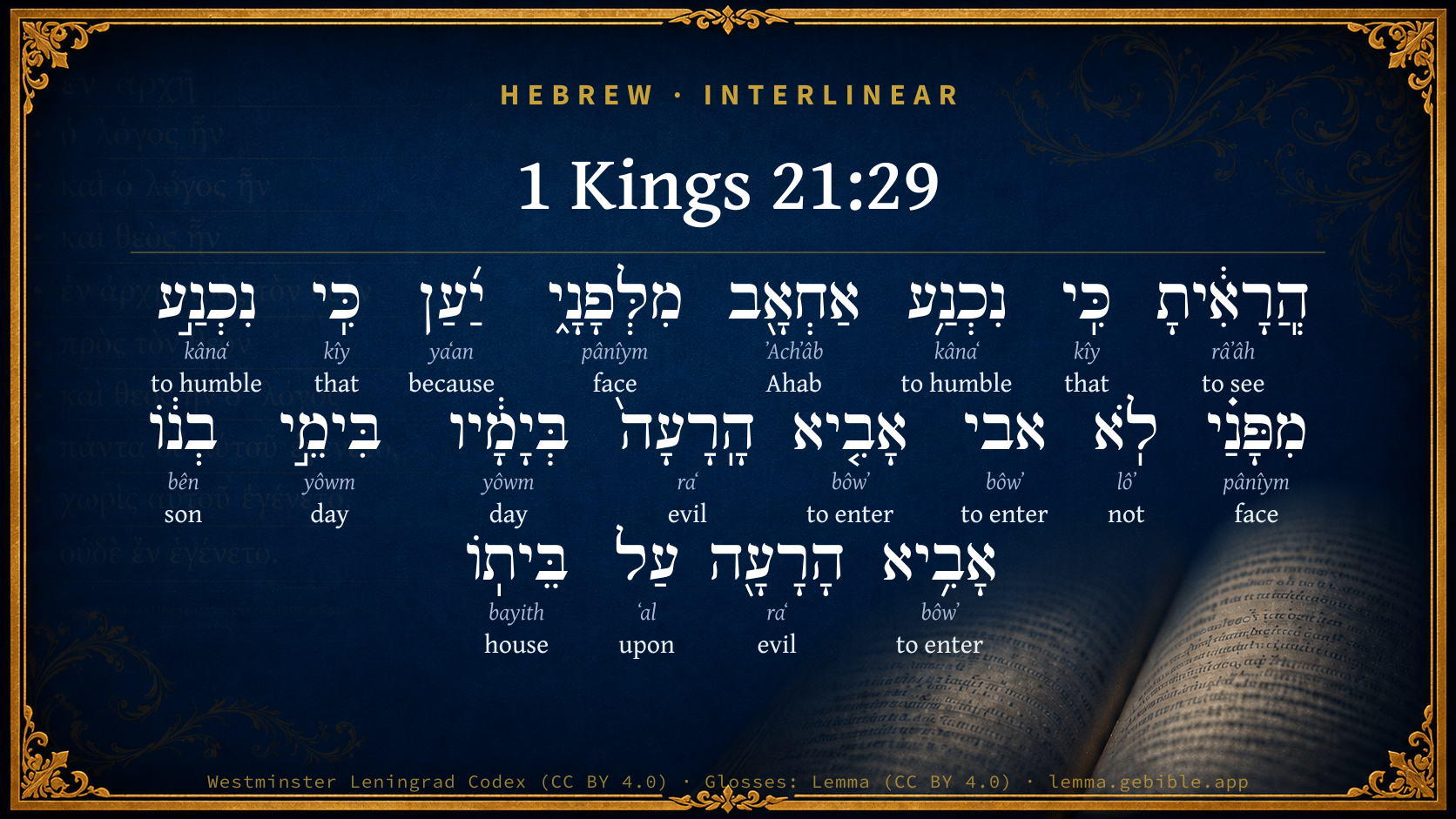
Hebrew (Westminster Leningrad Codex) 1 Kings 21:29 appears in the Hebrew Old Testament. The text above is from the Westminster Leningrad Codex. Each word links to its Strong’s number, a concise gloss, and parsing drawn from the Open Scriptures Hebrew Bible morphology. Click any word for its full Brown-Driver-Briggs (BDB) entry.
Download image
Cite this verse

1 Kings 21:29 (World English Bible). Public Domain. Lemma interlinear Bible study tool, https://lemma.gebible.app/v/1-kings/21/29.

Show BibTeX & RIS
BibTeX
RIS
English Translation
See you how Ahab humbles himself before me? because he humbles himself before me, I will not bring the evil in his days; but in his son's days will I bring the evil on his house.
World English Bible · Public Domain
Download a study sheet

One document with this verse’s original text, its word-by-word gloss line, the meaning frame, cross-references with their text, attributed commentary, and full source and license credits — printable, and it pastes into notes with its structure intact.

This verse Autodidact and up

Study sheet (.html) Plain text (.txt)

A passage Seminary Student

Up to 50 verses in one chapter. A passage sheet keeps up to 6 commentary sources and 12 cross-references per verse, in the order this page ranks them, and says so on the sheet whenever that leaves anything out. Ask for a single verse and you get the Autodidact verse sheet above.

Everything on this page stays free to read, with no account — the sheet is a download of what is already on screen, not access to it.

Want to remove ads? Support Godless Engineer
Compare translations 3

The same verse in 3 English versions, stacked beneath the original-language interlinear above. Click any original word for its lexicon entry.

Each is an independent rendering of the whole verse — the interlinear is not word-aligned to these translations.

Highlighted words mark where these versions differ — a whole-verse word diff, not a word-by-word alignment.

  • World English Bible Public Domain
    See you how Ahab humbles himself before me? because he humbles himself before me, I will not bring the evil in his days; but in his son's days will I bring the evil on his house.
  • King James Version Public Domain
    Seest thou how Ahab humbleth himself before me? because he humbleth himself before me, I will not bring the evil in his days: but in his son's days will I bring the evil upon his house.
  • unfoldingWord Literal Text CC BY-SA 4.0
    “Have you seen that Ahab has humbled himself from to my face? Because he has humbled himself from my face, I will not bring harm in his days. In the days of his son, I will bring harm on his house.”

unfoldingWord Literal Text — © unfoldingWord, licensed CC BY-SA 4.0. Word-aligned USFM3 via Door43 (git.door43.org/unfoldingWord/en_ult).

Versions to compare (up to 4)

3 of 4 selected

Show all 18 translations

Every available English version of this verse, each an independent rendering of the whole verse.

  • World English Bible Public Domain
    See you how Ahab humbles himself before me? because he humbles himself before me, I will not bring the evil in his days; but in his son's days will I bring the evil on his house.
  • Berean Standard Bible Public Domain
    “Have you seen how Ahab has humbled himself before Me? Because he has humbled himself before Me, I will not bring the calamity during his days, but I will bring it upon his house in the days of his son.”
  • Majority Standard Bible Public Domain
    “Have you seen how Ahab has humbled himself before Me? Because he has humbled himself before Me, I will not bring the calamity during his days, but I will bring it upon his house in the days of his son.”
  • King James Version Public Domain
    Seest thou how Ahab humbleth himself before me? because he humbleth himself before me, I will not bring the evil in his days: but in his son's days will I bring the evil upon his house.
  • American Standard Version (1901) Public Domain
    Seest thou how Ahab humbleth himself before me? because he humbleth himself before me, I will not bring the evil in his days; but in his son's days will I bring the evil upon his house.
  • Revised Version (1885) Public Domain
    Seest thou how Ahab humbleth himself before me? because he humbleth himself before me, I will not bring the evil in his days: but in his son’s days will I bring the evil upon his house.
  • Geneva Bible (1599) Public Domain
    Seest thou how Ahab is humbled before me? because he submitteth himselfe before me, I will not bring that euill in his dayes, but in his sonnes dayes wil I bring euill vpon his house.
  • Douay-Rheims (1899) Public Domain
    Hast thou not seen Achab humbled before me? therefore, because he hath humbled himself for my sake, I will not bring the evil in his days, but in his son's days will I bring the evil upon his house.
  • Young's Literal Translation Public Domain
    `Hast thou seen that Ahab hath been humbled before Me? because that he hath been humbled before Me, I bring not in the evil in his days; in the days of his son I bring in the evil on his house.'
  • Literal Standard Version CC BY-SA 4.0
    “Have you seen that Ahab has been humbled before Me? Because that he has been humbled before Me, I do not bring in the calamity in his days; I bring in the calamity on his house in the days of his son.”
  • Unlocked Literal Bible CC BY-SA 4.0
    “Do you see how Ahab humbles himself before me? Because he humbles himself before me, I will not bring the coming disaster in his days; it is in his son's day that I will bring disaster on his family.”
  • unfoldingWord Literal Text CC BY-SA 4.0
    “Have you seen that Ahab has humbled himself from to my face? Because he has humbled himself from my face, I will not bring harm in his days. In the days of his son, I will bring harm on his house.”
  • Darby Bible Public Domain
    Seest thou how Ahab humbleth himself before me? because he humbleth himself before me, I will not bring the evil in his days: in his son's days will I bring the evil upon his house.
  • World Messianic Bible Public Domain
    “See how Ahab humbles himself before me? Because he humbles himself before me, I will not bring the evil in his days; but I will bring the evil on his house in his son’s day.”
  • Webster's Bible Public Domain
    Seest thou how Ahab humbleth himself before me? because he humbleth himself before me, I will not bring the evil in his days: but in his son's days will I bring the evil upon his house.
  • Free Bible Version CC BY-SA 4.0
    “Have you seen how Ahab has humbled himself before me? Because he has humbled himself before me, I will not bring the disaster during his lifetime, but I will bring down disaster on his family in the lifetime of his son.”
  • Bible in Basic English Public Domain
    Do you see how Ahab has made himself low before me? because he has made himself low before me, I will not send the evil in his life-time, but in his son's time I will send the evil on his family.
  • JPS Tanakh (1917) Public Domain
    'Seest thou how Ahab humbleth himself before Me? because he humbleth himself before Me, I will not bring the evil in his days; but in his son's days will I bring the evil upon his house.'

Literal Standard Version (2020), Covenant Press — licensed CC BY-SA 4.0. Text via the HelloAO Bible API (eBible.org). Unlocked Literal Bible (unfoldingWord) — licensed CC BY-SA 4.0. Text via the HelloAO Bible API (eBible.org). unfoldingWord Literal Text — © unfoldingWord, licensed CC BY-SA 4.0. Word-aligned USFM3 via Door43 (git.door43.org/unfoldingWord/en_ult). Free Bible Version, Dr. Jonathan Gallagher — licensed CC BY-SA 4.0. Text via the HelloAO Bible API (eBible.org).

Word by word

More ways to search: Search by grammar → Find every occurrence → Compare this word →

Practice this passage: Drill this verse → Learn its vocabulary →

נִכְנַ֥ע
kânaʻ
H3665
“to humble”
Verb, Niphal, Perfect, 3rd Person, Masculine, Singular
Part of Speech
Verb
Stem
Niphal
Form
Perfect
Person
3rd Person
Gender
Masculine
Number
Singular
Full BDB Definition

Origin: a primitive root

TWOT: 1001

to be humble, be humbled, be subdued, be brought down, be low, be under, be brought into subjection - (Niphal) - to humble oneself - to be humbled, be subdued - (Hiphil) - to humble - to subdue
  1. הֲֽרָאִ֔יתָ râʼâh H7200 “to see” Particle, Interrogative + Verb, Qal, Perfect, 2nd Person, Masculine, Singular
  2. כִּֽי kîy H3588 “that” Conjunction
  3. אַחְאָ֖ב ʼAchʼâb H256 “Ahab” Noun, Proper
  4. מִלְּפָנָ֑י pânîym H6440 “from · to/for · face(s) · my” Preposition + Preposition + Noun, Common, Both, Plural, Construct + Suffix, Personal, 1st Person, Common, Singular
  5. יַ֜עַן yaʻan H3282 “because” Conjunction
  6. כִּֽי kîy H3588 “that” Conjunction
  7. נִכְנַ֣ע kânaʻ H3665 “to humble” Verb, Niphal, Perfect, 3rd Person, Masculine, Singular
  8. מִפָּנַ֗י pânîym H6440 “from · face(s) · my” Preposition + Noun, Common, Both, Plural, Construct + Suffix, Personal, 1st Person, Common, Singular
  9. לֹֽא lôʼ H3808 “not” Particle, Negative
  10. אבי bôwʼ H935 “to enter” Verb, Hiphil, Imperfect, 1st Person, Common, Singular
  11. אָבִ֤יא bôwʼ H935 “to enter” Verb, Hiphil, Imperfect, 1st Person, Common, Singular
  12. הָֽרָעָה֙ raʻ H7451 “the · evil” Particle, Definite Article + Noun, Common, Feminine, Singular, Absolute
  13. בְּיָמָ֔יו yôwm H3117 “in/at · days · his” Preposition + Noun, Common, Masculine, Plural, Construct + Suffix, Personal, 3rd Person, Masculine, Singular
  14. בִּימֵ֣י yôwm H3117 “in/at · days of” Preposition + Noun, Common, Masculine, Plural, Construct
  15. בְנ֔וֹ bên H1121 “son · his” Noun, Common, Masculine, Singular, Construct + Suffix, Personal, 3rd Person, Masculine, Singular
  16. אָבִ֥יא bôwʼ H935 “to enter” Verb, Hiphil, Imperfect, 1st Person, Common, Singular
  17. הָרָעָ֖ה raʻ H7451 “the · evil” Particle, Definite Article + Noun, Common, Feminine, Singular, Absolute
  18. עַל ʻal H5921 “upon” Preposition
  19. בֵּיתֽוֹ bayith H1004 “house · his” Noun, Common, Masculine, Singular, Construct + Suffix, Personal, 3rd Person, Masculine, Singular

About this verse

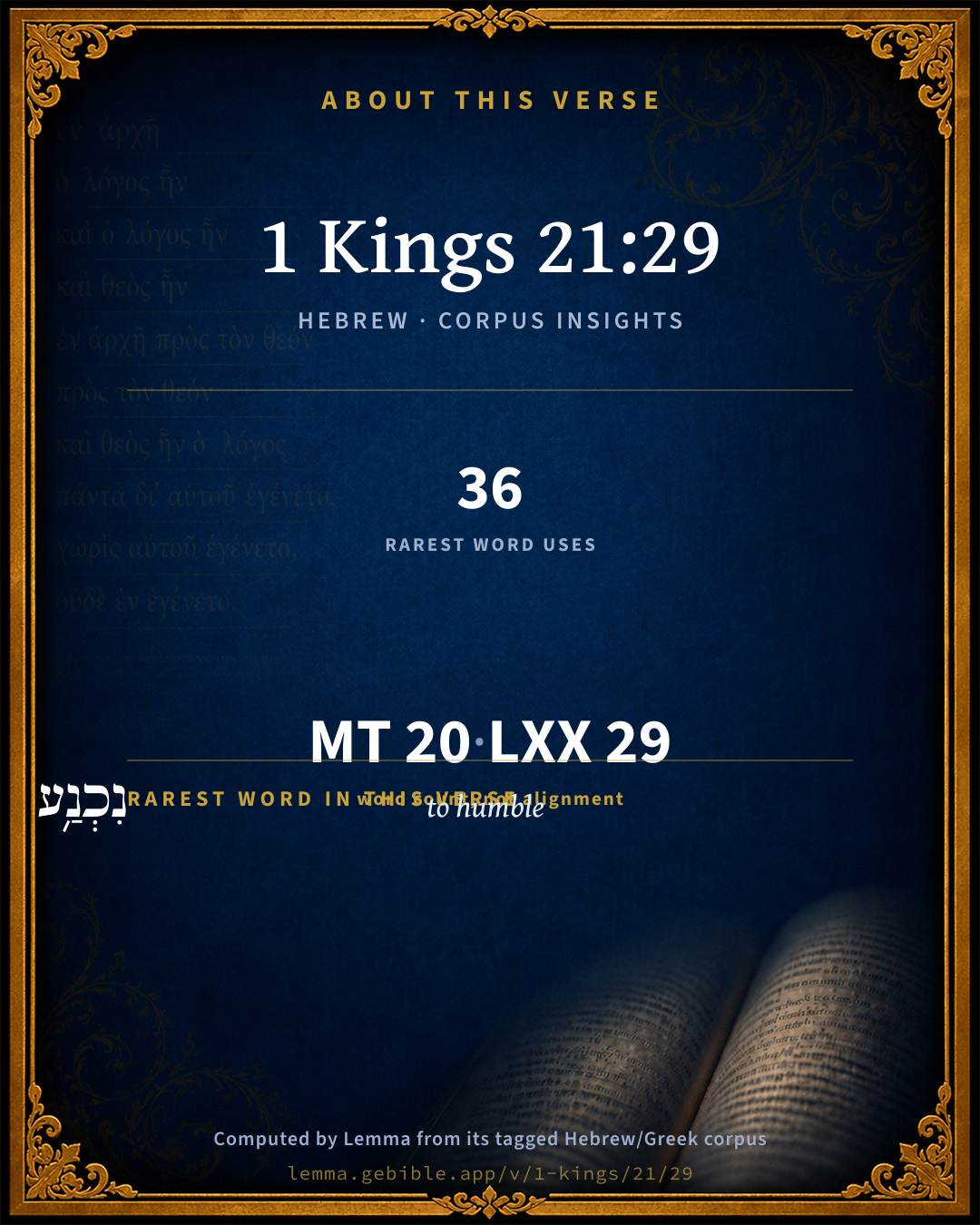
These counts appear in no published source. They are computed here, from the morphology-tagged text and Lemma’s own curated glosses. What Lemma adds →

20
words
13
distinct lemmas
Historical
section

Shared distinctive vocabulary

נִכְנַ֥ע to humble H3665 occurs in 32 verses of the Hebrew Bible. Also found in:

Grammatical profile

  • 6 verbs
  • 9 nouns
  • 1 preposition
  • 3 conjunctions
  • 1 particle

Verb forms

  • הֲֽרָאִ֔יתָ Qal · Perfect
  • נִכְנַ֥ע Niphal · Perfect
  • נִכְנַ֣ע Niphal · Perfect
  • אבי Hiphil · Imperfect
  • אָבִ֤יא Hiphil · Imperfect
  • אָבִ֥יא Hiphil · Imperfect

Repetition

Words recur within this verse — often emphatic in Hebrew:

  • אבי to enter H935 ×3
  • נִכְנַ֥ע to humble H3665 ×2
  • מִלְּפָנָ֑י face H6440 ×2
  • הָֽרָעָה֙ evil H7451 ×2
  • בְּיָמָ֔יו day H3117 ×2
  • כִּֽי that H3588 ×2

Hebrew & Septuagint length

In English translation the verse runs 36 words from the Hebrew and 38 from the Septuagint (LXX English) — closely comparable.

A rough comparison of the two English renderings, which tokenize alike — not a word-level alignment.

Word counts can differ between the Hebrew and the Greek without any difference in meaning — e.g. the Hebrew direct-object marker אֵת has no separate Greek word, and Greek often adds the article ὁ.

In the original languages it is 20 Hebrew tokens and 29 Greek tokens — but the two are counted differently (Hebrew bundles its prefixes and suffixes into one token; the Greek is in lemma form), so that isn’t a like-for-like length.

Cross-references

14

Topical passages linked to 1 Kings 21:29 in the Treasury of Scripture Knowledge — connected by theme and wording, ordered by reader-vote popularity; previews shown in the World English Bible.

  • 2 Peter 3:9 The Lord is not slow concerning his promise, as some count slowness; but is patient with us, not wishing that any should perish, but that all should come to repentance.
  • Micah 7:18 Who is a God like you, who pardons iniquity, And passes over the disobedience of the remnant of his heritage? He doesn't retain his anger forever, Because he delights in loving kindness.
  • 2 Kings 9:25–26 Then said [Jehu] to Bidkar his captain, Take up, and cast him in the portion of the field of Naboth the Jezreelite; for remember how that, when I and you rode together after Ahab his father, Yahweh laid this burden on him:
  • Psalms 86:15 But you, Lord, are a merciful and gracious God, Slow to anger, and abundant in loving kindness and truth.
  • 2 Kings 9:33–10:7 He said, Throw her down. So they threw her down; and some of her blood was sprinkled on the wall, and on the horses: and he trod her under foot.
  • 2 Kings 10:11 So Jehu struck all that remained of the house of Ahab in Jezreel, and all his great men, and his familiar friends, and his priests, until he left him none remaining.
  • Psalms 18:44 As soon as they hear of me they shall obey me. The foreigners shall submit themselves to me.
  • Ezekiel 33:10–11 You, son of man, tell the house of Israel: Thus you speak, saying, Our transgressions and our sins are on us, and we pine away in them; how then can we live?
  • Psalms 78:34–37 When he killed them, then they inquired after him. They returned and sought God earnestly.
  • Jeremiah 7:17 Don't you see what they do in the cities of Judah and in the streets of Jerusalem?
  • Romans 2:4 Or do you despise the riches of his goodness, forbearance, and patience, not knowing that the goodness of God leads you to repentance?
  • Exodus 10:3 Moses and Aaron went in to Pharaoh, and said to him, "This is what Yahweh, the God of the Hebrews, says: 'How long will you refuse to humble yourself before me? Let my people go, that they may serve me.
  • Psalms 66:3 Tell God, "How awesome are your deeds! Through the greatness of your power, your enemies submit themselves to you.
  • Luke 7:44 Turning to the woman, he said to Simon, "Do you see this woman? I entered into your house, and you gave me no water for my feet, but she has wet my feet with her tears, and wiped them with the hair of her head.

Cross-references courtesy of OpenBible.info (CC BY 4.0).

Hebrew and Greek witnesses Masoretic Hebrew ↔ Greek Septuagint

The same verse in the two great witnesses to the Old Testament, shown verse-for-verse.

These are two independent witnesses, not word-aligned to each other, and the Septuagint is shown in lemma (dictionary) form.

Hebrew 1 Kings 21:29 Masoretic · Westminster Leningrad Codex

הֲֽרָאִ֔יתָ כִּֽי נִכְנַ֥ע אַחְאָ֖ב מִלְּפָנָ֑י יַ֜עַן כִּֽי נִכְנַ֣ע מִפָּנַ֗י לֹֽא אבי אָבִ֤יא הָֽרָעָה֙ בְּיָמָ֔יו בִּימֵ֣י בְנ֔וֹ אָבִ֥יא הָרָעָ֖ה עַל בֵּיתֽוֹ

See you how Ahab humbles himself before me? because he humbles himself before me, I will not bring the evil in his days; but in his son's days will I bring the evil on his house.

World English Bible · Public Domain

Greek LXX 1 Kings 21:29 Septuagint · lemma form

καί παρα ἐνβάλλω οὗτος ἀπέναντι οὗτος ἑπτά ἡμέρα καί γίγνομαι ἐν ὁ ἡμέρα ὁ ἕβδομος καί προςἄγω ὁ πόλεμος καί πατάσσω ἰσραήλ ὁ συρία ἑκατόν χιλιάς πεζός εἷς ἡμέρα

And they encamp one over against the other before them seven days. And it came to pass on the seventh day that the battle drew on, and Israel struck Syria, even one hundred thousand footmen in one day.

LXX2012 (modern English Septuagint) · Public Domain

On this verse, The Cambridge Bible for Schools and Colleges discusses the Septuagint’s reading. Read the note in Commentary ↓

Hebrew: Westminster Leningrad Codex (CC BY 4.0). Greek: Septuagint (public domain); English from LXX2012 (modern English Septuagint) (Public Domain). How the Septuagint differs from the Hebrew →

Targum (Aramaic paraphrase)

1

The Targum is the ancient Jewish Aramaic paraphrase of the Hebrew Scriptures — an interpretive translation, not the Hebrew text itself. Onkelos (literal) and Pseudo-Jonathan (expansive) render the Torah, and Jonathan the Prophets. Coverage is partial: where no permissively-licensed English translation exists for a verse, only the Aramaic is shown. This is verse-level text, not a word-by-word alignment to the Hebrew.

  1. Targum Jonathan Prophets (Joshua–Malachi)
    הַחֲזִיתָא אֲרֵי אִתְכְּנַע אַחְאָב מִן קֳדָמַי חֲלַף דְאִתְכְּנַע מִן קֳדָמָי לָא אַיְתֵי בִישְׁתָא בְּיוֹמוֹהִי בְּיוֹמֵי בְּרֵיהּ אַיְתֵי בִּישְׁתָא עַל בֵּיתֵיהּ:

    (no public-domain English translation for this verse)

    Targum Jonathan — Aramaic: “Mikraot Gedolot” (public domain). English: “Sefaria Community Translation” (CC0 1.0 (public-domain dedication)); “London "Chaldee Paraphrase," 1871” (public domain). Text via Sefaria.

Commentary

Notes on 1 Kings 21:29 from classic Christian and Jewish commentators (each source and its license shown beneath its notes). The classic Christian expositions comment on the surrounding passage and are grouped to its opening verse, so a note may address several verses; the Jewish commentaries on the Tanakh (Rashi and others) are per-verse, so they appear only where the commentator wrote on this verse.

Lemma curates 59 commentaries, every one of them public domain or Creative Commons licensed, each selected and text-cleaned for this edition rather than reprinted as found. About our sources →

Trapp's Complete Commentary

John Trapp

1Ki 21:29 Seest thou how Ahab humbleth himself before me? because he humbleth himself before me, I will not bring the evil in his days: [but] in his son’s days will I bring the evil upon his house.

Ver. 29. I will not bring the evil.] I will recompense his temporary repentance with a temporary deliverance. Thus noble captains have honoured their enemies that have fought valiantly, to put some spirits into their own soldiers. And thus parents reward their servants’ dutifulness, to provoke their own children.

John Trapp, A Commentary or Exposition upon All the Books of the Old and New Testament (1647–1656) — public domain. Text from a community e-Sword module.

Joseph Benson's Commentary

1Ki 21:29. Seest thou how Ahab humbleth himself before me? — His humiliation was real, though not lasting, and accordingly pleasing to God. This discovers the great goodness of God, and his readiness to show mercy: it teaches us to take notice of that which is good, even in the worst of men: it gives a reason why wicked persons often prosper; God rewards the little good which is in them: and it encourages true penitents. If even Ahab goes to his house reprieved, doubtless they shall go to their houses justified.

Joseph Benson's Commentary on the Old and New Testaments (1811–1818) — public domain. Text from a community e-Sword module.

Geneva Bible (1599)

Geneva Bible translators

Meaning, in Jehoram’s time, 2 Kings 9:26.

Geneva Bible (1599) marginal notes — public domain. Text via Bolls.life.

Adam Clarke's Commentary

Verse 29. Seest thou how Ahab humbleth himself] He did abase himself; he did truly repent him of his sins, and it was such a repentance as was genuine in the sight of God: He humbleth himself BEFORE ME.

The penitent heart ever meets the merciful eye of God; repentance is highly esteemed by the Father of compassion, even where it is comparatively shallow and short-lived. Any measure of godly sorrow has a proportionate measure of God's regard; where it is deep and lasting, the heart of God is set upon it. He that mourns shall be comforted; thus hath God spoken, and though repentance for our past sins can purchase no favour, yet without it God will not grant us his salvation.

Adam Clarke's Commentary on the Bible (1810–1826) — public domain. Text from a community e-Sword/MySword module.

Ellicott's Commentary for English Readers

(29) How Ahab humbleth himself.—As there is something entirely characteristic of Ahab’s impressible nature in this burst of penitence; so in the acceptance of it there is a remarkable illustration of the Divine mercy. The repentance might seem not only to come too late, but to be the mere offspring of fear—more sensible of the shame of discovery than of the shamefulness of sin. Man’s judgment would despise it; God sees in its imperfection some germs of promise, and His partial remission of penalty shows it to be not disregarded in His sight. Ahab himself is still to suffer the predicted doom; but he is to die in honour, and the utter destruction waits, till Jehoram shall fill up the measure of iniquity.

A Bible Commentary for English Readers, edited by Charles John Ellicott (1878–1897) — public domain. Text from a community e-Sword module.

The Cambridge Bible for Schools and Colleges

gen. ed. J. J. S. Perowne

29. because he humbleth himself before me] These words are left out by the LXX., as are also ‘upon his house’ at the close of the verse.

I will not bring the evil in his days] That is, the whole penalty shall not be inflicted on him. A portion of it was, as we are told in 1Ki_22:37-38. The Jews explain the word נשׂא which is rendered ‘forgiving’ iniquity (Exo_34:7; Num_14:18; &c.) by reference to its original meaning which is ‘to lift up’. God, say they, raises the load, so that it does not press all at once, or men would perish under it, but the lifted burden is divided into parts, and men feel it in consequence for a long time to come. In every punishment of Israel, there is mixed up an ounce of the golden calf.

but in his son’s days] Fulfilled in the death of Jehoram, Ahab’s son. 2Ki_9:25.

The Cambridge Bible for Schools and Colleges (gen. ed. J. J. S. Perowne; Cambridge University Press, 1878–1918) — public domain. Text from a community e-Sword module.

Albert Barnes' Notes on the Bible

The evil - i. e., the main evil. See 1Ki 21:19 note; and compare 1Ki 22:38 with marginal reference.

Albert Barnes' Notes on the Bible (1834–1885) — public domain. Text from a community e-Sword/MySword module.

Haydock's Catholic Bible Commentary

Sake. Hebrew, "before me," publicly. (Haydock) --- The threat of the prophet caused Achab to invest his son with the royal dignity, and Josaphat followed his example. (Salien, the year before Christ 916.) --- But some call this in question. (Haydock)

George Leo Haydock (1774–1849), Haydock's Catholic Family Bible and Commentary, 1859 edition — public domain. Excludes Psalms (Douay-Rheims chapter numbering differs from Protestant) and Deuterocanonical books (Catholic canon only).

Matthew Poole's English Annotations

Before me, i.e. in my presence, and upon my threatening. But this humiliation or repentance of Ahab’s was only external and superficial, arising from the terror of God’s judgments; and not sincere and serious, proceeding from the love of God, or a true sense of his sin, or a solemn purpose of amendment of his life, as appears, because all the particulars of his repentance here, 1Ki 21:27, are external and ritual only; nor is there the least intimation of any one sign or fruit of his true repentance, as that he restored Naboth’s land, or reproved his infamous wife; but in the very next chapter you find him returning to his former vomit, hating and threatening the Lord’s prophets, &c.

The evil, i.e. the judgment threatened, both that 1Ki 21:19, which was not inflicted upon Ahab with so much ignominy, and with that particular signature of God’s vengeance, that it was to be done in the same place, as it was upon his son Joram; and especially that 1Ki 21:21,22, which was wholly suspended until his son’s days.

Matthew Poole's English Annotations on the Holy Bible (1683–1685) — public domain. Text from a community e-Sword/MySword module.

The Pulpit Commentary

Seest thou how Ahab humbleth himself before me? The repentance, if it was not profound, or enduring, was nevertheless, while it lasted, sincere. The Searcher of hearts saw in it a genuine self-abasement. And "He will not break the bruised reed nor quench the smoking flax;" (Isa_42:3; Mat_12:20) Because he humbleth himself before me, I will not bring the evil There is a manifest reference to ver. 21, where the same words are used in his days; but in his son"s days There is no injustice here no threat of punishment against the innocent instead of the guilty as might at first sight appear. For in the first place, God knew well what the son would be, and in the second place, if the son had departed from his father"s sins he would have been spared (Eze_18:14 sqq.); the sentence would have been revoked. Judgment was deferred to give the house of Ahab another chance. When Ahab lapsed into sin, he suffered in his own person: when his sons persisted in sin, excision befell the family will I bring the evil ver. 19 upon his house ver. 22,

The Pulpit Commentary (1880–1919), ed. H.D.M. Spence-Jones & Joseph S. Exell — public domain. Text from a community e-Sword module.

John Wesley's Explanatory Notes

Humbleth himself - His humiliation was real, though not lasting, and accordingly pleasing to God. This discovers the great goodness of God, and his readiness to shew mercy. It teaches us to take notice of that which is good, even in the worst of men. It gives a reason why wicked persons often prosper: God rewards what little good is in them. And it encourages true penitents. If even Ahab goes to his house reprieved, doubtless they shall go to their houses justified.

John Wesley, Explanatory Notes Upon the Whole Bible (1754–1765) — public domain. Text via the GEBible commentary corpus.

Rashi

Rabbi Shlomo Yitzchaki (Rashi)

I will not bring the evil. The disaster of this house I will not bring in his days, but the decree that the dogs will lick his blood is not possible to come in the days of his son, but upon him.

Rashi on the Tanakh — English translations: “The Judaica Press complete Tanach with Rashi, translated by A. J. Rosenberg” (CC BY 4.0); “Pentateuch with Rashi's commentary by M. Rosenbaum and A.M. Silbermann, 1929-1934” (public domain); “The Metsudah Tanach series, Lakewood, N.J” (CC BY 4.0); and “The Book of Joshua, Metsudah Publications, 1997” (CC BY 4.0). Text via Sefaria.

Lesson kit

Teaching starters — assembled from the data on this page, not authored interpretation. Every prompt links to the verse data it draws on. Edit before teaching.

1 Kings, in the Historical, opens this verse with 20 words (13 distinct Hebrew lemmas). Its most distinctive word is kânaʻ (“to humble”). A historical commentator’s framing appears above. Read the whole chapter for the surrounding context.

Discussion questions

  1. What does “to humble” (kânaʻ) contribute to the verse as a whole?
  2. How does Leviticus 26:41, which shares the word «to humble», read alongside this verse?
  3. What does the repetition of “to enter” (3× in this one verse) do in this verse?
  4. These translations render this verse differently; the difference is in the English rendering, not the original. What questions does that raise?
  5. «הֲֽרָאִ֔יתָ» is a Qal Perfect verb. How does that grammatical form shape the action described?
  6. Compare how Trapp's Complete Commentary and Joseph Benson's Commentary read this verse. Where do they agree or differ?

Things to notice

Reading settings

Reading text

Shown beneath each verse's original-language words.

Old Testament
Old Testament edition

Read the OT as the Masoretic Hebrew (MT) or the Greek Septuagint (LXX).

English shown for the Greek Septuagint (in the Hebrew ↔ Greek comparison).

Comparing translations? Open the Compare panel on any verse page to stack up to four side by side.