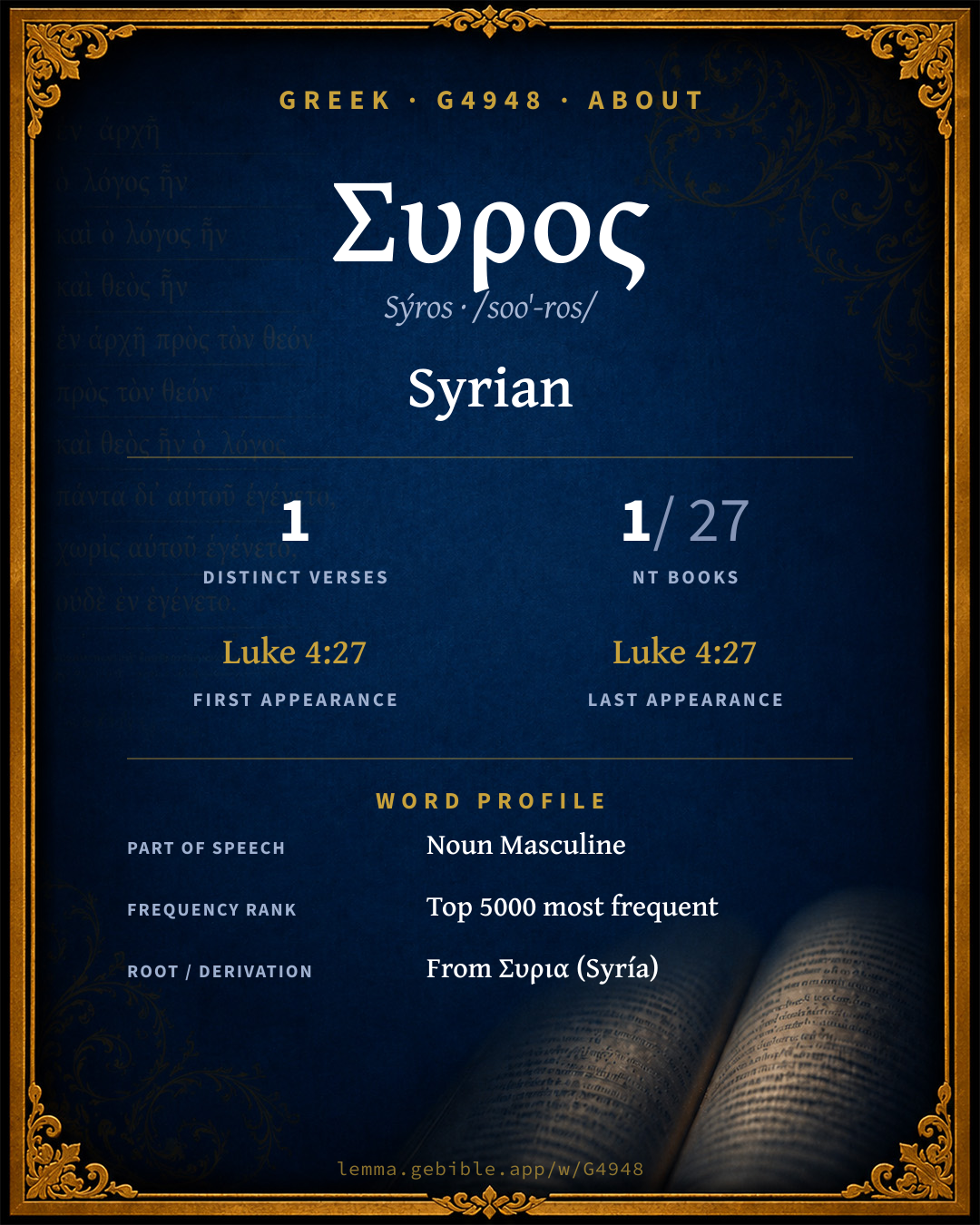
Σύρος
Syrian
Full lexicon entry — Thayer's Greek Lexicon
From Thayer's Greek Lexicon
Where this word appears
Grammar key — what these labels mean
Part of speech
- Noun
- A naming word — a person, place, thing, or idea.
Case
- Nominative
- The case of the subject (and the predicate nominative).
Gender
- Masculine
- Grammatically masculine.
Number
- Singular
- One.
Every verse where G4948 appears — 1 distinct verse across 1 book. Click any verse to open its interlinear word-by-word view. Verse text shown in the World English Bible for context — . Each verse’s Greek form is shown with its reference; the English is not keyword-highlighted, since the data carries no word-level English alignment. Use “Compare translations” on any verse to read it across multiple English versions. This concordance covers the Greek New Testament; Septuagint (Greek Old Testament) occurrences of this word are not indexed here.
Luke 1 verse
About this entry
At a glance — auto-summarized from this page’s data, not written by a person. Every figure links to its source below. This summary describes the numbers; it doesn’t interpret them.
Συρος — transliterated Sýros — is a Greek name carrying the sense “Syrian.” With only 1 verse it sits in the long tail of Greek New Testament vocabulary. More than three-quarters of its appearances fall in Luke. A true hapax — its single appearance is Luke 4:27. See 1-verse concordance and the renderings breakdown below.
Gloss history
Strong's 1890 vs modern scholarship
About this word
Strong's G4948 catalogs a Greek word from the Greek New Testament.
These counts are not copied from any lexicon or concordance. They are computed here, from the morphology-tagged Greek New Testament. What Lemma adds →
- 1
- distinct verses
- The word appears in 1 distinct verse.
- 1 / 27
- NT books
- The word appears in 1 of 27 New Testament books.
- #3,503
- by frequency
- Top 5000 most frequent Greek words (rank 3,503 of 5,347 Greek words by occurrence).
View all 1 occurrence in the concordance →
Most concentrated in
- Luke 1 verse 100%
By section of the New Testament
By traditional corpus
Conventional, traditional groupings — biblical authorship is debated, so this is a traditional corpus grouping, not an authorship claim. Some books belong to more than one corpus (Luke is in both the Gospels and the Lukan corpus, and so on), so these shares overlap and need not total 100%. Each figure is a share of the word’s 1 distinct verse.
- Gospels 1 verse · 100%
- Lukan (Luke–Acts) 1 verse · 100%
How translations render this word
Counts come from each version’s own published word-to-Strong’s tagging or interlinear alignment — an approximate guide to how each version renders this word, not a word-level alignment the data otherwise carries. Because each total is that version’s own tagged count, the per-version totals vary from one another and need not match the appearance or distinct-verse counts above. These counts may also differ from a printed concordance because Lemma counts each distinctly tagged rendering and does not collapse phrase taggings into a single head-word total. This is a fixed set of word-tagged versions (KJV, ASV, BSB, ULT) and does not change with the reading translation you choose elsewhere. Each version’s license is shown beside its name below (and on Sources).
- King James Version: Syrian 1×
- American Standard Version: Syrian 1×
- Berean Standard Bible: Syrian 1×
- unfoldingWord Literal Text: Syrian 1×
King James Version Public Domain
Renders G4948 across 1 tagged occurrence — most commonly:
American Standard Version Public Domain
Renders G4948 across 1 tagged occurrence — most commonly:
Berean Standard Bible Public Domain
Renders G4948 across 1 tagged occurrence — most commonly:
unfoldingWord Literal Text CC BY-SA 4.0
Renders G4948 across 1 tagged occurrence — most commonly:
Senses in Thayer's
The 1 sense Thayer's distinguishes for this word, in lexicon order (not ranked by frequency or importance). The full entry — with sub-senses — is in the Lexicon Entry tab.
- an inhabitant of Syria
Word origin
Derived from Συρια (Syría) (G4947) — Syria.
From the same as G4947 ; a Syran (that is probably Tyrian ) a native of Syria : - Syrian.
— Strong’s Exhaustive Concordance (1890), public domain.
Same root — word family
Other Thayer's entries built from the same root as G4948, grouped by Strong’s listed origin. These share a root / origin per the lexicon — not necessarily a shared meaning. Each links to that word’s own entry.
Derives from
Proper names from this root
People and places named from this root — a name, not an additional meaning of the word.
Compare all same-root words → 2 of the same-root words are proper names (people or places). They share a root, not necessarily a meaning.
Septuagint usage
The same Greek word Συρος appears 32 times in the Greek Old Testament (Septuagint), across 28 verses in 8 books.
- 32
- LXX occurrences
- Tagged occurrences of this Greek word in the Septuagint.
- 28
- verses
- Distinct Septuagint verses containing this word.
- 8 / 39
- OT books
- The word appears in 8 of the 39 Old Testament books.
Sample Septuagint occurrences
- Genesis 22:21 σύρος
- 1 Samuel 21:8 σύρος
- 2 Samuel 8:5 σύρος
- 2 Kings 5:20 σύρος
- 1 Chronicles 18:5 σύρος
- 2 Chronicles 22:6 σύρος
- Isaiah 17:3 σύρος
- Amos 9:7 σύρος
Septuagint occurrences (same lexeme)
Every verse where the same Strong’s number (G4948) appears in the Greek Septuagint. Verse text shown in the World English Bible for context; the Greek form is the matched word — the English is not keyword-highlighted.
- Genesis 22:21 σύρος Uz his firstborn, Buz his brother, Kemuel the father of Aram,
- Genesis 25:20 σύρος Isaac was forty years old when he took Rebekah, the daughter of Bethuel the Syrian of Paddan Aram, the sister of Laban the Syrian, to be his wife.
- Genesis 28:5 σύρος Isaac sent Jacob away. He went to Paddan Aram to Laban, son of Bethuel the Syrian, Rebekah's brother, Jacob's and Esau's mother.
- Genesis 29:1 σύρος Then Jacob went on his journey, and came to the land of the children of the east.
- Genesis 31:20 σύρος Jacob deceived Laban the Syrian, in that he didn't tell him that he was running away.
- Genesis 31:22 σύρος Laban was told on the third day that Jacob had fled.
- Genesis 31:24 σύρος God came to Laban, the Syrian, in a dream of the night, and said to him, "Take heed to yourself that you don't speak to Jacob either good or bad."
- 1 Samuel 21:8 σύρος David said to Ahimelech, Isn't there here under your hand spear or sword? for I have neither brought my sword nor my weapons with me, because the king's business required haste.
- 1 Samuel 22:9 σύρος Then answered Doeg the Edomite, who stood by the servants of Saul, and said, I saw the son of Jesse coming to Nob, to Ahimelech the son of Ahitub.
- 1 Samuel 22:18 σύρος The king said to Doeg, Turn you, and fall on the priests. Doeg the Edomite turned, and he fell on the priests, and he killed on that day eighty-five persons who wore a linen ephod.
- 1 Samuel 22:22 σύρος David said to Abiathar, I knew on that day, when Doeg the Edomite was there, that he would surely tell Saul: I have occasioned [the death] of all the persons of your father's house.
- 2 Samuel 8:5 σύρος When the Syrians of Damascus came to help Hadadezer king of Zobah, David struck of the Syrians two and twenty thousand men.
- 2 Samuel 8:6 σύρος Then David put garrisons in Syria of Damascus; and the Syrians became servants to David, and brought tribute. Yahweh gave victory to David wherever he went.
- 2 Kings 5:20 σύρος But Gehazi the servant of Elisha the man of God, said, Behold, my master has spared this Naaman the Syrian, in not receiving at his hands that which he brought: as Yahweh lives, I will run after him, and take somewhat of him.
- 2 Kings 8:28 σύρος He went with Joram the son of Ahab to war against Hazael king of Syria at Ramoth-gilead: and the Syrians wounded Joram.
- 2 Kings 9:15 σύρος but king Joram was returned to be healed in Jezreel of the wounds which the Syrians had given him, when he fought with Hazael king of Syria.) Jehu said, If this be your mind, then let none escape and go forth out of the city, to go to tell it in Jezreel.
- 1 Chronicles 18:5 σύρος When the Syrians of Damascus came to help Hadarezer king of Zobah, David struck of the Syrians twenty-two thousand men.
- 1 Chronicles 19:10 σύρος Now when Joab saw that the battle was set against him before and behind, he chose of all the choice men of Israel, and put them in array against the Syrians.
- 1 Chronicles 19:12 σύρος He said, If the Syrians be too strong for me, then you shall help me; but if the children of Ammon be too strong for you, then I will help you.
- 1 Chronicles 19:15 σύρος When the children of Ammon saw that the Syrians were fled, they likewise fled before Abishai his brother, and entered into the city. Then Joab came to Jerusalem.
- 1 Chronicles 19:16 σύρος When the Syrians saw that they were put to the worse before Israel, they sent messengers, and drew forth the Syrians who were beyond the River, with Shophach the captain of the host of Hadarezer at their head.
- 1 Chronicles 19:17 σύρος It was told David; and he gathered all Israel together, and passed over the Jordan, and came on them, and set the battle in array against them. So when David had put the battle in array against the Syrians, they fought with him.
- 1 Chronicles 19:18 σύρος The Syrians fled before Israel; and David killed of the Syrians [the men of] seven thousand chariots, and forty thousand footmen, and killed Shophach the captain of the host.
- 1 Chronicles 19:19 σύρος When the servants of Hadarezer saw that they were put to the worse before Israel, they made peace with David, and served him: neither would the Syrians help the children of Ammon any more.
- 2 Chronicles 22:6 σύρος He returned to be healed in Jezreel of the wounds which they had given him at Ramah, when he fought against Hazael king of Syria. Azariah the son of Jehoram king of Judah went down to see Jehoram the son of Ahab in Jezreel, because he was sick.
- 2 Chronicles 36:5 σύρος Jehoiakim was Twenty-five years old when he began to reign; and he reigned eleven years in Jerusalem: and he did that which was evil in the sight of Yahweh his God.
- Isaiah 17:3 σύρος The fortress shall cease from Ephraim, and the kingdom from Damascus, and the remnant of Syria; they shall be as the glory of the children of Israel, says Yahweh of Hosts.
- Amos 9:7 σύρος Are you not like the children of the Ethiopians to me, children of Israel?" says Yahweh. "Haven't I brought up Israel out of the land of Egypt, and the Philistines from Caphtor, and the Syrians from Kir?
These are occurrences of the same Greek lexeme (G4948) in the Septuagint — not a translation of any one Hebrew word. The store carries no word-level Hebrew↔Greek alignment, so no Hebrew original is asserted here. Counts come from the recovered LXX Strong's tagging — high-frequency vocabulary is well covered, while rare or late forms may be untagged — so they reflect tagged occurrences and may slightly undercount.