Galatians 1:21

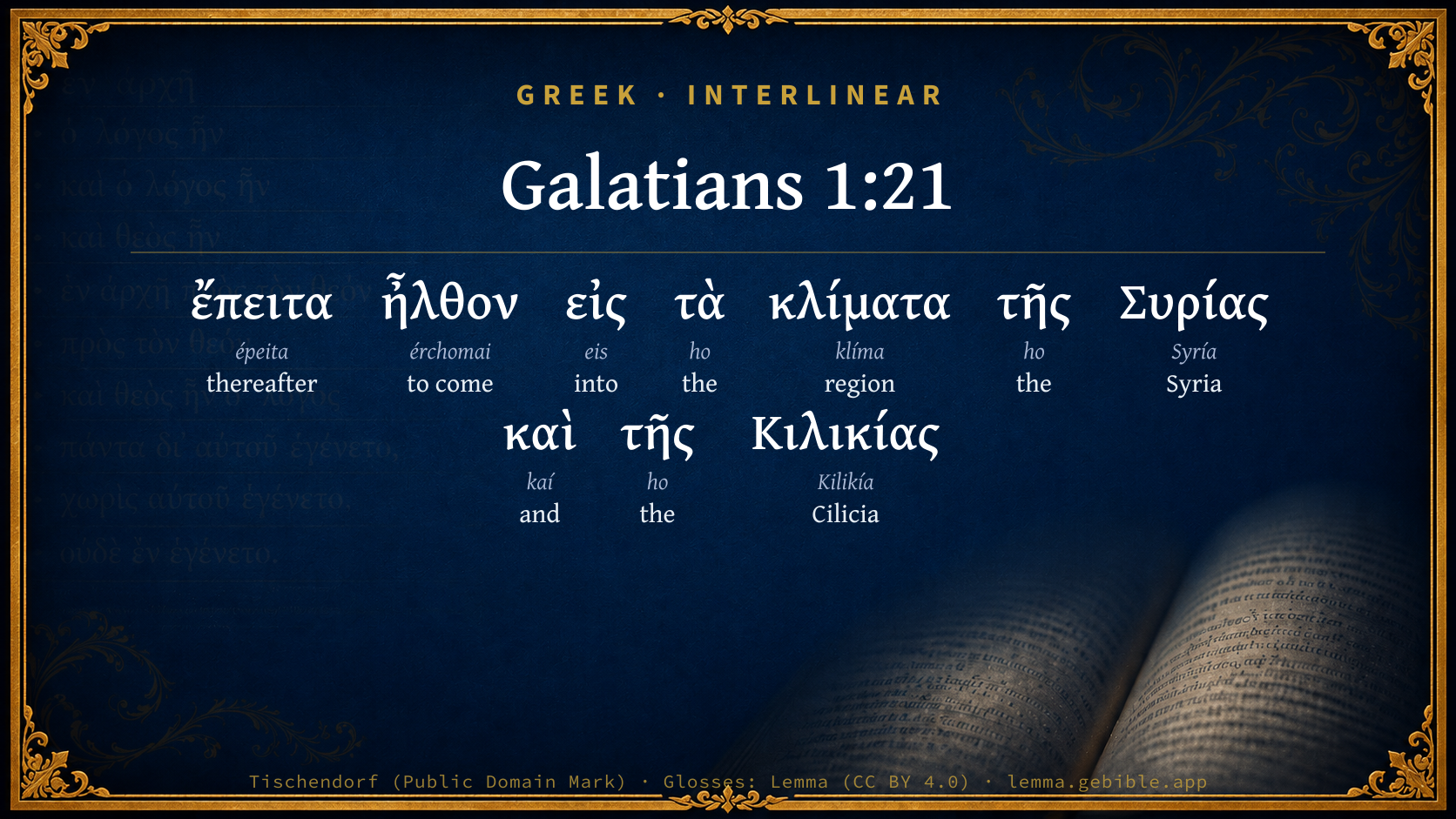
Greek (Tischendorf 8th ed.) Galatians 1:21 appears in the Greek New Testament. The text above is from the Tischendorf 8th edition. Each word links to its Strong’s number and a concise gloss. Click any word for its full Thayer’s Greek Lexicon entry.
Download image
Cite this verse

Galatians 1:21 (World English Bible). Public Domain. Lemma interlinear Bible study tool, https://lemma.gebible.app/v/galatians/1/21.

Show BibTeX & RIS
BibTeX
RIS
English Translation
Then I came to the regions of Syria and Cilicia.
World English Bible · Public Domain
Download a study sheet

One document with this verse’s original text, its word-by-word gloss line, the meaning frame, cross-references with their text, attributed commentary, and full source and license credits — printable, and it pastes into notes with its structure intact.

This verse Autodidact and up

Study sheet (.html) Plain text (.txt)

A passage Seminary Student

Up to 50 verses in one chapter. A passage sheet keeps up to 6 commentary sources and 12 cross-references per verse, in the order this page ranks them, and says so on the sheet whenever that leaves anything out. Ask for a single verse and you get the Autodidact verse sheet above.

Everything on this page stays free to read, with no account — the sheet is a download of what is already on screen, not access to it.

Want to remove ads? Support Godless Engineer
Compare translations 3

The same verse in 3 English versions, stacked beneath the original-language interlinear above. Click any original word for its lexicon entry.

Each is an independent rendering of the whole verse — the interlinear is not word-aligned to these translations.

Highlighted words mark where these versions differ — a whole-verse word diff, not a word-by-word alignment.

  • World English Bible Public Domain
    Then I came to the regions of Syria and Cilicia.
  • King James Version Public Domain
    Afterwards I came into the regions of Syria and Cilicia;
  • unfoldingWord Literal Text CC BY-SA 4.0
    Then I went to the regions of Syria and Cilicia.

unfoldingWord Literal Text — © unfoldingWord, licensed CC BY-SA 4.0. Word-aligned USFM3 via Door43 (git.door43.org/unfoldingWord/en_ult).

Versions to compare (up to 4)

3 of 4 selected

Show all 19 translations

Every available English version of this verse, each an independent rendering of the whole verse.

  • World English Bible Public Domain
    Then I came to the regions of Syria and Cilicia.
  • Berean Standard Bible Public Domain
    Later I went to the regions of Syria and Cilicia.
  • Majority Standard Bible Public Domain
    Later I went to the regions of Syria and Cilicia.
  • King James Version Public Domain
    Afterwards I came into the regions of Syria and Cilicia;
  • American Standard Version (1901) Public Domain
    Then I came unto the regions of Syria and Cilicia.
  • Revised Version (1885) Public Domain
    Then I came into the regions of Syria and Cilicia.
  • Geneva Bible (1599) Public Domain
    After that, I went into the coastes of Syria and Cilicia: for I was vnknowen by face vnto the Churches of Iudea, which were in Christ.
  • Douay-Rheims (1899) Public Domain
    Afterwards I came into the regions of Syria and Cilicia.
  • Young's Literal Translation Public Domain
    then I came to the regions of Syria and of Cilicia,
  • Literal Standard Version CC BY-SA 4.0
    then I came into the regions of Syria and of Cilicia,
  • Unlocked Literal Bible CC BY-SA 4.0
    Then I went to the regions of Syria and Cilicia.
  • unfoldingWord Literal Text CC BY-SA 4.0
    Then I went to the regions of Syria and Cilicia.
  • Darby Bible Public Domain
    Then I came into the regions of Syria and Cilicia.
  • World Messianic Bible Public Domain
    Then I came to the regions of Syria and Cilicia.
  • Webster's Bible Public Domain
    Afterwards I came into the regions of Syria and Cilicia;
  • Free Bible Version CC BY-SA 4.0
    Then I went to Syria and Cilicia.
  • Bible in Basic English Public Domain
    Then I came to the parts of Syria and Cilicia.
  • Text-Critical English NT CC BY 4.0
    Then I went into the regions of Syria and Cilicia.
  • Tyndale New Testament (1534) Public Domain
    After that I went into the costes of Siria and Cilicia:

Literal Standard Version (2020), Covenant Press — licensed CC BY-SA 4.0. Text via the HelloAO Bible API (eBible.org). Unlocked Literal Bible (unfoldingWord) — licensed CC BY-SA 4.0. Text via the HelloAO Bible API (eBible.org). unfoldingWord Literal Text — © unfoldingWord, licensed CC BY-SA 4.0. Word-aligned USFM3 via Door43 (git.door43.org/unfoldingWord/en_ult). Free Bible Version, Dr. Jonathan Gallagher — licensed CC BY-SA 4.0. Text via the HelloAO Bible API (eBible.org).

Word by word

More ways to search: Search by grammar → Find every occurrence → Compare this word →

Practice this passage: Drill this verse → Learn its vocabulary →

About this verse

These counts appear in no published source. They are computed here, from the morphology-tagged text and Lemma’s own curated glosses. What Lemma adds →

10
words
8
distinct lemmas
Pauline Epistles
section

Notable vocabulary

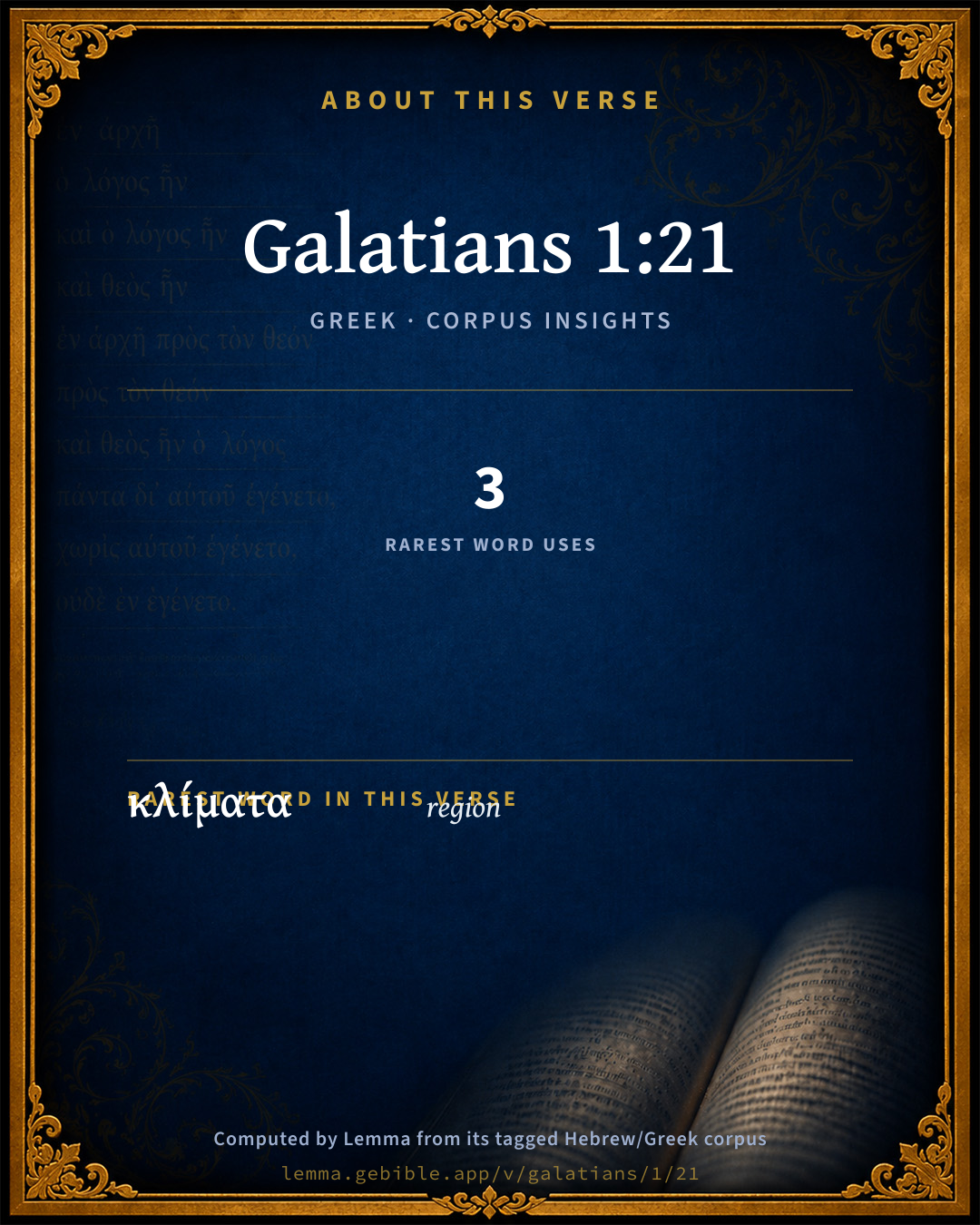
The rarest word here is κλίματα region G2824 — appearing just 3 times in the whole Greek New Testament.

Shared distinctive vocabulary

κλίματα region G2824 occurs in 3 verses of the Greek New Testament. Also found in:

Repetition

A word recurs within this verse:

Cross-references

11

Topical passages linked to Galatians 1:21 in the Treasury of Scripture Knowledge — connected by theme and wording, ordered by reader-vote popularity; previews shown in the World English Bible.

  • Acts 15:41 He went through Syria and Cilicia, strengthening the assemblies.
  • Acts 6:9 But some of those who were of the synagogue called "The Libertines," and of the Cyrenians, of the Alexandrians, and of those of Cilicia and Asia arose, disputing with Stephen.
  • Acts 9:30 When the brothers knew it, they brought him down to Caesarea, and sent him off to Tarsus.
  • Acts 11:25–26 Barnabas went out to Tarsus to look for Saul.
  • Acts 13:1 Now in the assembly that was at Antioch there were some prophets and teachers: Barnabas, Simeon who was called Niger, Lucius of Cyrene, Manaen the foster-brother of Herod the tetrarch, and Saul.
  • Acts 15:23 They wrote these things by their hand: "The apostles, the elders, and the brothers, to the brothers who are of the Gentiles in Antioch, Syria, and Cilicia: greetings.
  • Acts 18:18 Paul, having stayed after this many more days, took his leave of the brothers, and sailed from there for Syria, together with Priscilla and Aquila. He shaved his head in Cenchreae, for he had a vow.
  • Acts 21:3 When we had come in sight of Cyprus, leaving it on the left hand, we sailed to Syria, and landed at Tyre, for there the ship was to unload her cargo.
  • Acts 21:39 But Paul said, "I am a Jew, from Tarsus in Cilicia, a citizen of no insignificant city. I beg you, allow me to speak to the people."
  • Acts 22:3 "I am indeed a Jew, born in Tarsus of Cilicia, but brought up in this city at the feet of Gamaliel, instructed according to the strict manner of the law of our fathers, being zealous for God, even as you all are this day.
  • Acts 23:34 When the governor had read it, he asked what province he was from. When he understood that he was from Cilicia, he said,

Cross-references courtesy of OpenBible.info (CC BY 4.0).

Commentary

Notes on Galatians 1:21 from classic Christian and Jewish commentators (each source and its license shown beneath its notes). The classic Christian expositions comment on the surrounding passage and are grouped to its opening verse, so a note may address several verses; the Jewish commentaries on the Tanakh (Rashi and others) are per-verse, so they appear only where the commentator wrote on this verse.

Lemma curates 59 commentaries, every one of them public domain or Creative Commons licensed, each selected and text-cleaned for this edition rather than reprinted as found. About our sources →

The Biblical Illustrator

Joseph S. Exell

Gal_1:21

I came into the regions of Syria and Cilicia.

Christian service

I. Its sphere.

1. Among strangers--Syria.

2. Friends--Cilicia.

II. Its nature.

1. Not

(1) the propagation of philosophic dogmas;

(2) the practice of mere philanthropy;

(3) the gathering of a personal following.

2. But preaching the faith once destroyed.

(1) The unconverted destroy the faith by opposition or neglect--He that is not for Me, etc.

(2) It is the duty of the converted to repair the injuries they have inflicted on the faith.

III. Its fame. Strangers hear of it.

1. Not trumpeted by self or interested friends.

2. Not secured by unworthy arts.

3. But by words which, like light, cannot be hid. This is true popularity, and has been won by Carey, Judson, Hunt, Moffat, Ellis, etc.

IV. Its Result: Gods glory.

1. This was what Paul wished.

2. His apostleship was not of man but of God. God, therefore, deserved the praise. All ministerial and Church gifts from Him, therefore to Him the glory.

Apostolic labours

I. The work to which Paul was devoted was preaching the faith. The preaching of the faith signified--

1. The declaration of the whole gospel. He had been subdued by the gospel, and what he had felt of the word of life that he declared unto others.

II. Pauls labours were exercised in different places. In Damascus and Jerusalem, and now in various parts of Cilicia as well as Syria, Paul preached the gospel. His message was the same in substance in every place, be-cause--

1. All men needed salvation; and,

2. A salvation was provided for all.

III. Pauls labours were extensive in their influence. Even those who had not seen his face heard of him, and of the grace of God which was manifested by him. Many of them in Judaea who once dreaded his name were now cheered and blessed, and their faith was strengthened by what they heard of him.

IV. Pauls labours exalted the glory of God. It is of Gods grace when, from a persecutor and misleader, a man becomes a true teacher and confessor. O wonder! Is not that as much as if a dead man were raised to life? And it serves to the praise of the Divine confession that the Lord does not destroy His enemies, but wins them over, and converts them to His service. Lessons:

1. The religion of Jesus Christ inspires a man to active service. His love constrains every believer to do something in His cause.

2. A holy and zealous life is a confirmation of the truth. Hence Paul introduced the text as an argument to show that the mission entrusted to him was of God. (Richard Nicholls.)

The Biblical Illustrator, edited by Joseph S. Exell (c. 1880s–1900s) — public domain. Text from a community e-Sword module.

The Pulpit Commentary

Afterwards I came into the regions of Syria and Cilicia (epeita hlqon eijv tamata thv Suriav kaiav); then I came into the regions of Syria and Cilicia. St. Luke tells Us (Act_9:30) that "the brethren brought him down to Caesarea, and sent him forth to Tarsus." The verb "brought down" of itself indicates that the Caesarea here mentioned was Caesarea Stratonis, the seaport of Jerusalem, and not Caesarea Philippi towards Damascus (see Bishop Lightfoot on (Gal_1:21) When, later, Barnabas required Saul"s help at Antioch, it was to Tarsus that he went to seek him. It is, therefore, probable that, in mentioning "Syria" with "Cilicia" as containing "regions" (cf. 2Co_11:10) in which, after this departure from Jerusalem, he was actively engaged in ministerial work, he is thinking of the northern part of Syria, as in "Cilicia" he is thinking of the eastern portion of Cilicia about Tarsus; northern Syria and eastern Cilicia having a great geographical affinity (see Conybeare and Howson, vol. 1. pp. 26, 130). It thus appears that the Epistle is in perfect harmony with the Acts. To the apostle"s labours during this period that he was making Tarsus his head-quarters, was most probably due in no small measure the founding of the Churches in Syria, and especially in Cilicia, which are referred to in Act_15:23, Act_15:41.

The Pulpit Commentary (1880–1919), ed. H.D.M. Spence-Jones & Joseph S. Exell — public domain. Text from a community e-Sword module.

Tyndale Open Study Notes

Tyndale Open Resources

1:21-22 Paul was not working under the supervision of the apostles in Jerusalem nor of the churches . . . in Judea.

Tyndale Open Study Notes — © Tyndale Open Resources, licensed CC BY-SA 4.0. Text via the HelloAO Bible API.

Bengel's Gnomon

Johann Albrecht Bengel

Gal 1:21. Ἦλθον, I came) with the Gospel, Gal 1:23.

Bengel's Gnomon of the New Testament — English translation (T&T Clark, Edinburgh, 1860) — public domain. Text from a community e-Sword module.

Meyer's Critical & Exegetical Commentary

Heinrich August Wilhelm Meyer

Gal_1:21. After this stay of fifteen days in Jerusalem (ἔπειτα, comp. Gal_1:18), I came into the regions of Syria and Cilicia; and consequently was again far enough away from the seat of the apostles!

τῆς Συρίας] As it is said in Act_9:30 that Paul was accompanied from Jerusalem to Caesarea, it is assumed by most modern expositors: Syriae earn partem dicit, cui Phoenices nomen fuit, Winer. So also Koppe, Rückert, Usteri, Matthies, Schott. Comp. Mat_4:24; Act_21:3. This view runs entirely counter to the design of the apostle. For here his main concern was to bring out his comparatively wide separation from Judaea, as it had occurred in his actual history; the whole context (comp. Gal_1:22) shows that it was so, and therefore the reader could only understand τῆς Συρίας as meaning Syria proper (with Antioch as its capital). It could not in the least occur to him to think of Phoenicia (which even Wieseler, though not understanding it alone to be referred to, includes), the more especially as alongside of τῆς Συρίας Cilicia, which borders on Syria proper, is immediately named (comp. Act_15:23; Act_15:41; Plin. v. 22, xviii. 30). An appeal is also wrongly made to Mat_4:24 (where, in the language of hyperbole, a very large districtnamely, the whole province of Syria, of which Judaea and Samaria formed portionsis meant to be designated) and Act_21:3 (where likewise the Roman province is intended, and that only loosely and indefinitely with reference to the coast district[38]). The relation of our passage to Act_9:30 is this: On leaving Jerusalem, Paul desired to visit Syria and Cilicia; he was accordingly conducted by the Christians as far as the first stage, Caesarea (the Roman capital of Judaea, not Caesarea Philippi), and thence he went on by land to Syria and Cilicia. Comp. on Act_9:30.

For what object he visited Syria and Cilicia, he does not state; but for this very reason, and in accordance with Gal_1:5, it cannot be doubted that he preached the gospel there. Tarsus was certainly the central point of this ministry; it was at Tarsus that Barnabas sought and found him (Act_11:25).

[38] For any one sailing from Patara and passing in front of Cyprus to the right has the Syrian coast before him towards the east, and is sailing towards it. Thus indefinitely, as was suggested by the popular view and report, Luke relates, Act_21:3, ἐπλέομεν εἰς Συρίαν, without meaning by the καὶ κατήχθημεν εἰς Τύρον that follows to make this Συρίαν equivalent to Phoenicia. For instance, a man might say, We sailed towards Denmark and landed at Glückstadt, without intending it to be inferred that Denmark is equivalent to Holstein.

Meyer — Critical and Exegetical Commentary on the New Testament — English translation by Peter Christie, edited by Frederick Crombie (T&T Clark, 1880) — public domain. Text from a community e-Sword module.

Expositor's Greek Testament

ed. W. Robertson Nicoll

Gal 1:21-23 . About ten years of the life of Paul, between his flight from Jerusalem to Tarsus and his return to Jerusalem for the Apostolic Council, are here passed over. They were spent, partly in and around Tarsus and Antioch, partly in the joint mission with Barnabas to Cyprus and Asia Minor. The Galatians were already acquainted with the leading facts of that period, and it was needless to refer to them here: enough that he spent those years, like those at Damascus, in an independent ministry at a distance from Jerusalem. He did indeed repair thither once with Barnabas to carry alms from Antioch to the Elders; but circumstances prevented any intercourse with the Twelve at that time: for before they reached the city the Herodian persecution had begun, and the leading Christians were in peril of death at the hands of Herod. Paul himself can only have paid a secret and hurried visit to the city, and thought it needless apparently to mention it in this place. κλίματα . This word denotes the fringes of coastland sloping down from the mountains to the sea in north-western Syria and eastern, i.e. Roman, Cilicia. It is applied in 2Co 11:10 to the coastlands of Achaia.

The name Syria is placed before Cilicia, though the ministry at Tarsus preceded that at Antioch: for the latter was by far the more important and prolonged ministry. A further reason for placing Syria first was the subordinate position of Cilicia: for Roman Cilicia was, like Judæa, only a district of the great province of Syria, separately administered by an imperial procurator at Tarsus.

In Act 15:41 Syria and Cilicia are coupled together as forming a single region ( τὴν Συρίαν καὶ Κιλικίαν ), no article being inserted before Κιλικίαν ; not so here, for the first ministry at Tarsus was distinct from that at Antioch.

The Expositor's Greek Testament, edited by W. Robertson Nicoll (1897–1910) — public domain. Text from a community e-Sword module.

Cambridge Greek Testament for Schools and Colleges

21. ἔπειτα, Gal 1:18 note. Gal 1:21-24 continue the description of his independence of the Twelve. He stayed in Jerusalem only a fortnight and then went far away, and that for a long time.

An endeavour has been made to press these verses against the South Galatian theory, by saying that if the letter was addressed to South Galatia, St Paul must have mentioned his first visit, Acts 13, 14, for it would be the strongest proof that he was away from Jerusalem. But if his first visit to South Galatia was long after this decisive journey to Syria and Cilicia there was no need to mention it, and in any case he is not drawing an itinerary. It had nothing to do with his relation to Jerusalem.

ἦλθον εἰς τὰ κλίματα. κλίματα originally “slopes.” In Aquila (Lev 19:27) apparently of the “side,” “edge” of the head, and so perhaps in Jer 48:45 (= Num 24:17, κλίματα Symmachus) of Moab depicted under the figure of a man, though this latter passage may also mean the “slopes” or “corner districts” of the land of Moab. Elsewhere in the N.T. (Rom 15:23; 2Co 11:10[61]) “districts,” as probably here (cf. Polyb. 1:44. 6; x. 1. 3), not meaning the whole regions of Syria and of Cilicia, but districts in them. Thus the phrase indicates that St Paul did not stay only in Antioch or in Tarsus (Act 9:30; Act 11:25).

[61] Is affixed to a word it means that all the passages are mentioned where that word occurs in the New Testament.

τῆς Συρίας καὶ [τῆς] Κιλικίας. See note on Textual Criticism.

There is the same doubt about the text in Act 15:41 (cf. 23). Ramsay (Gal. p. 277) says “Paul here thinks and speaks of the Roman Province, which consisted of two great divisions, Syria and Cilicia; and he designates it by the double name, like Provincia Bithynia et Pontus. We must accordingly read τῆς Συρίας καὶ Κιλικίας.” But, apart from the difficulty of accepting this naïve idea of textual criticism, the expression Provincia Syria et Cilicia has never been discovered. Perhaps when St Paul was writing, though hardly when he made his journey, they were separate provinces, for although “Cilicia was usually under the legatus of Syria (Dio Cass. 53. 12 where Coele-Syria, Phoenicia, Cilicia, Cyprus are ἐν τῇ τοῦ Καίσαρος μερίδι; cf. Tac. Ann. 2. 78), Cilicia is found under a separate governor, however, in 57 A.D. (Tac. Ann. 13. 33) perhaps as a temporary measure after the disturbances of 52 A.D. (Ann. 12. 55)” (Woodhouse in Enc. Bib. col. 828). In Mr J. G. C. Anderson’s map (1903) marking the boundaries of the Provinces from A.D. 63 to A.D. 72 it is separated from Syria. If we are to assume that the mention of these two places corresponds with the formal visits recorded in Act 9:30 (Tarsus), Act 11:25 (Syria), then of course the order here given is not chronological, and is due either to the greater political and commercial importance of Syria or to the closer geographical relation of Syria to Jerusalem (= “I went to Syria (Act 11:25), nay as far as Cilicia” (Act 9:30). But the above assumption is arbitrary, and it may well be that St Paul is simply describing his course to his home in Tarsus, “I went away from Jerusalem through Syria to Cilicia.” See also Introd. p. xx.

Cambridge Greek Testament for Schools and Colleges (Cambridge University Press, 1896; 21 vols, various authors incl. Carr, Maclear, Plummer, Farrar, Lumby, Moule, M. R. James, Simcox) — public domain. Text from a community e-Sword module.

Jamieson, Fausset & Brown

Robert Jamieson, A. R. Fausset & David Brown

I came into . . . Syria and Cilicia--"preaching the faith" (Gal 1:23), and so, no doubt, founding the churches in Syria and Cilicia, which he subsequently confirmed in the faith (Act 15:23, Act 15:41). He probably went first to Cæsarea, the main seaport, and thence by sea to Tarsus of Cilicia, his native place (Act 9:30), and thence to Syria; Cilicia having its geographical affinities with Syria, rather than with Asia Minor, as the Tarsus mountains separate it from the latter. His placing "Syria" in the order of words before "Cilicia," is due to Antioch being a more important city than Tarsus, as also to his longer stay in the former city. Also "Syria and Cilicia," from their close geographical connection, became a generic geographical phrase, the more important district being placed first [CONYBEARE and HOWSON]. This sea journey accounts for his being "unknown by face to the churches of Judea" (Gal 1:22). He passes by in silence his second visit, with alms, to Judea and Jerusalem (Act 11:30); doubtless because it was for a limited and special object, and would occupy but a few days (Act 12:25), as there raged at Jerusalem at the time a persecution in which James, the brother of John, was martyred, and Peter was m prison, and James seems to have been the only apostle present (Act 12:17); so it was needless to mention this visit, seeing that he could not at such a time have received the instructions which the Galatians alleged he had derived from the primary fountains of authority, the apostles.

Jamieson, Fausset & Brown — Commentary Critical and Explanatory on the Whole Bible (1871) — public domain (CC PDM 1.0). Text via the HelloAO Bible API.

Adam Clarke's Commentary

Verse 21. Afterwards I came into the regions of Syria, c.] The course of the apostle's travels, after his conversion, was this: He went from Damascus to Jerusalem, and from Jerusalem into Syria and Cilicia. "At Damascus the disciples took him by night, and let him down by the wall in a basket and when Saul was come to Jerusalem, he assayed to join himself to the disciples;" Ac 9:25-26. Afterwards, when the brethren knew the conspiracy formed against him at Jerusalem, they brought him down to Caesarea, and sent him forth to Tarsus, a city of Cilicia, Ac 9:30. This account in the Acts agrees with that in this epistle.

Adam Clarke's Commentary on the Bible (1810–1826) — public domain. Text from a community e-Sword/MySword module.

Ellicott's Commentary for English Readers

(21) Afterwards I came into the regions of Syria and Cilicia.—We gather from the parallel narrative in Act_9:30; Act_11:25-26, that the course which the Apostle followed was this:—He was first conveyed secretly by the disciples to the sea-port Cæsarea Stratonis; there he took ship and sailed for Tarsus. Here he was found, somewhat later, by Barnabas, and taken to Antioch, where he remained a year. It would thus appear that the order in which the two names, Syria and Cilicia, occur does not represent the order in which the two provinces were visited. The Apostle, reviewing his past career at a distance of time, and with a certain special object in view, which is not affected by the geographical direction of his movements, speaks in this general way. It hardly seems necessary to suppose an unrecorded visit to Syria on the way to Tarsus, though that, of course, is possible. Still more gratuitous is the supposition that there is any contradiction between the historical narrative and our Epistle, for such generalities of expression are what most persons may constantly detect themselves in using. The accuracy of the pedant neither belongs to St. Paul’s Epistles nor to real life.

Regions.—The Greek word here is the same as that which is translated “parts” in Rom_15:23, where see the Note.

A Bible Commentary for English Readers, edited by Charles John Ellicott (1878–1897) — public domain. Text from a community e-Sword module.

The Cambridge Bible for Schools and Colleges

gen. ed. J. J. S. Perowne

21. In the Acts we are told that when the brethren knew of the plot against St Paul’s life, they “brought him down to Cæsarea, and sent him forth to Tarsus”. This is in agreement with the statement of the text. Cæsarea was the port from which in all probability St Paul sailed to Tarsus, the capital of Cilicia. The expression “the regions of Syria and Cilicia” must not be pressed as describing the order in which he visited the two countries. We learn from Act_11:25-30 that Barnabas went to Tarsus, and, having found Saul, brought him to Antioch, the capital of Syria, where he continued teaching for a whole year.

The Cambridge Bible for Schools and Colleges (gen. ed. J. J. S. Perowne; Cambridge University Press, 1878–1918) — public domain. Text from a community e-Sword module.

John Gill's Exposition

Afterwards I came into the regions of Syria and Cilicia. For having disputed against the Grecians at Jerusalem, and being too hard for them, it so irritated them, that they were going to murder him; which being known to the brethren there, they got him out of the way, and had him down to Caesarea, and so to Tarsus, a city in Cilicia; where he was born; in which places and in the countries about he preached the Gospel of Christ; to Tarsus, Barnabas went for him seeking him, and finding him brought him to Antioch in Syria; and both in Syria and Cilicia he preached, no doubt with success, since we read of believing Gentiles and churches in those parts he afterwards visited; being sent along with others, with the letter and decrees of the synod at Jerusalem to them, and whom he confirmed; See Gill on Act 15:23,

See Gill on Act 15:41, in the Greek text these countries are called "climates"; a climate in geography is said (y) to be a part of the surface of the earth, bounded by two circles parallel to the equator, and of such a breadth as that the longest day in the parallel nearer the pole, exceeds the longest day in that next the equator, by some certain space, viz. half an hour--. The beginning of the climate is the parallel circle wherein the day is the shortest, the end of the climate is that wherein the day is the longest;--each climate only differs from its contiguous ones, in that the longest day in summer is longer or shorter by half an hour in the one place than in the other:--vulgarly the term climate is bestowed on any country or region differing from another, either in respect of the seasons, the quality of the soil, or even the manners of the inhabitants, without any regard to the length of the longest day; in which sense it seems to be used here, as also in Rom 15:23. Of the country of Syria; see Gill on Mat 4:24. Cilicia is a country of Asia Minor, now called Caramania; it had its name of Cilicia, as Herodotus says (z), from Cilix, the son of Agenor, a Phoenician: though Bochart (a) derives it from Challekim or Challukim, which signifies stones, it being a stony country; and so Herodotus (b) calls it "mountainous" Cilicia; it is said to have Pamphilia on the west, the tops of Mount Taurus on the north, Mount Amanus on the east, and the Cilician sea on the south; Jerom says (c), Cilicia is a province of Asia, which the river Cydnus cuts in the middle, and Mount Amanus, of which Solomon makes mention, separates it from Syria-Coele.

(y) Chambers's Cyclopaedia in the word "Climate". (z) L. 7. Polymnia, c. 91. Solinus, c. 51. (a) Canaan, p. 376. (b) L. 2. Euterpe, c. 34. (c) De locis Hebraicis, fol. 95. M.

John Gill's Exposition of the Whole Bible (1746–1763) — public domain (CC PDM 1.0). Text via the HelloAO Bible API.

Trapp's Complete Commentary

John Trapp

21 Afterwards I came into the regions of Syria and Cilicia;

Ver. 21. Afterwards I came] He kept, likewise, a diary of his travels, and was able to give a good account of his daily courses. It is not to be doubted, but that our Saviour’s disciples kept a register of his holy oracles and miracles, out of which the history of the gospel was afterwards compiled and composed. Father Latimer did the like, as appeareth by his discourses. Mr Bradford also had a journal or dairy, wherein he used to set down all such notable things as either he did see or hear, each day that passed.

John Trapp, A Commentary or Exposition upon All the Books of the Old and New Testament (1647–1656) — public domain. Text from a community e-Sword module.

Albert Barnes' Notes on the Bible

Afterward I came ... - In this account be has omitted a circumstance recorded by Luke Act 9:29, of the controversy which he had with the Grecians (Hellenists). It was not material to the purpose which he has here in view, which is to state that he was not indebted to the apostles for his knowledge of the doctrines of Christianity. He therefore merely states that he left Jerusalem soon after he went there, and traveled to other places.

The regions of Syria - Syria was between Jerusalem and Cilicia. Antioch was the capital of Syria, and in that city and the adjacent places he spent considerable time; compare Act 15:23, Act 15:41.

Cilicia - This was a province of Asia Minor, of which Tarsus, the native place of Paul, was the capital; see the note at Act 6:9.

Albert Barnes' Notes on the Bible (1834–1885) — public domain. Text from a community e-Sword/MySword module.

Matthew Poole's English Annotations

After that I came from Jerusalem, I came into the country of Syria; probably not to Damascus, the chief city of Syria, (where he had so narrow an escape in a basket), but into the country parts of Syria; for Syria lay in the way between Judea and Cilicia. It appeareth by Act 9:30, that Paul was designed for Tarsus, his native place; where we are also told, that the brethren conducted him to Caesarea, which stood upon the confines of Syria. It is probable that he stayed some time at Tarsus; for there Barnabas found him, Act 11:25,26, and brought him to Antioch; so that Paul had but fifteen days at Jerusalem to converse with the apostles, and in that time he saw none of them, but Peter, and James the son of Alpheus.

Matthew Poole's English Annotations on the Holy Bible (1683–1685) — public domain. Text from a community e-Sword/MySword module.

Whedon's Commentary on the Bible

Daniel D. Whedon

21. Syria and Cilicia—He was driven from Jerusalem by plots of the Jews, Act_9:29-30, and so was beyond the reach of apostolic teaching.

Daniel D. Whedon (gen. ed.), Commentary on the Old and New Testaments (1874–1909) — public domain. Text from a community e-Sword module.

Luther on Galatians

Martin Luther

VERSE 21. Afterwards I came into the regions of Syria and Cilicia.

Syria and Cilicia are adjacent countries. Paul traces his movements carefully in order to convince the Galatians that he had never been the disciple of any apostle.

Martin Luther — Commentary on the Epistle to the Galatians (1535), English translation by Theodore Graebner (Zondervan, 1939) — public domain (U.S. copyright not renewed). Text from a community e-Sword module.

Burkitt's Expository Notes on the New Testament

William Burkitt

The fourth evidence is here produced by St. Paul, to prove, that both his ministry and his message, his office and his doctrine, were divine; and that he was so far from learning the Christian religion from the Christian churches in Judea, that he was not by face so much as known to them, or they to him: They had heard, indeed, that one Paul, a persecutor, was become a preacher, but they had never seen him; and accordingly they magnified the grace of God in his conversion, admiring the wonderful change wrought in him.

Observe here, 1. The laborious diligence and indefatigable industry of St. Paul, in planting and propagating the Christian faith throughout the world; he travels, as soon as converted, into Arabia, then into the regions of Syria and Cilicia, thinking he could never do service enough for Christ, who had suffered and done so much for him. Oh, how full of life and zeal are young converts! What activity and industry for Christ and souls is found with them! They despise all dangers, they surmount all difficulties, are above all discouragements, in expressing their love to Christ, and venturing their lives for him: But, alas! as they grow older, their affections are cooler; so that they have many times just cause to say, Oh, that it were with me, as in the months of old, in the day when God converted me, when the secret of God was with me, and when by his light I walked through all difficulties to subserve his interest, and to promote his glory.

Observe, 2. The great and mighty power of the heart-changing grace of God, which turns the haters and professed enemies of religion into friends, and bitter and bloody persecutors into bold and painful preachers of the gospel: He who persecuted in times past, now preacheth the faith which once he destroyed. He that leads captivity captive, can soon make the stoutest enemies of religion to become its strongest friends.

Observe, 3. Paul, before his conversion, is said to destroy the faith, because he intended it, and endeavoured it, though he could not actually effect it, and accomplish it. Sin and evil, intended by a determinate resolution, are as good as acted, in God’s account. Bloody persecutors design no less than a total extirpation of the truth, to destroy the faith; which though it be out of their reach to effect, yet having deliberately resolved it, it is as actually accomplished in the account of God; He now preacheth the faith that once he destroyed.

Observe, lastly, to whom the glory and praise of converting grace is due, namely, to God, and to God alone; They glorified God in me; that is, they owned and admired the grace of God bestowed upon me, which wrought such a glorious and blessed change in me. The converting grace of God, wrought either in ourselves, or others, is matter of admiration, and calls for thanksgivings and acknowlegments unto God; They glorified God in me.

William Burkitt's Expository Notes on the New Testament (1700–1703) — public domain. Text from a community e-Sword module.

McGarvey & Pendleton's Commentaries

J. W. McGarvey

Then I came into the regions of Syria and Cilicia.

J. W. McGarvey (with Philip Y. Pendleton), Commentaries on the New Testament (The Fourfold Gospel, 1914; Acts; and the epistles) — public domain. Text from a community e-Sword/MySword module.

The People's New Testament

B. W. Johnson

21. Afterwards I came into … Syria and Cilicia. See Acts 9:30. He was forced to leave Jerusalem by the attempt of the Hellenistic Jews to kill him.

B. W. Johnson's The People's New Testament with Notes (1889–1891) — public domain. Electronic text from the Christian Classics Ethereal Library (CCEL) ThML edition.

unfoldingWord translationNotes

Door43 World Missions Community

regions of

"part of the world called"

They only heard it being said

"but they only knew what they heard others saying about me"

I was still not personally known to the churches of Judea that are in Christ

"None of the people in the churches of Judea that are in Christ had ever met me"

translationWords

Syria

Cilicia

church

Judea

in Christ

persecute

preach

faith

glory

unfoldingWord translationNotes — © Distant Shores Media and the Door43 World Missions Community, licensed CC BY-SA 4.0. Source: git.door43.org/Door43/en_tn.

Alford’s Greek Testament

Henry Alford

2:21.] First, or Apologetic part of the Epistle; consisting in an historical defence of his own teaching, as not being from men, but revealed to him by the Lord,—nor influenced even by the chief Apostles, but of independent authority.

11,

21.] The beginning only of this journey is related in Act 9:30, where see note. Dean Howson suggests (edn. 2, i. p. 129, f.) that he may have gone at once from Cæsarea to Tarsus by sea, and Syria and Cilicia may afterwards have been the field of his activity,—these provinces being very generally mentioned together, from their geographical affinity, Cilicia being separated from Asia Minor by Mount Taurus. (See also note on Luk 2:1, Luk 2:2.) Winer, al. have understood by Syria here, Phœnicia: but as Meyer has shewn, inconsistently with usage. In Act 15:23, Act 15:41, we find churches in Syria and Cilicia, which may have been founded by Paul on this journey. The supposition is confirmed by our ver. 23: see below.

22,

Henry Alford, The Greek Testament (1849–1861) — public domain. Text from a community e-Sword module.

International Critical Commentary

21. Ἔπειτα ἦλθον εἰς τὰ κλίματα τῆς Συρίας καὶ τῆς Κιλικίας. “Then I went into the regions of Syria and Cilicia.” That this was a period of preaching, not, like that in Arabia, of retirement, is implied in v. 23, εὐαγγελίζεται. On the question whether he had yet begun to work distinctively for the Gentiles in these regions, see below on v. 24.

The repetition of the article before Κιλικίας is very unusual. The two regions being adjacent and both nouns limiting κλίματα, one would expect a single article, standing before the first one. See, e. g., Act 1:8, Act 1:8:1, Act 1:9:35, Act 1:15:23, 41, 27:5; Jos. Ant. 8. 36 (2:3), 12. 154 (4:1); Bell. 2. 95 (6:3), 2. 247 (12:8), which reflect the all but uniform usage of N. T. and Josephus, to which Ant. 13. 175 (4:4) and 12. 233 (4:11) are not really exceptions. Note especially Act 15:23, κατὰ τὴν Ἀντιόχειαν καὶ Συρίαν καὶ Κιλικίαν. In Act 15:41, where Συρίαν and Κιλικίαν occur in the same order, the article is inserted before Κιλικίαν by BD cat260 Thphylb only. This strong preponderance of usage makes the second article in the present passage a very difficult reading, but even more strongly points to the secondary character of the reading without it, sustained by א* 33, 241, 1908. That some mss. should have omitted it in conformity with common usage is not strange; that all the rest should have inserted it, departing thereby both from usage and the original text, is almost impossible.

International Critical Commentary — older volumes (1896–1929), various authors — public domain. Text from a community e-Sword module.

Vincent's Word Studies in the New Testament

Marvin R. Vincent

Regions [κλιματα] . P o. Comp. Rom 14:23; 2Co 11:10. Klima, originally an inclination or slope of ground : the supposed slope of the earth from the equator to the pole. The ancient geographers ran imaginary parallel lines from the equator toward the pole, and the spaces or zones or regions between these lines, viewed in their slope or inclination toward the pole, were klimata. The word came to signify the temperature of these zones, hence our climate. In Chaucer's treatise on the Astrolabe, chapter 39 is headed "Description of the Meridional Lyne, of Longitudes and Latitudes of Cities and Towns from on to another of Clymatz." He says : "The longitude of a clymat is a lyne imagined fro est to west, y - lyke distant by - twene them alle. The latitude of a clymat is a lyne imagined fro north to south the space of the erthe, fro the byginning of the firste clymat unto the verrey ende of the same clymat, even directe agayns the pole artik." In poetical language, "climes" is used for regions of the earth, as Milton :

"Whatever clime the sun's bright circle warms."

Syria and Cilicia. Syria, in the narrower sense, of the district of which Antioch was the capital : not the whole Roman province of Syria, including Galilee and Judaea. Mt 4:24; Luk 2:2; Act 20:3. This district was the scene of Paul 's first apostolic work among the Gentiles. Cilicia was the southeasterly province of Asia Minor, directly adjoining Syria, from which it was separated by Mt. Pierius and the range of Amanus. It was bordered by the Mediterranean on the south. It was Paul 's native province, and its capital was Tarsus, Paul 's birthplace.

Marvin R. Vincent, Word Studies in the New Testament (1887–1900) — public domain. Text from a community e-Sword/MySword module.

Lesson kit

Teaching starters — assembled from the data on this page, not authored interpretation. Every prompt links to the verse data it draws on. Edit before teaching.

Galatians, in the Pauline Epistles, opens this verse with 10 words (8 distinct Greek lemmas). Its most distinctive word is klíma (“region”). A historical commentator’s framing appears above. Read the whole chapter for the surrounding context.

Discussion questions

  1. How does “region” (klíma) shape what this verse is saying?
  2. Romans 15:23 shares the word «region» with this verse. How do the two illuminate each other?
  3. “the” occurs 3× in this one verse. What is the effect of the repetition?
  4. The translations on this page render this verse differently — a whole-verse word diff, not a word-by-word alignment. What might account for the different wordings?
  5. Reading how The Biblical Illustrator and The Pulpit Commentary read this verse, where do the two commentators agree and where do they part?

Things to notice

  • These translations choose different wording for 4 words in this verse.
  • “the” occurs 3× in this single verse.
  • 8 distinct Greek lemmas span 10 words in this verse.

Reading settings

Reading text

Shown beneath each verse's original-language words.

Old Testament
Old Testament edition

Read the OT as the Masoretic Hebrew (MT) or the Greek Septuagint (LXX).

English shown for the Greek Septuagint (in the Hebrew ↔ Greek comparison).

Comparing translations? Open the Compare panel on any verse page to stack up to four side by side.