
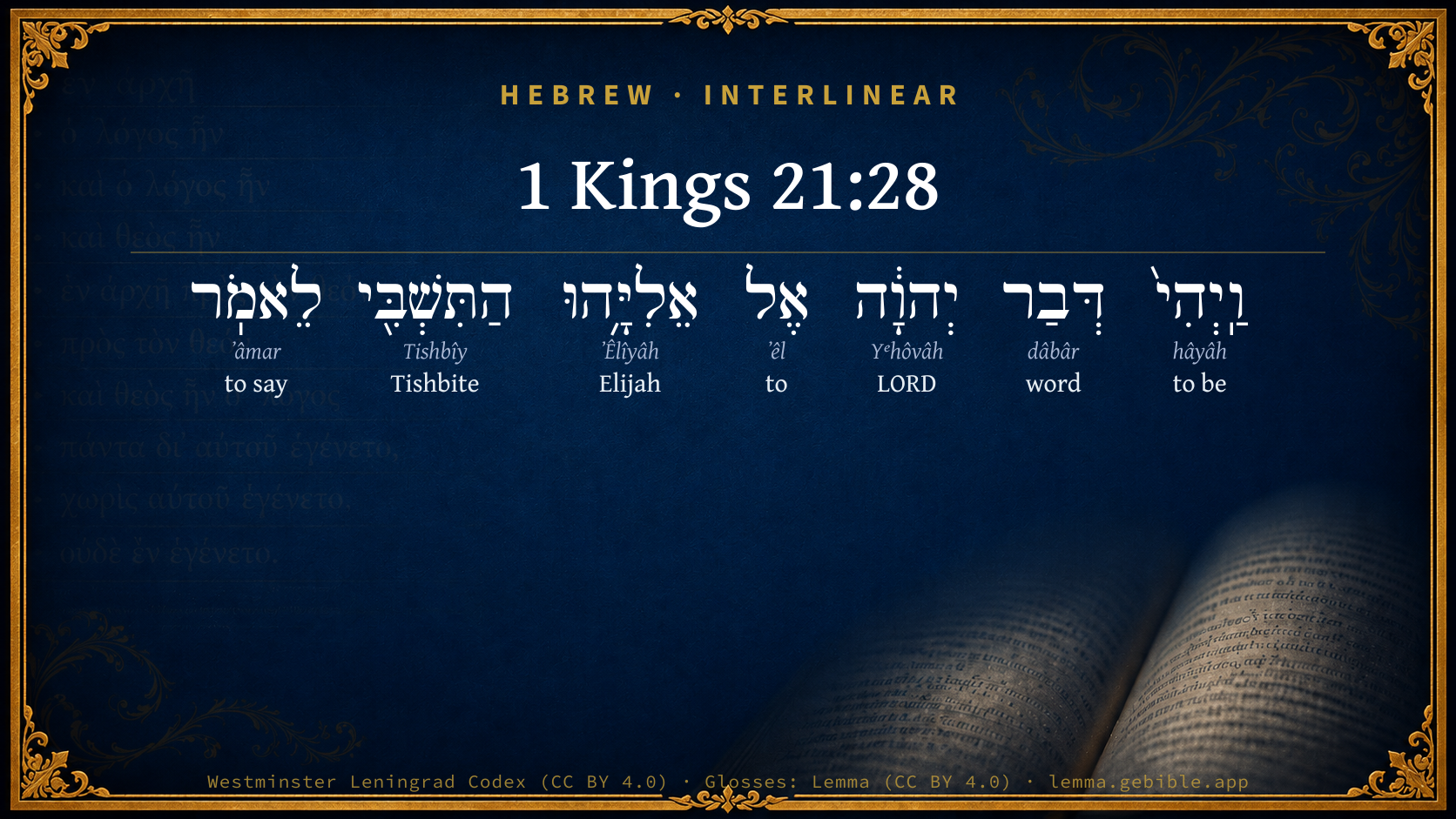
1 Kings 21:28

Hebrew (Westminster Leningrad Codex) 1 Kings 21:28 appears in the Hebrew Old Testament. The text above is from the Westminster Leningrad Codex. Each word links to its Strong’s number, a concise gloss, and parsing drawn from the Open Scriptures Hebrew Bible morphology. Click any word for its full Brown-Driver-Briggs (BDB) entry.
Download image
Cite this verse

1 Kings 21:28 (World English Bible). Public Domain. Lemma interlinear Bible study tool, https://lemma.gebible.app/v/1-kings/21/28.

Show BibTeX & RIS
BibTeX
RIS
English Translation
The word of Yahweh came to Elijah the Tishbite, saying,
World English Bible · Public Domain
Download a study sheet

One document with this verse’s original text, its word-by-word gloss line, the meaning frame, cross-references with their text, attributed commentary, and full source and license credits — printable, and it pastes into notes with its structure intact.

This verse Autodidact and up

Study sheet (.html) Plain text (.txt)

A passage Seminary Student

Up to 50 verses in one chapter. A passage sheet keeps up to 6 commentary sources and 12 cross-references per verse, in the order this page ranks them, and says so on the sheet whenever that leaves anything out. Ask for a single verse and you get the Autodidact verse sheet above.

Everything on this page stays free to read, with no account — the sheet is a download of what is already on screen, not access to it.

Want to remove ads? Support Godless Engineer
Compare translations 3

The same verse in 3 English versions, stacked beneath the original-language interlinear above. Click any original word for its lexicon entry.

Each is an independent rendering of the whole verse — the interlinear is not word-aligned to these translations.

Highlighted words mark where these versions differ — a whole-verse word diff, not a word-by-word alignment.

  • World English Bible Public Domain
    The word of Yahweh came to Elijah the Tishbite, saying,
  • King James Version Public Domain
    And the word of the LORD came to Elijah the Tishbite, saying,
  • unfoldingWord Literal Text CC BY-SA 4.0
    And the word of Yahweh was to Elijah the Tishbite, saying,

unfoldingWord Literal Text — © unfoldingWord, licensed CC BY-SA 4.0. Word-aligned USFM3 via Door43 (git.door43.org/unfoldingWord/en_ult).

Versions to compare (up to 4)

3 of 4 selected

Show all 18 translations

Every available English version of this verse, each an independent rendering of the whole verse.

  • World English Bible Public Domain
    The word of Yahweh came to Elijah the Tishbite, saying,
  • Berean Standard Bible Public Domain
    Then the word of the LORD came to Elijah the Tishbite, saying:
  • Majority Standard Bible Public Domain
    Then the word of the LORD came to Elijah the Tishbite, saying:
  • King James Version Public Domain
    And the word of the LORD came to Elijah the Tishbite, saying,
  • American Standard Version (1901) Public Domain
    And the word of Jehovah came to Elijah the Tishbite, saying,
  • Revised Version (1885) Public Domain
    And the word of the LORD came to Elijah the Tishbite, saying,
  • Geneva Bible (1599) Public Domain
    And the worde of the Lord came to Eliiah the Tishbite, saying,
  • Douay-Rheims (1899) Public Domain
    And the word of the Lord came to Elias the Thesbite, saying:
  • Young's Literal Translation Public Domain
    And the word of Jehovah is unto Elijah the Tishbite, saying,
  • Literal Standard Version CC BY-SA 4.0
    And the word of YHWH is to Elijah the Tishbite, saying,
  • Unlocked Literal Bible CC BY-SA 4.0
    Then the word of Yahweh came to Elijah the Tishbite, saying,
  • unfoldingWord Literal Text CC BY-SA 4.0
    And the word of Yahweh was to Elijah the Tishbite, saying,
  • Darby Bible Public Domain
    And the word of Jehovah came to Elijah the Tishbite, saying,
  • World Messianic Bible Public Domain
    The LORD’s word came to Elijah the Tishbite, saying,
  • Webster's Bible Public Domain
    And the word of the LORD came to Elijah the Tishbite, saying,
  • Free Bible Version CC BY-SA 4.0
    Then the Lord sent a message to Elijah the Tishbite:
  • Bible in Basic English Public Domain
    Then the word of the Lord came to Elijah the Tishbite, saying,
  • JPS Tanakh (1917) Public Domain
    And the word of the LORD came to Elijah the Tishbite, saying:

Literal Standard Version (2020), Covenant Press — licensed CC BY-SA 4.0. Text via the HelloAO Bible API (eBible.org). Unlocked Literal Bible (unfoldingWord) — licensed CC BY-SA 4.0. Text via the HelloAO Bible API (eBible.org). unfoldingWord Literal Text — © unfoldingWord, licensed CC BY-SA 4.0. Word-aligned USFM3 via Door43 (git.door43.org/unfoldingWord/en_ult). Free Bible Version, Dr. Jonathan Gallagher — licensed CC BY-SA 4.0. Text via the HelloAO Bible API (eBible.org).

Word by word

More ways to search: Search by grammar → Find every occurrence → Compare this word →

Practice this passage: Drill this verse → Learn its vocabulary →

About this verse

These counts appear in no published source. They are computed here, from the morphology-tagged text and Lemma’s own curated glosses. What Lemma adds →

7
words
7
distinct lemmas
Historical
section

Notable vocabulary

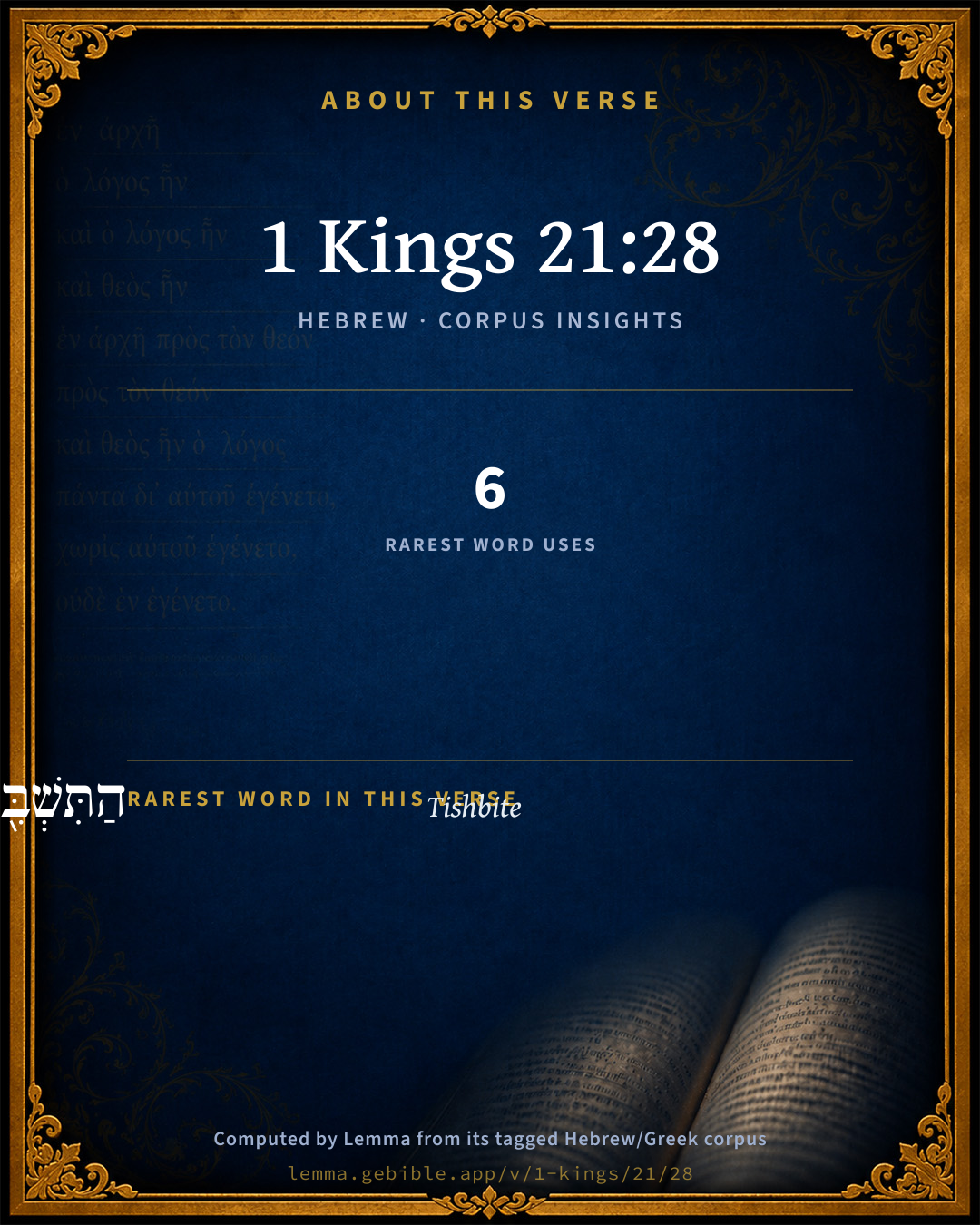
The rarest word here is הַתִּשְׁבִּ֖י Tishbite H8664 — appearing just 6 times in the whole Hebrew Bible.

Shared distinctive vocabulary

הַתִּשְׁבִּ֖י Tishbite H8664 occurs in 6 verses of the Hebrew Bible. Also found in:

Grammatical profile

  • 2 verbs
  • 4 nouns
  • 1 preposition

Verb forms

  • וַֽיְהִי֙ Qal · Sequential Imperfect
  • לֵאמֹֽר Qal · Infinitive Construct

Hebrew & Septuagint length

In English translation the verse runs 10 words from the Hebrew and 61 from the Septuagint (LXX English) — the Septuagint runs noticeably longer here. See the side-by-side →

A rough comparison of the two English renderings, which tokenize alike — not a word-level alignment.

Word counts can differ between the Hebrew and the Greek without any difference in meaning — e.g. the Hebrew direct-object marker אֵת has no separate Greek word, and Greek often adds the article ὁ.

Hebrew and Greek witnesses Masoretic Hebrew ↔ Greek Septuagint

The same verse in the two great witnesses to the Old Testament, shown verse-for-verse.

Here the Septuagint runs noticeably longer than the Hebrew — LXX2012 (modern English Septuagint) 61 words vs World English Bible 10. A rough length comparison of the two English translations, not a word-level alignment — read both below.

These are two independent witnesses, not word-aligned to each other, and the Septuagint is shown in lemma (dictionary) form.

Hebrew 1 Kings 21:28 Masoretic · Westminster Leningrad Codex

וַֽיְהִי֙ דְּבַר יְהוָ֔ה אֶל אֵלִיָּ֥הוּ הַתִּשְׁבִּ֖י לֵאמֹֽר

The word of Yahweh came to Elijah the Tishbite, saying,

World English Bible · Public Domain

Greek LXX 1 Kings 21:28 Septuagint · lemma form

καί προςἔρχομαι ὁ ἄνθρωπος ὁ θεός καί εἶπον ὁ βασιλεύς ἰσραήλ ὅδε λέγω κύριος ἀντί ὅς εἶπον συρία θεός ὄρος κύριος ὁ θεός ἰσραήλ καί οὐ θεός κοιλάς αὐτός καί δίδωμι ὁ δύναμις ὁ μέγας οὗτος εἰς χείρ σός καί γιγνώσκω ὅτι ἐγώ κύριος

And there came the man of God, and said to the king of Israel, Thus says the Lord, Because Syria has said, The Lord God of Israel is a God of the hills, and he is not a God of the valleys, therefore will I give this great army into your hand, and you shall know that I am the Lord.

LXX2012 (modern English Septuagint) · Public Domain

Hebrew: Westminster Leningrad Codex (CC BY 4.0). Greek: Septuagint (public domain); English from LXX2012 (modern English Septuagint) (Public Domain). How the Septuagint differs from the Hebrew →

Targum (Aramaic paraphrase)

1

The Targum is the ancient Jewish Aramaic paraphrase of the Hebrew Scriptures — an interpretive translation, not the Hebrew text itself. Onkelos (literal) and Pseudo-Jonathan (expansive) render the Torah, and Jonathan the Prophets. Coverage is partial: where no permissively-licensed English translation exists for a verse, only the Aramaic is shown. This is verse-level text, not a word-by-word alignment to the Hebrew.

  1. Targum Jonathan Prophets (Joshua–Malachi)
    וַהֲוָה פִתְגָם נְבוּאָה מִן קֳדָם יְיָ עִם אֵלִיָהוּ דְמִן תּוֹשָׁב לְמֵימָר:

    (no public-domain English translation for this verse)

    Targum Jonathan — Aramaic: “Mikraot Gedolot” (public domain). English: “Sefaria Community Translation” (CC0 1.0 (public-domain dedication)); “London "Chaldee Paraphrase," 1871” (public domain). Text via Sefaria.

Commentary

Notes on 1 Kings 21:28 from classic Christian and Jewish commentators (each source and its license shown beneath its notes). The classic Christian expositions comment on the surrounding passage and are grouped to its opening verse, so a note may address several verses; the Jewish commentaries on the Tanakh (Rashi and others) are per-verse, so they appear only where the commentator wrote on this verse.

Lemma curates 59 commentaries, every one of them public domain or Creative Commons licensed, each selected and text-cleaned for this edition rather than reprinted as found. About our sources →

Trapp's Complete Commentary

John Trapp

1Ki 21:28 And the word of the LORD came to Elijah the Tishbite, saying,

Ver. 28. And the word of the Lord.] Who had soon seen this - though but feigned and forced - humiliation, and sent words of comfort. O felix poenitentia, quae ad se Dei traxit oculos, saith Jerome. Surely if the leaves of repentance be so medicinal, much more the fruit; - if the shadow of it be so sovereign, what the substance!

John Trapp, A Commentary or Exposition upon All the Books of the Old and New Testament (1647–1656) — public domain. Text from a community e-Sword module.

Whedon's Commentary on the Bible

Daniel D. Whedon

28. In his son’s days will I bring the evil — Jehovah makes this announcement, not because he will punish the son for the sins of his father, but because he foresees that the son will also do evil in the sight of the Lord, and will, therefore, like his father, deserve punishment.

Daniel D. Whedon (gen. ed.), Commentary on the Old and New Testaments (1874–1909) — public domain. Text from a community e-Sword module.

The Pulpit Commentary

And the word of the Lord came to Elijah the Tishbite, saying, It is not clear that this mitigation of the sentence was announced to Ahab,

Vers. 28, 29.

Divine Relentings.

If we were to seek the Scriptures through for a proof that God"s "property is always to have mercy," and that judgment is His strange work, where should we find a more striking and eminent one than in this relenting towards Ahab? Consider

I AHAB"S SIN. In this respect "there was none like him." He "sold himself to work wickedness." It was not because of Naboth"s murder alone that the sentence of vers. 19-22 was pronounced against him; it was for the varied and accumulated sins of a reign of twenty years. Among these were

1. The sin of schism. He continued the calf worship. (1Ki_16:1) He kept "the statutes of Omri." Despite the warnings of prophets and of history, he maintained the shrines, sacrifices, priests, of Bethel and Daniel

2. The sin of his marriage. "Was it a light thing to walk in the way of Jeroboam that he must take to wife Jezebel", (1Ki_15:31 Hebrews) in direct violation of the law, (Deu_7:1-3) in disregard of the example of Solomon? To place such a woman, daughter of such a house, on the throne of Israel was to insult the true religion, and to court its overthrow.

3. The sin of idolatry. (1Ki_16:32) Samaria had its house of Baal, its altar for Baal. He did very abominably in following idols. (1Ki_21:26)

4. The sin of impurity. This was involved, as we have already remarked, in the idolatry of that age. "Ahab made an Asherah". (1Ki_16:32) Indeed, it is to the impurities of Canaanitish worship that the words just cited (ver. 26) refer. The abominations of the Amorites are not to be named amongst Christians.

5. The sin of persecuting the prophets. It is very possible that Ahab himself was no persecutor, but Jezebel was, and he should have restrained her. (1Sa_3:18) He was directly responsible for her deeds. She owed her power, place, and influence to him.

1. The sin of releasing the persecutor of God"s people. The pardon and favour he accorded to Ben-hadad are mentioned as a part of the provocation wherewith he provoked the Lord. (1Ki_20:42) It sprang out of his forgetting God. He ignored altogether God"s will and pleasure in the matter. See p. 492.

2. The sin of slaying Naboth and his sons. For with this crime Ahab is charged. "Hast thou killed?" I have seen yesterday the blood of Naboth., and I will requite thee". (2Ki_9:26) Perhaps he flattered himself that that sin lay at Jezebel"s door. If so, he is soon undeceived.

Such was Ahab"s sevenfold sin. Consider

II ITS AGGRAVATIONS. It enhanced his guilt that

1. He was the Lord"s anointed. He was the head of the Jewish Church. Fidei Defensor this was the highest function of a true king of Israel. His very position reminded him of the gracious and marvellous history of his

2. fathers. To him it was granted to be the representative of heaven to the chosen people. How great the sin when the champion of the faith became its oppressor, when the "nursing father" of the Church depraved and prostituted it.

3. He had witnessed miracles. The drought, the fire, the rain, all these signs and tokens had been wrought in his presence. Unto him they were showed that he might know that the Lord He was God (Deu_4:35, Deu_4:36; cf. 1Ki_18:39) Did ever king hear the voice of God as he had done?

1. He had been miraculously helped and delivered. Cf. 2Ch_26:15. If he gave no heed to the signs, he should have been moved by thevictories God had granted him. These were plain proofs that the Lord alone was God. (1Ki_20:13, 1Ki_20:28) But neither plagues, nor signs, nor victories moved that rebellious heart. He is scarce home from his Syrian compaigns, to enjoy the fruit of his success, than he lends himself to fresh sin, to murder and oppression, He, the executor and guardian of law, connives at the murder of a law-abiding subject. Let us now consider

III HIS REPENTANCE. Now that he is found out and denounced, like Felix, he trembles. As Elijah stands over him, and announces the doom of his house, he sees a horrible vision of blood and slaughter. The garden of herbs he has pictured dies away from his view. He sees in its stead his own mangled body cast into the plot of ground where he was then standing. He sees his hands, his feet, his face gnawed by the curs of the adjoining city. He sees his proud consort stripped of her silk attire, suffering a like indignity in the neighbouring ditch. He sees his children, the fruit of his body, stretched in the streets of the town, or in the open champaign, a feast for the jackal and the carrion crow. "Like the house of Jeroboam," "like the house of Baasha," he knew the horrors involved in these words. A horrible dread overwhelms him. He is smitten by sudden compunction. He must get away from this cursed spot at once. He might then have justly said to his charioteer, "Turn thine hand and carry me away, for I am wounded". (1Ki_22:34) An arrow from Elijah"s lips has pierced his harness through. He mounts his chariot, it bears him through the plain, bears him to his palace no longer "heavy and displeased," but utterly crushed and terrified. Again he steals to his bedchamber, and turns his face to the wall and eats no bread. In vain the queen assays to laugh him out of his fears. No instruments of music can charm his melancholy, no physicians can minister to that mind diseased. He cannot banish that vision from his thoughts. It haunts him like a nightmare. Can he not avert the doom? Can he not make his peace with Heaven? He has but lately forgiven cruel and persistent enemy; is there no forgiveness for him? He will make the effort. He too will "gird sackcloth on his loins, and put a rope on his head," and go to the great king of Israel. He rises from his couch a sadder and a wiser man. He rends his kingly robes and casts them from him; he assumes the garment of humiliation, he fasts, he prays, he goes softly. It is true his penitence was neither profound nor enduring, (1Ki_22:8, 1Ki_22:26) but it was undoubtedly

1. Sincere while it lasted. It is a mistake to call it the "shadow of a repentance." There was real contrition not only fear of punishment, but also sorrow for his sin. We may be sure that, like a former king of Israel, his cry was, "I have sinned against the Lord". (2Sa_12:13)

2. Open and public. His queen, his courtiers, saw the sackcloth, marked the hushed voice, the downcast eye, and knew what it meant (ver. 29). Seest thou how Ahab?" etc., implies that it was notorious. The crime was known of all men; the sorrow and humiliation must be the same.

3. Marked by restitution. The Scripture does not say so, but it does not need to say so. There could be no real repentance, certainly no relenting, on God"s part so long as Ahab kept the vineyard. His prayers would have been unheeded so long as there was a lie in his right hand. A "penitent thief" has always restored the theft. Ahab could not recall Naboth to life. But he could surrender the vineyard to the widow, and we may be sure he did so.

But this repentance, this self abasement was observed, was carefully watched outside the palace. As day by day, with contrite heart and bowed head and soft footstep, the miserable king moved among his retainers, the merciful God and Father of the spirits of all flesh beheld his returning prodigal, yearned over him, ran to meet him. He who will not break the bruised reed nor quench the smoking wick welcomed the first faint tokens of contrition. The sentence of doom shall be deferred. The same voice which just now thundered, "Hast thou killed?" etc., is now hushed into tenderness. "Seest thou," it says, "seest thou how Ahab humbleth himself before me? Because," etc. (ver. 29). Ahab receives

IV PARDON. And this pardon, it is to be observed, was

1. Instant. The rebellion had lasted for years. The forgiveness follows on the heels of repentance. While he was speaking God heard. Cf. Dan_10:12.

1. Free and full. If Ahab"s repentance, that is to say, had been lasting, the sentence would have been reversed so far as he was concerned. It was not finally reversed because of his subsequent sin and that of his sons. The guilt of innocent blood, no doubt, could only be purged by the blood of him that shed it, (Num_35:33) and it is to be remembered that Jezebel was never included in the pardon. But it is probable that God, to "show forth all long-suffering," would have spared the king and his sons, if they had turned from their evil way.

2. Conditional. Dum se bere gesserit." This provision is always understood, if not expressed.

3. Forfeited. When Ahab turned like a dog to his vomit, then the sword which had been sheathed awhile leapt again from its scabbard, and he was suddenly destroyed, and that without remedy.

The Pulpit Commentary (1880–1919), ed. H.D.M. Spence-Jones & Joseph S. Exell — public domain. Text from a community e-Sword module.

Lesson kit

Teaching starters — assembled from the data on this page, not authored interpretation. Every prompt links to the verse data it draws on. Edit before teaching.

1 Kings, in the Historical, opens this verse with 7 words (7 distinct Hebrew lemmas). Its most distinctive word is Tishbîy (“Tishbite”). The Greek Septuagint runs longer here. A historical commentator’s framing appears above. Read the whole chapter for the surrounding context.

Discussion questions

  1. How does “Tishbite” (Tishbîy) shape what this verse is saying?
  2. 1 Kings 17:1 shares the word «Tishbite» with this verse. How do the two illuminate each other?
  3. Compared with the Hebrew, the Septuagint runs longer here. What questions does that raise?
  4. These translations render this verse differently; the difference is in the English rendering, not the original. What questions does that raise?
  5. The verb «וַֽיְהִי֙» is Qal Sequential Imperfect. How does its form color the action?
  6. Reading how Trapp's Complete Commentary and Whedon's Commentary on the Bible read this verse, where do the two commentators agree and where do they part?

Things to notice

Reading settings

Reading text

Shown beneath each verse's original-language words.

Old Testament
Old Testament edition

Read the OT as the Masoretic Hebrew (MT) or the Greek Septuagint (LXX).

English shown for the Greek Septuagint (in the Hebrew ↔ Greek comparison).

Comparing translations? Open the Compare panel on any verse page to stack up to four side by side.