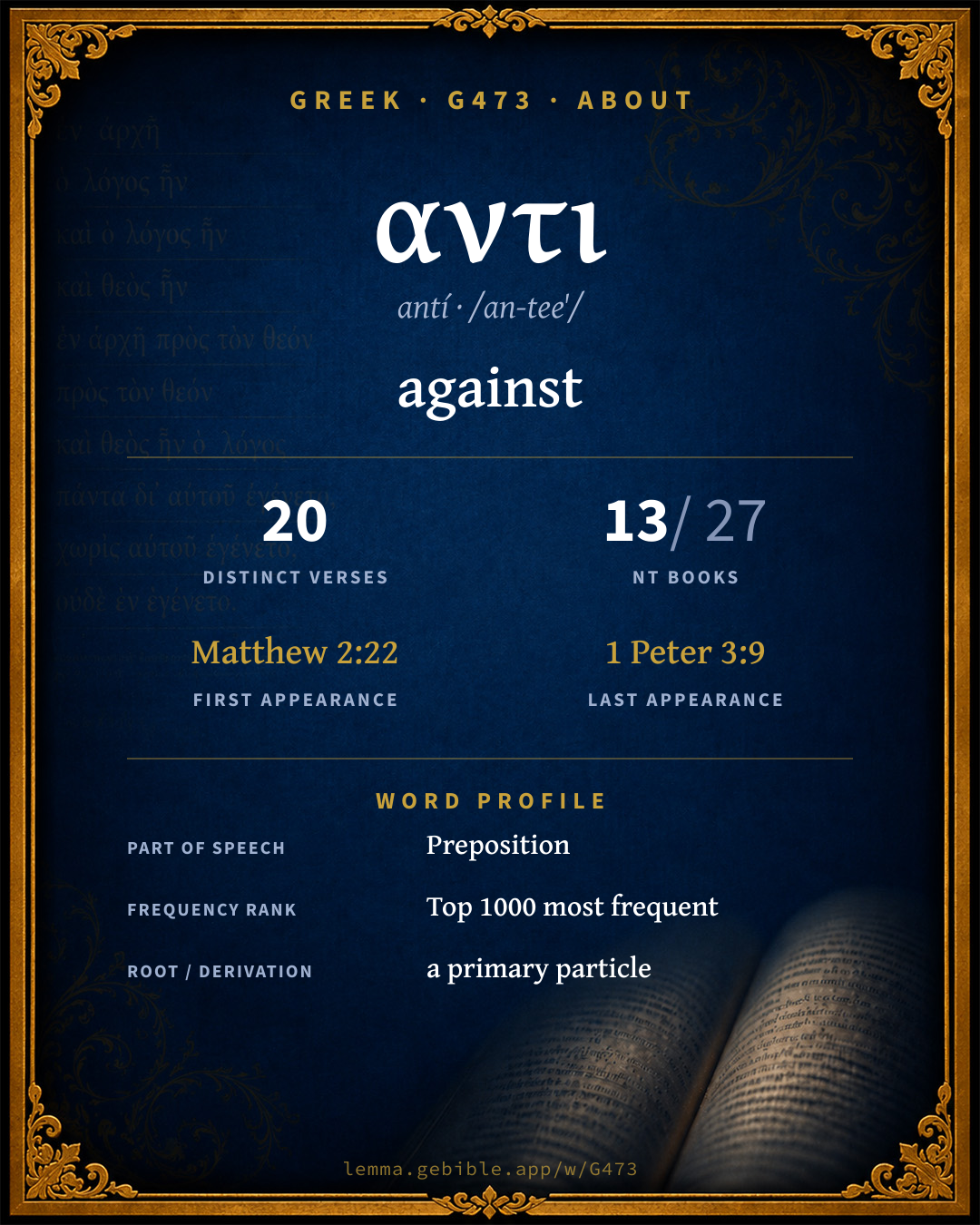
ἀντί
against
‘against’ is one of 2 main senses fuller range ↓
Full lexicon entry — Thayer's Greek Lexicon
From Thayer's Greek Lexicon
Where this word appears
Grammar key — what these labels mean
Part of speech
- Preposition
- A relational word governing a noun in a particular case.
Every verse where G473 appears in the Book of Mark — 1 distinct verse. Click any verse to open its interlinear word-by-word view. Verse text shown in the World English Bible for context — . Each verse’s Greek form is shown with its reference; the English is not keyword-highlighted, since the data carries no word-level English alignment. Use “Compare translations” on any verse to read it across multiple English versions. This concordance covers the Greek New Testament; Septuagint (Greek Old Testament) occurrences of this word are not indexed here.
Mark
About this entry
At a glance — auto-summarized from this page’s data, not written by a person. Every figure links to its source below. This summary describes the numbers; it doesn’t interpret them.
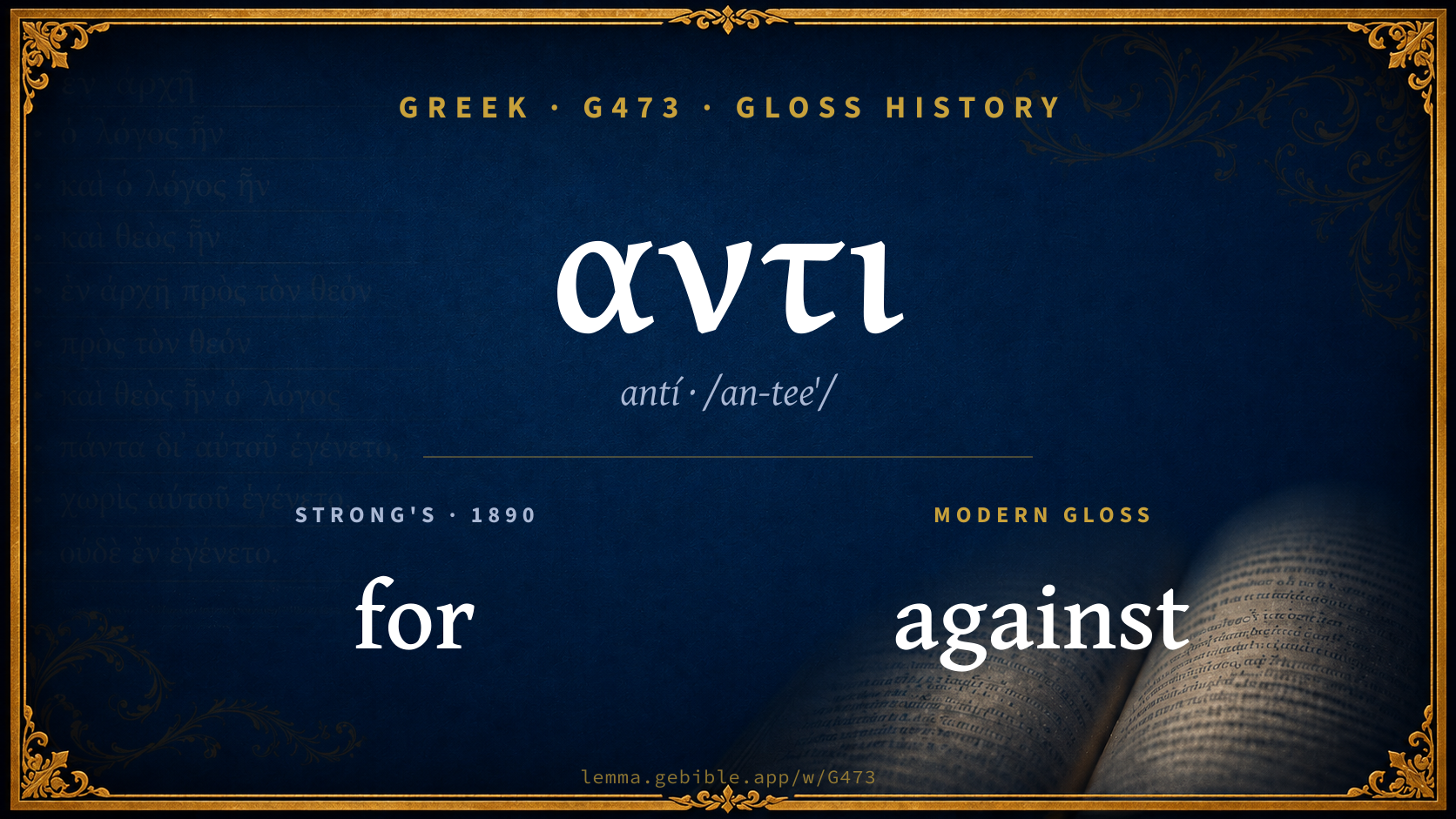
The Greek preposition αντι centers on the idea of “against.” Its English rendering has broadened — “for” classically, “exchange for” (unfoldingWord Literal Text) in modern versions; see the renderings breakdown. Spanning 20 verses in 13 books, it ranks among the uncommon words of the Greek New Testament. Its earliest occurrence is Matthew 2:22. Lexicons map it across 2 senses. Dig into 20-verse concordance and the renderings breakdown below.
Gloss history
Strong's 1890 vs modern scholarship
About this word
Strong's G473 catalogs a Greek word from the Greek New Testament.
These counts are not copied from any lexicon or concordance. They are computed here, from the morphology-tagged Greek New Testament. What Lemma adds →
- 20
- distinct verses
- The word appears in 20 distinct verses.
- 13 / 27
- NT books
- The word appears in 13 of 27 New Testament books.
- #586
- by frequency
- Top 1000 most frequent Greek words (rank 586 of 5,347 Greek words by occurrence).
View all 20 occurrences in the concordance →
By section of the New Testament
By traditional corpus
Conventional, traditional groupings — biblical authorship is debated, so this is a traditional corpus grouping, not an authorship claim. Some books belong to more than one corpus (Luke is in both the Gospels and the Lukan corpus, and so on), so these shares overlap and need not total 100%. Each figure is a share of the word’s 20 distinct verses.
- Gospels 10 verses · 50%
- Lukan (Luke–Acts) 5 verses · 25%
- Pauline corpus 5 verses · 25%
- Hebrews 2 verses · 10%
- General (Catholic) Epistles 2 verses · 10%
- Johannine 1 verse · 5%
How translations render this word
Counts come from each version’s own published word-to-Strong’s tagging or interlinear alignment — an approximate guide to how each version renders this word, not a word-level alignment the data otherwise carries. Because each total is that version’s own tagged count, the per-version totals vary from one another and need not match the appearance or distinct-verse counts above. These counts may also differ from a printed concordance because Lemma counts each distinctly tagged rendering and does not collapse phrase taggings into a single head-word total. This is a fixed set of word-tagged versions (KJV, ASV, BSB, ULT) and does not change with the reading translation you choose elsewhere. Each version’s license is shown beside its name below (and on Sources).
- King James Version: For 15×, Because 4×
- American Standard Version: For 15×, Because 3×
- Berean Standard Bible: For 9×, Because 4×, With 2×
- unfoldingWord Literal Text: Exchange for 7×, Because 4×, For 3×
King James Version Public Domain
Renders G473 across 22 tagged occurrences — most commonly:
Plus 3 renderings that appear only once — usually multi-word phrases or single function words the recovered tagging swept in, not distinct renderings.
American Standard Version Public Domain
Renders G473 across 20 tagged occurrences — most commonly:
Plus 2 renderings that appear only once — usually multi-word phrases or single function words the recovered tagging swept in, not distinct renderings.
Berean Standard Bible Public Domain
Renders G473 across 20 tagged occurrences — most commonly:
Plus 5 renderings that appear only once — usually multi-word phrases or single function words the recovered tagging swept in, not distinct renderings. Not rendered by a distinct English word in 1 further occurrence.
unfoldingWord Literal Text CC BY-SA 4.0
Renders G473 across 22 tagged occurrences — most commonly:
Plus 8 renderings that appear only once — usually multi-word phrases or single function words the recovered tagging swept in, not distinct renderings.
Senses in Thayer's
The 2 senses Thayer's distinguishes for this word, in lexicon order (not ranked by frequency or importance). The full entry — with sub-senses — is in the Lexicon Entry tab.
- over against, opposite to, before
- for, instead of, in place of (something)
Word origin
Origin: a primary particle
A primary particle; opposite that is instead or because of (rarely in addition to): - for in the room of. Often used in composition to denote contrast requital substitution correspondence etc.
— Strong’s Exhaustive Concordance (1890), public domain.
Forms in the corpus
The 2 distinct written forms G473 takes in the Greek New Testament, most frequent first — each parse links to that case’s occurrences in the concordance.
| Form | Parsing | Example | Uses |
|---|---|---|---|
| ἀντὶ antì | Preposition | Matthew 2:22 | 17 |
| ἀνθ’ anth | Preposition | Luke 1:20 | 5 |
Same root — word family
Other Thayer's entries built from the same root as G473, grouped by Strong’s listed origin. These share a root / origin per the lexicon — not necessarily a shared meaning. Each links to that word’s own entry.
Derived from this word
- ανθιστημι anthístēmi G436 to resist
- ανθομολογεομαι anthomologéomai G437 to acknowledge
- ανθυπατος anthýpatos G446 proconsul
- ανταγωνιζομαι antagōnízomai G464 to struggle
- ανταλλαγμα antállagma G465 exchange
- ανταναπληροω antanaplēróō G466 to fill up
- ανταποδιδωμι antapodídōmi G467 to repay
- ανταποκρινομαι antapokrínomai G470 to contradict
- αντεπω antépō G471 to speak against
- αντεχομαι antéchomai G472 to withstand
- αντιβαλλω antibállō G474 to throw back
- αντιδιατιθεμαι antidiatíthemai G475 to oppose
- αντιδικος antídikos G476 opponent
- αντιθεσις antíthesis G477 opposition
- αντικαθιστημι antikathístēmi G478 to place opposite
- αντικαλεω antikaléō G479 to invite in turn
- αντικειμαι antíkeimai G480 to oppose
- αντικρυ antikrý G481 opposite
- αντιλαμβανομαι antilambánomai G482 to take hold
- αντιλεγω antilégō G483 to contradict
- αντιλοιδορεω antiloidoréō G486 to revile back
- αντιλυτρον antílytron G487 ransom
- αντιμετρεω antimetréō G488 to repay
- αντιμισθια antimisthía G489 reward
+8 more words derive from G473 (not shown).
Proper names from this root
People and places named from this root — a name, not an additional meaning of the word.
Compare all same-root words → Showing 4 of 35 — not the complete family. 2 of the same-root words are proper names (people or places). They share a root, not necessarily a meaning.
Septuagint usage
The same Greek word αντι appears 403 times in the Greek Old Testament (Septuagint), across 348 verses in 32 books.
- 403
- LXX occurrences
- Tagged occurrences of this Greek word in the Septuagint.
- 348
- verses
- Distinct Septuagint verses containing this word.
- 32 / 39
- OT books
- The word appears in 32 of the 39 Old Testament books.
Sample Septuagint occurrences
- Genesis 2:21 ἀντί
- Exodus 21:23 ἀντί
- Leviticus 6:15 ἀντί
- Numbers 3:12 ἀντί
- Deuteronomy 2:12 ἀντί
- Joshua 2:14 ἀντί
- Judges 1:7 ἀντι
- 1 Samuel 2:20 ἀντί
- 2 Samuel 3:30 ἀντί
- 1 Kings 1:30 ἀντί
- 2 Kings 3:27 ἀντί
- 1 Chronicles 1:32 ἀντί
Septuagint occurrences (same lexeme)
Every verse where the same Strong’s number (G473) appears in the Greek Septuagint — showing the first 50 of 348. Verse text shown in the World English Bible for context; the Greek form is the matched word — the English is not keyword-highlighted.
- Genesis 2:21 ἀντί Yahweh God caused a deep sleep to fall on the man, and he slept; and he took one of his ribs, and closed up the flesh in its place.
- Genesis 4:25 ἀντί Adam knew his wife again. She gave birth to a son, and named him Seth. For, she said, "God has appointed me another child instead of Abel, for Cain killed him."
- Genesis 9:6 ἀντί Whoever sheds man's blood, by man will his blood be shed, for in the image of God made he man.
- Genesis 22:13 ἀντί Abraham lifted up his eyes, and looked, and saw that behind him was a ram caught in the thicket by his horns. Abraham went and took the ram, and offered him up for a burnt offering instead of his son.
- Genesis 22:18 ἀντί In your seed will all the nations of the earth be blessed, because you have obeyed my voice."
- Genesis 26:5 ἀντί because Abraham obeyed my voice, and kept my charge, my commandments, my statutes, and my laws."
- Genesis 29:27 ἀντί Fulfill the week of this one, and we will give you the other also for the service which you will serve with me yet seven other years."
- Genesis 30:2 ἀντί Jacob's anger was kindled against Rachel, and he said, "Am I in God's place, who has withheld from you the fruit of the womb?"
- Genesis 30:15 ἀντί She said to her, "Is it a small matter that you have taken away my husband? Would you take away my son's mandrakes, also?" Rachel said, "Therefore he will lie with you tonight for your son's mandrakes."
- Genesis 30:16 ἀντί Jacob came from the field in the evening, and Leah went out to meet him, and said, "You must come in to me; for I have surely hired you with my son's mandrakes." He lay with her that night.
- Genesis 30:18 ἀντί Leah said, "God has given me my hire, because I gave my handmaid to my husband." She named him Issachar.
- Genesis 31:41 ἀντί These twenty years have I been in your house. I served you fourteen years for your two daughters, and six years for your flock, and you have changed my wages ten times.
- Genesis 36:33 ἀντί Bela died, and Jobab, the son of Zerah of Bozrah, reigned in his place.
- Genesis 36:34 ἀντί Jobab died, and Husham of the land of the Temanites reigned in his place.
- Genesis 36:35 ἀντί Husham died, and Hadad, the son of Bedad, who struck Midian in the field of Moab, reigned in his place. The name of his city was Avith.
- Genesis 36:36 ἀντί Hadad died, and Samlah of Masrekah reigned in his place.
- Genesis 36:37 ἀντί Samlah died, and Shaul of Rehoboth by the river, reigned in his place.
- Genesis 36:38 ἀντί Shaul died, and Baal Hanan, the son of Achbor reigned in his place.
- Genesis 36:39 ἀντί Baal Hanan the son of Achbor died, and Hadar reigned in his place. The name of his city was Pau. His wife's name was Mehetabel, the daughter of Matred, the daughter of Me-zahab.
- Genesis 44:4 ἀντιἀντί When they had gone out of the city, and were not yet far off, Joseph said to his steward, "Up, follow after the men. When you overtake them, ask them, 'Why have you rewarded evil for good?
- Genesis 44:33 ἀντί Now therefore, please let your servant stay instead of the boy, a bondservant to my lord; and let the boy go up with his brothers.
- Genesis 47:16 ἀντί Joseph said, "Give your cattle; and I will give you food for your cattle, if money fails."
- Genesis 47:17 ἀντί They brought their cattle to Joseph, and Joseph gave them bread in exchange for the horses, and for the flocks, and for the herds, and for the donkeys: and he fed them with bread in exchange for all their cattle for that year.
- Genesis 47:19 ἀντί Why should we die before your eyes, both we and our land? Buy us and our land for bread, and we and our land will be servants to Pharaoh. Give us seed, that we may live, and not die, and that the land won't be desolate."
- Genesis 50:15 ἀντι When Joseph's brothers saw that their father was dead, they said, "It may be that Joseph will hate us, and will fully pay us back for all of the evil which we did to him.
- Exodus 21:23 ἀντί But if any harm follows, then you must take life for life,
- Exodus 21:24 ἀντί eye for eye, tooth for tooth, hand for hand, foot for foot,
- Exodus 21:25 ἀντί burning for burning, wound for wound, and bruise for bruise.
- Exodus 21:26 ἀντί "If a man strikes his servant's eye, or his maid's eye, and destroys it, he shall let him go free for his eye's sake.
- Exodus 21:27 ἀντί If he strikes out his man-servant's tooth, or his maid-servant's tooth, he shall let him go free for his tooth's sake.
- Exodus 21:36 ἀντί Or if it is known that the bull was in the habit of goring in the past, and its owner has not kept it in, he shall surely pay bull for bull, and the dead animal shall be his own.
- Exodus 21:37 ἀντί
- Exodus 22:2 ἀντιἀντί If the thief is found breaking in, and is struck so that he dies, there shall be no guilt of bloodshed for him.
- Exodus 22:14 ἀντί "If a man borrows anything of his neighbor's, and it is injured, or dies, the owner of it not being with it, he shall surely make restitution.
- Exodus 29:30 ἀντί Seven days shall the son who is priest in his place put them on, when he comes into the tent of meeting to minister in the holy place.
- Leviticus 6:15 ἀντί He shall take from there his handful of the fine flour of the meal offering, and of its oil, and all the frankincense which is on the meal offering, and shall burn it on the altar for a sweet savor, as its memorial, to Yahweh.
- Leviticus 14:42 ἀντί They shall take other stones, and put them in the place of those stones; and he shall take other mortar, and shall plaster the house.
- Leviticus 17:11 ἀντί For the life of the flesh is in the blood; and I have given it to you on the altar to make atonement for your souls: for it is the blood that makes atonement by reason of the life.
- Leviticus 18:25 ἀντι The land was defiled: therefore I punished its iniquity, and the land vomitted out her inhabitants.
- Leviticus 24:18 ἀντί He who strikes a animal mortally shall make it good, life for life.
- Leviticus 24:20 ἀντί fracture for fracture, eye for eye, tooth for tooth; as he has injured someone, so shall it be done to him.
- Leviticus 26:24 ἀντί then I will also walk contrary to you; and I will strike you, even I, seven times for your sins.
- Leviticus 26:43 ἀντί The land also will be left by them, and will enjoy its sabbaths while it lies desolate without them: and they will accept the punishment of their iniquity; because, even because they rejected my ordinances, and their soul abhorred my statutes.
- Leviticus 27:18 ἀντι But if he dedicates his field after the Jubilee, then the priest shall reckon to him the money according to the years that remain to the Year of Jubilee; and an abatement shall be made from your valuation.
- Numbers 3:12 ἀντί "Behold, I have taken the Levites from among the children of Israel instead of all the firstborn who open the womb among the children of Israel; and the Levites shall be mine:
- Numbers 3:41 ἀντί You shall take the Levites for me (I am Yahweh) instead of all the firstborn among the children of Israel; and the cattle of the Levites instead of all the firstborn among the cattle of the children of Israel."
- Numbers 3:45 ἀντί "Take the Levites instead of all the firstborn among the children of Israel, and the cattle of the Levites instead of their cattle; and the Levites shall be mine. I am Yahweh.
- Numbers 8:16 ἀντί For they are wholly given to me from among the children of Israel; instead of all who open the womb, even the firstborn of all the children of Israel, I have taken them to me.
- Numbers 8:18 ἀντί I have taken the Levites instead of all the firstborn among the children of Israel.
- Numbers 18:21 ἀντί To the children of Levi, behold, I have given all the tithe in Israel for an inheritance, in return for their service which they serve, even the service of the tent of meeting.
These are occurrences of the same Greek lexeme (G473) in the Septuagint — not a translation of any one Hebrew word. The store carries no word-level Hebrew↔Greek alignment, so no Hebrew original is asserted here. Counts come from the recovered LXX Strong's tagging — high-frequency vocabulary is well covered, while rare or late forms may be untagged — so they reflect tagged occurrences and may slightly undercount.