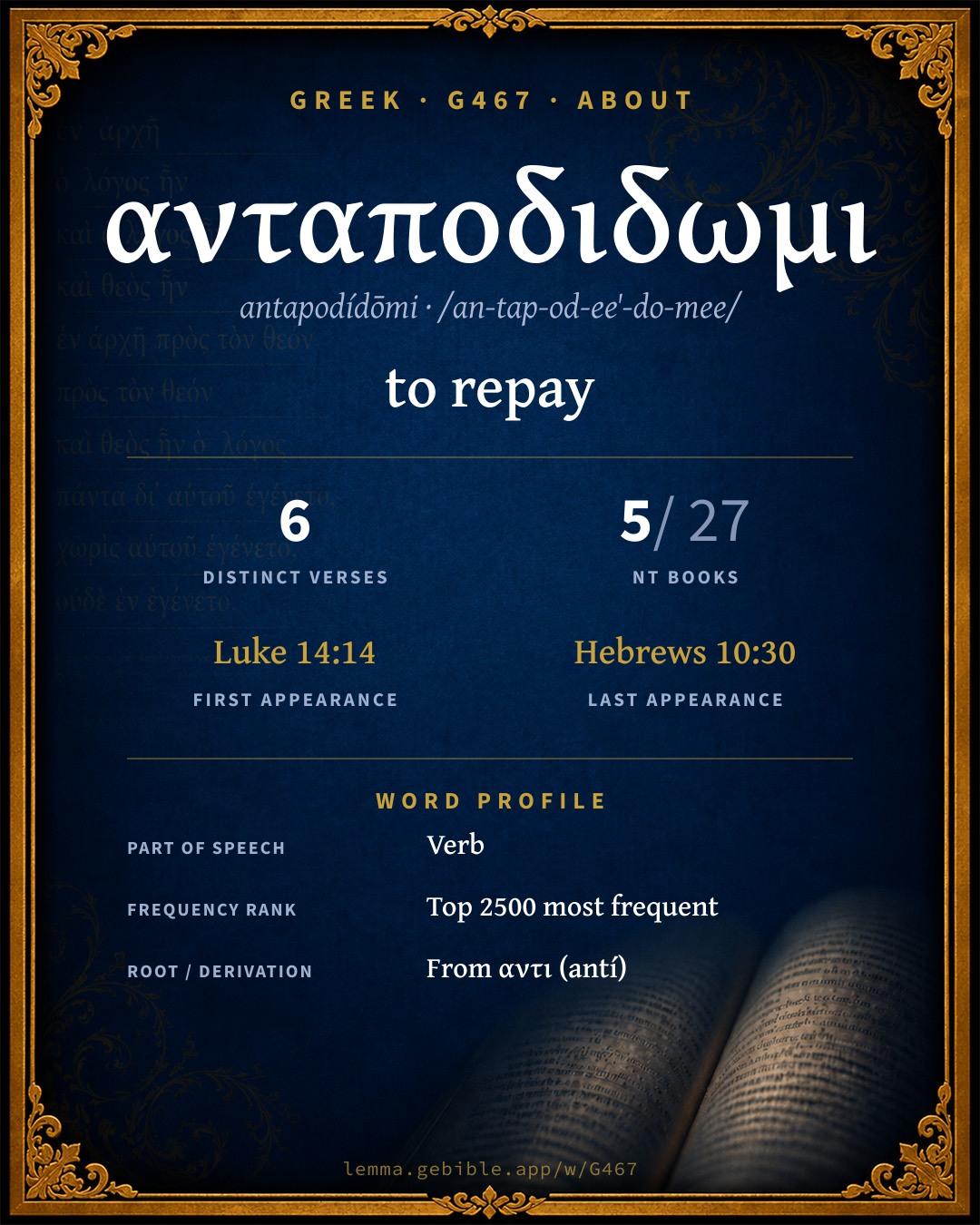
ἀνταποδίδωμι
to repay
‘to repay’ is one of 2 main senses fuller range ↓
Full lexicon entry — Thayer's Greek Lexicon
From Thayer's Greek Lexicon
Where this word appears
See every Future-tense verb in the Greek New Testament →
Grammar key — what these labels mean
Part of speech
- Verb
- An action or state-of-being word.
Tense
- Aorist
- Action viewed as a simple whole, without regard to duration — often past (perfective aspect).
- Future
- Action expected in future time.
Voice
- Active
- The subject performs the action.
- Passive
- The subject receives the action.
Mood
- Infinitive
- A verbal noun (“to write”), unmarked for person or number.
- Indicative
- States a fact or asks a factual question (the mood of reality).
Person
- 1st person
- The speaker (“I / we”).
- 3rd person
- The one spoken about (“he / she / it / they”).
Number
- Singular
- One.
Grammatical forms
- Verb, Aorist, Active, Infinitive 3 times (43%)
- Verb, Future, Active, Indicative, 1st person, Singular 2 times (29%)
- Verb, Future, Passive, Indicative, 3rd person, Singular 2 times (29%)
Parsed forms decoded from the imported morphology (Robinson–Tischendorf, public domain), counted across 7 parsed occurrences — not distinct verses.
Every verse where G467 appears — 6 distinct verses across 5 books. Click any verse to open its interlinear word-by-word view. Verse text shown in the World English Bible for context — . Each verse’s Greek form is shown with its reference; the English is not keyword-highlighted, since the data carries no word-level English alignment. Use “Compare translations” on any verse to read it across multiple English versions. This concordance covers the Greek New Testament; Septuagint (Greek Old Testament) occurrences of this word are not indexed here.
Luke 1 verse
Romans 2 verses
- Romans 11:35 ἀνταποδοθήσεται fut pass ind 3sg "Or who has first given to him, And it will be repaid to him again?"
- Romans 12:19 ἀνταποδώσω fut act ind 1sg Don't seek revenge yourselves, beloved, but give place to God's wrath. For it is written, "Vengeance belongs to me; I will repay, says the Lord."
1 Thessalonians 1 verse
2 Thessalonians 1 verse
Hebrews 1 verse
About this entry
At a glance — auto-summarized from this page’s data, not written by a person. Every figure links to its source below. This summary describes the numbers; it doesn’t interpret them.
ανταποδιδωμι (antapodídōmi) is a Greek verb most often rendered “to repay.” Debuting at Luke 14:14, it then recurs through the corpus. The Greek New Testament uses it across 6 verses — uncommon. Romans dominates its distribution — 2 of 6 verses. Its lexical range runs to 2 senses. For the data behind this summary, explore the sense tree and the renderings breakdown below.
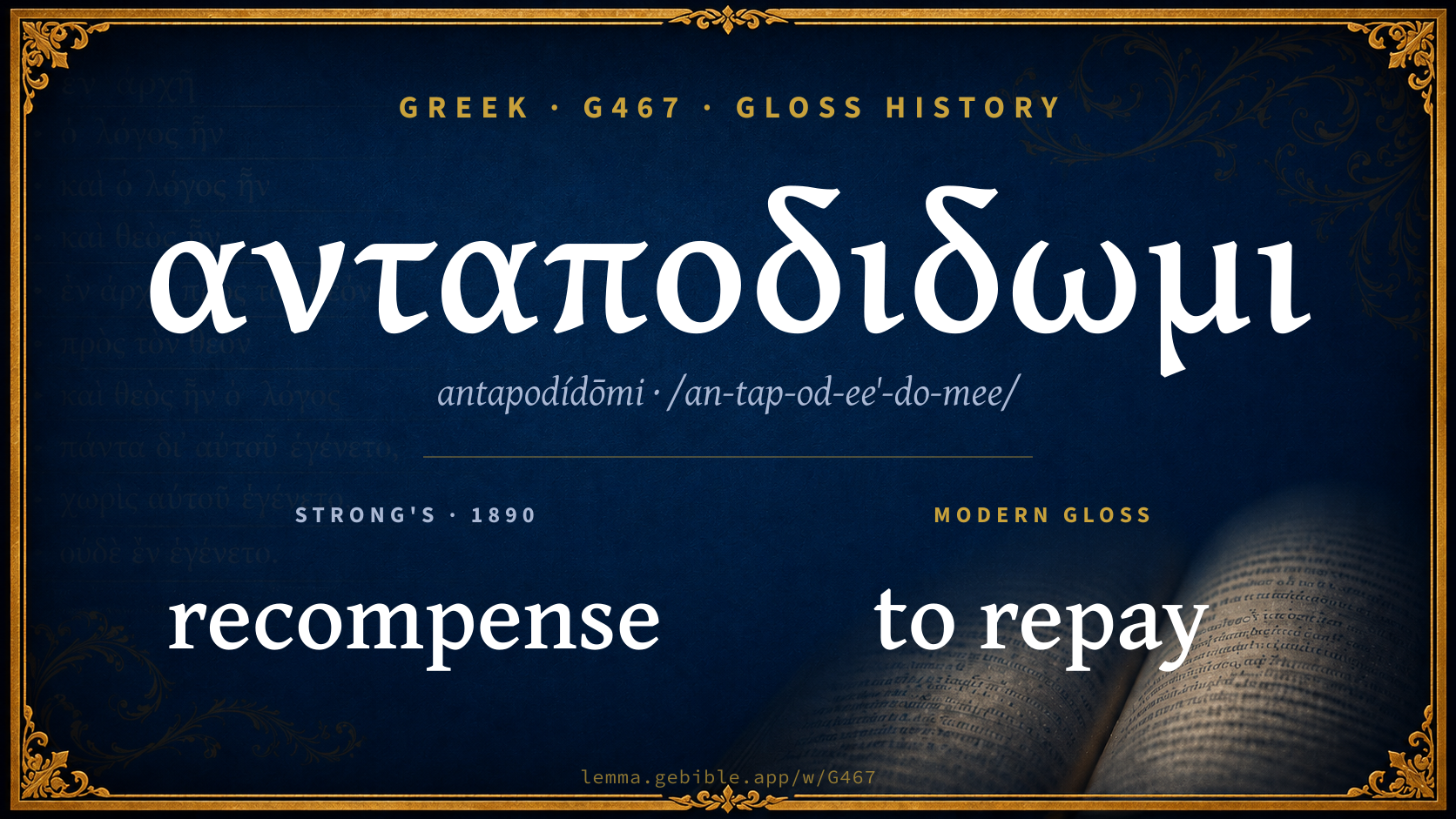
Gloss history
Strong's 1890 vs modern scholarship
About this word
Strong's G467 catalogs a Greek word from the Greek New Testament.
These counts are not copied from any lexicon or concordance. They are computed here, from the morphology-tagged Greek New Testament. What Lemma adds →
- 6
- distinct verses
- The word appears in 6 distinct verses.
- 5 / 27
- NT books
- The word appears in 5 of 27 New Testament books.
- #1,358
- by frequency
- Top 2500 most frequent Greek words (rank 1,358 of 5,347 Greek words by occurrence).
View all 6 occurrences in the concordance →
Most concentrated in
- Romans 2 verses 33%
- Luke 1 verse 17%
- 1 Thessalonians 1 verse 17%
By section of the New Testament
By traditional corpus
Conventional, traditional groupings — biblical authorship is debated, so this is a traditional corpus grouping, not an authorship claim. Some books belong to more than one corpus (Luke is in both the Gospels and the Lukan corpus, and so on), so these shares overlap and need not total 100%. Each figure is a share of the word’s 6 distinct verses.
- Pauline corpus 4 verses · 67%
- Gospels 1 verse · 17%
- Lukan (Luke–Acts) 1 verse · 17%
- Hebrews 1 verse · 17%
How translations render this word
Counts come from each version’s own published word-to-Strong’s tagging or interlinear alignment — an approximate guide to how each version renders this word, not a word-level alignment the data otherwise carries. Because each total is that version’s own tagged count, the per-version totals vary from one another and need not match the appearance or distinct-verse counts above. These counts may also differ from a printed concordance because Lemma counts each distinctly tagged rendering and does not collapse phrase taggings into a single head-word total. This is a fixed set of word-tagged versions (KJV, ASV, BSB, ULT) and does not change with the reading translation you choose elsewhere. Each version’s license is shown beside its name below (and on Sources).
- King James Version: Again 2×, Recompense 2×
- American Standard Version: Again 2×, Will recompense 2×
- Berean Standard Bible: Repay 2×, Will repay 2×
- unfoldingWord Literal Text: Give back 1×, He should be repaid 1×, Repay 1×
King James Version Public Domain
Renders G467 across 9 tagged occurrences — most commonly:
Plus 5 renderings that appear only once — usually multi-word phrases or single function words the recovered tagging swept in, not distinct renderings.
American Standard Version Public Domain
Renders G467 across 9 tagged occurrences — most commonly:
Plus 5 renderings that appear only once — usually multi-word phrases or single function words the recovered tagging swept in, not distinct renderings.
Berean Standard Bible Public Domain
Renders G467 across 6 tagged occurrences — most commonly:
Plus 2 renderings that appear only once — usually multi-word phrases or single function words the recovered tagging swept in, not distinct renderings.
unfoldingWord Literal Text CC BY-SA 4.0
Renders G467 across 7 tagged occurrences — most commonly:
Senses in Thayer's
The 2 senses Thayer's distinguishes for this word, in lexicon order (not ranked by frequency or importance). The full entry — with sub-senses — is in the Lexicon Entry tab.
- in a good sense, to repay, requite
- in a bad sense, penalty and vengeance
Word origin
Derived from αντι (antí) (G473) — against.
Forms in the corpus
The 4 distinct written forms G467 takes in the Greek New Testament, most frequent first — each parse links to that tense’s occurrences in the concordance.
| Form | Parsing | Example | Uses |
|---|---|---|---|
| ἀνταποδοθήσεται antapodothḗsetai | Verb, Future, Passive, Indicative, 3rd person, Singular | Luke 14:14 | 2 |
| ἀνταποδοῦναι antapodoûnai | Verb, Aorist, Active, Infinitive | 1 Thessalonians 3:9 | 2 |
| ἀνταποδώσω antapodṓsō | Verb, Future, Active, Indicative, 1st person, Singular | Romans 12:19 | 2 |
| ἀνταποδοῦναί antapodoûnaí | Verb, Aorist, Active, Infinitive | Luke 14:14 | 1 |
Same root — word family
Other Thayer's entries built from the same root as G467, grouped by Strong’s listed origin. These share a root / origin per the lexicon — not necessarily a shared meaning. Each links to that word’s own entry.
Derives from
Shares the same root
- ανθιστημι anthístēmi G436 to resist
- ανθομολογεομαι anthomologéomai G437 to acknowledge
- ανθυπατος anthýpatos G446 proconsul
- ανταγωνιζομαι antagōnízomai G464 to struggle
- ανταλλαγμα antállagma G465 exchange
- ανταναπληροω antanaplēróō G466 to fill up
- ανταποκρινομαι antapokrínomai G470 to contradict
- αντεπω antépō G471 to speak against
- αντεχομαι antéchomai G472 to withstand
- αντιβαλλω antibállō G474 to throw back
- αντιδιατιθεμαι antidiatíthemai G475 to oppose
- αντιδικος antídikos G476 opponent
- αντιθεσις antíthesis G477 opposition
- αντικαθιστημι antikathístēmi G478 to place opposite
- αντικαλεω antikaléō G479 to invite in turn
- αντικειμαι antíkeimai G480 to oppose
- αντικρυ antikrý G481 opposite
- αντιλαμβανομαι antilambánomai G482 to take hold
- αντιλεγω antilégō G483 to contradict
- αντιλοιδορεω antiloidoréō G486 to revile back
- αντιλυτρον antílytron G487 ransom
- αντιμετρεω antimetréō G488 to repay
- αντιμισθια antimisthía G489 reward
- αντιπαρερχομαι antiparérchomai G492 to pass by
+7 more words share this root (not shown).
Derived from this word
Proper names from this root
People and places named from this root — a name, not an additional meaning of the word.
Compare all same-root words → Showing 4 of 37 — not the complete family. 2 of the same-root words are proper names (people or places). They share a root, not necessarily a meaning.