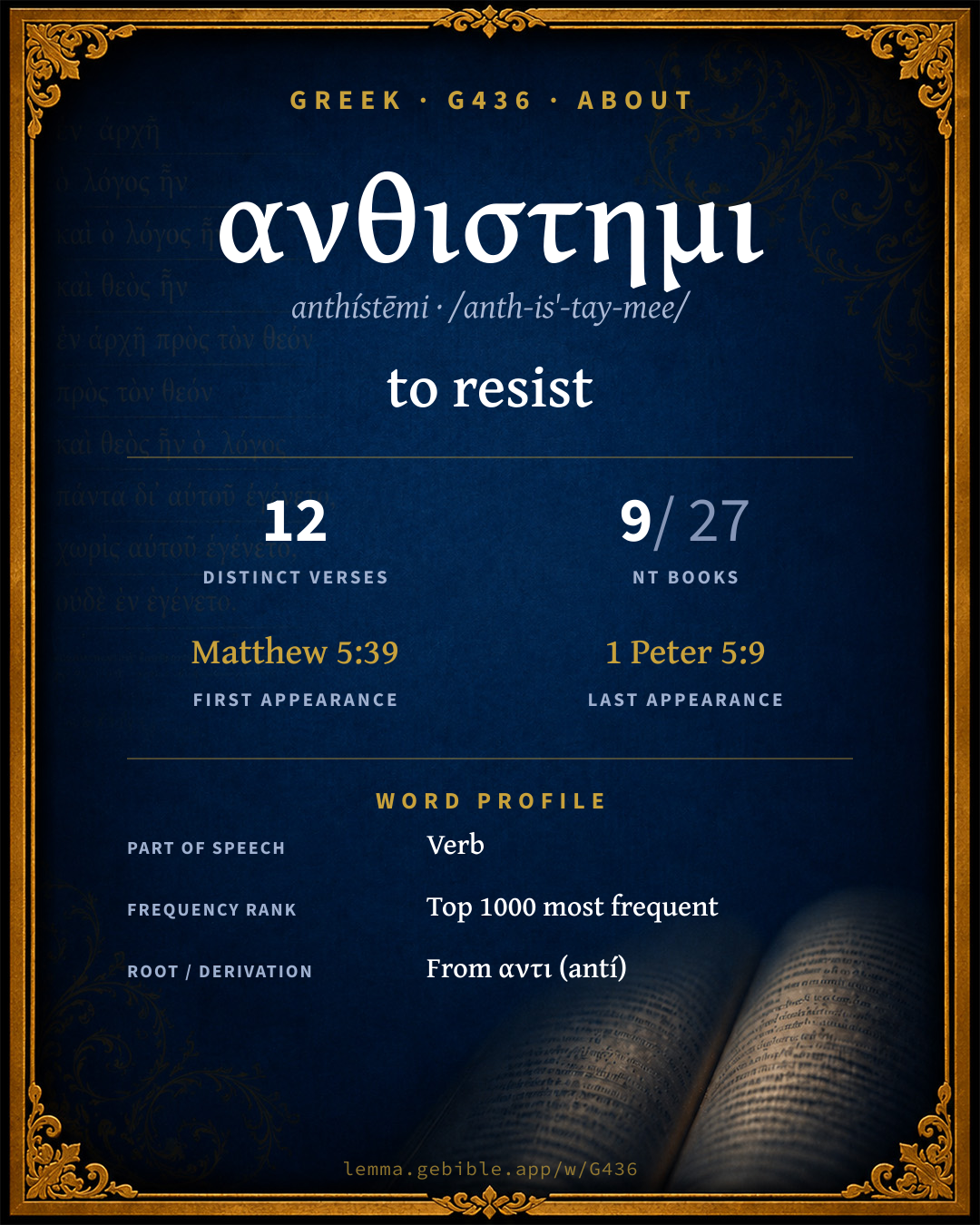
ἀνθίστημι
to resist
‘to resist’ is one of 2 main senses fuller range ↓
Full lexicon entry — Thayer's Greek Lexicon
From Thayer's Greek Lexicon
Where this word appears
See every Aorist-tense verb in the Greek New Testament →
Grammar key — what these labels mean
Part of speech
- Verb
- An action or state-of-being word.
Tense
- Aorist
- Action viewed as a simple whole, without regard to duration — often past (perfective aspect).
- Perfect
- A completed past action with continuing present results.
- Imperfect
- Continuous or repeated action in past time (“was writing”).
- Present
- Ongoing or general action in present time (imperfective aspect).
Voice
- Active
- The subject performs the action.
- Middle
- The subject acts on or for itself, or with special interest in the action.
Mood
- Infinitive
- A verbal noun (“to write”), unmarked for person or number.
- Imperative
- Expresses a command or request.
- Indicative
- States a fact or asks a factual question (the mood of reality).
- Participle
- A verbal adjective (“writing,” “having written”).
Case
- Nominative
- The case of the subject (and the predicate nominative).
Person
- 2nd person
- The one addressed (“you”).
- 3rd person
- The one spoken about (“he / she / it / they”).
- 1st person
- The speaker (“I / we”).
Gender
- Masculine
- Grammatically masculine.
Number
- Plural
- More than one.
- Singular
- One.
Grammatical forms 9 distinct
- Verb, Aorist, Active, Infinitive 4 times (29%)
- Verb, Aorist, Active, Imperative, 2nd person, Plural 2 times (14%)
- Verb, Perfect, Active, Indicative, 3rd person, Singular 2 times (14%)
- Verb, Aorist, Active, Indicative, 1st person, Singular 1 time (7%)
- Verb, Aorist, Active, Indicative, 3rd person, Plural 1 time (7%)
- Verb, Aorist, Active, Indicative, 3rd person, Singular 1 time (7%)
- Verb, Imperfect, Middle, Indicative, 3rd person, Singular 1 time (7%)
- Verb, Present, Middle, Indicative, 3rd person, Plural 1 time (7%)
+1 more form (1 occurrence)
Parsed forms decoded from the imported morphology (Robinson–Tischendorf, public domain), counted across 14 parsed occurrences — not distinct verses.
Every verse where G436 appears — 12 distinct verses across 9 books. Click any verse to open its interlinear word-by-word view. Verse text shown in the World English Bible for context — . Each verse’s Greek form is shown with its reference; the English is not keyword-highlighted, since the data carries no word-level English alignment. Use “Compare translations” on any verse to read it across multiple English versions. This concordance covers the Greek New Testament; Septuagint (Greek Old Testament) occurrences of this word are not indexed here.
Matthew 1 verse
Luke 1 verse
Acts 2 verses
Romans 2 verses
- Romans 9:19 ἀνθέστηκεν perf act ind 3sg You will say then to me, "Why does he still find fault? For who withstands his will?"
- Romans 13:2 ἀνθέστηκεν ἀνθεστηκότες perf act ind 3sg perf act ptcp nom pl masc Therefore he who resists the authority, withstands the ordinance of God; and those who withstand will receive to themselves judgment.
Galatians 1 verse
Ephesians 1 verse
2 Timothy 2 verses
- 2 Timothy 3:8 ἀντέστησαν ἀνθίστανται aor act ind 3pl pres mid ind 3pl Even as Jannes and Jambres opposed Moses, so do these also oppose the truth; men corrupted in mind, reprobate concerning the faith.
- 2 Timothy 4:15 ἀντέστη aor act ind 3sg of whom you also must beware; for he greatly opposed our words.
James 1 verse
1 Peter 1 verse
About this entry
At a glance — auto-summarized from this page’s data, not written by a person. Every figure links to its source below. This summary describes the numbers; it doesn’t interpret them.
At its core, ανθιστημι (anthístēmi) means “to resist.” Scripture first uses it in Matthew 5:39. It turns up in 12 verses across 9 books, an uncommon footprint. Catalogued under 2 senses, its meaning is not single-sense. It shares a root with αντι, ανθομολογεομαι and ανθυπατος. Dig into 12-verse concordance and the renderings breakdown below.
Gloss history
Strong's 1890 vs modern scholarship
About this word
Strong's G436 catalogs a Greek word from the Greek New Testament.
These counts are not copied from any lexicon or concordance. They are computed here, from the morphology-tagged Greek New Testament. What Lemma adds →
- 12
- distinct verses
- The word appears in 12 distinct verses.
- 9 / 27
- NT books
- The word appears in 9 of 27 New Testament books.
- #814
- by frequency
- Top 1000 most frequent Greek words (rank 814 of 5,347 Greek words by occurrence).
View all 12 occurrences in the concordance →
By section of the New Testament
By traditional corpus
Conventional, traditional groupings — biblical authorship is debated, so this is a traditional corpus grouping, not an authorship claim. Some books belong to more than one corpus (Luke is in both the Gospels and the Lukan corpus, and so on), so these shares overlap and need not total 100%. Each figure is a share of the word’s 12 distinct verses.
- Pauline corpus 6 verses · 50%
- Lukan (Luke–Acts) 3 verses · 25%
- Gospels 2 verses · 17%
- General (Catholic) Epistles 2 verses · 17%
How translations render this word
Counts come from each version’s own published word-to-Strong’s tagging or interlinear alignment — an approximate guide to how each version renders this word, not a word-level alignment the data otherwise carries. Because each total is that version’s own tagged count, the per-version totals vary from one another and need not match the appearance or distinct-verse counts above. These counts may also differ from a printed concordance because Lemma counts each distinctly tagged rendering and does not collapse phrase taggings into a single head-word total. This is a fixed set of word-tagged versions (KJV, ASV, BSB, ULT) and does not change with the reading translation you choose elsewhere. Each version’s license is shown beside its name below (and on Sources).
- King James Version: Resist 5×, Withstood 3×
- American Standard Version: Withstand 5×, Withstood 3×, Resist 2×
- Berean Standard Bible: Resist 4×, Opposed 2×
- unfoldingWord Literal Text: Resist 4×, Opposed 2×
King James Version Public Domain
Renders G436 across 16 tagged occurrences — most commonly:
Plus 8 renderings that appear only once — usually multi-word phrases or single function words the recovered tagging swept in, not distinct renderings.
American Standard Version Public Domain
Renders G436 across 16 tagged occurrences — most commonly:
Plus 4 renderings that appear only once — usually multi-word phrases or single function words the recovered tagging swept in, not distinct renderings.
Berean Standard Bible Public Domain
Renders G436 across 13 tagged occurrences — most commonly:
Plus 7 renderings that appear only once — usually multi-word phrases or single function words the recovered tagging swept in, not distinct renderings. Not rendered by a distinct English word in 1 further occurrence.
unfoldingWord Literal Text CC BY-SA 4.0
Renders G436 across 14 tagged occurrences — most commonly:
Plus 8 renderings that appear only once — usually multi-word phrases or single function words the recovered tagging swept in, not distinct renderings.
Senses in Thayer's
The 2 senses Thayer's distinguishes for this word, in lexicon order (not ranked by frequency or importance). The full entry — with sub-senses — is in the Lexicon Entry tab.
- to set one's self against, to withstand, resist, oppose
- to set against
Word origin
Derived from αντι (antí) (G473) — against.
Forms in the corpus
The 9 distinct written forms G436 takes in the Greek New Testament, most frequent first — each parse links to that tense’s occurrences in the concordance.
| Form | Parsing | Example | Uses |
|---|---|---|---|
| ἀντιστῆναι antistē̂nai | Verb, Aorist, Active, Infinitive | Matthew 5:39 | 4 |
| ἀνθέστηκεν anthéstēken | Verb, Perfect, Active, Indicative, 3rd person, Singular | Romans 9:19 | 2 |
| ἀντίστητε antístēte | Verb, Aorist, Active, Imperative, 2nd person, Plural | James 4:7 | 2 |
| ἀνθίστανται anthístantai | Verb, Present, Middle, Indicative, 3rd person, Plural | 2 Timothy 3:8 | 1 |
| ἀνθίστατο anthístato | Verb, Imperfect, Middle, Indicative, 3rd person, Singular | Acts 13:8 | 1 |
| ἀνθεστηκότες anthestēkótes | Verb, Perfect, Active, Participle, Nominative, Plural, Masculine | Romans 13:2 | 1 |
| ἀντέστη antéstē | Verb, Aorist, Active, Indicative, 3rd person, Singular | 2 Timothy 4:15 | 1 |
| ἀντέστην antéstēn | Verb, Aorist, Active, Indicative, 1st person, Singular | Galatians 2:11 | 1 |
| ἀντέστησαν antéstēsan | Verb, Aorist, Active, Indicative, 3rd person, Plural | 2 Timothy 3:8 | 1 |
Same root — word family
Other Thayer's entries built from the same root as G436, grouped by Strong’s listed origin. These share a root / origin per the lexicon — not necessarily a shared meaning. Each links to that word’s own entry.
Derives from
Shares the same root
- ανθομολογεομαι anthomologéomai G437 to acknowledge
- ανθυπατος anthýpatos G446 proconsul
- ανταγωνιζομαι antagōnízomai G464 to struggle
- ανταλλαγμα antállagma G465 exchange
- ανταναπληροω antanaplēróō G466 to fill up
- ανταποδιδωμι antapodídōmi G467 to repay
- ανταποκρινομαι antapokrínomai G470 to contradict
- αντεπω antépō G471 to speak against
- αντεχομαι antéchomai G472 to withstand
- αντιβαλλω antibállō G474 to throw back
- αντιδιατιθεμαι antidiatíthemai G475 to oppose
- αντιδικος antídikos G476 opponent
- αντιθεσις antíthesis G477 opposition
- αντικαθιστημι antikathístēmi G478 to place opposite
- αντικαλεω antikaléō G479 to invite in turn
- αντικειμαι antíkeimai G480 to oppose
- αντικρυ antikrý G481 opposite
- αντιλαμβανομαι antilambánomai G482 to take hold
- αντιλεγω antilégō G483 to contradict
- αντιλοιδορεω antiloidoréō G486 to revile back
- αντιλυτρον antílytron G487 ransom
- αντιμετρεω antimetréō G488 to repay
- αντιμισθια antimisthía G489 reward
- αντιπαρερχομαι antiparérchomai G492 to pass by
+7 more words share this root (not shown).
Proper names from this root
People and places named from this root — a name, not an additional meaning of the word.
Compare all same-root words → Showing 4 of 35 — not the complete family. 2 of the same-root words are proper names (people or places). They share a root, not necessarily a meaning.
Septuagint usage
The same Greek word ανθιστημι appears 46 times in the Greek Old Testament (Septuagint), across 45 verses in 19 books.
- 46
- LXX occurrences
- Tagged occurrences of this Greek word in the Septuagint.
- 45
- verses
- Distinct Septuagint verses containing this word.
- 19 / 39
- OT books
- The word appears in 19 of the 39 Old Testament books.
Sample Septuagint occurrences
- Leviticus 26:37 ἀντιἵστημι
- Numbers 10:9 ἀντιἵστημι
- Deuteronomy 7:24 ἀντιἵστημι
- Joshua 1:5 ἀντιἵστημι
- Judges 2:14 ἀντιἵστημι
- 2 Samuel 5:6 ἀντιἵστημι
- 2 Chronicles 13:7 ἀντιἵστημι
- Esther 9:2 ἀντιἵστημι
- Job 9:19 ἀντιἵστημι
- Psalms 16:7 ἀντιἵστημι
- Isaiah 3:9 ἀντιἵστημι
- Jeremiah 14:7 ἀντιἵστημι
Septuagint occurrences (same lexeme)
Every verse where the same Strong’s number (G436) appears in the Greek Septuagint. Verse text shown in the World English Bible for context; the Greek form is the matched word — the English is not keyword-highlighted.
- Leviticus 26:37 ἀντιἵστημι They will stumble over one another, as it were before the sword, when no one pursues: and you will have no power to stand before your enemies.
- Numbers 10:9 ἀντιἵστημι When you go to war in your land against the adversary who oppresses you, then you shall sound an alarm with the trumpets; and you shall be remembered before Yahweh your God, and you shall be saved from your enemies.
- Numbers 22:23 ἀντιἵστημι The donkey saw the angel of Yahweh standing in the way, with his sword drawn in his hand; and the donkey turned aside out of the way, and went into the field: and Balaam struck the donkey, to turn her into the way.
- Numbers 22:31 ἀντιἵστημι Then Yahweh opened the eyes of Balaam, and he saw the angel of Yahweh standing in the way, with his sword drawn in his hand; and he bowed his head, and fell on his face.
- Numbers 22:34 ἀντιἵστημι Balaam said to the angel of Yahweh, I have sinned; for I didn't know that you stood in the way against me: now therefore, if it displease you, I will get me back again.
- Deuteronomy 7:24 ἀντιἵστημι He will deliver their kings into your hand, and you shall make their name to perish from under the sky: there shall no man be able to stand before you, until you have destroyed them.
- Deuteronomy 9:2 ἀντιἵστημι a people great and tall, the sons of the Anakim, whom you know, and of whom you have heard say, Who can stand before the sons of Anak?
- Deuteronomy 11:25 ἀντιἵστημι There shall no man be able to stand before you: Yahweh your God shall lay the fear of you and the dread of you on all the land that you shall tread on, as he has spoken to you.
- Deuteronomy 19:18 ἀντιἵστημι and the judges shall make diligent inquisition: and, behold, if the witness is a false witness, and has testified falsely against his brother;
- Deuteronomy 25:18 ἀντιἵστημι how he met you by the way, and struck the hindmost of you, all who were feeble behind you, when you were faint and weary; and he didn't fear God.
- Deuteronomy 28:7 ἀντιἵστημι Yahweh will cause your enemies who rise up against you to be struck before you: they shall come out against you one way, and shall flee before you seven ways.
- Joshua 1:5 ἀντιἵστημι There shall not any man be able to stand before you all the days of your life. As I was with Moses, so I will be with you; I will not fail you, nor forsake you.
- Joshua 7:13 ἀντιἵστημι Up, sanctify the people, and say, Sanctify yourselves against tomorrow: for thus says Yahweh, the God of Israel, There is a devoted thing in the midst of you, Israel; you can not stand before your enemies, until you take away the devoted thing from among you.
- Joshua 23:9 ἀντιἵστημι For Yahweh has driven out from before you great nations and strong: but as for you, no man has stood before you to this day.
- Judges 2:14 ἀντιἵστημι The anger of Yahweh was kindled against Israel, and he delivered them into the hands of spoilers who despoiled them; and he sold them into the hands of their enemies round about, so that they could not any longer stand before their enemies.
- 2 Samuel 5:6 ἀντιἵστημι The king and his men went to Jerusalem against the Jebusites, the inhabitants of the land, who spoke to David, saying, Except you take away the blind and the lame, you shall not come in here; thinking, David can't come in here.
- 2 Chronicles 13:7 ἀντιἵστημι There were gathered to him worthless men, base fellows, who strengthened themselves against Rehoboam the son of Solomon, when Rehoboam was young and tender-hearted, and could not withstand them.
- 2 Chronicles 13:8 ἀντιἵστημι Now you think to withstand the kingdom of Yahweh in the hand of the sons of David; and you are a great multitude, and there are with you the golden calves which Jeroboam made you for gods.
- 2 Chronicles 20:6 ἀντιἵστημι and he said, Yahweh, the God of our fathers, aren't you God in heaven? and aren't you ruler over all the kingdoms of the nations? and in your hand is power and might, so that none is able to withstand you.
- 2 Chronicles 20:12 ἀντιἵστημι Our God, will you not judge them? for we have no might against this great company that comes against us; neither know we what to do: but out eyes are on you.
- Esther 9:2 ἀντιἵστημι the Jews gathered themselves together in their cities throughout all the provinces of the king Ahasuerus, to lay hand on such as sought their hurt: and no man could withstand them; for the fear of them was fallen on all the peoples.
- Job 9:19 ἀντιἵστημι If it is a matter of strength, behold, he is mighty! If of justice, 'Who,' says he, 'will summon me?'
- Job 41:2 ἀντιἵστημι Can you put a rope into his nose? Or pierce his jaw through with a hook?
- Job 41:3 ἀντιἵστημι Will he make many petitions to you? Or will he speak soft words to you?
- Psalms 16:7 ἀντιἵστημι I will bless Yahweh, who has given me counsel. Yes, my heart instructs me in the night seasons.
- Psalms 75:8 ἀντιἵστημι For in the hand of Yahweh there is a cup, Full of foaming wine mixed with spices. He pours it out. Indeed the wicked of the earth drink and drink it to its very dregs.
- Isaiah 3:9 ἀντιἵστημι The look of their faces testify against them. They parade their sin like Sodom. They don't hide it. Woe to their soul! For they have brought disaster upon themselves.
- Isaiah 50:8 ἀντιἵστημι He is near who justifies me; who will bring charges against me? Let us stand up together: who is my adversary? Let him come near to me.
- Isaiah 59:12 ἀντιἵστημι For our transgressions are multiplied before you, and our sins testify against us; for our transgressions are with us, and as for our iniquities, we know them:
- Jeremiah 14:7 ἀντιἵστημι Though our iniquities testify against us, work you for your name's sake, Yahweh; for our backslidings are many; we have sinned against you.
- Jeremiah 27:24 ἀντιἵστημι
- Jeremiah 27:29 ἀντιἵστημι
- Jeremiah 27:44 ἀντιἵστημι
- Jeremiah 30:13 ἀντιἵστημι There is none to plead your cause, that you may be bound up: you have no healing medicines.
- Daniel 10:13 ἀντιἵστημι But the prince of the kingdom of Persia withstood me twenty-one days; but, behold, Michael, one of the chief princes, came to help me: and I remained there with the kings of Persia.
- Daniel 11:2 ἀντιἵστημι Now will I show you the truth. Behold, there shall stand up yet three kings in Persia; and the fourth shall be far richer than they all: and when he has grown strong through his riches, he shall stir up all against the realm of Greece.
- Daniel 11:15 ἀντιἵστημι So the king of the north shall come, and cast up a mound, and take a well-fortified city: and the forces of the south shall not stand, neither his chosen people, neither shall there be any strength to stand.
- Daniel 11:16 ἀντιἵστημι But he who comes against him shall do according to his own will, and none shall stand before him; and he shall stand in the glorious land, and in his hand shall be destruction.
- Hosea 14:1 ἀντιἵστημι Israel, return to Yahweh your God; For you have fallen because of your sin.
- Obadiah 1:7 ἀντιἵστημι All the men of your alliance have brought you on your way, even to the border. The men who were at peace with you have deceived you, and prevailed against you. Friends who eat your bread lay a snare under you. There is no understanding in him.
- Obadiah 1:11 ἀντιἵστημι In the day that you stood on the other side, in the day that strangers carried away his substance, and foreigners entered into his gates, and cast lots for Jerusalem, even you were like one of them.
- Micah 2:8 ἀντιἵστημι But lately my people have risen up as an enemy. You strip the robe and clothing from those who pass by without a care, returning from battle.
- Nahum 1:6 ἀντιἵστημι Who can stand before his indignation? Who can endure the fierceness of his anger? His wrath is poured out like fire, and the rocks are broken apart by him.
- Habakkuk 1:9 ἀντιἵστημι All of them come for violence. Their hordes face the desert. He gathers prisoners like sand.
- Malachi 3:15 ἀντιἵστημι Now we call the proud happy; yes, those who work wickedness are built up; yes, they tempt God, and escape.'
These are occurrences of the same Greek lexeme (G436) in the Septuagint — not a translation of any one Hebrew word. The store carries no word-level Hebrew↔Greek alignment, so no Hebrew original is asserted here. Counts come from the recovered LXX Strong's tagging — high-frequency vocabulary is well covered, while rare or late forms may be untagged — so they reflect tagged occurrences and may slightly undercount.