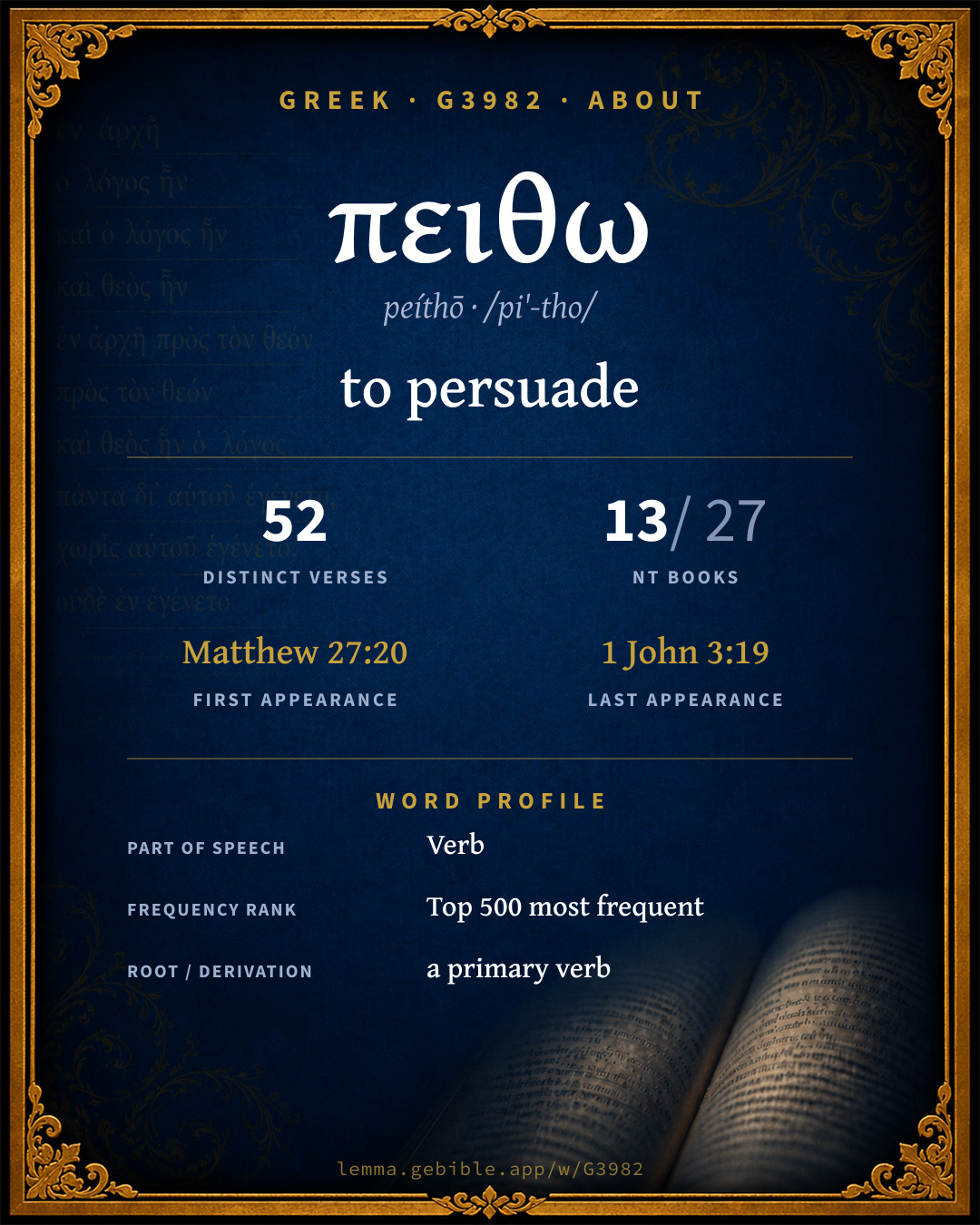
πείθω
to persuade
‘to persuade’ is one of 3 main senses fuller range ↓
Full lexicon entry — Thayer's Greek Lexicon
From Thayer's Greek Lexicon
Where this word appears
See every Perfect-tense verb in the Greek New Testament →
Grammar key — what these labels mean
Part of speech
- Verb
- An action or state-of-being word.
Tense
- Perfect
- A completed past action with continuing present results.
- Imperfect
- Continuous or repeated action in past time (“was writing”).
- Aorist
- Action viewed as a simple whole, without regard to duration — often past (perfective aspect).
- Future
- Action expected in future time.
- Present
- Ongoing or general action in present time (imperfective aspect).
- Pluperfect
- A past action completed before another past point (“had written”).
Voice
- Active
- The subject performs the action.
- Passive
- The subject receives the action.
- Middle
- The subject acts on or for itself, or with special interest in the action.
Mood
- Participle
- A verbal adjective (“writing,” “having written”).
- Indicative
- States a fact or asks a factual question (the mood of reality).
- Infinitive
- A verbal noun (“to write”), unmarked for person or number.
- Subjunctive
- Expresses probability, purpose, or possibility (the mood of contingency).
- Imperative
- Expresses a command or request.
Case
- Nominative
- The case of the subject (and the predicate nominative).
- Accusative
- The case of the direct object and of extent.
- Dative
- The case of the indirect object, means, or location — “to / for / with / in.”
- Genitive
- The case of source, possession, or “of” — answers “whose / from what.”
Person
- 1st person
- The speaker (“I / we”).
- 3rd person
- The one spoken about (“he / she / it / they”).
- 2nd person
- The one addressed (“you”).
Gender
- Masculine
- Grammatically masculine.
Number
- Singular
- One.
- Plural
- More than one.
3 distinct verses where G3982 appears in the Future tense, across 3 books. Filtered view — show all forms. Click any verse to open its interlinear word-by-word view. Verse text shown in the World English Bible for context — . Each verse’s Greek form is shown with its reference; the English is not keyword-highlighted, since the data carries no word-level English alignment. Use “Compare translations” on any verse to read it across multiple English versions. This concordance covers the Greek New Testament; Septuagint (Greek Old Testament) occurrences of this word are not indexed here.
Matthew 1 verse
Luke 1 verse
1 John 1 verse
About this entry
At a glance — auto-summarized from this page’s data, not written by a person. Every figure links to its source below. This summary describes the numbers; it doesn’t interpret them.
The Greek verb πειθω centers on the idea of “to persuade.” The King James Version usually renders it “persuaded,” while modern versions prefer “having become confident” (unfoldingWord Literal Text) — see the renderings breakdown. Spanning 52 verses in 13 books, it ranks among the moderately common words of the Greek New Testament. Acts dominates its distribution — 17 of 52 verses. Thayer's distinguishes 3 senses for it. Dig into 52-verse concordance and the renderings breakdown below.
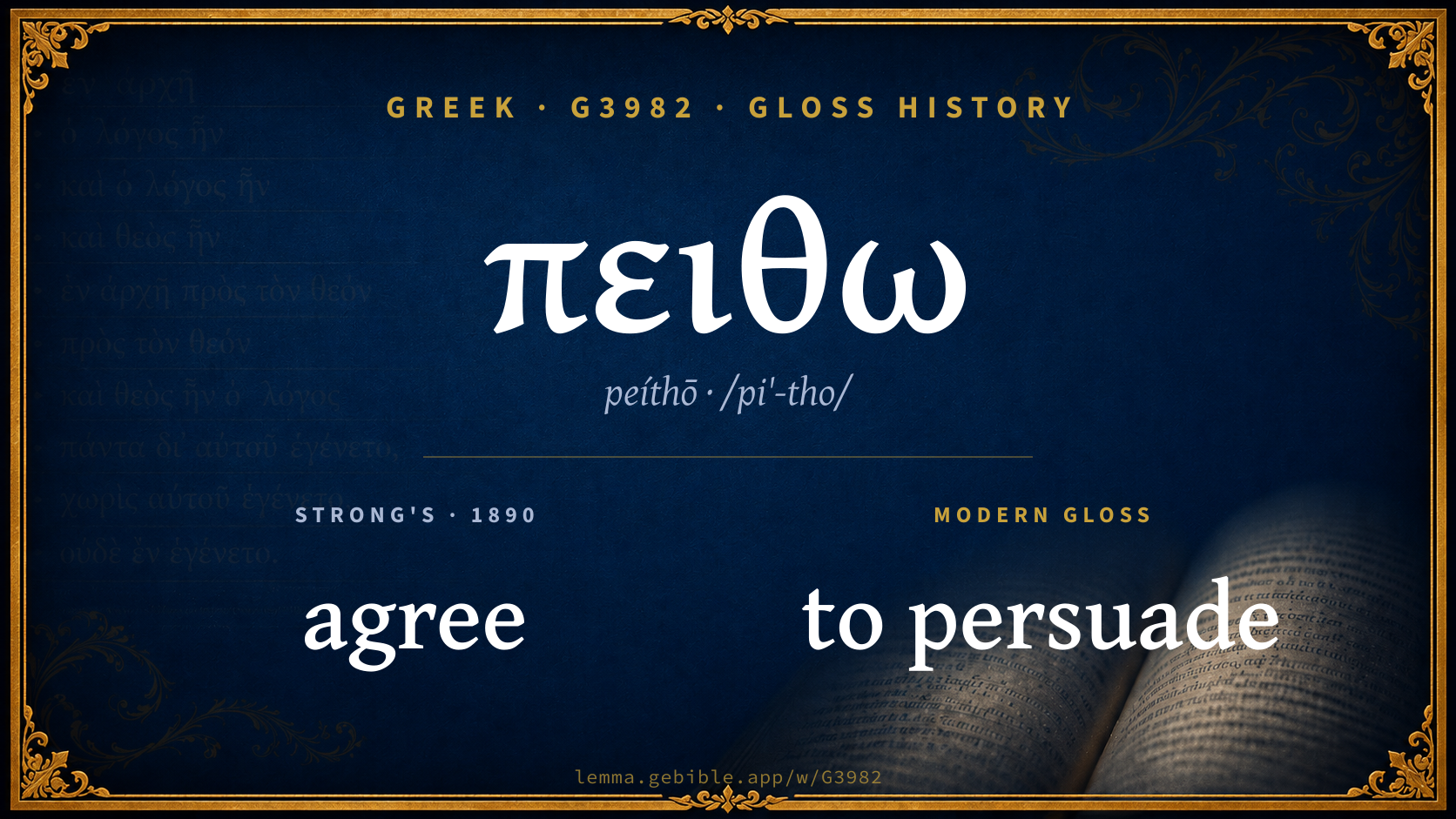
Gloss history
Strong's 1890 vs modern scholarship
About this word
Strong's G3982 catalogs a Greek word from the Greek New Testament.
These counts are not copied from any lexicon or concordance. They are computed here, from the morphology-tagged Greek New Testament. What Lemma adds →
- 52
- distinct verses
- The word appears in 52 distinct verses.
- 13 / 27
- NT books
- The word appears in 13 of 27 New Testament books.
- #305
- by frequency
- Top 500 most frequent Greek words (rank 305 of 5,347 Greek words by occurrence).
View all 52 occurrences in the concordance →
Most concentrated in
- Acts 17 verses 33%
- Philippians 6 verses 12%
- Romans 5 verses 10%
By section of the New Testament
By traditional corpus
Conventional, traditional groupings — biblical authorship is debated, so this is a traditional corpus grouping, not an authorship claim. Some books belong to more than one corpus (Luke is in both the Gospels and the Lukan corpus, and so on), so these shares overlap and need not total 100%. Each figure is a share of the word’s 52 distinct verses.
- Pauline corpus 22 verses · 42%
- Lukan (Luke–Acts) 21 verses · 40%
- Gospels 7 verses · 13%
- Hebrews 4 verses · 8%
- General (Catholic) Epistles 2 verses · 4%
- Johannine 1 verse · 2%
How translations render this word
Counts come from each version’s own published word-to-Strong’s tagging or interlinear alignment — an approximate guide to how each version renders this word, not a word-level alignment the data otherwise carries. Because each total is that version’s own tagged count, the per-version totals vary from one another and need not match the appearance or distinct-verse counts above. These counts may also differ from a printed concordance because Lemma counts each distinctly tagged rendering and does not collapse phrase taggings into a single head-word total. This is a fixed set of word-tagged versions (KJV, ASV, BSB, ULT) and does not change with the reading translation you choose elsewhere. Each version’s license is shown beside its name below (and on Sources).
- King James Version: Persuaded 5×, Obey 4×, Am persuaded 3×
- American Standard Version: Am persuaded 3×, I am persuaded 3×, Obey 3×
- Berean Standard Bible: I am convinced 3×, Obey 2×, Trusted 2×
- unfoldingWord Literal Text: Having become confident 5×, Having persuaded 3×, Persuaded 3×
King James Version Public Domain
Renders G3982 across 63 tagged occurrences — most commonly:
Plus 30 renderings that appear only once — usually multi-word phrases or single function words the recovered tagging swept in, not distinct renderings.
American Standard Version Public Domain
Renders G3982 across 60 tagged occurrences — most commonly:
Plus 35 renderings that appear only once — usually multi-word phrases or single function words the recovered tagging swept in, not distinct renderings.
Berean Standard Bible Public Domain
Renders G3982 across 50 tagged occurrences — most commonly:
Plus 41 renderings that appear only once — usually multi-word phrases or single function words the recovered tagging swept in, not distinct renderings. Not rendered by a distinct English word in 2 further occurrences.
unfoldingWord Literal Text CC BY-SA 4.0
Renders G3982 across 61 tagged occurrences — most commonly:
Plus 32 renderings that appear only once — usually multi-word phrases or single function words the recovered tagging swept in, not distinct renderings.
Senses in Thayer's
The 3 senses Thayer's distinguishes for this word, in lexicon order (not ranked by frequency or importance). The full entry — with sub-senses — is in the Lexicon Entry tab.
- persuade
- be persuaded
- to trust, have confidence, be confident
Word origin
Origin: a primary verb
A primary verb; to convince (by argument true or false); by analogy to pacify or conciliate (by other fair means); reflexively or passively to assent (to evidence or authority) to rely (by inward certainty): - agree assure believe have confidence be (wax) content make friend obey persuade trust yield.
— Strong’s Exhaustive Concordance (1890), public domain.
Forms in the corpus
The 35 distinct written forms G3982 takes in the Greek New Testament, most frequent first — each parse links to that tense’s occurrences in the concordance.
Same root — word family
Other Thayer's entries built from the same root as G3982, grouped by Strong’s listed origin. These share a root / origin per the lexicon — not necessarily a shared meaning. Each links to that word’s own entry.
Derived from this word
- πειθαρχεω peitharchéō G3980 to obey
- πειθος peithós G3981 persuasive
- πεισμονη peismonḗ G3988 persuasion
- πεποιθησις pepoíthēsis G4006 confidence
- πιθανολογια pithanología G4086 persuasive speech
- πιστις pístis G4102 faith
- πιστος pistós G4103 faithful
Compare all same-root words → Showing 4 of 8 — not the complete family. They share a root, not necessarily a meaning.
Septuagint usage
The same Greek word πειθω appears 128 times in the Greek Old Testament (Septuagint), across 121 verses in 22 books.
- 128
- LXX occurrences
- Tagged occurrences of this Greek word in the Septuagint.
- 121
- verses
- Distinct Septuagint verses containing this word.
- 22 / 39
- OT books
- The word appears in 22 of the 39 Old Testament books.
Sample Septuagint occurrences
- Genesis 48:18 πείθω
- Leviticus 25:18 πείθω
- Numbers 17:11 πείθω
- Deuteronomy 28:52 πείθω
- Judges 8:11 πείθω
- Ruth 2:12 πείθω
- 1 Samuel 12:11 πείθω
- 2 Samuel 22:3 πείθω
- 1 Kings 2:46 πείθω
- 2 Kings 18:19 πείθω
- 2 Chronicles 14:10 πείθω
- Esther 4:4 πείθω
Septuagint occurrences (same lexeme)
Every verse where the same Strong’s number (G3982) appears in the Greek Septuagint — showing the first 50 of 121. Verse text shown in the World English Bible for context; the Greek form is the matched word — the English is not keyword-highlighted.
- Genesis 48:18 πείθω Joseph said to his father, "Not so, my father; for this is the firstborn; put your right hand on his head."
- Leviticus 25:18 πείθω "'Therefore you shall do my statutes, and keep my ordinances and do them; and you shall dwell in the land in safety.
- Leviticus 25:19 πείθω The land shall yield its fruit, and you shall eat your fill, and dwell therein in safety.
- Numbers 17:11 πείθω Thus did Moses: as Yahweh commanded him, so did he.
- Deuteronomy 28:52 πείθω They shall besiege you in all your gates, until your high and fortified walls come down, in which you trusted, throughout all your land; and they shall besiege you in all your gates throughout all your land, which Yahweh your God has given you.
- Deuteronomy 32:37 πείθω He will say, Where are their gods, The rock in which they took refuge;
- Deuteronomy 33:12 πείθω Of Benjamin he said, The beloved of Yahweh shall dwell in safety by him; He covers him all the day long, He dwells between his shoulders.
- Deuteronomy 33:28 πείθω Israel dwells in safety, The fountain of Jacob alone, In a land of grain and new wine; Yes, his heavens drop down dew.
- Judges 8:11 πείθω Gideon went up by the way of those who lived in tents on the east of Nobah and Jogbehah, and struck the host; for the host was secure.
- Judges 18:27 πείθω They took that which Micah had made, and the priest whom he had, and came to Laish, to a people quiet and secure, and struck them with the edge of the sword; and they burnt the city with fire.
- Ruth 2:12 πείθω Yahweh recompense your work, and a full reward be given you of Yahweh, the God of Israel, under whose wings you are come to take refuge.
- 1 Samuel 12:11 πείθω Yahweh sent Jerubbaal, and Bedan, and Jephthah, and Samuel, and delivered you out of the hand of your enemies on every side; and you lived in safety.
- 1 Samuel 24:8 πείθω David also arose afterward, and went out of the cave, and cried after Saul, saying, My lord the king. When Saul looked behind him, David bowed with his face to the earth, and did obeisance.
- 2 Samuel 22:3 πείθω God, my rock, in him will I take refuge; My shield, and the horn of my salvation, my high tower, and my refuge; My savior, you save me from violence.
- 2 Samuel 22:31 πείθω As for God, his way is perfect: The word of Yahweh is tried; He is a shield to all those who take refuge in him.
- 1 Kings 2:46 πείθω So the king commanded Benaiah the son of Jehoiada; and he went out, and fell on him, so that he died. The kingdom was established in the hand of Solomon.
- 2 Kings 18:19 πείθω Rabshakeh said to them, Say you now to Hezekiah, Thus says the great king, the king of Assyria, What confidence is this in which you trust?
- 2 Kings 18:20 πείθω You say (but they are but vain words), [There is] counsel and strength for the war. Now on whom do you trust, that you have rebelled against me?
- 2 Kings 18:21 πείθω Now, behold, you trust on the staff of this bruised reed, even on Egypt; whereon if a man lean, it will go into his hand, and pierce it: so is Pharaoh king of Egypt to all who trust on him.
- 2 Kings 18:22 πείθω But if you tell me, We trust in Yahweh our God; isn't that he whose high places and whose altars Hezekiah has taken away, and has said to Judah and to Jerusalem, You shall worship before this altar in Jerusalem?
- 2 Kings 19:10 πείθω Thus shall you speak to Hezekiah king of Judah, saying, Don't let your God in whom you trust deceive you, saying, Jerusalem shall not be given into the hand of the king of Assyria.
- 2 Chronicles 14:10 πείθω Then Asa went out to meet him, and they set the battle in array in the valley of Zephathah at Mareshah.
- 2 Chronicles 16:7 πείθω At that time Hanani the seer came to Asa king of Judah, and said to him, Because you have relied on the king of Syria, and have not relied on Yahweh your God, therefore is the host of the king of Syria escaped out of your hand.
- 2 Chronicles 16:8 πείθω Weren't the Ethiopians and the Lubim a huge host, with chariots and horsemen exceeding many? yet, because you did rely on Yahweh, he delivered them into your hand.
- 2 Chronicles 32:10 πείθω Thus says Sennacherib king of Assyria, Whereon do you trust, that you abide the siege in Jerusalem?
- 2 Chronicles 32:15 πείθω Now therefore don't let Hezekiah deceive you, nor persuade you after this manner, neither believe you him; for no god of any nation or kingdom was able to deliver his people out of my hand, and out of the hand of my fathers: how much less shall your God deliver you out of my hand?
- Esther 4:4 πείθω Esther's maidens and her chamberlains came and told it her; and the queen was exceedingly grieved: and she sent clothing to clothe Mordecai, and to take his sackcloth from off him; but he didn't receive it.
- Job 6:13 πείθω Isn't it that I have no help in me, That wisdom is driven quite from me?
- Job 6:20 πείθω They were distressed because they were confident; They came there, and were confounded.
- Job 11:18 πείθω You shall be secure, because there is hope; Yes, you shall search, and shall take your rest in safety.
- Job 12:6 πείθω The tents of robbers prosper, Those who provoke God are secure; Who carry their God in their hands.
- Job 27:8 πείθω For what is the hope of the godless, when he is cut off, When God takes away his life?
- Job 31:21 πείθω If I have lifted up my hand against the fatherless, Because I saw my help in the gate:
- Job 31:24 πείθω "If I have made gold my hope, And have said to the fine gold, 'You are my confidence;'
- Job 39:11 πείθω Will you trust him, because his strength is great? Or will you leave to him your labor?
- Job 40:23 πείθω Behold, if a river overflows, he doesn't tremble. He is confident, though the Jordan swells even to his mouth.
- Psalms 2:12 πείθω Kiss the son, lest he be angry, and you perish in the way, For his wrath will soon be kindled. Blessed are all those who take refuge in him.
- Psalms 10:1 πείθω Why do you stand far off, Yahweh? Why do you hide yourself in times of trouble?
- Psalms 24:2 πείθω For he has founded it on the seas, And established it on the floods.
- Psalms 48:7 πείθω With the east wind, you break the ships of Tarshish.
- Psalms 56:2 πείθω My enemies want to swallow me up all day long, For they are many who fight proudly against me.
- Psalms 113:16 πείθω
- Psalms 117:8 πείθω
- Psalms 118:20 πείθω This is the gate of Yahweh; The righteous will enter into it.
- Psalms 118:174 πείθω
- Psalms 124:1 πείθω If it had not been Yahweh who was on our side, Let Israel now say,
- Psalms 134:18 πείθω
- Psalms 145:3 πείθω Great is Yahweh, and greatly to be praised! His greatness is unsearchable.
- Proverbs 3:5 πείθω Trust in Yahweh with all your heart, And don't lean on your own understanding.
- Proverbs 3:23 πείθω Then you shall walk in your way securely. Your foot won't stumble.
These are occurrences of the same Greek lexeme (G3982) in the Septuagint — not a translation of any one Hebrew word. The store carries no word-level Hebrew↔Greek alignment, so no Hebrew original is asserted here. Counts come from the recovered LXX Strong's tagging — high-frequency vocabulary is well covered, while rare or late forms may be untagged — so they reflect tagged occurrences and may slightly undercount.