
Job 31:24

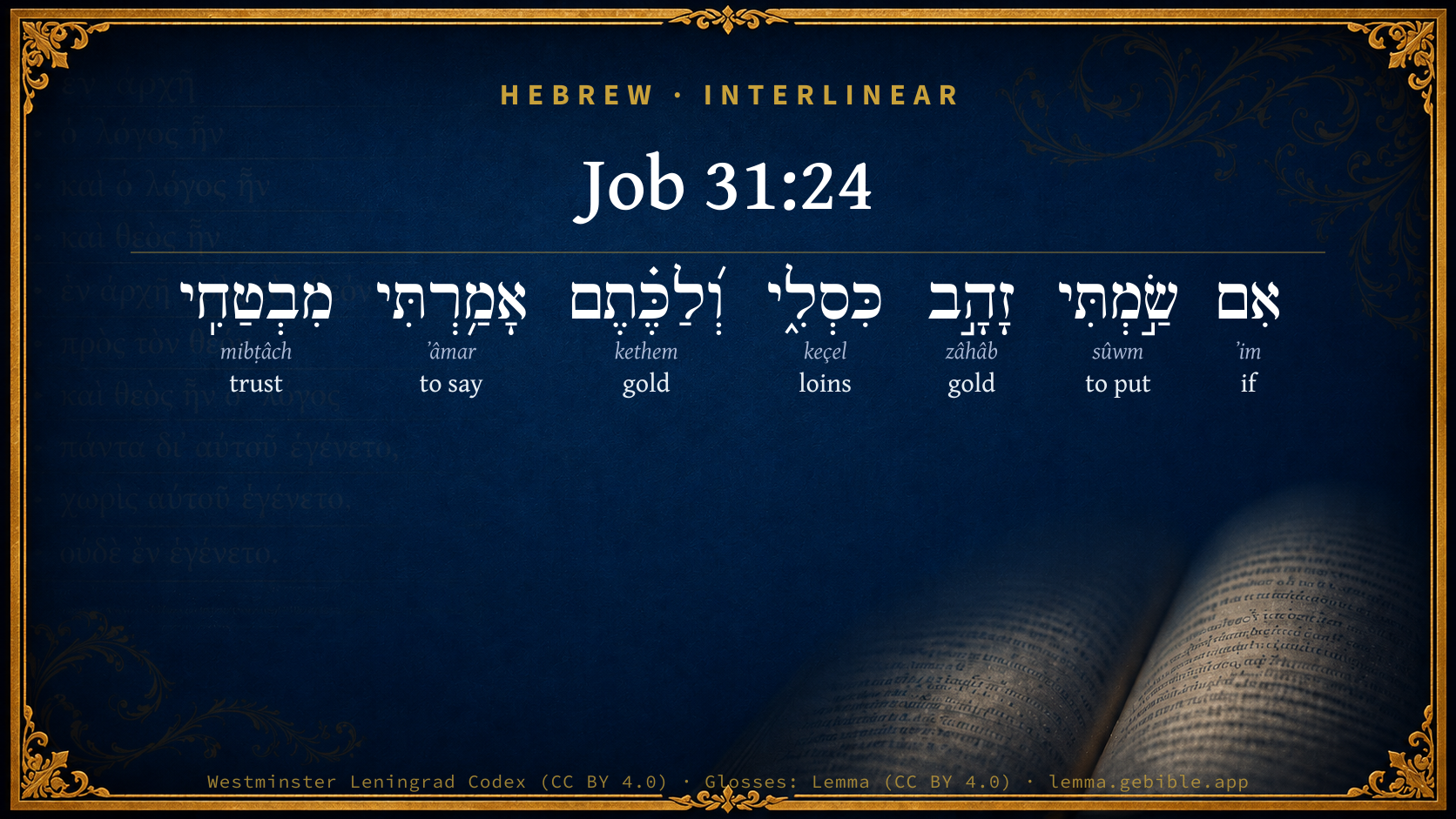
Hebrew (Westminster Leningrad Codex) Job 31:24 appears in the Hebrew Old Testament. The text above is from the Westminster Leningrad Codex. Each word links to its Strong’s number, a concise gloss, and parsing drawn from the Open Scriptures Hebrew Bible morphology. Click any word for its full Brown-Driver-Briggs (BDB) entry.
Download image
Cite this verse

Job 31:24 (World English Bible). Public Domain. Lemma interlinear Bible study tool, https://lemma.gebible.app/v/job/31/24.

Show BibTeX & RIS
BibTeX
RIS
English Translation
"If I have made gold my hope, And have said to the fine gold, 'You are my confidence;'
World English Bible · Public Domain
Download a study sheet

One document with this verse’s original text, its word-by-word gloss line, the meaning frame, cross-references with their text, attributed commentary, and full source and license credits — printable, and it pastes into notes with its structure intact.

This verse Autodidact and up

Study sheet (.html) Plain text (.txt)

A passage Seminary Student

Up to 50 verses in one chapter. A passage sheet keeps up to 6 commentary sources and 12 cross-references per verse, in the order this page ranks them, and says so on the sheet whenever that leaves anything out. Ask for a single verse and you get the Autodidact verse sheet above.

Everything on this page stays free to read, with no account — the sheet is a download of what is already on screen, not access to it.

Want to remove ads? Support Godless Engineer
Compare translations 3

The same verse in 3 English versions, stacked beneath the original-language interlinear above. Click any original word for its lexicon entry.

Each is an independent rendering of the whole verse — the interlinear is not word-aligned to these translations.

Highlighted words mark where these versions differ — a whole-verse word diff, not a word-by-word alignment.

  • World English Bible Public Domain
    "If I have made gold my hope, And have said to the fine gold, 'You are my confidence;'
  • King James Version Public Domain
    If I have made gold my hope, or have said to the fine gold, Thou art my confidence;
  • unfoldingWord Literal Text CC BY-SA 4.0
    If I have made gold my hope and I have said to fine gold, ‘My confidence’;

unfoldingWord Literal Text — © unfoldingWord, licensed CC BY-SA 4.0. Word-aligned USFM3 via Door43 (git.door43.org/unfoldingWord/en_ult).

Versions to compare (up to 4)

3 of 4 selected

Show all 18 translations

Every available English version of this verse, each an independent rendering of the whole verse.

  • World English Bible Public Domain
    "If I have made gold my hope, And have said to the fine gold, 'You are my confidence;'
  • Berean Standard Bible Public Domain
    If I have put my trust in gold or called pure gold my security,
  • Majority Standard Bible Public Domain
    If I have put my trust in gold or called pure gold my security,
  • King James Version Public Domain
    If I have made gold my hope, or have said to the fine gold, Thou art my confidence;
  • American Standard Version (1901) Public Domain
    If I have made gold my hope, And have said to the fine gold, `Thou art' my confidence;
  • Revised Version (1885) Public Domain
    If I have made gold my hope, and have said to the fine gold, Thou art my confidence;
  • Geneva Bible (1599) Public Domain
    If I made gold mine hope, or haue sayd to the wedge of golde, Thou art my confidence,
  • Douay-Rheims (1899) Public Domain
    If I have thought gold my strength, and have said to fine gold: My confidence:
  • Young's Literal Translation Public Domain
    If I have made gold my confidence, And to the pure gold have said, `My trust,'
  • Literal Standard Version CC BY-SA 4.0
    If I have made gold my confidence, || And to the pure gold have said, My trust;
  • Unlocked Literal Bible CC BY-SA 4.0
    If I have made gold my hope, and if I have said to fine gold, 'You are what I am confident in';
  • unfoldingWord Literal Text CC BY-SA 4.0
    If I have made gold my hope and I have said to fine gold, ‘My confidence’;
  • Darby Bible Public Domain
    If I have made gold my hope, or said to the fine gold, My confidence!
  • World Messianic Bible Public Domain
    “If I have made gold my hope, and have said to the fine gold, ‘You are my confidence;’
  • Webster's Bible Public Domain
    If I have made gold my hope, or have said to the fine gold, Thou art my confidence;
  • Free Bible Version CC BY-SA 4.0
    Have I put my trust in gold, calling fine gold, ‘My security’?
  • Bible in Basic English Public Domain
    If I made gold my hope, or if I ever said to the best gold, I have put my faith in you;
  • JPS Tanakh (1917) Public Domain
    If I have made gold my hope, and have said to the fine gold: 'Thou art my confidence';

Literal Standard Version (2020), Covenant Press — licensed CC BY-SA 4.0. Text via the HelloAO Bible API (eBible.org). Unlocked Literal Bible (unfoldingWord) — licensed CC BY-SA 4.0. Text via the HelloAO Bible API (eBible.org). unfoldingWord Literal Text — © unfoldingWord, licensed CC BY-SA 4.0. Word-aligned USFM3 via Door43 (git.door43.org/unfoldingWord/en_ult). Free Bible Version, Dr. Jonathan Gallagher — licensed CC BY-SA 4.0. Text via the HelloAO Bible API (eBible.org).

Word by word

More ways to search: Search by grammar → Find every occurrence → Compare this word →

Practice this passage: Drill this verse → Learn its vocabulary →

About this verse

These counts appear in no published source. They are computed here, from the morphology-tagged text and Lemma’s own curated glosses. What Lemma adds →

7
words
7
distinct lemmas
Wisdom
section

Notable vocabulary

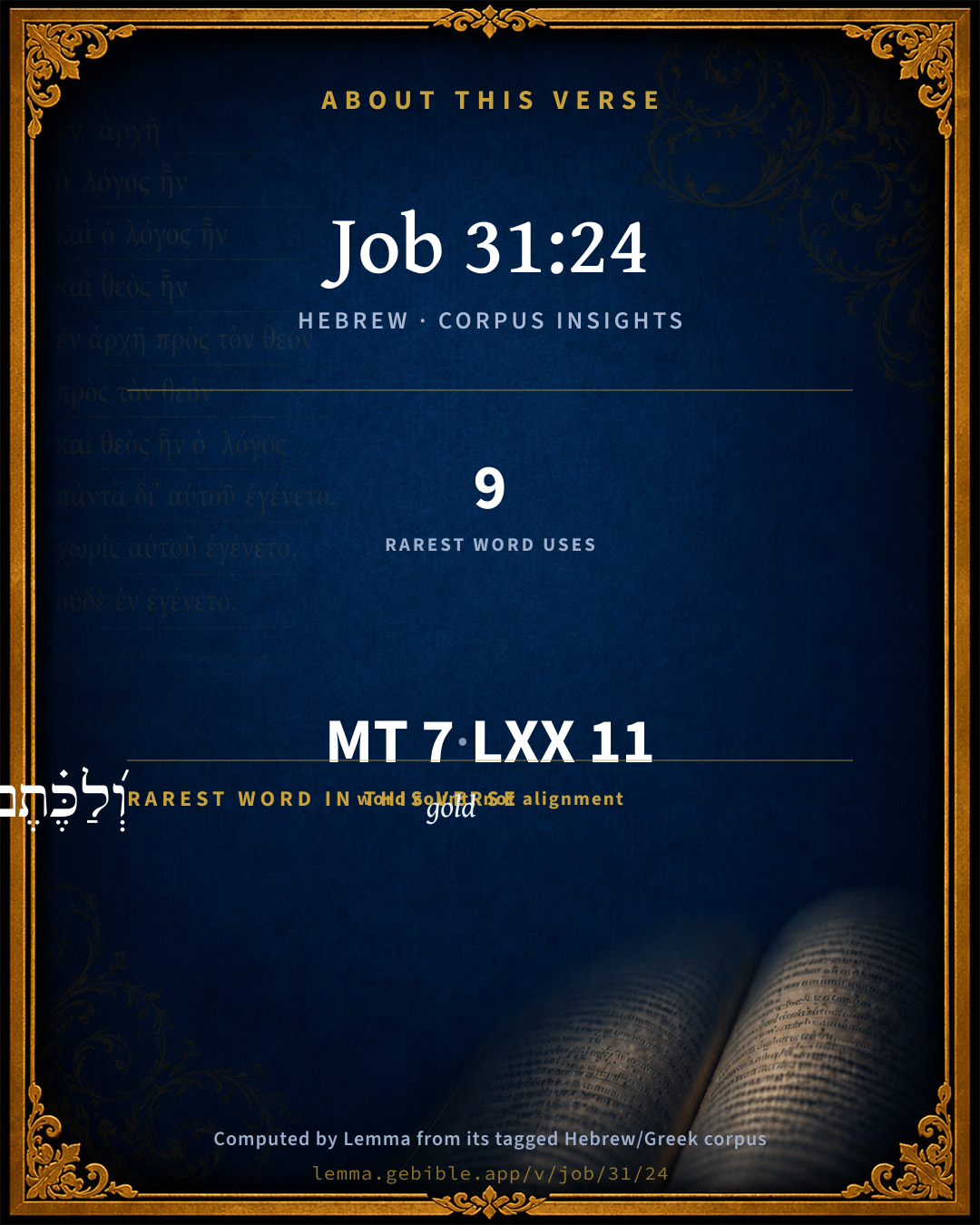
The rarest word here is וְ֝לַכֶּ֗תֶם gold H3800 — appearing just 9 times in the whole Hebrew Bible.

Shared distinctive vocabulary

וְ֝לַכֶּ֗תֶם gold H3800 occurs in 9 verses of the Hebrew Bible. Also found in:

Grammatical profile

  • 2 verbs
  • 4 nouns
  • 1 conjunction

Verb forms

  • שַׂ֣מְתִּי Qal · Perfect
  • אָמַ֥רְתִּי Qal · Perfect

Hebrew & Septuagint length

In English translation the verse runs 18 words from the Hebrew and 14 from the Septuagint (LXX English) — closely comparable.

A rough comparison of the two English renderings, which tokenize alike — not a word-level alignment.

Word counts can differ between the Hebrew and the Greek without any difference in meaning — e.g. the Hebrew direct-object marker אֵת has no separate Greek word, and Greek often adds the article ὁ.

In the original languages it is 7 Hebrew tokens and 11 Greek tokens — but the two are counted differently (Hebrew bundles its prefixes and suffixes into one token; the Greek is in lemma form), so that isn’t a like-for-like length.

Cross-references

14

Topical passages linked to Job 31:24 in the Treasury of Scripture Knowledge — connected by theme and wording, ordered by reader-vote popularity; previews shown in the World English Bible.

  • Deuteronomy 8:12–14 lest, when you have eaten and are full, and have built goodly houses, and lived therein;
  • Psalms 49:6–7 Those who trust in their wealth, And boast in the multitude of their riches--
  • Psalms 52:7 "Behold, this is the man who didn't make God his strength, But trusted in the abundance of his riches, And strengthened himself in his wickedness."
  • Proverbs 11:28 He who trusts in his riches will fall, But the righteous shall flourish as the green leaf.
  • Psalms 49:17 For when he dies he shall carry nothing away. His glory shall not descend after him.
  • Psalms 62:10 Don't trust in oppression. Don't become vain in robbery. If riches increase, Don't set your heart on them.
  • Proverbs 10:15 The rich man's wealth is his strong city. The destruction of the poor is their poverty.
  • Proverbs 30:9 Lest I be full, deny you, and say, 'Who is Yahweh?' Or lest I be poor, and steal, And so dishonor the name of my God.
  • Luke 12:15 He said to them, "Beware! Keep yourselves from covetousness, for a man's life doesn't consist of the abundance of the things which he possesses."
  • 1 Timothy 6:10 For the love of money is a root of all kinds of evil. Some have been led astray from the faith in their greed, and have pierced themselves through with many sorrows.
  • 1 Timothy 6:17 Charge those who are rich in this present world that they not be haughty, nor have their hope set on the uncertainty of riches, but on the living God, who richly provides us with everything to enjoy;
  • Genesis 31:1 He heard the words of Laban's sons, saying, "Jacob has taken away all that was our father's. From that which was our father's, has he gotten all this wealth."
  • Mark 10:24–25 The disciples were amazed at his words. But Jesus answered again, "Children, how hard is it for those who trust in riches to enter into the Kingdom of God!
  • Colossians 3:5 Put to death therefore your members which are on the earth: sexual immorality, uncleanness, depraved passion, evil desire, and covetousness, which is idolatry;

Cross-references courtesy of OpenBible.info (CC BY 4.0).

Hebrew and Greek witnesses Masoretic Hebrew ↔ Greek Septuagint

The same verse in the two great witnesses to the Old Testament, shown verse-for-verse.

These are two independent witnesses, not word-aligned to each other, and the Septuagint is shown in lemma (dictionary) form.

Hebrew Job 31:24 Masoretic · Westminster Leningrad Codex

אִם שַׂ֣מְתִּי זָהָ֣ב כִּסְלִ֑י וְ֝לַכֶּ֗תֶם אָמַ֥רְתִּי מִבְטַחִֽי

"If I have made gold my hope, And have said to the fine gold, 'You are my confidence;'

World English Bible · Public Domain

Greek LXX Job 31:24 Septuagint · lemma form

εἰ τάσσω χρυσίον ἰσχύς ἐγώ εἰ δέ καί λίθος πολυτελής πείθω

If I made gold my treasure, and if too I trusted the precious stone;

LXX2012 (modern English Septuagint) · Public Domain

On this verse, John Gill's Exposition discusses the Septuagint’s reading. Read the note in Commentary ↓

Hebrew: Westminster Leningrad Codex (CC BY 4.0). Greek: Septuagint (public domain); English from LXX2012 (modern English Septuagint) (Public Domain). How the Septuagint differs from the Hebrew →

Commentary

Notes on Job 31:24 from classic Christian and Jewish commentators (each source and its license shown beneath its notes). The classic Christian expositions comment on the surrounding passage and are grouped to its opening verse, so a note may address several verses; the Jewish commentaries on the Tanakh (Rashi and others) are per-verse, so they appear only where the commentator wrote on this verse.

Lemma curates 59 commentaries, every one of them public domain or Creative Commons licensed, each selected and text-cleaned for this edition rather than reprinted as found. About our sources →

Matthew Henry's Commentary

Four articles more of Job's protestation we have in these verses, which, as all the rest, not only assure us what he was and did, but teach us what we should be and do: -

I. He protests that he never set his heart upon the wealth of this world, nor took the things of it for his portions and happiness. He had gold; he had fine gold. His wealth was great, and he had gotten much. Our wealth is either advantageous or pernicious to us according as we stand affected to it. If we make it our rest and our ruler, it will be our ruin; if we make it our servant, and an instrument of righteousness, it will be a blessing to us. Job here tells us how he stood affected to his worldly wealth. 1. He put no great confidence in it: he did not make gold his hope, Job 31:24. Those are very unwise that do, and enemies to themselves, who depend upon it as sufficient to make them happy, who think themselves safe and honourable, and sure of comfort, in having abundance of this world's goods. Some make it their hope and confidence for another world, as if it were a certain token of God's favour; and those who have so much sense as not to think so yet promise themselves that it will be a portion for them in this life, whereas the things themselves are uncertain and our satisfaction in them is much more so. It is hard to have riches and not to trust in riches; and it is this which makes it so difficult for a rich man to enter into the kingdom of God, Mat 19:23; Mar 10:24. 2. He took no great complacency in it (Job 31:25): If I rejoiced because my wealth was great and boasted that my hand had gotten much. He took no pride in his wealth, as if it added any thing to his real excellency, nor did he think that his might and the power of his hand obtained it for him, Deu 8:17. He took no pleasure in it in comparison with the spiritual things which were the delight of his soul. His joy did not terminate in the gift, but passed through it to the giver. When he was in the midst of his abundance he never said, Soul, take thy ease in these things, eat, drink, and be merry, nor blessed himself in his riches. He did not inordinately rejoice in his wealth, which helped him to bear the loss of it so patiently as he did. The way to weep as though we wept not is to rejoice as though we rejoiced not. The less pleasure the enjoyment is the less pain the disappointment will be.

II. He protests that he never gave the worship and glory to the creature which are due to God only; he was never guilty of idolatry, Job 31:26-28. We do not find that Job's friends charged him with this. But there were those, it seems, at that time, who were so sottish as to worship the sun and moon, else Job would not have mentioned it. Idolatry is one of the old ways which wicked men have trodden, and the most ancient idolatry was the worshipping of the sun and moon, to which the temptation was most strong, as appears Deu 4:19, where Moses speaks of the danger which the people were in of being driven to worship them. But as yet it was practised secretly, and durst not appear in open view, as afterwards the most abominable idolatries did. Observe,

1. How far Job kept from this sin. He not only never bowed the knee to Baal (which, some think, was designed to represent the sun), never fell down and worshipped the sun, but he kept his eye, his heart, and his lips, clean from this sin. (1.) He never so much as beheld the sun or the moon in their pomp and lustre with any other admiration of them than what led him to give all the glory of their brightness and usefulness to their Creator. Against spiritual as well as corporal adultery he made a covenant with his eyes; and this was his covenant, that, whenever he looked at the lights of heaven, he should by faith look through them, and beyond them, to the Father of lights. (2.) He kept his heart with all diligence, that that should not be secretly enticed to think that there is a divine glory in their brightness, or a divine power in their influence, and that therefore divine honours are to be paid to them. Here is the source of idolatry; it begins in the heart. Every man is tempted to that, as to other sins, when he is drawn away by his own lust and enticed. (3.) He did not so much as put a compliment upon these pretended deities, did not perform the least and lowest act of adoration: His mouth did not kiss his hand, which, it is likely, was a ceremony then commonly used even by some that yet would not be thought idolaters. It is an old-fashioned piece of civil respect among ourselves, in making a bow, to kiss the hand, a form which, it seems, was anciently used in giving divine honours to the sun and moon. They could not reach to kiss them, as the men that sacrificed kissed the calves (Hos 13:2, Kg1 19:18); but, to show their good will, they kissed their hand, reverencing those as their masters which God has made servants to this lower world, to hold the candle for us. Job never did it.

2. How ill Job thought of this sin, Job 31:28. (1.) He looked upon it as an affront to the civil magistrate: It were an iniquity to be punished by the judge, as a public nuisance, and hurtful to kings and provinces. Idolatry debauches men's minds, corrupts their manners, takes off the true sense of religion which is the great bond of societies, and provokes God to give men up to a reprobate sense, and to send judgments upon a nation; and therefore the conservators of the public peace are concerned to restrain it by punishing it. (2.) He looked upon it as a much greater affront to the God of heaven, and no less than high treason against his crown and dignity: For I should have denied the God that is above, denied his being as God and his sovereignty as God above. Idolatry is, in effect, atheism; hence the Gentiles are said to be without God (atheists) in the world. Note, We should be afraid of every thing that does but tacitly deny the God above, his providence, or any of his perfections.

III. He protests that he was so far from doing or designing mischief to any that he neither desired nor delighted in the hurt of the worst enemy he had. The forgiving of those that do us evil, it seems, was Old Testament duty, though the Pharisees made the law concerning it of no effect, by teaching, Thou shalt love thy neighbour and hate thy enemy, Mat 5:43. Observe here,

1. Job was far from revenge. He did not only not return the injuries that were done him, not only not destroy those who hated him; but, (1.) He did not so much as rejoice when any mischief befel them, Job 31:29. Many who would not wilfully hurt those who stand in their light, or have done them a diskindness, yet are secretly pleased and laugh in their sleeve (as we say) when hurt is done them. But Job was not of that spirit. Though Job was a very good man, yet, it seems, there were those that hated him; but evil found them. He saw their destruction, and was far from rejoicing in it; for that would justly have brought the destruction upon him, as it is intimated, Pro 24:17, Pro 24:18. (2.) He did not so much as wish in his own mind that evil might befel them, Job 31:30. He never wished a curse to his soul (curses to the soul are the worst of curses), never desired his death; he knew that, if he did, it would turn into sin to him. He was careful not to offend with his tongue (Psa 39:1), would not suffer his mouth to sin, and therefore durst not imprecate any evil, no, not to his worst enemy. If others bear malice to us, that will not justify us in bearing malice to them.

2. He was violently urged to revenge, and yet he kept himself thus clear from it (Job 31:31): The men of his tabernacle, his domestics, his servants, and those about him, were so enraged at Job's enemy who hated him, that they could have eaten him, if Job would but have set them on or given them leave. "O that we had of his flesh! Our master is satisfied to forgive him, but we cannot be so satisfied." See how much beloved Job was by his family, how heartily they espoused his cause, and what enemies they were to his enemies; but see what a strict hand Job kept upon his passions, that he would not avenge himself, though he had those about him that blew the coals of his resentment. Note, (1.) A good man commonly does not himself lay to heart the affronts that are done him so much as his friends do for him. (2.) Great men have commonly those about them that stir them up to revenge. David had so, Sa1 24:4; Sa1 26:8; Sa2 16:9. But if they keep their temper, notwithstanding the spiteful insinuations of those about them, afterwards it shall be no grief of heart to them, but shall turn very much to their praise.

IV. He protests that he had never been unkind or inhospitable to strangers (Job 31:32): The stranger lodged not in the street, as angels might lately have done in the streets of Sodom if Lot alone had not entertained them. Perhaps by that instance Job was taught (as we are, Heb 13:2) not to be forgetful to entertain strangers. He that is at home must consider those that are from home, and put his soul into their soul's stead, and then do as he would be done by. Hospitality is a Christian duty, Pe1 4:9. Job, in his prosperity, was noted for good house-keeping: He opened his door to the road (so it may be read); he kept the street-door open, that he might see who passed by and invite them in, as Abraham, Gen 18:1.

Matthew Henry's Commentary on the Whole Bible (1708–1710) — public domain (CC PDM 1.0). Text via the HelloAO Bible API.

The Cambridge Bible for Schools and Colleges

gen. ed. J. J. S. Perowne

24–34. Repudiation of another class of secret sins, that would have dishonoured him: (1) secret joy in the possession of wealth—that love of gain which is idolatry (Col_3:5), Job_31:24-25; (2) a momentary impulse to salute the rising sun or the moon in her splendour and thus be false to the true spiritual God on high, Job_31:26-28; (3) secret joy of heart at the misfortune of his enemy, Job_31:29-30; (4) narrowness of soul and niggardliness, Job_31:31-32; and finally, hypocrisy, Job_31:33-34.

The Cambridge Bible for Schools and Colleges (gen. ed. J. J. S. Perowne; Cambridge University Press, 1878–1918) — public domain. Text from a community e-Sword module.

Trapp's Complete Commentary

John Trapp

Job 31:24 If I have made gold my hope, or have said to the fine gold, [Thou art] my confidence;

Ver. 24. If I have made gold my hope] The Seventy read, Si posui aurum in coniugmm meum; signifying the covetous man’s great love (Minut. Octav.). If I have trusted in uncertain riches, and been high minded, as Paul expounds it, 1Ti 6:17, holding myself simply the better or the safer for the wealth I have gotten; this is creature confidence, this is fiat idolatry, worse than that of the belly god, who sacrificeth to his gut, but trusteth not to it. An ancient complaineth (and not without cause), Divites facultatibus suis alligatos magis aurum consuevisse suspicere quam caelum, That rich men mind gold more than God, and money more than mercy. If wealth be wanting, they sit down in a faithless sullen discontent and despair; as, if they have it, they rise up in a corky, frothy confidence that all shall go well with them. This St Paul calls idolatry, Col 3:5; St James, adultery, Jas 4:4, and enmity with God, in a sense both active and passive; for it maketh a man both to hate God and to be hated by God. Now who would buy gold at so dear a rate?

Or have said to the fine gold, Thou art my confidence] This the mammonist speaketh, as if he were bowing before his golden god, whereunto, though he bow not the knee, yet with his heart he serveth it (and obedience is better than sacrifice), and with his tongue he talketh of it, saying, Thou art my confidence; if thou fail me, I must needs sink: and with all his might he makes after it, as if his life lay upon it, which yet, our Saviour saith, doth not consist in the abundance of those things a man hath, Luk 12:15, since (as a ship) he may have enough to sink him, but not enough to satisfy him.

John Trapp, A Commentary or Exposition upon All the Books of the Old and New Testament (1647–1656) — public domain. Text from a community e-Sword module.

The Biblical Illustrator

Joseph S. Exell

Job_31:24-28

If I have made gold my hope.

On the love of money

How universal is it among those who are in pursuit of wealth to make gold their hope; and, among those who are in possession of wealth, to make fine gold their confidence! Yet we are here told that this is virtually as complete a renunciation of God as to practise some of the worst charms of idolatry. We recoil from an idolater as from one who labours under a great moral derangement, in suffering his regards to be carried away from the true God to an idol. But is it not just the same derangement, on the part of man, that he should love any created good, and in the enjoyment of it lose sight of the Creator--that, thoroughly absorbed with the present and the sensible gratification, there should be no room left for the movements of duty, or regard to the Being who furnished him with the materials, and endowed him with the organs of every gratification? There is an important distinction between the love of money, and the love of what money purchases. Either of these affections may equally displace God from the heart. But there is a malignity and an inveteracy of atheism in the former which does not belong to the latter, and in virtue of which it may be seen that the love of money is, indeed, the root of all evil. A man differs from an animal in being something more than a sensitive being. He is also a reflective being. He has the power of thought, and inference, and anticipation. And yet it will be found, in the case of every natural man, that the exercise of those powers, so far from having carried him nearer, has only widened his departure from God, and given a more deliberate and wilful character to his atheism than if he had been without them altogether. In virtue of the powers of mind which belong to him, he can carry his thoughts beyond the present desires and the present gratification. He can calculate on the visitations of future desire, and on the means of its gratification. But the reason of man, and the retrospective power of man, still fail to carry him, by an ascending process, to the first cause. He stops at the instrumental cause, which, by his own wisdom and his own power, he has put into operation. In a word, the mans understanding is overrun with atheism, as well as his desires. To look no further than to fortune as the dispenser of all the enjoyments which money can purchase, is to make that fortune stand in the place of God. It is to make sense shut out faith. We have the authority of that Word which has been pronounced a discerner of the thoughts and intents of the heart, that it cannot have two masters, or that there is not in it room for two great and ascendant affections. Covetousness offers a more daring and positive aggression on the right and territory of the Godhead, than even infidelity. The latter would only desolate the sanctuary of heaven; the former would set up an abomination in the midst of it. When the liking and the confidence of men are toward money, there is no direct intercourse, either by the one or the other of these affections towards God; and in proportion as he sends forth his desires, and rests his security on the former, in that very proportion does he renounce God as his hope, and God as his dependence. (T. Chalmers, D. D.)

The worship of wealth

What is the true idea of property--something to be left behind when we die, or something which may be interwoven with our immortal nature, and so will last us for eternity? Money, jewels, lands, houses, books, decorations of all sorts and kinds, must be taken leave of at the bed of death. But there are things that last. Habits are wrought into the intellect and will--the love of God and of man, sincerity, purity, disinterestedness, these things live, and are really property, for death cannot touch them. Most men regard civilisation as mere material progress; but true human improvement must be an improvement of the man himself. And man himself is not what he owns and can handle, nor even his bodily frame, but he is a spirit clothed in a bodily form. His real improvement consists in that which secures the freedom and the supremacy of the noblest part of his nature. A true civilisation is that which shall promote this upon a great scale in human society. What do we see every year as the London season draws near, but a bevy of mothers, like generals, set out on a campaign, prepared to undergo any amount of fatigue if only they can marry their daughters, not necessarily to high-souled, virtuous men, but in any ease to a fortune! What do we see but a group of young men, thinking, after perhaps a career of dissipation, that the time has arrived for settling respectably in life, and looking, each one of them, not for a girl who has the graces and character which will make her husband and children happy, but for somebody who has a sufficient dowry to enable him to keep up a large establishment! Who can wonder, when the most sacred of all human relations, the union of hearts for time and for eternity, is thus prostituted to the brutal level of an affair of cash, that such transactions are quickly followed by months or years of misery--misery which, after seething long in private, is at last paraded before the eyes of the wondering world amid the unspeakable shame and degradation of the Divorce Court! (Canon Liddon.)

The Biblical Illustrator, edited by Joseph S. Exell (c. 1880s–1900s) — public domain. Text from a community e-Sword module.

Joseph Benson's Commentary

Job 31:24. If I have made gold my hope — That is, the matter of my hope and trust, expecting safety and happiness from it, and placing my chief joy in the increase of my riches.

Joseph Benson's Commentary on the Old and New Testaments (1811–1818) — public domain. Text from a community e-Sword module.

Whedon's Commentary on the Bible

Daniel D. Whedon

Fourth strophe — Job declares himself to have discharged his more secret and private obligations to God and man. He was not only free from covetous extortion, as he had previously declared, (Job_31:21,) but also from avaricious idolatry of glittering wealth and a concealed adoration of the most conspicuous of the heavenly bodies. Nor had he cherished emotions of retaliation and revenge, nor neglected the rites of hospitality, nor in general laid claim to virtues which he possessed not, Job_31:24-34.

Dillmann and others make the fourth strophe end with Job_31:32; Hengstenberg continues it to Job_31:34, and calls it a new decalogue of trespasses with an appended curse. The strophe divides itself into halves — the first, treating of sin directly against God; the second, of sin against man.

24. Gold my hope — Job here links the love of the shining metals with the worship of the shining luminaries — covert idolatry with overt idolatry — and thus anticipates the apostle in his estimate of covetousness. Col_3:5. “They whose God is gold have not God.” Dr. Chalmers has a sermon (in loc., Job_31:24-28) on “The Love of Money.”

Daniel D. Whedon (gen. ed.), Commentary on the Old and New Testaments (1874–1909) — public domain. Text from a community e-Sword module.

Tyndale Open Study Notes

Tyndale Open Resources

31:24 Have I put my trust in . . . my gold: Job left the consequence of this oath unstated because the if-then pattern was now established (31:5-23). He rejected Eliphaz’s implied judgment (22:24-25; see Pss 52:7; 62:10; 1 Tim 6:10, 17).

Tyndale Open Study Notes — © Tyndale Open Resources, licensed CC BY-SA 4.0. Text via the HelloAO Bible API.

Jamieson, Fausset & Brown

Robert Jamieson, A. R. Fausset & David Brown

Job asserts his freedom from trust in money (Ti1 6:17). Here he turns to his duty towards God, as before he had spoken of his duty towards himself and his neighbor. Covetousness is covert idolatry, as it transfers the heart from the Creator to the creature (Col 3:5). In Job 31:26-27 he passes to overt idolatry.

Jamieson, Fausset & Brown — Commentary Critical and Explanatory on the Whole Bible (1871) — public domain (CC PDM 1.0). Text via the HelloAO Bible API.

Adam Clarke's Commentary

Verse 24. Gold my hope] For the meaning of זהב zahab, polished gold, and כתם kethem, stamped gold, see on Job 28:15-17.

Adam Clarke's Commentary on the Bible (1810–1826) — public domain. Text from a community e-Sword/MySword module.

Ellicott's Commentary for English Readers

(24) If I have made gold my hope.—He here refers to the admonition of Eliphaz (Job_22:23-24), and declares that such had not been his practice.

A Bible Commentary for English Readers, edited by Charles John Ellicott (1878–1897) — public domain. Text from a community e-Sword module.

John Gill's Exposition

If I beheld the sun when it shined,.... Some take this to be a reason why Job did not make gold his hope and confidence, because all sublunary and earthly enjoyments must be uncertain, fading, and perish, since the sun and moon are not without their deficiencies and changes, to which sense the Septuagint version inclines; others, as Nachmanides, that they are a denial that Job ascribed his wealth and substance to the influence of the heavenly bodies; and many interpreters are of opinion that they are a continuation of the same subject as before; Job hereby declaring that neither his eye nor his heart were set upon his outward prosperity, comparable to the light of the sun, and the brightness of the moon; that he did not secretly please himself with it, nor congratulate himself upon it nor applaud his own wisdom and industry; and of late Schultens and others interpret it of flattering great personages, complimenting: them, and courting their favour, which we call worshipping the rising sun; but I rather think it is to be understood, as it more generally is, of worshipping the sun and moon in a literal sense; which was the first kind of idolatry men went into; those very ancient idolaters, the Zabii, worshipped the sun as their greater god, as Maimonides (a) observes, to whom he says they offered seven bats, seven mice, and seven other creeping things, with some other things also; in later times horses were offered to it, see Kg2 23:11. So the ancient Egyptians worshipped the sun and moon, calling the one Osiris, and the other Isis (b). The word for sun is "light", and it is so called because it is a luminous body, and the fountain of light to others; it is called the greater light, Gen 1:16; and from this Hebrew word "or", with the Egyptians, Apollo, who is the sun, is called Horus, as Macrobius (c) relates; it is said to "shine", as it always does, even when below our horizon, or in an eclipse, or under a cloud, though not seen by us. Job has here respect to its shining clearly and visibly, and perhaps at noon day, when it is in its full strength; unless regard is had to its bright and shining appearance at its rising, when the Heathens used to pay their homage and adoration to it (d): now when Job denies that he beheld it shining, it cannot be understood of the bare sight of it, which he continually had; nor of beholding it with delight and pleasure, which might be very lawfully done, Ecc 11:7; nor of considering it as the work of God, being a very glorious and useful creature, in which his glory is displayed, and for which he is to be praised, because of its beneficial influence on the earth; see Psa 8:3; but of his beholding it with admiration, as if it was more than a creature, ascribing deity to it, and worshipping it as God; and the same must be understood of the moon in the next clause:

or the moon walking in brightness; as at first rising, or rather when in the full, in the middle of the month, as Aben Ezra; when it walks all night, in its brightness, illuminated by the sun: these two luminaries, the one called the king, the other the queen of heaven, were very early worshipped, if not the first instances of idolatry. Diodorus Siculus (e) says, that the first men of old, born in Egypt, beholding and admiring the beauty of the world, thought there were two gods in the nature of the universe, and that they were eternal; namely, the sun and moon, the one they called Osiris, and the other Isis; hence the Israelites, having dwelt long in Egypt, were in danger of being drawn into this idolatry, against which they are cautioned, Deu 4:19; and where was a city called Heliopolis, or the city of the sun, as in the Greek version of Isa 19:18; where was a temple dedicated to the worship of it; and so the Arabians, the neighbours of Job, according to Herodotus (f), worshipped the sun and moon; for he says the Persians were taught by them and the Assyrians to sacrifice to the sun and moon; and so did the old Canaanites and the Phoenicians; hence one of their cities is called Bethshemesh, the house or temple of the sun, Jos 19:22, yea, we are told (g), that to this day there are some traces of this ancient idolatry in Arabia, the neighbourhood of Job; as in a large city in Arabia, upon the Euphrates, called Anna, where they worship the sun only; this being common in those parts in Job's time, he purges himself from it.

(a) Moreh Nevochim, par. 3. c. 29. p. 424. (b) Diodor. Sic. l. 1. p. 10. (c) Saturnal. l. 1. c. 21. (d) "Illi ad surgentem conversi limina solem", Virgil. Aeneid. 12. (e) Bibliothec. l. 1. c. 10. (f) Clio, sive, l. 1. c. 131. (g) De la Valle Itinerar. par. 2. c. 9. apud Spanheim. Hist. Job. c. 6. sect. 14. No. 6. p. 108, 109.

John Gill's Exposition of the Whole Bible (1746–1763) — public domain (CC PDM 1.0). Text via the HelloAO Bible API.

Albert Barnes' Notes on the Bible

If I have made gold my hope - That is, if I have put my trust in gold rather than in God; if I have fixed my affections with idolatrous attachment on riches rather than on my Maker. Job here introduces another class of sins, and says that his conscience did not charge him with guilt in respect to them. He had before spoken mainly of social duties, and of his manner of life toward the poor, the needy, the widow, and the orphan. He here turns to the duty which he owed to God, and says that his conscience did not charge him with idolatry in any form. He had indeed been rich, but he had not fixed his affections with idolatrous attachment on his wealth.

Or have said to fine gold - The word used here (כתם kethem) is the same which is employed in Job 28:16, to denote the gold of Ophir. It is used to express that which was most pure - from the verb כתם kâtham - to hide, to hoard, and then denoting that which was hidden, hoarded, precious. The meaning is, that he had not put his trust in that which was most sought after, and which was deemed of the highest value by people.

Albert Barnes' Notes on the Bible (1834–1885) — public domain. Text from a community e-Sword/MySword module.

Haydock's Catholic Bible Commentary

Fine obrizo. Hebrew cethem, chap. xxviii. 15. (Haydock)

George Leo Haydock (1774–1849), Haydock's Catholic Family Bible and Commentary, 1859 edition — public domain. Excludes Psalms (Douay-Rheims chapter numbering differs from Protestant) and Deuterocanonical books (Catholic canon only).

Matthew Poole's English Annotations

My hope, i.e. the matter of my hope and trust, placing my chief joy and satisfaction in worldly wealth, expecting safety and happiness from it. Compare Psa 62:10.

Matthew Poole's English Annotations on the Holy Bible (1683–1685) — public domain. Text from a community e-Sword/MySword module.

The Pulpit Commentary

If I have made gold my hope. This is a sin with which the patriarch had not been directly charged. But it had been more or less insinuated. (see Job_15:28 Job_20:10, Job_20:15, 19 22:24, etc.) He may also,perhaps, have felt some inclination to it. Or have said to the fine gold, Thou art my confidence. (On the wicked man"s trust in riches, see Psa_49:6 Psa_52:7 Psa_62:10 Mar_10:24 Luk_12:16-19)

The hope of gold.

Job here reminds us of the Egyptian "Book of the Dead," in which the soul, summoned before its judges, recites a long list of sins, and declares itself innocent of them all. In this chapter the patriarch runs over many kinds of wickedness, and invokes just punishment if he has been guilty of any of them. His self-vindication has been forced from him by the repeated false accusations of his friends. We know that Job was not without the consciousness of sin; but he was not guilty of the crimes and of the great deeds of wickedness which had boon charged against him. Among other evil things, he honestly repudiates resting his hope and confidence in gold.

I THE FASCINATION OF THE HOPE OF GOLD. This hope has a wide influence over men. It is not by any means confined to the owners of wealth. The poor make too much of" the hope of gold which they covet, while the rich overvalue that which is within their grasp. The passion for gold goes mad at the diggings; but it is found in sober walks of business life. Let us consider its sources.

1. Wide purchasing power. Gold is not sought for its glitter. The old miser who dived his hand into his bags of coins with wild glee is extinct. The modern gold worshiper is too wise to hoard his money uselessly. But whether the money is spent or not it is held as a potential good. It buys all visible commodities. People come to think that whatever they want can be had for gold.

2. Materialism. The habit of engrossing one"s self with earthly things appears to enlarge the value of gold by blotting out of view everything that is above the earth. The heavens are lost sight of, and the universe shrinks into the circle of the objects that can be procured for money.

II THE FATALITY OF THE HOPE OF GOLD. The fascination is fatal; it lures ruin.

1. It lowers the soul. The worshipper is always being assimilated to his idol. He who adores gold comes to have a heart that is as hard and earthly as the metal he is enslaved to. Thus all the finer spiritual qualities are crushed and quenched, and a sordid appetite for money dominates the inner man.

2. It encourages selfishness. The hope is for one"s sell We see this in the frightfully prevalent vice of gambling. The infatuated gambler is intoxicated with an excitement the root of which is pure greed, heartless selfishness. His gains are not productions, adding to the wealth of the world, but simply and solely what can be got out of other people"s possessions. His whole profit is made by the loss of other people. Gambling is the most antisocial vice.

3. It leads to crime. Gold is thought more of than truth or duty, or the rights of one"s neighbour.

4. It is dishonouring to God. God is the true Hope of his children. When men turn from him to gold they turn to an idol, and are unfaithful to their Lord.

5. It ends in disappointment. Gold cannot buy the best things peace of mind, purity, love, heaven. Midas is a failure in the end. We must learn to see the limits of the utility of money, and look beyond them for our true hope and confidence in what is better than gold the unsearchable fiches of Christ. W.F.A.

The Pulpit Commentary (1880–1919), ed. H.D.M. Spence-Jones & Joseph S. Exell — public domain. Text from a community e-Sword module.

Keil & Delitzsch

C. F. Keil & F. Delitzsch

24 If I made gold my confidence,

And said to the fine gold: O my trust;

25 If I rejoiced that my wealth was great,

And that my hand had gained much; -

26 If I saw the sunlight when it shone,

And the moon walking in splendour,

27 And my heart was secretly enticed,

And I threw them a kiss by my hand:

28 This also would be a punishable crime,

For I should have played the hypocrite to God above.

Not only from covetous extortion of another's goods was he conscious of being clear, but also from an excessive delight in earthly possessions. He has not made gold his כּסל, confidence (vid., on כּסלתך, Job 4:6); he has not said to כּתם, fine gold (pure, Job 28:19, of Ophir, Job 28:16), מבטחי (with Dag. forte implicitum as Job 8:14; Job 18:14): object (ground) of my trust! He has not rejoiced that his wealth is great (רב, adj.), and that his hand has attained כּבּיר, something great (neutral masc. Ew. 172, b). His joy was the fear of God, which ennobles man, not earthly things, which are not worthy to be accounted as man's highest good. He indeed avoided πλεονεξία as εἰλωλολατρεία (Col 3:5), how much more the heathenish deification of the stars! אור is here, as Job 37:21 and φάος in Homer, the sun as the great light of the earth. ירח is the moon as a wanderer (from רח = ארח), i.e., night-wanderer (noctivaga), as the Arab. târik in a like sense is the name of the morning-star. The two words יקר הלד describe with exceeding beauty the solemn majestic wandering of the moon; יקר is acc. of closer definition, like תמים, Psa 15:2, and this "brilliantly rolling on" is the acc. of the predicate to אראה, corresponding to the כּי יחל, "that (or how) it shoots forth rays" (Hiph. of הלל, distinct from יחל Isa 13:20), or even: that it shot forth rays (fut. in signif. of an imperf. as Gen 48:17).

Job 31:27 proceeds with futt. consec. in order to express the effect which this imposing spectacle of the luminaries of the day and of the night might have produced on him, but has not. The Kal ויּפתּ is to be understood as in Deu 11:16 (comp. ib. iv. 19, נדּח): it was enticed, gave way to the seducing influence. Kissing is called נשׁק as being a joining of lip to lip. Accordingly the kiss by hand can be described by נשׁקה יד לפה; the kiss which the mouth gives the hand is to a certain extent also a kiss which the hand gives the mouth, since the hand joins itself to the mouth. Thus to kiss the hand in the direction of the object of veneration, or also to turn to it the kissed hand and at the same time the kiss which fastens on it (as compensation for the direct kiss, Kg1 19:18; Hos 13:2), is the proper gesture of the προσκύνησις and adoratio mentioned; comp. Pliny, h. n. xxviii. 2, 5; Inter adorandum dexteram ad osculum referimus et totum corpus circumagimus. Tacitus, Hist. iii. 24, says that in Syria they value the rising sun; and that this was done by kissing the hand (τῆν χεῖρα κύσαντες) in Western Asia as in Greece, is to be inferred from Lucians Περὶ ὀρχήσεως, c. xvii.

(Note: Vid., Freund's Lat. Wrterbuch s. v. adorare, and K. Fr. Hermann's Gottesdienstliche Alterth. der Griechen, c. xxi. 16, but especially Excursus 123 in Dougtaeus' Analecta.)

In the passage before us Ew. finds an indication of the spread of the Zoroaster doctrine in the beginning of the seventh century b.c., at which period he is of opinion the book of Job was composed, but without any ground. The ancient Persian worship has no knowledge of the act of adoration by throwing a kiss; and the Avesta recognises in the sun and moon exalted genii, but created by Ahuramazda, and consequently not such as are to be worshipped as gods. On the other hand, star-worship is everywhere the oldest and also comparatively the purest form of heathenism. That the ancient Arabs, especially the Himjarites, adored the sun, שׁמשׁ, and the moon, שׂין (סין, whence סיני, the mountain dedicated to the moon), as divine, we know from the ancient testimonies,

(Note: Vid., the collection in Lud. Krehl's Religion der vorislamischen Araber, 1863.)

and many inscriptions

(Note: Vid., Osiander in the Deutsche Morgenl. Zeitschr. xvii. (1863) 795.)

which confirm and supplement them; and the general result of Chwolsohn's

(Note: In his great work, Ueber die Ssabier und den Ssabismus, 2 Bdd. Petersburg, 1856.)

researches is unimpeachable, that the so-called Sabians (Arab. ṣâbı̂wn with or without Hamza of the Jê), of whom a section bore the name of worshippers of the sun, shemsı̂je, were the remnant of the ancient heathenism of Western Asia, which lasted into the middle ages. This heathenism, which consisted, according to its basis, in the worship of the stars, was also spread over Syria, and its name, usually combined with צבא השּׁמים (Deu 4:19), perhaps is not wholly devoid of connection with the name of a district of Syria, ארם צובה; certainly our poet found it already there, where he heard the tradition about Job, and in his hero presents to us a true adherent of the patriarchal religion, who had kept himself free from the influence of the worship of the stars, which was even in his time forcing its way among the tribes.

It is questionable whether Job 31:28 is to be regarded as a conclusion, with Umbr. and others, or as a parenthesis, with Ew., Hahn, Schlottm., and others. We take it as a conclusion, against which there is no objection according to the syntax, although strictly it is only a confirmation (vid., Job 31:11, Job 31:23) of an implied imprecatory conclusion: therefore it is (would be) also a judicial misdeed, i.e., one to be severely punished, for I should have played the hypocrite to God above (לאל ממּעל, recalling the universal Arabic expression allah ta‛âla, God, the Exalted One) by making gold and silver, the sun and moon my idols. By פּלילי both the sins belonging to the judgment-seat of God, as in ἔνοχος τῷ συνεδρίῳ, Mat 5:22, are not referred to a human tribunal, but only described κατ ̓ ἄνθρωπον as punishable transgressions of the highest grade. כּחשׁ ל signifies to play the hypocrite to any one, whereas to disown any one is expressed by כחשׁ בּ. His worship of God would have been hypocrisy, if he had disowned in secret the God whom he acknowledged openly and outwardly.

Now follow strophes to which the conclusion is wanting. The single imprecatory conclusion which yet follows (Job 31:40), is not so worded that it might avail for all the preceding hypothetical antecedents. There are therefore in these strophes no conclusions that correspond to the other clauses. The inward emotion of the confessor, which constantly increases in fervour the more he feels himself superior to his accusers in the exemplariness of his life hitherto, struggles against this rounding off of the periods. A "yea then - !" is easily supplied in thought to these strophes which per aposiopesin are devoid of conclusions.

Keil & Delitzsch — Biblical Commentary on the Old Testament (1861–1891) — public domain (CC PDM 1.0). Text via the HelloAO Bible API. (Old Testament only.)

unfoldingWord translationNotes

Door43 World Missions Community

General Information:

Job continues describing situations in which he would deserve God's punishment, but he knows they are not true. (See: Hypothetical Situations)

If I have made gold my hope

The abstract noun "hope" can be translated with the verbs "trust" or "hope." AT: "If I trusted in gold" or "If I hoped that having a lot of gold would make me secure" (See: Abstract Nouns)

if I have said to fine gold, 'You are what I am confident in'

This line means the same as the previous line. (See: Parallelism)

my hand had gotten many possessions

Here "my hand" represents Job's ability to do things. AT: "I have gained many possessions by my own ability" (See: Metonymy)

then bring charges against me

This phrase is not in the original language or in other versions of the Bible. It was added here to help preserve the meaning of Job's statement in this long sentence.

translationWords

gold

hope

confidence

joy

hand

possess

unfoldingWord translationNotes — © Distant Shores Media and the Door43 World Missions Community, licensed CC BY-SA 4.0. Source: git.door43.org/Door43/en_tn.

Rashi

Rabbi Shlomo Yitzchaki (Rashi)

my hope Heb. כסלי, like (8:14), “whose confidence (כסלו) shall be cut off.” My hope and my thought, and because the kidneys are on the flanks (כסלים), and the kidneys advise, the thought is called כֶּסֶל.

and to jewelry A gathering of gold and treasures.

I said, ‘My confidence.’ therewith to strengthen myself over the poor.

Rashi on the Tanakh — English translations: “The Judaica Press complete Tanach with Rashi, translated by A. J. Rosenberg” (CC BY 4.0); “Pentateuch with Rashi's commentary by M. Rosenbaum and A.M. Silbermann, 1929-1934” (public domain); “The Metsudah Tanach series, Lakewood, N.J” (CC BY 4.0); and “The Book of Joshua, Metsudah Publications, 1997” (CC BY 4.0). Text via Sefaria.

Lesson kit

Teaching starters — assembled from the data on this page, not authored interpretation. Every prompt links to the verse data it draws on. Edit before teaching.

Job, in the Wisdom, opens this verse with 7 words (7 distinct Hebrew lemmas). Its most distinctive word is kethem (“gold”). A historical commentator’s framing appears above. Read the whole chapter for the surrounding context.

Discussion questions

  1. What does “gold” (kethem) contribute to the verse as a whole?
  2. How does Job 28:16, which shares the word «gold», read alongside this verse?
  3. The translations on this page render this verse differently — a whole-verse word diff, not a word-by-word alignment. What might account for the different wordings?
  4. «שַׂ֣מְתִּי» is a Qal Perfect verb. How does that grammatical form shape the action described?
  5. Compare how Matthew Henry's Commentary and The Cambridge Bible for Schools and Colleges read this verse. Where do they agree or differ?

Things to notice

Reading settings

Reading text

Shown beneath each verse's original-language words.

Old Testament
Old Testament edition

Read the OT as the Masoretic Hebrew (MT) or the Greek Septuagint (LXX).

English shown for the Greek Septuagint (in the Hebrew ↔ Greek comparison).

Comparing translations? Open the Compare panel on any verse page to stack up to four side by side.