
Acts 12:20

Greek (Tischendorf 8th ed.) Acts 12:20 appears in the Greek New Testament. The text above is from the Tischendorf 8th edition. Each word links to its Strong’s number and a concise gloss. Click any word for its full Thayer’s Greek Lexicon entry.
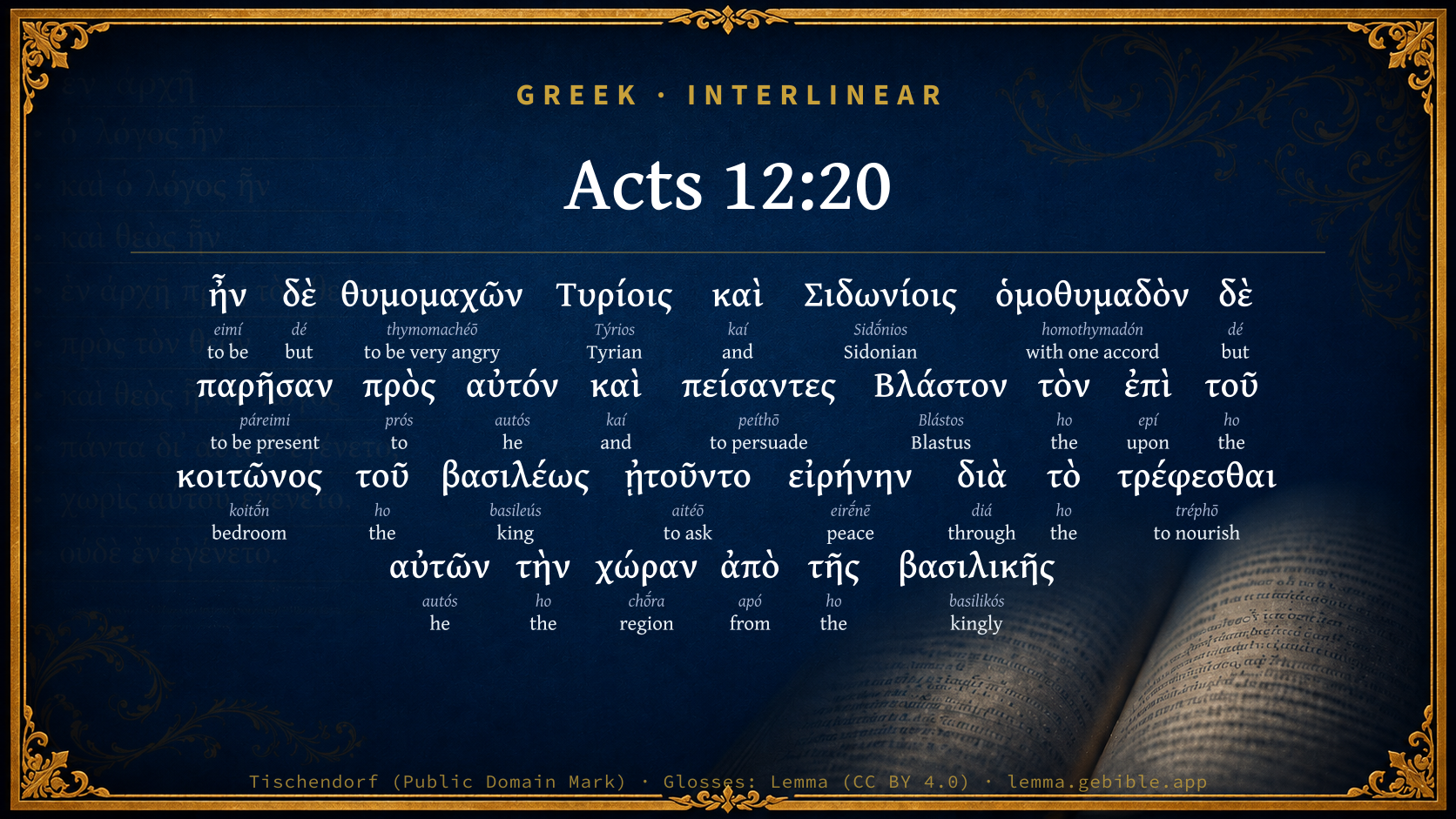
Download image
Cite this verse

Acts 12:20 (World English Bible). Public Domain. Lemma interlinear Bible study tool, https://lemma.gebible.app/v/acts/12/20.

Show BibTeX & RIS
BibTeX
RIS
English Translation
Now Herod was very angry with the people of Tyre and Sidon. They came with one accord to him, and, having made Blastus, the king's chamberlain, their friend, they asked for peace, because their country depended on the king's country for food.
World English Bible · Public Domain
Highlights
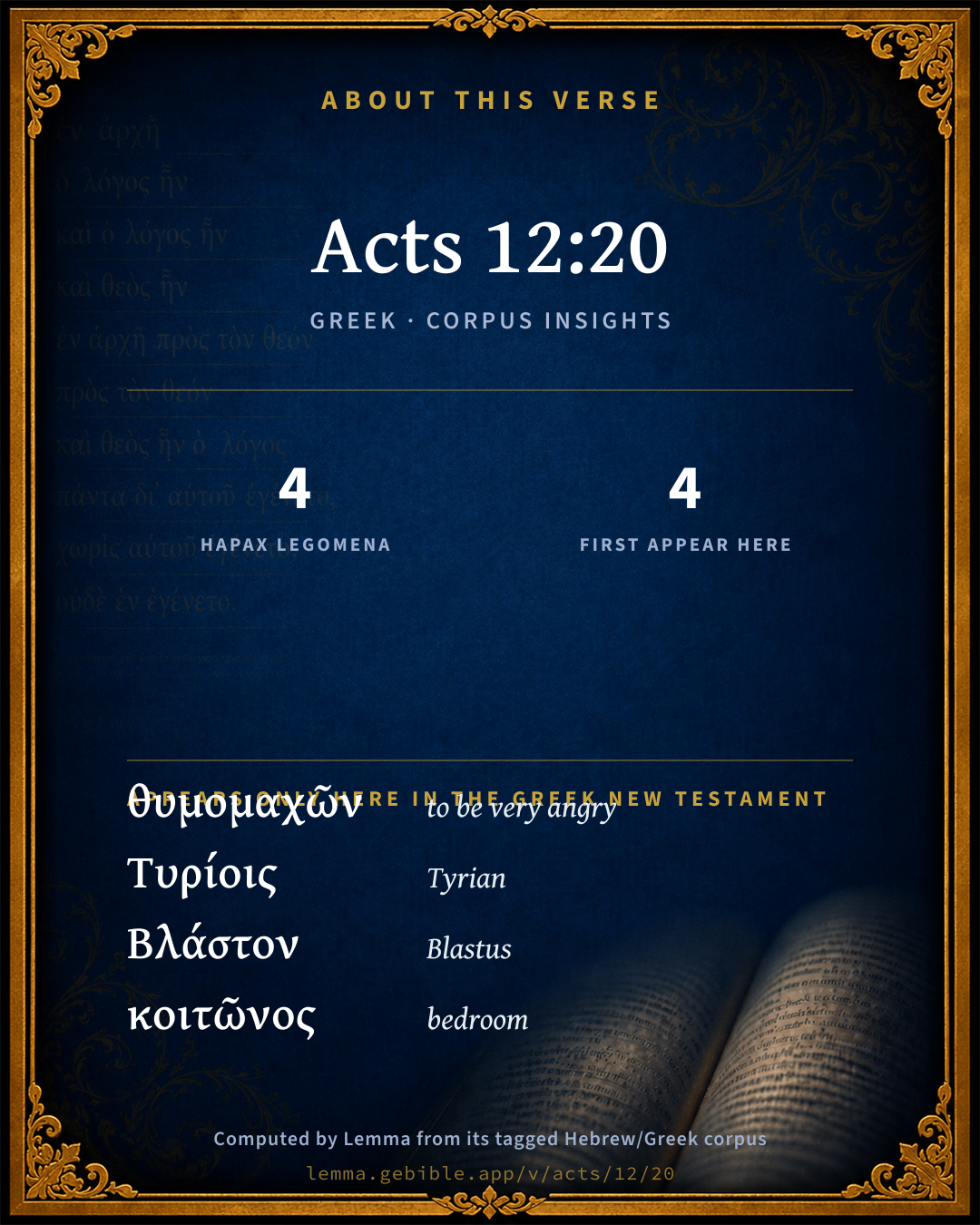
  • 4 hapax legomena — only here in the Greek New Testament
  • 4 first appearances in the Greek New Testament
Full analysis ↓
Download a study sheet

One document with this verse’s original text, its word-by-word gloss line, the meaning frame, cross-references with their text, attributed commentary, and full source and license credits — printable, and it pastes into notes with its structure intact.

This verse Autodidact and up

Study sheet (.html) Plain text (.txt)

A passage Seminary Student

Up to 50 verses in one chapter. A passage sheet keeps up to 6 commentary sources and 12 cross-references per verse, in the order this page ranks them, and says so on the sheet whenever that leaves anything out. Ask for a single verse and you get the Autodidact verse sheet above.

Everything on this page stays free to read, with no account — the sheet is a download of what is already on screen, not access to it.

Want to remove ads? Support Godless Engineer
Compare translations 3

The same verse in 3 English versions, stacked beneath the original-language interlinear above. Click any original word for its lexicon entry.

Each is an independent rendering of the whole verse — the interlinear is not word-aligned to these translations.

Highlighted words mark where these versions differ — a whole-verse word diff, not a word-by-word alignment.

  • World English Bible Public Domain
    Now Herod was very angry with the people of Tyre and Sidon. They came with one accord to him, and, having made Blastus, the king's chamberlain, their friend, they asked for peace, because their country depended on the king's country for food.
  • King James Version Public Domain
    And Herod was highly displeased with them of Tyre and Sidon: but they came with one accord to him, and, having made Blastus the king's chamberlain their friend, desired peace; because their country was nourished by the king's country.
  • unfoldingWord Literal Text CC BY-SA 4.0
    Now he was quarreling with the Tyrians and Sidonians. So they came to him unanimously, and having persuaded Blastus, the one over the bedchamber of the king, they were requesting peace, because their country was nourished from the king’s country.

unfoldingWord Literal Text — © unfoldingWord, licensed CC BY-SA 4.0. Word-aligned USFM3 via Door43 (git.door43.org/unfoldingWord/en_ult).

Versions to compare (up to 4)

3 of 4 selected

Show all 19 translations

Every available English version of this verse, each an independent rendering of the whole verse.

  • World English Bible Public Domain
    Now Herod was very angry with the people of Tyre and Sidon. They came with one accord to him, and, having made Blastus, the king's chamberlain, their friend, they asked for peace, because their country depended on the king's country for food.
  • Berean Standard Bible Public Domain
    Now Herod was in a furious dispute with the people of Tyre and Sidon, and they convened before him. Having secured the support of Blastus, the king’s chamberlain, they asked for peace, because their region depended on the king’s country for food.
  • Majority Standard Bible Public Domain
    Now Herod was in a furious dispute with the people of Tyre and Sidon, and they convened before him. Having secured the support of Blastus, the king’s chamberlain, they asked for peace, because their region depended on the king’s country for food.
  • King James Version Public Domain
    And Herod was highly displeased with them of Tyre and Sidon: but they came with one accord to him, and, having made Blastus the king's chamberlain their friend, desired peace; because their country was nourished by the king's country.
  • American Standard Version (1901) Public Domain
    Now he was highly displeased with them of Tyre and Sidon: and they came with one accord to him, and, having made Blastus the king's chamberlain their friend, they asked for peace, because their country was fed from the king's country.
  • Revised Version (1885) Public Domain
    Now he was highly displeased with them of Tyre and Sidon: and they came with one accord to him, and, having made Blastus the king’s chamberlain their friend, they asked for peace, because their country was fed from the king’s country.
  • Geneva Bible (1599) Public Domain
    Then Herod was angrie with them of Tyrus and Sidon, but they came all with one accord vnto him, and perswaded Blastus the Kings Chamberlaine, and they desired peace, because their countrey was nourished by the Kings land.
  • Douay-Rheims (1899) Public Domain
    And he was angry with the Tyrians and the Sidonians. But they with one accord came to him, and having gained Blastus, who was the king's chamberlain, they desired peace, because their countries were nourished by him.
  • Young's Literal Translation Public Domain
    And Herod was highly displeased with the Tyrians and Sidonians, and with one accord they came unto him, and having made a friend of Blastus, who `is' over the bed-chambers of the king, they were asking peace, because of their country being nourished from the king's;
  • Literal Standard Version CC BY-SA 4.0
    And Herod was highly displeased with the Tyrians and Sidonians, and with one accord they came to him, and having made a friend of Blastus, who [is] over the bed-chambers of the king, they were asking peace, because of their country being nourished from the king’s;
  • Unlocked Literal Bible CC BY-SA 4.0
    Now Herod was very angry with the people of Tyre and Sidon. They went to him together. They persuaded Blastus, the king's assistant, to help them. Then they asked for peace, because their country received its food from the king's country.
  • unfoldingWord Literal Text CC BY-SA 4.0
    Now he was quarreling with the Tyrians and Sidonians. So they came to him unanimously, and having persuaded Blastus, the one over the bedchamber of the king, they were requesting peace, because their country was nourished from the king’s country.
  • Darby Bible Public Domain
    And he was in bitter hostility with [the] Tyrians and Sidonians; but they came to him with one accord, and, having gained Blastus the king's chamberlain, sought peace, because their country was nourished by the king's.
  • World Messianic Bible Public Domain
    Now Herod was very angry with the people of Tyre and Sidon. They came with one accord to him and, having made Blastus, the king’s personal aide, their friend, they asked for peace, because their country depended on the king’s country for food.
  • Webster's Bible Public Domain
    And Herod was highly displeased with them of Tyre and Sidon. But they came with one accord to him, and having made Blastus the king's chamberlain their friend, desired peace, because their country was nourished by the king's country.
  • Free Bible Version CC BY-SA 4.0
    Now Herod had become furious with the people of Tyre and Sidon. They sent a joint delegation to see him and managed to win Blastus, the king's personal assistant, over to their side. They pleaded for peace with Herod because they were dependent on the king's territory for food.
  • Bible in Basic English Public Domain
    Now he was very angry with the people of Tyre and Sidon: and they came to him, all together, and having made friends with Blastus, the controller of the king's house, they made a request for peace, because their country was dependent on the king's country for its food.
  • Text-Critical English NT CC BY 4.0
    Now Herod was having an angry dispute with the people of Tyre and Sidon. So they came to him with one accord, and having won over Blastus, the king's personal attendant, they asked for peace, because their country was supplied with food from the king's country.
  • Tyndale New Testament (1534) Public Domain
    Herode was displeased with them of Tyre and Sydon. And they came all at once and made intercession vnto Blastus the kynges chamberlen and desyred peace because their countrey was norysshed by the kynges londe.

Literal Standard Version (2020), Covenant Press — licensed CC BY-SA 4.0. Text via the HelloAO Bible API (eBible.org). Unlocked Literal Bible (unfoldingWord) — licensed CC BY-SA 4.0. Text via the HelloAO Bible API (eBible.org). unfoldingWord Literal Text — © unfoldingWord, licensed CC BY-SA 4.0. Word-aligned USFM3 via Door43 (git.door43.org/unfoldingWord/en_ult). Free Bible Version, Dr. Jonathan Gallagher — licensed CC BY-SA 4.0. Text via the HelloAO Bible API (eBible.org).

Word by word

More ways to search: Search by grammar → Find every occurrence → Compare this word →

Practice this passage: Drill this verse → Learn its vocabulary →

θυμομαχῶν
thymomachéō
G2371
“to be very angry”
Verb, Present, Active, Participle, Nominative, Singular, Masculine
Part of Speech
Verb
Tense
Present
Voice
Active
Mood
Participle
Case
Nominative
Number
Singular
Gender
Masculine
Full Thayer's Definition

Origin: from a presumed compound of G2372 and G3164

TDNT: None

1. to carry on war with great animosity 2. to be very angry, be exasperated
  1. ἦν eimí G1510 “to be” Verb, Imperfect, Active, Indicative, 3rd person, Singular
  2. δὲ dé G1161 “but” Conjunction
  3. Τυρίοις Týrios G5183 “Tyrian” Noun, Dative, Plural, Masculine
  4. καὶ kaí G2532 “and” Conjunction
  5. Σιδωνίοις Sidṓnios G4606 “Sidonian” Adjective, Dative, Plural, Feminine
  6. ὁμοθυμαδὸν homothymadón G3661 “with one accord” Adverb
  7. δὲ dé G1161 “but” Conjunction
  8. παρῆσαν páreimi G3918 “to be present” Verb, Imperfect, Active, Indicative, 3rd person, Plural
  9. πρὸς prós G4314 “to” Preposition
  10. αὐτόν autós G846 “he” Personal pronoun, Accusative, Singular, Masculine
  11. καὶ kaí G2532 “and” Conjunction
  12. πείσαντες peíthō G3982 “to persuade” Verb, Aorist, Active, Participle, Nominative, Plural, Masculine
  13. Βλάστον Blástos G986 “Blastus” Noun, Accusative, Singular, Masculine
  14. τὸν ho G3588 “the” Article, Accusative, Singular, Masculine
  15. ἐπὶ epí G1909 “upon” Preposition
  16. τοῦ ho G3588 “the” Article, Genitive, Singular, Masculine
  17. κοιτῶνος koitṓn G2846 “bedroom” Noun, Genitive, Singular, Masculine
  18. τοῦ ho G3588 “the” Article, Genitive, Singular, Masculine
  19. βασιλέως basileús G935 “king” Noun, Genitive, Singular, Masculine
  20. ᾐτοῦντο aitéō G154 “to ask” Verb, Imperfect, Middle, Indicative, 3rd person, Plural
  21. εἰρήνην eirḗnē G1515 “peace” Noun, Accusative, Singular, Feminine
  22. διὰ diá G1223 “through” Preposition
  23. τὸ ho G3588 “the” Article, Accusative, Singular, Neuter
  24. τρέφεσθαι tréphō G5142 “to nourish” Verb, Present, Passive, Infinitive
  25. αὐτῶν autós G846 “he” Personal pronoun, Genitive, Plural, Masculine
  26. τὴν ho G3588 “the” Article, Accusative, Singular, Feminine
  27. χώραν chṓra G5561 “region” Noun, Accusative, Singular, Feminine
  28. ἀπὸ apó G575 “from” Preposition
  29. τῆς ho G3588 “the” Article, Genitive, Singular, Feminine
  30. βασιλικῆς basilikós G937 “kingly” Adjective, Genitive, Singular, Feminine

About this verse

These counts appear in no published source. They are computed here, from the morphology-tagged text and Lemma’s own curated glosses. What Lemma adds →

31
words
23
distinct lemmas
Acts
section

Notable vocabulary

4 hapax legomena — words that appear only here in the entire Greek New Testament:

  • θυμομαχῶν to be very angry G2371
  • Τυρίοις Tyrian G5183
  • Βλάστον Blastus G986
  • κοιτῶνος bedroom G2846

First appearance in Scripture

These words make their first canonical appearance in the Greek New Testament here:

  • θυμομαχῶν to be very angry G2371
  • Τυρίοις Tyrian G5183
  • Βλάστον Blastus G986
  • κοιτῶνος bedroom G2846

Shared distinctive vocabulary

Σιδωνίοις Sidonian G4606 occurs in 2 verses of the Greek New Testament. Also found in:
Repetition

Words recur within this verse:

Cross-references

21

Topical passages linked to Acts 12:20 in the Treasury of Scripture Knowledge — connected by theme and wording, ordered by reader-vote popularity; previews shown in the World English Bible.

  • Ezra 3:7 They gave money also to the masons, and to the carpenters; and food, and drink, and oil, to them of Sidon, and to them of Tyre, to bring cedar trees from Lebanon to the sea, to Joppa, according to the grant that they had of Cyrus king of Persia.
  • Ezekiel 27:17 Judah, and the land of Israel, they were your traffickers: they traded for your merchandise wheat of Minnith, and confections, and honey, and oil, and balm.
  • Matthew 11:21–22 "Woe to you, Chorazin! Woe to you, Bethsaida! For if the mighty works had been done in Tyre and Sidon which were done in you, they would have repented long ago in sackcloth and ashes.
  • Luke 14:31–32 Or what king, as he goes to encounter another king in war, will not sit down first and consider whether he is able with ten thousand to meet him who comes against him with twenty thousand?
  • Luke 16:8 "His lord commended the dishonest manager because he had done wisely, for the children of this world are, in their own generation, wiser than the children of the light.
  • Genesis 10:15 Canaan became the father of Sidon (his firstborn), Heth,
  • Genesis 10:19 The border of the Canaanites was from Sidon, as you go toward Gerar, to Gaza; as you go toward Sodom, Gomorrah, Admah, and Zeboiim, to Lasha.
  • Joshua 19:29 and the border turned to Ramah, and to the fortified city of Tyre; and the border turned to Hosah; and the goings out of it were at the sea by the region of Achzib;
  • 1 Kings 5:9–11 My servants shall bring them down from Lebanon to the sea; and I will make them into rafts to go by sea to the place that you shall appoint me, and will cause them to be broken up there, and you shall receive them; and you shall accomplish my desire, in giving food for my household.
  • 2 Chronicles 2:10 Behold, I will give to your servants, the cutters who cut timber, twenty thousand measures of beaten wheat, and twenty thousand measures of barley, and twenty thousand baths of wine, and twenty thousand baths of oil.
  • 2 Chronicles 2:15 Now therefore the wheat and the barley, the oil and the wine, which my lord has spoken of, let him send to his servants:
  • Proverbs 17:14 The beginning of strife is like breaching a dam, Therefore stop contention before quarreling breaks out.
  • Proverbs 25:8 Don't be hasty in bringing charges to court. What will you do in the end when your neighbor shames you?
  • Ecclesiastes 10:4 If the spirit of the ruler rises up against you, don't leave your place; for gentleness lays great offenses to rest.
  • Isaiah 23:1–4 The burden of Tyre. Howl, you ships of Tarshish; for it is laid waste, so that there is no house, no entering in: from the land of Kittim it is revealed to them.
  • Isaiah 27:4–5 Wrath is not in me: would that the briers and thorns were against me in battle! I would march on them, I would burn them together.
  • Hosea 2:8–9 For she did not know that I gave her the grain, the new wine, and the oil, And multiplied to her silver and gold, which they used for Baal.
  • Amos 4:6–9 "I also have given you cleanness of teeth in all your cities, And lack of bread in every town; Yet you haven't returned to me," says Yahweh.
  • Haggai 1:8–11 Go up to the mountain, bring wood, and build the house. I will take pleasure in it, and I will be glorified," says Yahweh.
  • Haggai 2:16–17 Through all that time, when one came to a heap of twenty measures, there were only ten. When one came to the wine vat to draw out fifty, there were only twenty.
  • Proverbs 20:18 Plans are established by advice; By wise guidance you wage war!

Cross-references courtesy of OpenBible.info (CC BY 4.0).

Where the printed editions differ

1 variant

Places in this verse where the major printed Greek editions disagree on the wording in a way that affects the translation — a comparison of editions, not a manuscript-by-manuscript collation. The editions are the modern critical texts (Nestlé-Aland 28/27, SBL, Westcott-Hort, Tregelles, Tyndale House) and the traditional texts behind the KJV (the Textus Receptus and the Byzantine/Majority text). It is not a claim about which reading is original.

  1. Extra text
    Ἡρῴδης

    “Herod”

    In TRByz Not in NA28NA27TynSBLWHTreg

    Ἡρῴδης (Hērōdēs) 'Herod' is only in traditional manuscripts (TR+Byz)

Textual data: Translators Amalgamated Greek New Testament (STEPBible TAGNT) · CC BY 4.0.

Commentary

Notes on Acts 12:20 from classic Christian and Jewish commentators (each source and its license shown beneath its notes). The classic Christian expositions comment on the surrounding passage and are grouped to its opening verse, so a note may address several verses; the Jewish commentaries on the Tanakh (Rashi and others) are per-verse, so they appear only where the commentator wrote on this verse.

Lemma curates 59 commentaries, every one of them public domain or Creative Commons licensed, each selected and text-cleaned for this edition rather than reprinted as found. About our sources →

Jamieson, Fausset & Brown

Robert Jamieson, A. R. Fausset & David Brown

HEROD'S MISERABLE END--GROWING SUCCESS OF THE GOSPEL--BARNABAS AND SAUL RETURN TO ANTIOCH. (Act 12:20-25)

Herod was . . . displeased with them of Tyre and Sidon--for some reason unknown; but the effect on their commercial relations made the latter glad to sue for peace.

their country was nourished by the king's country--See Kg1 5:11; Ezr 3:7; Eze 27:17. Perhaps the famine (Act 11:28) made them the more urgent for reconciliation.

Jamieson, Fausset & Brown — Commentary Critical and Explanatory on the Whole Bible (1871) — public domain (CC PDM 1.0). Text via the HelloAO Bible API.

Joseph Benson's Commentary

Act 12:20. Herod, &c. — The historian now proceeds to mention some circumstances that were introductory to the miserable end of Herod; was highly displeased with them of Tyre and Sidon — On account of some supposed affront which he had received from them, and which provoked him so far that, having vowed a severe revenge, he was preparing with all speed to make war upon them. But they came with one accord to him — Being a trading people, and apprehensive of the consequences of the king’s displeasure, they unanimously adopted the resolution of sending proper representatives to Cesarea, to appear before him; and having made Blastus their friend, desired peace — They sued for, and obtained, reconciliation with Herod. And thus the Christians of those parts were, by the providence of God, delivered from scarcity: because their country was nourished — Was provided with corn; by the king’s country — Thus Hiram also, king of Tyre, desired of Solomon food, or corn, for his household, 1Ki 5:9.

Joseph Benson's Commentary on the Old and New Testaments (1811–1818) — public domain. Text from a community e-Sword module.

Whedon's Commentary on the Bible

Daniel D. Whedon

2. Herod’s Judicial Death, Act_12:20-23.

20. Displeased—Fighting in mind, is the literal force of the Greek; quarrelling, carrying on, perhaps, a war of commercial hostilities.

Tyre and Sidon—Two great commercial towns on the Mediterranean coast, to whom Herod’s new city, Cesarea, was very probably a troublesome rival, and Herod would, of course, espouse the quarrel of his Cesareans.

One accord—The embassies of both cities visiting Herod together.

Chamberlain—Superintendent of his bedchamber, and so very intimate, and thereby influential, with Herod. And as the funds were often retained in these inner apartments the chamberlain was often the treasurer.

Desired peace—The cessation of all quarrel, and the removal of all restrictions upon trade.

Nourished—They were large cities with small inland territories; for Phenicia was but a narrow strip of sea coast. They were, therefore, largely dependent on Herod’s territories of Palestine both for country supplies and for all their trade with the East.

Daniel D. Whedon (gen. ed.), Commentary on the Old and New Testaments (1874–1909) — public domain. Text from a community e-Sword module.

The Preacher's Complete Homiletical Commentary

Joseph S. Exell (gen. ed.)

CRITICAL REMARKS

Act_12:20. For And Herod read And, or but, he—i.e., Herod. Highly displeased.—θυμομαχῶν, in a hostile state of mind, in modern phrase, “contemplating hostilities” (Plumptre), though it is doubtful whether open war against Phœnicia would have been permitted by Rome. Perhaps prohibitory tariffs with shutting of ports and markets were what Agrippa had in view. Tyre and Sidon.—The first mention of these Phœnician cities in the Acts. For their antiquity and splendour see Isa_23:7-8; Ezekiel 27, 28. Blastus.—Judging from his name may have been a Roman, and from the epithet, ὁ ἐπὶ τοῦ κοιτῶνος, præfectus cubiculi, cubicularis, was a chamberlain like Candace’s minister (Act_8:27), though not like him a eunuch.

Act_12:21. The set day.—According to Josephus was August 1st, and the second day of the public games celebrated by Agrippa in honour of Claudius (Jos., Ant., XIX. viii. 2). The royal apparel.—Was wholly of silver and of a contexture truly wonderful. The throne, or judgment seat, had been prepared for him in the theatre.

Act_12:23. For the read an angel of the Lord. Smote him … eaten of worms … gave up the ghost.—According to Josephus (Ant., XIX. viii. 2), the disease, which was acute disorder of the bowels, smote the king with sudden and violent pain. Forthwith he was carried out of the theatre a dying man; and in five days—i.e., on August 6th, he was dead. Compare the deaths of Joram (2Ch_21:19), Antiochus Epiphanes (2Ma_9:5-10), and of Herod the Great (Jos., Ant., XVII. vi. 5). As to the nature of this disease by which Agrippa was cut off see “Homiletical Analysis.” The suggestion that Herod was poisoned by Blastus, the king’s valet, whom the Phœnicians had gained over for this purpose (Renan), is scarcely worthy of consideration, having no plausible support either from Josephus or Luke.

Act_12:24. But the word of God grew and multiplied.—An antithesis to the horrible end of the persecuting king. (Compare Act_5:12 ff., Act_6:7; Act_9:31.)

Act_12:25. And Barnabas and Saul returned.—Not to, as some authorities read, but from Jerusalem.—Shortly after Herod’s death. How long they remained in the metropolis is not stated, but it is not likely to have been long. Alford thinks their arrival should be placed after Herod’s death, as “of all the persons whose execution would be pleasing to the Jews Saul would hold the foremost place.” Took with them John, whose surname was Mark.—See Act_12:12, whence the inference has been drawn that Barnabas and Saul, while in the city, belonged to the congregation that assembled in John’s mother’s house.

HOMILETICAL ANALYSIS.—Act_12:20-25

The Death of Herod; or, the Church’s Persecutor punished

I. The occasion of, and circumstances connected with, Herod’s death (Act_12:20-22).—

1. The place where it occurred—Cœsarea (see on Act_8:40). If Luke suggests that Herod’s motive for leaving Jerusalem and taking up his quarters in that “city of sumptuous palaces” (Conybeare and Howson, The Life and Epistles of Paul, 2:306) was the disgust felt in consequence of failing in his project to remove Peter, Josephus (Ant., XIX. vii. 3, viii. 2) so far confirms this as to state that while Agrippa “loved to live at Jerusalem,” he suddenly, after reigning three years over all Judæa, “came to the city of Cæsarea” with the obvious intention of residing there for a season.

2. The time when it happened. Manifestly within a month or two after Peter’s deliverance, though the precise date is not specified. The interval between Herod’s murder of James, shortly before the Passover of A.D. 44, and God’s judgment on Herod, in August A.D. 44, was sufficiently short to show that in the monarch’s overthrow the martyr’s death was divinely avenged.

3. The occasion on which it took place. According to Luke that was the reception of an embassy from the cities of Tyre and Sidon, with which at the time Herod was displeased. The ground of this displeasure, though not stated, may be assumed to have been the commercial rivalry existing between those ancient ports and the newly founded harbour of Cæsarea. In consequence of this the Phœnicians, it may be supposed, had been subjected to prohibitory measures which prevented them from obtaining supplies of corn out of Palestine, and accordingly were aroused to embrace the opportunity afforded them by Agrippa’s presence in Cæsarea to approach him with overtures for peace, which were laid before him by a friend of theirs at court—viz., Blastus, the king’s chamberlain. According to the story in the Acts Herod died, or at least received his death stroke, on the day when the Phœnician ambassadors were admitted to his presence, and while he himself, arrayed in royal apparel and seated upon his throne, was making to them a bombastical harangue. Josephus agrees with Luke in mentioning that Herod’s mortal malady seized him in a crowded assembly; and though the Jewish historian does not mention Herod’s quarrel with the Phœnicians or the presence of their ambassadors in the meeting, but ascribes the vast gatherings to a festival which at the time was being held in the city “to make vows for his safety,” possibly in honour of his return from Britain which took place that year, A.D. 44, nevertheless he (Josephus) says nothing to contradict Luke’s account, while he concurs with the sacred writer in affirming that the special flattery offered to Agrippa was that of calling him a god. According to Luke the people shouted—“The voice of a god and not of a man!” According to Josephus, “his flatterers cried out, one from one place and another from another, though not for his good, that he was a god,” adding, “Be thou merciful to us, for although we have hitherto reverenced thee only as a man, yet shall we henceforth own thee as superior to mortal nature.” Both forms of utterance may have been used, though Josephus’s appears like a paraphrase of Luke’s. The result, however, will remain unaffected, even if Luke should be held as having abbreviated the exclamations of the people.

II. The cause and the reason of Herod’s death (Act_12:23).

1. The cause was twofold.

(1) The natural, material, instrumental, and visible cause was a violent distemper of the bowels, which the sacred writer describes more particularly by saying “He was eaten of worms.” According to Josephus “a severe pain arose in his belly, and began in a most violent manner.” “The two accounts considered together,” writes Sir Risdon Bennett (The Diseases of the Bible, p. 101), “leave scarcely any room for doubt that the cause of death was perforation of the bowels by intestinal worms, inducing ulceration and acute peritonitis,” instances of which, he adds, are well known to medical science. “Without doubt,” says Leyrer, “one must think of abscesses and worm ulcers (ulcera verminosa), out of which, when they break up, maggots creep forth” (quoted by Keil, Biblische Archœologie, p. 564). To the same effect speaks Kamphausen in Riehm’s Handwörterbuch, art. Krankheiten):—“It is well known that masses of round worms can break through a place in the bowels which has been rendered thin by suppuration, or even through stoppage of the bowels lead to a horrible death; nor is it less certain that through ulcer holes worms can empty themselves out.”

(2) The supernatural, immaterial, direct, and invisible cause was the hand of God to which Luke points by writing, “An angel of the Lord smote him.” If Josephus does not introduce an angel into his report, it would almost seem as if by his story of the ill-omened bird, the owl, which Herod saw in the theatre (see Ant., XIX. viii. 2), he intended to suggest the direct interposition of Heaven in bringing about Agrippa’s death; and, indeed, according to Josephus, Agrippa himself regarded it in this light, and exclaimed when he saw the bird, “I, whom you call a god, am commanded presently to depart this life; while Providence thus reproves the lying words you just now said to me; and I, who was called immortal, am immediately to be carried, away by death.”

2. The reason. “Because he gave not God the glory,” writes Luke; which Josephus confirms by saying, “Upon this the king did neither rebuke them nor reject their impious flattery.” He, a Jew, to whom it was a foremost article in religion that Jehovah alone was God, and that to set up a creature alongside of Him was blasphemy and worthy of death (Mat_26:66), had allowed himself to suck in and drink down the adulation of puny mortals, and had actually began to consider himself a superior being, if not a veritable God; and so Jehovah, who is a jealous God (Exo_20:5), smote him till he died.

III. The effect and consequence of Herod’s death.—

1. The people rejoiced. “When it was known that Agrippa was departed this life, the inhabitants of Cæsarea and Sebaste forgot the kindnesses he had bestowed upon them, and acted the part of his bitterest enemies.… They also laid themselves down in public places and celebrated general feastings, with garlands on their heads, and with ointments and libations to Charon, and drinking to one another for joy that the king was dead” (Jos., Ant., XIX. ix. 1). What a commentary—and not selected from the Bible—on the vanity of popular applause, and the insincerity of popular adulation!

2. The word of God grew and multiplied. Grew in weight and influence upon the hearts of those who listened to it; grew in the extent and circumference over which it travelled; grew in its power of overcoming difficulties and in making friends. Multiplied itself by multiplying the number of believers, by drawing towards the young Church crowds of men and women who believed on the Lord Jesus Christ, and cast in their lot with His cause.

Learn.—

1. The certainty that God will avenge the blood of His martyrs (Deu_32:43; Luk_18:7).

2. The vanity of attempting to war with God (Isa_27:4; compare Iliad, v. 407, “By no means is he long lived who fights with the immortals”).

3. The wickedness of doing anything to rob God of His glory (Isa_42:8; Isa_48:11).

4. The ultimate triumph of the gospel over all obstacles (Isa_11:9; Mar_13:10).

HINTS AND SUGGESTIONS

Act_12:20-23. The Sin and Punishment of Herod.

I. How the measure of his iniquity was filled up.—It was pride that did it.

1. He picked a quarrel with his neighbours, the men of Tyre and Sidon.

2. He displayed before them his royal grandeur.

3. He accepted from them their senseless flattery.

4. He glorified himself above them as a god.

II. How the wickedness of his conduct was punished.—He who had killed James and would have slain Peter was himself destroyed.

1. The agent in his destruction was no less than an angel. The angel of the Lord who smote Peter on the side for life now smote the guilty Herod in the heart for death.

2. The instrument of Herod’s destruction was no more than a worm. The body in the grave is destroyed by worms, but Herod’s body putrefied while he was yet alive, and bred the worms which began to feed on it betimes. See

(1) what weak and contemptible creatures God can make the instruments of His justice when He pleases; and

(2) how God delights to bring down proud men in such a way as is most mortifying, and pours most contempt upon them.—After M. Henry.

Herod’s Death.

I. A proud man humbled.

II. A wicked man punished.

III. A powerful man weakened.

Act_12:1-23. God alone King. Proved:—

I. In the early death of James.

II. In the miraculous deliverance of Peter.

III. In the horrible end of Herod.—Gerok.

Act_12:2-23. The Deaths of James and of Herod.

I. (The apostle died) by the violence of man, (the king) by the visitation of God.

II. (The apostle), mature in grace; (the king), ripe in sin.

III. (The apostle,) lamented by his brethren; (the king) execrated by his subjects.

IV. (The apostle,) to ascend to glory; (the king) to go to his own place.

Act_12:24. The Progress of the Gospel in Apostolic Times.

I. The opposition it encountered.—From—

1. Jewish prejudices.

2. Heathen superstitions.

3. Human learning.

4. Satanic influence.

II. The success it achieved.—

1. It was widely published.

2. Its influence was extensive.

3. Its converts were multiplied.

III. The causes which enabled it to overcome opposition and attain success.—

1. The power of the Spirit.

2. The zeal of its preachers.

3. The holy lives of its disciples.

4. The unity of the Church. 5. The persecutions it suffered.

Act_12:24. The Progress of the Kingdom of God.

I. It has its origin in a seed.—“The kingdom of heaven is like unto a grain of mustard seed” (Mat_13:31-32). That seed is the truth of the gospel, which is:

1. Divine. Being the word of God (Luk_8:11; 1Pe_1:23; 1Jn_3:9).

2. Vital. Otherwise it would not spring up (Mar_4:27) and operate (Heb_4:12).

3. Small. Only a word, a gospel, a message of glad tidings, not a philosophy or a science, or elaborated system of truth.

II. It advances by growth.—Like the seed which extracts nutriment from the soil, the kingdom of God absorbs into itself that which makes it expand by attracting through the power of the gospel souls from the outside world.

III. It lives by reproduction.—As the seed multiplies according to its kind, so do believers who constitute the Church, as it were, reproduce themselves in other believers who are added to the congregation of the faithful.

Act_12:25. The Home Coming of the Messengers.

I. After a mission well executed.

II. With a fresh recruit to their ranks.

III. In readiness for further service.

The History of John Mark.

I. His family connections.—

1. The son of a pious mother. Mary was a disciple. In this respect Mark resembled Timothy (Act_16:1.). While grace does not run in the blood, there is an antecedent presumption that the piety of parents will reappear in their offspring. Mothers especially have an innate tendency to transmit their characters to their sons. How much pious mothers have in this way benefited both the Church and the world may be inferred from the annals of both, but will never be known till the day reveals.

2. The cousin of Barnabas (Col_4:10). Not sister’s son, in which case his father may have been the father of Barnabas; but cousin, so that his father and Barnabas’s may have been brothers, if the cousinship did not come through his mother. In any case, it was to Mark’s advantage that he stood so closely related to the Son of Consolation.

II. His excellent character.—

1. Fundamentally good. Like his mother he was a Christian disciple, having probably been converted by Peter, who afterwards affectionately regarded him as his son (1Pe_5:13), though of course the term “son,” as applied by Peter to Mark, may have referred to the service rendered by Mark to Peter. and this Mark may not have been John Mark, but either an actual son of the apostle’s (Bengel), or Mark the evangelist (Eusebius).

2. Constitutionally timid. As much as this may be feasibly inferred from his desertion of Paul and Barnabas at Perga (Act_13:13), on account probably of the hardships and dangers of the way. Grace does not all at once revolutionise a man’s natural temperament. Indeed, many good Christians have to struggle against constitutional infirmities all their lives.

3. Ultimately steadfast. This shines out conspicuously in his subsequent career. None reading of his after labours can doubt that Mark overcame his youthful indecision and became a splendid soldier of the cross. Youthful faults and indiscretions should not be allowed to hinder future usefulness or progress. Neither should they be used by others to disparage later merit.

III. His honourable career.—

1. An attendant of Paul and Barnabas on their first missionary journey (Act_13:5). Decidedly a good beginning, though it speedily came to a termination, for which he should not now be too severely judged. A colleague of Barnabas, after he and Paul had parted (Act_15:37; Act_15:39). Barnabas must have discerned in him elements of good notwithstanding his former lack of fortitude.

3. A companion of Paul in his imprisonment at Rome (Col_4:10-11; 2Ti_4:11; Phm_1:24); so that even Paul had come to recognise his true nobility of soul and to set a high value on his ministerial and friendly assistance. A lesson that old saints should not be too severe in judging the faults of young Christians.

The Preacher's Complete Homiletical Commentary (gen. ed. Joseph S. Exell; Funk & Wagnalls, c. 1892) — public domain (pre-1929). A full-Bible homiletical/sermon-outline anthology covering 65 of 66 books (2 John is absent from the source module). Text from a community e-Sword module.

Bengel's Gnomon

Johann Albrecht Bengel

Act 12:20. Ἦν δὲ, but Herod was) A restless kind of life.—(θυμομαχῶν, warring in mind) θυμομαχεῖν is said of one who is borne with hostility against his enemy only in mind, when his strength has been now lost, as Raphelius, from Polybius, shows to have been the case with Herod, or else has not been yet collected. Even without recourse to arms, by withholding supplies of grain, etc., to their markets, Herod could press heavily on the people of Tyre and Sidon, as usually happens in the case of marts for commerce.—πείσαντες, having appeased or made a friend of) So the Christians also, in the providence of God, were relieved from the dearness of provisions there: comp. ch. Act 11:28.—τὸν ἐπὶ τοῦ κοιτῶνος, the chamberlain) Such personages have often great power with kings; [and they were the more in need of peace on account of the dearness of provisions.—V. g.]—εἰρήνην, peace) They knew not to what lengths the offended king might proceed.—ἀπὸ τῆς βασιλικῆς, from the king’s) Repeat χώρας, country. Even Hiram, King of Tyre, had sought provisions for his household from Solomon: 1Ki 5:9.

Bengel's Gnomon of the New Testament — English translation (T&T Clark, Edinburgh, 1860) — public domain. Text from a community e-Sword module.

Meyer's Critical & Exegetical Commentary

Heinrich August Wilhelm Meyer

Act_12:20.[277] Θυμομαχεῖν] signifies to fight violently, which may be meant as well of actual war as of other kinds of enmity. See Schweighäuser, Lex. Polyb. p. 303; Kypke, II. p. 63 f.; Valcken. p. 493. Now, as an actual war of Herod against the Roman confederate cities of Tyre and Sidon is very improbable in itself, and is historically quite unknown; as, further, the Tyrians and Sidonians, for the sake of their special advantage (διὰ τὸ τρέφεσθαι … βασιλικῆς), might ask for peace, without a war having already broken out,namely, for the preservation of the peace, a breach of which was to be apprehended from the exasperation of the king; the explanation is to be preferred (in opposition to Raphel and Wolf): he was at vehement enmity with the Tyrians, was vehemently indignant against them (Polyb. xxvii. 8. 4). The reason of this θυμομαχία is unknown, but it probably had reference to commercial interests.

ὁμοθυμαδόν] here also, with one accord, both in one and the same frame of mind and intention. See on Act_1:14.

πρὸς αὐτόν] not precisely: with him, but before him, turned towards him (see on Joh_1:1).

Βλάστον] according to the original Greek name, perhaps a Greek or (see the inscription in Wetstein) a Roman in the service of Herod, his praefectus cubiculo (Sueton. Domit. 16), chamberlain, chief valet de chambre to the royal person[278] (ὁ ἐπὶ τοῦ κοιτῶος τοῦ βασιλέως, comp. on ἐπί, Act_8:27, and on κοιτών, Wetstein and Lobeck, ad Phryn. p. 252 f.). How they gained and disposed him in their favour (πείσαντες, see Nägelsb. on Iliad, p. 50 f.), possibly by bribery, is not mentioned.

διὰ τὸ τρέφεσθαι … βασιλικῆς] sc. χώρας. This refers partly to the important commercial gain which Tyre and Sidon derived from Palestine, where the people from of old purchased in large quantities timber, spices, and articles of luxury from the Phoenicians, to whom, in this respect, the harbour of Caesarea, improved by Herod, was very useful (Joseph. Antt. xv. 9. 6); and partly to the fact, that Phoenicia annually derived a portion of its grain from Palestine, 1Ki_5:9; 1Ki_5:11; Eze_27:17; Joseph. Antt. xiv. 10. 6.

[277] Chrysostom correctly remarks the internal relation of what follows: εὐθέως ἡ δίκη κατέλαβεν αὐτόν, εἰ καὶ μὴ διὰ Πέτρον, ἀλλὰ διὰ τὴν αὐτοῦ μεγαληγορίαν. Comp. Euseb. ii. 10. There is much subjectively supplied by Baumgarten, who considers it as the aim of this section to exhibit the character of the kingdom of the world in this bloody persecution directed against the apostles.

[278] Scarcely overseer of the royal treasure (Gerlach), as κοιτώς is used in Dio Cass. lxi. 5. For the meaning chamber, i.e. not treasure chamber, but sleeping room, is the usual one, and lies at the root of the designations of service, κοιτωνιάρχης (chamberlain) and κοιτωνίτης (valet de chambre). Comp. Lobeck, l.c. In the LXX. and Apocr. also κοιτ. is cubiculum. See Schleusn. Thes.

Meyer — Critical and Exegetical Commentary on the New Testament — English translation by Peter Christie, edited by Frederick Crombie (T&T Clark, 1880) — public domain. Text from a community e-Sword module.

Expositor's Greek Testament

ed. W. Robertson Nicoll

Act 12:20 . θυμομαχῶν : lit [254] , “to fight desperately” Polyb., ix., 40, 4; xxvii., 8, 4, and it might be used not only of open warfare, but of any violent quarrel; here almost = ὀργίζεσθαι . There could be no question of actual warfare, as Phœnicia was part of the province of Syria, and Herod had no power to wage war against it. Probably the cause of this θυμομαχία lay in commercial interests. The word is not found in LXX, or elsewhere in N.T. ὁμοθυμαδόν , Act 1:14 . πείσαντες , cf. Mat 28:14 , possibly with bribes, as Blass and Wendt suggest. τὸν ἐπὶ τοῦ κοιτῶνος , “chamberlain,” perhaps best. κοιτών will imply that he was over the king’s bed-chamber. Exo 8:3 , cf. 2Sa 4:7 , 2Ki 6:12 , Est 3:3Est 3:3 = Latin cubicularius . κοιτών , in Dio Cassius, lxi., 5, is used of the king’s treasury, but the ordinary usage is as above. In Attic Greek δωμάτιον , not κοιτών . τρέφεσθαι , i.e. , with corn ( cf. 1Ki 5:9 , Ezr 3:7 , Eze 27:17 ; Jos., Ant. , xiv, 10, 6), and see Blass, note in loco .

[254] literal, literally.

The Expositor's Greek Testament, edited by W. Robertson Nicoll (1897–1910) — public domain. Text from a community e-Sword module.

Geneva Bible (1599)

Geneva Bible translators

A miserable and shameful example of the end of the enemies of the Church.

Geneva Bible (1599) marginal notes — public domain. Text via Bolls.life.

Matthew Henry's Commentary

In these verses we have,

I. The death of Herod. God reckoned with him, not only for his putting James to death, but for his design and endeavour to put Peter to death; for sinners will be called to an account, not only for the wickedness of their deeds, but for the wickedness of their endeavours (Psa 28:4), for the mischief they have done and the mischief they would have done. It was but a little while that Herod lived after this. Some sinners God makes quick work with. Observe,

1. How the measure of his iniquity was filled up: it was pride that did it; it is this that commonly goes more immediately before destruction, and a haughty spirit before a fall. Nebuchadnezzar had been a very bloody man, and a great persecutor; but the word that was in the king's mouth when the judgments of God fell upon him was a proud word: Is not this great Babylon that I have built? Dan 4:30, Dan 4:31. It is the glory of God to look on every one that is proud, and bring him low, Job 40:12. The instance of it here is very remarkable, and shows how God resists the proud.

(1.) The men of Tyre and Sidon had, it seems, offended Herod. Those cities were now under the Roman yoke, and they had been guilty of some misdemeanours which Herod highly resented, and was resolved they should feel his resentment. Some very small matter would serve such a proud imperious man as Herod was for a provocation, where he was disposed to pick a quarrel. He was highly displeased with this people, and they must be made to know that his wrath was as the roaring of a lion, as messengers of death.

(2.) The offenders truckled, being convinced, if not that they had done amiss, yet that it was in vain to contend with such a potent adversary, who, right or wrong, would be too hard for them; they submitted and were willing upon any terms to make peace with him. Observe, [1.] The reason why they were desirous to have the matter accommodated: Because their country was nourished by the king's country. Tyre and Sidon were trading cities, and had little land belonging to them, but were always supplied with corn from the land of Canaan; Judah and Israel traded in their market, with wheat, and honey, and oil, Eze 27:17. Now if Herod should make a law to prohibit the exportation of corn to Tyre and Sidon (which they knew not but a man so revengeful as he might soon do, not caring how many were famished by it), their country would be undone; so that it was their interest to keep in with him. And is it not then our wisdom to make our peace with God, and humble ourselves before him, who have a much more constant and necessary dependence upon him than one country can have upon another? for in him we live, and move, and have our being. [2.] The method they took to prevent a rupture: They made Blastus the king's chamberlain their friend, probably with bribes and good presents; that is usually the way for men to make courtiers their friends. And it is the hard fate of princes that they must have not only their affairs, but their affections too, governed by such mercenary tools; yet such men as Herod, that will not be governed by reason, had better be so governed than by pride and passion. Blastus had Herod's ear, and has the art of mollifying his resentments; and a time is fixed for the ambassadors of Tyre and Sidon to come and make a public submission, to beg his majesty's pardon, throw themselves upon his clemency, and promise never again to offend in the like manner; and that which will thus feed his pride shall serve to cool his passion.

(3.) Herod appeared in all the pomp and grandeur he had: He was arrayed in his royal apparel (Act 12:21), and sat upon his throne. Josephus gives an account of this splendid appearance which Herod made upon this occasion - Antiq. 19.344. He says that Herod at this time wore a robe of cloth of silver, so richly woven, and framed with such art, that when the sun shone it reflected the light with such a lustre as dazzled the eyes of the spectators, and struck an awe upon them. Foolish people value men by their outward appearance; and no better are those who value themselves by the esteem of such, who court it, and recommend themselves to it as Herod did, who thought to make up the want of a royal heart with his royal apparel; and sat upon his throne, as if that gave him a privilege to trample upon all about him as his footstool.

(4.) He made a speech to the men of Tyre and Sidon, a fine oration, in which, probably, after he had aggravated their fault, and commended their submission, he concluded with an assurance that he would pass by their offence and receive them into his favour again - proud enough that he had it in his power whom he would to keep alive, as well as whom he would to slay; and probably he kept them in suspense as to what their doom should be, till he made this oration to them, that the act of grace might come to them with the more pleasing surprise.

(5.) The people applauded him, the people that had a dependence upon him, and had benefit by his favour, they gave a shout; and this was what they shouted, It is the voice of a god, and not of a man, Act 12:22. God is great and good, and they thought such was Herod's greatness in his apparel and throne, and such his goodness in forgiving them, that he was worthy to be called no less than a god; and perhaps his speech was delivered with such an air of majesty, and a mixture of clemency with it, as affected the auditors thus. Or, it may be, it was not from any real impression made upon their minds, or any high or good thoughts they had indeed conceived of him; but, how meanly soever they thought of him, they were resolved thus to curry favour with him, and strengthen the new-made peace between him and them. Thus great men are made an easy prey to flatterers if they lend an ear to them, and encourage them. Grotius here observes that, though magistrates are called gods (Psa 82:1), yet kings or monarchs, that is, single persons, are not, lest countenance should thereby be given to the Gentiles, who gave divine honours to their kings alive and dead, as here; but they are a college of senators, or a bench of judges, that are called gods - In collegio toto senatorum non idem erat periculi; itaque eos, non autem reges, invenimus dictos elohim. Those that live by sense vilify God, as if he were altogether such a one as themselves, and deify men, as if they were gods; having their persons in admiration, because of advantage. This is not only a great affront to God, giving that glory to others which is due to him alone, but a great injury to those who are thus flattered, as it makes them forget themselves, and so puffs them up with pride that they are in the utmost danger possible of falling into the condemnation of the devil.

(6.) These undue praises he took to himself, pleased himself with them, and prided himself in them; and this was his sin. We do not find that he had given any private orders to his confidants to begin such a shout, or to put those words into the mouths of the people, nor that he returned them thanks for the compliment and undertook to answer their opinion of him. But his fault was that he said nothing, did not rebuke their flattery, nor disown the title they had given him, nor give God the glory (Act 12:23); but he took it to himself, was very willing it should terminate in himself, and that he should be thought a god and have divine honours paid him. Si populus vult decipi, decipiatur - if the people will be deceived, let them. And it was worse in him who was a Jew, and professed to believe in one God only, than it was in the heathen emperors, who had gods many and lords many.

2. How his iniquity was punished: Immediately (Act 12:23) the angel of the Lord smote him (by the order of Christ, for to him all judgment is committed), because he gave not God the glory (for God is jealous for his own honour, and will be glorified upon those whom he is not glorified by); and he was eaten of worms above ground, and gave up the ghost. Now he was reckoned with for vexing the church of Christ, killing James, imprisoning Peter, and all the other mischiefs he had done. Observe in the destruction of Herod,

(1.) It was no less than an angel that was the agent - the angel of the Lord, that angel that was ordered and commissioned to do it, or that angel that used to be employed in works of this nature, the destroying angel: or the angel, that is, that angel that delivered Peter in the former part of the chapter - that angel smote Herod. For those ministering spirits are the ministers either of divine justice or of divine mercy, as God is pleased to employ them. The angel smote him with a sore disease just at that instant when he was strutting at the applauses of the people, and adoring his own shadow. Thus the king of Tyre said in his pride, I am a god, I sit in the seat of God; and set his heart as the heart of God; but he shall be a man, and no God, a weak mortal man, in the hand of him that slayeth him (Eze 28:2-9), so Herod here. Potent princes must know, not only that God is omnipotent, but that angels also are greater in power and might than they. The angel smote him, because he gave not the glory to God; angels are jealous for God's honour, and as soon as ever they have commission are ready to smite those that usurp his prerogatives, and rob God of his honour.

(2.) It was no more than a worm that was the instrument of Herod's destruction: He was eaten of worms, genomenos skōlēkobrōtos - he became worm-eaten, so it must be read; rotten he was, and he became like a piece of rotten wood. The body in the grave is destroyed by worms, but Herod's body putrefied while he was yet alive, and bred the worms which began to feed upon it betimes; so Antiochum, that great persecutor, died. See here, [1.] What vile bodies those are which we carry about with us; they carry about with them the seeds of their own dissolution, by which they will soon be destroyed whenever God does but speak the word. Surprising discoveries have of late been made by microscopes of the multitude of worms that there are in human bodies, and how much they contribute to the diseases of them, which is a good reason why we should not be proud of our bodies, or of any of their accomplishments, and why we should not pamper our bodies, for this is but feeding the worms, and feeding them for the worms. [2.] See what weak and contemptible creatures God can make the instruments of his justice, when he pleases. Pharaoh is plagued with lice and flies, Ephraim consumed as with a moth, and Herod eaten with worms. [3.] See how God delights not only to bring down proud men, but to bring them down in such a way as is most mortifying, and pours most contempt upon them. Herod is not only destroyed, but destroyed by worms, that the pride of his glory may be effectually stained. This story of the death of Herod is particularly related by Josephus, a Jew, Antiq. 19.343-350: "That Herod came down to Cesarea, to celebrate a festival in honour of Caesar; that the second day of the festival he went in the morning to the theatre, clothed with that splendid robe mentioned before; that his flatterers saluted him as a god, begged that he would be propitious to them; that hitherto they had reverenced him as a man, but now they would confess to be in him something more excellent than a mortal nature. That he did not refuse nor correct this impious flattery (so the historian expresses it); But, presently after, looking up, he saw an owl perched over his head, and was at the same instant seized with a most violent pain in his bowels, and gripes in his belly, which were exquisite from the very first; that he turned his eyes upon his friends, and said to this purpose: 'Now I, whom you called a god, and therefore immortal, must be proved a man, and mortal.' That his torture continued without intermission, or the least abatement, and then he died in the fifty-fourth year of his age, when he had been king seven years."

II. The progress of the gospel after this. 1. The word of God grew and multiplied, as seed sown, which comes up with a great increase, thirty, sixty, a hundred fold; wherever the gospel was preached, multitudes embraced it, and were added to the church by it, Act 12:24. After the death of James, the word of God grew; for the church, the more it was afflicted, the more it multiplied, like Israel in Egypt. The courage and comfort of the martyrs, and God's owning them, did more to invite people to Christianity, than their sufferings did to deter them from it. After the death of Herod the word of God gained ground. When such a persecutor was taken off by a dreadful judgment, many were thereby convinced that the cause of Christianity was doubtless the cause of Christ, and therefore embraced it. 2. Barnabas and Saul returned to Antioch as soon as they had despatched the business they were sent upon: When they had fulfilled their ministry, had paid in their money to the proper persons, and taken care about the due distribution of it to those for whom it was collected, they returned from Jerusalem. Though they had a great many friends there, yet at present their work lay at Antioch; and where our business is there we should be, and no longer from it than is requisite. When a minister is called abroad upon any service, when he has fulfilled that ministry, he ought to remember that he has work to do at home, which wants him there and calls him thither. Barnabas and Saul, when they went to Antioch, took with them John, whose surname was Mark, at whose mother's house they had that meeting for prayer which we read of Act 12:12. She was sister to Barnabas. It is probable that Barnabas lodged there, and perhaps Paul with him, while they were at Jerusalem, and it was that that occasioned the meeting there at that time (for wherever Paul was he would have some good work doing), and their intimacy in that family while they were at Jerusalem occasioned their taking a son of that family with them when they returned, to be trained up under them, and employed by them, in the service of the gospel. Educating young men for the ministry, and entering them into it, is a very good work for elder ministers to take care of, and of good service to the rising generation.

Matthew Henry's Commentary on the Whole Bible (1708–1710) — public domain (CC PDM 1.0). Text via the HelloAO Bible API.

Adam Clarke's Commentary

Verse 20. Highly displeased with them of Tyre] On what account Herod was thus displeased is not related by any historian, as far as I have been able to ascertain. Josephus, who speaks of this journey of Herod to Caesarea, says nothing of it; and it is useless for us to conjecture.

Having made Blastus-their friend] Blastus was probably a eunuch, and had considerable influence over his master Herod; and, to reach the master, it is likely they bribed the chamberlain.

Desired peace] The Tyrians and Sidonians being equally subjects of the Roman government with the inhabitants of Galilee, Herod could not go to war with them; but, being irritated against them, he might prevent their supplies: they therefore endeavoured to be on peaceable, i.e. friendly, terms with him.

Their country was nourished by the king's country.] That is, they had all their supplies from Galilee; for Tyre and Sidon, being places of trade and commerce, with little territory, were obliged to have all their provisions from the countries under Herod's jurisdiction. This had been the case even from the days of Solomon, as we learn 1Kg 5:11; where it is said that Solomon gave Hiram twenty thousand measures of wheat, for food to his household; and twenty measures of pure oil: thus gave Solomon to Hiram year by year. See also Eze 27:17.

Adam Clarke's Commentary on the Bible (1810–1826) — public domain. Text from a community e-Sword/MySword module.

John Calvin's Commentaries

20. A worthy history, which doth not only show, as it were in a glass, what end is prepared for the enemies of the Church, but also how greatly God hateth pride. The Scripture saith that “God resisteth the proud,” (1 Peter 5:5.) God himself did show a lively image thereof in the person of Herod. And assuredly men cannot extol themselves higher than becometh them, but they shall make war with God, who, to the end he may surpass all, commandeth all flesh to keep silence. And if God did so sharply punish pride in a king whom prosperity did puff up, what shall become of those of the common sort who are ridiculously puffed up without cause? Furthermore, we must note the course of the history, that all things go well with Herod after that he had miserably vexed the Church; he enforced the nations round about him, being tamed with hunger, to come to crave pardon upon their knees, as if God had rewarded him well for his wicked fury. This was no small trial for the godly, who might have thought thus with themselves that God cared not for them, and they were afraid lest with Herod’s power his tyranny and cruelty should increase. But the Lord had another purpose, for he set the oppressor of his Church on high that he might have the greater fall. Therefore, that shadowish felicity, wherein he delighted too much, was unto him a certain falling against the day of slaughter. In like sort, when at this day we see the bloody enemies of the Church carried up upon the wings of fortune into heaven, there is no cause why we should be discouraged; but let us rather call to mind that saying of Solomon,

“Pride goeth before calamity; and the heart is lifted up before a fall,” (Proverbs 16:18.)

Herod was displeased. Luke useth the compound participle, θυμομαχον which signifieth privy grudging or hatred. Therefore Herod did not make open war against those cities; but such was his displeasure, that he essayed to subdue them by policy, as it were by undermining them by little and little. It is a rare matter, saith Demosthenes, for free cities to agree with monarchs. Moreover, Herod was naturally cruel, bold, of insatiable covetousness; and it is not to be doubted but that Tyre and Sidon were, as it were, certain bars or rails to stay his fury, as they were wealthy cities, and unaccustomed to bear the yoke. Also, the remembrance of their old glory might have encouraged them; forasmuch as pride cometh commonly of wealth, it is no marvel if these two cities were proud, the one whereof Isaiah calleth queen of the seas, whose merchants, he said, were kings, and her chapmen dukes, (Isaiah 23:8.) Also, he saith elsewhere that Sidon was become proud by reason of her wealth. And although they had sundry times been brought almost to utter ruin, yet the commodiousness of their situation did shortly restore them to their wonted state. Hereby it came to pass that they could more hardly digest Agrippa, of late a base fellow, a man of no estimation, and one who had been let out of prison; especially seeing that he had behaved himself so cruelly toward his own subjects, and was troublesome and injurious to his neighbors.

Forasmuch as their country was nourished. It had not been good for him to have assailed the men of Tyre and Sidon with open war, therefore he giveth commandment that there should no corn nor victual be carried out of his realm. By this means did he, without any army, besiege them by little and little. For the borders of both cities were strait, and their ground barren, whereas there was a great people to be fed. Therefore, after that they were tamed with hunger, they humbly crave peace, and that not free, for assuredly they had some laws given them; and it is to be thought that this Blastus mentioned by Luke was not with bare words persuaded, but with rewards [gifts] won to entreat the peace. I know not why Erasmus did think it good to translate this place otherwise than the words import.

John Calvin's Commentaries (1540-1563) — public domain. Text from the Calvin Translation Society English edition (1840s-50s) via the Christian Classics Ethereal Library (ccel.org). Calvin's coverage is partial (roughly two-thirds of the Bible); uncommented books and verses are honest gaps, never fabricated. The 19th-century editor's footnotes and remarks are omitted so the notes are faithfully Calvin's own voice.

Ellicott's Commentary for English Readers

(20) Herod was highly displeased with them of Tyre and Sidon.—Literally, as in the margin, was in a hostile state of mind; was, in modern phrase, “contemplating hostilities.” The two Phœnician cities were not subject to Agrippa, but were under the control of Rome with a nominal independence.

Desired peace.—Literally, were seeking peace. They apparently feared that Herod would show his displeasure by prohibiting the export of corn, and oil, and wine, on which the Phœnician cities, with their large population and narrow strips of territory, were dependent for subsistence. Comp. 1Ki_5:11, and Eze_27:17, as showing the identity of the commercial relations of the two countries at long intervals in their history.

A Bible Commentary for English Readers, edited by Charles John Ellicott (1878–1897) — public domain. Text from a community e-Sword module.

The Cambridge Bible for Schools and Colleges

gen. ed. J. J. S. Perowne

20–25. Death of Herod Agrippa I. Growth of the Church

20. And Herod was highly displeased] The oldest MSS. omit Herod. Read, “Now he,” &c. The verb implies a deep-seated feeling of anger. It is not found elsewhere in the N. T.

with them of Tyre and Sidon] They were still seats of maritime industry, and perhaps Herod’s regard for the people of Berytus (Beyrout), another Phœnician seaport a little north of Sidon, may have been connected as cause or effect with his anger at the people of the two older cities. Josephus (xix.7. 5) gives an account of splendid buildings which this king provided for Berytus. It is clear that the way in which the royal anger had made itself felt was one which interfered with the commercial prosperity of Tyre and Sidon.

but they came with one accord to him] i.e. they joined in a common embassy and sent persons from both towns to make representations and use their influence to appease Herod’s anger.

Blastus the king’s chamberlain] Probably, as his name implies, some Roman who had taken office under this Eastern king who rejoiced in the favour of the Roman Emperor.

desired (asked for) peace] We are not to understand from these words that Agrippa was making war on Tyre and Sidon, but only that he was on unfriendly terms with them and was impeding their trade.

nourished by the king’s country] The extent of Herod’s rule was very great, and if he encouraged another port, and made regulations by which traffic was diverted from the towns of Tyre and Sidon, it was in his power to take away from them at least one-half of the commerce which was their support.

The Cambridge Bible for Schools and Colleges (gen. ed. J. J. S. Perowne; Cambridge University Press, 1878–1918) — public domain. Text from a community e-Sword module.

John Gill's Exposition

And Herod was highly displeased with them of Tyre and Sidon,.... Two cities on the sea coast, in the land of Phoenicia; with the inhabitants of which Herod was so enraged, that though he had not declared war against them, yet he had meditated it in his mind, and intended to do it at a proper time: what gave him this offence is not certain; that it should be for entertaining and concealing of Peter, when he made his escape, is without any foundation; and nothing but this following on that account, could ever occasion such a thought:

but they came with one accord to him; the ambassadors from both cities united in an address to him, and joined in ways and means to reconcile him to them:

and having made Blastus the king's chamberlain their friend; not merely by arguments, entreaties, and good works, but very likely by gifts, by making presents to him: persons in such an office had usually very great interest in the princes they served (q), as Blastus doubtless had with Herod; Commodus the emperor did every thing at the instances of his chamberlains, and so other princes; for these officers had access when others could not, the king's bedchamber next to sacred; and therefore the Tyrians and Sidonians privately applied to him first:

desired peace; either of Herod himself, to whom, by the means of Blastus, they were introduced; and in their address to him, entreated he would forgive the offence, and be at peace with them; or else of Blastus, whom by some means or another they made their friend; and therefore entreated of him, that he would use his interest with the king, and procure peace for them: and this sense the Arabic version inclines to, which renders the words thus, "and they prayed him that he would take care of reconciliation and peace"; though the former seems to be the true sense: "because their country was nourished by the king's country". These cities were seaports, and the inhabitants of them were much concerned in sending ships to sea, and in merchandise; and it was in Judea and Galilee, which were under Herod's jurisdiction, where they vented the goods they imported, and from whence they were supplied with wheat, honey, and oil, both for their own use, and perhaps to export abroad; see Kg1 5:1 Eze 27:3, &c. And it looks as if Herod had forbid all commerce with them, which if it had been continued, would have been the ruin of them.

(q) Vid. Pignorium de servis, p. 480, 481. Popmam de operis Servorum, p. 33. & Alstorph. de Lectis veterum, c. 12. p. 63.

John Gill's Exposition of the Whole Bible (1746–1763) — public domain (CC PDM 1.0). Text via the HelloAO Bible API.

Trapp's Complete Commentary

John Trapp

20 And Herod was highly displeased with them of Tyre and Sidon: but they came with one accord to him, and, having made Blastus the king’s chamberlain their friend, desired peace; because their country was nourished by the king’s country.

Ver. 20. Because their country, &c.] Should not God’s manifold mercies move us to make peace with him? Will he not else curse our blessings, and destroy us "after that he hath done us good?" Jos 24:20.

John Trapp, A Commentary or Exposition upon All the Books of the Old and New Testament (1647–1656) — public domain. Text from a community e-Sword module.

Albert Barnes' Notes on the Bible

And Herod was highly displeased ... - Greek: “bore a hostile mind,” intending war. See the margin. The Greek word θυμομαχῶν thumomachōn does not occur elsewhere in the New Testament. It means to meditate war; to purpose war in the mind; or here, probably, to be enraged or angry at them. What was the cause of this hostility to the people of Tyre and Sidon is not mentioned, and conjecture is useless. It is not at all inconsistent, however, with the well known character of Herod. It was probably from some cause relating to commerce. Tyre and Sidon were under the Roman power, and had some shadow of liberty (Grotius), and it is probable that they might have embarrassed Herod in some of his regulations respecting commerce.

Tyre and Sidon - See the notes on Mat 11:21. They were north of Caesarea.

They came with one accord - Fearing the effects of his anger, they united in sending an embassage to him to make peace.

Blastus, the king’s chamberlain - See Rom 16:23. The word “chamberlain” denotes an officer who is charged with the direction and management of a chamber or chambers, particularly a bed-chamber. It denotes here a man who had charge of the bed chamber of Herod.

Because their country was nourished ... - Was supplied by the territories of Herod. The country of Tyre and Sidon included a narrow strip of land on the coast of the Mediterranean. Of course they were dependent for provisions, and for articles of commerce, on the interior country; but this belonged to the kingdom of Herod; and as they were entirely dependent on his country, as he had power to dry up the sources of their support and commerce, they were the more urgent to secure his favor.

Albert Barnes' Notes on the Bible (1834–1885) — public domain. Text from a community e-Sword/MySword module.

Haydock's Catholic Bible Commentary

In the Greek, he was preparing to make war against them. These applied not to agriculture, but drew their support from Judea, Samaria, and Galilee. (Bible de Vence)

George Leo Haydock (1774–1849), Haydock's Catholic Family Bible and Commentary, 1859 edition — public domain. Excludes Psalms (Douay-Rheims chapter numbering differs from Protestant) and Deuterocanonical books (Catholic canon only).

Matthew Poole's English Annotations

Tyre and Sidon; these were two coast towns in Phoenicia, famous, especially the former, for their great trading; and being rich, might be insolent, or possibly might tempt Herod to a war against them, whose conquest would pay the charge of it.

The king’s chamberlain, or chief of his bed chamber.

Desired peace, or begged pardon; there being no war yet begun.

Their country was nourished by the king’s country; these cities lying upon the sea, had little land belonging to them, and of old were forced to have their provision from other places, especially from Judea; thus Solomon gave Hiram, king of Tyre, twenty thousand measures of wheat for his household, and twenty measures of pure oil yearly, 1Ki 5:9,11; and long after that, they of Judah and Israel are said to have traded with their wheat in Tyre, Eze 27:17.

Matthew Poole's English Annotations on the Holy Bible (1683–1685) — public domain. Text from a community e-Sword/MySword module.

The Pulpit Commentary

Now he for and Herod, A.V. and T.R.; and for but, A.V.; they asked for for desired, A.V.; fed from for nourished by, A.V. Highly displeased (qumomacwn); only here in the New Testament, but used by Polybius, as well as the kindred word yucomacein, in the sense of having a hostile spirit against any one, maintaining a strong resentment. It describes a state of feeling which may exist before war, during war, and after war when only a hollow peace has been made. Tyro and Sidon at this time were semi-independent cities under the Roman supremacy. The occasion of Herod"s displeasure is not known. Chamberlain; literally, the officer over his bedchamber his chief groom of the chambers an office which would give him easy access to the king"s private ear. Was fed. This commerce, by which Palestine supplied Tyro and Sidon with wheat in return for timber, was as old as the time of Solomon at least; (1Ki_5:9, 1Ki_5:11) see too Eze_27:17, and the decree of Caligula, in which he speaks of the large exportation of corn to Sidon from the Jewish harbor of Joppa. ("Ant. Jud:," 14:10:6)

Vers. 20-23. Human pride and Divine retribution.

The main lesson which this incident conveys is the folly of human presumption. But there are side truths which the narrative suggests.

1. The interdependence of one nation on another: "Their country was nourished by the king"s country" (ver. 20). One land has metals in abundance; another has corn; another, cotton; another, timber, etc. It was clearly the intention of the Father of all that all peoples should live in close friendship and constant intercourse with one another. Yet the heathen idea was that the natural relation between neighboring nations was war. The motto of Christianity is "Peace;" its spirit is that of brotherhood; its counsel and fruit are active interchange of services and resources.

2. The evil of autocracy: "Herod was highly displeased with them of Tyre and Sidon" (ver. 20). It may have been some slight affront he had received, and which he was determined to avenge. All responsibility rested with him, and the caprice or resentment of one single soul would have been sufficient to plunge the thousands of Tyre and Sidon men, women, and children into terror and distress. We may unite to thank God that the sword isbeing taken out of the hand of the autocrat.

3. The drawbacks to human greatness. Herod Agrippa was a man in a very fine position, and he was no doubt envied by thousands of his subjects; doubtless he often congratulated himself on the success of his subtlety. Yet he was

(1) much at the mercy of venal counselors, probably rich presents had found their way into the treasury of Blastus before that chamberlain spoke honeyed words of peace in Herod"s ear (ver. 20);

(2) the dupe of base flatterers (ver. 22), he must either have been constantly engaged in weighing words and distinguishing the false from the sincere, or else he must have been continually deceived. But to read the lesson of the text we turn to

I THE HEIGHT TO WHICH HUMAN PRESUMPTION WILL RISE. The scene which is briefly sketched in the text (ver. 21) has been more fully described elsewhere (see Farrar"s "Life of St. Paul," 2. pp. 315-317). It may seem incredible to those who move in humble spheres that a mortal man could ever be so inflated with a sense of his own greatness as to accept Divine honors when they were offered. History, however, fully proves that arrogance may rise even as high as this. The spirit of self-exaggeration," "the insolent exaltation of himself," with which Channing charges Napoleon Bonaparte, is a spirit which has been exemplified in every age and nation in greater or less degree. The acquisition of honor does not satisfy but only inflames ambition, and from height to height it rises until, leaving far behind it merely unwarrantable hope, it reaches shameful arrogance and even, as here, a horrible impiety.

II THE DEPTH TO WHICH IT MUST FALL. It ends in shame and ruin. Sometimes, as here, in terrible torture. It is noticeable that some of the worst persecutors of their race have come to a frightful end at death: witness, Herod the Great; this man, his grandson; Antiochus Epiphanes; Philip II of Spain, etc. But where this is not the ease, the end is dishonor. God "will not give his glory to another." Pride must perish, and great must be its fall. From its high pedestal it topples down. No angel-hand is needed to secure the overthrow; its foundations are certain to be undermined, and the god who was at the summit lies, a broken and shattered idol, at the base.

III THE SIGNIFICANCE OF HEROD"S DEATH. It says to those who wonder at the delays of providence and speak of

Truth forever on the scaffold, Wrong for ever on the throne,

Wait! God will reveal himself in righteousness. Go into the sanctuary; (Psa_73:17) look back on the page of history, and understand their end; and see what "the end of the Lord" is. Wait a while, and the enthroned king, enrobed in tissued silver, receiving the acclamations of the people, accepting their ascriptions of deity behold! he lies writhing in awful agony; he passes away; he is dust of the ground. And that despised sect, smitten, suffering, degraded behold! it rises to honor, to power, to influence; it will be enthroned on the intelligence and conscience of mankind. Herod Agrippa gave up the ghost, "but the Word of God grew and multiplied" (ver. 24). C.

Vers. 20-25. The death of Herod.

I THE CIRCUMSTANCES. In the height of his power and haughtiness be is suddenly cast down. While raising himself arrogantly against the Majesty on high, by that Majesty he is brought low and put to shame. Also it is while he is being sought by petitioners, and hailed by the flattering voice of the multitude as a god. These features have all the elements of the most solemn tragedy. The messenger of Divine judgment smites him straightway, and he perishes miserably,

II ITS MORAL.

1. "Because he gave not the glory to God" is the reason of the judgment. To God alone belongs honor. He is the Fountain of power, the Foundation of all stability. He who forsakes God ruins himself and causes destruction to others. God "resists the proud, but gives grace to the humble.

2. The moral is seen also in contrast. Those who honor God, as Barnabas and Saul, receive honor from God. The persecutor is cast down, while the persecuted flourish and the work goes on. The blood of the martyr waters the field of the Church, and the tyrant fertilizes it with his bones. J.

Vers. 20-23. Judgment on the royal persecutor.

I THE WORLDLY POLICY, AND WHAT IT LEADS TO. Idolatry. Blasphemy. The atmosphere of corruption attacks the vitals. The man lives in a moral pest-house. He himself is at last devoured by the filth of his own sins. Examples in all history. The French king in eighteenth century. Napoleon III

II THE CERTAINTY OF DIVINE PROTECTION. He takes away the evil man. He disperses the dark cloud. Blessed are those that wait on his will. R.

The Pulpit Commentary (1880–1919), ed. H.D.M. Spence-Jones & Joseph S. Exell — public domain. Text from a community e-Sword module.

John Wesley's Explanatory Notes

Having gained Blastus - To their side, they sued for, and obtained peace - Reconciliation with Herod. And so the Christians of those parts were, by the providence of God, delivered from scarcity. Their country was nourished - Was provided with, corn, by the king's country - Thus Hiram also, king of Tyre, desired of Solomon food or corn for his household, 1 Kings v, 9.

John Wesley, Explanatory Notes Upon the Whole Bible (1754–1765) — public domain. Text via the GEBible commentary corpus.

Kretzmann's Popular Commentary

Paul E. Kretzmann

The judgment of God upon Herod:

v. 20. And Herod was highly displeased with them of Tyre and Sidon; but they came with one accord to him, and, having made Blastus, the king’s chamberlain, their friend, desired peace, because their country was nourished by the king’s country.

v. 21. And upon a set day Herod, arrayed in royal apparel, sat upon his throne, and made an oration unto them.

v. 22. And the people gave a shout, saying, It is the voice of a god, and not of a man.

v. 23. And immediately the angel of the Lord smote him, because he gave not God the glory; and he was eaten of worms, and gave up the ghost.

v. 24. But the Word of God grew and multiplied.

v. 25. And Barnabas and Saul returned from Jerusalem when they had fulfilled their ministry, and took with them John, whose surname was Mark.

Luke here adds a few words in regard to the cause of the death of Herod Agrippa I to round out the narrative. Herod was king of Palestine and of all the provinces south of Syria, but Phoenicia, which belonged to Syria, was a thorn in his side. Whether it was merely a case of commercial warfare or of jealousy on account of some other advantage which the maritime province enjoyed, Herod was engaged in a violent quarrel with them, which might easily have culminated in some sort of bitter clash. But the cities along the coast could not afford to have such a condition obtain, since they received their grain and other foods from Palestine. Therefore they waited on him unanimously, having instructed their delegates to that effect. In addition, they managed to gain the good will of Blastus, the chamberlain, or minister of finance, of Herod, securing his good will in using his good offices for maintaining peace and removing the cause of the feud. It is by no means outside of the pale of the story or beyond reasonable possibility to suppose that bribery was resorted to, and that the king’s good will was gained in this manner. Herod was highly pleased with his success in this matter, and so on a certain set day he received the embassy of the Phoenicians, arrayed in the splendor of all his royal garments and sitting upon his throne, from which he formally addressed the commissioners and the assembled people. And the entire multitude of the people, knowing that flattery will obtain in the case of a tyrant what reasonable arguments should in the case of a sensible person, cried out: The voice of a god and not of a man! Instead of reproving the flatterers with all signs of horror, the tyrant was highly pleased with their shouting. And therefore the punishment of God struck Herod at once. An angel of the Lord, as minister of the divine will, smote him for taking the glory away from God and thus becoming guilty of the basest blasphemy. He was seized with violent pains in the abdomen, caused by the fact that he was eaten by worms, lingered in great agony for five days, and then breathed his last. That was a visible judgment of God upon the persecutor of the Church. And many a tyrant since has felt the heavy hand of the Lord on account of his blasphemy, and has had a terrible end. But the death of Herod removed the pressure upon the congregations everywhere. The Word of God grew. spread, and multiplied. The removal of this obstacle gave a new impetus to the preaching of the Gospel. And Barnabas and Saul, having carried out their commission and fulfilled their service of mercy by transmitting the money that had been entrusted to them for the use of the sufferers, with the sincere good wishes of the congregation at Antioch, returned from Jerusalem, taking along with them John, with the surname Mark. He was their companion on this journey back to Antioch, and incidentally received some training in actual ministerial work, always of value to a young man that intends to enter the service of the Lord as a preacher.

Summary

Herod has James beheaded and Peter imprisoned, the latter being delivered by an angel of the Lord, while the king is stricken by God; whereupon the Church again enters upon a season of prosperity.

Paul E. Kretzmann, Popular Commentary of the Bible (1921–1924) — public domain. Text from a community e-Sword module.

Burkitt's Expository Notes on the New Testament

William Burkitt

Observe, Herod, upon St. Peter’s escape out of his hands, leaves Jerusalem, and goes to dwell at Cesarea, where, being highly displeased with the rich citizens of Tyre and Sidon, he designs to make war upon them. But they being sensible tht their cities lying upon the sea coasts, and having little land belonging to them, they must be beholden to Judea and Galilee, which were under Herod’s jurisdiction, for a great part of their provisions; therefore they prudently compound the matter with him, knowing that to fight with him who fed them, was the ready way to be famished. And opening the breast of Blastus the king’s chamberlain, with a golden key, through the passage they made their access to pacify the king. Interest leads us to pay homage to them, whom our dependency is upon: Yet though men depend upon God for all, for life, and for the comforts and supports of life, which they do enjoy, (our country being nourished by the King of heaven’s country) yet how few by prayer do own their dependence upon him, or by praise and thanksgiving do acknowledge the hand that supplies them?

William Burkitt's Expository Notes on the New Testament (1700–1703) — public domain. Text from a community e-Sword module.

Godbey's Commentary on the New Testament

William B. Godbey

DOOM OF THE TYRANT

20-23. For reasons not here specified, the king was exceedingly mad at the people of Tyre and Sidon, those great mercantile cities on the Mediterranean coasts. He was not allowed to make war on them, because they were all under the Roman Empire. Immediately after the escape of Peter and the execution of the soldiers, fortunately for the saints at Jerusalem lie goes away to Caesarea, where he had a palace and spent a portion of his time. As this city is accessible to Tyre and Sid on by sea, and at no great distance, those people availed themselves of the opportunity to wait on the king in great numbers impleading reconciliation, because they were much dependent on the mercantile patronage of Judea to sustain the financial interests of Tyre and Sidon. They very adroitly manipulate [perhaps by bribery] Blastus, the king’s chamberlain, into their co- operation. While thus progressing with their conciliatory enterprise, the king, somewhat yielding, invested in his royal splendor, delivered an oration to these Tyrians and Sidonians. In their enthusiasm, to flatter his vanity, they loudly applauded him and vociferate: “It is the voice of God, and not man.”

William B. Godbey, Commentary on the New Testament (1896–1900) — public domain. Text from a community e-Sword module.

McGarvey & Pendleton's Commentaries

J. W. McGarvey

20-23. The historian pursues the history of this murderous prince a little further. (20) " Now Herod was enraged against the Tyrians and Sidonians. But they came to him with one accord, and having made Blastus the king's chamberlain their friend, desired peace, because their country was nourished by that of the king. (21) And upon a set day Herod, arrayed in royal apparel, sat upon his throne, and made an oration to them. (22) And the people cried out, The voice of a God, and not of a man. (23) And immediately an angel of the Lord smote him, because he gave not God the glory, and being eaten by worms, he expired. " Josephus says of the "royal apparel" in which he was arrayed, that it was woven wholly of silver threads, the glittering of which, in the morning sun, suggested the idolatrous exclamation of the multitude. He also relates that Herod was seized with pains in the bowels, so violent that he had to be carried into the palace, and lingered five days in excruciating torments from the worms also mentioned by Luke. This historian mentions some circumstances of a superstitious character in connection with this terrible event, but his account agrees substantially with that of Luke. Thus was the righteous judgment of God, which is chiefly reserved for the future state, displayed even in the world, for the terror of wicked men and the encouragement of the righteous.

J. W. McGarvey (with Philip Y. Pendleton), Commentaries on the New Testament (The Fourfold Gospel, 1914; Acts; and the epistles) — public domain. Text from a community e-Sword/MySword module.

The People's New Testament

B. W. Johnson

20. Herod was highly displeased with them of Tyre and Sidon. The reason of this displeasure is not known. These cities were on the sea-coast, but Herod's dominions occupied the country behind them. Having made Blastus, the king's chamberlain, their friend. Probably by a bribe. The chamberlain guarded his bed-chamber and would be a trusted friend and adviser.

B. W. Johnson's The People's New Testament with Notes (1889–1891) — public domain. Electronic text from the Christian Classics Ethereal Library (CCEL) ThML edition.

unfoldingWord translationNotes

Door43 World Missions Community

Connecting Statement:

Luke continues with another event in Herod's life.

Now

This word is used here to mark the next event in the story. (See: Introduction of a New Event)

They went to him together

Here the word "They" is a generalization. It is unlikely that all the people of Tyre and Sidon went to Herod. AT: "Men representing the people of Tyre and Sidon went together to talk with Herod" (See: Hyperbole and Generalization)

They persuaded Blastus

"These men persuaded Blastus"

Blastus

Blastus was an assistant to or an officer of King Herod. (See: How to Translate Names)

they asked for peace

"these men requested peace"

their country received its food from the king's country

They probably purchased this food. AT: "the people of Tyre and Sidon bought all their food from the people that Herod ruled" (See: Assumed Knowledge and Implicit Information)

received its food

It is implied that Herod restricted this supply of food because he was angry with the people of Tyre and Sidon. (See: Assumed Knowledge and Implicit Information)

On a set day

This was probably the day on which Herod agreed to meet with the representatives. AT: "On the day when Herod agreed to meet them"

royal clothing

expensive clothing that would demonstrate he was the king

sat on a throne

This was where Herod formally addressed people who came to see him.

translationWords

Tyre

Sidon

peace

unfoldingWord translationNotes — © Distant Shores Media and the Door43 World Missions Community, licensed CC BY-SA 4.0. Source: git.door43.org/Door43/en_tn.

Cambridge Greek Testament for Schools and Colleges

20–25. DEATH OF HEROD AGRIPPA I. GROWTH OF THE CHURCH

20. ὁ Ἡρώδης omitted with אABD. Unrepresented in Vulg.

20. ἦν δὲ θυμομαχῶν, now he was highly displeased. The word is of very rare occurrence, being found once in Polybius and once in Diodorus Siculus, and nowhere else. It implies a very deep seated feeling of anger.

Τυρίοις καὶ Σιδωνίοις, with them of Tyre and Sidon. These cities were still seats of maritime industry, and perhaps Herod’s regard for the people of Berytus (Beyrout), another Phoenician seaport a little north of Sidon, may have been connected as cause or effect with his anger at the people of the two older cities. Josephus (XIX. 7. 5) gives an account of splendid buildings which this king provided for Berytus. It is clear that the way in which the royal anger had made itself felt was one which interfered with the commercial prosperity of Tyre and Sidon.

ὁμοθυμαδὸν δὲ παρῆσαν πρὸς αὐτόν, but they came with one accord to him, i.e. they joined in a common embassy and sent persons from both towns to make representations and to use their influence to appease Herod’s anger.

Βλάστον τὸν ἐπὶ τοῦ κοιτῶνος τοῦ βασιλέως, Blastus the king’s chamberlain. The name Blastus is Roman, and the man had probably taken office under this eastern king because he was high in the favour of the Roman emperor.

ᾐτοῦντο εἰρήνην, they asked for peace. We are not to understand from these words that Agrippa was making war on Tyre and Sidon, but only that he was on unfriendly terms with them and was impeding their trade.

διὰ τὸ τρέφεσθαι αὐτῶν τὴν χώραν ἀπὸ τῆς βασιλικῆς, because their country was nourished by the king’s country. The extent of Herod’s rule was very great, and if he encouraged another port, and made regulations by which traffic was diverted from the towns of Tyre and Sidon, it was in his power to take away from them at least one-half of the commerce which was their support.

Cambridge Greek Testament for Schools and Colleges (Cambridge University Press, 1896; 21 vols, various authors incl. Carr, Maclear, Plummer, Farrar, Lumby, Moule, M. R. James, Simcox) — public domain. Text from a community e-Sword module.

Alford’s Greek Testament

Henry Alford

20. θυμομαχῶν] It is impossible that Herod should have been at war with the Tyrians and Sidonians, belonging as they did to a Roman province, and he himself being in high favour at Rome:—nor is this implied in our text. The quarrel, however it originated, appears to have been carried out on Herod’s part by some commercial regulation opposed to their interest, dependent as they were on supplies from his territory, ἦν θυμ. is therefore best rendered as in E. V., was highly displeased.

ὁμ. παρῆς. viz. by a deputation.

Blastus is a Roman name (Wetst. from an inscription), and, from Herod’s frequent visits to Rome, it is likely that he would have Romans as his confidential servants, Blastus was his cubicularius, or præfectus cubiculo (Suet. Deu_16): see ch. 8:27.

εἰρήνην] not (see above) peace, in its strict sense, but reconciliation.

διὰ τὸ τρέφεσθαι] We learn from 1Ki 5:11 that Solomon made presents of wheat and oil to Hiram in return for the cedar and fir-trees for the Lord’s house: and from Eze 27:17, that Judah and Israel exported wheat, honey, oil, and balm (or resin) to Tyre. In Ezr 3:7 also, we find Zerubbabel giving meat, drink, and oil to them of Sidon and Tyre, to bring cedar-trees to Joppa. Mr. Humphry quotes from , ‘Tyrii necessariam habebant vicini regis amicitiam, eo quod eorum regio valde angusta et Galilææ Damascique pressa finibus esset,’

An additional reason for their request at this particular time may have been, the prevalence of famine.

Henry Alford, The Greek Testament (1849–1861) — public domain. Text from a community e-Sword module.

Vincent's Word Studies in the New Testament

Marvin R. Vincent

Highly displeased [θυμομαχων] . Originally, to fight desperately : but as there is no record of any war of Herod with the Tyrians and Sidonians, the word is to be taken in the sense of the A. V. Only here in New Testament.

Chamberlain [τον επι του κοιτωνος] . Lit., the one over the bedchamber.

Marvin R. Vincent, Word Studies in the New Testament (1887–1900) — public domain. Text from a community e-Sword/MySword module.

Lesson kit

Teaching starters — assembled from the data on this page, not authored interpretation. Every prompt links to the verse data it draws on. Edit before teaching.

Acts, in the Acts, opens this verse with 31 words (23 distinct Greek lemmas). Its most distinctive word is thymomachéō (“to be very angry”). A historical commentator’s framing appears above. Read the whole chapter for the surrounding context.

Discussion questions

  1. The word thymomachéō carries the sense “to be very angry.” How does it shape the verse?
  2. This verse holds 4 words here found nowhere else in the Greek New Testament. What might the rare words draw attention to?
  3. 4 words here appear for the first time in Scripture. What is being introduced at this debut?
  4. Luke 4:26 shares the word «Sidonian» with this verse. How do the two illuminate each other?
  5. “the” occurs 6× in this one verse. What is the effect of the repetition?
  6. These translations render this verse differently; the difference is in the English rendering, not the original. What questions does that raise?
  7. Reading how Jamieson, Fausset & Brown and Joseph Benson's Commentary read this verse, where do the two commentators agree and where do they part?

Things to notice

  • 4 words in this verse appear nowhere else in the Greek New Testament.
  • 4 words make their first canonical appearance in Scripture here.
  • These translations choose different wording for 29 words in this verse.
  • “the” occurs 6× in this single verse.
  • 23 distinct Greek lemmas span 31 words in this verse.

Reading settings

Reading text

Shown beneath each verse's original-language words.

Old Testament
Old Testament edition

Read the OT as the Masoretic Hebrew (MT) or the Greek Septuagint (LXX).

English shown for the Greek Septuagint (in the Hebrew ↔ Greek comparison).

Comparing translations? Open the Compare panel on any verse page to stack up to four side by side.