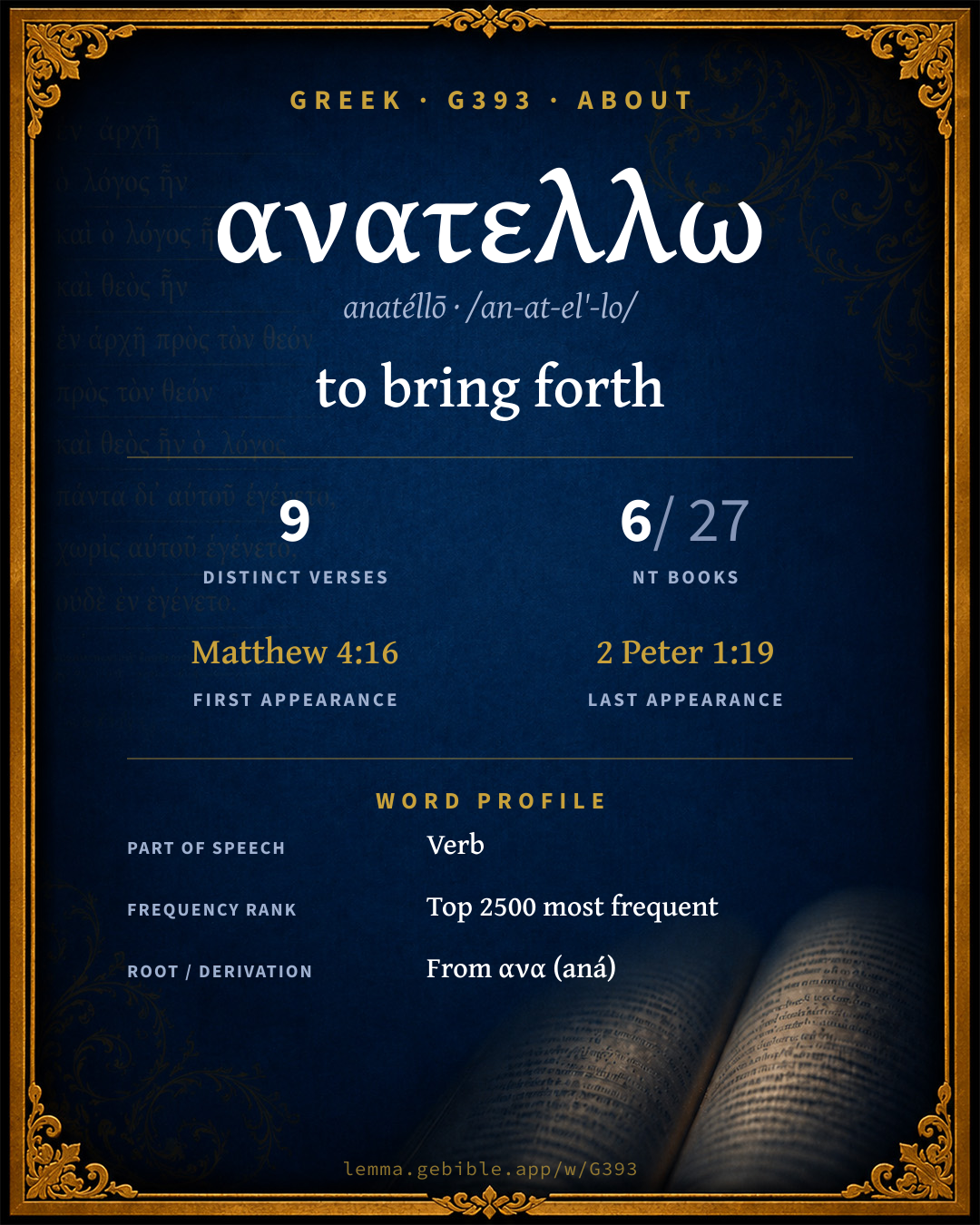
ἀνατέλλω
to bring forth
Full lexicon entry — Thayer's Greek Lexicon
From Thayer's Greek Lexicon
Where this word appears
See every Aorist-tense verb in the Greek New Testament →
Grammar key — what these labels mean
Part of speech
- Verb
- An action or state-of-being word.
Tense
- Aorist
- Action viewed as a simple whole, without regard to duration — often past (perfective aspect).
- Present
- Ongoing or general action in present time (imperfective aspect).
- Perfect
- A completed past action with continuing present results.
Voice
- Active
- The subject performs the action.
Mood
- Indicative
- States a fact or asks a factual question (the mood of reality).
- Participle
- A verbal adjective (“writing,” “having written”).
- Subjunctive
- Expresses probability, purpose, or possibility (the mood of contingency).
Case
- Genitive
- The case of source, possession, or “of” — answers “whose / from what.”
- Accusative
- The case of the direct object and of extent.
Person
- 3rd person
- The one spoken about (“he / she / it / they”).
Gender
- Masculine
- Grammatically masculine.
- Feminine
- Grammatically feminine.
Number
- Singular
- One.
Grammatical forms
- Verb, Aorist, Active, Indicative, 3rd person, Singular 3 times (33%)
- Verb, Aorist, Active, Participle, Genitive, Singular, Masculine 2 times (22%)
- Verb, Aorist, Active, Subjunctive, 3rd person, Singular 1 time (11%)
- Verb, Present, Active, Indicative, 3rd person, Singular 1 time (11%)
- Verb, Present, Active, Participle, Accusative, Singular, Feminine 1 time (11%)
- Verb, Perfect, Active, Indicative, 3rd person, Singular 1 time (11%)
Parsed forms decoded from the imported morphology (Robinson–Tischendorf, public domain), counted across 9 parsed occurrences — not distinct verses.
Every verse where G393 appears — 9 distinct verses across 6 books. Click any verse to open its interlinear word-by-word view. Verse text shown in the World English Bible for context — . Each verse’s Greek form is shown with its reference; the English is not keyword-highlighted, since the data carries no word-level English alignment. Use “Compare translations” on any verse to read it across multiple English versions. This concordance covers the Greek New Testament; Septuagint (Greek Old Testament) occurrences of this word are not indexed here.
Matthew 3 verses
- Matthew 4:16 ἀνέτειλεν aor act ind 3sg The people who sat in darkness saw a great light, To those who sat in the region and shadow of death, To them light has dawned."
- Matthew 5:45 ἀνατέλλει pres act ind 3sg that you may be children of your Father who is in heaven. For he makes his sun to rise on the evil and the good, and sends rain on the just and the unjust.
- Matthew 13:6 ἀνατείλαντος aor act ptcp gen sg masc When the sun had risen, they were scorched. Because they had no root, they withered away.
Mark 2 verses
Luke 1 verse
Hebrews 1 verse
James 1 verse
2 Peter 1 verse
About this entry
At a glance — auto-summarized from this page’s data, not written by a person. Every figure links to its source below. This summary describes the numbers; it doesn’t interpret them.
ανατελλω — transliterated anatéllō — is a Greek verb carrying the sense “to bring forth.” Debuting at Matthew 4:16, it then recurs through the corpus. Spanning 9 verses in 6 books, it ranks among the uncommon words of the Greek New Testament. Its uses concentrate in Matthew (33% of all occurrences). From the same root come ανα, αναβαινω and αναβαλλομαι. See the sense tree, 9-verse concordance, and the renderings breakdown below.
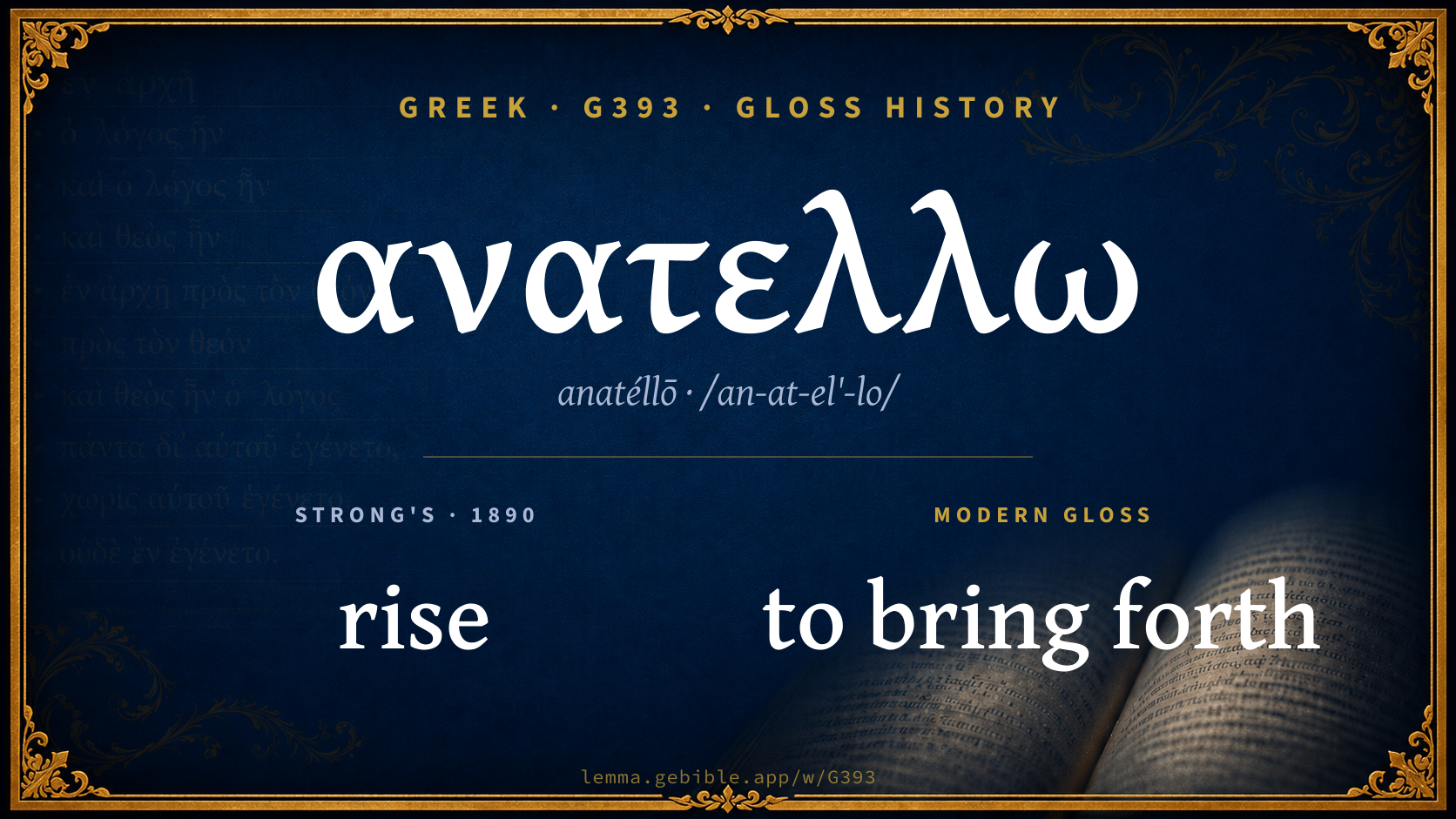
Gloss history
Strong's 1890 vs modern scholarship
About this word
Strong's G393 catalogs a Greek word from the Greek New Testament.
These counts are not copied from any lexicon or concordance. They are computed here, from the morphology-tagged Greek New Testament. What Lemma adds →
- 9
- distinct verses
- The word appears in 9 distinct verses.
- 6 / 27
- NT books
- The word appears in 6 of 27 New Testament books.
- #1,140
- by frequency
- Top 2500 most frequent Greek words (rank 1,140 of 5,347 Greek words by occurrence).
View all 9 occurrences in the concordance →
By section of the New Testament
By traditional corpus
Conventional, traditional groupings — biblical authorship is debated, so this is a traditional corpus grouping, not an authorship claim. Some books belong to more than one corpus (Luke is in both the Gospels and the Lukan corpus, and so on), so these shares overlap and need not total 100%. Each figure is a share of the word’s 9 distinct verses.
- Gospels 6 verses · 67%
- General (Catholic) Epistles 2 verses · 22%
- Lukan (Luke–Acts) 1 verse · 11%
- Hebrews 1 verse · 11%
How translations render this word
Counts come from each version’s own published word-to-Strong’s tagging or interlinear alignment — an approximate guide to how each version renders this word, not a word-level alignment the data otherwise carries. Because each total is that version’s own tagged count, the per-version totals vary from one another and need not match the appearance or distinct-verse counts above. These counts may also differ from a printed concordance because Lemma counts each distinctly tagged rendering and does not collapse phrase taggings into a single head-word total. This is a fixed set of word-tagged versions (KJV, ASV, BSB, ULT) and does not change with the reading translation you choose elsewhere. Each version’s license is shown beside its name below (and on Sources).
- King James Version: Rise 2×, Was up 2×
- American Standard Version: Was risen 3×
- Berean Standard Bible: Rises 2×, Rose 2×
- unfoldingWord Literal Text: Rose 2×
King James Version Public Domain
Renders G393 across 11 tagged occurrences — most commonly:
Plus 7 renderings that appear only once — usually multi-word phrases or single function words the recovered tagging swept in, not distinct renderings.
American Standard Version Public Domain
Renders G393 across 11 tagged occurrences — most commonly:
Plus 8 renderings that appear only once — usually multi-word phrases or single function words the recovered tagging swept in, not distinct renderings.
Berean Standard Bible Public Domain
Renders G393 across 8 tagged occurrences — most commonly:
Plus 4 renderings that appear only once — usually multi-word phrases or single function words the recovered tagging swept in, not distinct renderings. Not rendered by a distinct English word in 1 further occurrence.
unfoldingWord Literal Text CC BY-SA 4.0
Renders G393 across 12 tagged occurrences — most commonly:
Plus 10 renderings that appear only once — usually multi-word phrases or single function words the recovered tagging swept in, not distinct renderings.
Senses in Thayer's
The 1 sense Thayer's distinguishes for this word, in lexicon order (not ranked by frequency or importance). The full entry — with sub-senses — is in the Lexicon Entry tab.
- rise
Word origin
Derived from ανα (aná) (G303) — among.
Forms in the corpus
The 6 distinct written forms G393 takes in the Greek New Testament, most frequent first — each parse links to that tense’s occurrences in the concordance.
| Form | Parsing | Example | Uses |
|---|---|---|---|
| ἀνέτειλεν anéteilen | Verb, Aorist, Active, Indicative, 3rd person, Singular | Matthew 4:16 | 3 |
| ἀνατείλαντος anateílantos | Verb, Aorist, Active, Participle, Genitive, Singular, Masculine | Matthew 13:6 | 2 |
| ἀνατέλλει anatéllei | Verb, Present, Active, Indicative, 3rd person, Singular | Matthew 5:45 | 1 |
| ἀνατέλλουσαν anatéllousan | Verb, Present, Active, Participle, Accusative, Singular, Feminine | Luke 12:54 | 1 |
| ἀνατέταλκεν anatétalken | Verb, Perfect, Active, Indicative, 3rd person, Singular | Hebrews 7:14 | 1 |
| ἀνατείλῃ anateílē | Verb, Aorist, Active, Subjunctive, 3rd person, Singular | 2 Peter 1:19 | 1 |
Same root — word family
Other Thayer's entries built from the same root as G393, grouped by Strong’s listed origin. These share a root / origin per the lexicon — not necessarily a shared meaning. Each links to that word’s own entry.
Derives from
Shares the same root
- αναβαινω anabaínō G305 to ascend
- αναβαλλομαι anabállomai G306 to delay
- αναβιβαζω anabibázō G307 to draw up
- αναβλεπω anablépō G308 to look up
- αναβοαω anaboáō G310 to cry out
- αναγγελλω anangéllō G312 to announce
- αναγενναω anagennáō G313 to be born again
- αναγινωσκω anaginṓskō G314 to recognize
- αναγκη anánkē G318 necessity
- αναγνωριζομαι anagnōrízomai G319 to recognize
- αναγω anágō G321 to lead up
- αναδεικνυμι anadeíknymi G322 to proclaim
- αναδεχομαι anadéchomai G324 to take up
- αναδιδωμι anadídōmi G325 to give forth
- αναζαω anazáō G326 to live again
- αναζητεω anazētéō G327 to search out
- αναζωννυμι anazṓnnymi G328 to gird up
- αναζωπυρεω anazōpyréō G329 to inflame
- αναθαλλω anathállō G330 to sprout up
- αναθεωρεω anatheōréō G333 to observe
- αναιρεω anairéō G337 to take away
- ανακαθιζω anakathízō G339 to sit up
- ανακαινιζω anakainízō G340 to renew
- ανακαινοω anakainóō G341 to make new
+51 more words share this root (not shown).
Derived from this word
Compare all same-root words → Showing 4 of 78 — not the complete family. They share a root, not necessarily a meaning.
Septuagint usage
The same Greek word ανατελλω appears 57 times in the Greek Old Testament (Septuagint), across 56 verses in 22 books.
- 57
- LXX occurrences
- Tagged occurrences of this Greek word in the Septuagint.
- 56
- verses
- Distinct Septuagint verses containing this word.
- 22 / 39
- OT books
- The word appears in 22 of the 39 Old Testament books.
Sample Septuagint occurrences
- Genesis 2:5 ἀνατέλλω
- Exodus 22:2 ἀνατέλλω
- Leviticus 13:37 ἀνατέλλω
- Numbers 24:17 ἀνατέλλω
- Deuteronomy 29:22 ἀνατέλλω
- Judges 9:33 ἀνατέλλω
- 2 Samuel 10:5 ἀνατέλλω
- 2 Kings 3:22 ἀνατέλλω
- 1 Chronicles 19:5 ἀνατέλλω
- 2 Chronicles 26:19 ἀνατέλλω
- Job 3:9 ἀνατέλλω
- Psalms 64:11 ἀνατέλλω
Septuagint occurrences (same lexeme)
Every verse where the same Strong’s number (G393) appears in the Greek Septuagint — showing the first 50 of 56. Verse text shown in the World English Bible for context; the Greek form is the matched word — the English is not keyword-highlighted.
- Genesis 2:5 ἀνατέλλω No plant of the field was yet in the earth, and no herb of the field had yet sprung up; for Yahweh God had not caused it to rain on the earth. There was not a man to till the ground,
- Genesis 2:9 ἀνατέλλω Out of the ground Yahweh God made every tree to grow that is pleasant to the sight, and good for food; the tree of life also in the midst of the garden, and the tree of the knowledge of good and evil.
- Genesis 3:18 ἀνατέλλω Thorns also and thistles will it bring forth to you; and you will eat the herb of the field.
- Genesis 19:25 ἀνατέλλω He overthrew those cities, all the plain, all the inhabitants of the cities, and that which grew on the ground.
- Genesis 32:32 ἀνατέλλω Therefore the children of Israel don't eat the sinew of the hip, which is on the hollow of the thigh, to this day, because he touched the hollow of Jacob's thigh in the sinew of the hip.
- Exodus 22:2 ἀνατέλλω If the thief is found breaking in, and is struck so that he dies, there shall be no guilt of bloodshed for him.
- Leviticus 13:37 ἀνατέλλω But if in his eyes the itch is arrested, and black hair has grown in it; the itch is healed, he is clean. The priest shall pronounce him clean.
- Leviticus 14:43 ἀνατέλλω "If the plague comes again, and breaks out in the house, after he has taken out the stones, and after he has scraped the house, and after it was plastered;
- Numbers 24:17 ἀνατέλλω I see him, but not now; I see him, but not near: There shall come forth a star out of Jacob, A scepter shall rise out of Israel, Shall strike through the corners of Moab, Break down all the sons of tumult.
- Deuteronomy 29:22 ἀνατέλλω The generation to come, your children who shall rise up after you, and the foreigner who shall come from a far land, shall say, when they see the plagues of that land, and the sicknesses with which Yahweh has made it sick;
- Judges 9:33 ἀνατέλλω and it shall be, that in the morning, as soon as the sun is up, you shall rise early, and rush on the city; and, behold, when he and the people who are with him come out against you, then may you do to them as you shall find occasion.
- Judges 14:18 ἀνατέλλω The men of the city said to him on the seventh day before the sun went down, What is sweeter than honey? and what is stronger than a lion? He said to them, If you hadn't plowed with my heifer, You wouldn't have found out my riddle.
- 2 Samuel 10:5 ἀνατέλλω When they told it to David, he sent to meet them; for the men were greatly ashamed. The king said, Wait at Jericho until your beards be grown, and then return.
- 2 Samuel 23:4 ἀνατέλλω [He shall be] as the light of the morning, when the sun rises, A morning without clouds, [When] the tender grass [springs] out of the earth, Through clear shining after rain.
- 2 Kings 3:22 ἀνατέλλω They rose up early in the morning, and the sun shone on the water, and the Moabites saw the water over against them as red as blood:
- 2 Kings 19:29 ἀνατέλλω This shall be the sign to you: You shall eat this year that which grows of itself, and in the second year that which springs of the same; and in the third year sow you, and reap, and plant vineyards, and eat the fruit of it.
- 1 Chronicles 19:5 ἀνατέλλω Then there went certain persons, and told David how the men were served. He sent to meet them; for the men were greatly ashamed. The king said, Stay at Jericho until your beards be grown, and then return.
- 2 Chronicles 26:19 ἀνατέλλω Then Uzziah was angry; and he had a censer in his hand to burn incense; and while he was angry with the priests, the leprosy broke forth in his forehead before the priests in the house of Yahweh, beside the altar of incense.
- Job 3:9 ἀνατέλλω Let the stars of the twilight of it be dark. Let it look for light, but have none, Neither let it see the eyelids of the morning,
- Job 9:7 ἀνατέλλω Who commands the sun, and it doesn't rise, And seals up the stars;
- Job 11:17 ἀνατέλλω Life shall be clearer than the noonday; Though there is darkness, it shall be as the morning.
- Psalms 64:11 ἀνατέλλω
- Psalms 71:7 ἀνατέλλω I am a marvel to many, But you are my strong refuge.
- Psalms 84:12 ἀνατέλλω Yahweh of Hosts, Blessed is the man who trusts in you.
- Psalms 91:8 ἀνατέλλω You will only look with your eyes, And see the recompense of the wicked.
- Psalms 96:11 ἀνατέλλω Let the heavens be glad, and let the earth rejoice. Let the sea roar, and it's fullness!
- Psalms 103:14 ἀνατέλλω For he knows how we are made. He remembers that we are dust.
- Psalms 103:22 ἀνατέλλω Praise Yahweh, all you works of his, In all places of his dominion. Praise Yahweh, my soul.
- Psalms 111:4 ἀνατέλλω He has caused his wonderful works to be remembered. Yahweh is gracious and merciful.
- Psalms 131:17 ἀνατέλλω
- Psalms 146:8 ἀνατέλλω Yahweh opens the eyes of the blind. Yahweh raises up those who are bowed down. Yahweh loves the righteous.
- Proverbs 11:28 ἀνατέλλω He who trusts in his riches will fall, But the righteous shall flourish as the green leaf.
- Ecclesiastes 1:5 ἀνατέλλω The sun also rises, and the sun goes down, and hurries to its place where it rises.
- Ecclesiastes 1:6 ἀνατέλλω The wind goes toward the south, and turns around to the north. It turns around continually as it goes, and the wind returns again to its courses.
- Isaiah 13:10 ἀνατέλλω For the stars of the sky and the constellations of it shall not give their light; the sun shall be darkened in its going forth, and the moon shall not cause its light to shine.
- Isaiah 14:12 ἀνατέλλω How you are fallen from heaven, day-star, son of the morning! How you are cut down to the ground, who laid the nations low!
- Isaiah 42:9 ἀνατέλλω Behold, the former things have happened, and new things do I declare. Before they spring forth I tell you of them.
- Isaiah 43:19 ἀνατέλλω Behold, I will do a new thing; now shall it spring forth; shall you not know it? I will even make a way in the wilderness, and rivers in the desert.
- Isaiah 44:4 ἀνατέλλω and they shall spring up among the grass, as willows by the watercourses.
- Isaiah 44:26 ἀνατέλλω who confirms the word of his servant, and performs the counsel of his messengers; who says of Jerusalem, She shall be inhabited; and of the cities of Judah, They shall be built, and I will raise up the waste places of it;
- Isaiah 45:8 ἀνατέλλω Distil, you heavens, from above, and let the skies pour down righteousness: let the earth open, that it may bring forth salvation, and let it cause righteousness to spring up together; I, Yahweh, have created it.
- Isaiah 58:8 ἀνατέλλω Then shall your light break forth as the morning, and your healing shall spring forth speedily; and your righteousness shall go before you; the glory of Yahweh shall by your rearward.
- Isaiah 58:10 ἀνατέλλω and if you draw out your soul to the hungry, and satisfy the afflicted soul: then shall your light rise in darkness, and your obscurity be as the noonday;
- Isaiah 58:11 ἀνατέλλω and Yahweh will guide you continually, and satisfy your soul in dry places, and make strong your bones; and you shall be like a watered garden, and like a spring of water, whose waters don't fail.
- Isaiah 60:1 ἀνατέλλω Arise, shine; for your light is come, and the glory of Yahweh is risen on you.
- Isaiah 61:11 ἀνατέλλω For as the earth brings forth its bud, and as the garden causes the things that are sown in it to spring forth; so the Lord Yahweh will cause righteousness and praise to spring forth before all the nations.
- Isaiah 66:14 ἀνατέλλω You shall see [it], and your heart shall rejoice, and your bones shall flourish like the tender grass: and the hand of Yahweh shall be known toward his servants; and he will have indignation against his enemies.
- Ezekiel 16:7 ἀνατέλλω I caused you to multiply as that which grows in the field, and you increased and grew great, and you attained to excellent ornament; your breasts were fashioned, and your hair was grown; yet you were naked and bare.
- Ezekiel 17:6 ἀνατέλλω It grew, and became a spreading vine of low stature, whose branches turned toward him, and the roots of it were under him: so it became a vine, and brought forth branches, and shot forth sprigs.
- Ezekiel 29:21 ἀνατέλλω In that day will I cause a horn to bud forth to the house of Israel, and I will give you the opening of the mouth in the midst of them; and they shall know that I am Yahweh.
These are occurrences of the same Greek lexeme (G393) in the Septuagint — not a translation of any one Hebrew word. The store carries no word-level Hebrew↔Greek alignment, so no Hebrew original is asserted here. Counts come from the recovered LXX Strong's tagging — high-frequency vocabulary is well covered, while rare or late forms may be untagged — so they reflect tagged occurrences and may slightly undercount.